
Sections
- 5000128
- 5000129
- 5000130
- 5000131
- 5000134
- 5000135
- 5000138
- 5000139
- 5000140
- 5000143
- 5000144
- 5000147
- 5000148
- 5000149
- 5000150
- 5000153
- 5000154
- 5000155
- 5000158
- 5000159
- 5000162
- 5000163
- 5000166
- 5000167
- 5000170
- 5000171
- 5000172
- 5000175
- 5000176
- 5000177
- 5000180
- 5000181
- 5000184
- 5000185
- 5000188
- 5000189
- 5000192
- 5000193
- 5000196
- 5000197
- 5000200
- 5000201
- 5000202
- 5000203
- 5000206
- 5000207
- 5000210
- 5000211
- 5000214
- 5000215
- 5000218
- 5000219
- 5000222
- 5000223
- 5000224
- 5000227
- 5000228
- 5000231
- 5000232
- 5000235
- 5000236
- 5000239
- 5000240
- 5000241
Nifeelas appeye'im — Laws of Falling on One’s Face in Supplication — Halacha 4:
ליקוטי הלכות - Likutay Halachos
Matched source edition · Volume 5 · Bracketed references are separate from the traditional items.
נפילת אפים ד:Nifeelas appeye'im — Laws of Falling on One’s Face in Supplication — Halacha 4:
וּבוֹ יִתְבָּאֵר עִנְיַן פּוּרִים וּפֶסַח וְאַרְבַּע פָּרָשִׁיּוֹת:
In which the matters of Purim and Pesach and the four Parsheyoas will be explained:
עַל-פִּי הַתּוֹרָה 'אֶמְצָעוּתָא דְּעָלְמָא הֵיכָא' וְכוּ' בְּסִימָן כד בְּלִקּוּטֵי חֵלֶק א עַיֵּן שָׁם כָּל הַתּוֹרָה מֵרֹאשָׁהּ לְסוֹפָהּ:
Based on the teaching “Where Is the Center of the World?” etc., in section 24 of Likutay, Part 1. See there the entire teaching from its beginning to its end:
וְהַכְּלָל שֶׁעַל-יְדֵי עֲשִׂיַּת הַמִּצְוָה בְּשִׂמְחָה זוֹכִין לְהַעֲלוֹת הַשְּׁכִינָה מֵהַגָּלוּת וְלַעֲלוֹת מִדַּרְגָּא לְדַרְגָּא ומֵעוֹלָם לְעוֹלָם עַד שֶׁזּוֹכִין לַעֲלוֹת לְמַעְלָה לְמַעְלָה עַד שֶׁזּוֹכִין לְהַשִּיג אוֹר הַאֵין סוֹף בְּחִינַת מָטֵי וְלֹא מָטֵי שֶׁהוּא לְמַעְלָה מִנֶּפֶשׁ רוּחַ נְשָׁמָה לְמַעְלָה מֵהַסְּפִירוֹת וְכוּ', עַיֵּן שָׁם כָּל זֶה הֵיטֵב מַה שֶּׁכָּתַב שָׁם שֶׁמִּפְּנִימִיּוּת הַבִּרְכָאָן שֶׁהֵם דַּקּוּת הַבִּרְכָאָן נִתְבָּרֵךְ הַמְסַדֵּר וְהַמְיַשֵּׁב אֶת הַמֹּחִין שֶׁהוּא בְּחִינַת הַכֶּתֶר שֶׁהוּא הַבְּחִינָה הַמְעַכֵּב וְהַמְסַדֵּר אֶת הַמֹּחִין לְבַל יֶהֶרְסוּ לַעֲלוֹת אֶל ה' וְכוּ' שֶׁעַל -יְדֵי בְּחִינַת הָרְדִיפָה וְהַמְעַכֵּב עַל-יְדֵי זֶה נַעֲשִׂין בְּחִינַת הַתִּשְׁעָה הֵיכָלִין שֶׁעַל יָדָם מַשִּיגִין אוֹר הָאֵין סוֹף בִּבְחִינַת מָטֵי וְלֹא מָטֵי וְכוּ', עַיֵּן שָׁם כָּל זֶה הֵיטֵב:
The essential principle is that through performing the mitzvah with joy, one merits raising the Shechinah from exile, and ascending from level to level and from world to world, until one merits ascending higher and higher, until one merits attaining the light of the Infinite in the aspect of reaching and not reaching, which is above nefesh, roo'ach, and nishumuh, above the Sefiros, etc. See all this there carefully: what he wrote there, that from the inner dimension of the blessings, which is the subtlety of the blessings, the power that orders and settles the intellect is blessed. This is the aspect of the Crown, which is the aspect that restrains and orders the intellect so they do not break through to ascend to G-d, etc. Through the aspect of the pursuit and the restraint, through this the aspect of the nine halls is formed, through which one attains the light of the Infinite in the aspect of reaching and not reaching, etc. See all this there carefully.
א1
וְזֶה בְּחִינַת נְפִילַת אַפַּיִם שֶׁאָז הוּא תַּכְלִית הַיִּחוּד וְהַזִּוּוּג הָעֶלְיוֹן, כַּמּוּבָא בְּכַוָּנוֹת הַתְּפִלָּה, כִּי כָּל הַבְּחִינוֹת הַנַּ"ל הַמְבֹאָרִין בְּהַתּוֹרָה הַנַּ"ל, דְּהַיְנוּ שֶׁמַּלְכוּת עוֹלָה מִן הַקְּלִפּוֹת וּמַלְכוּת מַלְבִּישׁ וְעוֹלָה לִבְחִינַת נה"י ]נֶצַח הוֹד יְסוֹד[, ונה"י לחג"ת ]חָכְמָה גְּבוּרָה תִּפְאֶרֶת[, וחג"ת לחב"ד ]חָכְמָה בִּינָה דַּעַת[ וְכוּ' כָּל זֶה הוּא כַּוָּנַת סֵדֶר הַתְּפִלָּה שֶׁאוֹמְרִים מִתְּחִלָּה קָרְבָּנוֹת וּקְטֹרֶת, וְאַחַר כָּךְ פְּסוּקֵי דְּזִמְרָה, וְאַחַר כָּךְ בִּרְכַּת קְרִיאַת שְׁמַע, וְאַחַר כָּךְ הַתְּפִלָּה שְׁמוֹנֶה עֶשְׂרֵה וְכוּ' שֶׁעַל-יְדֵי כָּל זֶה עוֹלִין הָעוֹלָמוֹת בַּבְּחִינוֹת הַמְבֹאָרִין בַּתּוֹרָה הַנַּ"ל שֶׁמַּלְכוּת עוֹלָה מִן הַקְּלִפּוֹת וּמַלְכוּת מַלְבִּישׁ נה"י וְכוּ' וְכוּ', כַּמְבֹאָר הֵיטֵב בַּכַּוָּנוֹת. וְרַבֵּנוּ זִכְרוֹנוֹ לִבְרָכָה גִּלָּה וּבֵאֵר שֶׁכָּל סוֹד עֲלִיַּת הָעוֹלָמוֹת בַּבְּחִינָה הַנַּ"ל נַעֲשִׂין עַל-יְדֵי עֲשִׂיַּת הַמִּצְוָה בְּשִׂמְחָה כַּנַּ"ל. נִמְצָא שֶׁעֲשִׂיַּת הַמִּצְוָה בְּשִׂמְחָה וּבְחִינַת סֵדֶר הַתְּפִלָּה הֵם בְּחִינָה אַחַת שֶׁעַל יָדָם עוֹלִין הָעוֹלָמוֹת בַּבְּחִינָה הַנַּ"ל הַמְבֹאָרִין בַּתּוֹרָה הַנַּ"ל שֶׁהֵם סוֹד כַּוָּנוֹת סֵדֶר הַתְּפִלָּה כַּנַּ"ל עַד שֶׁזּוֹכִין עַל -יְדֵי זֶה לַעֲלוֹת עַד הַכֶּתֶר לְבָרֵךְ וּלְתַקֵּן בְּחִינַת הַמְסַדֵּר וְהַמְיַשֵּׁב אֶת הַמֹּחִין שֶׁעַל-יְדֵי זֶה זוֹכִין לְהַשִּיג אוֹר הַאֵין סוֹף בִּבְחִינַת מָטֵי וְלֹא מָטֵי שֶׁעַל-יְדֵי זֶה נַעֲשִׂין בְּחִינַת הַתִּשְׁעָה הֵיכָלִין הַנַּ"ל כַּנַּ"ל וְזֶהוּ בְּחִינַת נְפִילַת אַפַּיִם אַחַר גְּמַר הַתְּפִלָּה, כִּי אַחַר גְּמַר הַתְּפִלָּה אָז כְּבָר נִגְמְרוּ עֲלִיַּת כָּל הָעוֹלָמוֹת לְמַעְלָה עַד אֲצִילוּת לְמַעְלָה לְמַעְלָה כַּמּוּבָא בַּכַּוָּנוֹת. וְאָז צְרִיכִין לְהִכָּלֵל בָּאוֹר הַאֵין סוֹף שֶׁזֶּהוּ עִקַּר סוֹד הַיִּחוּד וְהַזִּוּוּג שֶׁנַּעֲשֶׂה בִּגְמַר הַתְּפִלָּה, כִּי עִקַּר בְּחִינַת הַיִּחוּד וְהַזִּוּוּג הוּא הִתְחַבְּרוּת עָלְמָא תַּתָּאָה בְּעִלָּאָה, כַּמּוּבָן בַּזֹּהַר בְּכַמָּה מְקוֹמוֹת וּבִפְרָט בְּפָרָשַׁת וַיִּגַּשׁ עַל-פָּסוּק כִּי הִנֵּה הַמְּלָכִים נוֹעָדוּ וְכוּ', עַיֵּן שָׁם הַיְנוּ כְּשֶׁהַנֶּפֶשׁ מִיִּשְׂרָאֵל שֶׁהִיא בְּחִינַת עָלְמָא תַּתָּאָה נֶגֶד אוֹר אֵין סוֹף בָּרוּךְ הוּא כְּשֶׁזּוֹכָה לִהְיוֹת נִכְלָל בְּאוֹר הַאֵין סוֹף בִּבְחִינַת מָטֵי וְלֹא מָטֵי, זֶהוּ בְּחִינַת תַּכְלִית הַיִּחוּד וְהַזִּוּוּג שֶׁל עוֹלָמוֹת עֶלְיוֹנִים וְזֶה אִי אֶפְשָׁר כִּי אִם עַל-יְדֵי תִּקּוּן הַמְסַדֵּר וְהַמְיַשֵּׁב אֶת הַמֹּחִין שֶׁהוּא בְּחִינַת כֶּתֶר כַּנַּ"ל שֶׁעַל-יְדֵי בְּחִינָה זוֹ נִמְשָׁךְ בְּחִינַת מְעַכֵּב אֶל הַמֹּחִין לְבַל יֶהֶרְסוּ הַגְּבוּל וְעַל-יְדֵי שְׁנֵי בְּחִינַת אֵלּוּ דַּיְקָא, דְּהַיְנוּ הָרְדִיפָה וְהַמְעַכֵּב עַל-יְדֵי זֶה דַּיְקָא נַעֲשִׂין הַהֵיכָלִין הַנַּ"ל שֶׁעַל יָדָם מַשִּיגִין אוֹר הַאֵין סוֹף בִּבְחִינַת מָטֵי וְלֹא מָטֵי שֶׁזֶּהוּ עִקַּר בְּחִינַת הַיִּחוּד כַּנַּ"ל וְזֶה בְּחִינַת נְפִילַת אַפַּיִם שֶׁאָז הוּא עִקַּר בְּחִינַת הַיִּחוּד וְהַזִּוּוּג כַּמְבֹאָר בַּכַּוָּנוֹת כַּנַּ"ל וְעַל-כֵּן צְרִיכִין אָז לִפֹּל עַל פָּנָיו, שֶׁזֶּהוּ בְּחִינַת וַיַּסְתֵּר משֶׁה פָּנָיו כִּי יָרֵא מֵהַבִּיט אֶל הָאֱלֹקִים שֶׁבְּחִינָה זֹאת נִמְשֶׁכֶת מִבְּחִינַת הַמְסַדֵּר וְהַמְיַשֵּׁב שֶׁנִּתְבָּרֵךְ מִפְּנִימִיּוּת הַבִּרְכָאִין וְכוּ' כַּנַּ"ל שֶׁהוּא בְּחִינַת הַכֶּתֶר כַּנַּ"ל וּמִבְּחִינָה זֹאת יֵשׁ כֹּחַ בְּהַמֹּחִין לְעַכֵּב אֶת הַמֹּחִין מֵרְדִיפָתָן וְכוּ' כַּנַּ"ל שֶׁזֶּהוּ בְּחִינַת נְפִילַת אַפַּיִם בְּחִינַת וַיַּסְתֵּר משֶׁה פָּנָיו בְּחִינַת הַכֹּחַ הַמְעַכֵּב הַמְסַדֵּר וְהַמְיַשֵּׁב אֶת הַמֹּחִין כַּנַּ"ל שֶׁעַל-יְדֵי זֶה דַּיְקָא מַשִּיגִין אוֹר הָאֵין סוֹף בָּרוּךְ הוּא כַּנַּ"ל:
This is the aspect of Nifeelas appeye'im — for then is the ultimate unification and higher union, as brought in the prayer intentions (Pree Aitz Cheye'im, Sha'ar Nifeelas Appeye'im, chapter 2). For all the aforementioned aspects explained in the aforementioned teaching — namely, that Malchoos rises from the husks, and Malchoos clothes and ascends to the aspect of NHY [Netzach, Hoad, Yesod], and NHY to ChGT [Wisdom, Strength, Beauty], and ChGT to ChBD [Wisdom, Understanding, Knowledge], etc. — all this is the intention of the order of tefillah: first the offerings and incense are recited, then the verses of song, then the blessing of the reading of Shema, then the Shemoneh Esrai prayer, etc. Through all this the worlds ascend in the aspects explained in the aforementioned teaching: Malchoos rises from the husks, and Malchoos clothes NHY, etc., etc., as explained carefully in the intentions (Pree Aitz Cheye'im, Shar HaTefilah, chapter 5). Rabbainu of blessed memory revealed and explained that the entire secret of the ascent of the worlds in the aforementioned aspect is accomplished through performing the mitzvah with joy, as above. Thus performing the mitzvah with joy and the aspect of the order of tefillah are one aspect, through which the worlds ascend in the aforementioned aspects explained in the aforementioned teaching, which are the secret of the intentions of the order of tefillah, as above, until through this one merits ascending to the Crown, to bless and rectify the power that orders and settles the intellect, through which one merits attaining the light of the Infinite in the aspect of reaching and not reaching, through which the aspect of the aforementioned nine halls is formed, as above. This is the aspect of Nifeelas appeye'im after tefillah is complete, for after tefillah is complete, the ascent of all the worlds upward has already been completed, to Atzeeloos, higher and higher, as brought in the intentions (Pree Aitz Cheye'im, Shar HaTefilah, chapter 5). Then one must be included in the light of the Infinite, which is the essential secret of the unification and union accomplished at the conclusion of tefillah. For the essential aspect of unification and union is the joining of the lower world with the upper, as understood from the Zohar in several places, particularly in Parshas Va'yeegash on the verse “For behold, the kings assembled,” etc. See there. Namely, when the soul of a member of Yisroel, which is the aspect of the lower world relative to the light of the Infinite, blessed be He, merits being included in the light of the Infinite in the aspect of reaching and not reaching, this is the aspect of the ultimate unification and union of the higher worlds. This is only possible through the rectification of the power that orders and settles the intellect, which is the aspect of the Crown, as above. Through this aspect, the aspect of restraint is drawn to the intellect so they do not break through the boundary. Precisely through these two aspects — namely, pursuit and restraint — precisely through this the aforementioned halls are formed, through which one attains the light of the Infinite in the aspect of reaching and not reaching, which is the essential aspect of unification, as above. This is the aspect of Nifeelas appeye'im, for then is the essential aspect of unification and union, as explained in the intentions, as above (see the beginning of this halacha). Therefore one must then fall on one’s face, which is the aspect of “Moshe hid his face, for he feared to gaze upon G-d.” This aspect is drawn from the aspect of the power that orders and settles, which is blessed from the inner dimension of the blessings, etc., as above, which is the aspect of the Crown, as above. From this aspect the intellect has the power to restrain the intellect from their pursuit, etc., as above. This is the aspect of Nifeelas appeye'im, the aspect of “Moshe hid his face,” the aspect of the restraining power that orders and settles the intellect, as above. Precisely through this one attains the light of the Infinite, blessed be He, as above.
ב2
וְעַל-כֵּן צְרִיכִין לוֹמַר וִדּוּי עַל חֲטָאָיו קֹדֶם נְפִילַת אַפַּיִם. זֶה סוֹד מַה שֶּׁכָּתַב רַבֵּנוּ זִכְרוֹנוֹ לִבְרָכָה שָׁם בְּהַתּוֹרָה הַנַּ"ל עַל מַה שֶּׁשָּׁאֲלוּ סָבֵי דְּבֵי אַתּוּנָא מִי יֵימַר וּפֵרֵשׁ שָׁם, מִי יָכוֹל לִכְנֹס לְהֵיכְלֵי הַתְּמוּרוֹת לְהַעֲלוֹת הַקְּדֻשָּׁה וְהַשִּמְחָה מִשָּׁם כְּדֵי שֶׁעַל -יְדֵי זֶה תַּעֲלֶה הַשְּׁכִינָה מֵהַגָּלוּת וְתַעֲלֶה בְּכָל עֲלִיּוֹת הַנַּ"ל עַד שֶׁיִּזְכֶּה לְהַשִּיג אֶמְצָעוּתָא דְּעָלְמָא שֶׁהוּא בְּחִינַת אוֹר אֵין סוֹף, עַיֵּן שָׁם וְזֶה בְּחִינַת וִדּוּי עַל הַחֲטָאִים שֶׁאוֹמְרִים קֹדֶם נְשִׂיאַת אַפַּיִם שֶׁאָז הוּא תַּכְלִית הַיִּחוּד שֶׁנִּכְלָלִין בָּאֵין סוֹף בִּבְחִינַת מְטֵי וְלֹא מְטֵי וְכוּ' כַּנַּ"ל, כִּי אִי אֶפְשָׁר לְהַשִּיג זֶה הָאוֹר בְּחִינַת אוֹר אֵין סוֹף כִּי אִם עַל-יְדֵי שֶׁמַּעֲלִין כָּל נִיצוֹצוֹת הַקְּדֻשָּׁה מֵעִמְקֵי הַקְּלִפּוֹת שֶׁזֶּהוּ בְּחִינַת עֲלִיַּת הַשְּׁכִינָה מֵהַגָּלוּת כַּנַּ"ל וְלָזֶה צְרִיכִין וִדּוּי דְּבָרִים, כִּי עַל-יְדֵי כָּל הַחֲטָאִים נוֹפְלִין נִיצוֹצֵי הַקְּדֻשָּׁה בֵּין הַקְּלִפּוֹת שֶׁזֶּהוּ עִקַּר פְּגַם שֶׁל כָּל הַחֲטָאִים שֶׁבָּעוֹלָם כַּיָּדוּעַ וְעִקַּר הַפְּגָם הוּא מַה שֶּׁמִּתְגַּבֵּר חַס וְשָׁלוֹם הָעַצְבוּת עַל-יְדֵי הַחֲטָאִים בִּבְחִינַת ( תְּהִלִּים לח) אֶדְאַג מֵחַטָּאתִי, בְּחִינַת ( בְּרֵאשִׁית ו) וַיִּתְעַצֵּב אֶל לִבּוֹ, כִּי הַשְּׁכִינָה שֶׁהִיא כְּלָלִיּוּת הַקְּדֻשָּׁה הִיא שִׂמְחָתָן שֶׁל יִשְׂרָאֵל וְהַקְּלִפּוֹת שֶׁכְּנֶגֶד הַקְּדֻשָּׁה הֵם בְּחִינַת עַצְבוּת תּוּקְפָא דְּדִינָא, כַּמְבֹאָר בְּהַתּוֹרָה הַנַּ"ל וְעַל-יְדֵי הַחֲטָאִים גּוֹרְמִים חַס וְשָׁלוֹם, שֶׁנִּיצוֹצֵי הַקְּדֻשָּׁה בְּחִינַת נִיצוֹצֵי הַשִּמְחָה לִשְׂמֹחַ בְּהַשֵּׁם יִתְבָּרַךְ לִשְׂמֹחַ בְּשִׂמְחַת אַחְדוּתוֹ יִתְבָּרַךְ אֵלּוּ נִיצוֹצוֹת הַשִּמְחָה הֵם בְּחִינַת נִיצוֹצֵי הַקְּדֻשָּׁה שֶׁנּוֹפְלִים בֵּין הַקְּלִפּוֹת שֶׁהֵם בְּחִינַת עַצְבוּת, כִּי הַשִּמְחָה הִיא הַקְּדֻשָּׁה כַּנַּ"ל וַאֲזַי הָעַצְבוּת וְהַמָּרָה שְׁחוֹרָה מִתְגַּבֵּר חַס וְשָׁלוֹם וְאֵינָם מַנִּיחִים לְיִשְׂרָאֵל לִשְׂמֹחַ. וְזֶה עִקַּר גָּלוּת הַשְּׁכִינָה עִקַּר פְּגַם כָּל הַחֲטָאִים שֶׁבָּעוֹלָם. וְעַל-כֵּן אַחַר הַתְּפִלָּה שֶׁצְּרִיכִין לִכְלֹל בְּאוֹר הָאֵין סוֹף בִּבְחִינַת מְטֵי וְלֹא מְטֵי כַּנַּ"ל, שֶׁזֶּה אִי אֶפְשָׁר כִּי אִם עַל-יְדֵי שִׂמְחָה כַּנַּ"ל וּמֵחֲמַת שֶׁעַכְשָׁיו בַּגָּלוּת, הַשְּׁכִינָה שֶׁהוּא בְּחִינַת הַשִּמְחָה בַּגָּלוּת, עַל-כֵּן אִי אֶפְשָׁר לִזְכּוֹת לְשִׂמְחָה כְּדֵי לְהַשִּיג אוֹר הָאֵין סוֹף כַּנַּ"ל כִּי אִם עַל-יְדֵי שֶׁיּוֹרְדִין לְעִמְקֵי הַקְּלִפּוֹת לְהַעֲלוֹת נִיצוֹצֵי הַשִּמְחָה שֶׁהֵם נִיצוֹצֵי הַקְּדֻשָּׁה לְהַעֲלוֹתָם מֵעִמְקֵי הַקְּלִפּוֹת שֶׁעַל-יְדֵי הַשִּמְחָה הַזֹּאת עוֹלִין מֵעוֹלָם לְעוֹלָם וְכוּ' עַד שֶׁמַּשִּיגִין אוֹר הָאֵין סוֹף בִּבְחִינַת הַנַּ"ל וְעַל-כֵּן צְרִיכִין וִדּוּי דְּבָרִים אָז, כִּי עַל-יְדֵי הַוִּדּוּי שֶׁמִּתְוַדִּין עַל הַחֲטָאִים עַל-יְדֵי זֶה מִתְכַּפְּרִין הַחֲטָאִים, כְּמוֹ שֶׁכָּתוּב ( מִשְׁלֵי כח), וּמוֹדֶה וְעֹזֵב יְרֻחָם, כִּי עַל-יְדֵי הַוִּדּוּי מַעֲלִין כָּל הַנִּיצוֹצוֹת שֶׁנָּפְלוּ עַל-יְדֵי הַחֲטָאִים וְאָז כְּשֶׁעוֹלִין נִיצוֹצוֹת הַקְּדֻשָּׁה עַל-יְדֵי מְחִילַת עֲוֹנוֹת שֶׁזּוֹכִין עַל-יְדֵי הַוִּדּוּי אֲזַי עוֹלָה הַשִּמְחָה מֵהַגָּלוּת שֶׁהוּא עִקַּר הַקְּדֻשָּׁה כַּנַּ"ל וְעַל-יְדֵי שִׂמְחָה זֹאת זוֹכִין לְהִכָּלֵל בְּאוֹר הָאֵין סוֹף לְהַשִּיגוֹ בִּבְחִינַת מְטֵי וְלֹא מְטֵי כָּל אֶחָד לְפִי בְּחִינָתוֹ וְזֶהוּ בְּעַצְמוֹ בְּחִינַת נְפִילַת אַפַּיִם שֶׁמְּבֹאָר בַּכַּוָּנוֹת שֶׁאָז מַפִּילִין אֶת עַצְמָם לְמַטָּה לְמַטָּה לְסִטְרָא דְּמוֹתָא כְּדֵי לְהַעֲלוֹת הַקְּדֻשָּׁה מִשָּׁם וְאָז נַעֲשֶׂה תַּכְלִית הַיִּחוּד, עַיֵּן שָׁם, הַיְנוּ כַּנַּ"ל, כִּי הָא בְּהָא תַּלְיָא, כִּי אִי אֶפְשָׁר לְהַשִּיג וּלְהַגִּיעַ לִבְחִינַת תַּכְלִית הַיִּחוּד שֶׁהוּא בְּחִינַת הַשָּגַת אוֹר הָאֵין סוֹף בַּבְּחִינָה הַנַּ"ל כִּי אִם עַל-יְדֵי שִׂמְחָה שֶׁזּוֹכִין עַל -יְדֵי שֶׁיּוֹרְדִין לְעִמְקֵי הַקְּלִפּוֹת לְהַעֲלוֹת הַקְּדֻשָּׁה שֶׁהִוא הַשִּמְחָה מִשָּׁם כַּנַּ"ל שֶׁזֶּהוּ בְּחִינַת מִי יֵימַר הַנֶּאֱמַר בְּהַתּוֹרָה הַנַּ"ל:
Therefore one must say confession over one’s sins before Nifeelas appeye'im (Sha'ar HaKavunoas, repetition of the Amidah, derush 5). This is the secret of what Rabbainu of blessed memory wrote there in the aforementioned teaching regarding what the elders of the house of Athens asked: “Who can say?” He explained there: Who can enter the halls of exchange to raise holiness and joy from there, so that through this the Shechinah will rise from exile and ascend through all the aforementioned ascents, until one merits attaining the center of the world, which is the aspect of the light of the Infinite? See there. This is the aspect of confession over sins that is recited before the raising of the face, for then is the ultimate unification, when one is included in the Infinite in the aspect of reaching and not reaching, etc., as above, for one cannot attain this light, the aspect of the light of the Infinite, except by raising all the sparks of holiness from the depths of the husks. This is the aspect of the Shechinah rising from exile, as above. For this one needs verbal confession, for through all sins sparks of holiness fall among the husks, which is the essential damage of all the sins in the world, as is known. The essential damage is that sadness intensifies, G-d forbid, through the sins, in the aspect of “I worry because of my sin” (Tehillim 38), the aspect of “He was grieved in His heart” (Biraishis 6). For the Shechinah, which is the totality of holiness, is the joy of Yisroel, and the husks opposite holiness are the aspect of sadness, the force of severe judgment, as explained in the aforementioned teaching. Through sins one causes, G-d forbid, the sparks of holiness — the aspect of sparks of joy, to rejoice in G-d, blessed be He, to rejoice in the joy of His unity, blessed be He — to fall among the husks, which are the aspect of sadness; these sparks of joy are the aspect of sparks of holiness. For joy is holiness, as above. Then sadness and melancholy intensify, G-d forbid, and do not allow Yisroel to rejoice. This is the essential exile of the Shechinah, the essential damage of all the sins in the world. Therefore after tefillah, when one must be included in the light of the Infinite in the aspect of reaching and not reaching, as above — which is only possible through joy, as above — and because now in exile the Shechinah, which is the aspect of joy, is in exile, one cannot therefore merit joy in order to attain the light of the Infinite, as above, except by descending into the depths of the husks to raise the sparks of joy, which are the sparks of holiness, to raise them from the depths of the husks. Through this joy one ascends from world to world, etc., until attaining the light of the Infinite in the aforementioned aspect. Therefore one needs verbal confession then, for through the confession in which one confesses one’s sins, through this the sins are atoned for, as it is written (Mishlay 28), “He who confesses and abandons [sin] will be shown mercy,” for through confession one raises all the sparks that fell through the sins. Then, when the sparks of holiness ascend through the forgiveness of sins that one merits through confession, joy rises from exile, which is the essence of holiness, as above. Through this joy one merits being included in the light of the Infinite, to attain it in the aspect of reaching and not reaching, each person according to his aspect. This itself is the aspect of Nifeelas appeye'im: it is explained in the intentions (Pree Aitz Cheye'im, Sha'ar Nifeelas Appeye'im, chapter 2) that then one casts oneself down, lower and lower, to the side of death in order to raise holiness from there, and then the ultimate unification is accomplished. See there. Namely, as above, for one depends on the other, for one cannot attain and reach the aspect of the ultimate unification, which is the aspect of attaining the light of the Infinite in the aforementioned aspect, except through joy that one merits by descending into the depths of the husks to raise holiness, which is joy, from there, as above. This is the aspect of “Who can say?” stated in the aforementioned teaching.
וְאַף-עַל-פִּי שֶׁכְּבָר הֶעֱלִינוּ וּבֵרַרְנוּ אֶת הַקְּדֻשָּׁה מֵעִמְקֵי הַקְּלִפּוֹת עַל-יְדֵי אֲמִירַת קְטֹרֶת וְקָרְבָּנוֹת בִּבְחִינַת ( מִשְׁלֵי כז) קְטֹרֶת יְשַׂמַּח לֵב, כִּי עַל-יְדֵי קְטֹרֶת עוֹלָה הַקְּדֻשָּׁה שֶׁהִיא הַשִּמְחָה מֵהַקְּלִפּוֹת, כַּמְבֹאָר בְּהַתּוֹרָה הַנַּ"ל אַף-עַל-פִּי-כֵן עַתָּה אַחַר גְּמַר הַתְּפִלָּה קֹדֶם שֶׁזּוֹכִין לְתַכְלִית הַיִּחוּד לְהַשִּיג אוֹר הָאֵין סוֹף בַּבְּחִינָה הַנַּ"ל צְרִיכִין לַחֲזֹר וְלֵירֵד לְהַעֲלוֹת הַקְּדֻשָּׁה מֵעִמְקֵי הַקְּלִפּוֹת שֶׁזֶּהוּ בְּחִינַת וִדּוּי דְּבָרִים בְּחִינַת נְפִילַת אַפַּיִם כַּנַּ"ל, כִּי מִתְּחִלָּה בֵּרַרְנוּ הַקְּדֻשָּׁה וְהַשִּמְחָה בִּשְׁבִיל עֲלִיַּת הָעוֹלָמוֹת כְּדֵי שֶׁנּוּכַל לַעֲלוֹת מֵעוֹלָם לְעוֹלָם כְּדֵי שֶׁנִּזְכֶּה לְהַשִּיג הַמֹּחִין הַקְּדוֹשִׁים כְּדֵי שֶׁנִּזְכֶּה לִרְדֹּף לְהַשִּיג אוֹר הָאֵין סוֹף שֶׁכָּל זֶה אָנוּ עוֹסְקִין לַעֲשׂוֹת עַל-יְדֵי עֲבוֹדָתֵנוּ מִתְּחִלַּת סֵדֶר הַתְּפִלָּה עַד סוֹף שֶׁעַל-יְדֵי שֶׁעוֹלִין מֵעֲשִׂיָּה לִיצִירָה וּמִיצִירָה לִבְרִיאָה וְכוּ' וּמַלְכוּת מַלְבִּישׁ נה"י ונה"י מַלְבִּישׁ חג"ת וְכוּ' וְכוּ' אֲבָל עַכְשָׁיו שֶׁכְּבָר זָכִינוּ לְהַמֹּחִין, אֲבָל הָעִקָּר מַה שֶּׁצְּרִיכִין עַכְשָׁיו הוּא לְתַקֵּן בְּתַכְלִית הַשְּׁלֵמוּת אֶת הַמְסַדֵּר וְהַמְיַשֵּׁב אֶת הַמֹּחִין, דְּהַיְנוּ בְּחִינַת הַמְעַכֵּב הַנַּ"ל וּבִשְׁבִיל זֶה צְרִיכִין שִׂמְחָה יְתֵרָה וּצְרִיכִין לַחֲזֹר וְלֵירֵד לְעִמְקֵי הַקְּלִפּוֹת לְבָרֵר הַקְּדֻשָּׁה מֵעִמְקֵי הַקְּלִפּוֹת עַל -יְדֵי וִדּוּי דְּבָרִים וּנְפִילַת אַפַּיִם שֶׁמַּפִּילִין עַצְמָן לְמַטָּה כְּדֵי שֶׁנִּזְכֶּה לְהַעֲלוֹת הַשִּמְחָה מֵעִמְקֵי עִמְקֵי הַקְּלִפּוֹת כְּדֵי שֶׁיִּתְבָּרַךְ וְיֻשְׁלַם בְּתַכְלִית הַשְּׁלֵמוּת הַמְסַדֵּר וְהַמְיַשֵּׁב כְּדֵי שֶׁנִּזְכֶּה לְהַשִּיג אוֹר הָאֵין סוֹף בִּבְחִינַת מְטֵי וְלֹא מְטֵי, כִּי עִקַּר שְׁלֵמוּת הַהַשָּגָה הוּא עַל-יְדֵי כֹּחַ הַמְסַדֵּר וְהַמְיַשֵּׁב הַנַּ"ל שֶׁהוּא בְּחִינַת כֶּתֶר שֶׁגָּבוֹהַּ מִן הַכֹּל שֶׁעַל-יְדֵי זֶה דַּיְקָא מַשִּיגִין אוֹר הָאֵין סוֹף עַל-יְדֵי הָרְדִיפָה וְהַמְעַכֵּב דַּיְקָא כַּנַּ"ל, כִּי עִקַּר תִּקּוּן הַמְסַדֵּר וְהַמְיַשֵּׁב הוּא עַל-יְדֵי הַשִּמְחָה, כִּי הַמְסַדֵּר וְהַמְיַשֵּׁב הוּא בְּחִינַת כֶּתֶר שֶׁשָּׁם מְקוֹר הַשִּמְחָה בְּחִינַת ( יְשַׁעְיָה לה) וְשִׂמְחַת עוֹלָם עַל רֹאשָׁם, עַל רֹאשָׁם דַּיְקָא זֶה בְּחִינַת כֶּתֶר שֶׁהוּא לְמַעְלָה מֵהָרֹאשׁ שֶׁהוּא בְּחִינַת הַמֹּחִין כִּי הַשִּמְחָה מַרְחֶבֶת הַמֹּחִין וְאָז יֵשׁ לָהֶם כֹּחַ לִסְבֹּל מַה שֶּׁמַּשִּיגִין מֵאוֹר הָאֵין סוֹף וְלִבְלִי לַהֲרֹס אֶת הַגְּבוּל, אֲבָל הָעַצְבוּת חַס וְשָׁלוֹם מְצַמְצֵם אֶת הַדַּעַת עַד שֶׁהוּא קָטָן מֵהָכִיל אֶת הָאוֹר וְאָז אֵינוֹ יָכוֹל לִסְבֹּל אֲפִלּוּ מְעַט נִיצוֹצֵי הָאוֹר שֶׁמְּאִירִין לוֹ וְיָכוֹל לַהֲרֹס אֶת הַגְּבוּל חַס וְשָׁלוֹם וְעַל-כֵּן עִקַּר הַהַשָּגָה עַל-יְדֵי הַשִּמְחָה בִּבְחִינַת ( שַׁבָּת ל) אֵין הַשְּׁכִינָה שׁוֹרָה מִתּוֹךְ עַצְבוּת אֶלָּא מִתּוֹךְ שִׂמְחָה:
Although we already raised and refined holiness from the depths of the husks through reciting the incense and offerings, in the aspect of “Incense gladdens the heart” (Mishlay 27), for through incense holiness, which is joy, rises from the husks, as explained in the aforementioned teaching, nevertheless now, after tefillah is complete, before one merits the ultimate unification, to attain the light of the Infinite in the aforementioned aspect, one must descend again to raise holiness from the depths of the husks. This is the aspect of verbal confession, the aspect of Nifeelas appeye'im, as above, for at first we refined holiness and joy for the ascent of the worlds, so we could ascend from world to world, so we would merit attaining the holy intellect, so we would merit pursuing the attainment of the light of the Infinite. We engage in accomplishing all this through our service from the beginning of the order of tefillah to its end, by ascending from Aseyuh to Yitzeeruh and from Yitzeeruh to Beriah, etc., and Malchoos clothes NHY, and NHY clothes ChGT, etc., etc. But now we have already merited the intellect. But the essential thing we need now is to rectify, in ultimate completeness, the power that orders and settles the intellect, namely, the aspect of the aforementioned restraint. For this an even greater joy is needed, and one must descend again into the depths of the husks to refine holiness from the depths of the husks through verbal confession and Nifeelas appeye'im, when one casts oneself down, so that we merit raising joy from the deepest depths of the husks, so that the power that orders and settles will be blessed and completed in ultimate completeness, so that we merit attaining the light of the Infinite in the aspect of reaching and not reaching. For the essential completeness of attainment is through the power that orders and settles, as above, which is the aspect of the Crown, highest of all. Precisely through this one attains the light of the Infinite, specifically through pursuit and restraint, as above, for the essential rectification of the power that orders and settles is through joy, for the power that orders and settles is the aspect of the Crown, where the source of joy is, the aspect of “Eternal joy upon their heads” (Yeshaya 35). Specifically “upon their heads”: this is the aspect of the Crown, which is above the head, which is the aspect of the intellect. For joy expands the intellect, and then they have the power to bear what they perceive of the light of the Infinite without breaking through the boundary, but sadness, G-d forbid, constricts knowledge until it is too small to contain the light, and then one cannot bear even the few sparks of light that illuminate him, and can break through the boundary, G-d forbid. Therefore the essential attainment is through joy, in the aspect of “The Shechinah does not rest through sadness but through joy” (Shabbos 30b).
ג3
וְעַל-כֵּן בְּשַׁבָּת וְיוֹם טוֹב וּשְׁאָר יָמִים שֶׁאֵין אוֹמְרִים בָּהֶם תַּחֲנוּן אֵין בָּהֶם נְפִילַת אַפַּיִם, כִּי שַׁבָּת הוּא מֵעֵין עוֹלָם הַבָּא שֶׁאָז תִּגְדַּל הַשִּמְחָה מְאֹד בְּחִינַת ( יְשַׁעְיָה נה) כִּי בְּשִׂמְחָה תֵצֵאוּ בְּחִינַת ( שָׁם כה) וְאָמַר בַּיּוֹם הַהוּא וְכוּ' זֶה ה' קִוִּינוּ לוֹ נָגִילָה וְנִשְׂמְחָה בִּישׁוּעָתוֹ וְכוּ' וְכֵן בְּיוֹם טוֹב וְכָל הַיָּמִים שֶׁאֵין אוֹמְרִים בָּהֶם תַּחֲנוּן כֻּלָּם הֵם בְּחִינַת יָמִים טוֹבִים שֶׁמֵּאִיר בָּהֶם הֶאָרַת שַׁבָּת וְעַל-כֵּן אֵין אוֹמְרִים אָז וִדּוּי וְאֵין נוֹפְלִים אָז עַל פְּנֵיהֶם, כִּי אָז אֵין שְׁלִיטָה לְהַקְּלִפּוֹת שֶׁהֵם בְּחִינַת עַצְבוּת וְעַל -כֵּן אָז הַשִּמְחָה בִּשְׁלֵמוּת וְאֵין צְרִיכִין אָז לֵירֵד לְעִמְקֵי הַקְּלִפּוֹת לְהַעֲלוֹת הַשִּמְחָה מִשָּׁם כִּי אָז אֵין לְהַקְּלִפּוֹת שֶׁהֵם הָעַצְבוּת שְׁלִיטָה כְּלָל וְאָז נִתְעוֹרֵר בְּחִינַת שְׁלֵמוּת הַשִּמְחָה שֶׁלֶּעָתִיד כַּנַּ"ל וְעַל-כֵּן אָז מִמֵּילָא זוֹכִין לְהַשִּיג אוֹר אֵין סוֹף בַּבְּחִינָה הַנַּ"ל שֶׁעִקַּר הַשָּגָתוֹ עַל-יְדֵי הַשִּמְחָה, כִּי אָז הֵם יְמֵי שִׂמְחָה וְאֵין צְרִיכִין אָז לֵירֵד לְהַעֲלוֹת וּלְבָרֵר הַשִּמְחָה מֵהַקְּלִפּוֹת, כִּי אָז אֵין לְהַקְּלִפּוֹת, שֶׁהֵם הָעַצְבוּת, שׁוּם שְׁלִיטָה כְּלָל וְאָז מֵאִיר הַשִּמְחָה מִמֵּילָא מֵעֶצֶם תּוֹסֶפֶת קְדֻשָּׁה שֶׁבְּאוֹתוֹ הַיּוֹם שֶׁזֹּאת הַתּוֹסֶפֶת קְדֻשָּׁה שֶׁל אֵלּוּ הַיָּמִים שֶׁאֵין אוֹמְרִים בָּהֶם תַּחֲנוּן הוּא בְּחִינַת שַׁבָּת שֶׁהוּא מֵעֵין עוֹלָם הַבָּא שֶׁאָז הוּא עִקַּר הַשִּמְחָה וְעַל-יְדֵי זֶה נִכְלָלִין בְּאוֹר הָאֵין סוֹף בַּבְּחִינָה הַנַּ"ל, וְאֵין צְרִיכִין אָז וִדּוּי דְּבָרִים וְלֹא נְפִילַת אַפַּיִם כְּלָל מֵחֲמַת גֹּדֶל הַשִּמְחָה שֶׁמֵּאִיר אָז כַּנַּ"ל:
Therefore on Shabbos, Yoam Toav, and other days when Tachanoon is not said, there is no Nifeelas appeye'im. For Shabbos is a foretaste of the World to Come, when joy will be immensely great, the aspect of “For in joy you shall go out” (Yeshaya 55), the aspect of “And he will say on that day,” etc., “This is G-d for whom we hoped; let us exult and rejoice in His salvation,” etc. (ibid. 25). Likewise Yoam Toav and all days when Tachanoon is not said are all the aspect of festive days, on which the illumination of Shabbos shines. Therefore one does not then say confession and does not then fall on one’s face, for then the husks, which are the aspect of sadness, have no dominion. Therefore joy is then complete, and one need not then descend into the depths of the husks to raise joy from there, for then the husks, which are sadness, have no dominion at all. Then the aspect of the completeness of future joy is aroused, as above. Therefore one then automatically merits attaining the light of the Infinite in the aforementioned aspect, whose essential attainment is through joy. For these are then days of joy, and one need not then descend to raise and refine joy from the husks, for then the husks, which are sadness, have no dominion at all. Then joy shines of itself, from the very additional holiness of that day, for this additional holiness of these days when Tachanoon is not said is the aspect of Shabbos, which is a foretaste of the World to Come, when the essence of joy is. Through this one is included in the light of the Infinite in the aforementioned aspect, and one need not then make verbal confession or perform Nifeelas appeye'im at all, because of the immense joy that shines then, as above.
ד4
וְזֶה בְּחִינַת פּוּרִים שֶׁעִקַּר מִצְוַת פּוּרִים הוּא לִשְׂמֹחַ בְּכָל עֵת, לְשַׂמֵּחַ אֶת עַצְמוֹ בְּכָל מִינֵי שִׂמְחָה, כְּמוֹ שֶׁכָּתוּב ( אֶסְתֵּר ט) לַעֲשׂוֹת אוֹתָם יְמֵי מִשְׁתֶּה וְשִׂמְחָה וּכְמוֹ שֶׁנּוֹהֲגִים כָּל יִשְׂרָאֵל לִשְׂמֹחַ בְּכָל מִינֵי שְׂמָחוֹת בְּפוּרִים שֶׁזֶּהוּ עִקַּר מִצְוַת פּוּרִים, כִּי עִקַּר הַכְנָעַת הַסִּטְרָא אָחֳרָא שֶׁהוּא זֻהֲמַת הַנָּחָשׁ הוּא בְּפוּרִים, כִּי אָז מַכְנִיעִין קְלִפַּת הָמָן עֲמָלֵק שֶׁהוּא עִקַּר זֻהֲמַת הַנָּחָשׁ שֶׁנִּמְשָׁךְ עַל-יְדֵי חֵטְא עֵץ הַדַּעַת שֶׁמִּשָּׁם אֲחִיזַת הָמָן הָרָשָׁע יִמַּח שְׁמוֹ, כְּמוֹ שֶׁאָמְרוּ רַבּוֹתֵינוּ זִכְרוֹנָם לִבְרָכָה ( חֻלִּין קלט), הָמָן מִן הַתּוֹרָה מִנַּיִן, שֶׁנֶּאֱמַר ( בְּרֵאשִׁית ג), הֲמִן הָעֵץ וְכוּ' נִמְצָא שֶׁהָמָן הָרָשָׁע יִמַּח שְׁמוֹ הוּא בְּחִינַת פְּגַם עֵץ הַדַּעַת טוֹב וָרָע שֶׁעַל -יְדֵי זֶה נִמְשָׁךְ זֻהֲמַת הַנָּחָשׁ וְעִקַּר זֻהֲמַת הָמָן זֻהֲמַת הַנָּחָשׁ, הוּא בְּחִינַת עַצְבוּת וּמָרָה שְׁחוֹרָה שֶׁמִּתְגַּבְּרִים בְּכָל עֵת עַל יִשְׂרָאֵל וְאֵינָם מַנִּיחִים אוֹתָם לִשְׂמֹחַ, כִּי עִקַּר הַסִּטְרָא אָחֳרָא הוּא עַצְבוּת כַּנַּ"ל שֶׁזֶּה נִמְשָׁךְ מִפְּגַם עֵץ הַדַּעַת בְּחִינַת ( שָׁם) בְּעִצָּבוֹן תֹּאכֲלֶנָּה שֶׁנִּגְזַר אָז בְּחִינַת ( שָׁם ו) וַיִּתְעַצֵּב אֶל לִבּוֹ הַנֶּאֱמַר בְּדוֹר הַמַּבּוּל שֶׁכָּל זֶה נִמְשָׁךְ עַל-יְדֵי פְּגַם עֵץ הַדַּעַת כַּיָּדוּעַ, כִּי עִקַּר הַקְּדֻשָּׁה הִוא שִׂמְחָה, דְּהַיְנוּ לִשְׂמֹחַ בְּהַשֵּׁם יִתְבָּרַךְ, כִּי מִי שֶׁיֵּשׁ לוֹ אֱמוּנָה שְׁלֵמָה בְּהַשֵּׁם יִתְבָּרַךְ בְּוַדַּאי רָאוּי לוֹ לִשְׂמֹחַ תָּמִיד בְּהַשֵּׁם יִתְבָּרַךְ וְזֶה הַדָּבָר אִי אֶפְשָׁר לְבָאֵר בִּכְתָב, כִּי הוּא לְכָל חַד כְּפוּם מַה דִּמְשָׁעֵר בְּלִבֵּהּ וּכְבָר מְבֹאָר בִּדְבָרֵינוּ מִזֶּה כַּמָּה פְּעָמִים וְהָמָן וַעֲמָלֵק שֶׁהֵם בְּחִינַת הַמְחַקְּרִים וְהַכּוֹפְרִים מֵהֶם נִמְשָׁךְ עִקַּר הָעַצְבוּת וְהַמָּרָה שְׁחוֹרָה, כִּי עִקַּר הַשִּמְחָה הִוא שִׂמְחַת הַמִּצְוֹת בְּחִינַת ( תְּהִלִּים יט) פִּקּוּדֵי ה' יְשָׁרִים מְשַׂמְּחֵי לֵב וּמִי שֶׁמַּאֲמִין בְּהַשֵּׁם יִתְבָּרַךְ וּבְתוֹרָתוֹ הַקְּדוֹשָׁה בִּתְמִימוּת וּבִפְשִׁיטוּת כְּמוֹ שֶׁכָּל יִשְׂרָאֵל מַאֲמִינִים, בְּוַדַּאי אֵין שִׂמְחָה בָּעוֹלָם כְּמוֹ שִׂמְחַת עֲשִיַּת הַמִּצְווֹת שֶׁאָנוּ זוֹכִין לַעֲשׂוֹת נַחַת רוּחַ לְיוֹצְרֵנוּ וּבוֹרְאֵנוּ יִתְבָּרַךְ וְאָנוּ קוֹנִים לָנוּ חַיֵּי עוֹלָם לְעוֹלְמֵי עַד וּלְנֵצַח נְצָחִים עַל-יְדֵי חוּטֵי הַצִּיצִית שֶׁקּוֹנִים אוֹתוֹ בְּעַד גָּדוֹל אֶחָד וְאָנוּ נִכְלָלִים עַל-יְדֵי זֶה בְּאוֹר הָאֵין סוֹף, הֲיֵשׁ שִׂמְחָה גְּדוֹלָה מִזּוֹ כִּי זֶה כָּל אָדָם יָכוֹל לְהָבִין שֶׁבָּעוֹלָם הַזֶּה אֵין שׁוּם שִׂמְחָה בָּעוֹלָם, כִּי מַה יִּתְרוֹן לְאָדָם בְּכָל עֲמָלוֹ שֶׁיַּעֲמֹל תַּחַת הַשֶּׁמֶשׁ וְאִם יִצְבֹּר כֶּעָפָר כֶּסֶף וְזָהָב סוֹף כָּל סוֹף מַה יִּתְרוֹן לוֹ בְּכָל זֶה כִּי לֹא בְמוֹתוֹ יִקַּח הַכֹּל וְהַכֹּל יוֹדְעִין שֶׁסּוֹף אָדָם לָמוּת וְיָמֵינוּ כְּצֵל עוֹבֵר, וּמִי שֶׁיֵּשׁ לוֹ רַק אֵיזֶה רְשִׁימָה בְּעָלְמָא שֶׁל שֵׂכֶל אֲמִתִּי אֲפִלּוּ נָכְרִי יָכוֹל לְהָבִין שֶׁאֵין שׁוּם שִׂמְחָה בְּזֶה הָעוֹלָם כְּלָל, כִּי אַחֲרִית שִׂמְחָה תּוּגָה, וְעַל זֶה נֶאֱמַר וּלְשִׂמְחָה מַה-זֹּה עוֹשָׂה ( קֹהֶלֶת ב):
This is the aspect of Purim. The essential mitzvah of Purim is to rejoice at all times, to gladden oneself with every kind of joy, as it is written (Esther 9), “To make them days of feasting and joy,” and as all Yisroel are accustomed to rejoice with every kind of joy on Purim, which is the essential mitzvah of Purim. For the essential subduing of the Other Side, which is the contamination of the serpent, is on Purim, for then one subdues the husk of Haman-Amalek, which is the essential contamination of the serpent, drawn through the sin of the Tree of Knowledge. From there is the hold of Haman the wicked, may his name be erased, as our Sages of blessed memory said (Chullin 139b), “Where is Haman [alluded to] in the Torah? For it is stated (Biraishis 3), ‘From the tree?’ [הֲמִן הָעֵץ], etc.” Thus Haman the wicked, may his name be erased, is the aspect of the damage of the Tree of Knowledge of Good and Evil, through which the contamination of the serpent is drawn. The essential contamination of Haman, the contamination of the serpent, is the aspect of sadness and melancholy, which constantly intensify against Yisroel and do not allow them to rejoice. For the essential Other Side is sadness, as above, which is drawn from the damage of the Tree of Knowledge, the aspect of “In sorrow shall you eat of it” (ibid.), which was then decreed, the aspect of “He was grieved in His heart” (ibid. 6), stated about the generation of the Flood. All this is drawn through the damage of the Tree of Knowledge, as is known (Pree Aitz Cheye'im, Sha'ar Chag HaMatzoas, chapter 1). For the essential holiness is joy, namely, rejoicing in G-d, blessed be He, for whoever has complete faith in G-d, blessed be He, certainly ought to rejoice constantly in G-d, blessed be He. This matter cannot be conveyed in writing, for it is for each person according to what he perceives in his heart. This has already been explained in our words several times. Haman and Amalek, who are the aspect of the philosophical investigators and deniers — from them derives the essential sadness and melancholy. For the essential joy is the joy of the mitzvoas, the aspect of “The precepts of G-d are upright, gladdening the heart” (Tehillim 19). Whoever believes in G-d, blessed be He, and His holy Torah with wholeheartedness and simplicity, as all Yisroel believe, certainly there is no joy in the world like the joy of performing the mitzvoas, when we merit giving satisfaction to our Former and Creator, blessed be He, and we acquire eternal life for ourselves, forever and ever and for all eternity, through threads of tzitzis purchased for a single gudoal. Through this we are included in the light of the Infinite. Is there any greater joy? For everyone can understand this: in this world there is no joy in the world, for what profit is there for a person in all his toil that he toils under the sun? Even if he heaps up silver and gold like dust, ultimately, what profit is there for him in all this? For at his death he will not take everything, and everyone knows that a person’s end is to die, and our days are like a passing shadow. Anyone with even a mere trace of true intellect, even a non-Jew, can understand that there is no joy in this world at all, for the end of joy is sorrow. Concerning this it is said, “And as for joy, what does it accomplish?” (Koheles 2).
וְעַל-כֵּן אֵלּוּ הַמְחַקְּרִים וְהַכּוֹפְרִים אֵין לָהֶם שׁוּם שִׂמְחָה אֲמִתִּית כְּלָל וְהַכָּרַת פְּנֵיהֶם עָנְתָה בָּם שֶׁעַל-פִּי רֹב הֵם מְלֵאִים עַצְבוּת יָגוֹן וַאֲנָחָה כִּי מֵהֵיכָן יְקַבְּלוּ חִיּוּת וְשִׂמְחָה אֲמִתִּית מֵאַחַר שֶׁכּוֹפְרִים בְּתוֹרָתוֹ הַקְּדֻשָּׁה וּבַעֲשִׂיַּת מִצְוֹתָיו יִתְבָּרַךְ וּבוֹדִים מִלִּבָּם טְעָמִים שֶׁל הֶבֶל וּשְׁטוּת עַל עֲשִיַּת הַמִּצְוֹת הַקְּדוֹשִׁים. וַיְחַפְאוּ עַל ה' וְעַל תּוֹרַת משֶׁה דְּבָרִים אֲשֶׁר לֹא כֵּן אֲשֶׁר בָּדוּ מִלִּבָּם, כְּאִלּוּ חַס וְשָׁלוֹם כָּל טַעֲמֵי הַמִּצְוֹת הַקְּדוֹשִׁים הֵם נִימוּסִיּוֹת חַס וְשָׁלוֹם בִּשְׁבִיל תִּקּוּן הָעוֹלָם, תִּקּוּן הַמְּדִינָה חַס וְשָׁלוֹם, אוֹי לָהֶם וְאוֹי לְנַפְשָׁם, תִּפַּח רוּחָם וְנִשְׁמָתָם כִּי אֵין כְּפִירָה גְּדוֹלָה מִזּוֹ וּלְדִבְרֵיהֶם הָרָעִים וְהַזָּרִים וְהַמָּרִים וְהַמְטֻנָּפִים בְּוַדַּאי אֵין לִשְׂמֹחַ בְּשׁוּם מִצְוָה חַס וְשָׁלוֹם מֵאַחַר שֶׁתַּכְלִית הַמִּצְוָה הִוא בִּשְׁבִיל תִּקּוּן זֶה הָעוֹלָם וְאִם בְּגוּף הָעֲשִׁירוּת וְהַמָּמוֹן וּשְׁאָר חֶפְצֵי הָעוֹלָם אֵין שׁוּם שִׂמְחָה אֲמִתִּית, כִּי אַחֲרִיתוֹ מָרָה כְּלַעֲנָה כַּנַּ"ל, מִכָּל שֶׁכֵּן אֵיךְ יִשְׂמַח בְּהַמִּצְוָה שֶׁהִיא רַק בִּשְׁבִיל קִיּוּם נִימוּס הַמְּדִינָה חַס וְשָׁלוֹם לְפִי דַּעְתָּם הָרָעָה וְהַמְשֻׁבֶּשֶׁת וְאֵיךְ יִשְׂמַח בְּמִצְוַת סֻכָּה מֵאַחַר שֶׁאוֹמֵר עָלָיו טַעַם שֶׁל שְׁטוּת כָּזֶה שֶׁאָז טוֹב לֵישֵׁב בַּאֲוִיר כָּזֶה וְהוּא בְּעַצְמוֹ יוֹדֵעַ שֶׁזֶּה שְׁטוּת, כִּי עַל -פִּי פְּשׁוּטוֹ בְּוַדַּאי אָז טוֹב יוֹתֵר לָשָׁבֶת בְּבֵיתוֹ מִלֵּישֵׁב בַּסֻּכָּה וְאִם יִרְצֶה לֵישֵׁב בַּצֵּל יַעֲשֶׂה לוֹ אֹהֶל שֶׁל פִּשְׁתָּן כְּדֶרֶךְ הַשָּרִים וְלֹא סֻכָּה הָעֲשׂוּיָה כְּדִינוֹ שֶׁסְּכָכָהּ מִפְּסֹלֶת גֹּרֶן וְיֶקֶב דַּיְקָא וְכֵן בִּשְׁאָר הַמִּצְוֹת, וְאֵין צְרִיכִין לַחֲזֹר לִסְתֹּר שְׁטוּתִים וּשְׁקָרִים וּדְבָרִים בְּדוּיִים כָּאֵלֶּה שֶׁהֵם הֵם עִקַּר הָאֶפִּיקוֹרְסוּת וְהַכְּפִירוֹת שֶׁכּוֹפְרִים בְּתוֹרַת משֶׁה לְגַמְרֵי וּמְחַפִּין הַשֶּׁקֶר שֶׁלָּהֶם בִּשְׁטוּתִים כָּאֵלֶּה כְּאִלּוּ הֵם מְתָרְצִים אֶת דִּבְרֵי משֶׁה רַבֵּנוּ עָלָיו הַשָּׁלוֹם וְנוֹתְנִים טַעַם לִדְבָרָיו טְעָמִים מָרִים וּסְרוּחִים שֶׁכָּאֵלֶּה אִם יֵשׁ טַעַם בְּרִיר חַלָמוּת וּשְׁטוּתִים כָּאֵלֶּה, בִּפְרָט עַתָּה שֶׁכְּבָר זָכִינוּ לְסִפְרֵי הַזֹּהַר הַקָּדוֹשׁ וְכִתְבֵי הָאֲרִיזַ"ל שֶׁמְּבֹאָר בָּהֶם שֶׁכָּל מִצְוָה וּמִצְוָה מְרַמֵּז לִדְבָרִים גְּבוֹהִים וְעֶלְיוֹנִים מְאֹד מְאֹד עַד אֵין סוֹף וְאֵין תַּכְלִית, כִּי הֵם חַיֵּינוּ וְאֹרֶךְ יָמֵינוּ בָּזֶה וּבַבָּא לְעוֹלְמֵי עַד וּלְנֵצַח נְצָחִים וְאָנוּ בְּנֵי יִשְׂרָאֵל אֲשֶׁר הַשֵּׁם יִתְבָּרַךְ הִבְדִּילָנוּ בְּרַחֲמָיו מִן הַתּוֹעִים וְהַכּוֹפְרִים הָאֵלֶּה שֶׁהֵם בְּוַדַּאי מִן הָעֵרֶב רַב מַה טּוֹב חֶלְקֵנוּ וּמַה נָּעִים גּוֹרָלֵנוּ וְכוּ'. כַּמָּה וְכַמָּה יֵשׁ לָנוּ לִשְׂמֹחַ בְּכָל עֵת וּבִפְרָט כְּשֶׁאָנוּ מַגִּיעִים לַעֲשׂוֹת אֵיזֶה מִצְוָה, אֲשֶׁר אָנוּ זוֹכִים בְּרֶגַע קַלָּה שֶׁל עֲשִׂיַּת הַמִּצְוָה לִהְיוֹת נִכְלָלִים בְּהַשֵּׁם יִתְבָּרַךְ בְּאוֹר הָאֵין סוֹף בָּרוּךְ הוּא. וְאָנוּ קוֹנִים לָנוּ חַיֵּי עוֹלָם לָעַד וְלָנֶצַח עַל-יְדֵי כָּל מִצְוָה וּמִצְוָה שֶׁרֻבָּם כְּכֻלָּם קַלִּים לַעֲשׂוֹתָם וּנְעִימִים מְאֹד, כְּמוֹ שֶׁכָּתוּב ( מִשְׁלֵי ג), דְּרָכֶיהָ דַּרְכֵי נֹעַם וְכוּ' וְאֵין לְהַאֲרִיךְ בָּזֶה לְאַחֵינוּ בְּנֵי יִשְׂרָאֵל מַאֲמִינִים בְּנֵי מַאֲמִינִים, כִּי הֶחָכָם יָבִין מִדַּעְתּוֹ כַּמָּה יֵשׁ לוֹ לִשְׂמֹחַ בִּשְׁעַת עֲשִיַּת כָּל מִצְוָה וּמִצְוָה וְדַיְקָא עַל-יְדֵי שִׂמְחַת הַמִּצְוָה עַל-יְדֵי זֶה דַּיְקָא עִקַּר עֲלִיַּת הַשְּׁכִינָה מֵהַגָּלוּת עַד שֶׁזּוֹכִין לְהַעֲלוֹת כָּל הָעוֹלָמוֹת לְמַעְלָה לְמַעְלָה עַד שֶׁמַּשִּיגִין אוֹר הָאֵין סוֹף בַּבְּחִינָה הַנַּ"ל כַּנַּ"ל:
Therefore these philosophical investigators and deniers have no true joy at all, and the appearance of their faces testifies against them, for usually they are full of sadness, sorrow, and sighing. From where would they receive true vitality and joy, since they deny His holy Torah and the performance of His mitzvoas, blessed be He, and fabricate in their hearts vapid and foolish reasons for the performance of the holy mitzvoas? They impute to G-d and to the Torah of Moshe things that are not so, which they have fabricated in their hearts, as though, G-d forbid, all the reasons for the holy mitzvoas were conventions, G-d forbid, for the improvement of the world, the improvement of the state, G-d forbid. Woe to them and woe to their souls! May their spirit and soul perish, for there is no greater denial than this! According to their evil, strange, bitter, and filthy words, certainly one could not rejoice in any mitzvah, G-d forbid, since the purpose of the mitzvah would be for the improvement of this world. If wealth and money themselves, and the other objects of this world, hold no true joy, for their end is bitter as wormwood, as above, how much less could one rejoice in a mitzvah that is only for maintaining the convention of the state, G-d forbid, according to their evil and confused opinion? How could one rejoice in the mitzvah of sookuh, since he gives for it such a foolish reason, that it is then good to sit in such air? He himself knows that this is foolish, for according to the plain sense it is certainly then better to sit in one’s house than to sit in the sookuh. If he wishes to sit in the shade, let him make himself a linen tent like the nobles, and not a sookuh made according to its law, whose covering is specifically from the refuse of the granary and winepress. Likewise with the other mitzvoas. We need not return to refuting such foolishness, falsehoods, and fabricated words, which are the very essence of heresy and denials that deny the Torah of Moshe completely. They cover their falsehood with such foolishness, as though they were explaining the words of Moshe Rabbainu, peace be upon him, and giving reasons for his words — such bitter and rancid reasons, if there is any taste in the slime of chalumoos and such foolishness! Especially now that we have already merited the books of the holy Zohar and the writings of the Ari of blessed memory, in which it is explained that every single mitzvah alludes to exceedingly, exceedingly lofty and elevated matters, without end or limit. For they are our life and length of days, in this world and the next, forever and ever and for all eternity. We, the children of Yisroel, whom G-d, blessed be He, in His mercy has separated from these erring deniers, who are certainly from the mixed multitude — how good is our portion and how pleasant our lot, etc.! How very much we ought to rejoice at all times, particularly when we come to perform some mitzvah, when in the brief moment of performing the mitzvah we merit being included in G-d, blessed be He, in the light of the Infinite, blessed be He. We acquire eternal life for ourselves, forever and eternally, through every single mitzvah, almost all of which are easy to perform and very pleasant, as it is written (Mishlay 3), “Its ways are ways of pleasantness,” etc. There is no need to elaborate on this to our brothers, the children of Yisroel, believers, the children of believers, for the wise will understand of his own knowledge how much he ought to rejoice when performing every single mitzvah. Specifically through the joy of the mitzvah, precisely through this is the essential ascent of the Shechinah from exile, until one merits raising all the worlds higher and higher, until attaining the light of the Infinite in the aforementioned aspect, as above.
וְזֶה עִקַּר בְּחִינַת פּוּרִים שֶׁהוּא בְּחִינַת עֲשִׂיַּת הַמִּצְוָה בְּשִׂמְחָה, כִּי אָז שְׂמֵחִים כָּל יִשְׂרָאֵל בְּשִׂמְחָה גְּדוֹלָה מְאֹד עַד אֵין סוֹף וְאֵין תַּכְלִית, כִּי הָמָן זֻהֲמַת הַנָּחָשׁ הוּא בְּחִינַת עַצְבוּת כַּנַּ"ל, כִּי הָמָן בְּגִימַטְרִיָּא צַ"ו עִם הַכּוֹלֵל שֶׁהוּא בְּחִינַת תֹּקֶף הַקְּלִפּוֹת שֶׁבַּעֲשִׂיָּה, כַּמְבֹאָר בַּכַּוָּנוֹת, כִּי אֵין צ"ו אֶלָּא עֲבוֹדָה זָרָה, כְּמוֹ שֶׁאָמְרוּ רַבּוֹתֵינוּ זִכְרוֹנָם לִבְרָכָה ( סַנְהֶדְרִין נו) הַיְנוּ שֶׁעִקַּר בְּחִינַת צ"ו, שֶׁהוּא בְּחִינַת כְּלָלִיּוּת צִוּוּי הַמִּצְוֹת, הָעִקָּר הוּא בִּשְׁבִיל לְהַכְנִיעַ הָעֲבוֹדָה זָרָה שֶׁהֵם הַכְּפִירוֹת שֶׁהֵם בְּחִינַת הָמָן שֶׁעוֹלֶה צַ"ו עִם הַכּוֹלֵל שֶׁהוּא כּוֹפֵר בַּעֲשִׂיַּת הַמִּצְוֹת וּבוֹדֶה עֲלֵיהֶם טְעָמִים שֶׁל שֶׁקֶר וְעַל-כֵּן עִקַּר קִטְרוּגוֹ וְהִתְגָּרוּתוֹ הוּא בְּהַשִּמְחָה שֶׁל הַמִּצְוֹת, כִּי אֵינוֹ מַנִּיחַ לִשְׂמֹחַ בְּשׁוּם מִצְוָה מֵחֲמַת שֶׁמַּכְנִיס כְּפִירוֹת שֶׁהֵם טְעָמִים שֶׁל שְׁטוּת בִּשְׁבִיל עִסְקֵי עוֹלָם הַזֶּה חַס וְשָׁלוֹם שֶׁעַל-יְדֵי זֶה בְּוַדַּאי אֵין לִשְׂמֹחַ חַס וְשָׁלוֹם בְּשׁוּם מִצְוָה, כִּי בָּעוֹלָם הַזֶּה אֵין שׁוּם שִׂמְחָה כַּנַּ"ל וּמֵחֲמַת קִנְאָתוֹ שֶׁל הָמָן בְּמָרְדְּכַי וְיִשְׂרָאֵל שֶׁרָאָה שֶׁהֵם חֲזָקִים כָּל כָּךְ בַּעֲשִׂיַּת מִצְוֹתֵיהֶם וְעוֹשִׂין אוֹתָם בְּשִׂמְחָה גְּדוֹלָה וּבִמְסִירַת נֶפֶשׁ עַל -יְדֵי זֶה נִתְקַנֵּא בָּהֶם מְאֹד עַד שֶׁרָצָה לְהַעֲבִירָם מִן הָעוֹלָם חַס וְשָׁלוֹם וּמֵחֲמַת שֶׁעִקַּר קִנְאָתָם הוּא בְּהַשִּמְחָה שֶׁל הַמִּצְוָה, כִּי עַל גּוּף הַמִּצְוָה הֵם יְכוֹלִים לוֹמַר חַס וְשָׁלוֹם שֶׁהוּא נִימוּס חַס וְשָׁלוֹם כְּמוֹ שְׁאָר נִימוּסֵי הָעוֹבְדֵי כּוֹכָבִים חַס וְשָׁלוֹם, אֲבָל מֵאַחַר שֶׁרוֹאִים שֶׁיִּשְׂרָאֵל מוֹסְרִים נַפְשָׁם עַל קִדּוּשׁ הַשֵּׁם בְּשִׂמְחָה גְּדוֹלָה בִּשְׁבִיל עֲשִׂיַּת הַמִּצְוֹת כְּמוֹ שֶׁרָאִינוּ שֶׁרַבִּי עֲקִיבָא הֲוָה גָּחִין וְחַיֵּיךְ בְּשָׁעָה שֶׁדָּנוּ אוֹתוֹ לִפְנֵי טוֹרְנוֹסְרוֹפּוּס הָרָשָׁע יִמַּח שְׁמוֹ, כַּמּוּבָא בְּמִדְרַשׁ שׁוֹחֵר טוֹב מִשְׁלֵי, וְכַיּוֹצֵא בָּזֶה בִּשְׁאָר קְדוֹשִׁים וְכָל יִשְׂרָאֵל קְדוֹשִׁים שְׂמֵחִים בְּמִצְוָתָם וּבָזֶה מִתְקַנֵּא הָמָן שֶׁהוּא בְּחִינַת הַכּוֹפְרִים בְּיוֹתֵר וְעַל-כֵּן בְּפוּרִים שֶׁאָז נִכְנָע הָמָן -עֲמָלֵק שֶׁהֵם בְּחִינַת הַכּוֹפְרִים הַנַּ"ל אָז עִקַּר הַמִּצְוָה הִוא שִׂמְחָה, כִּי זֶה עִקַּר הַכְנָעָתוֹ כַּנַּ"ל:
This is the essential aspect of Purim, which is the aspect of performing the mitzvah with joy. For then all Yisroel rejoice with exceedingly great joy, without end or limit. Haman, the contamination of the serpent, is the aspect of sadness, as above. For Haman has the numerical value of TZV [96] with the inclusive unit, which is the aspect of the force of the husks in Aseyuh, as explained in the intentions (Pree Aitz Cheye'im, Shar HaPurim, chapter 5). For “TZV refers only to idolatry,” as our Sages of blessed memory said (Sanhedrin 56b) (see also Zohar, Pikooday 239b). Namely, the essential aspect of TZV, which is the aspect of the totality of the commanding of the mitzvoas, its essential purpose is to subdue idolatry, which is the denials, which are the aspect of Haman, who amounts to TZV with the inclusive unit, who denies the performance of the mitzvoas and fabricates false reasons for them. Therefore his essential accusation and provocation are against the joy of the mitzvoas, for he does not allow one to rejoice in any mitzvah, because he introduces denials, which are foolish reasons for the affairs of this world, G-d forbid. Through this, certainly one could not rejoice, G-d forbid, in any mitzvah, for in this world there is no joy, as above. Because of Haman’s envy of Mordecheye and Yisroel, when he saw that they were so strong in performing their mitzvoas and performed them with great joy and self-sacrifice, through this he became exceedingly jealous of them, until he wanted to remove them from the world, G-d forbid. Their essential envy is against the joy of the mitzvah, for regarding the mitzvah itself they can say, G-d forbid, that it is a convention, G-d forbid, like the other conventions of the idolaters, G-d forbid, but since they see that Yisroel sacrifice their lives for the sanctification of the Name with great joy for the performance of the mitzvoas, as we have seen that Rabbi Akiva would bow and laugh at the time he was judged before the wicked Tornosroopus, may his name be erased, as brought in Medrush Shoachair Toav Mishlay, and similarly with other holy people — and all Yisroel are holy and rejoice in their mitzvoas — Haman, who is the aspect of the deniers, is especially jealous of this. Therefore on Purim, when Haman-Amalek, who are the aspect of the aforementioned deniers, is subdued, then the essential mitzvah is joy, for this is what essentially subdues him, as above.
ה5
וְזֶה בְּחִינַת גֹּדֶל הַפְלָגַת הַשִּמְחָה מְאֹד מְאֹד שֶׁנּוֹהֲגִים כָּל יִשְׂרָאֵל בְּפוּרִים לְהַרְבּוֹת אָז בְּשִׂמְחָה גְּדוֹלָה מְאֹד וְעוֹשִׂים אָז כָּל מִינֵי צְחוֹק וּשְׂחוֹק בִּשְׁבִיל לְהַרְבּוֹת הַשִּמְחָה, כִּי עִקַּר מִצְוַת פּוּרִים הִוא הַשִּמְחָה כַּנַּ"ל וְעַל-כֵּן עוֹשִׂים כָּל מִינֵי שְׂחוֹק וּמִילֵי דִּשְׁטוּתָא וְעוֹשִׂים אָז מַעֲשֵׂה שִׁכְרוּת וּשְׁטוּת בִּשְׁבִיל הַשִּמְחָה, כִּי אִיתָא בְּדִבְרֵי רַבֵּנוּ זִכְרוֹנוֹ לִבְרָכָה בְּכַמָּה מְקוֹמוֹת כַּמָּה אַזְהָרוֹת גְּדוֹלוֹת שֶׁצָּרִיךְ הָאָדָם לְהַרְגִּיל אֶת עַצְמוֹ לִהְיוֹת בְּשִׂמְחָה תָּמִיד. וְאִיתָא בִּדְבָרָיו הַקְּדוֹשִׁים שֶׁאִי אֶפְשָׁר לִהְיוֹת בְּשִׂמְחָה כִּי אִם עַל -יְדֵי מִילֵי דִּשְׁטוּתָא דַּיְקָא, שֶׁעוֹשִׂין עַצְמָן כְּשׁוֹטֶה וּמְשַׂמְּחִין אֶת עַצְמָן בְּמִילֵי דִּשְׁטוּתָא, כִּי מֵחֲמַת שֶׁטֶּבַע הָאָדָם נִמְשָׁךְ אַחַר הָעַצְבוּת מְאֹד, כִּי כָּל אָדָם מָלֵא יִסּוּרִים וִיגוֹנוֹת כַּיָּדוּעַ לְכָל אֶחָד וְאֶחָד עַל-כֵּן צְרִיכִין לְהַכְרִיחַ אֶת עַצְמוֹ בְּכָל הַכֹּחוֹת לִהְיוֹת בְּשִׂמְחָה וְעִקַּר הַשִּמְחָה אִי אֶפְשָׁר לִהְיוֹת כִּי אִם עַל -יְדֵי מִילֵי דִּשְׁטוּתָא, כְּמוֹ שֶׁשָּׁמַעְתִּי מִפִּיו זִכְרוֹנוֹ לִבְרָכָה שֶׁאָמַר בָּזֶה הַלָּשׁוֹן "סֶע הָאט אַ פָּנִים אָז מֶע קֶען מֶער נִיט פְרֵיילִיךְ זַיין נָאר מִיט נַארִישׁ מַאכִין זִיךְ" וְכֵן דִּבֵּר עוֹד מִזֶּה כַּמָּה פְּעָמִים. וְזֶהוּ הָעִנְיָן מַה שֶּׁהָיוּ נוֹהֲגִין כָּל הַצַּדִּיקִים הַגְּדוֹלִים הַמְפֻרְסָמִים שֶׁהָיוּ בְּיָמֵינוּ שֶׁעַל-פִּי רֹב הָיָה לָהֶם אֲנָשִׁים שֶׁהָיוּ כְּמוֹ בַּדְּחָנִים, וְהָיוּ עוֹשִׂים לְפָנִים כָּל מִינֵי צְחוֹק וּשְׁטוּת כַּמְפֻרְסָם וְהַכֹּל בִּשְׁבִיל שִׂמְחָה, כִּי אֵין דָּבָר מַזִּיק לַעֲבוֹדַת ה' כְּמוֹ הָעַצְבוּת, כַּמּוּבָא בְּכָל הַסְּפָרִים הַקְּדוֹשִׁים וּמִגֹּדֶל מְרִירַת וְצָרוֹת הַגָּלוּת הַמַּר הַזֶּה בְּגוּף וְנֶפֶשׁ וּמָמוֹן אִי אֶפְשָׁר לִהְיוֹת בְּשִׂמְחָה כִּי אִם עַל-יְדֵי מִילֵי דִּשְׁטוּתָא דַּיְקָא כַּנַּ"ל וְזֶה בְּחִינַת מִילֵי דִּבְדִיחוּתָא שֶׁהָיוּ נוֹהֲגִים הַתַּנָּאִים וַאֲמוֹרָאִים הַקְּדוֹשִׁים קֹדֶם הַלִּמּוּד כְּדֵי לָבֹא לְשִׂמְחָה עַל-יְדֵי מִילֵי דִּבְדִיחוּתָא שֶׁהֵם מִילֵי דִּשְׁטוּתָא דַּיְקָא וְזֶהוּ בְּחִינַת מַה שֶּׁכָּתוּב בַּזֹּהַר הַקָּדוֹשׁ ( וַיִּקְרָא דַּף מז,) שֶׁרַב הַמְנוֹנָא סָבָא הֲוָה מְסַדֵּר קָמֵי חַבְרַיָּא פִּרְקָא דְּמִילֵי דִּשְׁטוּתָא, הַיְנוּ כַּנַּ"ל כִּי עִקַּר גָּלוּת יִשְׂרָאֵל שֶׁהוּא גָּלוּת הַשְּׁכִינָה, עִקַּר הַגָּלוּת הוּא מַה שֶּׁהָעַצְבוּת, שֶׁהֵם הַסִּטְרָא אָחֳרָא וְהַקְּלִפּוֹת, מִתְגַּבְּרִין עַל יִשְׂרָאֵל וְאֵינָם מַנִּיחִים אוֹתָם לִשְׂמֹחַ בַּה' וּבְתוֹרָתוֹ הַקְּדוֹשָׁה, כַּמְבֹאָר בְּהַתּוֹרָה אֶמְצָעוּתָא דְּעָלְמָא הַנַּ"ל שֶׁזֶּהוּ עִקַּר גָּלוּת הַשְּׁכִינָה שֶׁהוּא שִׂמְחָתָן שֶׁל יִשְׂרָאֵל שֶׁעִקַּר גָּלוּתָהּ כְּשֶׁהָעַצְבוּת מִתְגַּבֵּר עָלֶיהָ, דְּהַיְנוּ עַל יִשְׂרָאֵל חַס וְשָׁלוֹם, עַיֵּן שָׁם:
This is the aspect of the immensely, immensely great joy that all Yisroel practice on Purim, abounding then in exceedingly great joy and performing all kinds of laughter and play to increase joy. For the essential mitzvah of Purim is joy, as above. Therefore they do all kinds of laughter and foolish matters, and then perform acts of drunkenness and folly for the sake of joy. For in the words of Rabbainu of blessed memory, in several places, there are many great warnings that a person must accustom himself to be in joy always. It is stated in his holy words that it is impossible to be in joy except specifically through foolish matters, making oneself like a fool and gladdening oneself with foolish matters, for since human nature is drawn strongly after sadness, for every person is full of suffering and sorrows, as each and every one knows, one must therefore force oneself with all one’s powers to be in joy. The essential joy is only possible through foolish matters, as I heard from his mouth, of blessed memory, that he said in these words: “It seems that one can no longer be happy except by making oneself foolish.” (Likutay Halachos, Nifeelas Appeye'im, Halacha 4, item 5) He spoke of this several more times. This is the matter of what all the great, famous tzaddeekim who were in our days used to practice: usually they had people who were like jesters, and they would perform before [them] all kinds of laughter and foolishness, as is widely known, all for joy. For nothing is as damaging to the service of G-d as sadness, as brought in all the holy books. Due to the great bitterness and troubles of this bitter exile, in body, soul, and money, it is impossible to be in joy except specifically through foolish matters, as above. This is the aspect of humorous words that the holy Tannaim and Amoraim used to practice before learning, to arrive at joy through humorous words, which are specifically foolish matters (Shabbos 30b). This is the aspect of what is written in the holy Zohar (Va'yeekruh, folio 47), that Rav Hamnuna the Elder would arrange before the companions a chapter of foolish matters, namely, as above. For the essential exile of Yisroel, which is the exile of the Shechinah — the essential exile is that sadness, which is the Other Side and the husks, intensifies against Yisroel and does not allow them to rejoice in G-d and His holy Torah, as explained in the aforementioned teaching “The Center of the World.” This is the essential exile of the Shechinah, which is the joy of Yisroel: her essential exile is when sadness overwhelms her, namely, Yisroel, G-d forbid. See there.
נִמְצָא שֶׁעִקַּר גָּלוּת הַשְּׁכִינָה וּכְנֶסֶת יִשְׂרָאֵל הִוא מַה שֶּׁהַשִּמְחָה הִיא בַּגָּלוּת וְעַל-כֵּן עַכְשָׁיו בַּגָּלוּת שֶׁעִקַּר הַגָּלוּת הִוא שֶׁהַשִּמְחָה נָפְלָה לְמַטָּה בַּגָּלוּת וּמִשָּׁם נִמְשָׁךְ כָּל הַשִּמְחָה שֶׁל הָעוֹבְדֵי כּוֹכָבִים וְהָרְשָׁעִים הַהוֹלְכִים בִּשְׁרִירוּת לִבָּם אֲשֶׁר בֶּאֱמֶת הֵם רְחוֹקִים מִשִּמְחָה אֲמִתִּית, כְּמוֹ שֶׁכָּתוּב ( מִשְׁלֵי יז), יֹלֵד כְּסִיל לְתוּגָה לוֹ כִּי כָּל יָמָיו כַּעַס וּמַכְאוֹבוֹת וְכוּ', כִּי הַסִּטְרָא אָחֳרָא נִקְרֵאת יָגוֹן וַאֲנָחָה כַּיָּדוּעַ, אַךְ כָּל הַשִּמְחָה שֶׁיֵּשׁ אֶצְלָם נִמְשָׁךְ רַק מִבְּחִינַת גָּלוּת הַשְּׁכִינָה שֶׁהִיא שִׂמְחָתָן שֶׁל יִשְׂרָאֵל שֶׁהוּא עַכְשָׁיו בַּגָּלוּת וּמִשָּׁם נִמְשָׁךְ נִיצוֹצֵי הַשִּמְחָה שֶׁנָּפַל אֶצְלָם בַּגָּלוּת וּמִשָּׁם כָּל שִׂמְחָתָם לְפִי שָׁעָה וַעֲלֵיהֶם נֶאֱמַר, וּלְשִׂמְחָה מַה-זֹּה עֹשָׂה, כְּמוֹ שֶׁכָּתוּב ( קֹהֶלֶת ב) לִשְׂחוֹק אָמַרְתִּי מְהוֹלָל וּלְשִׂמְחָה מַה-זֹּה עֹשָׂה לִשְׂחוֹק אָמַרְתִּי מְהוֹלָל, לְשׁוֹן מְעֻרְבָּב, הַיְנוּ שֶׁכָּל הַשִּמְחָה שֶׁאֵינָהּ לַשָּׁמַיִם הִיא נִמְשֶׁכֶת רַק מִתַּעֲרוֹבוֹת נִיצוֹצֵי הַשִּמְחָה שֶׁנָּפְלָה עַל-יְדֵי גָּלוּת הַשְּׁכִינָה וְנִתְעָרְבָה בֵּינֵיהֶם וְהֵם מְהַפְּכִים וּמְמִירִים רַע בְּטוֹב וְלוֹקְחִים הַשִּמְחָה שֶׁבָּאָה מִמָּקוֹם עֶלְיוֹן מְאֹד וּשְׂמֵחִים עִמָּהּ בְּדִבְרֵי תַּאֲוֹת רָעוֹת שֶׁלָּהֶם אֲשֶׁר בֶּאֱמֶת הֵם יָגוֹן וַאֲנָחָה וּמָרִים מִמָּוֶת וְעַל-כֵּן בְּוַדַּאי וּלְשִׂמְחָה כָּזֹאת מַה זֹּה עֹשָׂה כִּי אַחֲרִיתָהּ יָגוֹן וַאֲנָחָה, כְּמוֹ שֶׁכָּתוּב ( מִשְׁלֵי יד) וְאַחֲרִית שִׂמְחָה תוּגָה וְעַל-כֵּן מֵחֲמַת שֶׁעַכְשָׁיו הַשִּמְחָה בַּגָּלוּת הִיא מְלֻבֶּשֶׁת בְּמִלִּין דְּעָלְמָא שֶׁהֵם מִלִּין דִּשְׁטוּתָא עַל-כֵּן מִי שֶׁרוֹצֶה לָבוֹא לְשִׂמְחָה לִשְׂמֹחַ בִּקְדֻשַּׁת יַהֲדוּתוֹ בְּמַה שֶּׁזָּכָה לִהְיוֹת מִזֶּרַע יִשְׂרָאֵל וְלֹא עָשַׂנִּי גּוֹי אִי אֶפְשָׁר לָבֹא לְשִׂמְחָה כִּי אִם עַל-יְדֵי מִילֵי דִּשְׁטוּתָא דַּיְקָא, כִּי לְשָׁם נָפְלָה הַשִּמְחָה מֵחֲמַת גָּלוּת הַשְּׁכִינָה שֶׁהוּא שִׂמְחָתָן שֶׁל יִשְׂרָאֵל כַּנַּ"ל וְעַל-כֵּן אִישׁ הַיִּשְׂרְאֵלִי כְּשֶׁמְּשַׂמֵּחַ אֶת עַצְמוֹ עַל-יְדֵי מִילֵי דִּשְׁטוּתָא אֲזַי נַעֲשֶׂה מִזֶּה תִּקּוּן גָּדוֹל בְּחִינַת עֲלִיַּת נִיצוֹצֵי הַשְּׁכִינָה מִגָּלוּתָהּ כִּי מַעֲלֶה נִיצוֹצֵי הַשִּמְחָה מִן הַגָּלוּת מֵאַחַר שֶׁהוּא בָּא לְשִׂמְחָה עַל-יְדֵי מִילֵי דִּשְׁטוּתָא אֵלּוּ, כִּי תֵּכֶף כְּשֶׁאִישׁ יִשְׂרָאֵל הוּא בְּשִׂמְחָה, תֵּכֶף חָזְרָה וְעָלְתָה הַשִּמְחָה לִמְקוֹמָהּ וְשָׁרְשָׁהּ שֶׁהִיא אֵצֶל יִשְׂרָאֵל שֶׁשָּׁם שֹׁרֶשׁ הַשִּמְחָה הָאֲמִתִּית, כִּי יִשְׂרָאֵל יֵשׁ לָהֶם לִשְׂמֹחַ כָּל יְמֵיהֶם בְּכָל מִינֵי שִׂמְחָה בְּלִי קֵץ וְסוֹף מֵאַחַר שֶׁזָּכִינוּ לְהַאֲמִין בַּה' וּבְמשֶׁה עַבְדּוֹ וּבְתוֹרָתוֹ הַקְּדוֹשָׁה וְכוּ', כִּי מְקוֹר נִשְׁמַת יִשְׂרָאֵל הוּא בִּבְחִינַת שִׂמְחָה שֶׁהִיא הַשְּׁכִינָה שֶׁהִיא שִׂמְחָתָן שֶׁל יִשְׂרָאֵל שֶׁשָּׁם שֹׁרֶשׁ נִשְׁמָתֵנוּ, כְּמוֹ שֶׁכָּתוּב ( יְשַׁעְיָה מו), הָעֲמֻסִים מִנִּי בֶטֶן הַנְּשֻׂאִים מִנִּי רָחַם שֶׁיִּשְׂרָאֵל הֵם חֵלֶק מֵהַשְּׁכִינָה שֶׁהִיא הַשִּמְחָה כַּנַּ"ל:
Thus the essential exile of the Shechinah and the congregation of Yisroel is that joy is in exile. Therefore now in exile, when the essential exile is that joy has fallen down into exile, from there is drawn all the joy of the idolaters and the wicked who follow the stubbornness of their hearts, who in truth are far from true joy, as it is written (Mishlay 17), “He who fathers a fool has sorrow through him,” for “All his days are anger and pains,” etc. For the Other Side is called sorrow and sighing, as is known, but all the joy they possess is drawn only from the aspect of the exile of the Shechinah, which is the joy of Yisroel, which is now in exile. From there are drawn the sparks of joy that fell among them in exile, and from there is all their momentary joy. Concerning them it is said, “And as for joy, what does it accomplish?” As it is written (Koheles 2), “Of laughter I said, ‘Mad,’ and as for joy, what does it accomplish?” “Of laughter I said, ‘Mad’” — an expression of being mixed up, namely, all joy that is not for Heaven is drawn only from the admixture of sparks of joy that fell through the exile of the Shechinah and became mixed among them. They invert and exchange bad for good, taking the joy that comes from an exceedingly lofty place and rejoicing with it in their evil desires, which in truth are sorrow and sighing, more bitter than death. Therefore certainly, as for such joy, what does it accomplish? For its end is sorrow and sighing, as it is written (Mishlay 14), “The end of joy is grief.” Therefore because joy is now in exile, it is clothed in worldly matters, which are foolish matters. Therefore whoever wants to come to joy, to rejoice in the holiness of his being a Jew, in his having merited being of the seed of Yisroel, and “He has not made me a non-Jew,” (Siddur Ashkenaz, morning blessings, “שלא עשני גוי”) can only come to joy specifically through foolish matters, for that is where joy fell because of the exile of the Shechinah, which is the joy of Yisroel, as above. Therefore when a Jew gladdens himself through foolish matters, a great rectification is accomplished through this, the aspect of the ascent of the sparks of the Shechinah from her exile, for he raises sparks of joy from exile, since he comes to joy through these foolish matters. For immediately when a Jew is in joy, joy immediately returns and ascends to its place and root, which is with Yisroel, where the root of true joy lies. For Yisroel ought to rejoice all their days with every kind of joy, without limit or end, since we merited believing in G-d, in Moshe His servant, and in His holy Torah, etc., for the source of the soul of Yisroel is in the aspect of joy, which is the Shechinah, which is the joy of Yisroel, where our soul is rooted, as it is written (Yeshaya 46), “Borne from the belly, carried from the womb.” For Yisroel are a portion of the Shechinah, which is joy, as above.
ו6
וְזֶה בְּחִינַת ( תְּהִלִּים לד) לְדָוִד בְּשַׁנּוֹתוֹ אֶת טַעְמוֹ לִפְנֵי אֲבִימֶלֶךְ וַיְגָרְשֵׁהוּ וַיֵּלַךְ כִּי דָּוִד הַמֶּלֶךְ הוּא בְּחִינַת מַלְכוּת דִּקְדֻשָּׁה שֶׁהוּא בְּחִינַת הַשְּׁכִינָה שֶׁהוּא בְּחִינַת מַלְכוּת דָּוִד מָשִׁיחַ כַּיָּדוּעַ שֶׁהוּא בְּחִינַת שִׂמְחָה כַּנַּ"ל וְעִקַּר הַמִּלְחָמָה שֶׁל דָּוִד עִם הַסִּטְרָא אָחֳרָא וְהַקְּלִפּוֹת הָיָה רַק לְשַׁבֵּר הָעַצְבוּת וְלִזְכּוֹת לְשִׂמְחָה שֶׁזֶּהוּ בְּחִינַת עֲשָׂרָה מִינֵי נְגִינָה שֶׁהִמְשִׁיךְ דָּוִד בָּעוֹלָם עַל-יְדֵי סֵפֶר תְּהִלִּים שֶׁכָּלוּל מִכָּל הָעֲשָׂרָה מִינֵי נְגִינָה שֶׁהֵם בְּחִינַת שִׂמְחָה, כְּמוֹ שֶׁכָּתוּב ( שָׁם ב), עֲלֵי עָשוֹר וַעֲלֵי נָבֶל וְכוּ' כִּי שִׂמַּחְתַּנִי ה' בְּפָעֳלֶךָ וְכוּ' כְּמוֹ שֶׁכָּתַב רַבֵּנוּ זִכְרוֹנוֹ לִבְרָכָה בְּמָקוֹם אַחֵר וְכֵן מְבֹאָר בַּזֹּהַר הַקָּדוֹשׁ שֶׁדָּוִד הַמֶּלֶךְ עָלָיו הַשָּׁלוֹם הוּא בַּדְחָא דְּמַלְכָּא שֶׁאֲפִלּוּ בְּעֵת שֶׁהִתְוַדָּה עַל חֶטְאוֹ בִּשְׁבִירַת לֵב לֹא עָזַב אֶת דַּרְכֵי בְּדִיחָתוֹ, כַּמְבֹאָר שָׁם, בַּזֹּהַר עַיֵּן שָׁם כִּי דָּוִד הוּא בְּחִינַת מַלְכוּת דִּקְדֻשָּׁה שֶׁהִיא בְּחִינַת הַשְּׁכִינָה שֶׁהִיא שִׂמְחָתָן שֶׁל יִשְׂרָאֵל כַּנַּ"ל וְעַל-כֵּן בְּעֵת שֶׁבָּא דָּוִד בְּיַד הַפְּלִשְׁתִּים בַּגָּלוּת וְתָפְסוּ אוֹתוֹ וֶהֱבִיאוּהוּ לִפְנֵי אֲבִימֶלֶךְ וְרָצוּ לִנְקֹם בּוֹ וְרָאָה דָּוִד שֶׁאִי אֶפְשָׁר לְהִתְגַּבֵּר עֲלֵיהֶם וְלָצֵאת מֵהֶם כִּי אִם עַל-יְדֵי שִׂמְחָה שֶׁעַל-יְדֵי זֶה עִקַּר הַהִתְגַּבְּרוּת עַל הַקְּלִפּוֹת וְהַסִּטְרָא אָחֳרָא שֶׁהֵם בְּחִינַת עַצְבוּת כַּנַּ"ל, אֲבָל בְּעֵת תֹּקֶף הַגָּלוּת שֶׁמִּתְגַּבְּרִין בִּמְרִירַת הַשִּׁעְבּוּד וְאֵינָם מַנִּיחִים לִשְׂמֹחַ וְאִם כֵּן מֵאַיִן יָבֹא עֶזְרֵנוּ כִּי אִי אֶפְשָׁר לְהִמָּלֵט מֵהַסִּטְרָא אָחֳרָא כִּי אִם עַל-יְדֵי שִׂמְחָה, וּלְשִׂמְחָה אִי אֶפְשָׁר לִזְכּוֹת מֵחֲמַת תֹּקֶף הִתְגַּבְּרוּתָם בַּגָּלוּת כַּנַּ"ל, עַל-כֵּן דָּוִד הַמֶּלֶךְ שֶׁהָיָה שִׂמְחָתָן שֶׁל יִשְׂרָאֵל כְּשֶׁנָּפַל בַּגָּלוּת בְּיַד הַסִּטְרָא אָחֳרָא שֶׁהֵם הַפְּלִשְׁתִּים חָנַן ה' אוֹתוֹ בָּעֵצָה הַזֹּאת שֶׁעָשָׂה עַצְמוֹ כְּשׁוֹטֶה מַמָּשׁ וְעָשָׂה מַעֲשֵׂה שְׁטוּת וְשִׁגָּעוֹן מַמָּשׁ וְהוֹרִיד רִירוֹ עַל זְקָנוֹ וַיְתָו עַל דַּלְתוֹת הַשַּׁעַר וְכוּ' ( שְׁמוּאֵל-א כא) וְעַל-יְדֵי זֶה נִמְלַט מִיָּדָם, כִּי עַל-יְדֵי מִילֵי דִּשְׁטוּתָא דַּיְקָא בָּאִים לְתוֹךְ שִׂמְחָה שֶׁעַל-יְדֵי זֶה נִצּוֹלִין מֵהֶם, כִּי עִקַּר הַהִתְגַּבְּרוּת עֲלֵיהֶם הוּא עַל-יְדֵי שִׂמְחָה, וְאִי אֶפְשָׁר בַּגָּלוּת לִשְׂמֹחַ כִּי אִם עַל-יְדֵי מִילֵי דִּשְׁטוּתָא דַּיְקָא כַּנַּ"ל וְזֶהוּ בְּחִינַת שִׂמְחַת פּוּרִים שֶׁעוֹשִׂין אָז כָּל מִינֵי שְׂחוֹק וּמִילֵי דִּשְׁטוּתָא בִּשְׁבִיל שִׂמְחָה, כִּי עִקַּר הַשִּמְחָה הוּא עַל-יְדֵי מִילֵי דִּשְׁטוּתָא דַּיְקָא כַּנַּ"ל:
This is the aspect of “By Dovid, when he altered his behavior before Aveemelech, who drove him away and he left” (Tehillim 34). For Dovid the king is the aspect of holy Malchoos, which is the aspect of the Shechinah, which is the aspect of the kingship of Dovid the Messiah, as is known, which is the aspect of joy, as above. Dovid’s essential war against the Other Side and the husks was only to shatter sadness and merit joy, which is the aspect of the ten types of melody that Dovid drew into the world through the book of Tehillim, which contains all ten types of melody, which are the aspect of joy, as it is written (ibid. 2), “Upon the ten-stringed [instrument] and upon the lyre,” etc., “For You have gladdened me, G-d, through Your work,” etc., as Rabbainu of blessed memory wrote (Likutay Moharan II, teaching 24; I, teaching 205). Likewise it is explained in the holy Zohar that Dovid the king, peace be upon him, is the King’s jester: even when he confessed his sin with a broken heart, he did not abandon his ways of humor, as explained there in the Zohar. See there. For Dovid is the aspect of holy Malchoos, which is the aspect of the Shechinah, which is the joy of Yisroel, as above. Therefore when Dovid came into the hands of the Philistines in exile, and they seized him and brought him before Aveemelech and wanted to take vengeance on him, Dovid saw that he could only overcome them and escape from them through joy. Through this is the essential overcoming of the husks and the Other Side, which are the aspect of sadness, as above. But at the time of the intensity of exile, when they intensify with the bitterness of subjugation and do not allow one to rejoice, if so, from where shall our help come? For one can only escape the Other Side through joy, and it is impossible to merit joy because of the intensity of their overwhelming power in exile, as above, and therefore Dovid the king, who was the joy of Yisroel, when he fell into exile in the hands of the Other Side, which are the Philistines, G-d graced him with this strategy: he made himself truly like a fool and performed actual acts of foolishness and madness, and let his saliva drip into his beard, and scratched upon the doors of the gate, etc. (Shmuel 1, chapter 21). Through this he escaped from their hands. For specifically through foolish matters one comes to joy, through which one is saved from them. For the essential overcoming of them is through joy, and in exile it is impossible to rejoice except specifically through foolish matters, as above. This is the aspect of the joy of Purim, when they perform all kinds of laughter and foolish matters for joy, for the essential joy is specifically through foolish matters, as above.
ז7
וְזֶהוּ בְּחִינַת ( מְגִלָּה ז) חַיָּב אֱנָש לִבְסוּמֵי בְּפוּרַיָּא עַד דְּלֹא יָדַע בֵּין אָרוּר הָמָן לְבָרוּךְ מָרְדְּכַי, כִּי בְּפוּרִים אָז עִקַּר הַכְנָעַת זֻהֲמַת הַנָּחָשׁ שֶׁהוּא הָעַצְבוּת בְּחִינַת בְּעִצָּבוֹן תֹּאכֲלֶנָּה כַּנַּ"ל. וּצְרִיכִין אָז לְהַעֲלוֹת הַשִּמְחָה מֵעִמְקֵי הַקְּלִפּוֹת בִּבְחִינַת מִי יֵימַר הַנַּ"ל עַד שֶׁנִּזְכֶּה עַל-יְדֵי הַשִּמְחָה לְהַשִּיג בְּחִינַת הַתִּשְׁעָה הֵיכָלִין הַנַּ"ל שֶׁעַל יָדָם מַשִּיגִין אוֹר הָאֵין סוֹף בִּבְחִינַת מְטֵי וְלֹא מְטֵי שֶׁזֶּהוּ בְּחִינַת תַּכְלִית הַיְדִיעָה אֲשֶׁר לֹא נֵדַע כַּנַּ"ל וְעַל-כֵּן חַיָּב אֱנָשׁ לִבְסוּמֵי, דְּהַיְנוּ לְהִשְׁתַּכֵּר בְּפוּרִים בִּשְׁבִיל שִׂמְחָה, כְּמוֹ שֶׁכָּתוּב ( תְּהִלִּים קד), וְיַיִן יְשַׂמַּח לְבַב אֱנוֹשׁ. וּצְרִיכִין לְהַגְדִּיל הַשִּמְחָה עַד שֶׁיִּזְכֶּה עַל-יְדֵי הַשִּׁכְרוּת וְהַשִּמְחָה שֶׁל פּוּרִים לָבֹא לִבְחִינַת תַּכְלִית הַיְדִיעָה אֲשֶׁר לֹא נֵדַע שֶׁזֶּהוּ בְּחִינַת עַד דְּלֹא יָדַע וְכוּ', כִּי עִקַּר אֲחִיזַת הַטּוֹב וְהָרַע שֶׁזֶּהוּ בְּחִינַת בָּרוּךְ מָרְדְּכַי וְאָרוּר הָמָן, עִקַּר אֲחִיזָתוֹ הוּא מֵעֵץ הַדַּעַת טוֹב וָרָע שֶׁעִקָּרוֹ נִמְשָׁךְ מִבְּחִינַת ( מִשְׁלֵי טז) נִרְגָּן מַפְרִיד אַלּוּף, דְּהַיְנוּ שֶׁמַּפְרִיד בְּחִינַת הַכֶּתֶר שֶׁהוּא בְּחִינַת אָלֶף, בְּחִינַת פֶּלֶא שֶׁהוּא הַמְסַדֵּר וְהַמְיַשֵּׁב אֶת הַמֹּחִין שֶׁהוּא הַמְעַכֵּב אֶת הַמֹּחִין מֵרְדִיפָתָן, שֶׁעִקַּר הַשָּגַת הַיְדִיעָה הוּא עַל-יְדֵי זֶה דַּיְקָא בִּבְחִינַת תַּכְלִית הַיְדִיעָה אֲשֶׁר לֹא נֵדַע שֶׁבְּחִינַת לֹא נֵדַע הוּא עִקַּר תַּכְלִית הַיְדִיעָה וּמִי שֶׁזּוֹכֶה לָזֶה אָז נִכְלָל הַיְדִיעָה וְהֶעְדֵּר הַיְדִיעָה יַחַד שֶׁהֵם בְּחִינַת הָרְדִיפָה וְהַמְעַכֵּב שֶׁבֶּאֱמֶת שְׁנֵיהֶם אֶחָד בְּשָׁרְשָׁם וְעַל-יְדֵי זֶה עִקַּר תַּכְלִית הַיְדִיעָה וְאָז נִתְבַּטֵּל הָרָע לְגַמְרֵי, כִּי עִקַּר אֲחִיזַת הָרָע הוּא הֶעְדֵּר הַיְדִיעָה וְהַסְתָּרָתוֹ שֶׁנִּמְשָׁךְ מֵחֲמַת רִבּוּי אוֹר שֶׁגּוֹרֵם שְׁבִירַת כֵּלִים שֶׁזֶּהוּ מֵחֲמַת שֶׁאֵינָם כּוֹלְלִים הַיְדִיעָה וְהֶעְדֵּר הַיְדִיעָה יַחַד ( וְכַאֲשֶׁר יְבֹאַר עוֹד מִזֶּה לְקַמָּן בְּעֶזְרַת הַשֵּׁם יִתְבָּרַךְ) וְעַל-כֵּן בְּפוּרִים אָז צְרִיכִין לְהִשְׁתַּכֵּר עַד שֶׁיָּבוֹאוּ לִידֵי שִׂמְחָה כָּזֹאת עַד שֶׁיִּזְכֶּה לִבְחִינַת תַּכְלִית הַיְדִיעָה הַנַּ"ל שֶׁשָּׁם נִכְלָל הָרְדִיפָה וְהַמְעַכֵּב יַחַד, שֶׁהֵם הַיְדִיעָה וְהֶעְדֵּר הַיְדִיעָה שְׁנֵיהֶם נִכְלָלִין יַחַד בִּבְחִינַת תַּכְלִית הַיְדִיעָה אֲשֶׁר לֹא נֵדַע, וְשָׁם נִתְבַּטֵּל כָּל הָרָע לְגַמְרֵי כַּנַּ"ל וְזֶהוּ בְּחִינַת עַד דְּלֹא יָדַע בֵּין אָרוּר הָמָן לְבָרוּךְ מָרְדְּכַי, כִּי שָׁם אֵין שַׁיָּךְ לוֹמַר טוֹב וָרָע, כִּי שָׁם כֻּלּוֹ אֶחָד כֻּלּוֹ טוֹב וְכַנִּזְכָּר לְעֵיל:
This is the aspect of “A person is obligated to become intoxicated on Purim until he does not know the difference between ‘cursed is Haman’ and ‘blessed is Mordecheye’” (Megillah 7b). For on Purim is the essential subduing of the contamination of the serpent, which is sadness, the aspect of “In sorrow shall you eat of it,” as above. One must then raise joy from the depths of the husks, in the aspect of the aforementioned “Who can say?” until, through joy, we merit attaining the aspect of the aforementioned nine halls, through which one attains the light of the Infinite in the aspect of reaching and not reaching, which is the aspect of the ultimate knowledge, that we do not know, as above. Therefore a person is obligated to become intoxicated, namely, to become drunk on Purim for the sake of joy, as it is written (Tehillim 104), “Wine gladdens the heart of man.” One must increase joy until, through the drunkenness and joy of Purim, one merits coming to the aspect of the ultimate knowledge, that we do not know, which is the aspect of “until he does not know,” etc. For the essential hold of good and evil, which is the aspect of “blessed is Mordecheye” and “cursed is Haman” — their essential hold is from the Tree of Knowledge of Good and Evil, which essentially stems from the aspect of “A gossip separates the Chief” (Mishlay 16). Namely, he separates the aspect of the Crown, which is the aspect of alef, the aspect of wonder [pele], which is the power that orders and settles the intellect, which restrains the intellect from their pursuit, for the essential attainment of knowledge is precisely through this, in the aspect of the ultimate knowledge, that we do not know. The aspect of not knowing is the essential ultimate knowledge. Whoever merits this, then knowledge and the absence of knowledge are included together, which are the aspect of pursuit and restraint, which in truth are both one in their root. Through this is the essential ultimate knowledge, and then evil is completely nullified, for the essential hold of evil is the absence of knowledge and its concealment, drawn because of an excess of light that causes the breaking of the vessels. This is because they do not include knowledge and the absence of knowledge together (as more of this will be explained below, with the help of G-d, blessed be He). Therefore on Purim one must become drunk until coming to such joy that one merits the aspect of the aforementioned ultimate knowledge, where pursuit and restraint are included together, which are knowledge and the absence of knowledge: both are included together in the aspect of the ultimate knowledge, that we do not know. There all evil is completely nullified, as above. This is the aspect of “until he does not know the difference between ‘cursed is Haman’ and ‘blessed is Mordecheye,’” for there one cannot speak of good and evil, for there all is one, all is good, as mentioned above.
ח8
וְזֶה בְּחִינַת אַרְבַּע פָּרָשִׁיּוֹת, פָּרָשַׁת שְׁקָלִים וּפָרָשַׁת זָכוֹר וּפָרָשַׁת פָּרָה וּפָרָשַׁת הַחֹדֶשׁ, שֶׁקּוֹרִין בַּאֲדָר סָמוּךְ לְפוּרִים מִלְּפָנָיו וּמִלְּאַחֲרָיו שֶׁכָּל זֶה הוּא הֲכָנָה לִגְאֻלַּת וִישׁוּעַת יִשְׂרָאֵל שֶׁנִּזְכֶּה בְּנִיסָן שֶׁבּוֹ נִגְאֲלוּ וּבוֹ עֲתִידִין לְהִגָּאֵל, כְּמוֹ שֶׁאָמְרוּ רַבּוֹתֵינוּ זִכְרוֹנָם לִבְרָכָה ( רֹאשׁ הַשָּׁנָה יא) כִּי עִקַּר גְּאֻלַּת יִשְׂרָאֵל מִן הַגָּלוּת הוּא עַל-יְדֵי הַשִּמְחָה, כְּמוֹ שֶׁכָּתוּב ( יְשַׁעְיָה נה), כִּי בְּשִׂמְחָה תֵצֵאוּ, כְּמוֹ שֶׁמְּבֹאָר לְעֵיל בְּהַתּוֹרָה הַנַּ"ל, הַיְנוּ עַל-יְדֵי עֲשִיַּת הַמִּצְוָה בְּשִׂמְחָה שֶׁעַל-יְדֵי זֶה עוֹלָה הַשְּׁכִינָה מֵהַגָּלוּת וְכוּ' כַּנַּ"ל, עַד שֶׁזּוֹכִין לְהַשִּיג אוֹר הָאֵין סוֹף וְכוּ' כַּנַּ"ל וְזֶהוּ בְּחִינַת פָּרָשַׁת שְׁקָלִים, כִּי מִצְוַת שְׁקָלִים הִיא בִּשְׁבִיל הַקָּרְבָּנוֹת וּקְטֹרֶת שֶׁעַל-יְדֵי זֶה עִקַּר עֲלִיַּת נִיצוֹצוֹת הַקְּדוֹשִׁים מִן הַקְּלִפּוֹת וְעַל-כֵּן נֶאֱמַר בַּקָּרְבָּנוֹת וּקְטֹרֶת שִׂמְחָה כְּמוֹ שֶׁכָּתוּב בַּקָּרְבָּנוֹת ( דְּבָרִים יב), וּשְׂמַחְתֶּם בְּכֹל מִשְׁלַח יֶדְכֶם וְשָׂמַחְתָּ בְּכָל הַטּוֹב אַתָּה וּבֵיתְךָ וְכַיּוֹצֵא בָּזֶה בִּפְסוּקִים הַרְבֵּה וְכֵן בִּקְטֹרֶת נֶאֱמַר קְטֹרֶת יְשַׂמַּח לֵב וּכְמוֹ שֶׁמְּבֹאָר בְּהַתּוֹרָה הַנַּ"ל וְעַל-כֵּן הָיוּ הַלְּוִיִּים מְנַצְּחִים בְּשִׁיר עַל הַדּוּכָן בִּשְׁעַת הַקָּרְבָּנוֹת, כִּי שִׁיר וְזִמְרָה הוּא בְּחִינַת שִׂמְחָה, כִּי עַל-יְדֵי הַקָּרְבָּנוֹת וּקְטֹרֶת עוֹלִין כָּל נִיצוֹצוֹת הַקְּדֻשָּׁה מִן הַקְּלִפּוֹת וְהָעִקָּר עַל-יְדֵי הַשִּמְחָה שֶׁנִּמְשֶׁכֶת עַל-יְדֵי הַקָּרְבָּנוֹת וּקְטֹרֶת, כִּי עִקַּר עֲלִיַּת הַקְּדֻשָּׁה מִן הַקְּלִפּוֹת הוּא עַל -יְדֵי הַשִּמְחָה כַּנַּ"ל וְזֶהוּ בְּחִינַת שְׁקָלִים שֶׁמְּחֻיָּבִים לִתֵּן בְּכָל שָׁנָה בִּשְׁבִיל קָרְבְּנוֹת צִבּוּר וּקְטֹרֶת שֶׁהֵם בְּחִינַת שִׂמְחָה כַּנַּ"ל, כְּדֵי לְהַעֲלוֹת עַל-יְדֵי זֶה כָּל נִיצוֹצֵי הַקְּדֻשָּׁה מִגָּלוּת הַקְּלִפּוֹת. וְעַל-יְדֵי זֶה עוֹלִין לְמַעְלָה עַד שֶׁזּוֹכִין לְבִרְכַּת הַשֵּכֶל עַד שֶׁמְּתַקְּנִין הַמְסַדֵּר וְהַמְיַשֵּׁב אֶת הַמֹּחִין שֶׁהוּא בְּחִינַת הַכֶּתֶר, שֶׁעַל-יְדֵי זֶה דַּיְקָא זוֹכִין עַל-יְדֵי הָרְדִיפָה וְהַמְעַכֵּב שֶׁל הַמְסַדֵּר וְהַמְיַשֵּׁב הַנַּ"ל לְהַשִּיג אוֹר הָאֵין סוֹף בִּבְחִינַת מְטֵי וְלָא מְטֵי וְאָז נַעֲשִׂין הַתִּשְׁעָה הֵיכָלִין דְּלָאו אִנּוּן נְהוֹרִין וְכוּ', כַּמְבֹאָר הֵיטֵב בְּהַתּוֹרָה הַנַּ"ל, עַיֵּן שָׁם הֵיטֵב וְכָל זֶה זוֹכִין עַל-יְדֵי עֲשִׂיַּת הַמִּצְוֹת בְּשִׂמְחָה דַּיְקָא שֶׁהוּא בְּחִינַת קָרְבָּנוֹת וּקְטֹרֶת כַּנַּ"ל, שֶׁזֶּהוּ בְּחִינַת שְׁקָלִים שֶׁמֵּהֶם נַעֲשׂוּ קָרְבָּנוֹת וּקְטֹרֶת כַּנַּ"ל וְזֶה בְּחִינַת ( שְׁמוֹת לח) בֶּקַע לַגֻּלְגֹּלֶת. לַגֻּלְגֹּלֶת דַּיְקָא, כִּי גֻּלְגַּלְתָּא דָּא כֶּתֶר, כִּי עִקַּר הַתִּקּוּן הוּא לִזְכּוֹת לְתַקֵּן הַמְסַדֵּר וְהַמְיַשֵּׁב אֶת הַמֹּחִין שֶׁהוּא בְּחִינַת כֶּתֶר גֻּלְגַּלְתָּא שֶׁעַל יְדֵי זֶה עִקַּר הַשָּגַת בְּחִינַת תִּשְׁעָה הֵיכָלִין הַנַּ"ל כַּמּוּבָן בְּהַתּוֹרָה הַנַּ"ל:
This is the aspect of the four Parsheyoas: Parshas Shekalim, Parshas Zuchoar, Parshas Puruh, and Parshas HaChoadesh, which are read in Adar near Purim, before it and after it. All this is preparation for the redemption and salvation of Yisroel that we will merit in Nissan, in which they were redeemed and in which they are destined to be redeemed, as our Sages of blessed memory said (Roash HaShunuh 11a). For the essential redemption of Yisroel from exile is through joy, as it is written (Yeshaya 55), “For in joy you shall go out,” as explained above in the aforementioned teaching. Namely, through performing the mitzvah with joy, through which the Shechinah rises from exile, etc., as above, until one merits attaining the light of the Infinite, etc., as above. This is the aspect of Parshas Shekalim, for the mitzvah of the shekels is for the offerings and incense, through which is the essential ascent of the holy sparks from the husks. Therefore joy is stated in connection with the offerings and incense, as it is written concerning the offerings (Divurim 12), “You shall rejoice in all the work of your hands,” “You shall rejoice in all the good, you and your household,” and similarly in many verses. Likewise concerning incense it is said, “Incense gladdens the heart,” as explained in the aforementioned teaching. Therefore the Levites would lead in song on the platform at the time of the offerings, for song and melody are the aspect of joy. For through the offerings and incense all the sparks of holiness ascend from the husks, principally through the joy drawn through the offerings and incense, for the essential ascent of holiness from the husks is through joy, as above. This is the aspect of the shekels that one is obligated to give every year for the communal offerings and incense, which are the aspect of joy, as above, in order through this to raise all the sparks of holiness from the exile of the husks. Through this one ascends above, until one merits the blessing of the intellect, until one rectifies the power that orders and settles the intellect, which is the aspect of the Crown. Precisely through this one merits, through the pursuit and the restraint of the aforementioned power that orders and settles, attaining the light of the Infinite in the aspect of reaching and not reaching. Then the nine halls, which are not lights, etc., are formed, as explained carefully in the aforementioned teaching. See there carefully. All this one merits specifically through performing the mitzvoas with joy, which is the aspect of the offerings and incense, as above, which is the aspect of the shekels from which the offerings and incense are made, as above. This is the aspect of “A half-shekel per skull” (Shimos 38). Specifically “per skull,” for the skull is the Crown. For the essential rectification is to merit rectifying the power that orders and settles the intellect, which is the aspect of the Crown, the skull, through which is the essential attainment of the aspect of the aforementioned nine halls, as understood from the aforementioned teaching.
ט9
וְזֶהוּ ( שָׁם ל), כִּי תִשָּא אֶת רֹאשׁ בְּנֵי יִשְׂרָאֵל לִפְקֻדֵיהֶם וְנָתְנוּ אִישׁ כֹּפֶר נַפְשׁוֹ וְכוּ' וְלֹא יִהְיֶה בָהֶם נֶגֶף בִּפְקֹד אֹתָם זֶה יִתְּנוּ וְכוּ' מַחֲצִית הַשֶּׁקֶל בְּשֶׁקֶל הַקֹּדֶשׁ וְכוּ' מַחֲצִית הַשֶּׁקֶל תְּרוּמָה לַה' וּמְבֹאָר בְּפֵרוּשׁ רַשִׁ"י וּבְדִבְרֵי רַבּוֹתֵינוּ זִכְרוֹנָם לִבְרָכָה ( בְּרָכוֹת סב) שֶׁהַמַּגֵּפָה תּוּכַל לִשְׁלֹט חַס וְשָׁלוֹם עַל-יְדֵי הַמִּנְיָן עַל-כֵּן צִוְּתָה הַתּוֹרָה שֶׁיִּתֵּן כָּל אֶחָד מַחֲצִית הַשֶּׁקֶל כְּדֵי שֶׁלֹּא יִהְיֶה בָּהֶם נֶגֶף, כַּמְבֹאָר בַּפָּסוּק גּוּפֵהּ, כִּי עִקַּר אֲחִיזַת סִטְרָא דְּמוֹתָא חַס וְשָׁלוֹם נִמְשֶׁכֶת מִבְּחִינַת מִנְיָן שֶׁהוּא בְּחִינַת ( קֹהֶלֶת ז) בִקְשׁוּ חִשְּׁבֹנוֹת רַבִּים שֶׁנִּמְשָׁךְ עַל-יְדֵי פְּגַם עֵץ הַדַּעַת טוֹב וָרָע שֶׁאָז נִגְזַר מִיתָה עַל הָעוֹלָם, כִּי עִקַּר פְּגַם עֵץ הַדַּעַת טוֹב וָרָע הוּא בְּחִינַת בִקְשׁוּ חִשְּׁבֹנוֹת רַבִּים שֶׁהוּא בְּחִינַת פְּגַם כָּל הַחוֹקְרִים הַנִּכְנָסִין בַּחֲקִירוֹת וְקֻשְׁיוֹת לְמַעְלָה מִשִּכְלָם עַד שֶׁבָּאִים עַל-יְדֵי זֶה לִכְפִירוֹת גְּדוֹלוֹת וּלְאֶפִּיקוֹרְסוּת גְּמוּרָה. כִּי בֶּאֱמֶת אֵין חָכְמָה וְאֵין תְּבוּנָה וְאֵין עֵצָה לְנֶגֶד ה' וּכְמוֹ שֶׁכָּתוּב ( יִרְמְיָה ח), הִנֵּה בִדְבַר ה' מָאָסוּ וְחָכְמַת מֶה לָהֶם כִּי הַשֵּׁם יִתְבָּרַךְ לֵית מַחֲשָׁבָה תְּפִיסָא בֵּהּ כְּלָל וְאִי אֶפְשָׁר לֵידַע מֵאֱלֹקוּתוֹ יִתְבָּרַךְ כִּי אִם עַל-יְדֵי מַעֲשִׂים טוֹבִים, הַיְנוּ עַל -יְדֵי עֲשִׂיַּת הַמִּצְוָה בְּשִׂמְחָה שֶׁעַל-יְדֵי זֶה דַּיְקָא זוֹכֶה לַעֲלוֹת לְמַעְלָה מַעְלָה עַד שֶׁזּוֹכֶה לְהַשִּיג אוֹר אֵין סוֹף בִּבְחִינַת מְטֵי וְלָא מְטֵי בִּבְחִינַת הַתִּשְׁעָה הֵיכָלִין הַנַּ"ל, שֶׁזֶּה עִקַּר הַשָּגַת אֱלֹקוּת, אַשְׁרֵי הַזּוֹכֶה לָזֶה וְעִקַּר תַּכְלִית שְׁלֵמוּת הַתִּקּוּן שֶׁזּוֹכִין עַל -יְדֵי עֲשִיַּת הַמִּצְוָה בְּשִׂמְחָה הִוא מַה שֶּׁזּוֹכִין עַל-יְדֵי זֶה לְתַקֵּן אֶת בְּחִינַת הַמְסַדֵּר וְהַמְיַשֵּׁב אֶת הַמֹּחִין שֶׁהוּא בְּחִינַת כֶּתֶר שֶׁהוּא גָּבוֹהַּ מִן הַכֹּל וְאַף-עַל-פִּי שֶׁזֹּאת הַבְּחִינָה הוּא כְּמוֹ מוֹנֵעַ וּמְעַכֵּב אֶת הַמֹּחִין מֵרְדִיפָתָן לְהַשִּיג אוֹר הָאֵין סוֹף, אַף -עַל-פִּי-כֵן בֶּאֱמֶת, אַדְּרַבָּא, זֶהוּ עִקַּר תַּכְלִית שְׁלֵמוּת תִּקּוּן הַמֹּחִין וְאִי אֶפְשָׁר לְהַשִּיג שׁוּם הַשָּגָה אֲמִתִּית כִּי אִם עַל-יְדֵי זֶה דַּיְקָא, דְּהַיְנוּ עַל-יְדֵי תִּקּוּן הַמְסַדֵּר וְהַמְיַשֵּׁב שֶׁהוּא בְּחִינַת כֶּתֶר שֶׁהוּא כְּמוֹ מְעַכֵּב אֶת הַמֹּחִין מֵרְדִיפָתָם וְכַמְבֹאָר בְּהַתּוֹרָה הַנַּ"ל וְזֶה הַכֶּתֶר שֶׁהוּא בְּחִינַת הַמְעַכֵּב הַמְסַדֵּר וְהַמְיַשֵּׁב אֶת הַמֹּחִין כַּנַּ"ל, זֶה אִי אֶפְשָׁר לְהַשִּיג כִּי אִם עַל -יְדֵי עֲשִיַּת מִצְוֹת מַעֲשִיּוֹת דַּיְקָא, דְּהַיְנוּ עַל-יְדֵי עֲשִׂיַּת הַמִּצְוֹת בְּשִׂמְחָה כַּנַּ"ל, כִּי עִקַּר תַּכְלִית שְׁלֵמוּת הַשִּמְחָה הוּא שָׁם בִּבְחִינַת כֶּתֶר בִּבְחִינַת ( יְשַׁעְיָה לה) וְשִׂמְחַת עוֹלָם עַל רֹאשָׁם. 'עַל רֹאשָׁם' דַּיְקָא זֶה בְּחִינַת כֶּתֶר גֻּלְגַּלְתָּא שֶׁהוּא בְּחִינַת עַל רֹאשָׁם כַּנַּ"ל, כִּי הַכֶּתֶר הוּא עַל הָרֹאשׁ, כִּי הוּא לְמַעְלָה מֵהָרֹאשׁ וְהַמֹּחִין, כִּי הוּא הַמְסַדֵּר וְהַמְיַשֵּׁב אֶת הַמֹּחִין וְשָׁם עִקַּר הַשִּמְחָה בְּחִינַת וְשִׂמְחַת עוֹלָם עַל רֹאשָׁם, 'עַל רֹאשָׁם' דַּיְקָא כַּנַּ"ל וְהָעִקָּר כְּשֶׁזֹּאת הַשִּמְחָה עוֹלָה מֵעוֹלַם הָעֲשִׂיָּה דַּיְקָא, דְּהַיְנוּ כְּשֶׁזּוֹכִין לַעֲשׂוֹת מִצְוֹת בְּשִׂמְחָה שֶׁאָז דַּיְקָא זוֹכִין לִבְחִינַת כֶּתֶר הַנַּ"ל שֶׁהוּא הַמְסַדֵּר וְהַמְיַשֵּׁב שֶׁעַל-יְדֵי זֶה דַּיְקָא נַעֲשִׂין תִּשְׁעָה הֵיכָלִין הַנַּ"ל שֶׁעַל-יְדֵי זֶה דַּיְקָא מַשִּיגִין אוֹר הָאֵין סוֹף בִּבְחִינַת מְטֵי וְלָא מְטֵי וְכוּ' כַּנַּ"ל, כִּי עִקַּר שְׁלֵמוּת זְכוּת הַצַּדִּיק שֶׁזּוֹכֶה עַל-יְדֵי מַעֲשָׂיו הַטּוֹבִים הוּא כְּשֶׁזּוֹכֶה לִבְחִינַת כֶּתֶר שֶׁהוּא גָּבוֹהַּ מִן הַכֹּל שֶׁהוּא בְּחִינַת הַמְסַדֵּר וְהַמְיַשֵּׁב הַנַּ"ל שֶׁעַל-יְדֵי זֶה עִקַּר הַשָּגַת אֱלֹקוּת, דְּהַיְנוּ הַשָּגַת אוֹר אֵין סוֹף וְכוּ' כַּנַּ"ל וְזֶהוּ הַחִלּוּק שֶׁבֵּין אָדָם לְמַלְאָךְ שֶׁהָאָדָם הַצַּדִּיק הוּא גָּבוֹהַּ הַרְבֵּה מִן הַמַּלְאָךְ כַּמּוּבָא וְעִקַּר הַחִלּוּק הוּא בִּבְחִינַת הַשָּגַת הַכֶּתֶר הַנַּ"ל, כִּי לִבְחִינַת הַשָּגַת הַכֶּתֶר הַנַּ"ל אֵין זוֹכִין כִּי אִם עַל-יְדֵי מַעֲשֵׂה הַתַּחְתּוֹנִים דַּיְקָא בְּעֻבְדוֹת וּבְמַעֲשִׂים טוֹבִים דַּיְקָא וּבִשְׁבִיל זֶה נִבְרָא הָאָדָם בְּזֶה הָעוֹלָם הַשָּׁפָל לְעָבְדָהּ וּלְשָׁמְרָהּ בְּפִקּוּדִין דַּעֲשֵׂה וְלֹא תַעֲשֶׂה כְּדֵי לִזְכּוֹת לִבְחִינַת הַכֶּתֶר הַנַּ"ל שֶׁהוּא תַּכְלִית שְׁלֵמוּת הָאָדָם, כִּי עַל-יְדֵי זֶה עִקַּר הַשָּגַת אֱלֹקוּת כַּנַּ"ל, כִּי הַשֵּׁם יִתְבָּרַךְ בָּרוּךְ הוּא מְרוֹמָם וּמְנֻשֵּא לְמַעְלָה מִכָּל הַמַּחֲשָׁבוֹת מְאֹד מְאֹד, כִּי לֵית מַחֲשָׁבָה תְּפִיסָה בֵּהּ כְּלָל וְאֵין שׁוּם נוֹצָר וְנִבְרָא וְנַעֲשֶׂה וְנֶאֱצָל לְמַטָּה וּלְמַעְלָה לְמַעֲלָה שֶׁיּוּכְלוּ לְהַשִּיגוֹ, כִּי ה' עֶלְיוֹן נוֹרָא מְאֹד, נַעֲלָה עַל כָּל הַהַשָּגוֹת שֶׁל כָּל דָּרֵי מַעֲלָה וּמַטָּה וְכָל בְּרוּאֵי מַעֲלָה וּמַטָּה כֻּלָּם יִרְעֲדוּן וִיפַחֲדוּן מֵאֵימַת שְׁמוֹ הַגָּדוֹל וּמַלְאָכִים יֵחָפֵזוּן וְחִיל וּרְעָדָה יֹאחֵזוּן בְּזָכְרָם אֵימַת שְׁמוֹ וְזִכְרוֹ הַגָּדוֹל וְהַנּוֹרָא יִתְבָּרַךְ וְיִתְעַלֶּה לָנֶצַח וּכְמוֹ שֶׁאָנוּ אוֹמְרִים בְּבִרְכַּת קְרִיאַת שְׁמַע וְכֻלָּם עוֹשִׂים בְּאֵימָה וּבְיִרְאָה רְצוֹן קוֹנָם וְכוּ' וְהָאוֹפַנִּים וְחַיּוֹת הַקֹּדֶשׁ בְּרַעַשׁ גָּדוֹל מִתְנַשְּאִים לְעֻמַּת שְׂרָפִים וְכוּ' וְכַמְבֹאָר בִּפְסוּקִים רַבִּים וּבְדִבְרֵי רַבּוֹתֵינוּ זִכְרוֹנָם לִבְרָכָה וְכָל בְּרוּאֵי מַעְלָה וּמַטָּה הַכֹּל רוֹעֲשִׁין וּבוֹעֲרִים וּמִתְלַהֲבִים וְרוֹדְפִים מַחֲשַׁבְתָּם לְהַשִּיג הַשָּגַת אֱלֹקוּתוֹ תְּבֹרַךְ אֲבָל אִי אֶפְשָׁר לְהַשִּיג הַשָּגַת אֱלֹקוּתוֹ יִתְבָּרַךְ כִּי אִם בִּבְחִינַת מְטֵי וְלָא מְטֵי כַּנַּ"ל. וְזֶה אִי אֶפְשָׁר לְהַשִּיג בְּתַכְלִית הַשְּׁלֵמוּת כִּי אִם עַל-יְדֵי הָעֲבוֹדָה שֶׁל מַעֲשֵׂה הַתַּחְתּוֹנִים דַּיְקָא, כִּי עִקַּר מְנִיעַת הַהַשָּגָה הוּא מֵחֲמַת רִבּוּי אוֹר שֶׁאִי אֶפְשָׁר לְקַבֵּל כַּיָּדוּעַ:
This is “When you take up the head of the children of Yisroel for their counting, each man shall give a ransom for his soul,” etc., “and there shall be no plague among them when counting them. This they shall give,” etc., “half a shekel by the holy shekel,” etc., “half a shekel as an offering to G-d” (Shimos 30:12–13). It is explained in Rashi’s commentary (Shimos 30:12) and in the words of our Sages of blessed memory (Brachos 62b) that plague can take hold, G-d forbid, through counting. Therefore the Torah commanded each person to give a half-shekel so there would be no plague among them, as explained in the verse itself, for the essential hold of the side of death, G-d forbid, is drawn from the aspect of counting, which is the aspect of “They sought many calculations” (Koheles 7), drawn through the damage of the Tree of Knowledge of Good and Evil, when death was decreed upon the world. For the essential damage of the Tree of Knowledge of Good and Evil is the aspect of “They sought many calculations,” which is the aspect of the damage of all the philosophical investigators who enter into inquiries and questions beyond their intellect, until through this they arrive at great denials and complete heresy. For in truth there is no wisdom, no understanding, and no counsel against G-d, and as it is written (Yirmeya 8), “Behold, they rejected the word of G-d; what wisdom have they?” For as to G-d, blessed be He, no thought can grasp Him at all, and one can only know of His Divinity, blessed be He, through good deeds. Namely, through performing the mitzvah with joy, precisely through which one merits ascending higher and higher, until one merits attaining the light of the Infinite in the aspect of reaching and not reaching, in the aspect of the aforementioned nine halls, which is the essential attainment of Divinity. Fortunate is the one who merits this! The essential ultimate completeness of the rectification that one merits through performing the mitzvah with joy is that through this one merits rectifying the aspect of the power that orders and settles the intellect, which is the aspect of the Crown, highest of all. Although this aspect is like something preventing and restraining the intellect from their pursuit to attain the light of the Infinite, nevertheless in truth, to the contrary, this is the essential ultimate completeness of the rectification of the intellect, and it is impossible to attain any true attainment except precisely through this, namely, through rectifying the power that orders and settles, which is the aspect of the Crown, which is like something restraining the intellect from their pursuit, as explained in the aforementioned teaching. This Crown, which is the aspect of the restraint that orders and settles the intellect, as above — one can only attain this specifically through performing practical mitzvoas, namely, through performing the mitzvoas with joy, as above. For the essential ultimate completeness of joy is there, in the aspect of the Crown, in the aspect of “Eternal joy upon their heads” (Yeshaya 35). Specifically “upon their heads”: this is the aspect of the Crown, the skull, which is the aspect of “upon their heads,” as above. For the Crown is upon the head, for it is above the head and the intellect, for it is the power that orders and settles the intellect, and there is the essential joy, the aspect of “Eternal joy upon their heads,” specifically “upon their heads,” as above. The essential thing is when this joy ascends specifically from the world of Aseyuh, namely, when one merits performing mitzvoas with joy. Specifically then one merits the aspect of the aforementioned Crown, which is the power that orders and settles, precisely through which the aforementioned nine halls are formed, precisely through which one attains the light of the Infinite in the aspect of reaching and not reaching, etc., as above. For the essential completeness of the tzadik’s merit that he merits through his good deeds is when he merits the aspect of the Crown, highest of all, which is the aspect of the aforementioned power that orders and settles, through which is the essential attainment of Divinity, namely, attaining the light of the Infinite, etc., as above. This is the distinction between man and angel: the righteous person is far higher than the angel, as brought. The essential distinction is in the aspect of attaining the aforementioned Crown, for one can only merit the aspect of attaining the aforementioned Crown specifically through the deeds of the lower beings, specifically through acts of service and good deeds. For this man was created in this lowly world, “to work it and to guard it,” through positive and negative commandments, in order to merit the aspect of the aforementioned Crown, which is the ultimate completeness of man. For through this is the essential attainment of Divinity, as above. For G-d, blessed be He, blessed is He, is exalted and elevated exceedingly, exceedingly far above all thoughts, for no thought can grasp Him at all, and no being formed, created, made, or emanated, below or high above, can attain Him. For G-d Most High is exceedingly awesome, exalted above all the attainments of all the inhabitants above and below. All the creatures above and below tremble and fear from the dread of His great Name. Angels hasten, and terror and trembling seize them (Machzor Roash HaShunuh, Moosuf, “ונתנה תוקף”) when they remember the dread of His Name and His great and awesome remembrance, blessed and exalted forever. As we say in the blessing of the reading of Shema, “They all do with dread and fear the will of their Maker,” etc., “The wheels and holy living creatures rise with a great tumult opposite the Seraphim,” etc. (Siddur Ashkenaz, Shacharis, first blessing before Shema, “יוצר אור”), as explained in many verses and in the words of our Sages of blessed memory. All the creatures above and below, all are in tumult and burning and aflame, and pursue with their thought to attain His Divinity, blessed be He. But it is impossible to attain His Divinity, blessed be He, except in the aspect of reaching and not reaching, as above. This one can only attain in ultimate completeness specifically through the service of the deeds of the lower beings, for the essential impediment to attainment is because of the excess of light, which it is impossible to receive, as is known.
וְעִקַּר הַכֵּלִים וְהַהֵיכָלוֹת לְקַבֵּל הָאוֹר בְּהַדְרָגָה וּבְמִדָּה בִּבְחִינַת מְטֵי וְלָא מְטֵי הֵם נַעֲשִׂין עַל-יְדֵי תִּקּוּן הַכֶּתֶר דַּיְקָא שֶׁהוּא הַמְסַדֵּר וְהַמְיַשֵּׁב אֶת הַמֹּחִין שֶׁהוּא כְּמוֹ מְעַכֵּב וּמוֹנֵעַ אֶת הַמֹּחִין מֵרְדִיפָתָם שֶׁעַל-יְדֵי זֶה עִקַּר הַהַשָּגָה כַּנַּ"ל וְזֶה אֵין זוֹכִין כִּי אִם עַל-יְדֵי מִצְוֹת מַעֲשִׂיּוֹת דַּיְקָא וּכְמוֹ שֶׁאָמְרוּ רַבּוֹתֵינוּ זִכְרוֹנָם לִבְרָכָה ( שַׁבָּת פֶּרֶק ח), בְּשָׁעָה שֶׁאָמְרוּ יִשְׂרָאֵל נַעֲשֶׂה וְנִשְׁמָע יָרְדוּ שִׁשִּׁים רִבּוֹא מַלְאָכִים וְנָתְנוּ שְׁנֵי כְּתָרִים עַל רֹאשָׁם וְכוּ', שֶׁנֶּאֱמַר, וְשִׂמְחַת עוֹלָם עַל רֹאשָׁם נִמְצָא שֶׁעַל-יְדֵי קַבָּלַת הַתּוֹרָה בְּחִינַת נַעֲשֶׂה וְנִשְׁמָע זָכוּ לִבְחִינַת כֶּתֶר שֶׁעַל-יְדֵי זֶה עִקַּר הַהַשָּגָה, כִּי זֶה הָעוֹלַם הָעֲשִׂיָּה הוּא תַּכְלִית הַגַּשְׁמִיּוּת וְהוּא עִקַּר מָסָךְ הַמַּבְדִּיל בִּפְנֵי הַשָּגַת אֱלֹקוּתוֹ יִתְבָּרַךְ, אֲבָל כְּשֶׁזּוֹכִין לַעֲבֹד אֶת ה' בְּזֶה הָעוֹלַם הָעֲשִׂיָּה וְלַעֲשׂוֹת מִצְוֹת מַעֲשִׂיּוֹת בְּשִׂמְחָה, אֲזַי זֶה עִקַּר הַתִּקּוּן, כִּי זוֹכֶה עַל-יְדֵי הַמִּצְוֹת מַעֲשִׂיּוֹת בְּשִׂמְחָה, שֶׁמְּבָרֵר וּמְתַקֵּן וּמַעֲלֶה אֶת בְּחִינַת הָעֲשִׂיָּה מִבְּחִינַת מָסָךְ הַמַּבְדִּיל נַעֲשֶׂה מִמֶּנּוּ בְּחִינַת כֶּתֶר שֶׁהוּא גַּם כֵּן בְּחִינַת הַמַּבְדִּיל בְּרוּחָנִיּוּת עֶלְיוֹן, כִּי הַכֶּתֶר פָּרוּס בֵּין הַנֶּאֱצָלִים לְבֵין הַמַּאֲצִיל כְּמוֹ שֶׁמְּבֹאָר בְּהַתּוֹרָה הַנַּ"ל, כִּי הַכֶּתֶר הוּא כְּמוֹ מוֹנֵעַ וּמְעַכֵּב אֶת הַמֹּחִין מֵרְדִיפָתָם לְהַשִּיג אוֹר הָאֵין סוֹף, אֲבָל זֶה הַמְּנִיעָה וְהַמְעַכֵּב הוּא עִקַּר הַתַּכְלִית שְׁלֵמוּת הַתִּקּוּן כַּנַּ"ל, כִּי אִי אֶפְשָׁר לְהַשִּיג הַשָּגַת אוֹר הָאֵין סוֹף כִּי אִם עַל-יְדֵי זֶה דַּיְקָא נִמְצָא שֶׁמִּבְּחִינַת עֲשִׂיָּה גַּשְׁמִיּוּת שֶׁהוּא עִקַּר הַמְּנִיעָה וְהַמְעַכֵּב וְהַמָּסָךְ הַמַּבְדִּיל וְהַמּוֹנֵעַ מֵהַשָּגַת אֱלֹקוּתוֹ יִתְבָּרַךְ כְּשֶׁזּוֹכֶה לְטַהֵר וּלְקַדֵּשׁ אֶת הָעֲשִׂיָּה עַל-יְדֵי עֲשִיַּת הַמִּצְוֹת בְּשִׂמְחָה אָז מִזֶּה דַּיְקָא עִקַּר הַתִּקּוּן, כִּי עוֹלֶה עַל-יְדֵי זֶה לְמַעְלָה לְמַעְלָה עַד שֶׁנַּעֲשֶׂה עַל-יְדֵי זֶה דַּיְקָא בְּחִינַת כֶּתֶר שֶׁהוּא גַּם כֵּן בְּחִינַת מוֹנֵעַ וּמְעַכֵּב שֶׁזֶּה הַמּוֹנֵעַ וְהַמְעַכֵּב הוּא עִקַּר תַּכְלִית שְׁלֵמוּת הַתִּקּוּן כַּנַּ"ל וְזֶה בְּחִינַת סוֹף מַעֲשֶׂה בְּמַחֲשָׁבָה תְּחִלָּה, כִּי סוֹף מַעֲשֶׂה שֶׁהוּא תַּכְלִית גַּשְׁמִיּוּת הָעֲשִׂיָּה הוּא בְּמַחֲשָׁבָה תְּחִלָּה שֶׁהוּא בְּחִינַת כֶּתֶר שֶׁהוּא בְּחִינַת תְּחִלַּת הַמַּחֲשָׁבָה, כִּי הַכֶּתֶר הוּא שֹׁרֶשׁ כָּל הַמֹּחִין שֶׁהֵם הַמַּחֲשָׁבוֹת כַּיָּדוּעַ וְזֶה עִקַּר הַתַּכְלִית וְהַתִּקּוּן כְּשֶׁזּוֹכִין לְהַשְׁלִים כַּוָּנַת הַבְּרִיאָה לְהַעֲלוֹת סוֹף הַמַּעֲשֶׂה לִתְחִלַּת הַמַּחֲשָׁבָה, הַיְנוּ שֶׁמִּגַּשְׁמִיּוּת הָעֲשִׂיָּה שֶׁהוּא בְּחִינַת סוֹף מַעֲשֶׂה מִזֶּה דַּיְקָא יִזְכּוּ לְהַשִּיג תְּחִלַּת הַמַּחֲשָׁבָה שֶׁהוּא בְּחִינַת כֶּתֶר שֶׁנַּעֲשֶׂה עַל-יְדֵי תִּקּוּן הָעֲשִׂיָּה דַּיְקָא, דְּהַיְנוּ עַל -יְדֵי עֲשִׂיַּת הַמִּצְוֹת מַעֲשִׂיּוֹת דַּיְקָא כַּנַּ"ל, שֶׁעַל-יְדֵי זֶה עִקַּר הַשָּגַת אֱלֹקוּת כַּנַּ"ל וְעַל-כֵּן אָמְרוּ רַבּוֹתֵינוּ זִכְרוֹנָם לִבְרָכָה ( שַׁבָּת פֶּרֶק ב בִּיְרוּשַׁלְמִי), עֲתִידִין צַדִּיקִים שֶׁיִּהְיֶה מְחִצָּתָן לִפְנִים מִמַּלְאֲכֵי הַשָּׁרֵת, שֶׁנֶּאֱמַר ( בַּמִּדְבָּר כג), כָּעֵת יֵאָמֵר לְיַעֲקֹב וּלְיִשְׂרָאֵל מַה פָּעַל אֵל, מְחִצָּתָם דַּיְקָא, שֶׁהוּא בְּחִינַת כֶּתֶר שֶׁהוּא בְּחִינַת מְחִצָּה, כִּי הוּא פָּרוּס בֵּין הַנֶּאֱצָלִים לְבֵין הַמַּאֲצִיל כַּנַּ"ל וְיִשְׂרָאֵל יַשִּיגוּ הַשָּגוֹת אֱלֹקוּתוֹ יִתְבָּרַךְ עַל -יְדֵי זֶה דַּיְקָא וּבָזֶה יִהְיוּ גְּבוֹהִים מִן הַמַּלְאָכִים, כִּי הַמַּלְאָכִים הֵם עוֹמְדִים, וְלֹא עָמְדוּ בַּנִּסָּיוֹן שֶׁל זֶה הָעוֹלָם הַמְגֻשָּׁם עַל-כֵּן אֵין זוֹכִין לִבְחִינַת כֶּתֶר כַּנַּ"ל, וְעַל-כֵּן אִי אֶפְשָׁר לָהֶם לְהַשִּיג אֱלֹקוּתוֹ יִתְבָּרַךְ כְּמוֹ הַצַּדִּיקִים, כִּי לֹא יוּכְלוּ לְקַבֵּל רִבּוּי הָאוֹר מֵחֲמַת שֶׁאֵין לָהֶם כֵּלִים וּמְחִצּוֹת בְּדַעְתָּם לְעַכֵּב הַהַשָּגָה אֶצְלָם וְעַל-כֵּן נִקְרָאִים שְׂרָפִים, כִּי הֵם נִשְׂרָפִים וְנִתְלַהֲבִים מֵאוֹר הַשָּגָתָם הָעֲצוּמָה מֵחֲמַת שֶׁאֵין לָהֶם מְחִצּוֹת לְעַכֵּב מֵחֲמַת שֶׁאֵין לָהֶם מִצְוֹת מַעֲשִׂיּוֹת וְכוּ' כַּנַּ"ל ( וְעַיֵּן בְּהַתּוֹרָה וַיְהִי מִקֵּץ כִּי מְרַחֲמֵם יְנַהֲגֵם וְכוּ' בְּלִקּוּטֵי תִּנְיָנָא סִימָן ז שָׁם מְבֹאָר גַּם כֵּן זֶה הַמַּאֲמָר עֲתִידִין צַדִּיקִים שֶׁיִּהְיוּ מְחִצָּתָן וְכוּ' שֶׁמְּחִצָּה הוּא בְּחִינַת כֶּתֶר וְעַיֵּן עוֹד בְּמָקוֹם אַחֵר וְהָבֵן הֵיטֵב):
The essential vessels and halls to receive the light gradually and in measure, in the aspect of reaching and not reaching, are formed specifically through the rectification of the Crown, which is the power that orders and settles the intellect, which is like something restraining and preventing the intellect from their pursuit. Through this is the essential attainment, as above. One can only merit this specifically through practical mitzvoas. As our Sages of blessed memory said (Shabbos 88a), at the time Yisroel said, “We will do and we will hear,” six hundred thousand angels descended and placed two crowns upon their heads, etc., as it is said, “Eternal joy upon their heads.” Thus through receiving the Torah, the aspect of “We will do and we will hear,” they merited the aspect of the Crown, through which is the essential attainment, for this world of Aseyuh is the ultimate materiality, and it is the essential separating screen before the attainment of His Divinity, blessed be He. But when one merits serving G-d in this world of Aseyuh and performing practical mitzvoas with joy, then this is the essential rectification. For through the practical mitzvoas with joy one merits refining, rectifying, and raising the aspect of Aseyuh: from the aspect of the separating screen, the aspect of the Crown is formed from it, which is also the aspect of separation in supernal spirituality. For the Crown is spread between the emanated beings and the Emanator, as explained in the aforementioned teaching. For the Crown is like something preventing and restraining the intellect from their pursuit to attain the light of the Infinite, but this prevention and restraint is the essential ultimate completeness of the rectification, as above, for it is impossible to attain the light of the Infinite except precisely through this. Thus from the aspect of material Aseyuh, which is the essential prevention and restraint, and the separating screen that prevents the attainment of His Divinity, blessed be He — when one merits purifying and sanctifying Aseyuh through performing the mitzvoas with joy, then precisely from this is the essential rectification. For through this it ascends higher and higher, until precisely through this the aspect of the Crown is formed, which is also the aspect of prevention and restraint. This prevention and restraint is the essential ultimate completeness of the rectification, as above. This is the aspect of “The end of action was first in thought,” (Siddur Ashkenaz, Shabbos evening, “לכה דודי,” second stanza) for the end of action, which is the ultimate materiality of Aseyuh, was first in thought, which is the aspect of the Crown, which is the aspect of the beginning of thought. For the Crown is the root of all the intellect, which are the thoughts, as is known. This is the essential purpose and rectification: when one merits fulfilling the intention of Creation, to raise the end of action to the beginning of thought. Namely, from the materiality of Aseyuh, which is the aspect of the end of action, precisely from this they will merit attaining the beginning of thought, which is the aspect of the Crown, formed specifically through the rectification of Aseyuh, namely, specifically through performing practical mitzvoas, as above, through which is the essential attainment of Divinity, as above. Therefore our Sages of blessed memory said (Yirooshalmee Shabbos, chapter 6, halacha 9), “In the future, the tzaddeekim's partition will be further inward than that of the ministering angels,” for it is said (Bamidbur 23), “At that time it will be said to Yaakov and Yisroel: What has G-d wrought?” Specifically “their partition”: this is the aspect of the Crown, which is the aspect of a partition, for it is spread between the emanated beings and the Emanator, as above. Yisroel will attain perceptions of His Divinity, blessed be He, precisely through this, and in this they will be higher than the angels. For the angels are “standing,” and did not undergo the trial of this material world. Therefore they do not merit the aspect of the Crown, as above, and therefore they cannot attain His Divinity, blessed be He, like the tzaddeekim, for they cannot receive the excess of light, because they have no vessels and partitions in their knowledge to restrain the attainment within them. Therefore they are called Seraphim, for they are burned and aflame from the light of their immense attainment, because they have no partitions to restrain, because they have no practical mitzvoas, etc., as above. (See the teaching “And It Was at the End,” “For He Who Has Mercy on Them Will Lead Them,” etc., in Likutay, Second Part, section 7. There this statement, “In the future, the tzaddeekim's partition will be,” etc., is also explained: a partition is the aspect of the Crown. See further elsewhere, and understand carefully.)
י10
וְזֶהוּ הַחִלּוּק שֶׁבֵּין פֶּסַח לְשָׁבוּעוֹת וּבִשְׁבִיל זֶה בְּפֶסַח אָסוּר הֶחָמֵץ בְּבַל יֵרָאֶה וּבַל יִמָּצֵא בְּאִסּוּר חָמוּר מְאֹד בְּאִסּוּר כָּרֵת. וּבְשָׁבוּעוֹת צְרִיכִין לְהָבִיא שְׁתֵּי הַלֶּחֶם מֵחָמֵץ דַּיְקָא, כִּי אִיתָא בִּפְרִי עֵץ חַיִּים בַּכַּוָּנוֹת שֶׁל פֶּסַח, שֶׁבְּפֶסַח יוֹרֶדֶת הֶאָרָה גְּדוֹלָה מִן הַשָּׁמַיִם הֶאָרַת מֹחִין גְּדוֹלִים מְאֹד מְאֹד שֶׁיּוֹרְדִים בְּלֵיל פֶּסַח בְּפַעַם אַחַת שֶׁלֹּא בְּהַדְרָגָה וְשֶׁלֹּא כַּסֵּדֶר, כִּי יוֹרְדִין כָּל הַמֹּחִין בְּפַעַם אַחַת וְכוּ' מַה שֶּׁאֵין נִמְצָא כֵּן בְּכָל הַשָּׁנָה וַאֲפִלּוּ בְּשַׁבָּת וְשָׁבוּעוֹת, כִּי תָּמִיד צְרִיכִין לְקַבֵּל הֶאָרַת הַמֹּחִין וְכַסֵּדֶר מִדַּרְגָּא לְדַרְגָּא בְּהֶמְשֵׁךְ הַזְּמַן אֲבָל בְּלֵיל פֶּסַח יוֹרְדִין כָּל הַמֹּחִין בְּרֶגַע אֶחָת וְעַל-יְדֵי זֶה הָיָה תֹּקֶף הַנֵּס וְהַגְּאֻלָּה הַנִּפְלָאָה שֶׁל יְצִיאַת מִצְרַיִם, אֲבָל אַף-עַל-פִּי-כֵן בַּבְּחִינָה הָאַחֶרֶת הַהֶאָרָה שֶׁל שָׁבוּעוֹת גְּדוֹלָה יוֹתֵר מִפֶּסַח כִּי בְּשָׁבוּעוֹת מְקַבְּלִין גַּם אוֹר הַכֶּתֶר בְּאוֹר הַבֹּקֶר עַל-יְדֵי עֵסֶק הַתּוֹרָה בַּלַּיְלָה שֶׁנֵּעוֹרִין כָּל הַלַּיְלָה שֶׁעַל-יְדֵי זֶה מְקַבְּלִין הַמֹּחִין כַּסֵּדֶר בְּהַדְרָגָה עַד שֶׁזּוֹכִין בְּאוֹר הַבֹּקֶר לִבְחִינַת כֶּתֶר שֶׁהוּא בְּחִינַת הַהֶאָרָה שֶׁל שַׁבָּת בְּעַצְמוֹ, אֲבָל בְּלֵיל פֶּסַח אַף-עַל-פִּי שֶׁמְּקַבְּלִין כָּל הַמֹּחִין בְּבַת אַחַת שֶׁזֹּאת הַבְּחִינָה אֵין נִמְצָא אֲפִלּוּ בְּשַׁבָּת וְשָׁבוּעוֹת, אֲבָל אַף-עַל-פִּי-כֵן אֵין זוֹכִין לִבְחִינַת כֶּתֶר כָּל זֶה מְבֹאָר בַּכַּוָּנוֹת שֶׁל פֶּסַח, הַיְנוּ כִּי בְּפֶסַח הוּא בְּחִינַת אִתְעָרוּתָא דִּלְעֵלָּא קֹדֶם אִתְעָרוּתָא דִּלְתַתָּא, כִּי אָז הוּא עֲדַיִן קֹדֶם קַבָּלַת הַתּוֹרָה וְעַל-כֵּן בֶּאֱמֶת עֲדַיִן לֹא הָיוּ יִשְׂרָאֵל רְאוּיִין לְהִגָּאֵל אֶלָּא שֶׁהַקָּדוֹשׁ בָּרוּךְ הוּא דִּלֵּג עַל הַקֵּץ כַּמּוּבָא שֶׁבִּשְׁבִיל זֶה נִקְרָא פֶּסַח לְשׁוֹן דִּלּוּג וּקְפִיצָה שֶׁפָּסַח וְדִלֵּג עַל הַקֵּץ, כִּי עֲדַיִן לֹא זָכוּ לְמַעֲשִׂים טוֹבִים שֶׁיִהְיוּ רְאוּיִים לִגְאֻלָּה, כִּי עֲדַיִן לֹא קִבְּלוּ אֶת הַתּוֹרָה וּכְמוֹ שֶׁכָּתוּב בַּזֹּהַר, וּבְגָלוּתָא קַדְמָאָה דְּנָפְקוּ בְּלָא אוֹרָיְתָא כְּעַבְדָּא דְּבָרַח מֵרִבּוֹנֵהּ וְכוּ' וְעַל-כֵּן מֵחֲמַת שֶׁהַגְּאֻלָּה הָיְתָה בְּלִי מַעֲשֵׂה הַתַּחְתּוֹנִים רַק עַל-יְדֵי אִתְעָרוּתָא דִּלְעֵלָּא אַף-עַל-פִּי שֶׁהֵאִיר הַשֵּׁם יִתְבָּרַךְ עֲלֵיהֶם הֶאָרָה גְּדוֹלָה מְאֹד מְאֹד בַּחֲסָדָיו הַגְּדוֹלִים שֶׁעַל -יְדֵי זֶה הָיְתָה הַגְּאֻלָּה כַּמְבֹאָר בַּכַּוָּנוֹת, אֲבָל אַף-עַל -פִּי-כֵן אִי אֶפְשָׁר לְתַקֵּן אֶת בְּחִינַת הַכֶּתֶר שֶׁהוּא הַמְסַדֵּר וְהַמְיַשֵּׁב אֶת הַמֹּחִין שֶׁהוּא בְּחִינַת הַמְעַכֵּב אֶת הַמֹּחִין מֵרְדִיפָתָם וְכוּ' שֶׁזֶּה אִי אֶפְשָׁר לְתַקֵּן כִּי אִם עַל-יְדֵי מַעֲשֵׂה הַתַּחְתּוֹנִים דַּיְקָא עַל-יְדֵי עֲשִיַּת הַמִּצְוֹת בְּשִׂמְחָה כַּנַּ"ל וְעַל -כֵּן אָסוּר הֶחָמֵץ אָז בְּאִסּוּר חָמוּר מְאֹד, כִּי חָמֵץ הוּא עַל-יְדֵי אִחוּר הַזְּמַן כַּנִּרְאֶה בַּחוּשׁ שֶׁעִקַּר הַחִמּוּץ הָעִסָּה עַל-יְדֵי הַשְּׁהִיָּה שֶׁכְּשֶׁמַּשְׁהִין אֶת הָעִסָּה אֵיזֶה זְמַן הִיא בָּאָה לִידֵי חִמּוּץ. וְשֹׁרֶשׁ הֶחָמֵץ הוּא מִבְּחִינַת חִמּוּץ הַמֹּחַ, כִּי הַלֶּחֶם שֶׁל חֲמֵשֶׁת מִינִים שֶׁהוּא עִקַּר אֲכִילַת הָאָדָם וּמְזוֹנוֹ הוּא בְּחִינַת דַּעַת, כִּי עַל-יְדֵי הָאֲכִילָה נִמְשָׁכִין הַמֹּחִין כַּיָּדוּעַ וּכְמוֹ שֶׁכָּתוּב ( שִׁיר הַשִּׁירִים ה), אִכְלוּ רֵעִים, שֶׁהֵם תְּרֵין רֵעִין דְּלָא מִתְפָּרְשִׁין שֶׁהֵם חָכְמָה וּבִינָה שֶׁהֵם הַמֹּחִין שֶׁנִּמְשָׁכִין כְּפִי הָאֲכִילָה שֶׁהוּא חִיּוּת הָאָדָם, כִּי עִקַּר הַחִיּוּת הוּא הַדַּעַת וְהַמֹּחִין, כְּמוֹ שֶׁכָּתוּב ( קֹהֶלֶת ז), הַחָכְמָה תְּחַיֶּה וְכַמְבֹאָר בְּדִבְרֵי רַבֵּנוּ זִכְרוֹנוֹ לִבְרָכָה בְּכַמָּה מְקוֹמוֹת שֶׁהַמֹּחַ וְהַדַּעַת כְּפִי הָאֲכִילָה וְעִקַּר הָאֲכִילָה הוּא הַלֶּחֶם שֶׁהוּא סוֹעֵד לְבַב אֱנוֹשׁ שֶׁזֶּה חֲמֵשֶׁת מִינֵי דָּגָן שֶׁמְּבָרְכִין עֲלֵיהֶם הַמּוֹצִיא וּבִרְכַּת הַמָּזוֹן שֶׁהֵם עִקַּר הַמָּזוֹן וְחִיּוּת הָאָדָם, דְּהַיְנוּ בְּחִינַת מֹחִין וְדַעַת שֶׁזֶּהוּ עִקַּר הַחִיּוּת כַּנַּ"ל וְעַל-כֵּן הֵם חֲמֵשֶׁת מִינֵי דָּגָן בְּחִינַת ה' הַדַּעַת וְכַמְבֹאָר בְּמָקוֹם אַחֵר ( סִימָן נג חֵלֶק א) וְאֵלּוּ הַה' מִינֵי דָּגָן שֶׁהֵם בְּחִינַת דַּעַת הֵם בָּאִים לִידֵי חִמּוּץ עַל-יְדֵי שְׁהִיָּה וְהַמְתָּנָה וְאָז עִקַּר תִּקּוּן אֲכִילָתָם כַּנִּרְאֶה בַּחוּשׁ וְשֹׁרֶשׁ הֶחָמֵץ בִּקְדֻשָּׁה עֶלְיוֹנָה הוּא מִשְׁתַּלְשֵׁל מִבְּחִינַת הַכֹּחַ הַמְסַדֵּר וְהַמְיַשֵּׁב אֶת הַמֹּחִין שֶׁהוּא בְּחִינַת כֶּתֶר שֶׁהוּא בְּחִינַת הַמְתָּנָה, בְּחִינַת כַּתַּר לִי זְעֵיר וְכוּ' ( אִיּוֹב לו) כִּי כְּשֶׁאֶחָד שׁוֹאֵל אֶת חֲבֵרוֹ אֵיזֶה דָּבָר הוּא אוֹמֵר לוֹ הַמְתֵּן עַד שֶׁאֶתְיַשֵּׁב שֶׁזֶּהוּ בְּחִינַת כֶּתֶר שֶׁהוּא לְשׁוֹן הַמְתָּנָה כַּנַּ"ל כַּמְבֹאָר כָּל זֶה בְּהַתּוֹרָה הַנַּ"ל וְעִקַּר תִּקּוּן הַדַּעַת וְהַמֹּחִין הִיא עַל-יְדֵי בְּחִינָה זֹאת שֶׁהוּא הַכֹּחַ הַמְסַדֵּר וְהַמְיַשֵּׁב בְּחִינַת כֶּתֶר כַּנַּ"ל וּמִשָּׁם שֹׁרֶשׁ הֶחָמֵץ בִּקְדֻשָּׁה שֶׁהוּא עַל-יְדֵי הַמְתָּנָה וּשְׁהִיָּה שֶׁזֶּהוּ בְּחִינַת הַכֹּחַ הַמְסַדֵּר הַנַּ"ל שֶׁהוּא בְּחִינַת הַמְתָּנָה, בְּחִינַת כֶּתֶר, דְּהַיְנוּ בְּחִינַת הַמְתֵּן עַד שֶׁאֶתְיַשֵּׁב וְכַנַּ"ל וּכְשֶׁזּוֹכִין לְתַקֵּן אֶת הַמְסַדֵּר וְהַמְיַשֵּׁב בִּקְדֻשָּׁה כָּרָאוּי עַל-יְדֵי שֶׁמְּקַבְּלִין הֶאָרַת הַכֶּתֶר אֲזַי עִקַּר תִּקּוּן הַמֹּחִין עַל-יְדֵי זֶה עַד שֶׁיְּכוֹלִין לִזְכּוֹת עַל-יְדֵי זֶה לִבְחִינַת תִּשְׁעָה הֵיכְלִין הַנַּ"ל שֶׁהֵם בְּחִינַת אוֹרוֹת הַצַּחְצָחוֹת שֶׁעַל יָדָם מַשִּיגִין אוֹתוֹ יִתְבָּרַךְ, כִּי עַל-יְדֵי זֶה מַשִּיגִין אוֹר הָאֵין סוֹף בִּבְחִינַת מְטֵי וְלָא מְטֵי כַּנַּ"ל אֲבָל זֶה הַכֶּתֶר אִי אֶפְשָׁר לְתַקֵּן כִּי אִם עַל-יְדֵי מַעֲשֵׂה הַתַּחְתּוֹנִים דַּיְקָא וְכַנַּ"ל וְכָל זְמַן שֶׁאֵין הָאָדָם זוֹכֶה לְמַעֲשִׂים טוֹבִים בְּשִׂמְחָה בְּתַכְלִית הַשְּׁלֵמוּת כָּרָאוּי, דְּהַיְנוּ לְשַׁבֵּר אֶת הַיֵּצֶר הָרָע וּלְבַטֵּל כָּל הַמְּנִיעוֹת וְהָעִכּוּבִים מֵעֲבוֹדַת הַשֵּׁם יִתְבָּרַךְ עַד שֶׁיִּזְכֶּה לַעֲבוֹדָה תַּמָּה כָּרָאוּי כָּל זְמַן שֶׁאֵין זוֹכֶה לָזֶה, עֲדַיִן לֹא זָכָה לְתַקֵּן אֶת בְּחִינַת הַכֶּתֶר שֶׁהוּא הַכֹּחַ הַמְסַדֵּר וְהַמְיַשֵּׁב הַנַּ"ל וְכָל זְמַן שֶׁאֵינוֹ מְתַקֵּן אֶת כֹּחַ הַמְסַדֵּר הַזֶּה, אֵינוֹ רַשַּׁאי לִכְנֹס לְשׁוּם הַשָּגָה וְלֹא לְשׁוּם חֲקִירָה בִּידִיעָתוֹ יִתְבָּרַךְ, כִּי עָלָיו נֶאֱמַר, וְכָל זָר לֹא יֹאכַל קֹדֶשׁ רַק צָרִיךְ לִסְמֹךְ עַל אֱמוּנָה לְבַד לֵילֵךְ בְּעִקְּבוֹת הַצַּדִּיקִים הָאֲמִתִּיִּים בְּעִקְּבוֹת אֲבוֹתֵינוּ הַקְּדוֹשִׁים הֵם זָכוּ לָזֶה עַל-יְדֵי מַעֲשִׂים טוֹבִים וְאָנוּ מְחֻיָּבִים לֵילֵךְ בְּדַרְכֵיהֶם בֶּאֱמוּנָה לְבַד בְּלִי שׁוּם חֲקִירָה כְּלָל וּמִי שֶׁמַּקְדִּים חַס וְשָׁלוֹם חָכְמָתוֹ לְיִרְאַת חֶטְאוֹ וְחָכְמָתוֹ מְרֻבָּה מִמַּעֲשָׂיו, מִכָּל שֶׁכֵּן וְכָל שֶׁכֵּן כְּשֶׁאֵין לוֹ מַעֲשִׂים טוֹבִים וְיִרְאַת חֵטְא כְּלָל חַס וְשָׁלוֹם וְרוֹצֶה לְהִתְחַכֵּם בְּחָכְמַת יְדִיעַת אֱלֹקוּתוֹ יִתְבָּרַךְ וּדְרָכָיו הַנִּפְלָאִים הוּא מְקַלְקֵל וּפוֹגֵם הַרְבֵּה, וְרָאוּי לוֹ שֶׁלֹּא בָּא לְעוֹלָם, כִּי בְּוַדַּאי יִפֹּל בְּאֵין סוֹמֵךְ בִּכְפִירוֹת וְאֶפִּיקוֹרְסוּת גָּדוֹל וְיַעֲקֹר עַצְמוֹ מִשְּׁנֵי עוֹלָמוֹת וְעָלָיו נֶאֱמַר ( יְשַׁעְיָה מז), חָכְמָתֵךְ וְדַעְתֵּךְ הִיא שׁוֹבְבָתֶךָ כִּי מֵאַחַר שֶׁלֹּא זָכָה לְמַעֲשִׂים טוֹבִים וְלֹא תִּקֵּן עֲדַיִן הַמְסַדֵּר וְהַמְיַשֵּׁב, עַל -כֵּן אֵין לוֹ שׁוּם כְּלִי לְקַבֵּל אֶת הַדַּעַת דִּקְדֻשָּׁה וּבְוַדַּאי יְקַלְקֵל הַרְבֵּה עַל-יְדֵי דַּעְתּוֹ וְחָכְמָתוֹ, כִּי יִכְנֹס בַּמֻּפְלָא מִמֶּנּוּ, כִּי הַכֹּל מֻפְלָא וְרָחוֹק מִמֶּנּוּ וְכָל הַהַשָּגוֹת הֵם כְּנֶגְדּוֹ בְּחִינַת מַה לְּמַעֲלָה מַה לְּמַטָּה וְכוּ' מֵאַחַר שֶׁלֹּא תִּקֵּן עֲדַיִן כְּלֵי הַמֹּחִין, שֶׁעִקַּר תִּקּוּנָם נִמְשָׁךְ מִבְּחִינַת הַכֶּתֶר שֶׁהוּא בְּחִינַת הַכֹּחַ הַמְסַדֵּר וְהַמְיַשֵּׁב הַנַּ"ל שֶׁמִּשָּׁם נִמְשָׁךְ תִּקּוּן כָּל הַמֹּחִין, כִּי הַכֶּתֶר הוּא שֹׁרֶשׁ תִּקּוּן כָּל הַמֹּחִין וְזֶה בְּחִינַת מַה שֶּׁאִיתָא בַּזֹּהַר הַקָּדוֹשׁ לְעִנְיַן תִּקּוּן בְּחִינַת שְׁבִירַת כֵּלִים וּמִיתַת הַמְּלָכִים ( אִדְּרָא רַבָּא קלה), כָּל רֵישָׁא דְּעַמָּא דְּלָא אִתְתָּקַן בְּקַדְמִיתָא לֵית עַמָּא מְתַתְּקְנָא וְכוּ', עַיֵּן שָׁם שֶׁעִקַּר הַתִּקּוּן הוּא עַל-יְדֵי תִּקּוּן הַכֶּתֶר שֶׁהוּא בְּחִינַת עַתִּיק שֶׁהוּא רֹאשׁ כָּל הַמֹּחִין וְהַמִּדּוֹת וְכוּ'. וְזֶה הַכֶּתֶר אֵין זוֹכִין לְתַקֵּן כִּי אִם עַל-יְדֵי מַעֲשֵׂה הַתַּחְתּוֹנִים דַּיְקָא כַּנַּ"ל וְזֶה בְּחִינַת חֵטְא אָדָם הָרִאשׁוֹן שֶׁאָכַל מֵעֵץ הַדַּעַת טוֹב וָרָע שֶׁעַל-יְדֵי זֶה נִגְזַר עָלָיו מִיתָה לְדוֹרוֹת וְנִמְשָׁךְ הָעַצְבוּת חַס וְשָׁלוֹם שֶׁהוּא סִטְרָא דְּמוֹתָא בְּחִינַת בְּעִצָּבוֹן תֹּאכֲלֶנָּה, כִּי אָדָם הָרִאשׁוֹן הָיְתָה הַשָּגָתוֹ עֲצוּמָה מְאֹד מְאֹד, כַּמּוּבָא בְּדִבְרֵי רַבּוֹתֵינוּ זִכְרוֹנָם לִבְרָכָה עַד שֶׁכָּל הַמַּלְאָכִים הָיוּ מְקַנְּאִין אוֹתוֹ וְכוּ' כַּמּוּבָא, אֲבָל כָּל הַשָּגָתוֹ הָיְתָה עֲדַיִן בִּבְחִינַת אִתְעָרוּתָא דִּלְעֵלָּא לְבַד בְּלִי אִתְעָרוּתָא דִּלְתַתָּא כְּלָל, כִּי לֹא זָכָה לְהַשָּגָתוֹ עַל-יְדֵי תְּפִלָּה וּמַעֲשִׂים טוֹבִים שֶׁהִקְדִּים מִקֹּדֶם רַק הַשֵּׁם יִתְבָּרַךְ בְּרָאוֹ בְּעַצְמוֹ בְּהַשָּגָה עֲצוּמָה הַזֹּאת וְכָל עִקַּר בְּרִיאָתוֹ וְהַשָּגָתוֹ הַכֹּל הָיָה עַל-יְדֵי אִתְעָרוּתָא דִּלְעֵלָּא לְבַד, כִּי בִּשְׁעַת בְּרִיאַת הָעוֹלָם וְהָאָדָם לֹא הָיָה עֲדַיִן מִי שֶׁיְּעוֹרֵר אִתְעָרוּתָא דִּלְתַתָּא, כַּמּוּבָא בַּסְּפָרִים וְעַל-כֵּן מֵחֲמַת שֶׁהַשָּגַת אָדָם הָרִאשׁוֹן הָיָה בִּבְחִינַת אִתְעָרוּתָא דִּלְעֵלָּא לְבַד בְּלִי אִתְעָרוּתָא דִּלְתַתָּא כְּלָל, עַל-כֵּן עֲדַיִן הָיָה צָרִיךְ תִּקּוּן הָאָדָם עִם כָּל הָעוֹלָמוֹת הַתְּלוּיִים בּוֹ וְכַמּוּבָא בַּסְּפָרִים שֶׁכָּל הָעוֹלָמוֹת הָיוּ תְּלוּיִם וְעוֹמְדִים אָז עַד שֶׁיִּתְפַּלֵּל תְּפִלָּתוֹ וְיַמְתִּין בְּזִוּוּגוֹ עַד שַׁבָּת וְלֹא יַעֲבֹר עַל חֵטְא עֵץ הַדַּעַת, שֶׁלֹּא הָיָה זוֹכֶה לְתַקֵּן כָּל הָעוֹלָמוֹת וְהָיָה הַכֹּל מְתֻקָּן אָז כְּמוֹ שֶׁיִּהְיֶה לֶעָתִיד:
This is the distinction between Pesach and Shuvoo'oas, and why chumaitz is forbidden on Pesach under “it shall not be seen” and “it shall not be found,” with a very severe prohibition, a prohibition of kurais. On Shuvoo'oas, however, one must bring the Two Loaves specifically from chumaitz. For the Pree Aitz Cheye'im states, in the intentions for Pesach (Pree Aitz Cheye'im, Sha'ar Chag HaMatzoas, chapter 1), that on Pesach a great illumination descends from heaven: the illumination of very, very great moacheen, which descend on Pesach night all at once, not gradually and not in order. All the moacheen descend at once, etc., something not found throughout the rest of the year, not even on Shabbos or Shuvoo'oas. For one must always receive the illumination of the moacheen in order, from level to level, over the course of time. But on Pesach night all the moacheen descend in one instant, and through this came the power of the miracle and the wondrous redemption of the Exodus from Egypt. Nevertheless, in another respect, the illumination of Shuvoo'oas is greater than Pesach: on Shuvoo'oas one also receives the light of the Kesehr at the light of morning, through engaging in Torah at night, remaining awake all night (Pree Aitz Cheye'im, Sha'ar Chag HaShuvoo'oas, chapter 1). Through this one receives the moacheen in order, gradually, until meriting at the light of morning the aspect of Kesehr, which is the aspect of the illumination of Shabbos itself. But on Pesach night, although one receives all the moacheen at once, an aspect not found even on Shabbos or Shuvoo'oas, nevertheless one does not merit the aspect of Kesehr. All this is explained in the intentions for Pesach. Namely, Pesach is the aspect of an awakening from above before an awakening from below, for it is still before the receiving of the Torah. Therefore, in truth, Yisroel were not yet worthy of being redeemed; rather, the Holy One, blessed be He, skipped over the appointed end, as is brought. This is why it is called Pesach, an expression of skipping and leaping: He passed over and skipped over the appointed end. For they had not yet merited good deeds that would make them worthy of redemption, since they had not yet received the Torah. As it is written in the Zohar: “In the first exile, they went out without Torah, like a slave fleeing his master,” etc. Therefore, because the redemption was without the deeds of the lower beings, only through an awakening from above, although G-d, blessed be He, shone upon them a very, very great illumination in His great kindnesses, through which the redemption came, as explained in the intentions, nevertheless it is impossible to rectify the aspect of Kesehr, which orders and settles the moacheen, which is the aspect that restrains the moacheen from their pursuit, etc. This cannot be rectified except specifically through the deeds of the lower beings, through performing the mitzvoas with joy, as above. Therefore chumaitz is forbidden then with a very severe prohibition. For chumaitz comes through the delay of time, as is visibly apparent: the dough is leavened chiefly through being left to stand, for when one leaves the dough for some time it becomes leavened. The root of chumaitz is from the aspect of leavening of the mind. For bread of the five species, which is man’s principal food and nourishment, is the aspect of da'as. Through eating, the moacheen are drawn down, as is known, and as it is written (Sheer HaSheerim 5), “Eat, companions.” These are the two companions who never separate, Chochmuh and Beenuh, which are the moacheen that are drawn down according to the eating that is man’s vitality. For the principal vitality is da'as and the moacheen, as it is written (Koheles 7), “Wisdom gives life.” As explained in Rabbainu’s words, of blessed memory, in several places, the mind and da'as are according to one’s eating. The principal food is bread, which sustains the heart of man: the five species of grain over which one recites HaMotzi and the blessing after meals, which are man’s principal nourishment and vitality, namely the aspect of moacheen and da'as, which is the principal vitality, as above. Therefore they are five species of grain, the aspect of the hai of da'as, as explained elsewhere (item 53, Part 1). These five species of grain, which are the aspect of da'as, become leavened through standing and waiting, and then is the principal rectification of eating them, as is visibly apparent. The root of chumaitz in supernal holiness develops from the aspect of the power that orders and settles the moacheen, which is the aspect of Kesehr, the aspect of waiting, as in “Wait for me a little,” etc. (Eyov 36). For when someone asks his fellow something, he says to him, “Wait until I settle [my mind].” This is the aspect of Kesehr, an expression of waiting, as above, as all this is explained in the above teaching. The principal rectification of da'as and the moacheen is through this aspect, the power that orders and settles, the aspect of Kesehr, as above. From there is the root of chumaitz in holiness, which comes through waiting and standing. This is the aspect of the above ordering power, which is the aspect of waiting, the aspect of Kesehr, namely the aspect of “Wait until I settle [my mind],” as above. When one merits properly rectifying that which orders and settles in holiness, by receiving the illumination of the Kesehr, then the principal rectification of the moacheen is through this, until through this one can merit the aspect of the above nine chambers. They are the aspect of the lights of the brilliances, through which one apprehends Him, blessed be He. For through this one apprehends the light of the Infinite in the aspect of reaching and not reaching, as above. But this Kesehr cannot be rectified except specifically through the deeds of the lower beings, as above. As long as a person does not merit good deeds with joy in the utmost completeness, as is fitting, namely to break the evil inclination and nullify all the obstacles and hindrances to the service of G-d, blessed be He, until meriting an unblemished service as is fitting—as long as he does not merit this, he has not yet merited rectifying the aspect of Kesehr, which is the above power that orders and settles. As long as he does not rectify this ordering power, he is not permitted to enter into any apprehension or any inquiry into knowing Him, blessed be He. For of him it is said, “No stranger may eat of the holy.” Rather, he must rely on faith alone, walking in the footsteps of the true Tzaddeekim, in the footsteps of our holy forefathers. They merited this through good deeds, and we are obligated to walk in their ways through faith alone, without any inquiry whatsoever. Whoever, G-d forbid, places his wisdom before his fear of sin, and whose wisdom exceeds his deeds (Uvoas 3:9)—all the more, and all the more, when he has no good deeds or fear of sin at all, G-d forbid—and wishes to be clever in the wisdom of knowing His G-dliness, blessed be He, and His wondrous ways, corrupts and damages greatly. It would have been fitting for him not to have come into the world. For he will certainly fall, with none to support him, into denials and great heresy, and uproot himself from both worlds. Of him it is said (Yeshaya 47), “Your wisdom and your knowledge have led you astray.” Since he has not merited good deeds and has not yet rectified that which orders and settles, he therefore has no vessel at all to receive holy da'as, and will certainly cause great corruption through his da'as and wisdom. For he will enter into what is beyond him, since everything is beyond and far from him. All apprehensions are, relative to him, the aspect of (Chageeguh 2:1) “What is above? What is below?” etc., since he has not yet rectified the vessels of the moacheen, whose principal rectification is drawn from the aspect of Kesehr, the above power that orders and settles, from which the rectification of all the moacheen is drawn. For Kesehr is the root of the rectification of all the moacheen. This is the aspect of what is stated in the holy Zohar concerning the rectification of the aspect of the breaking of the vessels and the death of the kings (Idra Rabbuh 135): “Any head of the people that is not rectified first—the people are not rectified,” etc.; see there. The principal rectification is through rectifying the Kesehr, which is the aspect of Ateek, which is the head of all the moacheen and attributes, etc. One does not merit rectifying this Kesehr except specifically through the deeds of the lower beings, as above. This is the aspect of the sin of Adam HuReeshoan, who ate from the Tree of Knowledge of Good and Evil. Through this death was decreed upon him for the generations, and sadness was drawn down, G-d forbid, which is the side of death, the aspect of “In sadness you shall eat of it.” For Adam HuReeshoan's apprehension was very, very immense, as is brought in the words of our Sages, of blessed memory, to the point that all the angels were jealous of him, etc., as is brought (Pirkay diRabbi Eliezer, chapter 13). But all his apprehension was still in the aspect of an awakening from above alone, without any awakening from below whatsoever. For he did not merit his apprehension through prayer and good deeds that he had performed beforehand; rather, G-d, blessed be He, Himself created him with this immense apprehension. The whole essence of his creation and apprehension was entirely through an awakening from above alone. For at the time of the creation of the world and man there was not yet anyone to arouse an awakening from below, as is brought in the books. Therefore, because all Adam HuReeshoan's apprehension was in the aspect of an awakening from above alone, without any awakening from below whatsoever, man, together with all the worlds dependent upon him, still required rectification. As is brought in the books, all the worlds were then suspended and waiting until he would pray his prayer, wait in his union until Shabbos, and not transgress in the sin of the Tree of Knowledge, so that he would not merit rectifying all the worlds; and everything would then have been rectified as it will be in the future.
וְלִכְאוֹרָה הַדָּבָר תָּמוּהַּ אֵיזֶה תִּקּוּן הָיוּ צְרִיכִין הָעוֹלָמוֹת מֵאַחַר שֶׁעֲדַיִן לֹא הָיָה שׁוּם חֵטְא וּפְגָם כְּלָל וְגַם מָה עִנְיַן עֵץ הַדַּעַת טוֹב וָרָע?! אַךְ כָּל עִקַּר הַתִּקּוּן שֶׁהָיוּ צְרִיכִין לְהָאָדָם וְהָעוֹלָמוֹת אָז, הַכֹּל הָיָה בְּסוֹד שְׁבִירַת כֵּלִים וּמִיתַת הַמְּלָכִים כַּיָּדוּעַ בְּכִתְבֵי הָאֲרִיזַ"ל, וְכָל עִקַּר הַתִּקּוּן שֶׁהָיוּ צְרִיכִין, הַכֹּל הָיָה מֵחֲמַת שֶׁכָּל הָעוֹלָמוֹת נִבְרְאוּ בְּלִי אִתְעָרוּתָא דִּלְתַתָּא, וְעַל -יְדֵי זֶה נָגַע אֵיזֶה פְּגָם דַּק מִן הַדַּק בִּבְחִינַת כֶּתֶר וּמִשָּׁם נִמְשָׁךְ וְנִשְׁתַּלְשֵׁל בְּחִינַת שְׁבִירַת כֵּלִים וְכוּ' כַּמּוּבָא בַּכְּתָבִים שֶׁהַכֶּתֶר אַף-עַל-פִּי שֶׁלֹּא הָיָה בּוֹ שְׁבִירָה נָגַע בּוֹ אֵיזֶה בְּחִינַת פְּגַם בְּחִינַת בִּטּוּל וְעִקַּר הַפְּגָם הָיָה מֵחֲמַת שֶׁלֹּא הָיָה עֲדַיִן אִתְעָרוּתָא דִּלְתַתָּא, כִּי הַכֶּתֶר שֶׁהוּא בְּחִינַת הַמְסַדֵּר וְהַמְיַשֵּׁב וְכוּ' אֵינוֹ נִתְתַּקֵּן בִּשְׁלֵמוּת כִּי אִם כְּשֶׁמְּשַׁבְּרִין אֶת הַיֵּצֶר הָרָע וְהַמְּנִיעוֹת שֶׁאָז מְהַפְּכִין הַיֵּצֶר הָרָע וְהַמְּנִיעוֹת לִבְחִינַת טוֹב נִפְלָא, כִּי נַעֲשִׂין מֵהַמְּנִיעוֹת בְּחִינַת כֹּחַ הַמְסַדֵּר שֶׁהִיא מְעַכֵּב וּמוֹנֵעַ אֶת הַמֹּחִין מִלָּצֵאת חוּץ לַגְּבוּל שֶׁזֶּהוּ בְּחִינַת כֶּתֶר שֶׁהוּא עִקַּר הַתִּקּוּן כַּנַּ"ל וּמֵחֲמַת שֶׁאָדָם הָרִאשׁוֹן נִבְרָא בְּלִי אִתְעָרוּתָא דִּלְתַתָּא וְכֵן הָיְתָה כָּל הַשָּגָתוֹ כַּנַּ"ל, עַל-כֵּן עֲדַיִן לֹא הָיָה לוֹ שְׁלֵמוּת וְעִקַּר שְׁלֵמוּתוֹ הָיָה נִגְמָר אִם הָיָה עוֹמֵד בַּנִּסָּיוֹן שֶׁל אֲכִילַת עֵץ הַדַּעַת טוֹב וָרָע וְעִקַּר אִסּוּר עֵץ הַדַּעַת טוֹב וָרָע הוּא בְּחִינָה זֹאת שֶׁאָסַר עָלָיו הַשֵׁם יִתְבָּרַךְ שֶׁלֹּא יֹאכַל אֲכִילָה כָּזֹאת שֶׁעַל יָדָהּ יִכָּנֵס מֹחוֹ לָדַעַת וְלַחֲקֹר בְּחִינַת טוֹב וָרָע, מֵהֵיכָן נִמְשָׁךְ הַטּוֹב וְהָרַע, הַיְנוּ בְּחִינַת חֲקִירוֹת וִידִיעוֹת בְּדַרְכֵי הַנְהָגָתוֹ יִתְבָּרַךְ, שֶׁאָסַר עָלָיו לִכְנֹס בָּזֶה מֵאַחַר שֶׁלֹּא זָכָה עֲדַיִן לְתַקֵּן בְּחִינַת הַכֶּתֶר עַל-יְדֵי מַעֲשָׂיו הַטּוֹבִים וְאִם הָיָה זוֹכֶה לַעֲמֹד בְּנִסָּיוֹן זֶה וְהָיָה מִתְפַּלֵּל תְּפִלָּתוֹ הָיָה זוֹכֶה עַל-יְדֵי זֶה לְתַקֵּן אֶת בְּחִינַת הַכֶּתֶר וְהָיָה מַשִּיג בְּחִינַת הַתִּשְׁעָה הֵיכְלִין הַנַּ"ל בִּשְׁלֵמוּת עַל-יְדֵי אִתְעָרוּתָא דִּלְתַתָּא. וְאָז הָיָה מִתְבַּטֵּל אֲחִיזַת עֵץ הַדַּעַת לְגַמְרֵי, כִּי עִקַּר אֲחִיזָתוֹ אָז לֹא הָיְתָה כִּי אִם מִבְּחִינַת הַשְּׁבִירָה שֶׁהָיְתָה מֵחֲמַת שֶׁנִּבְרְאוּ הָעוֹלָמוֹת בְּלִי אִתְעָרוּתָא דִּלְתַתָּא כַּנַּ"ל:
At first glance the matter is astounding: what rectification did the worlds require, since there had not yet been any sin or damage whatsoever? And also, what is the matter of the Tree of Knowledge of Good and Evil?! But the whole essence of the rectification that man and the worlds required then was entirely in the mystery of the breaking of the vessels and the death of the kings, as is known in the writings of the Arizal (Aitz Cheye'im, Shar 36, chapter 2). The whole essence of the rectification they required was entirely because all the worlds were created without an awakening from below. Through this, some damage subtler than subtle touched the aspect of Kesehr, and from there the aspect of the breaking of the vessels was drawn down and developed, etc. As is brought in the writings, although there was no breaking in the Kesehr, some aspect of damage touched it, an aspect of nullification. The principal damage was because there was not yet an awakening from below. For Kesehr, which is the aspect of that which orders and settles, etc., is not completely rectified except when one breaks the evil inclination and the obstacles. Then one transforms the evil inclination and the obstacles into an aspect of wondrous good. For from the obstacles is made the aspect of the ordering power, which holds back and prevents the moacheen from going beyond the boundary. This is the aspect of Kesehr, which is the principal rectification, as above. Because Adam HuReeshoan was created without an awakening from below, and all his apprehension was likewise, as above, he therefore did not yet have completeness. His principal completeness would have been finished had he withstood the test of eating from the Tree of Knowledge of Good and Evil. The principal prohibition of the Tree of Knowledge of Good and Evil is this aspect: G-d, blessed be He, forbade him to eat such food as would cause his mind to enter into knowing and investigating the aspect of good and evil—from where good and evil are drawn. Namely, the aspect of inquiries and knowledge concerning the ways of His governance, blessed be He, which He forbade him to enter, since he had not yet merited rectifying the aspect of Kesehr through his good deeds. Had he merited withstanding this test and prayed his prayer, he would thereby have merited rectifying the aspect of Kesehr, and would have apprehended the aspect of the above nine chambers in completeness through an awakening from below. Then the hold of the Tree of Knowledge would have been completely nullified. For its principal hold then was only from the aspect of the breaking that occurred because the worlds were created without an awakening from below, as above.
יא11
וְזֶהוּ בְּחִינַת אִסּוּר חָמֵץ בְּפֶסַח שֶׁהוּא חָמוּר מְאֹד, שֶׁהוּא בְּחִינַת חֵטְא עֵץ הַדַּעַת, שֶׁהוּא סִטְרָא דְּמוֹתָא, כַּמּוּבָא מַחְמֶצֶת תַּמָּן חָמֵץ תַּמָּן מֵת כִּי חָמֵץ הוּא בְּחִינַת חִמּוּץ הַמֹּחַ כַּנַּ"ל שֶׁבָּא עַל-יְדֵי הַמְתָּנָה וּשְׁהִיָּה כַּנַּ"ל וְכָל זְמַן שֶׁאֵין זוֹכִין לְתַקֵּן הַמֹּחִין עַל-יְדֵי אִתְעָרוּתָא דִּלְתַתָּא עַל-יְדֵי תְּפִלָּה וּמִצְוֹת וּמַעֲשִׂים טוֹבִים אֲזַי עֲדַיִן אֵינוֹ זוֹכֶה לִבְחִינַת הַכֶּתֶר כַּנַּ"ל וְעַל-כֵּן אָסוּר לוֹ לְהַחֲמִיץ אֶת מֹחוֹ בְּשׁוּם יְדִיעָה וְהַשָּגָה כַּנַּ"ל וְיִשְׂרָאֵל בְּמִצְרַיִם שֶׁהָיוּ בְּגָלוּת גָּדוֹל מְאֹד וְהָיוּ מְשֻׁקָּעִים בְּמ"ט שַׁעֲרֵי טֻמְאָה שֶׁנָּפְלוּ לְשָׁם עַל-יְדֵי חֵטְא אָדָם הָרִאשׁוֹן כַּמּוּבָא וְלֹא הָיָה אֶפְשָׁר לְגָאֳלָם כִּי אִם עַל-יְדֵי שֶׁיָּאִיר עֲלֵיהֶם הַשֵּׁם יִתְבָּרַךְ אוֹר גָּדוֹל מְאֹד לְהַשִּיג אֱלֹקוּתוֹ יִתְבָּרַךְ בְּהֶאָרָה גְּדוֹלָה מְאֹד, כַּמּוּבָא בַּכַּוָּנוֹת וְעַל-כֵּן בֶּאֱמֶת חָמַל עֲלֵיהֶם הַשֵּׁם יִתְבָּרַךְ וְהֵאִיר עֲלֵיהֶם הֶאָרָה נִפְלָאָה אָז כַּנַּ"ל, אֲבָל מֵחֲמַת שֶׁכָּל הֶאָרָתָם הָיָה עֲדַיִן בְּלִי אִתְעָרוּתָא דִּלְתַתָּא, כִּי הָיָה קֹדֶם קַבָּלַת הַתּוֹרָה עַל-כֵּן עֲדַיִן לֹא זָכוּ לִבְחִינַת כֶּתֶר כַּנַּ"ל, עַל -כֵּן אָסוּר אָז הֶחָמֵץ בְּאִסּוּר חָמוּר מְאֹד, כִּי הַשָּגָתָם וְהֶאָרָתָם אָז הָיָה רַק לְפִי שָׁעָה כַּמּוּבָא, בִּבְחִינַת חִפָּזוֹן, כְּמוֹ שֶׁכָּתוּב, כִּי בְּחִפָּזוֹן יָצָאתָ וְכוּ' וְלֹא יֵרָאֶה לְךָ חָמֵץ כִּי אֲסוּרִים לְהַחֲמִיץ מֹחָם וְדַעְתָּם כְּלָל בְּהַשָּגָתָם הָעֲצוּמָה מֵאַחַר שֶׁעֲדַיִן לֹא תִּקְּנוּ אֶת כֹּחַ הַמְסַדֵּר וְהַמְיַשֵּׁב שֶׁהוּא בְּחִינַת כֶּתֶר כַּנַּ"ל, עַל-כֵּן עֲדַיִן לֹא נִתְתַּקֵּן הֶחָמֵץ בִּקְדֻשָּׁה וְעַל-כֵּן אָז בְּפֶסַח אָז הֶחָמֵץ הוּא סִטְרָא דְּמוֹתָא מַמָּשׁ, כִּי הוּא בְּחִינַת עֵץ הַדַּעַת טוֹב וָרָע מַמָּשׁ מֵאַחַר שֶׁעֲדַיִן לֹֹא תִּקְּנוּ אֶת הַכֶּתֶר, עַל-כֵּן אָסוּר עֲלֵיהֶם הַהַמְתָּנָה וְהַשְּׁהִיָּה בְּדַעְתָּם, כִּי אֵין זוֹכִין עֲדַיִן לִבְחִינַת הַכֶּתֶר שֶׁהוּא בְּחִינַת הַמְתָּנָה כַּנַּ"ל, עַל-כֵּן כָּל אֲכִילָתָם צָרִיךְ לִהְיוֹת מַצָּה לְבַד, כִּי כָּל הֶאָרָתָם וְהַשָּגָתָם אָז הוּא בְּחִינַת מֹחִין גְּדוֹלִים מְאֹד שֶׁהֵם לְמַעְלָה מִמַּדְרֵגָתָם שֶׁבָּאוּ רַק לְפִי שָׁעָה לְצֹרֶךְ הַגְּאֻלָּה כַּנַּ"ל שֶׁכָּל זֶה הוּא בְּחִינַת מַצָּה שֶׁהוּא בְּחִינַת מֹחִין גְּדוֹלִים מְאֹד שֶׁמְּקַבְּלִין בְּחִפָּזוֹן שֶׁלֹּא בְּהַדְרָגָה וְשֶׁלֹּא כַּסֵּדֶר מֵחֲמַת שֶׁעֲדַיִן לֹא תִּקְּנוּ אֶת הַכֹּחַ הַמְסַדֵּר וְהַמְיַשֵּׁב אֶת הַמֹּחִין שֶׁאָז יוֹרְדִין הַמֹּחִין בְּהַדְרָגָה כַּסֵּדֶר וּמֵחֲמַת זֶה אָסוּר הֶחָמֵץ עַתָּה בְּאִסּוּר חָמוּר מְאֹד, כִּי אִם יִרְצֶה לְהַמְתִּין וּלְהַחֲמִיץ מֹחוֹ בְּאוֹר הַהַשָּגָה הַגְּדוֹלָה הַזֹּאת יָכוֹל לִתְעוֹת מְאֹד, כִּי תִּתְגַּבֵּר הַסִּטְרָא אָחֳרָא מְאֹד שֶׁהֵם הַכְּפִירוֹת וּבִלְבּוּל הַמֹּחִין וְכָל זֶה מֵחֲמַת שֶׁעֲדַיִן לֹא תִּקְּנוּ אֶת הַכֹּחַ הַמְסַדֵּר הַנַּ"ל וְהַמֹּחִין יוֹרְדִין בְּחִפָּזוֹן שֶׁלֹּא כַּסֵּדֶר וְזֶה הוּא תֹּקֶף הַנֵּס שֶׁל הַגְּאֻלָּה שֶׁל פֶּסַח שֶׁהַשֵּׁם יִתְבָּרַךְ עָשָׂה עִמָּנוּ חֶסֶד נִפְלָא וְנוֹרָא מְאֹד שֶׁאָנוּ זוֹכִין לְהֶאָרָה גְּדוֹלָה כָּזֹאת שֶׁאֵין אָנוּ רְאוּיִים לָזֶה עַל-יְדֵי אִתְעָרוּתָא דִּלְעֵלָּא, כִּי בְּלֹא זֶה לֹא הָיָה אֶפְשָׁר לְהִגָּאֵל בְּשׁוּם אֹפֶן כִּי אִי אֶפְשָׁר לְקַבֵּל אָז הַמֹּחִין כַּסֵּדֶר עַל-יְדֵי כֹּחַ הַמְסַדֵּר הַנַּ"ל מֵחֲמַת שֶׁבְּמִצְרַיִם נֶאֶחְזוּ בָּהֶם הַקְּלִפּוֹת מְאֹד. וּכְבָר מְבֹאָר בְּהַתּוֹרָה הַנַּ"ל שֶׁאִי אֶפְשָׁר לִזְכּוֹת לְתַקֵּן אֶת הַכֹּחַ הַמְסַדֵּר הַנַּ"ל שֶׁעַל יָדוֹ מַשִּיגִין אֶמְצָעוּתָא דְּעָלְמָא שֶׁהוּא אוֹר הָאֵין סוֹף כִּי אִם כְּשֶׁיּוֹרְדִין תְּחִלָּה לְעִמְקֵי הַקְּלִפּוֹת לְהַעֲלוֹת נִיצוֹצֵי הַשִּמְחָה שֶׁהֵם נִיצוֹצֵי הַקְּדֻשָּׁה לְבָרְרָם מִשָּׁם שֶׁזֶּהוּ בְּחִינַת מִי יֵימַר הַנֶּאֱמַר שָׁם בְּהַתּוֹרָה הַנַּ"ל, עַיֵּן שָׁם הֵיטֵב, אֲבָל עַכְשָׁיו בִּשְׁעַת גְּאֻלָּה הָרִאשׁוֹנָה בִּשְׁעַת יְצִיאַת מִצְרַיִם אָז אִי אֶפְשָׁר לְהַתְחִיל כַּסֵּדֶר לְבָרֵר תְּחִלַּת נִיצוֹצֵי הַקְּדֻשָּׁה מֵעִמְקֵי הַקְּלִפּוֹת עַל-יְדֵי עֲשִיַּת הַמִּצְוֹת בְּשִׂמְחָה, וְלַעֲלוֹת אַחַר כָּךְ בַּבְּחִינוֹת הַנֶּאֱמָרִים בְּהַתּוֹרָה הַנַּ"ל עַד שֶׁיִּזְכּוּ לְתַקֵּן הַמְסַדֵּר וְהַמְיַשֵּׁב עַד שֶׁיִּזְכּוּ עַל-יְדֵי זֶה לְהַשִּיג אֲמִתַּת הַשָּגַת אֱלֹקוּתוֹ יִתְבָּרַךְ, כִּי אָז בְּמִצְרַיִם נֶאֶחְזוּ בָּהֶם הַקְּלִפּוֹת מְאֹד וְלֹא הָיָה לָהֶם כֹּחַ לְהַעֲלוֹת הַשְּׁכִינָה מִגָּלוּתָהּ בְּהַדְרָגָה כַּסֵּדֶר, עַל-כֵּן הִפְלִיא הַשֵּׁם יִתְבָּרַךְ חַסְדּוֹ עִמָּנוּ וְהֵאִיר עֲלֵיהֶם הִתְגַּלּוּת אֱלֹקוּתוֹ בְּהֶאָרָה נִפְלָאָה שֶׁלֹּא בְּהַדְרָגָה וְשֶׁלֹּא כַּסֵּדֶר וְעַל-יְדֵי זֶה נִתְבַּטְּלוּ הַקְּלִפּוֹת וְיָצְאוּ הַשְּׁכִינָה וּכְנֶסֶת יִשְׂרָאֵל מִשָּׁם וְהַהֶאָרָה הָעֶלְיוֹנָה הַבָּאָה מִלְּמַעְלָה בְּפֶסַח שֶׁאָז עֲדַיִן אֵין זוֹכִין לְהַמְשִׁיךְ הַכֹּחַ הַמְסַדֵּר וְהַמְיַשֵּׁב מִבְּחִינַת כֶּתֶר כַּנַּ"ל זֹאת הַהֶאָרָה הִיא בְּחִינַת מַצָּה שֶׁהִוא בְּחִינַת מֹחִין גְּדוֹלִים מְאֹד, כִּי בִּבְחִינַת חָמֵץ, שֶׁהוּא בְּחִינַת חִמּוּץ הַמֹּחַ שָׁם נֶאֱחָז אָז הַסִּטְרָא אָחֳרָא מְאֹד מֵחֲמַת שֶׁעֲדַיִן לֹא זָכוּ לְהַמְשִׁיךְ בְּחִינַת כֹּחַ הַמְסַדֵּר וְהַמְיַשֵּׁב אֶת הַמֹּחִין מִבְּחִינַת כֶּתֶר וכַּנַּ"ל:
This is the aspect of the prohibition of chumaitz on Pesach, which is very severe, which is the aspect of the sin of the Tree of Knowledge, which is the side of death. As is brought: “Machmetzes: there is chumaitz there; there is mais [death].” (cf. Zohar III, 251b) For chumaitz is the aspect of leavening of the mind, as above, which comes through waiting and standing, as above. As long as one does not merit rectifying the moacheen through an awakening from below, through prayer, mitzvoas and good deeds, he has not yet merited the aspect of Kesehr, as above. Therefore he is forbidden to leaven his mind with any knowledge or apprehension, as above. Yisroel in Egypt, who were in a very great exile and were submerged in the forty-nine gates of impurity, into which they had fallen through the sin of Adam HuReeshoan, as is brought—it was impossible to redeem them except by G-d, blessed be He, shining upon them a very great light, to apprehend His G-dliness, blessed be He, in a very great illumination, as is brought in the intentions (Pree Aitz Cheye'im, Sha'ar Chag HaMatzoas, chapter 1). Therefore, in truth, G-d, blessed be He, had compassion on them and shone upon them a wondrous illumination then, as above. But because all their illumination was still without an awakening from below, for it was before the receiving of the Torah, they had therefore not yet merited the aspect of Kesehr, as above. Therefore chumaitz was then forbidden with a very severe prohibition. For their apprehension and illumination then was only temporary, as is brought, in the aspect of haste, as it is written, “For in haste you went out,” etc., and “Chumaitz shall not be seen by you.” For they are forbidden to leaven their minds and da'as at all within their immense apprehension, since they have not yet rectified the power that orders and settles, which is the aspect of Kesehr, as above. Therefore chumaitz has not yet been rectified in holiness. Therefore then, on Pesach, then chumaitz is literally the side of death, for it is literally the aspect of the Tree of Knowledge of Good and Evil. Since they have not yet rectified the Kesehr, waiting and standing within their da'as is therefore forbidden to them, for they do not yet merit the aspect of Kesehr, which is the aspect of waiting, as above. Therefore all their eating must be matzuh alone. For all their illumination and apprehension then is the aspect of very great moacheen that are above their level, which came only temporarily for the purpose of the redemption, as above. All this is the aspect of matzuh, which is the aspect of very great moacheen that are received in haste, not gradually and not in order, because they have not yet rectified the power that orders and settles the moacheen, through which the moacheen then descend gradually, in order. Because of this, chumaitz is now forbidden with a very severe prohibition. For if he wishes to wait and leaven his mind in the light of this great apprehension, he can stray greatly. For the other side will gain very great strength—namely denials and confusion of the moacheen. All this is because they have not yet rectified the above ordering power, and the moacheen descend in haste, not in order. This is the power of the miracle of the redemption of Pesach: G-d, blessed be He, did us a very wondrous and awesome kindness, so that we merit such a great illumination, of which we are not worthy, through an awakening from above. For without this it would have been impossible to be redeemed in any manner, since it is impossible then to receive the moacheen in order through the above ordering power, because in Egypt the husks had a very strong hold on them. It is already explained in the above teaching that it is impossible to merit rectifying the above ordering power, through which one apprehends the center of the world, which is the light of the Infinite, except when one first descends into the depths of the husks to raise the sparks of joy, which are the sparks of holiness, to sift them out from there. This is the aspect of “Who can say?” mentioned there in the above teaching; study it well there. But now, at the time of the first redemption, at the time of the Exodus from Egypt, it was then impossible to begin in order: first to sift the sparks of holiness from the depths of the husks through performing the mitzvoas with joy, and afterward to ascend through the aspects mentioned in the above teaching, until they would merit rectifying that which orders and settles, until they would thereby merit truly apprehending His G-dliness, blessed be He. For then, in Egypt, the husks had a very strong hold on them, and they did not have the strength to raise the Shechinah from her exile gradually, in order. Therefore G-d, blessed be He, made His kindness toward us wondrous, and shone upon them the revelation of His G-dliness in a wondrous illumination, not gradually and not in order. Through this the husks were nullified, and the Shechinah and the congregation of Yisroel went out from there. The supernal illumination that comes from above on Pesach, when one does not yet merit drawing down the power that orders and settles from the aspect of Kesehr, as above—this illumination is the aspect of matzuh, which is the aspect of very great moacheen. For in the aspect of chumaitz, which is the aspect of leavening of the mind, the other side then has a very strong hold there, because they have not yet merited drawing down the aspect of the power that orders and settles the moacheen from the aspect of Kesehr, as above.
יב12
אֲבָל אַחַר כָּךְ אַחַר יוֹם רִאשׁוֹן שֶׁל פֶּסַח נִסְתַּלֵּק הֶאָרָה הַגְּדוֹלָה הַזֹּאת וְלֹא נִשְׁאָר רַק הָרְשִׁימוּ וְאָז מַתְחִילִין לְקַבֵּל הַמֹּחִין בְּהַדְרָגָה כַּסֵּדֶר עַל-יְדֵי סְפִירַת הָעֹמֶר כַּיָּדוּעַ עַד שֶׁזּוֹכִין בְּשָׁבוּעוֹת עַל-יְדֵי קַבָּלַת הַתּוֹרָה לְתַקֵּן גַּם הַמְסַדֵּר וְהַמְיַשֵּׁב אֶת הַמֹּחִין, כִּי נִמְשָׁךְ עֲלֵיהֶם הֶאָרָה מִכֶּתֶר עֶלְיוֹן כַּנַּ"ל שֶׁאֵין זוֹכִין לָזֶה כִּי אִם עַל-יְדֵי מִצְוֹת וּמַעֲשִׂים טוֹבִים בְּשִׂמְחָה שֶׁזֶּהוּ בְּחִינַת קַבָּלַת הַתּוֹרָה וְכַנַּ"ל וְעַל-כֵּן אָז צְרִיכִין לְהָבִיא שְׁתֵּי הַלֶּחֶם מֵחָמֵץ דַּיְקָא, כְּמוֹ שֶׁכָּתוּב ( וַיִּקְרָא כג), חָמֵץ תֵּאָפֶינָה, כִּי אָז מַעֲלִין בְּחִינַת הֶחָמֵץ לְשָׁרְשׁוֹ הָעֶלְיוֹן בַּקְּדֻשָּׁה הָעֶלְיוֹנָה שֶׁהוּא בְּחִינַת כֹּחַ הַמְסַדֵּר, שֶׁהוּא בְּחִינַת הַמְתֵּן, בְּחִינַת כֶּתֶר, שֶׁזֶּהוּ בְּחִינַת חָמֵץ שֶׁנַּעֲשֶׂה עַל-יְדֵי הַמְתָּנָה וּשְׁהִיָּה וְכוּ' כַּנַּ"ל:
But afterward—after the first day of Pesach—the great illumination departs and only the imprint remains. Then one begins receiving the moacheen gradually, in order, through counting the Omer, as is known, until on Shuvoo'oas one merits, through receiving the Torah, rectifying also that which orders and settles the moacheen. For an illumination from the supernal Kesehr is drawn upon them, as above. One does not merit this except through mitzvoas and good deeds with joy, which is the aspect of receiving the Torah, as above. Therefore then one must bring the Two Loaves specifically from chumaitz, as it is written (Va'yeekruh 23), “They shall be baked leavened.” For then one elevates the aspect of chumaitz to its supernal root in supernal holiness, which is the aspect of the ordering power, which is the aspect of “Wait,” the aspect of Kesehr. This is the aspect of chumaitz, which is made through waiting and standing, etc., as above.
יג13
וְזֶהוּ הַחִלּוּק שֶׁבֵּין יִשְׂרָאֵל לְעוֹבְדֵי כּוֹכָבִים כִּי בְּיִשְׂרָאֵל נֶאֱמַר ( דְּבָרִים ז), כִּי אַתֶּם הַמְעַט מִכָּל הָעַמִּים, שֶׁאַתֶּם מַמְעִיטִין עַצְמְכֶם כְּשֶׁאֲנִי מַשְׁפִּיעַ לָכֶם טוֹבָה ( כַּמּוּבָא בְּפֵרוּשׁ רַשִׁ"י) שֶׁכְּשֶׁהַשֵּׁם יִתְבָּרַךְ מֵאִיר עֲלֵיהֶם הֶאָרַת הִתְנוֹצְצוּת אֱלֹקוּתוֹ יִתְבָּרַךְ אֵינָם רוֹדְפִים לַחֲקֹר אַחַר חֲקִירוֹת וִידִיעוֹת וְחָכְמוֹת, רַק הֵם מִתְחַזְּקִים בָּאֱמוּנָה וְרוֹדְפִים אַחֲרָיו מִיָּד בִּבְחִינַת ( שִׁיר הַשִּׁירִים א) מָשְׁכֵנִי אַחֲרֶיךָ נָרוּצָה, שֶׁתֵּכֶף כְּשֶׁהַשֵּׁם יִתְבָּרַךְ מַתְחִיל לְמָשְׁכָם אֵלָיו, אֲזַי תֵּכֶף הֵם רָצִים אַחֲרָיו וּכְמוֹ שֶׁפֵּרֵשׁ רַשִׁ"י שָׁם אֲנִי שָׁמַעְתִּי מִשְּׁלוּחֶיךָ שֶׁאַתָּה רוֹצֶה לְמָשְׁכֵנִי אֵלֶיךָ וַאֲנִי תֵּכֶף רַצְתִּי אַחֲרֶיךָ וְכוּ' וְתֵכֶף כְּשֶׁיִּשְׂרָאֵל מַתְחִילִין לִרְדֹּף אַחֲרָיו יִתְבָּרַךְ אֲזַי הַשֵּׁם יִתְבָּרַךְ עוֹשֶה עַצְמוֹ כְּמוֹ מִי שֶׁבּוֹרֵחַ וּמַסְתִּיר וּמַעֲלִים עַצְמוֹ בִּבְחִינַת ( שָׁם ח) בְּרַח דּוֹדִי וְכוּ' בִּבְחִינַת ( שָׁם ה) פָּתַחְתִּי אֲנִי לְדוֹדִי וְדוֹדִי חָמַק עָבַר וְכוּ' וְאַחַר כָּךְ צְרִיכִין לְהַתְחִיל בְּהַדְרָגָה כַּסֵּדֶר לִרְדֹּף אַחֲרָיו וּלְבַקְּשׁוֹ לְעָבְדוֹ בַּעֲבוֹדוֹת וּבְמַעֲשִׂים טוֹבִים בְּשִׂמְחָה עַד שֶׁנִּזְכֶּה לְמָצְאוֹ בְּהִתְגַּלּוּת נִפְלָא יוֹתֵר וְיוֹתֵר, שֶׁכָּל זֶה הוּא בְּחִינַת פֶּסַח וְשָׁבוּעוֹת כַּנַּ"ל, כִּי עַל-יְדֵי מַעֲשֵׂיהֶם הַטּוֹבִים בְּשִׂמְחָה זוֹכִין לְתַקֵּן הַמְסַדֵּר וְהַמְיַשֵּׁב, וַאֲזַי זוֹכִין לְמַה שֶּׁזּוֹכִין, הַיְנוּ בְּחִינַת הַשָּגַת הַתִּשְׁעָה הֵיכְלִין וְכוּ' הַנַּ"ל וְזֶהוּ בְּחִינַת ( שְׁמוֹת כד) כֹּל אֲשֶׁר דִּבֶּר ה' נַעֲשֶׂה וְנִשְׁמָע שֶׁהִקְדִּימוּ נַעֲשֶׂה לְנִשְׁמָע וְלִכְאוֹרָה אִי אֶפְשָׁר לְהָבִין הַדָּבָר כְּלָל אֵיךְ אֶפְשָׁר לַעֲשׂוֹת קֹדֶם שֶׁיִּשְׁמְעוּ הָאֱמֶת שֶׁהַתּוֹרָה שִׁבְּחָה אוֹתָם עַל זֶה שֶׁמִּגֹּדֶל תְּשׁוּקָתָם לְהַשֵּׁם יִתְבָּרַךְ הִקְדִּימוּ נַעֲשֶׂה לְנִשְׁמָע כַּמְבֹאָר בְּדִבְרֵי רַבּוֹתֵינוּ זִכְרוֹנָם לִבְרָכָה ( שַׁבָּת פֶּרֶק ח) גֹּדֶל שֶׁבַח יִשְׂרָאֵל בָּזֶה אֲבָל אַף-עַל-פִּי-כֵן קָשֶׁה הַדָּבָר מְאֹד אֵיךְ יְצֻיַּר עִנְיַן זֶה וְאֵיךְ עוֹלֶה עַל הַדַּעַת לַעֲשׂוֹת קֹדֶם שֶׁנִּשְׁמָע, אַךְ בֶּאֱמֶת בְּהַתּוֹרָה גּוּפָהּ מְבֹאָר הָעִנְיָן הֵיטֵב, כִּי מְבֹאָר בַּפָּסוּק שֶׁתְּשׁוּבָתָם הָיְתָה כָּךְ, כֹּל אֲשֶׁר דִּבֶּר ה' נַעֲשֶׂה וְנִשְׁמָע נִמְצָא שֶׁאָמְרוּ מַה שֶּׁיְּדַבֵּר ה' יַעֲשׂוּ וְכוּ' נִמְצָא שֶׁבֶּאֱמֶת הֵם עוֹשִׂין אַחַר שֶׁיִּשְׁמְעוּ דִּבְרֵי ה', כַּמְבֹאָר בַּפָּסוּק כֹּל אֲשֶׁר דִּבֶּר ה' נַעֲשֶׂה וְנִשְׁמָע אַךְ לְפִי זֶה קָשֶׁה אִם כֵּן מַה מַּעֲלָתָם שֶׁהִקְדִּימוּ נַעֲשֶׂה לְנִשְׁמָע הֲלֹא כְּבָר הִקְדִּימוּ לוֹמַר שֶׁיַּעֲשׂוּ מַה שֶּׁיְּדַבֵּר ה' כַּנַּ"ל אַךְ בֶּאֱמֶת הָעִנְיָן מְבֹאָר הֵיטֵב עַל פִּי הַנַּ"ל, דְּהַיְנוּ שֶׁיִּשְׂרָאֵל אָמְרוּ שֶׁהֵם אֵינָם רוֹצִים לַחֲקֹר שׁוּם חֲקִירָה בְּטַעֲמֵי הַמִּצְוֹת וּבְדַרְכֵי הַשָּגָתוֹ וְהַנְהָגוֹתָיו יִתְבָּרַךְ, רַק כָּל אֲשֶׁר יְדַבֵּר ה' נַעֲשֶׂה מִיָּד תֵּכֶף בְּלִי שׁוּם שְׁאֵלָה וַחֲקִירָה כְּלָל וְאַחַר כָּךְ וְנִשְׁמָע, כִּי נִשְׁמָע לְשׁוֹן הֲבָנָה בַּלֵּב, כַּמְבֹאָר בְּפֵרוּשׁ רַשִׁ"י וּבְדִבְרֵי רַבּוֹתֵינוּ זִכְרוֹנָם לִבְרָכָה בְּכַמָּה מְקוֹמוֹת, הַיְנוּ שֶׁיִּשְׂרָאֵל אָמְרוּ שֶׁכָּל אֲשֶׁר יְדַבֵּר ה' יַעֲשׂוּ מִיָּד כְּפִי אֲשֶׁר יֵצֵא מִפִּי משֶׁה רַבֵּנוּ בְּלִי שׁוּם חֲקִירָה וּשְׁאֵלָה אַחַר שׁוּם טַעַם כְּלָל וְאַחַר כָּךְ עַל-יְדֵי זֶה וְנִשְׁמָע, כִּי עַל -יְדֵי עֲשִיַּת הַמִּצְוֹת בֶּאֱמֶת בִּתְמִימוּת בְּשִׂמְחָה זוֹכִין אַחַר כָּךְ לְהַשִּיג מַה שֶּׁמַּשִּיגִין עַל-יְדֵי שֶׁזּוֹכִין לְתַקֵּן בְּחִינַת הַכֹּחַ הַמְסַדֵּר שֶׁהוּא בְּחִינַת כֶּתֶר וְכוּ' כַּנַּ"ל שֶׁשָּׁם מְקוֹר הַשִּמְחָה כַּיָּדוּעַ וְזֶה גֹּדֶל מַעֲלַת יִשְׂרָאֵל וְעַל-כֵּן בֶּאֱמֶת זָכוּ עַל -יְדֵי זֶה לִשְׁנֵי כְּתָרִים שֶׁהֵם בְּחִינַת שִׂמְחָה, כְּמוֹ שֶׁאָמְרוּ רַבּוֹתֵינוּ זִכְרוֹנָם לִבְרָכָה ( שָׁם) שֶׁבְּשָׁעָה שֶׁאָמְרוּ יִשְׂרָאֵל נַעֲשֶׂה וְנִשְׁמָע יָרְדוּ מַלְאָכִים וְנָתְנוּ שְׁנֵי כְּתָרִים בְּרֹאשׁ כָּל אֶחָד וְכוּ', שֶׁנֶּאֱמַר, וְשִׂמְחַת עוֹלָם עַל רֹאשָׁם כִּי אֵלּוּ הַהַשָּגוֹת וְהָעֲדַיִם שֶׁזָּכוּ עַל-יְדֵי נַעֲשֶׂה וְנִשְׁמָע הֵם בְּחִינַת כְּתָרִים בְּחִינַת שִׂמְחָה בְּחִינַת וְשִׂמְחַת עוֹלָם עַל רֹאשָׁם, כִּי זָכוּ לִבְחִינַת כֶּתֶר שֶׁהוּא בְּחִינַת הַמְסַדֵּר וְהַמְיַשֵּׁב כַּנַּ"ל:
This is the distinction between Yisroel and the idol worshipers. For of Yisroel it is said (Divurim 7:7), “For you are the fewest of all the peoples”: you diminish yourselves when I bestow good upon you (as is brought in Rashi’s commentary). When G-d, blessed be He, shines upon them the illumination of a flash of His G-dliness, blessed be He, they do not pursue investigating inquiries, knowledge and wisdom. Rather, they strengthen themselves in faith and pursue Him immediately, in the aspect of (Sheer HaSheerim 1:4), “Draw me; we will run after You.” For immediately, when G-d, blessed be He, begins to draw them to Him, then they immediately run after Him. As Rashi explains there: “I heard from Your messengers that You wish to draw me to You, and I immediately ran after You,” etc. Immediately, when Yisroel begin pursuing Him, blessed be He, then G-d, blessed be He, makes Himself as though fleeing, hiding and concealing Himself, in the aspect of (ibid. 8), “Flee, my beloved,” etc.; in the aspect of (ibid. 5), “I opened for my beloved, but my beloved had turned and gone,” etc. Afterward one must begin gradually, in order, to pursue Him and seek Him, to serve Him with acts of service and good deeds with joy, until we merit finding Him in more and more wondrous revelation. All this is the aspect of Pesach and Shuvoo'oas, as above. For through their good deeds with joy they merit rectifying that which orders and settles, and then they merit what they merit, namely the aspect of apprehending the above nine chambers, etc. This is the aspect of (Shimos 24:7), “All that G-d has spoken, we will do and we will hear”: they placed “we will do” before “we will hear.” At first glance the matter cannot be understood at all: how is it possible to do before hearing? The truth is that the Torah praised them for this, that out of the greatness of their longing for G-d, blessed be He, they placed “we will do” before “we will hear,” as our Sages’ words, of blessed memory (Shabbos 88a), explain the greatness of Yisroel's praise in this. But nevertheless the matter is very difficult: how can this be conceived, and how does it enter the mind to do before we hear? Yet in truth, in the Torah itself the matter is well explained. For the verse explains that their answer was thus: “All that G-d has spoken, we will do and we will hear.” Thus they said they would do what G-d would speak, etc. Thus, in truth, they do after they hear G-d’s words, as the verse explains: “All that G-d has spoken, we will do and we will hear.” But according to this it is difficult: if so, what is their excellence in placing “we will do” before “we will hear”? Have they not already said beforehand that they would do what G-d would speak, as above? But in truth the matter is well explained according to the above. Namely, Yisroel said that they do not wish to investigate any inquiry into the reasons for the mitzvoas or the ways of apprehending Him and His governance, blessed be He. Rather, “All that G-d will speak, we will do” immediately, at once, without any question or inquiry whatsoever; and afterward, “we will hear.” For “we will hear” is an expression of understanding in the heart, as explained in Rashi’s commentary (e.g., Biraishis 41:15; 42:23) and in the words of our Sages, of blessed memory, in several places. Namely, Yisroel said that all that G-d would speak they would do immediately, according to what would issue from the mouth of Moshe Rabbainu, without any inquiry or question after any reason whatsoever. Afterward, through this, “we will hear.” For through performing the mitzvoas truthfully, with wholehearted simplicity and joy, one afterward merits apprehending what one apprehends, by meriting to rectify the aspect of the ordering power, which is the aspect of Kesehr, etc., as above, where the source of joy is, as is known. This is the greatness of Yisroel's excellence. Therefore, in truth, through this they merited two crowns, which are the aspect of joy. As our Sages, of blessed memory, said (Shabbos 88a), when Yisroel said “we will do and we will hear,” angels descended and placed two crowns on each person’s head, etc., as it is said, “And everlasting joy upon their heads.” For these apprehensions and adornments that they merited through “we will do and we will hear” are the aspect of crowns, the aspect of joy, the aspect of “And everlasting joy upon their heads,” for they merited the aspect of Kesehr, which is the aspect of that which orders and settles, as above.
יד14
אֲבָל הָעוֹבְדֵי כּוֹכָבִים הָאֶפִּיקוֹרְסִים הֵם מִזֻּהֲמַת הַנָּחָשׁ מִפְּגַם עֵץ הַדַּעַת טוֹב וָרָע שֶׁאֵינָם בְּנֵי אֱמוּנָה, וְקֹדֶם שֶׁעוֹשִׂים שׁוּם עֹבָדָא טוֹבָה וְהֵם מְשֻׁקָּעִים עֲדַיִן בְּתַאֲוֹתֵיהֶן הָרָעוֹת הֵם רוֹצִים תֵּכֶף לְהַשִּיג בְּשִׂכְלָם הַמְגֻשָּׁם בַּתַּאֲוֹת לְהַשִּיג חֲקִירוֹת בִּידִיעַת אֱלֹקוּתוֹ יִתְבָּרַךְ וְהֵם רוֹצִים לְהַקְדִּים הַנִּשְׁמָע לַנַּעֲשֶׂה שֶׁבִּתְחִלָּה יְגַלֶּה לָהֶם הַשֵּׁם יִתְבָּרַךְ כָּל סוֹדוֹתָיו וִיגַלֶּה לָהֶם כָּל דַּרְכֵי הַנְהָגוֹתָיו וְטַעֲמֵי כָּל הַמִּצְוֹת וְאָז אֶפְשָׁר הָיוּ מְרֻצִּים לַעֲשׂוֹת אֵיזֶה מִצְוָה, כִּי בְּוַדַּאי אִם הָיוּ רוֹאִים אוֹר הַמִּצְוָה בְּשָׁרְשָׁהּ שֶׁהִיא מְאִירָה בְּכָל הָעוֹלָמוֹת וְהִיא תַּכְלִית כָּל הַתַּעֲנוּגִים שֶׁבָּעוֹלָם וּלְמַעְלָה מִכָּל הַתַּעֲנוּגִים לְמַעְלָה מִכָּל הַטּוֹבוֹת וְהַהַצְלָחוֹת וְכוּ' וְכוּ' בְּוַדַּאי מִי פֶּתִי יָסִיר הֵנָּה שֶׁלֹּא יִרְצֶה לְקַבֵּל טוֹב נִפְלָא וְנִצְחִי כָּזֶה, בִּפְרָט שֶׁיְּכוֹלִין לִקְנוֹתוֹ בְּדָמִים קַלִּים לִזְכּוֹת בְּעַד גָּדוֹל אֶחָד לִקְנוֹת צִיצִית לְטַלִּיתוֹ אֲשֶׁר כָּל הָעוֹלָם אֵינוֹ יָכוֹל לְקַבֵּל אוֹר הַצִּיצִית, כִּי שְׂכַר מִצְוָה בְּהַאי עָלְמָא לֵיכָּא, כִּי אוֹר כָּל מִצְוָה וּמִצְוָה נַעֲלֶה וְנִשְׂגָּב מְאֹד מְאֹד, אַשְׁרֵי הַזּוֹכֶה לַעֲשׂוֹתָם בְּשִׂמְחָה כָּרָאוּי לָנוּ לִשְׂמֹחַ אֲשֶׁר זִכָּה אוֹתָנוּ משֶׁה רַבֵּנוּ עָלָיו הַשָּׁלוֹם לְהַצְלָחָה אֲמִתִּית וְנִצְחִית כָּזֹאת וְרָאוּי לָנוּ לוֹמַר אַשְׁרֵנוּ מַה טּוֹב חֶלְקֵנוּ וְכוּ', אַשְׁרֵנוּ וְכוּ' בְּכָל יוֹם וָיוֹם בְּשִׂמְחָה רַבָּה נִפְלָאָה עַד אֵין קֵץ וְתַכְלִית, כִּי אָנוּ זוֹכִין לְהַאֲמִין בּוֹ יִתְבָּרַךְ וּבְמשֶׁה עַבְדּוֹ וּבְתוֹרָתוֹ וּבְמִצְוֹתָיו הַקְּדוֹשִׁים וְלִשְׂמֹחַ בָּהֶם עַל-יְדֵי הָאֱמוּנָה לְבַד וְעַל-יְדֵי זֶה נִזְכֶּה אַחַר כָּךְ לְמַה שֶּׁנִּזְכֶּה כָּל אֶחָד לְפִי מַדְרֵגָתוֹ, אֲבָל הָעוֹבְדֵי כּוֹכָבִים הָרְשָׁעִים הַחוֹקְרִים הַהוֹלְכִים בְּדַרְכֵיהֶם אֵינָם רוֹצִים לְהַאֲמִין בְּסוֹדוֹת כַּוָּנוֹת הַמִּצְוֹת וְאוֹמְרִים דְּבָרִים בְּדוּיִים עַל משֶׁה רַבֵּנוּ עָלָיו הַשָּׁלוֹם וּמְפָרְשִׁים טְעָמִים שֶׁל שְׁטוּת וְהֶבֶל עַל מִצְוֹתָיו יִתְבָּרַךְ הַקְּדוֹשִׁים וְהַנּוֹרָאִים, כִּי הֵם רוֹצִים לְהַשִּיג וּלְהָבִין קֹדֶם הַמַּעֲשֶׂה שֶׁזֶּהוּ עִקַּר פְּגַם חֵטְא עֵץ הַדַּעַת טוֹב וָרָע שֶׁהֱסִיתוֹ הַנָּחָשׁ הַקַּדְמוֹנִי וְאָמַר לוֹ שֶׁהַשֵּׁם יִתְבָּרַךְ מַטְעֶה אוֹתוֹ חַס וְשָׁלוֹם כְּמוֹ שֶׁכָּתוּב ( בְּרֵאשִׁית ג), כִּי יֹדֵעַ אֱלֹקִים כִּי בְּיוֹם אֲכָלְכֶם מִמֶּנּוּ וְנִפְקְחוּ עֵינֵיכֶם וְכוּ', וְזֶה עִקַּר הַנִּסָּיוֹן שֶׁל יִשְׂרָאֵל שֶׁזָּכוּ עַל -יְדֵי זֶה לְקַבָּלַת הַתּוֹרָה עַל-יְדֵי שֶׁהִקְדִּימוּ עֲשִׂיָּה לִשְׁמִיעָה, דְּהַיְנוּ לַעֲשׂוֹת כְּכָל אֲשֶׁר יְדַבֵּר ה' בְּלִי שׁוּם שְׁאֵלָה וַחֲקִירָה כְּלָל, וְאַחַר כָּךְ יִזְכּוּ לְהָבִין כְּפִי מַה שֶּׁיִּזְכּוּ עַל-יְדֵי עֲבוֹדָתָם כַּנַּ"ל וְעַל-כֵּן עַל-יְדֵי זֶה זָכוּ לַכְּתָרִים הַנַּ"ל בְּחִינַת שִׂמְחַת עוֹלָם, כִּי עַל-יְדֵי זֶה זוֹכִין לִבְחִינַת כֶּתֶר שֶׁהוּא מְקוֹר הַשִּמְחָה כַּנַּ"ל:
But the idol worshipers, the heretics, are from the serpent’s pollution, from the damage of the Tree of Knowledge of Good and Evil. They are not people of faith, and before performing any good deed, while still submerged in their evil desires, they wish immediately to apprehend with their intellect, coarsened by desires, to apprehend inquiries into the knowledge of His G-dliness, blessed be He. They wish to place “we will hear” before “we will do”: first G-d, blessed be He, should reveal all His secrets to them, and reveal all the ways of His governance and the reasons for all the mitzvoas, and then perhaps they would be willing to perform some mitzvah. For certainly, if they could see the light of the mitzvah at its root, which shines in all the worlds and is the ultimate of all the pleasures in the world, and above all pleasures, above all goodness and success, etc., etc., certainly who would be so foolish as to turn here and not wish to receive such wondrous and eternal good? Especially since one can acquire it for little money: to merit, for one gadol, buying tzitzis for his talis, whereas the entire world cannot receive the light of tzitzis. For the reward of a mitzvah is not in this world (Kidushin 39b), since the light of each and every mitzvah is very, very exalted and lofty. Fortunate is the one who merits performing them with joy! It is fitting for us to rejoice that Moshe Rabbainu, peace be upon him, enabled us to merit such true and eternal success. It is fitting for us to say, “Fortunate are we! How good is our portion,” etc., “Fortunate are we,” etc. (Siddur Ashkenaz, morning prayers, “לעולם יהא אדם,” “לפיכך” paragraph), each and every day with great, wondrous joy, without end or limit. For we merit believing in Him, blessed be He, and in Moshe His servant, and in His Torah and His holy mitzvoas, and rejoicing in them through faith alone. Through this we will afterward merit what we will merit, each one according to his level. But the wicked idol worshipers, the investigators who walk in their ways, do not wish to believe in the mysteries of the intentions of the mitzvoas. They say fabricated things about Moshe Rabbainu, peace be upon him, and explain foolish and vapid reasons for His holy and awesome mitzvoas, blessed be He. For they wish to apprehend and understand before the deed. This is the principal damage of the sin of the Tree of Knowledge of Good and Evil, to which the primordial serpent enticed him, telling him that G-d, blessed be He, was deceiving him, G-d forbid, as it is written (Biraishis 3), “For G-d knows that on the day you eat of it your eyes will be opened,” etc. This is the principal test of Yisroel, through which they merited receiving the Torah, by placing doing before hearing, namely to do according to all that G-d would speak, without any question or inquiry whatsoever. Afterward they would merit understanding according to what they would merit through their service, as above. Therefore through this they merited the above crowns, the aspect of everlasting joy, for through this one merits the aspect of Kesehr, which is the source of joy, as above.
טו15
הַכְּלָל, שֶׁעִקַּר תִּקּוּן כָּל הָעוֹלָמוֹת הוּא עַל-יְדֵי שֶׁמַּקְדִּימִין עֲשִׂיָּה לִשְׁמִיעָה, שֶׁזֶּהוּ בְּחִינַת אֱמוּנָה, דְּהַיְנוּ שֶׁמַּקְדִּימִין לַעֲשׂוֹת כָּל הַמִּצְוֹת בְּשִׂמְחָה גְּדוֹלָה עַל-יְדֵי הָאֱמוּנָה לְבַד, אַף -עַל-פִּי שֶׁאֵין מְבִינִין בָּהֶם שׁוּם טַעַם וְאָז עַל-יְדֵי זֶה, עַל -יְדֵי עֲשִׂיַּת הַמִּצְוֹת בְּשִׂמְחָה זוֹכֶה לַעֲלוֹת מַעְלָה מַעְלָה עַד שֶׁזּוֹכֶה לְהַמְשִׁיך בִּרְכַּת הַשֵּכֶל וּלְתַקֵּן הַמְסַדֵּר וְהַמְיַשֵּׁב, שֶׁהוּא בְּחִינַת כֶּתֶר וְאָז זוֹכֶה עַל-יְדֵי הָרְדִיפָה וְהַמְעַכֵּב לְהַשִּיג הַשָּגַת הַתִּשְׁעָה הֵיכְלִין הַנַּ"ל שֶׁעַל-יְדֵי זֶה מַשִּיגִין אֱלֹקוּתוֹ יִתְבָּרַךְ שֶׁהוּא אוֹר הָאֵין סוֹף כַּנַּ"ל, כִּי אִי אֶפְשָׁר לְהַשִּיג שׁוּם הַשָּגָה אֲמִתִּית בְּהַשָּגַת אֱלֹקוּתוֹ יִתְבָּרַךְ כִּי אִם כְּשֶׁזּוֹכֶה לְקַבֵּל וּלְהַמְשִׁיךְ כֹּחַ הַמְסַדֵּר וְהַמְיַשֵּׁב שֶׁנִּמְשָׁךְ מִבְּחִינַת כֶּתֶר, שֶׁהוּא בְּחִינַת הַמּוֹנֵעַ וְהַמְעַכֵּב אֶת הַמֹּחִין, שֶׁעַל-יְדֵי זֶה עִקַּר הַשָּגַת אוֹר הָאֵין סוֹף, בִּבְחִינַת מְטֵי וְלֹא מְטֵי, שֶׁעַל-יְדֵי זֶה נַעֲשִׂין הַתִּשְׁעָה הֵיכְלִין הַנַּ"ל כַּנַּ"ל וְזֶה הַכֹּחַ שֶׁל הַמְסַדֵּר וְהַמְיַשֵּׁב אֵין זוֹכִין כִּי אִם עַל-יְדֵי עֲשִׂיָּה וְעוֹבָדָא דַּיְקָא, דְּהַיְנוּ עַל-יְדֵי עֲשִׂיַּת הַמִּצְוֹת בְּשִׂמְחָה כַּנַּ"ל וְאָז דַּיְקָא זוֹכֶה לְהַשִּיג אוֹר הָאֵין סוֹף עַל-יְדֵי הָרְדִיפָה וְהַמְעַכֵּב דַּיְקָא בִּבְחִינַת מְטֵי וְלֹא מְטֵי כַּנַּ"ל, שֶׁזֶּהוּ בְּחִינַת תַּכְלִית הַיְדִיעָה אֲשֶׁר לֹא נֵדַע וְזֶה הַתַּכְלִית אֵין מִי שֶׁזּוֹכֶה כִּי אִם הַצַּדִּיקִים הַגְּדוֹלִים בְּמַעֲלָה מְאֹד, כִּי אַף-עַל-פִּי שֶׁהַכֹּל אוֹמְרִים שֶׁתַּכְלִית הַיְדִיעָה אֲשֶׁר לֹא נֵדַע אֲבָל אֵין מִי שֶׁיֵּדַע פֵּרוּשׁ דָּבָר זֶה בִּשְׁלֵמוּת כִּי אִם מִי שֶׁאוֹחֵז בָּזֶה, דְּהַיְנוּ שֶׁזּוֹכֶה לָזֶה עַל-יְדֵי מַעֲשָׂיו הַטּוֹבִים כַּאֲשֶׁר הֵבַנְתִּי מִפִּי רַבֵּנוּ זִכְרוֹנוֹ לִבְרָכָה, כַּמְבֹאָר בְּשִׂיחוֹתָיו הַקְּדוֹשִׁים וְאָז כְּשֶׁזּוֹכֶה לָזֶה אָז הַיְדִיעָה וְהֶעְדֵּר הַיְדִיעָה הַכֹּל אֶחָד כִּי עַל-יְדֵי שְׁנֵיהֶם דַּיְקָא נִגְמָר הַיְדִיעָה וְהַהַשָּגָה, כִּי שְׁנֵיהֶם אֶחָד בִּבְחִינַת תַּכְלִית הַיְדִיעָה אֲשֶׁר לֹא נֵדַע, שֶׁהַלֹּא נֵדַע בְּעַצְמוֹ, שֶׁהוּא הֶעְדֵּר הַיְדִיעָה, הוּא בְּעַצְמוֹ הַיְדִיעָה וּבֶאֱמֶת אֵין מִי שֶׁיָּבִין עִנְיָן זֶה בִּשְׁלֵמוּת כִּי אִם הַזּוֹכִין לָזֶה, אַשְׁרֵי לָהֶם, כִּי הַיְדִיעָה וְהֶעְדֵּר הַיְדִיעָה הֵם בְּחִינַת הָרְדִיפָה וְהַמְעַכֵּב שֶׁבֶּאֱמֶת שְׁנֵיהֶם אֶחָד כִּי עַל-יְדֵי שְׁנֵיהֶם דַּיְקָא נִמְשָׁךְ הַהַשָּגָה בִּבְחִינַת מְטֵי וְלֹא מְטֵי, וְעַל -כֵּן בֶּאֱמֶת הַהַשָּגָה הַזֹּאת הוּא בְּחִינַת הַשָּגַת הַתִּשְׁעָה הֵיכְלִין הַנַּ"ל דְּלֵית מָאן דִּקְיָמָא בְּהוּ וְלֹא מִתְדַּבְּקִין וְלֹא יְדִיעָן וְכוּ', שֶׁזֶּהוּ בְּחִינַת תַּכְלִית הַיְדִיעָה אֲשֶׁר לֹא נֵדַע כַּנַּ"ל וּמִי שֶׁזּוֹכֶה לְהַשָּגָה זֹאת הוּא מְתַקֵּן חֵטְא אָדָם הָרִאשׁוֹן וּמְבַטֵּל סִטְרָא דְּמוֹתָא, שֶׁהִוא הַסִּטְרָא אָחֳרָא, שֶׁהוּא בְּחִינַת הַכְּפִירוֹת, שֶׁהֵם בִקְשׁוּ חִשְּׁבֹנוֹת רַבִּים שֶׁנִּמְשָׁכִין מִפְּגַם עֵץ הַדַּעַת שֶׁעִקַּר הַפְּגָם הָיָה בִּבְחִינַת בִקְשׁוּ חִשְּׁבֹנוֹת רַבִּים, כְּמוֹ שֶׁפֵּרֵשׁ רַשִׁ"י עַל פָּסוּק ( קֹהֶלֶת ז), עָשָׂה הָאֱלֹהִים אֶת הָאָדָם יָשָׁר וְהֵמָּה בִקְשׁוּ חִשְּׁבֹנוֹת רַבִּים, שֶׁזֶּה נֶאֱמַר עַל חֵטְא אָדָם הָרִאשׁוֹן, עַיֵּן שָׁם כִּי עִקַּר חֵטְא אָדָם הָרִאשׁוֹן הָיָה שֶׁהִסְתַּכֵּל בְּמַה דְּלָא הֲווֹ לֵהּ רְשׁוּ, כַּמּוּבָא בַּזֹּהַר הַקָּדוֹשׁ, הַיְנוּ כַּנַּ"ל, כִּי הוּא לֹא זָכָה עֲדַיִן לְתַקֵּן הַכֹּח הַמְסַדֵּר וְהַמְיַשֵּׁב וְכוּ' כַּנַּ"ל, עַל כֵּן הָיָה צָרִיךְ לִבְלִי לְהַחֲמִיץ מֹחוֹ בְּהַשָּגָתוֹ וְלִבְלִי לִרְדֹּף כְּלָל לְהַשִּיג וְלַחֲקֹר בַּמֶּה שֶׁאֵין לוֹ רְשׁוּת רַק לְהַאֲמִין בְּהַשֵּׁם יִתְבָּרַךְ לְקַיֵּם הַמִּצְוָה שֶׁמִּצְוָה עָלָיו לִבְלִי לֶאֱכֹל מֵעֵץ הַדַּעַת וְהוּא עָבַר עַל זֶה וְהִרְהֵר אַחֵר הַשֵּׁם יִתְבָּרַךְ וְאַחַר מִצְוֹתָיו וְאָכַל מֵעֵץ הַדַּעַת וְהִסְתַּכֵּל בְּמַה דְּלֵית לֵהּ רְשׁוּ לְאִסְתַּכְּלָא וְעַל-יְדֵי זֶה נִגְזַר עָלָיו מִיתָה לְדוֹרוֹת, כִּי עַל-יְדֵי שֶׁאָכַל מֵעֵץ הַדַּעַת טוֹב וָרָע וְרָצָה לֵידַע שֹׁרֶשׁ הַטּוֹב וְהָרָע קֹדֶם שֶׁתִּקֵּן אֶת הַכֹּחַ הַמְסַדֵּר וְכוּ' עַל-יְדֵי זֶה נָפַל לִכְפִירוֹת, כְּמוֹ שֶׁאָמְרוּ רַבּוֹתֵינוּ זִכְרוֹנָם לִבְרָכָה, כִּי הָיָה בְּחִינַת נִרְגָּן מַפְרִיד אַלּוּף שֶׁהִפְרִיד אַלּוּפוֹ שֶׁל עוֹלָם, שֶׁהוּא בְּחִינַת כֶּתֶר שֶׁנִּקְרָא פֶּלֶא, בְּחִינַת אָלֶף כַּיָּדוּעַ , דְּהַיְנוּ שֶׁעָשָׂה פֵּרוּד בֵּין בְּחִינַת הַדַּעַת וּבֵין בְּחִינַת הַכֶּתֶר שֶׁהִפְרִיד הָרְדִיפָה מֵהַמְעַכֵּב וְעַל-יְדֵי זֶה נָפַל לְגַמְרֵי וְנִשְׁבַּר וְנִתְבַּטֵּל הַדַּעַת וְהַהַשָּגָה לְגַמְרֵי עַד שֶׁאִי אֶפְשָׁר לְהָבִין שׁוּם הַשָּגָה שְׁלֵמָה בִּבְחִינַת מְטֵי וְלֹא מְטֵי הַנַּ"ל כִּי אִם מִמְּעַט דִּמְעַט הַצַּדִּיקִים הַגְּדוֹלִים שֶׁזָּכוּ לְזַכֵּךְ עַצְמָן מִזֻּהֲמַת הַנָּחָשׁ לְגַמְרֵי שֶׁהֵם מְתַקְּנִין חֵטְא אָדָם הָרִאשׁוֹן, כִּי זוֹכִין לַעֲשׂוֹת מִצְוֹת בְּשִׂמְחָה בֶּאֱמוּנָה לְבַד כַּנַּ"ל עַד שֶׁזּוֹכִין עַל-יְדֵי זֶה לְהַשִּיג הַשָּגַת הַכֶּתֶר לְתַקֵּן בְּחִינַת הַמְסַדֵּר וְהַמְיַשֵּׁב הַנַּ"ל, שֶׁעַל-יְדֵי זֶה נַעֲשִׂין הַתִּשְׁעָה הֵיכְלִין הַנַּ"ל, שֶׁעַל-יְדֵי זֶה מַשִּיגִין אוֹר הָאֵין סוֹף, בִּבְחִינַת מְטֵי וְלֹא מְטֵי וְכוּ' כַּנַּ"ל:
The principle is that the principal rectification of all the worlds is through placing doing before hearing, which is the aspect of faith. Namely, one first performs all the mitzvoas with great joy through faith alone, although one understands no reason in them. Then through this, through performing the mitzvoas with joy, one merits ascending higher and higher, until meriting to draw down the blessing of the intellect and rectify that which orders and settles, which is the aspect of Kesehr. Then, through pursuit and restraint, one merits apprehending the apprehension of the above nine chambers, through which one apprehends His G-dliness, blessed be He, which is the light of the Infinite, as above. For it is impossible to apprehend any true apprehension of His G-dliness, blessed be He, except when one merits receiving and drawing down the power that orders and settles, which is drawn from the aspect of Kesehr. This is the aspect that prevents and restrains the moacheen, through which comes the principal apprehension of the light of the Infinite, in the aspect of reaching and not reaching, through which the above nine chambers are formed, as above. One does not merit this power of that which orders and settles except specifically through doing and practical deed, namely through performing the mitzvoas with joy, as above. Then specifically one merits apprehending the light of the Infinite, specifically through pursuit and restraint, in the aspect of reaching and not reaching, as above, which is the aspect of “The ultimate of knowledge is that we do not know.” No one merits this ultimate except the Tzaddeekim who are very great in stature. For although everyone says that the ultimate of knowledge is that we do not know, no one knows the meaning of this fully except one who holds to it, namely who merits it through his good deeds, as I understood from the mouth of Rabbainu, of blessed memory, as explained in his holy conversations (Sichos HaRan, item 3; see Likutay Moharan I, teaching 24, items 2, 8). Then, when one merits this, knowledge and the absence of knowledge are all one. For specifically through both of them knowledge and apprehension are completed, for both are one, in the aspect of “The ultimate of knowledge is that we do not know.” The “we do not know” itself, which is the absence of knowledge, is itself the knowledge. In truth, no one understands this matter fully except those who merit it—fortunate are they! For knowledge and the absence of knowledge are the aspect of pursuit and restraint, which in truth are both one, since specifically through both of them apprehension is drawn down in the aspect of reaching and not reaching. Therefore, in truth, this apprehension is the aspect of apprehending the above nine chambers, “in which none stands, and they are not cleaved to and are not known,” etc. This is the aspect of “The ultimate of knowledge is that we do not know,” as above. Whoever merits this apprehension rectifies the sin of Adam HuReeshoan and nullifies the side of death, which is the other side, which is the aspect of denials, which are “they sought many calculations,” drawn from the damage of the Tree of Knowledge. The principal damage was in the aspect of “they sought many calculations,” as Rashi explained on the verse (Koheles 7:29), “G-d made man upright, but they sought many calculations.” This was said concerning the sin of Adam HuReeshoan; see there. For the principal sin of Adam HuReeshoan was that he gazed at what he had no permission to [gaze at], as is brought in the holy Zohar, namely as above. For he had not yet merited rectifying the power that orders and settles, etc., as above. Therefore he needed not to leaven his mind within his apprehension, and not to pursue at all apprehension and inquiry into what he had no permission for. Rather, he was to believe in G-d, blessed be He, to fulfill the mitzvah that He commanded him, not to eat from the Tree of Knowledge. He transgressed this, questioned G-d, blessed be He, and His mitzvoas, ate from the Tree of Knowledge, and gazed at what he had no permission to gaze at. Through this death was decreed upon him for the generations. For by eating from the Tree of Knowledge of Good and Evil and wishing to know the root of good and evil before rectifying the ordering power, etc., through this he fell into denials, as our Sages, of blessed memory, said (Sanhedrin 38b). For he was the aspect of “A murmurer separates the Alloof”: he separated the Master of the world, who is the aspect of Kesehr, which is called pele [wonder], the aspect of alef, as is known. Namely, he made a separation between the aspect of da'as and the aspect of Kesehr; he separated pursuit from restraint. Through this he fell completely, and da'as and apprehension were completely shattered and nullified, until it is impossible to understand any complete apprehension in the above aspect of reaching and not reaching, except for the fewest of the few great Tzaddeekim who merited purifying themselves completely of the serpent’s pollution. They rectify the sin of Adam HuReeshoan, for they merit performing mitzvoas with joy through faith alone, as above, until through this they merit apprehending the apprehension of Kesehr, to rectify the aspect of that which orders and settles, as above, whereby the above nine chambers are formed, through which one apprehends the light of the Infinite, in the aspect of reaching and not reaching, etc., as above.
טז16
וְזֶהוּ ( שְׁמוֹת ל), כִּי תִשָּא אֶת רֹאשׁ בְּנֵי יִשְׂרָאֵל לִפְקֻדֵּיהֶם וְכוּ', הַיְנוּ כְּשֶׁתִּרְצֶה לִמְנוֹת אֶת יִשְׂרָאֵל וְאָז צְרִיכִין שְׁמִירָה וְתִקּוּן שֶׁלֹּא יִשְׁלֹט סִטְרָא דְּמוֹתָא חַס וְשָׁלוֹם, עַל-יְדֵי הַמִּנְיָן, כְּמוֹ שֶׁכָּתוּב ( שָׁם), וְאַל יִהְיֶה בָּהֶם נֶגֶף בִּפְקֹד אֹתָם כִּי הַמַּגֵּפָה בְּחִינַת מִיתָה שׁוֹלֶטֶת חַס וְשָׁלוֹם, עַל-יְדֵי הַמִּנְיָן, כִּי עִקַּר אֲחִיזַת הַסִּטְרָא אָחֳרָא, שֶׁהוּא סִטְרָא דְּמוֹתָא, הִוא מִבְּחִינַת מִנְיָן, כִּי הַסִּטְרָא אָחֳרָא הִוא בְּחִינַת בִקְשׁוּ חִשְּׁבֹנוֹת רַבִּים כַּנַּ"ל, כִּי זֶה יָדוּעַ שֶׁהַשֵּׁם יִתְבָּרַךְ הוּא לְמַעְלָה מֵהַמִּנְיָן וְהַמִּסְפָּר בִּבְחִינַת לִפְנֵי אֶחָד מָה אַתָּה סוֹפֵר וְכָל עִקַּר הַמִּנְיָן וְהַמִּסְפָּר שֶׁהוּא בְּחִינַת רִבּוּי מַתְחִיל אַחַר הַבְּרִיאָה, כִּי אַחַר הַבְּרִיאָה יֵשׁ כַּמָּה גְּוָנִין וּפְרָטִים וְשָׁם שַׁיָּךְ מִנְיָן שֶׁהוּא רַק בִּמְקוֹם הָרִבּוּי וְזֶה הַדָּבָר אִי אֶפְשָׁר לְהַשִּיג בְּשׁוּם דַּעַת אֱנוֹשִׁי אֵיךְ נִמְשָׁךְ הָרִבּוּי, שֶׁהוּא בְּחִינַת מִנְיָן וּמִסְפָּר מִמְּקוֹר הָאַחְדוּת, דְּהַיְנוּ בְּחִינַת פְּעֻלּוֹת מִשְׁתַּנּוֹת שֶׁנִּמְשָׁכִין מֵאֶחָד הַפָּשׁוּט יִתְבָּרַךְ, כִּי זֶה אִי אֶפְשָׁר לְהַשִּיג עַכְשָׁיו בְּהַדַּעַת כִּי אִם בֶּאֱמוּנָה לְבַד שֶׁמַּמְשִׁיכִין לָנוּ הַצַּדִּיקִים הַגְּדוֹלִים הַנַּ"ל, שֶׁזּוֹכִין לְהַשָּגַת הַתִּשְׁעָה הֵיכְלִין הַנַּ"ל, כִּי אֵלּוּ הַצַּדִּיקִים הַזּוֹכִין לְהַשָּגָה זֹאת, הֵם כּוֹלְלִין וּמְיַחֲדִין כְּלָלִיּוּת הַבְּרִיאָה, שֶׁהוּא בְּחִינַת מִסְפָּר וּמִנְיָן, שֶׁהִוא בִּבְחִינַת אַחַר הַבְּרִיאָה כַּנַּ"ל, הֵם כּוֹלְלִין הַכֹּל בְּקֹדֶם הַבְּרִיאָה בְּשֹׁרֶשׁ הָאַחְדוּת, כִּי הֵם מַשִּיגִין הַשָּגַת אֱלֹקוּתוֹ וְאַחְדוּתוֹ יִתְבָּרַךְ וְיִתְעַלֶּה בִּבְחִינַת מְטֵי וְלֹא מְטֵי, בִּבְחִינַת רְדִיפַת וּמְעַכֵּב עַד שֶׁנַּעֲשִׂין אֶצְלָן תִּשְׁעָה הֵיכְלִין הַנַּ"ל וְאֵלּוּ הַתִּשְׁעָה הֵיכְלִין בְּשָׁרְשָׁם לְמַעְלָה הֵם גְּבוֹהִים וְנֶעְלָמִים מְאֹד מְאֹד בְּתַכְלִית הַהֶעְלֵם, כִּי הֵם בְּחִינַת אוֹרוֹת הַצַּחְצָחוֹת שֶׁהֵם לְמַעְלָה מֵהַסְּפִירוֹת, כִּי לֵית מָאן דִּקְיָמָא בְּהוֹ וְלָא מִתְדַּבְּקִין וְלָא יְדִיעָן וְכוּ' כַּנַּ"ל, אֲבָל אַף-עַל-פִּי -כֵן מֵחֲמַת הָרְדִיפָה וְהַמְעַכֵּב הַנַּ"ל, עַל-יְדֵי זֶה מַכָּה הָרְדִיפָה בְּהַמְעַכֵּב עַד שֶׁנַּעֲשִׂין, כִּבְיָכוֹל, בְּחִינַת הֵיכָלוֹת בְּהַהַשָּגָה בִּבְחִינַת מִסְפָּר וּמִנְיָן, כִּי הֵם תִּשְׁעָה הֵיכְלִין וְאֵלּוּ הַתִּשְׁעָה הֵיכְלִין שֹׁרֶשׁ כָּל הַסְּפִירוֹת הֵם שֹׁרֶשׁ הַמִּסְפָּר וְהַמִּנְיָן, כִּי אֵלּוּ הַתִּשְׁעָה הֵיכְלִין הֵם אוֹרוֹת הַצַּחְצָחוֹת, שֶׁהֵם שֹׁרֶשׁ הַסְּפִירוֹת כַּיָּדוּעַ, שֶׁמִּשָּׁם נִמְשָׁכִין כָּל הַמִּסְפָּרִים שֶׁבָּעוֹלָם, שֶׁהֵם בְּחִינַת כְּלָלִיּוּת הַבְּרִיאָה כַּנַּ"ל וְעַל-כֵּן הֵם בְּמִסְפַּר תִּשְׁעָה הֵיכְלִין, תִּשְׁעָה דַּיְקָא, כִּי מִסְפַּר תִּשְׁעָה הוּא שֹׁרֶשׁ כָּל הַמִּסְפָּרִים שֶׁבָּעוֹלָם כַּיָּדוּעַ בַּחוּשׁ שֶׁהַמִּסְפָּר כָּלֶה אֵצֶל תִּשְׁעָה, כִּי אַחַר תִּשְׁעָה חוֹזֵר הַמִּסְפָּר לִמְקוֹר הָאַחְדוּת שֶׁהוּא עֲשָׂרָה, שֶׁהוּא בְּחִינַת אֶחָד, כִּי עֲשָׂרָה הוּא עֲשִׂירִית אֶחָד וְכֵן הוֹלֵךְ הַמִּסְפָּר עַד תִּשְׁעָה עֲשִׂירִיּוֹת וְאַחַר כָּךְ חוֹזֵר וְנִכְלָל בְּאֶחָד שֶׁהוּא מֵאָה אַחַת וְכֵן לְעוֹלָם כַּיָּדוּעַ נִמְצָא, שֶׁעִקַּר שֹׁרֶשׁ הַמִּסְפָּר הוּא תִּשְׁעָה וְאַחַר כָּךְ חוֹזֵר הַכֹּל וְנִכְלָל בָּאַחְדוּת, כִּי כֵן הַדָּבָר בֶּאֱמֶת שֶׁהַמִּסְפָּר וְהַמִּנְיָן חוֹזֵר וְנִכְלָל תָּמִיד בְּאַחְדוּתוֹ יִתְבָּרַךְ, שֶׁזֶּה עִקַּר תִּקּוּן כָּל הָעוֹלָמוֹת, כִּי בֶּאֱמֶת שֹׁרֶשׁ הַמִּסְפָּר נִמְשָׁךְ מֵאַחְדוּתוֹ יִתְבָּרַךְ עַל -יְדֵי בְּחִינַת תִּשְׁעָה הֵיכְלִין הַנַּ"ל שֶׁנַּעֲשִׂין עַל-יְדֵי הָרְדִיפָה וְהַמְעַכֵּב הַנַּ"ל, שֶׁהֵם בִּבְחִינַת מְטֵי וְלֹא מְטֵי, רָצוֹא וָשׁוֹב, רָצוֹא וָשׁוֹב, שֶׁהֵם שָׁבִים וְרָצִים תָּמִיד וְנִכְלָלִין בְּאַחְדוּתוֹ יִתְבָּרַךְ וְאֵינָם נִפְרָדִים לְעוֹלָם מִמְּקוֹר הָאַחְדוּת יִתְבָּרַךְ וְעַל-כֵּן הֵם רַק תִּשְׁעָה הֵיכְלִין כִּי אַחַר שֶׁמַּגִּיעִין לִבְחִינַת תִּשְׁעָה הֵיכְלִין הַנַּ"ל, אֲזַי אֶל מָקוֹם שֶׁהֵם הוֹלְכִים שָׁם הֵם שָׁבִים לָלֶכֶת בְּרָצוֹא וָשׁוֹב, בִּבְחִינַת מְטֵי וְלֹא מְטֵי, וְחוֹזְרִים וְנִכְלָלִים בְּאַחְדוּתוֹ יִתְבָּרַךְ נִמְצָא, שֶׁאֵלּוּ הַתִּשְׁעָה הֵיכְלִין, שֶׁהֵם שֹׁרֶשׁ כָּל הַמִּסְפָּרִים שֶׁבָּעוֹלָם הֵם מְקֻשָּׁרִים וּמְיֻחָדִים בְּאַחְדוּתוֹ יִתְבָּרַךְ. וּמִי שֶׁזּוֹכֶה לְהַשָּגָה זֹאת אֲזַי נִתְבַּטְּלִין כָּל הַכְּפִירוֹת וְנִתְבַּטֵּל סִטְרָא דְּמוֹתָא, שֶׁהוּא בְּחִינַת בִקְשׁוּ חִשְּׁבֹנוֹת רַבִּים שֶׁהֵם הַחֲקִירוֹת וְהַכְּפִירוֹת הַנִּמְשָׁכִין מֵהָרִבּוּי, כִּי זֶה הַצַדִּיק שֶׁזּוֹכֶה לְהַשָּגָה זֹאת זוֹכֶה לִכְלֹל כָּל הַמִּסְפָּרִים וְהַמִּנְיָן שֶׁהֵם בָּאִים אַחַר הַבְּרִיאָה, לִכְלֹל הַכֹּל בִּמְקוֹר הָאַחְדוּת עַל-יְדֵי הַשָּגַת הַתִּשְׁעָה הֵיכְלִין הַנַּ"ל כַּנַּ"ל:
This is (Shimos 30), “When you lift up the head of the children of Yisroel for their counting,” etc. Namely, when you wish to count Yisroel, then protection and rectification are needed so that the side of death should not rule, G-d forbid, through the counting, as it is written (ibid.), “And there shall not be a plague among them when counting them.” For the plague, the aspect of death, rules, G-d forbid, through counting. For the principal hold of the other side, which is the side of death, is from the aspect of counting. The other side is the aspect of “They sought many calculations,” as above. For it is known that G-d, blessed be He, is above counting and number, in the aspect of “Before One, what do you count?” (Sefer Yitzeeruh 1:7) The whole essence of counting and number, which is the aspect of multiplicity, begins after creation. For after creation there are various kinds and particulars, and counting applies there, for it is only in a place of multiplicity. No human da'as can apprehend this matter: how multiplicity, which is the aspect of counting and number, is drawn from the source of unity—namely, the aspect of varied actions that are drawn from the simple One, blessed be He. For this cannot now be apprehended through da'as, only through faith alone, which the above great Tzaddeekim draw down for us, who merit apprehending the above nine chambers. For these Tzaddeekim who merit this apprehension include and unify the totality of creation, which is the aspect of number and counting, which is in the aspect of after creation, as above. They include everything in before creation, in the root of unity. For they apprehend His G-dliness and unity, blessed and exalted be He, in the aspect of reaching and not reaching, in the aspect of pursuit and restraint, until the above nine chambers are formed for them. These nine chambers, in their root above, are very, very lofty and hidden, in the utmost concealment, for they are the aspect of the lights of the brilliances, which are above the sefiros. For “none stands in them, and they are not cleaved to and are not known,” etc., as above. Nevertheless, because of the above pursuit and restraint, by this the pursuit strikes against the restraint, until aspects of chambers are formed, as it were, within the apprehension, in the aspect of number and counting, for they are nine chambers. These nine chambers, the root of all the sefiros, are the root of number and counting. For these nine chambers are the lights of the brilliances, which are the root of the sefiros, as is known, from which all the numbers in the world are drawn, which are the aspect of the totality of creation, as above. Therefore their number is nine chambers—specifically nine. For the number nine is the root of all the numbers in the world, as is visibly known: the number ends at nine, for after nine the number returns to the source of unity, which is ten, which is the aspect of one. For ten is one aseerees, and likewise the number proceeds until nine asiriyos, and afterward it returns and is included in one, which is one hundred; and so on forever, as is known. Thus the principal root of number is nine, and afterward everything returns and is included in unity. For this is truly the case: number and counting always return and are included in His unity, blessed be He, which is the principal rectification of all the worlds. For in truth, the root of number is drawn from His unity, blessed be He, through the aspect of the above nine chambers, which are formed through the above pursuit and restraint, which are in the aspect of reaching and not reaching, running and returning, running and returning. For they always return and run and are included in His unity, blessed be He, and are never separated from the source of unity, blessed be He. Therefore they are only nine chambers, for after they reach the aspect of the above nine chambers, then “to the place where they go, there they return to go,” in running and returning, in the aspect of reaching and not reaching. They return and are included in His unity, blessed be He. Thus these nine chambers, which are the root of all the numbers in the world, are bound and unified in His unity, blessed be He. Whoever merits this apprehension, then all denials are nullified, and the side of death is nullified, which is the aspect of “They sought many calculations,” which are the inquiries and denials drawn from multiplicity. For this Tzadik who merits this apprehension merits including all the numbers and counting that come after creation, including everything in the source of unity through apprehending the above nine chambers, as above.
וְזֶהוּ בְּחִינַת מִצְוַת שְׁקָלִים לְצֹרֶךְ קָרְבְּנוֹת צִבּוּר וּקְטֹרֶת וּמְלֶאכֶת הַמִּשְׁכָּן, כִּי עַל-יְדֵי מִצְוַת שְׁקָלִים שֶׁמְּבִיאִין מֵהֶם קָרְבָּנוֹת וּקְטֹרֶת, עַל-יְדֵי זֶה נִמְשָׁךְ שִׂמְחָה, בְּחִינַת קְטֹרֶת יְשַׂמַּח לֵב כַּנַּ"ל, וְכֵן בְּקָרְבָּנוֹת כְּתִיב שִׂמְחָה, כְּמוֹ שֶׁכָּתוּב ( דְּבָרִים יב), וּשְׂמַחְתֶּם בְּכָל מִשְׁלַח יֶדְכֶם וְכֵן בִּפְסוּקִים הַרְבֵּה שֶׁעַל-יְדֵי הַשִּמְחָה הַזֹּאת שֶׁל קָרְבָּנוֹת וּקְטֹרֶת, שֶׁזֶּהוּ בְּחִינַת עֲשִׂיַּת הַמִּצְוָה בְּשִׂמְחָה עַל-יְדֵי זֶה מַעֲלִין הַקְּדֻשָּׁה מֵהַקְּלִפּוֹת עַד שֶׁזּוֹכִין לְהַשָּגַת תִּשְׁעָה הֵיכְלִין הַנַּ"ל כַּנַּ"ל, וַאֲזַי כְּשֶׁזּוֹכִין לְהַשָּגָה זֹאת נִתְבַּטֵּל סִטְרָא דְּמוֹתָא וְהַכְּפִירוֹת הַנֶּאֱחָזִין בְּהַמִּנְיָן וְהַמִּסְפָּר, כִּי נִכְלָל הַמִּסְפָּר וְהַמִּנְיָן בְּאַחְדוּתוֹ יִתְבָּרַךְ כַּנַּ"ל:
This is the aspect of the mitzvah of shekalim for the needs of the communal offerings, incense, and the work of the Mishkun. For through the mitzvah of shekalim, from which one brings offerings and incense, through this joy is drawn down, the aspect of “Incense gladdens the heart,” as above. Likewise joy is written concerning the offerings, as it is written (Divurim 12), “And you shall rejoice in all that you put your hand to,” and likewise in many verses. Through this joy of offerings and incense, which is the aspect of performing the mitzvah with joy, through this one raises holiness from the husks until meriting apprehension of the above nine chambers, as above. Then, when one merits this apprehension, the side of death and the denials that have a hold in counting and number are nullified, for number and counting are included in His unity, blessed be He, as above.
וְעַל-כֵּן צִוְּתָה הַתּוֹרָה לִתֵּן שְׁקָלִים לְצֹרֶךְ קָרְבָּנוֹת וּקְטֹרֶת בְּעֵת הַמִּנְיָן כְּדֵי שֶׁלֹּא יִהְיֶה בָּהֶם נֶגֶף בִּפְקֹד אֹתָם, כִּי נִתְבַּטֵּל סִטְרָא דְּמוֹתָא, שֶׁהוּא הַסִּטְרָא אָחֳרָא הַנֶּאֱחָז בְּהַמִּנְיָן, הוּא נִתְבַּטֵּל עַל-יְדֵי הַשְּׁקָלִים, שֶׁהֵם לְצֹרֶךְ הַקָּרְבָּנוֹת וּקְטֹרֶת, שֶׁהֵם בְּחִינַת עֲשִׂיַּת הַמִּצְוָה בְּשִׂמְחָה, שֶׁעַל-יְדֵי זֶה נִכְלָל הַמִּנְיָן בְּאַחְדוּתוֹ יִתְבָּרַךְ עַל-יְדֵי הַשָּגַת הַתִּשְׁעָה הֵיכְלִין הַנַּ"ל כַּנַּ"ל:
Therefore the Torah commanded giving shekalim for the needs of offerings and incense at the time of the counting, so that there should not be a plague among them when counting them. For the side of death is nullified—which is the other side that has a hold in counting. It is nullified through the shekalim, which are for the needs of the offerings and incense, which are the aspect of performing the mitzvah with joy. Through this, counting is included in His unity, blessed be He, through apprehending the above nine chambers, as above.
יז17
וְזֶה בְּחִינַת מַחֲצִית הַשֶּׁקֶל, 'מַחֲצִית הַשֶּׁקֶל' דַּיְקָא, בְּחִינַת מַחֲצִית הַשֶּׁקֶל תְּרוּמָה לַה', כִּי הַשָּגָה הַנִּפְלָאָה הַזֹּאת, שֶׁהֵם הַשָּגַת הַתִּשְׁעָה הֵיכְלִין הַנַּ"ל שֶׁזּוֹכִין עַל-יְדֵי הַשְּׁקָלִים, שֶׁהֵם בְּחִינַת עֲשִׂיַּת הַמִּצְוָה בְּשִׂמְחָה זֹאת הַהַשָּגָה הִיא בִּבְחִינַת מַחֲצִית הַשֶּׁקֶל, שֶׁזֶּהוּ בְּחִינַת מְטֵי וְלֹא מְטֵי בִּבְחִינַת רְדִיפָה וּמְעַכֵּב שֶׁצָּרִיךְ לַעֲמֹד עַל הַמִּשְׁקָל תָּמִיד כִּי אִם יִרְדֹּף לְהַשִּיג יוֹתֵר מֵהָרָאוּי לְפִי בְּחִינָתוֹ תִּתְבַּטֵּל הַהַשָּגָה לְגַמְרֵי, כִּי רִבּוּי הַשֶּׁמֶן גּוֹרֵם כִּבּוּי הַנֵּר וְאִם יְעַכֵּב וְיִמְנַע הַהַשָּגָה לְגַמְרֵי גַּם כֵּן לֹא יַשִּיג כְּלָל, עַל כֵּן זֹאת הַהַשָּגָה הִיא בִּבְחִינַת מַחֲצִית הַשֶּׁקֶל וְצָרִיךְ תָּמִיד לְהַכְרִיעַ הַמִּשְׁקָל לְמַעְלָה לִכְלֹל בְּאַחְדוּתוֹ יִתְבָּרַךְ תָּמִיד בְּרָצוֹא וָשׁוֹב בִּבְחִינַת מַחֲצִית הַשֶּׁקֶל תְּרוּמָה לַה', אַשְׁרֵי הַזּוֹכֶה לְזֶה וְעַל-כֵּן נִצְטַוּוּ לִתֵּן שְׁקָלִים בְּעֵת הֲקָמַת הַמִּשְׁכָּן, כִּי כָּל חַדְרֵי הַמִּשְׁכָּן וּבֵית הַמִּקְדָּשׁ וּכְלֵיהֶם, כֻּלָּם הֵם בְּחִינַת כֵּלִים וְהֵיכָלוֹת דִּקְדֻשָּׁה שֶׁנִּמְשָׁכִין מֵהֵיכְלִין הָעֶלְיוֹנִים שֶׁשֹּׁרֶשׁ כֻּלָּם הֵם בְּחִינַת הַתִּשְׁעָה הֵיכְלִין הַנַּ"ל שֶׁעַל יָדָם עִקַּר הַשָּגַת אֱלֹקוּתוֹ שֶׁזּוֹכִין לָהֶם עַל-יְדֵי עֲשִׂיַּת הַמִּצְוָה בְּשִׂמְחָה, שֶׁזֶּהוּ בְּחִינַת מִצְוַת שְׁקָלִים כַּנַּ"ל עַל -כֵּן נִצְטַוּוּ לִתֵּן שְׁקָלִים בִּשְׁבִיל בִּנְיַן הַמִּשְׁכָּן, כִּי הַמִּשְׁכָּן שֶׁהוּא בְּחִינַת הֵיכְלִין הַנַּ"ל נִבְנָה וְנַעֲשָׂה עַל-יְדֵי עֲשִׂיַּת הַמִּצְוָה בְּשִׂמְחָה, שֶׁהוּא בְּחִינַת שְׁקָלִים כַּנַּ"ל וְכֵן מְבֹאָר בְּהַתּוֹרָה הַנַּ"ל עַל פָּסוּק 'מִקְדָּשׁ ה' כּוֹנְנוּ יָדֶיךָ', שֶׁמִּקְדָּשׁ הוּא בְּחִינַת בִּרְכַּת הַשֵּכֶל, כַּמְבֹאָר שָׁם, עַיֵּן שָׁם כִּי עִקַּר הַשָּגַת אֱלֹקוּת הָיָה בְּבֵית הַמִּקְדָּשׁ וְהַמִּשְׁכָּן, כְּמוֹ שֶׁכָּתוּב ( שְׁמוֹת כה), וְנוֹעַדְתִּי לְךָ שָׁם וְכוּ':
This is the aspect of half the shekel—specifically “half the shekel”—the aspect of “Half the shekel, a contribution to G-d.” For this wondrous apprehension, the apprehension of the above nine chambers, which one merits through the shekalim, which are the aspect of performing the mitzvah with joy—this apprehension is in the aspect of half the shekel. This is the aspect of reaching and not reaching, in the aspect of pursuit and restraint, so that one must always stand upon the scale. For if he pursues to apprehend more than is fitting according to his aspect, the apprehension will be completely nullified, for too much oil extinguishes the lamp. If he completely restrains and prevents the apprehension, he will likewise apprehend nothing at all. Therefore this apprehension is in the aspect of half the shekel. One must always tip the scale upward, to be constantly included in His unity, blessed be He, in running and returning, in the aspect of “Half the shekel, a contribution to G-d.” Fortunate is the one who merits this! Therefore they were commanded to give shekalim at the erection of the Mishkun. For all the chambers of the Mishkun and Bais HaMikdush and their vessels are all the aspect of holy vessels and chambers, drawn from the supernal chambers. The root of them all is the aspect of the above nine chambers, through which comes the principal apprehension of His G-dliness, which one merits through performing the mitzvah with joy, which is the aspect of the mitzvah of shekalim, as above. Therefore they were commanded to give shekalim for building the Mishkun. For the Mishkun, which is the aspect of the above chambers, is built and made through performing the mitzvah with joy, which is the aspect of shekalim, as above. Likewise, it is explained in the above teaching on the verse “The Sanctuary, G-d, Your hands established,” that the Sanctuary is the aspect of the blessing of the intellect, as explained there; see there. For the principal apprehension of G-dliness was in Bais HaMikdush and the Mishkun, as it is written (Shimos 25), “I will meet with you there,” etc.
יח18
וְעַל-כֵּן אַחַר פָּרָשַׁת שְׁקָלִים קוֹרִין פָּרָשַׁת זָכוֹר, שֶׁהוּא בְּחִינַת מְחִיַּת עֲמָלֵק וְהָמָן יִמַּח שְׁמוֹ, שֶׁהֵם בְּחִינַת הַכְּפִירוֹת שֶׁל הַמְחַקְּרִים, שֶׁהֵם עִקַּר זֻהֲמַת הַנָּחָשׁ, בְּחִינַת סִטְרָא דְּמוֹתָא וְעַל -כֵּן רָצָה הָמָן בְּתֹקֶף אֲחִיזָתוֹ שָׁם בְּהַכְּפִירוֹת אֵלּוּ שֶׁהֵם סִטְרָא דְּמוֹתָא, עַל כֵּן רָצָה חַס וְשָׁלוֹם, לְהִתְגַּבֵּר לְהָמִית וּלְהַשְׁמִיד חַס וְשָׁלוֹם, אֶת כָּל יִשְׂרָאֵל וְהַשֵּׁם יִתְבָּרַךְ בְּעַצְמוֹ הֵפֵר עֲצָתוֹ וְקִלְקֵל מַחֲשַׁבְתּוֹ וּמָחָה אוֹתוֹ מִן הָעוֹלָם עַל-יְדֵי כֹּחַ הַשְּׁקָלִים שֶׁל יִשְׂרָאֵל, שֶׁהֵם בְּחִינַת עֲשִׂיַּת הַמִּצְוָה בְּשִׂמְחָה, שֶׁעַל-יְדֵי זֶה נִתְבַּטְּלִין כָּל הַקְּלִפּוֹת כַּנַּ"ל וּכְמוֹ שֶׁאָמְרוּ רַבּוֹתֵינוּ זִכְרוֹנָם לִבְרָכָה ( מְגִלָּה יג), רָשָׁע, כְּבָר קָדְמוּ שִׁקְלֵיהֶם לִשְׁקָלֶיךָ, הַיְנוּ כַּנַּ"ל:
Therefore after Parshas Shekalim we read Parshas Zuchoar, which is the aspect of wiping out Amalek and Haman, may his name be erased, who are the aspect of the denials of the investigators, who are the principal pollution of the serpent, the aspect of the side of death. Therefore Haman wished—through the strength of his hold there in these denials, which are the side of death—therefore he wished, G-d forbid, to gain strength to kill and destroy, G-d forbid, all Yisroel. G-d, blessed be He, Himself annulled his counsel, corrupted his plan, and wiped him from the world through the power of the shekalim of Yisroel, which are the aspect of performing the mitzvah with joy. Through this all the husks are nullified, as above. As our Sages, of blessed memory, said (Megillah 13b), “Wicked one! Their shekalim already preceded yours.” Namely, as above.
יט19
וְאַחַר-כָּךְ קוֹרִין פָּרָשַׁת פָּרָה שֶׁהִיא מְטַהֶרֶת מִטֻּמְאַת מֵת, כִּי פָּרָשַׁת פָּרָה אֲדֻמָּה מְגַלָּה לָנוּ שֶׁאִי אֶפְשָׁר לְהַשִּיג וּלְהָבִין שׁוּם טַעַם בְּמִצְוֹת הַבּוֹרֵא יִתְבָּרַךְ שְׁמוֹ וְאָסוּר לְהַרְהֵר בָּזֶה כְּלָל, כְּמוֹ שֶׁכָּתוּב ( בַּמִּדְבָּר יט), 'זֹאת חֻקַּת הַתּוֹרָה', וּכְמוֹ שֶׁפֵּרֵשׁ רַשִׁ"י שָׁם, לְפִי שֶׁהַשָּטָן וְאֻמּוֹת הָעוֹלָם מוֹנִין אֶת יִשְׂרָאֵל מַה מִּצְוָה הַזֹּאת וּמַה טַּעַם יֵשׁ בָּהּ, לְכָךְ כָּתוּב 'חֻקָּה', לוֹמַר, חֻקָּה חָקַקְתִּי, גְּזֵרָה גָּזַרְתִּי, אֵין לְךָ רְשׁוּת לְהַרְהֵר אַחֲרֶיהָ וְזֹאת הַמִּצְוָה שֶׁל פָּרָה אֲדֻמָּה לֹא לְלַמֵּד עַל עַצְמוֹ יָצָא אֶלָּא לְלַמֵּד עַל הַכְּלָל כֻּלּוֹ יָצָא, לְגַלּוֹת וּלְהוֹרוֹת עַל כָּל מִצְוֹת הַתּוֹרָה שֶׁאָסוּר לְהַרְהֵר אַחַר טְעָמִים כְּלָל וְעַל-כֵּן גַּם שְׁאָר הַמִּצְוֹת נִקְרָאִים חֻקִּים, כְּמוֹ שֶׁכָּתוּב, 'וְהַחֻקִּים וְהַתּוֹרוֹת', וּפֵרֵשׁ רַשִׁ"י גַּם שָׁם, כְּגוֹן אֲכִילַת חֲזִיר וּלְבִישַׁת שַׁעְטְנֵז וְכוּ' שֶׁאֻמּוֹת הָעוֹלָם מוֹנִין אֶת יִשְׂרָאֵל כִּי אֵין בָּהֶם שׁוּם טַעַם וְכוּ', כִּי בֶּאֱמֶת טַעֲמֵי הַמִּצְוֹת נֶעְלָמִים וְנִסְתָּרִים וְאִי אֶפְשָׁר לְהַשִּיגָם בְּדַעַת אֱנוֹשִׁי כְּלָל, רַק צְרִיכִין לְקַיְּמָם בֶּאֱמוּנָה בִּלְבַד, לְהַאֲמִין בַּה' וּבְמשֶׁה עַבְדּוֹ כְּמוֹ שֶׁכָּל יִשְׂרָאֵל מַאֲמִינִים בִּפְשִׁיטוּת בְּלִי דַּרְכֵי הַחָכְמוֹת וְהַשְּׁטוּת שֶׁלָּהֶם שֶׁרוֹצִים לַחֲקֹר וּלְהָבִין אֵיךְ דִּבֵּר הַשֵּׁם יִתְבָּרַךְ עִם משֶׁה שֶׁאָסוּר לְהַעֲלוֹת עַל הַכְּתָב, מִכָּל שֶׁכֵּן עַל הַפֶּה דִּבְרֵיהֶם וְדֵעוֹתֵיהֶם הַזָּרוֹת וְהַסְּרוּחוֹת וְהַמְטֻנָּפוֹת הַמְּלֵאִים קִיא צוֹאָה יוֹתֵר מִבֵּית הַכִּסֵּא וְאֵין סִרְחוֹן וְרֵיחַ רַע גָּרוּעַ מֵהֶם בָּעוֹלָם, וְעַל-כֵּן מִצְוַת פָּרָה אֲדֻמָּה מְטַהֶרֶת מִטֻּמְאַת מֵת, כִּי פָּרָשַׁת פָּרָה הִוא בְּחִינַת אָמַרְתִּי אֶחְכָּמָה וְהִיא רְחוֹקָה מִמֶּנִּי ( קֹהֶלֶת ז), כִּי הִיא מְטַהֶרֶת טְמֵאִים וּמְטַמֵּאת טְהוֹרִים, שֶׁזֶּה בְּוַדַּאי אִי אֶפְשָׁר לְהַשִּיג וּלְהָבִין בְּשׁוּם דַּעַת אֱנוֹשִׁי כְּלָל וְהִיא דַּיְקָא מְטַהֶרֶת מִטֻּמְאַת מֵת שֶׁעִקַּר הַטֻּמְאָה הִיא בְּחִינַת חֲקִירַת הַמְחַקְּרִים וְהַכּוֹפְרִים שֶׁהֵם סִטְרָא דְּמוֹתָא, כִּי הֵם עִקַּר זֻהֲמַת הַנָּחָשׁ כַּנַּ"ל וְעַל-כֵּן עַל-יְדֵי מִצְוַת פָּרָה, שֶׁהִיא בְּחִינַת חֻקַּת הַתּוֹרָה שֶׁמְּגַלֵּית לָנוּ שֶׁהַתּוֹרָה הִיא בְּחִינַת חֻקָּה, בְּחִינַת אָמַרְתִּי אֶחְכָּמָה וְהִיא רְחוֹקָה, בְּחִינַת חֻקָּה חָקַקְתִּי, גְּזֵרָה גָּזַרְתִּי, אֵין לְךָ רְשׁוּת לְהַרְהֵר אַחֲרֶיהָ, עַל-יְדֵי זֶה נִטְהָרִין מִטֻּמְאַת מֵת כִּי עַל -יְדֵי זֶה נִתְבַּטֵּל סִטְרָא דְּמוֹתָא, עַל-יְדֵי שֶׁמַּאֲמִינִים בְּהַשֵּׁם יִתְבָּרַךְ וּבְמִצְוֹתָיו וְאֵין חוֹקְרִין אַחַר שׁוּם טַעַם כְּלָל, רַק מְקַיְּמִין אוֹתָם בְּדֶרֶךְ חֻקָּה לְבַד שֶׁזֶּה עִקַּר הָאֱמוּנָה, וְעַל -יְדֵי זֶה דַּיְקָא זוֹכִין לְשִׂמְחָה, שֶׁעַל-יְדֵי זֶה מַשִּיגִין הַתִּשְׁעָה הֵיכְלִין הַנַּ"ל בִּבְחִינַת מְטֵי וְלֹא מְטֵי שֶׁשָּׁם נִכְלָל הָרְדִיפָה וְהַמְעַכֵּב יַחַד בְּאַחְדוּת גָּדוֹל וְשָׁם נִכְלָלִין וְנִתְיַחֲדִין כָּל הָהֲפָכִים יַחַד, וְכֻלָּם נִכְלָלִין בְּאַחְדוּתוֹ יִתְבָּרַךְ שֶׁשָּׁם שֹׁרֶשׁ סוֹד פָּרָה אֲדֻמָּה, שֶׁהִיא בְּחִינַת שְׁנֵי הֲפָכִים בְּנוֹשֵׂא אֶחָד, כִּי מְטַהֶרֶת טְמֵאִים וּמְטַמֵּאת טְהוֹרִים, שֶׁזֶּה נִמְשָׁךְ מִסּוֹד בְּחִינַת הָרְדִיפָה וְהַמְעַכֵּב הַנַּ"ל, שֶׁעַל-יְדֵי שֶׁפָּגַם בּוֹ אָדָם הָרִאשׁוֹן וְהִפְרִיד הָרְדִיפָה מִן הַמְעַכֵּב עַל-יְדֵי אֲכִילַת עֵץ הַדַּעַת וְכוּ', עַל-יְדֵי זֶה הִמְשִׁיךְ הַמִּיתָה וְהַטֻּמְאָה בָּעוֹלָם וּמִשָּׁם כָּל הַהֲפָכִים שֶׁבָּעוֹלָם, שֶׁאִי אֶפְשָׁר לְהַשִּיגָם כִּי כָּל הַקֻּשְׁיּוֹת הֵם בְּחִינַת הַפְכִּיִּים, כְּגוֹן קֻשְׁיוֹת הַיְדִיעָה וְהַבְּחִירָה וְכַיּוֹצֵא בָּזֶה, שֶׁאִי אֶפְשָׁר לְהָבִין אֵלּוּ הַקֻּשְׁיוֹת מֵחֲמַת שֶׁלְּפִי דַּעַת אֱנוֹשִׁי שֶׁל עַכְשָׁיו נִרְאִים כִּשְׁנֵי הֲפָכִים בְּנוֹשֵׂא אֶחָד, אֲבָל אָנוּ מַאֲמִינִים שֶׁבֶּאֱמֶת הַכֹּל נָכוֹן וְצֶדֶק וּבֶאֱמֶת אֵינָם שְׁנֵי הֲפָכִים כְּלָל, רַק שֶׁמֵּחֲמַת חֵטְא אָדָם הָרִאשׁוֹן וּמֵחֲמַת גַּשְׁמִיּוּתֵנוּ וְחַטֹּאתֵנוּ שֶׁל עַצְמֵנוּ עַל-יְדֵי זֶה אִי אֶפְשָׁר לְהָבִין בְּשִׂכְלֵנוּ אֵיךְ נִכְלָלִים אֵלּוּ הַהֲפָכִים יַחַד וְכָל זֶה נִמְשָׁךְ מִפְּגַם הַפֵּרוּד שֶׁגָּרַם אָדָם הָרִאשׁוֹן בְּהַשָּגָתוֹ בֵּין הָרְדִיפָה וְהַמְעַכֵּב, וְעַיֵּן בַּתִּקּוּנִים בְּעִנְיַן חֵטְא אָדָם הָרִאשׁוֹן וְתָבִין עַתָּה קְצָת וְעַל -כֵּן עַל-יְדֵי מִצְוַת פָּרָה דַּיְקָא שֶׁאָנוּ מְקַיְּמִין מִצְוֹתָיו אַף עַל-פִּי שֶׁיֵּשׁ בָּהּ שְׁנֵי הֲפָכִים, שֶׁהִיא מְטַהֶרֶת טְמֵאִים וּמְטַמֵּאת טְהוֹרִים, שֶׁזֶּה אִי אֶפְשָׁר לְהָבִין בְּוַדַּאי, וְאַף עַל-פִּי-כֵן אָנוּ מְקַיְּמִין אוֹתָהּ בֶּאֱמוּנָה לְבַד, עַל-יְדֵי זֶה אָנוּ מַמְשִׁיכִין עָלֵינוּ אֱמוּנָה לְקַיֵּם כָּל מִצְוֹתָיו וְחֻקּוֹתָיו בְּלִי שׁוּם טַעַם כְּלָל וְעַל-יְדֵי זֶה נִטְהָרִין מִטֻּמְאַת מֵת שֶׁהוּא בְּחִינַת הַחֲקִירוֹת וְהַכְּפִירוֹת הַנַּ"ל, כִּי עַל-יְדֵי שֶׁמְּקַיְּמִין הַמִּצְוֹת בֶּאֱמוּנָה לְבַד, שֶׁזֶּה עִקַּר הַשִּמְחָה כַּנַּ"ל, עַל-יְדֵי זֶה נִכְלָלִין בִּבְחִינַת הַתִּשְׁעָה הֵיכְלִין הַנַּ"ל שֶׁשָּׁם נִכְלָלִין כָּל הַהֲפָכִים יַחַד שֶׁלֶּעָתִיד תִּתְגַּלֶּה הַשָּגָה זֹאת וְיִרְאוּ שׂוֹנְאֵינוּ וְיֵבוֹשׁוּ וַאֲנַחְנוּ נָגִיל וְנָשִׂישׂ בַּה', כְּמוֹ שֶׁכָּתוּב ( יְשַׁעְיָה מא), וְאַתָּה תָּגִיל בַּה' בִּקְדוֹשׁ יִשְׂרָאֵל תִּתְהַלָּל:
Afterward we read Parshas Puruh, which purifies from the impurity of the dead. For the passage of the red heifer reveals to us that it is impossible to apprehend and understand any reason for the mitzvoas of the Creator, blessed be His Name, and it is forbidden to question this at all, as it is written (Bamidbur 19:2), “This is the statute of the Torah.” As Rashi explains there: because Satan and the nations of the world taunt Yisroel, “What is this mitzvah, and what reason is there in it?” therefore “statute” is written, to say, “A statute I have enacted, a decree I have decreed; you have no permission to question it.” This mitzvah of the red heifer did not come forth to teach about itself alone, but came forth to teach about the whole entirety, to reveal and instruct concerning all the mitzvoas of the Torah, that it is forbidden to question after reasons at all. Therefore the other mitzvoas too are called statutes, as it is written (Biraishis 26:5), “And the statutes and the teachings.” Rashi explains there too (Biraishis 26:5): such as eating pig and wearing shaatnez, etc., concerning which the nations of the world taunt Yisroel because there is no reason in them, etc. For in truth the reasons for the mitzvoas are hidden and concealed, and it is impossible to apprehend them through human da'as at all. Rather, one must fulfill them through faith alone, believing in G-d and in Moshe His servant, as all Yisroel believe with simplicity, without the ways of the wisdom and foolishness of those who wish to investigate and understand how G-d, blessed be He, spoke with Moshe. It is forbidden to put into writing, all the more to speak aloud, their alien, rotten and filthy words and opinions, filled with vomit and excrement more than a latrine; there is no stench or bad smell worse than theirs in the world. Therefore the mitzvah of the red heifer purifies from the impurity of the dead, for Parshas Puruh is the aspect of “I said I would become wise, but it is far from me” (Koheles 7). For it purifies the impure and makes the pure impure, which certainly cannot be apprehended and understood by any human da'as whatsoever. It specifically purifies from the impurity of the dead, for the principal impurity is the aspect of the inquiries of the investigators and deniers, who are the side of death. They are the principal pollution of the serpent, as above. Therefore through the mitzvah of the heifer, which is the aspect of the statute of the Torah, which reveals to us that the Torah is the aspect of a statute, the aspect of “I said I would become wise, but it is far,” the aspect of “A statute I have enacted, a decree I have decreed; you have no permission to question it”—through this one is purified from the impurity of the dead. For through this the side of death is nullified, by believing in G-d, blessed be He, and His mitzvoas, and not investigating after any reason whatsoever, but fulfilling them solely as a statute, which is the principal faith. Specifically through this one merits joy, through which one apprehends the above nine chambers in the aspect of reaching and not reaching. There pursuit and restraint are included together in great unity, and there all opposites are included and unified together, and all are included in His unity, blessed be He. There is the root of the mystery of the red heifer, which is the aspect of two opposites in one subject, for it purifies the impure and makes the pure impure. This is drawn from the mystery of the aspect of the above pursuit and restraint. By Adam HuReeshoan damaging it and separating pursuit from restraint through eating from the Tree of Knowledge, etc., through this he drew death and impurity into the world. From there are all the opposites in the world, which cannot be apprehended, for all the difficulties are the aspect of opposites, such as the difficulties of foreknowledge and free choice, and the like. These difficulties cannot be understood, because according to present human da'as they appear as two opposites in one subject. But we believe that in truth everything is correct and just, and in truth they are not two opposites at all. Only because of the sin of Adam HuReeshoan, and because of our physicality and our own sins, through this it is impossible to understand with our intellect how these opposites are included together. All this is drawn from the damage of the separation that Adam HuReeshoan caused in his apprehension between pursuit and restraint. See in the Teekoonim concerning the sin of Adam HuReeshoan, and you will now understand a little. Therefore, specifically through the mitzvah of the heifer, by our fulfilling His mitzvoas although it contains two opposites, for it purifies the impure and makes the pure impure, which certainly cannot be understood—nevertheless we fulfill it through faith alone, and through this we draw upon ourselves faith to fulfill all His mitzvoas and statutes without any reason whatsoever. Through this one is purified from the impurity of the dead, which is the aspect of the above inquiries and denials. For by fulfilling the mitzvoas through faith alone, which is the principal joy, as above, through this one is included in the aspect of the above nine chambers, where all opposites are included together. In the future this apprehension will be revealed, and our enemies will see and be ashamed, while we will rejoice and exult in G-d, as it is written (Yeshaya 41), “And you will rejoice in G-d; in the Holy One of Yisroel you will glory.”
כ20
וְאַחַר-כָּךְ קוֹרִין פָּרָשַׁת הַחֹדֶשׁ, כִּי כָּל זֶה הוּא סוֹד קִדּוּשׁ הַחֹדֶשׁ, שֶׁהוּא בְּחִינַת תִּקּוּן הַלְּבָנָה מִפְּגִימָתָהּ, כִּי חַמָּה וּלְבָנָה שָׁוִים נִבְרְאוּ, כְּמוֹ שֶׁכָּתוּב ( בְּרֵאשִׁית א), אֶת שְׁנֵי הַמְּאֹרֹת הַגְּדֹלִים וּכְמוֹ שֶׁאָמְרוּ רַבּוֹתֵינוּ זִכְרוֹנָם לִבְרָכָה ( חֻלִּין ס), אַךְ עַל-יְדֵי קִטְרוּג הַיָּרֵחַ שֶׁאָמְרָה, אִי אֶפְשָׁר לִשְׁנֵי מְלָכִים לְהִשְׁתַּמֵּשׁ בְּכֶתֶר אֶחָד, עַל-יְדֵי זֶה נִתְמַעֲטָה וְעַל-יְדֵי מִצְוַת קִדּוּשׁ הַחֹדֶשׁ, עַל-יְדֵי זֶה אָנוּ עוֹסְקִין בְּתִקּוּנָהּ לְמַלֹּאת פְּגִימַת הַלְּבָנָה וְכוּ' וְכָל זֶה נִמְשָׁךְ מִבְּחִינָה הַנַּ"ל, דְּהַיְנוּ זֶה שֶׁזּוֹכֶה לְהַשִּיג הַשָּגוֹת הַנַּ"ל עַל-יְדֵי הָרְדִיפָה וְהַמְעַכֵּב, בִּבְחִינַת מְטֵי וְלֹא מְטֵי, שֶׁזֶּהוּ בְּחִינַת תַּכְלִית הַיְדִיעָה אֲשֶׁר לֹא נֵדַע כַּנַּ"ל, זֶה זוֹכֶה לְמַלֹּאת פְּגִימַת הַלְּבָנָה, שֶׁהוּא בְּחִינַת קִדּוּשׁ הַחֹדֶשׁ כַּנַּ"ל, כִּי חַמָּה וּלְבָנָה אוֹרָם נִמְשָׁךְ מִבְּחִינַת הָאֵין סוֹף, שֶׁהוּא לְמַעְלָה מִנֶּפֶשׁ רוּחַ נְשָׁמָה וְכוּ' כַּנַּ"ל בְּהַתּוֹרָה הַנַּ"ל, כִּי מִשָּׁם עִקַּר הָאוֹר שֶׁל כָּל הַמְּאוֹרוֹת שֶׁבְּכָל הָעוֹלָמוֹת, וּמֵחֲמַת שֶׁזֶּה הָאוֹר אִי אֶפְשָׁר לְהַשִּיג כִּי אִם עַל-יְדֵי שְׁנֵי בְּחִינוֹת הַנַּ"ל שֶׁהֵם הָרְדִיפָה וְהַמְעַכֵּב כַּנַּ"ל, עַל-כֵּן מִשְּׁנֵי בְּחִינוֹת אֵלּוּ נִמְשָׁךְ וְנִשְׁתַּלְשֵׁל בְּחִינַת שְׁנֵי הַמְּאֹרֹת הַגְּדֹלִים, שֶׁהֵם חַמָּה וּלְבָנָה, שֶׁהֵם נִמְשָׁכִין מִשְּׁנֵי בְּחִינוֹת אֵלּוּ, שֶׁהֵם בְּחִינַת הָרְדִיפָה וְהַמְעַכֵּב שֶׁשְּׁנֵיהֶם נִכְלָלִין יַחַד, וְעַל-יְדֵי שְׁנֵיהֶם דַּיְקָא מַשִּיגִין אוֹר הָאֵין סוֹף בִּבְחִינַת מְטֵי וְלֹא מְטֵי וְכוּ' כַּנַּ"ל, כִּי חַמָּה הוּא בְּחִינַת יְדִיעָה, שֶׁהוּא בְּחִינַת רְדִיפָה הַנַּ"ל, הַיְנוּ רְדִיפַת הַמֹּחִין כַּנַּ"ל וּלְבָנָה הוּא בְּחִינַת הֶעְדֵּר הַיְדִיעָה, שֶׁהִוא בְּחִינַת הַמְעַכֵּב הַנַּ"ל, כִּי שֶׁמֶשׁ יָדַע מְבוֹאוֹ, אֲבָל לְבָנָה לֹא יָדַע מְבוֹאוֹ, כְּמוֹ שֶׁאָמְרוּ רַבּוֹתֵינוּ זִכְרוֹנָם לִבְרָכָה ( רֹאשׁ הַשָּׁנָה כה). נִמְצָא, כִּי חַמָּה הוּא בְּחִינַת יְדִיעָה, בְּחִינַת שֶׁמֶשׁ יָדַע מְבוֹאוֹ, אֲבָל לְבָנָה לֹא יָדַע מְבוֹאוֹ, זֶה בְּחִינַת הֶעְדֵּר הַיְדִיעָה שֶׁהוּא בְּחִינַת הַמְעַכֵּב הַנַּ"ל וּבֶאֱמֶת שְׁנֵיהֶם שָׁוִין בִּבְחִינַת שְׁנֵי הַמְּאֹרֹת הַגְּדֹלִים, כִּי בְּשָׁרְשָׁם הַכֹּל אֶחָד, כִּי נִכְלָלִים בְּיַחַד הָרְדִיפָה וְהַמְעַכֵּב שֶׁהֵם בְּחִינַת יְדִיעָה וְהֶעְדֵּר הַיְדִיעָה, כִּי דַּיְקָא עַל-יְדֵי שְׁנֵיהֶם יַחַד מַשִּיגִין אוֹר הָאֵין סוֹף כַּנַּ"ל, וְעַל -כֵּן הַחַמָּה וּלְבָנָה הַנִּמְשָׁכִין מִשְּׁנֵי בְּחִינוֹת אֵלּוּ כַּנַּ"ל נִבְרְאוּ שְׁנֵיהֶם שָׁוִין וְהָיוּ שְׁנֵיהֶם גְּדוֹלִים, כִּי בֶּאֱמֶת שְׁנֵיהֶם שָׁוִין מֵאַחַר שֶׁעַל-יְדֵי שְׁנֵיהֶם יַחַד דַּוְקָא מַשִּיגִין אוֹר הָאֵין סוֹף כַּנַּ"ל, אַךְ עַל-יְדֵי קִטְרוּג הַיָּרֵחַ שֶׁאָמְרָה, אִי אֶפְשָׁר לִשְׁנֵי מְלָכִים לְהִשְׁתַּמֵּשׁ בְּכֶתֶר אֶחָד, כִּי נִתְקַנְּאָה בַּחַמָּה וּפָגְמָה הַפְּגָם שֶׁפָּגַם אָדָם הָרִאשׁוֹן, שֶׁלֹּא רָצָה לְהַמְתִּין שָׁעָה אַחַת עַד שֶׁיִּהְיֶה רָאוּי לְהַשִּיג מַה שֶׁיַּשִּיג וְרָצָה לֵידַע וּלְהִסְתַּכֵּל תֵּכֶף בְּמַה שֶּׁאֵין לוֹ רְשׁוּת וְעַל-יְדֵי זֶה נִתְמַעֲטָה הַשָּגָתוֹ לְגַמְרֵי. וְזֶהוּ בְּעַצְמוֹ בְּחִינַת פְּגַם הַיָּרֵחַ שֶׁנִּתְקַנְּאָה בְּהַחַמָּה שֶׁנִּמְשֶׁכֶת אוֹרָהּ מִבְּחִינַת הַיְדִיעָה וְאוֹרָהּ שֶׁל הַלְּבָנָה נִמְשֶׁכֶת מִבְּחִינַת הַמְעַכֵּב הַנַּ"ל, עַל-כֵּן לֹא רָצְתָה לְהַמְתִּין וּלְהַאֲמִין שֶׁיִהְיוּ שְׁנֵיהֶם שָׁוִין וְאָמְרָה, אִי אֶפְשָׁר לִשְׁנֵי מְלָכִים לְהִשְׁתַּמֵּשׁ בְּכֶתֶר אֶחָד, כִּי לֹא רָצְתָה לְהַאֲמִין שֶׁהָרְדִיפָה וְהַמְעַכֵּב נִכְלָלִין שְׁנֵיהֶם יַחַד וְעַל-יְדֵי שְׁנֵיהֶם יַחַד דַּיְקָא מַשִּיגִין הַשָּגַת אֱלֹקוּתוֹ יִתְבָּרַךְ, וְעַל-יְדֵי זֶה נִתְמַעֲטָה וְעַל -כֵּן עִקַּר תִּקּוּן הַלְּבָנָה לְמַלֹּאת אוֹתָהּ מִפְּגִימָתָהּ הוּא עַל-יְדֵי בְּחִינָה הַנַּ"ל, דְּהַיְנוּ עַל-יְדֵי הַשִּמְחָה שֶׁל מִצְוָה, שֶׁעַל-יְדֵי זֶה זוֹכִין לְהַשִּיג אוֹר הָאֵין סוֹף עַל-יְדֵי הָרְדִיפָה וְהַמְעַכֵּב, עַל -יְדֵי שְׁנֵיהֶם יַחַד דַּיְקָא כַּנַּ"ל וְאָז נִכְלָלִין הַחַמָּה וּלְבָנָה בְּיַחַד וְנִמְשָׁךְ עֲלֵיהֶם אוֹרָם בְּשָׁוֶה בִּבְחִינַת אֶת שְׁנֵי הַמְּאֹרֹת הַגְּדֹלִים וְכַנַּ"ל וְזֶהוּ בְּחִינַת סוֹד הָעִבּוּר שֶׁלֹּא נִמְסַר כִּי אִם לִגְדוֹלֵי גְּדוֹלֵי יִשְׂרָאֵל, כִּי זֶה הַסּוֹד נִמְשָׁךְ מִסּוֹד הַשָּגַת הַתִּשְׁעָה הֵיכְלִין הַנַּ"ל עַל-יְדֵי הָרְדִיפָה וְהַמְעַכֵּב כַּנַּ"ל, שֶׁאֵין מִי שֶׁיִּזְכֶּה לָזֶה כִּי אִם גְּדוֹלֵי גְּדוֹלֵי הַדּוֹר וְעַל כֵּן נוֹהֲגִין לִשְׂמֹחַ מְאֹד בִּשְׁעַת קִדּוּשׁ הַלְּבָנָה, כְּמוֹ שֶׁכָּתוּב בַּשֻּׁלְחָן עָרוּךְ שֶׁנּוֹהֲגִין לַעֲשׂוֹת רִקּוּדִין וּמְחוֹלוֹת וְכוּ', כִּי עִקַּר תִּקּוּן פְּגִימַת הַלְּבָנָה הוּא עַל-יְדֵי שִׂמְחַת הַמִּצְוָה וְכוּ' כַּנַּ"ל וְזֶה שֶׁאָנוּ אוֹמְרִים שָׂשִׂים וּשְׂמֵחִים לַעֲשׂוֹת רְצוֹן קוֹנָם וְכֵן אוֹמְרִים בְּבִרְכַּת הַמְּאוֹרוֹת בְּשַׁבָּת, שְׂמֵחִים בְּצֵאתָם וְשָׂשִׂים בְּבוֹאָם, כִּי עִקַּר הַמְּאוֹרוֹת הוּא עַל-יְדֵי הַשִּמְחָה, שֶׁעַל-יְדֵי זֶה דַּיְקָא זוֹכִין לְהַשִּיג אֱלֹקוּתוֹ יִתְבָּרַךְ עַל-יְדֵי הָרְדִיפָה וְהַמְעַכֵּב כַּנַּ"ל, שֶׁעַל-יְדֵי זֶה נִתְתַּקֵּן פְּגִימַת הַיָּרֵחַ וְכַנַּ"ל וְעַל-כֵּן מִצְוַת קִדּוּשׁ הַחֹדֶשׁ הִיא מִצְוָה רִאשׁוֹנָה שֶׁנִּצְטַוּוּ בָּהּ יִשְׂרָאֵל, כִּי עִקַּר מִצְוַת קִדּוּשׁ הַחֹדֶשׁ, שֶׁהוּא תִּקּוּן הַיָּרֵחַ, תָּלוּי בְּשִׂמְחָה כַּנַּ"ל, שֶׁזֶּהוּ שֹׁרֶשׁ כָּל הַמִּצְוֹת שֶׁבַּתּוֹרָה, בִּבְחִינַת פִּקּוּדֵי ה' יְשָׁרִים מְשַׂמְּחֵי לֵב וְעַל-כֵּן נִצְטַוּוּ בַּמִּצְוָה הַזֹּאת בִּשְׁעַת יְצִיאַת מִצְרַיִם, כַּמְבֹאָר שָׁם בַּפָּרָשָׁה, כִּי עִקַּר יְצִיאַת מִצְרַיִם הוּא עַל-יְדֵי הַשִּמְחָה שֶׁעַל -יְדֵי זֶה יוֹצְאִין מִן הַגָּלוּת, כְּמוֹ שֶׁכָּתוּב, כִּי בְּשִׂמְחָה תֵצֵאוּ כַּנַּ"ל:
Afterward we read Parshas HaChoadesh. For all this is the mystery of sanctifying the month, which is the aspect of rectifying the moon from its diminishment. For the sun and moon were created equal, as it is written (Biraishis 1), “The two great luminaries,” and as our Sages, of blessed memory, said (Chullin 60b). But through the moon’s complaint, when she said, “It is impossible for two kings to use one crown,” through this she was diminished. Through the mitzvah of sanctifying the month, through this we engage in her rectification, filling the moon’s diminishment, etc. All this is drawn from the above aspect. Namely, one who merits apprehending the above apprehensions through pursuit and restraint, in the aspect of reaching and not reaching, which is the aspect of “The ultimate of knowledge is that we do not know,” as above—he merits filling the moon’s diminishment, which is the aspect of sanctifying the month, as above. For the sun and moon’s light is drawn from the aspect of the Infinite, which is above nefesh, roo'ach and nishumuh, etc., as above in the above teaching. For from there comes the principal light of all the luminaries in all the worlds. Because this light cannot be apprehended except through the above two aspects, which are pursuit and restraint, as above, therefore from these two aspects is drawn down and developed the aspect of the two great luminaries, which are the sun and moon. They are drawn from these two aspects, which are the aspect of pursuit and restraint, both of which are included together. Specifically through both of them one apprehends the light of the Infinite in the aspect of reaching and not reaching, etc., as above. For the sun is the aspect of knowledge, which is the aspect of the above pursuit, namely the pursuit of the moacheen, as above. The moon is the aspect of the absence of knowledge, which is the aspect of the above restraint. For “the sun knows its setting,” but the moon does not know its setting, as our Sages, of blessed memory, said (Roash HaShunuh 25a). Thus the sun is the aspect of knowledge, the aspect of “the sun knows its setting.” But the moon does not know its setting: this is the aspect of the absence of knowledge, which is the aspect of the above restraint. In truth both are equal, in the aspect of the two great luminaries, for at their root everything is one. For pursuit and restraint, which are the aspect of knowledge and the absence of knowledge, are included together. Specifically through both together one apprehends the light of the Infinite, as above. Therefore the sun and moon, drawn from these two aspects, as above, were both created equal, and both were great. For in truth both are equal, since specifically through both together one apprehends the light of the Infinite, as above. But through the moon’s complaint, when she said, “It is impossible for two kings to use one crown,” for she grew jealous of the sun, and caused the damage that Adam HuReeshoan caused, who did not wish to wait one hour until he would be fit to apprehend what he would apprehend, but wished immediately to know and gaze at what he had no permission for—through this his apprehension was completely diminished. This itself is the aspect of the moon’s damage: she grew jealous of the sun, whose light is drawn from the aspect of knowledge, while the moon’s light is drawn from the aspect of the above restraint. Therefore she did not wish to wait and believe that both would be equal, and said, “It is impossible for two kings to use one crown.” For she did not wish to believe that pursuit and restraint are both included together, and that specifically through both together one apprehends His G-dliness, blessed be He. Through this she was diminished. Therefore the principal rectification of the moon, to fill her from her diminishment, is through the above aspect, namely through the joy of a mitzvah, through which one merits apprehending the light of the Infinite through pursuit and restraint, specifically through both together, as above. Then the sun and moon are included together, and their light is drawn upon them equally, in the aspect of “The two great luminaries,” as above. This is the aspect of the mystery of intercalation, which was entrusted only to the greatest of the great of Yisroel. For this mystery is drawn from the mystery of apprehending the above nine chambers through pursuit and restraint, as above. No one merits this except the greatest of the great of the generation. Therefore the custom is to rejoice greatly at the time of sanctifying the moon, as it is written in the Shulchan Aruch, that the custom is to perform dances and round dances, etc. For the principal rectification of the moon’s diminishment is through the joy of the mitzvah, etc., as above. This is what we say: “Joyous and glad to do the will of their Master.” (Siddur Ashkenaz, blessing of the moon, “אשר במאמרו”) Likewise, in the blessing over the luminaries on Shabbos, we say, “Glad in their going out and joyous in their coming.” (Siddur Ashkenaz, Shabbos Shacharis, “אל אדון”) For the principal [illumination] of the luminaries is through joy. Specifically through this one merits apprehending His G-dliness, blessed be He, through pursuit and restraint, as above. Through this the moon’s diminishment is rectified, as above. Therefore the mitzvah of sanctifying the month is the first mitzvah in which Yisroel were commanded. For the principal mitzvah of sanctifying the month, which is the rectification of the moon, depends on joy, as above. This is the root of all the mitzvoas in the Torah, in the aspect of “The precepts of G-d are upright, gladdening the heart.” Therefore they were commanded in this mitzvah at the time of the Exodus from Egypt, as is explained there in the passage. For the principal Exodus from Egypt is through joy, by which one goes out from exile, as it is written, “For with joy you will go out,” as above.
כא21
וְזֶה בְּחִינַת חֲצוֹת לַיְלָה, שֶׁאָז הָיָה עִקַּר גְּאֻלַּת מִצְרַיִם, כְּמוֹ שֶׁכָּתוּב ( שְׁמוֹת יא), כַּחֲצֹת הַלַּיְלָה אֲנִי יוֹצֵא בְּתוֹךְ מִצְרָיִם. כִּי יוֹם וָלַיְלָה הֵם בְּחִינַת חַמָּה וּלְבָנָה שֶׁשָּׁרְשָׁם נִמְשָׁךְ מִשְּׁנֵי הַבְּחִינוֹת הַנַּ"ל שֶׁהֵם בְּחִינַת הָרְדִיפָה וְהַמְעַכֵּב הַנַּ"ל שֶׁעַל -יְדֵי שְׁנֵיהֶם יַחַד דַּיְקָא מַשִּיגִין הַשָּגַת אֱלֹקוּתוֹ בִּבְחִינַת מְטֵי וְלֹא מְטֵי בִּבְחִינַת תַּכְלִית הַיְדִיעָה אֲשֶׁר לֹא נֵדַע כַּנַּ"ל. וְעַל-כֵּן שָׁם נִכְלָלִין יוֹם וָלַיְלָה יַחַד, שֶׁזֶּהוּ בְּחִינַת ( זְכַרְיָה יד) וְהָיָה יוֹם אֶחָד הוּא יִוָּדַע לַה' לֹא יוֹם וְלֹא לָיְלָה וְהָיָה לְעֵת עֶרֶב יִהְיֶה אוֹר, כִּי לֶעָתִיד נִזְכֶּה לְהַשָּגָה זֹאת שֶׁנִּמְשֶׁכֶת עַל -יְדֵי כְּלָלִיּוּת הָרְדִיפָה וְהַמְעַכֵּב בְּיַחַד כַּנַּ"ל, שֶׁשָּׁם נִכְלָלִין לַיְלָה וְיוֹם יַחַד כַּנַּ"ל וְעַל-כֵּן יִהְיֶה אָז יוֹם אֶחָד אֲשֶׁר הוּא לֹא יוֹם וְלֹא לַיְלָה, כִּי שָׁם הוּא לְמַעְלָה מֵהַזְּמַן וְשָׁם נִכְלָל יוֹם וָלַיְלָה יַחַד כַּנַּ"ל וְזֶהוּ, וְהָיָה לְעֵת עֶרֶב יִהְיֶה אוֹר כִּי עִקַּר הַשָּגַת הָאוֹר, שֶׁהוּא אוֹר הָאֵין סוֹף, הוּא עַל-יְדֵי הַמְסַדֵּר וְהַמְיַשֵּׁב, שֶׁהוּא בְּחִינַת הַמְעַכֵּב הַנַּ"ל, שֶׁהוּא בְּחִינַת חשֶׁךְ, בְּחִינַת ( תְּהִלִּים יח) יָשֶׁת חשֶׁךְ סִתְרוֹ שֶׁזֶּה הַחשֶׁךְ הוּא לְמַעְלָה מִכָּל הָאוֹרוֹת, כִּי עַל יְדֵי זֶה מַשִּיגִין אוֹר הָאֵין סוֹף כַּנַּ"ל, וְזֶהוּ, וְהָיָה לְעֵת עֶרֶב יִהְיֶה אוֹר כִּי עִקַּר הַשָּגַת הָאוֹר אֵין סוֹף הוּא עַל -יְדֵי הַמְעַכֵּב, שֶׁהוּא הַמְסַדֵּר וְהַמְיַשֵּׁב, שֶׁהוּא בְּחִינַת חשֶׁךְ הָעֶלְיוֹן כַּנַּ"ל וְעַל-כֵּן גַּם בְּסֵדֶר הַבְּרִיאָה קָדַם הַחשֶׁךְ לָאוֹר, כְּמוֹ שֶׁכָּתוּב, וַיְהִי עֶרֶב וַיְהִי בֹּקֶר וְכוּ'-בְּרֵישָׁא חֲשׁוּכָא וְהָדַר נְהוֹרָא ( שַׁבָּת עז), כִּי אִי אֶפְשָׁר לְהַשִּיג הָאוֹר כִּי אִם עַל-יְדֵי הַחשֶׁךְ, בִּבְחִינַת ( קֹהֶלֶת ב), כְּיִתְרוֹן הָאוֹר מִן הַחשֶׁךְ, כִּי כָּל הָאוֹרוֹת נִמְשָׁכִין מֵאוֹר הָאֵין סוֹף שֶׁאִי אֶפְשָׁר לְהַשִּיגוֹ אֶלָּא עַל -יְדֵי בְּחִינַת הַחשֶׁךְ, שֶׁהוּא בְּחִינַת הַמְעַכֵּב, בְּחִינַת הֶעְדֵּר הַיְדִיעָה, דְּהַיְנוּ כְּשֶׁיֵּשׁ לוֹ זֶה הַכֹּח בְּמֹחוֹ שֶׁיּוֹדֵעַ בְּעַצְמוֹ שֶׁאֵינוֹ יוֹדֵעַ כְּלָל, כִּי אִי אֶפְשָׁר לְהַשִּיג זֶה הָאוֹר כִּי אִם כְּשֶׁיֵּשׁ לוֹ כֹּחַ הַמְסַדֵּר שֶׁהוּא כֹּחַ הַמְעַכֵּב כְּדֵי שֶׁיְּעַכֵּב מֹחוֹ בִּשְׁעַת רְדִיפָה שֶׁלֹּא יִכָּנֵס בְּמַה שֶּׁאֵין לוֹ רְשׁוּת, אָז דַּיְקָא יָכוֹל לְהַשִּיג מַה שֶּׁיַּשִּיג בִּבְחִינַת מְטֵי וְלֹא מְטֵי וְכוּ' כַּנַּ"ל:
This is the aspect of midnight, when the principal redemption of Egypt took place, as it is written (Shimos 11), “At about midnight I go out in the midst of Egypt.” For day and night are the aspect of sun and moon, whose root is drawn from the two above aspects, which are the aspect of the above pursuit and restraint. Specifically through both together one apprehends His G-dliness in the aspect of reaching and not reaching, in the aspect of “The ultimate of knowledge is that we do not know,” as above. Therefore there day and night are included together. This is the aspect of (Zecharyah 14), “And there will be one day—it will be known to G-d—neither day nor night, and it will be that at evening time there will be light.” For in the future we will merit this apprehension, which is drawn through the inclusion of pursuit and restraint together, as above. There night and day are included together, as above. Therefore there will then be one day that is neither day nor night, for there it is above time, and there day and night are included together, as above. This is “And it will be that at evening time there will be light.” For the principal apprehension of the light, which is the light of the Infinite, is through that which orders and settles, which is the aspect of the above restraint, which is the aspect of darkness, the aspect of (Tehillim 18), “He made darkness His hiding place.” This darkness is above all lights, for through this one apprehends the light of the Infinite, as above. This is “And it will be that at evening time there will be light.” For the principal apprehension of the light of the Infinite is through the restraint, which is that which orders and settles, which is the aspect of supernal darkness, as above. Therefore, in the order of creation too, darkness preceded light, as it is written, “And there was evening and there was morning,” etc.—“First darkness, and afterward light” (Shabbos 77b). For it is impossible to apprehend the light except through darkness, in the aspect of (Koheles 2), “As the advantage of light from darkness.” For all lights are drawn from the light of the Infinite, which cannot be apprehended except through the aspect of darkness, which is the aspect of restraint, the aspect of the absence of knowledge, namely when he has this power in his mind, so that he knows within himself that he does not know at all. For it is impossible to apprehend this light except when he has the ordering power, which is the restraining power, so that it will restrain his mind at the time of pursuit, so that he will not enter into what he has no permission for. Then specifically he can apprehend what he will apprehend in the aspect of reaching and not reaching, etc., as above.
וְזֶה בְּחִינַת חֲצוֹת שֶׁהַנְּקֻדָּה הָאֲמִתִּית שֶׁל חֲצוֹת לַיְלָה קָשֶׁה לְהַשִּיג עַד שֶׁאָמְרוּ זִכְרוֹנָם לִבְרָכָה ( בְּרָכוֹת ג) שֶׁאֲפִלּוּ משֶׁה לֹא יָדַע חֲצוֹת אֵימַת וְכוּ' כִּי בַּחֲצוֹת הַלַּיְלָה אָז מַתְחִיל לְהִתְנוֹצֵץ אוֹר הַיּוֹם, הַיְנוּ שֶׁאָז נִמְשָׁךְ הִתְגַּלּוּת אֱלֹקוּתוֹ יִתְבָּרַךְ, שֶׁהוּא בְּחִינַת אוֹר הָאֵין סוֹף, שֶׁהוּא שֹׁרֶשׁ שֶׁל כָּל הַמְּאוֹרוֹת שֶׁנִּתְגַּלֶּה בַּחֲצוֹת דַּיְקָא כִּי אָז נִכְלָלִין לַיְלָה וְיוֹם יַחַד שֶׁהֵם בְּחִינַת הָרְדִיפָה וְהַמְעַכֵּב שֶׁשְּׁנֵיהֶן נִכְלָלִין יַחַד שֶׁעַל-יְדֵי זֶה דַּיְקָא מַשִּיגִין אוֹרוֹ יִתְבָּרַךְ וְעַל-כֵּן אָז הוּא זְמַן יְצִיאַת מִצְרַיִם, שֶׁאָז נִתְגַּלֶּה אֱלֹקוּתוֹ יִתְבָּרַךְ בִּבְחִינַת כַּחֲצוֹת הַלַּיְלָה אֲנִי יוֹצֵא בְּתוֹךְ מִצְרַיִם, דְּהַיְנוּ שֶׁאָז בַּחֲצוֹת, כִּבְיָכוֹל, הַשֵּׁם יִתְבָּרַךְ בְּעַצְמוֹ יוֹצֵא וּמְגַלֶּה עַצְמוֹ שֶׁעַל-יְדֵי זֶה יוֹצְאִין מִמִּצְרַיִם שֶׁהֵם כְּלַל כָּל הַגָּלֻיּוֹת, כִּי הַקְּלִפּוֹת, שֶׁהֵם הַכְּפִירוֹת, שֶׁהֵם עִקַּר הַגָּלוּת נִתְבַּטְּלִין וְנִכְנָעִין עַל-יְדֵי הִתְגַּלּוּת אֱלֹקוּתוֹ שֶׁנִּתְגַּלֶּה בַּחֲצוֹת דַּיְקָא שֶׁאָז בְּעֵת הַנְּקֻדָּה שֶׁל חֲצוֹת לַיְלָה אָז נִכְלָלִין הַחשֶׁךְ וְהָאוֹר יוֹם וְלַיְלָה יַחַד שֶׁהֵם בְּחִינַת הָרְדִיפָה וְהַמְעַכֵּב שֶׁנִּכְלָלִין יַחַד, שֶׁעַל-יְדֵי זֶה נִתְגַּלֶּה הַשָּגַת אֱלֹקוּתוֹ כַּנַּ"ל וְזֹאת הַנְּקֻדָּה אִי אֶפְשָׁר לְהַשִּיג וְעַל-כֵּן אָמְרוּ רַבּוֹתֵינוּ זִכְרוֹנָם לִבְרָכָה ( שָׁם) שֶׁגַּם משֶׁה לֹא יָדַע חֲצוֹת אֵימַת, כִּי זֶהוּ בְּחִינַת תַּכְלִית הַיְדִיעָה אֲשֶׁר לֹא נֵדַע שֶׁזֶּה אִי אֶפְשָׁר לְהַשִּיג אֵיךְ נִכְלָלִין הַיְדִיעָה וְהֶעְדֵּר הַיְדִיעָה יַחַד וְאִי אֶפְשָׁר לְכַוֵּן הָרֶגַע וְהַנְקֻדָּה שָׁם נִכְלָלִין שְׁנֵיהֶם יַחַד, שֶׁזֶּהוּ בְּחִינַת חֲצוֹת כַּנַּ"ל וְעַל-כֵּן נִסְמָךְ פָּרָשַׁת כַּחֲצֹת הַלַּיְלָה וְכוּ' לְפָרָשַׁת קִדּוּשׁ הַחֹדֶשׁ, כִּי שְׁנֵיהֶם בְּחִינָה אַחַת, כִּי זֶהוּ גַּם כֵּן סוֹד הָעִבּוּר, שֶׁהוּא סוֹד קִדּוּשׁ הַחֹדֶשׁ לְמַלֹּאת פְּגִימַת הַלְּבָנָה, עַל-יְדֵי זֶה הַסּוֹד שֶׁשָּׁם נִכְלָלִין חַמָּה וּלְבָנָה יַחַד וְכוּ' כַּנַּ"ל:
This is the aspect of midnight, for the true point of midnight is difficult to apprehend, to the extent that they said, of blessed memory (Brachos 3b), that even Moshe did not know when midnight was, etc. For at midnight the light of day then begins to sparkle. Namely, the revelation of His G-dliness, blessed be He, is then drawn down, which is the aspect of the light of the Infinite, which is the root of all the luminaries, revealed specifically at midnight. For then night and day are included together, which are the aspect of pursuit and restraint; both are included together, and specifically through this one apprehends His light, blessed be He. Therefore then is the time of the Exodus from Egypt, when His G-dliness, blessed be He, was revealed, in the aspect of “At about midnight I go out in the midst of Egypt.” Namely, then at midnight, as it were, G-d, blessed be He, Himself goes out and reveals Himself, through which one goes out from Egypt, which comprises all the exiles. For the husks, which are the denials, which are the principal exile, are nullified and subdued through the revelation of His G-dliness, revealed specifically at midnight. Then, at the time of the point of midnight, then darkness and light, day and night, are included together. These are the aspect of pursuit and restraint, included together, through which the apprehension of His G-dliness is revealed, as above. This point cannot be apprehended. Therefore our Sages, of blessed memory, said (Brachos 3b) that Moshe too did not know when midnight was, for this is the aspect of “The ultimate of knowledge is that we do not know.” It is impossible to apprehend how knowledge and the absence of knowledge are included together, and it is impossible to pinpoint the moment and the point where both are included together, which is the aspect of midnight, as above. Therefore the passage “At about midnight,” etc., is placed next to the passage of sanctifying the month, for both are one aspect. For this too is the mystery of intercalation, which is the mystery of sanctifying the month, filling the moon’s diminishment through this mystery, where the sun and moon are included together, etc., as above.
כב22
וְזֶהוּ שֶׁאָמְרוּ רַבּוֹתֵינוּ זִכְרוֹנָם לִבְרָכָה ( שָׁם), מִכְדֵי משֶׁה לֹא יָדַע חֲצוֹת אֵימַת וְדָוִד יָדַע? אֶלָּא כִּנּוֹר הָיָה תָּלוּי לְמַעְלָה מִמִּטָּתוֹ שֶׁל דָּוִד וְכוּ', כִּי משֶׁה הוּא בְּחִינַת חַמָּה, בְּחִינַת פְּנֵי משֶׁה כִּפְנֵי חַמָּה ( בָּבָא בָּתְרָא עה) וְדָוִד הוּא בְּחִינַת לְבָנָה, כִּי מַלְכוּת דָּוִד נִמְשָׁל לַלְּבָנָה כַּיָּדוּעַ, וּמֵאַחַר שֶׁמּשֶׁה לֹא הִשִּיג בְּחִינַת הַנְּקֻדָּה שֶׁל חֲצוֹת אֵיךְ אֶפְשָׁר לְדָוִד לְהַשִּיג, וּמַסִּיק אֶלָּא כִּנּוֹר הָיָה תָּלוּי לְמַעְלָה מִמִּטָּתוֹ שֶׁל דָּוִד וְכֵיוָן שֶׁהִגִּיעַ חֲצוֹת לַיְלָה הָיָה מְנַגֵּן מֵאֵלָיו, וְעַל-יְדֵי זֶה הָיָה יוֹדֵעַ חֲצוֹת אֵימַת, כִּי כִּנּוֹר הוּא בְּחִינַת שִׂמְחָה שֶׁנִּמְשֶׁכֶת עַל-יְדֵי עֲשָׂרָה מִינֵי נְגִינָה כְּמוֹ שֶׁכָּתַב רַבֵּנוּ זִכְרוֹנוֹ לִבְרָכָה בַּפָּסוּק עֲלֵי עָשׂוֹר וַעֲלֵי נָבֶל עֲלֵי הִגָּיוֹן בְּכִנּוֹר כִּי שִׂמַחְתַּנִי ה' בְּפָעֳלֶךָ, הַיְנוּ בְּחִינַת שִׂמְחָה שֶׁל מִצְוָה שֶׁנִּמְשֶׁכֶת מִכִּנּוֹר שֶׁל דָּוִד שֶׁעַל-יְדֵי זֶה זוֹכִין לְהַשִּיג אוֹר הָאֵין סוֹף בִּבְחִינַת מְטֵי וְלֹא מְטֵי עַל -יְדֵי הָרְדִיפָה וְהַמְעַכֵּב שֶׁעַל-יְדֵי זֶה הָיָה יוֹדֵעַ חֲצוֹת אֵימַת, כִּי זֶה הוּא סוֹד חֲצוֹת לַיְלָה סוֹד קִדּוּשׁ הַחֹדֶשׁ כַּנַּ"ל:
This is what our Sages, of blessed memory, said (Brachos 3b): Since Moshe did not know when midnight was, did Dovid know? Rather, a harp was suspended above Dovid’s bed, etc. For Moshe is the aspect of the sun, the aspect of ‘the face of Moshe was like the face of the sun’ (Bava Basra 75a), and Dovid is the aspect of the moon, for Malchoos Dovid is compared to the moon, as is known. Since Moshe did not attain the aspect of the point of midnight, how could Dovid attain it? The conclusion is: Rather, a harp was suspended above Dovid’s bed, and when midnight arrived it would play by itself, and through this he knew when midnight was. For the harp is the aspect of joy drawn through the ten types of melody, as Rabbainu, of blessed memory, wrote concerning the verse, ‘Upon a ten-stringed instrument and upon a lyre, upon a meditation with a harp; for You have gladdened me, G-d, through Your work’ (Likutay Moharan II, teaching 24). This means the aspect of the joy of a mitzvah drawn from Dovid’s harp, through which one merits attaining the light of the Ain Soaf in the aspect of reaching and not reaching, through pursuit and restraint. Through this he knew when midnight was, for this is the secret of midnight, the secret of Keeddoosh HaChoadesh, as above.
כג23
וְעַל-כֵּן דָּוִד דַּיְקָא זָכָה לָזֶה, כִּי דָּוִד הוּא בְּחִינַת מַלְכוּת מָשִׁיחַ, וְהוּא בְּחִינַת אִתְעָרוּתָא דִּלְתַתָּא, בִּבְחִינַת ( תְּהִלִּים נז), עוּרָה כְבוֹדִי עוּרָה הַנֵּבֶל וְכִנּוֹר אָעִירָה שָּׁחַר וְדָרְשׁוּ רַבּוֹתֵינוּ זִכְרוֹנָם לִבְרָכָה ( בְּרָכוֹת ד), אֲנִי מְעוֹרֵר הַשַּׁחַר וְאֵין הַשַּׁחַר מְעוֹרֵר אוֹתִי, דְּהַיְנוּ שֶׁזָּכָה לְאִתְעָרוּתָא דִּלְתַתָּא קֹדֶם אִתְעָרוּתָא דִּלְעֵלָּא, ( וּכְמוֹ שֶׁפֵּרֵשׁ הַ"טּוּרֵי זָהָב" בִּתְחִלַּת אֹרַח חַיִּים, עַיֵּן שָׁם), כִּי משֶׁה רַבֵּנוּ הוֹצִיא אֶת יִשְׂרָאֵל מִמִּצְרַיִם, שֶׁהִיא גְּאֻלָּה הָרִאשׁוֹנָה, שֶׁאָז הָיָה קֹדֶם קַבָּלַת הַתּוֹרָה, שֶׁהַהֶכְרֵחַ הָיָה לְגָאֳלָם עַל-יְדֵי אִתְעָרוּתָא דִּלְעֵלָּא לְבַד כַּנַּ"ל, וּמֵחֲמַת זֶה אָז נֶאֱסַר הֶחָמֵץ, וּמֵחֲמַת זֶה אָמַר כַּחֲצֹת, כִּי אִי אֶפְשָׁר לְהַשִּיג נְקֻדַּת חֲצוֹת, שֶׁהִוא נְקֻדַּת תַּכְלִית הָעֲלִיָּה הַנַּ"ל מֵחֲמַת שֶׁהָיָה קֹדֶם קַבָּלַת הַתּוֹרָה שֶׁלֹּא זָכוּ יִשְׂרָאֵל עֲדַיִן לִבְחִינַת אִתְעָרוּתָא דִּלְתַתָּא בִּשְׁלֵמוּת כַּנַּ"ל וְזֶהוּ ( שְׁמוֹת יב), "וַיֹּאפוּ אֶת הַבָּצֵק אֲשֶׁר הוֹצִיאוּ מִמִּצְרַיִם עֻגֹּת מַצּוֹת כִּי לֹא חָמֵץ כִּי גֹרְשׁוּ מִמִּצְרַיִם וְלֹא יָכְלוּ לְהִתְמַהְמֵהַּ וְכוּ' וְכָל זֶה הָיָה בְּעֵת נְקֻדַּת חֲצוֹת לַיְלָה, שֶׁאָז הָיָה עִקַּר הַגְּאֻלָּה, וּבְאוֹתָה הַנְּקֻדָּה הָיָה תָּלוּי גְּאֻלָּתָם, שֶׁאִם הָיָה מִתְמַהְמֵהַּ הַגְּאֻלָּה עוֹד רֶגַע אַחַת הָיוּ נִשְׁקָעִים שָׁם, חַס וְשָׁלוֹם, כַּמּוּבָא בִּסְפָרִים, וּמִשָּׁם נִמְשַׁךְ אִסּוּר חָמֵץ בְּפֶסַח שֶׁאָסוּר בְּמַשֶּׁהוּ, שֶׁהוּא סוֹד מַשֶּׁהוּ הַנַּ"ל שֶׁלֹּא יָכְלוּ לְהִתְמַהְמֵהַּ עוֹד אֲפִלּוּ מַשֶּׁהוּ, שֶׁמֵּחֲמַת זֶה נֶאֱסַר הֶחָמֵץ, כַּמְבֹאָר שָׁם בַּפָּסוּק גּוּפֵהּ, שֶׁזֶּהוּ סוֹד אִסּוּר חָמֵץ, כְּמוֹ שֶׁכָּתוּב, "וַיֹּאפוּ אֶת הַבָּצֵק וְכוּ' עֻגֹּת מַצּוֹת כִּי לֹא חָמֵץ כִּי גֹּרְשׁוּ מִמִּצְרַיִם וְלֹא יָכְלוּ לְהִתְמַהְמֵהַּ, וְכָל זֶה הָיָה בְּעֵת חֲצוֹת לַיְלָה, שֶׁאָז הָיָה עִקַּר הַגְּאֻלָּה כַּנַּ"ל, כִּי עִקַּר הִתְגַּלּוּת אֱלֹקוּתוֹ יִתְבָּרַךְ הוּא בִּבְחִינַת חֲצוֹת לַיְלָה, שֶׁאָז נִכְלָל לַיְלָה וָיוֹם יַחַד, שֶׁהֵם בְּחִינַת הָרְדִיפָה וְהַמְעַכֵּב כַּנַּ"ל, וּמֵחֲמַת שֶׁאָז לֹא זָכוּ עֲדַיִן לִבְחִינַת כֶּתֶר וְלֹא זָכוּ עֲדַיִן לְתַקֵּן בְּחִינַת הַמְעַכֵּב מֵחֲמַת שֶׁלֹּא הָיָה לָהֶם אִתְעָרוּתָא דִּלְתַתָּא בִּשְׁלֵמוּת, עַל-כֵּן הֻצְרְכוּ לָצֵאת בְּחִפָּזוֹן וְנֶאֱסַר הֶחָמֵץ אָז בְּאִסּוּר חָמוּר מְאֹד, כִּי כְּשֶׁהַהֶאָרָה וְהַהַשָּגָה נִמְשֶׁכֶת מִלְּמַעְלָה בְּלִי אִתְעָרוּתָא דִּלְתַתָּא צָרִיךְ לָרוּץ אַחֲרָיו יִתְבָּרַךְ בְּחִפָּזוֹן גָּדוֹל וְלִבְלִי לְהַחֲמִיץ מֹחוֹ וּלְיַשֵּׁב דַּעְתּוֹ כְּלָל, כִּי אִם יִרְצֶה אָז לְיַשֵּׁב דַּעְתּוֹ יִהְיֶה נִכְשָׁל וְיִפֹּל מְאֹד מְאֹד כְּמוֹ אָדָם הָרִאשׁוֹן שֶׁחָטָא בְּזֶה שֶׁרָצָה תֵּכֶף לַחֲקֹר וְכוּ', כַּנַּ"ל, מֵאַחַר שֶׁהַהַשָּגָה גְּדוֹלָה וְנִשְׂגָּבָה מְאֹד מְאֹד מִכְּלֵי הַמֹּחִין שֶׁלּוֹ, מֵאַחַר שֶׁיּוֹרֶדֶת מִלְּמַעְלָה בְּלִי אִתְעָרוּתָא דִּלְתַתָּא וְעַל-כֵּן צְרִיכִין לֶאֱכֹל אָז מַצָּה דַּיְקָא, שֶׁהוּא בְּחִינַת חִפָּזוֹן, בְּחִינַת הֶאָרָה הָעֶלְיוֹנָה הַגָּבֹהַּ מְאֹד, וְהַמַּצָּה בְּעַצְמָהּ הִיא אַסְוָתָא, כְּמוֹ שֶׁאִיתָא בַּזֹּהַר הַקָּדוֹשׁ, כִּי עַל-יְדֵי זֶה בְּעַצְמוֹ שֶׁאָנוּ אוֹכְלִין מַצָּה שִׁבְעַת יָמִים וְנִזְהָרִין מֵחָמֵץ בְּמַשֶּׁהוּ, עַל-יְדֵי זֶה אָנוּ שׁוֹמְרִין אֶת מֹחֵנוּ לִבְלִי לְהַרְהֵר אַחֲרֵי מִדּוֹתָיו וְלִבְלִי לְהִסְתַּכֵּל בְּמַה שֶּׁאֵין לָנוּ רְשׁוּת, וְעַל-יְדֵי זֶה בְּעַצְמוֹ נַעֲשֶׂה בְּחִינַת אִתְעָרוּתָא דִּלְתַתָּא עַד שֶׁאָנוּ זוֹכִין לְקַבֵּל אַחַר כָּךְ הַמֹּחִין בְּהַדְרָגָה כְּסֵדֶר וְעַל -כֵּן אַחַר פֶּסַח הֻתַּר הֶחָמֵץ, כִּי כְּשֶׁהַמֹּחִין יוֹרְדִין כְּסֵדֶר עַל -יְדֵי אִתְעָרוּתָא דִּלְתַתָּא, אָז כָּל אֶחָד לְפִי בְּחִינָתוֹ זוֹכֶה לִבְחִינַת כֹּחַ הַמְסַדֵּר וְהַמְיַשֵּׁב אֶת שִׂכְלוֹ, וְאָז אֵין צְרִיכִין חִפָּזוֹן, כִּי נִמְשָׁךְ עָלֵינוּ הֶאָרָה מִבְּחִינַת תַּכְלִית הַיְדִיעָה אֲשֶׁר לֹא נֵדַע, וְאָז הֻתָּר וְנִתְתַּקֵּן הֶחָמֵץ בִּקְדֻשָּׁה עַל-יְדֵי כֹּחַ הַמְסַדֵּר וְהַמְיַשֵּׁב שֶׁנִּמְשָׁךְ עָלֵינוּ, שֶׁהוּא הֶאָרַת הַכֶּתֶר כַּנַּ"ל:
Therefore Dovid specifically merited this, for Dovid is the aspect of Malchoos Mushee'ach, and he is the aspect of awakening from below, in the aspect of (Tehillim 57), ‘Awake, my glory! Awake, lyre and harp! I will awaken the dawn.’ Our Sages, of blessed memory, expounded (Brachos 4a, Rashi): ‘I awaken the dawn; the dawn does not awaken me.’ That is, he merited awakening from below before awakening from above. (As the Tooray Zuhuv explains at the beginning of Oarach Cheye'im; see there.) For Moshe Rabbainu took Yisroel out of Mitzreye'im, which was the first redemption. This was before receiving the Torah, when it was necessary to redeem them through awakening from above alone, as above. Because of this, chumaitz was then forbidden, and because of this he said ‘about midnight,’ for it was impossible to attain the point of midnight, which is the point of the ultimate ascent mentioned above, because this was before receiving the Torah, when Yisroel had not yet merited the aspect of awakening from below in completeness, as above. This is (Shimos 12), ‘They baked the dough that they brought out of Mitzreye'im into cakes of matzoas, for it had not leavened, because they were driven out of Mitzreye'im and could not tarry, etc.’ All this was at the point of midnight, when the essential redemption took place. Their redemption depended upon that point, for had the redemption been delayed one more instant, they would have sunk there, G-d forbid, as brought in the books. From there is drawn the prohibition of chumaitz on Pesach, which is forbidden even in the slightest amount, which is the secret of that slightest amount mentioned above: they could not tarry even the slightest amount longer, and because of this chumaitz was forbidden, as explained there in the verse itself. This is the secret of the prohibition of chumaitz, as it is written, ‘They baked the dough, etc., into cakes of matzoas, for it had not leavened, because they were driven out of Mitzreye'im and could not tarry.’ All this was at midnight, when the essential redemption took place, as above. For the essential revelation of His G-dliness, blessed is He, is in the aspect of midnight, when night and day are included together, being the aspect of pursuit and restraint, as above. Because they had not yet merited the aspect of Kesehr, and had not yet merited rectifying the aspect of restraint, since they did not have awakening from below in completeness, they therefore had to leave in haste, and chumaitz was then forbidden with a very severe prohibition. For when illumination and attainment are drawn from above without awakening from below, one must run after Him, blessed is He, in great haste, and not let one’s mind leaven or settle one’s mind at all. For if one wishes then to settle one’s mind, one will stumble and fall very, very far, like Adam HuReeshoan, who sinned in this by wishing immediately to investigate, etc., as above. This is because the attainment is very, very great and exalted beyond the vessels of one’s mental faculties, since it descends from above without awakening from below. Therefore one must then eat matzuh specifically, which is the aspect of haste, the aspect of the exceedingly high supernal illumination. The matzuh itself is a remedy, as stated in the holy Zohar, for through this very act of eating matzuh for seven days and guarding against chumaitz even in the slightest amount, we guard our minds against questioning His ways and against looking into that for which we have no permission. Through this very thing, awakening from below is brought about, until we merit afterward receiving the Moacheen gradually, in order. Therefore after Pesach chumaitz is permitted, for when the Moacheen descend in order through awakening from below, each person, according to his own aspect, merits the aspect of the power that orders and settles his intellect. Then haste is not needed, for illumination is drawn upon us from the aspect of the ultimate knowledge, that we do not know, and then chumaitz is permitted and rectified in holiness through the power that orders and settles, which is drawn upon us and is the illumination of Kesehr, as above.
כד24
כִּי אֵין בֵּין חָמֵץ לְמַצָּה אֶלָּא מַשֶּׁהוּ, שֶׁזֶּה הַמַּשֶּׁהוּ אִי אֶפְשָׁר לְהַשִּיג, שֶׁהוּא סוֹד נְקֻדַּת חֲצוֹת לַיְלָה, סוֹד קִדּוּשׁ הַחֹדֶשׁ, סוֹד תַּכְלִית הַיְדִיעָה אֲשֶׁר לֹא נֵדַע שֶׁזֶּהוּ הַסּוֹד לֹא יִתְגַּלֶּה עַד שֶׁיָּבֹא מָשִׁיחַ בֶן דָּוִד בִּמְהֵרָה בְּיָמֵינוּ, שֶׁאָז תִּהְיֶה הַגְּאֻלָּה עַל-יְדֵי הַתּוֹרָה, עַל-יְדֵי אִתְעָרוּתָא דִּלְתַתָּא, וְאָז יָאִיר עָלֵינוּ הֶאָרַת הַכֶּתֶר שֶׁיַּשִּיג מָשִׁיחַ, בִּבְחִינַת וְעַד עַתִּיק יוֹמִין מְטָא וְכוּ' ( דָּנִיאֵל ז) וְעַל-כֵּן אָז נֶאֱמַר, "כִּי לֹא בְחִפָּזוֹן תֵּצֵאוּ וּבִמְנוּסָה לֹא תֵלֵכוּן וְכוּ'" ( יְשַׁעְיָה נב) וְאָז יִהְיוּ נִכְלָלִים משֶׁה וְדָוִד בְּיַחַד, כִּי מָשִׁיחַ יִהְיֶה כָּלוּל מִשְּׁנֵיהֶם, שֶׁהֵם בְּחִינַת חַמָּה וּלְבָנָה, רְדִיפָה וּמְעַכֵּב, שֶׁהֵם בְּחִינַת דַּעַת וֶאֱמוּנָה, כִּי הַמְעַכֵּב הוּא בְּחִינַת אֱמוּנָה, שֶׁהוּא בְּחִינַת מַלְכוּת דָּוִד, דְּהַיְנוּ שֶׁמְּעַכֵּב הַמֹּחִין מֵרְדִיפָתָם רַק לִסְמֹךְ עַל אֱמוּנָה, וּכְשֶׁזּוֹכִין שֶׁיִּהְיוּ נִכְלָלִין שְׁנֵיהֶם יַחַד אָז עִקַּר הַשְׁגָּחַת אֱלֹקוּתוֹ יִתְבָּרַךְ, שֶׁאָז יִהְיֶה בִּימֵי הַמָּשִׁיחַ, שֶׁיִּהְיֶה כָּלוּל מִשְּׁנֵיהֶם, מִמּשֶׁה וְדָוִד כַּנַּ"ל, וְאָז יִתְתַּקֵּן חֵטְא אָדָם הָרִאשׁוֹן בִּשְׁלֵמוּת וְכָל זֶה נִזְכֶּה עַל-יְדֵי עֲשִׂיַּת הַמִּצְוֹת בְּשִׂמְחָה, שֶׁעַל-יְדֵי זֶה תִּהְיֶה עִקַּר הַגְּאֻלָּה, בְּחִינַת כִּי בְּשִׂמְחָה תֵצֵאוּ וְעַל-יְדֵי זֶה נִזְכֶּה לַהַשָּגָה הַנַּ"ל כַּנַּ"ל בְּהַתּוֹרָה הַנַּ"ל, אַשְׁרֵי מִי שֶׁיִּזְכֶּה לָזֶה בִּמְהֵרָה בְּיָמֵינוּ, אָמֵן:
There is only a mahshehoo, the slightest amount, between chumaitz and matzuh, and this mahshehoo cannot be perceived. It is the secret of the point of midnight, the secret of Keeddoosh HaChoadesh, the secret of the ultimate knowledge, that we do not know. This secret will not be revealed until Mushee'ach ben Dovid comes speedily in our days. Then the redemption will be through Torah, through awakening from below. Then the illumination of Kesehr, which Mushee'ach will attain, will shine upon us, in the aspect of ‘He reached the Ancient of Days, etc.’ (Daniel 7). Therefore then it is said, ‘Not in haste will you go out, and not in flight will you travel, etc.’ (Yeshaya 52). Then Moshe and Dovid will be included together, for Mushee'ach will comprise both, who are the aspect of the sun and the moon, pursuit and restraint, which are the aspect of da'as and faith. For restraint is the aspect of faith, which is the aspect of Malchoos Dovid: that is, restraining the Moacheen from their pursuit and relying only on faith. When one merits that both are included together, then there is the essential providence of His G-dliness, blessed is He. This will be in the days of Mushee'ach, who will comprise both, Moshe and Dovid, as above. Then the sin of Adam HuReeshoan will be rectified in completeness. All this we will merit through performing mitzvoas with joy, through which the essential redemption will take place, in the aspect of ‘For with joy you shall go out.’ Through this we will merit the attainment mentioned above, as explained above in the aforementioned teaching. Fortunate is the one who merits this speedily in our days, Amen!
כה25
וְנַחֲזֹר לְעִנְיָן רִאשׁוֹן, שֶׁכָּל זֶה הוּא בְּחִינַת סוֹד נְפִילַת אַפַּיִם, שֶׁאָז הוּא תַּכְלִית הַזִּוּוּג וְהַיִּחוּד שֶׁלְּמַעְלָה, שֶׁהוּא בְּחִינַת הַשָּגַת אוֹר הַאֵין סוֹף עַל-יְדֵי כְּלָלִיּוּת הָרְדִיפָה וְהַמְעַכֵּב וְכַנַּ"ל, וְעַל-כֵּן אַחַר נְפִילַת אַפַּיִם אוֹמְרִים קְדֻשָּׁה דְּסִידְרָא, וְאָז יוֹרֶדֶת וְנִמְשֶׁכֶת הַשֶּׁפַע לְמַטָּה כַּיָּדוּעַ בַּכַּוָּנוֹת, כִּי עִקַּר הַמְשָׁכַת הַשֶּׁפַע לְמַטָּה עַל-יְדֵי כֹּחַ הַמְסַדֵּר אֶת הַמֹּחִין, שֶׁהוּא כֹּחַ הַמְעַכֵּב אֶת הַמֹּחִין מֵרְדִיפָתָן, כִּי לְפִי רְהִיטַת וּרְדִיפַת הַמֹּחִין לְמַעְלָה לְמַעְלָה לְהַשִּיג אוֹר הַאֵין סוֹף אִם לֹא הָיָה כֹּחַ הַמְעַכֵּב הַנַּ"ל, הָיוּ הַמֹּחִין עוֹלִים לְמַעְלָה וְהָיוּ יוֹצְאִים מִכְּלֵיהֶם וְהָיוּ מִתְבַּטְּלִים לְגַמְרֵי, וְאָז בְּוַדַּאי לֹא הָיָה שׁוּם שֶׁפַע יוֹרֶדֶת לְמַטָּה מֵאַחַר שֶׁהָיוּ הַמֹּחִין עוֹלִים וְלֹא חוֹזְרִים כְּלָל, וְהָיָה בֶּאֱמֶת חַס וְשָׁלוֹם, נֶחֱרַב הָעוֹלָם, כִּי זֶהוּ בְּחִינַת מִיתַת הַמְּלָכִים, מֵחֲמַת שֶׁלֹּא הָיוּ הַכֵּלִים יְכוֹלִים לְקַבֵּל הָאוֹר וְחָזְרוּ הָאוֹרוֹת, שֶׁהֵם הַמֹּחִין, לְמַעְלָה לְשָׁרְשָׁם, אֲבָל עַל-יְדֵי כֹּחַ הַמְסַדֵּר שֶׁנִּמְשָׁךְ מִבְּחִינַת הַכֶּתֶר, שֶׁעַל יָדוֹ עִקַּר תִּקּוּן כָּל הָעוֹלָמוֹת כַּנַּ"ל, עַל-יְדֵי זֶה כְּשֶׁהַמֹּחִין רוֹדְפִין לְמַעְלָה, אֲזַי זֶה הַכֹּחַ הַמְסַדֵּר, שֶׁהוּא כֹּחַ הַמְעַכֵּב, הוּא מְעַכֵּב אוֹתָם מֵרְדִיפָתָם וְאָז מֵחֲמַת מְהִירַת רְדִיפַת הַמֹּחִין וְהַמְעַכֵּב מְעַכֵּב אוֹתָם, אֲזַי מַכָּה הָרְדִיפָה בְּהַמְעַכֵּב עַד שֶׁנַּעֲשִׂין עַל-יְדֵי זֶה תִּשְׁעָה הֵיכְלִין דְּלָאו אִנוּן נְהוֹרִין וְכוּ', שֶׁעַל יְדֵיהֶם מַשִּיגִין אוֹר הָאֵין סוֹף בְּרָצוֹא וָשׁוֹב בִּבְחִינַת מְטֵי וְלֹא מְטֵי כַּנַּ"ל. וְעַל-כֵּן, עַל-יְדֵי זֶה מַמְשִׁיכִין וּמוֹרִידִין הַשֶּׁפַע לְמַטָּה, כִּי עַל-יְדֵי הָרְדִיפָה נִכְלָלִין הַמֹּחִין לְמַעְלָה בִּבְחִינַת רָצוֹא, וְעַל-יְדֵי הַמְעַכֵּב הֵם חוֹזְרִין בִּבְחִינַת שׁוּב וּבַחֲזָרָתָם נִמְשָׁךְ כָּל הַהַשְׁפָּעוֹת וְהַבְּרָכוֹת לְמַטָּה, כִּי עִקַּר כָּל הַבְּרָכוֹת נִמְשָׁכִין מִשָּׁם מֵאוֹר הָאֵין סוֹף יִתְבָּרַךְ שְׁמוֹ, שֶׁהוּא מְחַיֶּה אֶת כֻּלָּם וְהוּא שֹׁרֶשׁ כָּל הַבְּרָכוֹת וְהַהַשְׁפָּעוֹת שֶׁבָּעוֹלָם וְאִי אֶפְשָׁר לְקַבֵּל הַשֶּׁפַע כִּי אִם עַל-יְדֵי הַכֵּלִים שֶׁנַּעֲשִׂין עַל-יְדֵי בְּחִינַת הַתִּשְׁעָה הֵיכְלִין שֶׁנַּעֲשִׂין עַל-יְדֵי הָרְדִיפָה וְהַמְעַכֵּב כַּנַּ"ל וְעַל-כֵּן אוֹמְרִים אָז קְדֻשָּׁה אַחַר נְפִילַת אַפַּיִם שֶׁהוּא קְדֻשַּׁת וּבָא לְצִיּוֹן, כִּי קֹדֶשׁ הוּא בְּחִינַת הַמֹּחִין כַּיָּדוּעַ, וְהֵם שָׁלשׁ קְדֻשּׁוֹת כְּנֶגֶד תְּלַת מֹחִין שֶׁנִּכְלָלִין יַחַד בִּשְׁעַת רְדִיפָה, שֶׁעַל-יְדֵי זֶה נַעֲשִׂין תִּשְׁעָה הֵיכְלִין עַל-יְדֵי הָרְדִיפָה וְהַמְעַכֵּב, כַּמְבֹאָר שָׁם בְּהַתּוֹרָה הַנַּ"ל וְעַל-כֵּן נִקְרֵאת זֹאת הַקְּדֻשָּׁה קְדֻשָּׁה דְּסִידְרָא, דְּסִידְרָא דַּיְקָא עַל שֵׁם הַמְסַדֵּר וְהַמְיַשֵּׁב אֶת הַמֹּחִין, שֶׁעִקַּר הַשֶּׁפַע יוֹרֶדֶת לְמַטָּה עַל-יְדֵי זֶה דַּיְקָא, כִּי עַל-יְדֵי זֶה חוֹזְרִין הַמֹּחִין לְתוֹךְ כְּלֵיהֶם וּמַמְשִׁיכִין שֶׁפַע וְרַב טוּב לְבֵית יִשְׂרָאֵל כַּנַּ"ל, אָמֵן וְאָמֵן:
Let us return to the original subject. All of this is the aspect of the secret of Nifeelas appeye'im, when the ultimate Zeevoog and Yeechood above take place, which is the aspect of attaining the light of the Ain Soaf through the inclusiveness of pursuit and restraint, as above. Therefore after Nifeelas appeye'im we say Kidooshuh DiSidruh. Then the shefa descends and is drawn below, as known in the Kavunoas (Pree Aitz Cheye'im, Sha'ar Kreyas Sefer Torah, chapter 5). For the essential drawing of shefa below is through the power that orders the Moacheen, which is the power restraining the Moacheen from their pursuit. For, given the running and pursuit of the Moacheen higher and higher to attain the light of the Ain Soaf, if there were not the aforementioned power of restraint, the Moacheen would ascend above, exit their vessels and be nullified entirely, and then certainly no shefa would descend below, since the Moacheen would ascend and not return at all. The world would indeed be destroyed, G-d forbid. For this is the aspect of the death of the kings, because the vessels could not receive the light and the lights, which are the Moacheen, returned upward to their root. But through the ordering power drawn from the aspect of Kesehr, through which the essential rectification of all the worlds takes place, as above, when the Moacheen pursue upward, this ordering power, which is the power of restraint, restrains them from their pursuit. Then, because of the swiftness of the pursuit of the Moacheen, while the restraining power restrains them, the pursuit strikes the restraint, until through this nine chambers ‘that are not lights, etc.’ are formed. Through them the light of the Ain Soaf is attained in running and returning, in the aspect of reaching and not reaching, as above. Therefore through this the shefa is drawn and brought down below. For through pursuit the Moacheen are included above in the aspect of running, and through restraint they return in the aspect of returning. In their return, all the influxes and blessings are drawn below, for essentially all blessings are drawn from there, from the light of the Ain Soaf, blessed is His Name, Who gives life to all, and Who is the root of all blessings and influxes in the world. The shefa can be received only through the vessels formed through the aspect of the nine chambers, which are formed through pursuit and restraint, as above. Therefore we then say Kidooshuh after Nifeelas appeye'im, which is the Kidooshuh of ‘Uva liTzeyoans.’ For koadesh, holiness, is the aspect of the Moacheen, as is known. There are three Kidooshoas, corresponding to the three Moacheen that are included together at the time of pursuit. Through this nine chambers are formed through pursuit and restraint, as explained there in the aforementioned teaching. Therefore this Kidooshuh is called Kidooshuh DiSidruh, specifically DiSidruh, on account of the power that orders and settles the Moacheen. Essentially the shefa descends below through precisely this, for through this the Moacheen return into their vessels and draw shefa and abundant good for Bais Yisroel, as above. Amen and Amen!
הִלְכוֹת נְפִילַת אַפַּיִם הֲלָכָה ה נִכְלֶלֶת בְּהִלְכוֹת נְשִׂיאַת כַּפַּיִם הֲלָכָה ה:
Hilchoas Nifeelas appeye'im, Halacha 5, is included in Hilchoas Nisi’as Kapeye'im, Halacha 5.
Summary & study aids — Nifeelas appeye'im — Laws of Falling on One’s Face in Supplication — Halacha 4:
Translator's editorial learning aids; separate from the original teaching
Translator's Summary — Nifeelas appeye'im — Laws of Falling on One’s Face in Supplication — Halacha 4
Translator's summary and study aid; not part of the original Likutay Halachos. Spiritual correspondences, not practical rulings or instructions for intoxication.
Core Message
Reb Noson reads Nifeelas appeye'im through Rabbainu's teaching that joyful mitzvoas raise the Shechinah from exile. Joy expands the intellect; Kesehr restrains its pursuit, forming nine halls through which the Infinite is perceived as reaching and not reaching. Confession restores fallen holiness and deeper joy; days without Tachanoon shine with future joy. Purim's humor, Dovid's melodies, and drinking for joy recover exiled sparks. Knowing and not knowing unite at their root, where evil has no hold; complete attainment belongs only to the greatest tzaddeekim. The four special readings, festivals, moon, and midnight unfold this principle. Deeds precede understanding, repairing Adam's separation of pursuit from restraint. Pesach's undeserved rescue in haste becomes ordered reception through the Omer and Torah. Future redemption joins Moshe and Dovid without haste. Restraint returns the intellect to its vessels: prayer's concluding Kidooshuh draws blessing below, not ascent alone.
Main Pillars
• Prayer and confession (1–3). Prayer raises the worlds; hiding the face expresses restraint. Confession and abandoning sin recover the greater joy needed for union. Shabbos and other days without Tachanoon already illuminate joy, without this descent.
• Purim and Dovid (4–7). Reb Noson polemicizes against deniers who reduce mitzvoas to social conventions. Humor retrieves exiled joy for holiness, not harmful desires. Dovid's melody, feigned madness, and humor amid confession illustrate this recovery; Purim drinking points toward knowing through not knowing.
• Deeds and the Crown (8–9). Shekalim fund offerings and incense, raising joyful holiness. Practical mitzvoas transform material obstruction into Kesehr's holy boundary. Reb Noson explains the righteous person's superiority to angels through this restraint earned amid earthly trials.
• Gift and reception (10–12). Pesach's sudden light precedes adequate service; matzuh expresses haste, chumaitz premature inquiry. The light withdraws; the Omer and Shuvoo'oas establish ordered reception, restoring leavened loaves to their holy root. Adam needed obedience and prayer; Kesehr's subtle impairment is not actual vessel-breaking.
• Doing before understanding (13–15). Yisroel humbly follows illumination with joyful service through concealment. Obeying the heard command precedes understanding its hidden meaning, earning two crowns. Reb Noson opposes deniers' demand for reasons before deeds; Adam similarly separated pursuit from restraint.
• Counting and the half-shekel (16–17). The great tzadik binds multiplicity to G-d's unity through nine halls; ten begins another unit. The half-shekel signifies measured aspiration, neither overreaching nor extinguished pursuit. Sanctuary chambers and vessels correspond to the supernal halls.
• Remembrance and the red heifer (18–19). Yisroel's shekels precede Haman's; Zuchoar subdues Amulaik. Puruh purifies death's impurity while purifying the impure and impurifying the pure. Reb Noson extends its statute to all mitzvoas, forbidding investigation of their reasons. Apparent opposites, including foreknowledge and choice, unite above present understanding.
• Moon and midnight (20–23). Joy repairs the moon's refusal to trust restraint's equality with pursuit. Midnight joins night and day; restraint's darkness stands above light. Moshe says approximately midnight; Dovid knows through his harp. Awakening dawn expresses service from below, unlike Egypt's urgent rescue from above. Matzuh itself is the remedy: eating it and guarding against chumaitz begin that response.
• Redemption and return (24–25). Full revelation of the subtle matzuh–chumaitz distinction awaits Mushee'ach, uniting Moshe and Dovid without haste. Restraint returns the intellect to its vessels, drawing blessing below. The concluding Kidooshuh's three declarations correspond to the united intellect; its ordering expresses Kesehr's settling power.
Practical Takeaways
• Rejoice in each mitzvah, however inexpensive; obey faithfully before understanding its concealed reasons.
• Use humor and melody for holy joy, not harmful desires; Dovid joins confession with humor.
• Confess and abandon sin to recover joy. Prayer's descent retrieves holiness; it never authorizes sin.
• Follow inspiration with ordered deeds. Aspire without exceeding your level or extinguishing pursuit; knowing through not knowing is not ordinary confusion.
— Translator's summary. Not part of the original text of Likutay Halachos. —
Expanded Study Aid — Nifeelas appeye'im — Laws of Falling on One’s Face in Supplication — Halacha 4
Key Terms and Concept Notes
• Nifeelas appeye'im — Falling on the face: union through pursuit and restraint, with confession recovering holiness.
• Simchuh — Joy in G-d and mitzvoas; raising exiled sparks restores the Shechinah.
• Kesehr — Crown — The source of the power that orders, settles, and restrains the intellect.
• Nine halls — Supernal vessels formed through pursuit meeting restraint, binding multiplicity to unity.
• Emoonuh — faith — Obeying the heard command before understanding its concealed meaning.
• Awakening above and below — Gifted illumination and the response of prayer, obedience, and joyful deeds.
Series Continuity Note
This halacha gathers prayer and seasonal redemption into joyful action, restraint, and return. Its final item brings the preceding correspondences back to Nifeelas appeye'im and blessing below. The closing notice places Halacha 5 under the Laws of Raising the Hands, Halacha 5; it supplies no further teaching here.
Diagram 1 — Prayer — Ascent, Restraint, and Blessing
Diagram 2 — Prayer and Redemption — Concept Map
— End of translator study aid and diagrams. Not part of the original text of Likutay Halachos. —
Nifeelas appeye'im (Falling on the Face) — Halacha 6
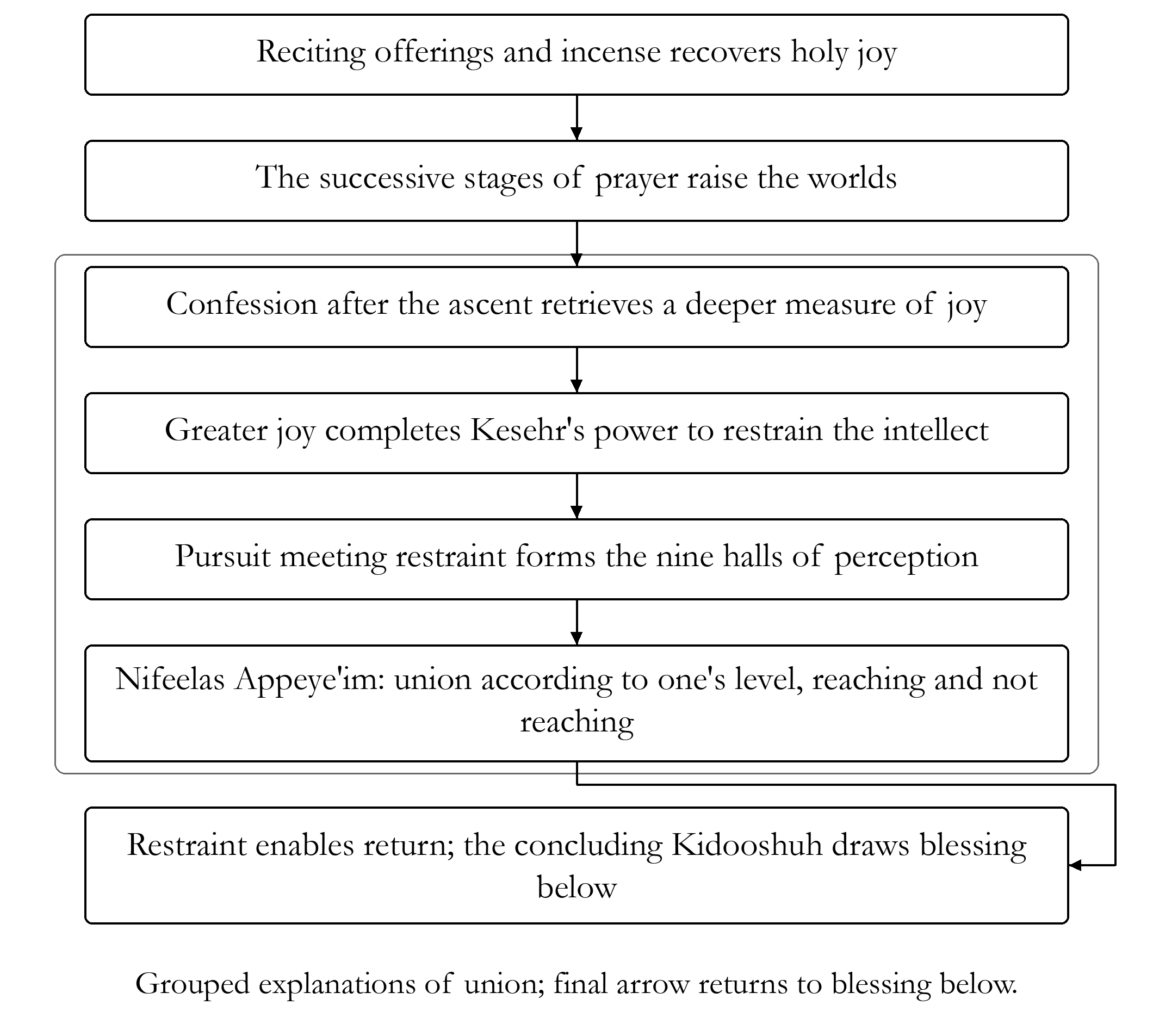
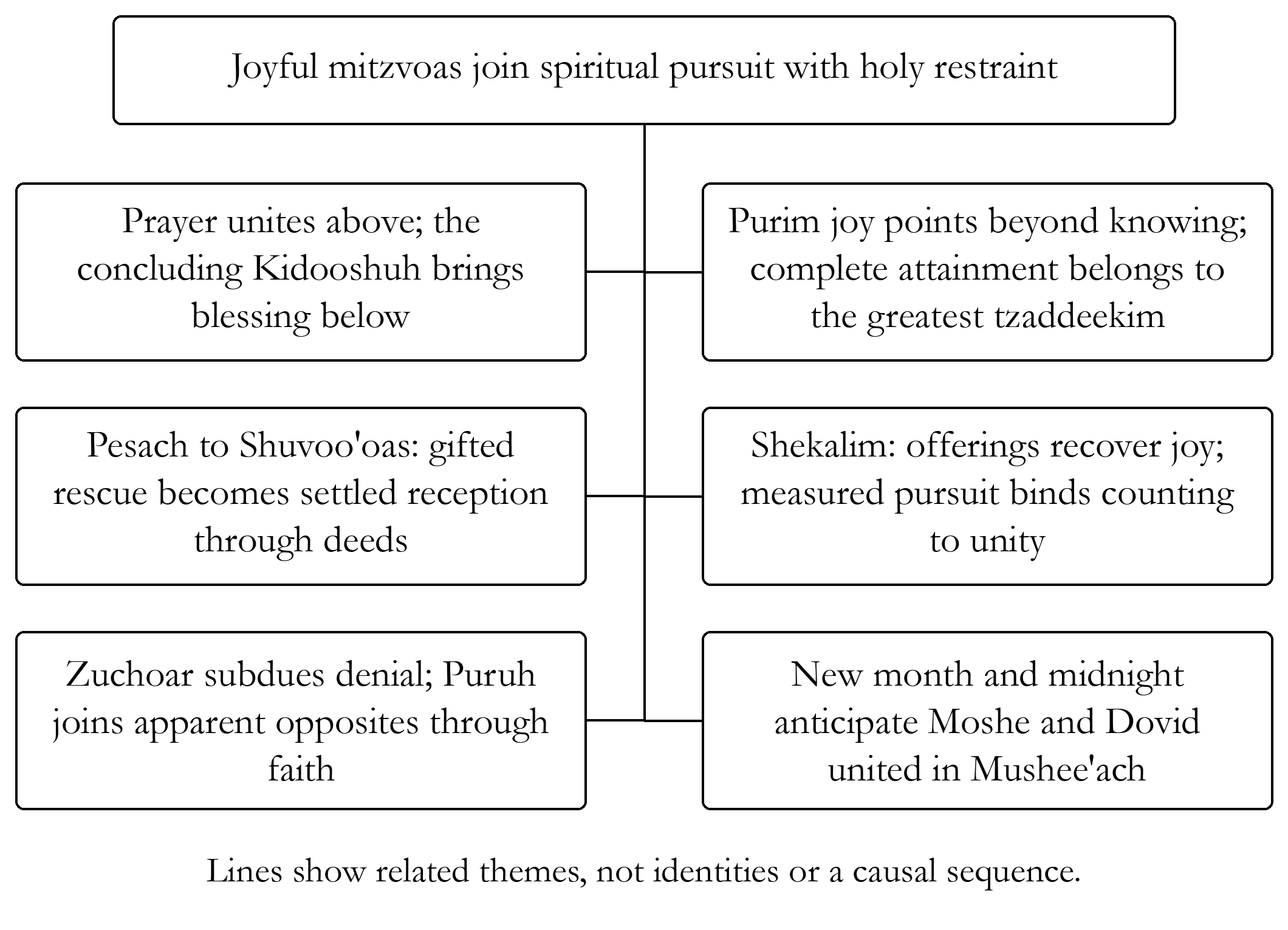
Earlier annotations and link context
Earlier Reader contexts are retained separately. Their links identify current source references; they do not assert that an earlier English selection has the same meaning in the corrected edition.
Earlier paragraph 3
Earlier Reader annotation context; not the corrected source edition
הלכה ד אות א ובו יתבאר ענין פורים ופסח וד' פרשיות:
Earlier pointed Hebrew field
וּבוֹ יִתְבָּאֵר עִנְיַן פּוּרִים וּפֶסַח וְאַרְבַּע פָּרָשִׁ
This is "S'mach Z'vulun b'tzais'cha v'Yissachar b'ohalecha" — "Rejoice, Z'vulun, in your going out, and Yissachar in your tents" (D'varim 33). Specifically when "Yissachar is in your tents" (= the Tzaddik engages in Torah) and you support him → then you have cause to rejoice in your going out to commerce and business. The Tzaddik will sustain and maintain you. "Nations will call to the mountain, there they will offer righteous offerings" — Rashi explains: "Nations will come and convert." Through the aspect of "your going out" and "your tents" (= Torah and derech eretz) → all are sustained, even the nations → their kitrug is nullified → far from contesting the inheritance of Eretz Yisrael, they themselves come and convert: "Amim har yikra'u, sham yizb'chu zivchay tzedek."
Earlier paragraph 4
Earlier Reader annotation context; not the corrected source edition
Current source references: [104]
על פי התורה אמצעותא דעלמא היכא וכו' (בסימן כ"ד בליקוטי חלק א') עיין שם כל התורה מראשה לסופה. והכלל שעל ידי עשיית המצוה בשמחה זוכין להעלות השכינה מהגלות.ולעלות מדרגא לדרגא ומעולם לעולם עד שזוכין לעלות למעלה למעלה. עד שזוכין להשיג אור האין סוף בחינת מטי ולא מטי שהוא למעלה מנפש רוח נשמה למעלה מהספירות וכו'. עיין שם כל זה היטב מה שכתב שם שמפנימיות הברכאן שהם דקות הברכאן נתברך המסדר והמיישב את המוחין שהוא בחינת הכתר שהוא הבחינה המעכב והמסדר את המוחין לבל יהרסו לעלות אל ה' וכו'. שעל ידי בחינת הרדיפה והמעכב על ידי זה נעשין בחינת הט' היכלין שעל ידם משיגין אור האין סוף בבחינת מטי ולא מטי וכו' עיין שם כל זה היטב:
Earlier pointed Hebrew field
עַל-פִּי הַתּוֹרָה 'אֶמְצָעוּתָא דְּעָלְמָא הֵיכָא' וְכוּ' בְּסִימָן כד בְּלִקּוּטֵי חֵלֶק א עַיֵּן שָׁם כָּל הַתּוֹרָה מֵרֹאשָׁהּ לְסוֹפָהּ: וְהַכְּלָל שֶׁעַל-יְדֵי עֲשִׂיַּת הַמִּצְוָה בְּשִׂמְחָה זוֹכִין לְהַעֲלוֹת הַשְּׁכִינָה מֵהַגָּלוּת וְלַעֲלוֹת מִדַּרְגָּא לְדַרְגָּא ומֵעוֹלָם לְעוֹלָם עַד שֶׁזּוֹכִין לַעֲלוֹת לְמַעְלָה לְמַעְלָה עַד שֶׁזּוֹכִין לְהַשִּיג אוֹר הַאֵין סוֹף בְּחִינַת מָטֵי וְלֹא מָטֵי שֶׁהוּא לְמַעְלָה מִנֶּפֶשׁ רוּחַ נְשָׁמָה לְמַעְלָה מֵהַסְּפִירוֹת וְכוּ', עַיֵּן שָׁם כָּל זֶה הֵיטֵב מַה שֶּׁכָּתַב שָׁם שֶׁמִּפְּנִימִיּוּת הַבִּרְכָאָן שֶׁהֵם דַּקּוּת הַבִּרְכָאָן נִתְבָּרֵךְ הַמְסַדֵּר וְהַמְיַשֵּׁב אֶת הַמֹּחִין שֶׁהוּא בְּחִינַת הַכֶּתֶר שֶׁהוּא הַבְּחִינָה הַמְעַכֵּב וְהַמְסַדֵּר אֶת הַמֹּחִין לְבַל יֶהֶרְסוּ לַעֲלוֹת אֶל ה' וְכוּ' שֶׁעַל -יְדֵי בְּחִינַת הָרְדִיפָה וְהַמְעַכֵּב עַל-יְדֵי זֶה נַעֲשִׂין בְּחִינַת הַתִּשְׁעָה הֵיכָלִין שֶׁעַל יָדָם מַשִּיגִין אוֹר הָאֵין סוֹף בִּבְחִינַת מָטֵי וְלֹא מָטֵי וְכוּ', עַיֵּן שָׁם כָּל זֶה הֵיטֵב: ~ אות א
Based on the Ma'aseh of the Prince Who Was Exchanged(Sipuray Ma'asiyos, Story #11)
Earlier paragraph 5
Earlier Reader annotation context; not the corrected source edition
Current source references: [105]
וזה בחינת נפילת אפים שאז הוא תכלית היחוד והזווג העליון כמובא בכונות התפלה. כי כל הבחינות הנ"ל המבוארין בהתורה הנ"ל, דהיינו שמלכות עולה מן הקליפות ומלכות מלביש ועולה לבחינת נה"י ונה"י לחג"ת וחג"ת לחב"ד וכו'. כל זה הוא כוונת סדר התפלה שאומרים מתחלה קרבנות וקטרת, ואחר כך פסוקי דזמרה, ואחר כך ברכת קריאת שמע, ואחר כך התפלה שמונה עשרה וכו'. שעל ידי כל זה עולין העולמות בבחינות המבוארין בתורה הנ"ל. שמלכות עולה מן הקליפות ומלכות מלביש נה"י וכו' וכו'. כמובאר היטב בכוונות. ורבינו ז"ל גילה וביאר שכל סוד עליית העולמות בבחינה הנ"ל נעשין על ידי עשיית המצוה בשמחה כנ"ל. נמצא שעשיית המצוה בשמחה ובחינת סדר התפלה הם בחינה אחת שעל ידם עולין העולמות בבחינת הנ"ל המבוארין בתורה הנ"ל שהם סוד כוונות סדר התפלה כנ"ל. עד שזוכין על ידי זה לעלות עד הכתר לברך ולתקן בחינת המסדר והמיישב את המוחין שעל ידי זה זוכין להשיג אור האין סוף בבחינת מטי ולא מטי שעל ידי זה נעשין בחינת הט' היכלין הנ"ל כנ"ל. וזהו בחינת נפילת אפים אחר גמר התפלה. כי אחר גמר התפלה אז כבר נגמרו עליית כל העולמות למעלה עד אצילות למעלה למעלה כמובא בכוונות. ואז צריכין להכלל באור האין סוף שזהו עיקר סוד היחוד והזווג שנעשה בגמר התפלה. כי עיקר בחינת היחוד והזווג הוא התחברות עלמא תתאה בעילאה כמובן בזוהר בכמה מקומות. ובפרט בפרשת ויגש עלפי כי הנה המלכים נועדו וכו' עיין שם. הייינו כשהנפש מישראל שהיא בחינת עלמא תתאה נגד אור אין סוף ברוך הוא. כשזוכה להיות נכלל באור האין סוף בבחינת מטי ולא מטי, זהו בחינת תכלית היחוד והזווג של עולמות עליונים. וזה אי אפשר כי אם על ידי תיקון המסדר והמיישב את המוחין שהוא בחינת כתר כנ"ל. שעל ידי בחינה זו נמשך בחינת מעכב אל המוחין לבל יהרסו הגבול. ועל ידי שני בחינת אלו דייקא, דהיינו הרדיפה והמעכב. על ידי זה דייקא נעאשין ההיכלין הנ"ל שעל ידם משיגין אור האין סוף בבחינת מטי ולא מטי שזהו עיקר בחינת היחוד כנ"ל. וזה בחינת נפילת אפים שאז הוא עיקר בחינת היחוד והזווג כמבואר בכוונות כנ"ל. ועל כן צריכין אז ליפול על פניו, זהו בחינת ויסתר משה פניו כי ירא מהביט אל האלקים שבחינה זאת נמשכת מבחינת המסדר והמיישב שנתברך מפנימיות הברכאין וכו' כנ"ל שהוא בחינת הכתר כנ"ל. ומבחינה זאת יש כח בהמוחין לעכב את המוחין מרדיפתן וכו' כנ"ל. שזהו בחינת נ"א בחינת ויסתר משה פניו בחינת הכח המעכב המסדר והמיישב את המוחין כנ"ל. שעל ידי זה דייקא משיגין אור האין סוף ברוך הוא כנ"ל:
Earlier pointed Hebrew field
וְזֶה בְּחִינַת נְפִילַת אַפַּיִם שֶׁאָז הוּא תַּכְלִית הַיִּחוּד וְהַזִּוּוּג הָעֶלְיוֹן, כַּמּוּבָא בְּכַוָּנוֹת הַתְּפִלָּה, כִּי כָּל הַבְּחִינוֹת הַנַּ"ל הַמְבֹאָרִין בְּהַתּוֹרָה הַנַּ"ל, דְּהַיְנוּ שֶׁמַּלְכוּת עוֹלָה מִן הַקְּלִפּוֹת וּמַלְכוּת מַלְבִּישׁ וְעוֹלָה לִבְחִינַת נה"י ]נֶצַח הוֹד יְסוֹד[, ונה"י לחג"ת ]חָכְמָה גְּבוּרָה תִּפְאֶרֶת[, וחג"ת לחב"ד ]חָכְמָה בִּינָה דַּעַת[ וְכוּ' כָּל זֶה הוּא כַּוָּנַת סֵדֶר הַתְּפִלָּה שֶׁאוֹמְרִים מִתְּחִלָּה קָרְבָּנוֹת וּקְטֹרֶת, וְאַחַר כָּךְ פְּסוּקֵי דְּזִמְרָה, וְאַחַר כָּךְ בִּרְכַּת קְרִיאַת שְׁמַע, וְאַחַר כָּךְ הַתְּפִלָּה שְׁמוֹנֶה עֶשְׂרֵה וְכוּ' שֶׁעַל-יְדֵי כָּל זֶה עוֹלִין הָעוֹלָמוֹת בַּבְּחִינוֹת הַמְבֹאָרִין בַּתּוֹרָה הַנַּ"ל שֶׁמַּלְכוּת עוֹלָה מִן הַקְּלִפּוֹת וּמַלְכוּת מַלְבִּישׁ נה"י וְכוּ' וְכוּ', כַּמְבֹאָר הֵיטֵב בַּכַּוָּנוֹת. וְרַבֵּנוּ זִכְרוֹנוֹ לִבְרָכָה גִּלָּה וּבֵאֵר שֶׁכָּל סוֹד עֲלִיַּת הָעוֹלָמוֹת בַּבְּחִינָה הַנַּ"ל נַעֲשִׂין עַל-יְדֵי עֲשִׂיַּת הַמִּצְוָה בְּשִׂמְחָה כַּנַּ"ל. נִמְצָא שֶׁעֲשִׂיַּת הַמִּצְוָה בְּשִׂמְחָה וּבְחִינַת סֵדֶר הַתְּפִלָּה הֵם בְּחִינָה אַחַת שֶׁעַל יָדָם עוֹלִין הָעוֹלָמוֹת בַּבְּחִינָה הַנַּ"ל הַמְבֹאָרִין בַּתּוֹרָה הַנַּ"ל שֶׁהֵם סוֹד כַּוָּנוֹת סֵדֶר הַתְּפִלָּה כַּנַּ"ל עַד שֶׁזּוֹכִין עַל -יְדֵי זֶה לַעֲלוֹת עַד הַכֶּתֶר לְבָרֵךְ וּלְתַקֵּן בְּחִינַת הַמְסַדֵּר וְהַמְיַשֵּׁב אֶת הַמֹּחִין שֶׁעַל-יְדֵי זֶה זוֹכִין לְהַשִּיג אוֹר הַאֵין סוֹף בִּבְחִינַת מָטֵי וְלֹא מָטֵי שֶׁעַל-יְדֵי זֶה נַעֲשִׂין בְּחִינַת הַתִּשְׁעָה הֵיכָלִין הַנַּ"ל כַּנַּ"ל וְזֶהוּ בְּחִינַת נְפִילַת אַפַּיִם אַחַר גְּמַר הַתְּפִלָּה, כִּי אַחַר גְּמַר הַתְּפִלָּה אָז כְּבָר נִגְמְרוּ עֲלִיַּת כָּל הָעוֹלָמוֹת לְמַעְלָה עַד אֲצִילוּת לְמַעְלָה לְמַעְלָה כַּמּוּבָא בַּכַּוָּנוֹת. וְאָז צְרִיכִין לְהִכָּלֵל בָּאוֹר הַאֵין סוֹף שֶׁזֶּהוּ עִקַּר סוֹד הַיִּחוּד וְהַזִּוּוּג שֶׁנַּעֲשֶׂה בִּגְמַר הַתְּפִלָּה, כִּי עִקַּר בְּחִינַת הַיִּחוּד וְהַזִּוּוּג הוּא הִתְחַבְּרוּת עָלְמָא תַּתָּאָה בְּעִלָּאָה, כַּמּוּבָן בַּזֹּהַר בְּכַמָּה מְקוֹמוֹת וּבִפְרָט בְּפָרָשַׁת וַיִּגַּשׁ עַל-פָּסוּק כִּי הִנֵּה הַמְּלָכִים נוֹעָדוּ וְכוּ', עַיֵּן שָׁם הַיְנוּ כְּשֶׁהַנֶּפֶשׁ מִיִּשְׂרָאֵל שֶׁהִיא בְּחִינַת עָלְמָא תַּתָּאָה נֶגֶד אוֹר אֵין סוֹף בָּרוּךְ הוּא כְּשֶׁזּוֹכָה לִהְיוֹת נִכְלָל בְּאוֹר הַאֵין סוֹף בִּבְחִינַת מָטֵי וְלֹא מָטֵי, זֶהוּ בְּחִינַת תַּכְלִית הַיִּחוּד וְהַזִּוּוּג שֶׁל עוֹלָמוֹת עֶלְיוֹנִים וְזֶה אִי אֶפְשָׁר כִּי אִם עַל-יְדֵי תִּקּוּן הַמְסַדֵּר וְהַמְיַשֵּׁב אֶת הַמֹּחִין שֶׁהוּא בְּחִינַת כֶּתֶר כַּנַּ"ל שֶׁעַל-יְדֵי בְּחִינָה זוֹ נִמְשָׁךְ בְּחִינַת מְעַכֵּב אֶל הַמֹּחִין לְבַל יֶהֶרְסוּ הַגְּבוּל וְעַל-יְדֵי שְׁנֵי בְּחִינַת אֵלּוּ דַּיְקָא, דְּהַיְנוּ הָרְדִיפָה וְהַמְעַכֵּב עַל-יְדֵי זֶה דַּיְקָא נַעֲשִׂין הַהֵיכָלִין הַנַּ"ל שֶׁעַל יָדָם מַשִּיגִין אוֹר הַאֵין סוֹף בִּבְחִינַת מָטֵי וְלֹא מָטֵי שֶׁזֶּהוּ עִקַּר בְּחִינַת הַיִּחוּד כַּנַּ"ל וְזֶה בְּחִינַת נְפִילַת אַפַּיִם שֶׁאָז הוּא עִקַּר בְּחִינַת הַיִּחוּד וְהַזִּוּוּג כַּמְבֹאָר בַּכַּוָּנוֹת כַּנַּ"ל וְעַל-כֵּן צְרִיכִין אָז לִפֹּל עַל פָּנָיו, שֶׁזֶּהוּ בְּחִינַת וַיַּסְתֵּר משֶׁה פָּנָיו כִּי יָרֵא מֵהַבִּיט אֶל הָאֱלֹקִים שֶׁבְּחִינָה זֹאת נִמְשֶׁכֶת מִבְּחִינַת הַמְסַדֵּר וְהַמְיַשֵּׁב שֶׁנִּתְבָּרֵךְ מִפְּנִימִיּוּת הַבִּרְכָאִין וְכוּ' כַּנַּ"ל שֶׁהוּא בְּחִינַת הַכֶּתֶר כַּנַּ"ל וּמִבְּחִינָה זֹאת יֵשׁ כֹּחַ בְּהַמֹּחִין לְעַכֵּב אֶת הַמֹּחִין מֵרְדִיפָתָן וְכוּ' כַּנַּ"ל שֶׁזֶּהוּ בְּחִינַת נְפִילַת אַפַּיִם בְּחִינַת וַיַּסְתֵּר משֶׁה פָּנָיו בְּחִינַת הַכֹּחַ הַמְעַכֵּב הַמְסַדֵּר וְהַמְיַשֵּׁב אֶת הַמֹּחִין כַּנַּ"ל שֶׁעַל-יְדֵי זֶה דַּיְקָא מַשִּיגִין אוֹר הָאֵין סוֹף
In truth, I am but an ignorant man, and the understanding of a person is not with me. I do not merit to understand what I have seen written in several sefarim of Kabbalah — imprecise language regarding the holy Names of Hashem, and in particular the language of the Siddur of the Maharik z"l, called Kol Yaakov, who wrote in his introduction, in these words: "Therefore, we have nothing with the Ba'al HaRatzon — may His Name be praised in the mouth of all His creatures — except that in all the berachos and thanksgivings, in all the matters and kavanos, it is 'muktar u'mugash liShmo' — 'liShmo' specifically," etc. See there. He wished to correct and instruct us in the path of kavanah — what we should intend in our tefillos and our avodah. But in truth, according to the plain reading of his language, he corrupted much and caused a stumbling-block to those who study his sefarim, touching the very foundation of holy emunah, which is the essence of everything.
Earlier paragraph 7
Earlier Reader annotation context; not the corrected source edition
Current source references: [106] [107]
אות ב ועל כן צריכין לומר ווידוי על חטאיו קודם נפילת אפים. זה סוד מה שכתב רבינו ז"ל שם בהתורה הנ"ל על מה ששאלו סבי דבי אתונא מי יימר. ופירש שם מי יכול לכנוס להיכלי התמורות להעלות הקדושה והשמחה משם כדי שעל ידי זה תעלה השכינה מהגלות ותעלה בכל עליות הנ"ל. עד שיזכה להשיג אמצעותא דעלמא שהוא בחינת אור אין סוף עיין שם. וזה בחינת ווידוי על החטאים שאומרים קודם נשיאת אפים שאז הוא תכלית היחוד שנכללין באין סוף בבחינת מטי ולא מטי וכו' כנ"ל. כי אי אפשר להשיג זה האור בחינת אור אין סוף כי אם על ידי שמעלין כל ניצוצות הקדושה מעמקי הקליפות שזהו בחינת עליית השכינה מהגלות כנ"ל. ולזה צריכין ווידוי דברים. כי על ידי כל החטאים נופלין ניצוצי הקדושה בין הקליפות שזהו עיקר פגם של כל החטאים שבעולם כידוע. ועיקר הפגם הוא מה שמתגבר ח"ו העצבות על ידי החטאים בבחינת (תהלים ל"ח) אדאג מחטאתי בחינת (בראשית ו') ויתעצב אל לבו. כי השכינה שהיא כלליות הקדושה היא שמחתן של ישראל. והקליפות שכנגד הקדושה הם בחינת עצבות תוקפא דדינא כמבואר בהתורה הנ"ל. ועל ידי החטאים גורמים ח"ו שניצוצי הקדושה בחינת ניצוצי השמחה לשמוח בהשם יבתרך לשמוח בשמחת אחדותו יתברך. אלו ניצוצות השמחה הם בחינת ניצוצי הקדושה שנופלים בין הקליפות שהם בחינת עצבות. כי השמחה היא הקדושה כנ"ל. ואזי העצבות והמרה שחורה מתגבר ח"ו ואינם מניחים לישראל לשמוח. וזה עיקר גלות השכינה עיקר פגם כל החטאים שבעולם. ועל כן אחר התפלה שצריכין לכלול באור האין סוף בבחינת מטי ולא מטי כנ"ל, שזה אי אפשר כי אם על ידי שמחה כנ"ל. ומחמת שעכשיו בגלות, השכינה שהוא בחינת השמחה בגלות, על כן אי אפשר לזכות לשמחה כדי להשיג אור האין סוף כנ"ל כי אם על ידי שיורדין לעמקי הקליפות להעלות ניצוצי השמחה שהם ניצוצי הקדושה להעלותם מעמקי הקליפות שעל ידי השמחה הזאת עולין מעולם לעולם וכו' עד שמשיגין אור האין סוף בבחינת הנ"ל. ועל כן צריכין ווידוי דברים אז כי על ידי הווידוי שמתוודין על החטאים על ידי זה מתכפרין החטאים כמו שכתוב (משלי כ"ח) ומודה ועוזב ירוחם. כי על ידי הווידוי מעלין כל הנצוצות שנפלו על ידי החטאים. ואז כשעולין ניצוצות הקדושה על ידי מחילת עוונות שזוכין על ידי הווידוי אזי עולה השמחה מהגלות שהוא עיקר הקדושה כנ"ל. ועל ידי שמחה זאת זוכין להכלל באור האין סוף להשיגו בבחינת מטי ולא מטי כל אחד לפי בחינתו. וזהו בעצמו בחינת נפילת אפים שמבואר בכונות שאז מפילין את עצמם למטה למטה לסטרא דמותא כדי להעלות הקדושה משם. ואז נעשה תכלית היחוד עיין שם היינו כנ"ל. כי הא בהא תליא כי אי אפשר להשיג ולהגיע לבחינת תכלית היחוד שהוא בחינת השגת אור האין סוף בבחינת הנ"ל כי אם על ידי שמחה שזוכין על ידי שיורדין לעמקי הקליפות להעלות הקדושה שהוא השמחה משם כנ"ל שזהו בחינת מי יימר הנאמר בהתורה הנ"ל. ואף על פי שכבר העלינו ובררנו את הקדושה מעמקי הקליפות על ידי אמירת קטרת וקרבנות בבחינת (משלי כ"ז) קטרת ישמח לב. כי על ידי קטרת עולה הקדושה שהיא השמחה מהקליפות כמבואר בהתורה הנ"ל. אף על פי כן עתה אחר גמר התפלה קודם שזוכין לתכלית היחוד להשיג אור האין סוף בבחינת הנ"ל צריכין לחזור ולירד להעלות הקדושה מעמקי הקליפות שזהו בחינת ווידוי דברים בחינת נפילת אפים כנ"ל. כי מתחלה בררנו הקדושה והשמחה בשביל עליית העולמות כדי שנוכל לעלות מעולם לעולם. כדי שנזכה להשיג המוחין הקדושים כדי שנזכה לרדוף להשיג אור האין סוף שכל זה אנו עוסקין לעשות על ידי עבודתינו מתחלת סדר התפלה עד סוף שעל ידי שעולין מעשיה ליצירה ומיצירה לבריאה וכו'. ומלכות מלביש נה"י ונה"י מלביש חג"ת וכו' וכו'. אבל עכשיו שכבר זכינו להמוחין. אבל העיקר מה שצריכין עכשיו הוא לתקן בתכלית השלימות את המסדר והמיישב את המוחין, דהיינו בחינת המעכב הנ"ל. ובשביל זה צריכין שמחה יתירה וצריהכין לחזור ולירד לעמקי הקליפות לברר הקדושה מעמקי הקליפות על ידי ווידוי דברים ונפילת אפים שמפילין עצמן למטה כדי שנזכה להעלות השמחה מעמקי עמקי הקליפות כדי שיתברך ויושלם בתכלית השלימות המסדר והמיישב כדי שנזכה להשיג אור האין סוף בבחינת מטי ולא מטי. כי עיקר שלימות ההשגה הוא על ידי כח המסדר והמיישב הנ"ל שהוא בחינת כתר שבגבוה מן הכל. שעל ידי זה דייקא משיגין אור האין סוף על ידי הרדיפה והמעכב דייקא כנ"ל. כי עיקר תיקון המסדר והמיישב הוא על ידי השמחה. כי המסדר והמיישב הוא בחינת כתר ששם מקור השמחה בחינת (ישעיה ל"ה) ושמחת עולם על ראשם, על ראשם דייקא זה בחינת כתר שהוא למעלה מהראש שהוא בחינתהמוחין. כי השמחה מרחבת המוחין ואז יש להם כח לסבול מה שמשיגין מאור האין סוף ולבלי להרוס את הגבול. אבל העצבות ח"ו מצמצם את הדעת עד שהוא קטן מהכיל את האור. ואז אינו יכול לסבול אפילו מעט ניצוצי האור שמאירין לו ויכול להרוס את הגבול ח"ו. ועל כן עיקר ההשגה על ידי השמחה בבחינת (שבת ל') אין השכינה שורה מתוך עצבות אלא מתוך שמחה:
.key-term{color:#6b1d1d;font-weight:600}
Earlier paragraph 9
Earlier Reader annotation context; not the corrected source edition
Current source references: [108]
אות ג ועל כן בשבת ויום טוב ושאר ימים שאין אומרים בהם תחנון אין בהם נפילת אפים. כי שבת הוא מעין עולם הבא שאז תגדל השמחה מאד בחינת (ישעיה נ"ה) כי בשמהח תצאו בחינת (שם כ"ה) ואמר ביום ההוא וכו' זה ה' קוינו לו נגילה ונשמחה בישועתו וכו'. וכן ביום טוב וכל הימים שאין אומרים בהם תחנון כולם הם בחינת ימים טובים שמאיר בהם הארת שבת. ועל כן אין אומרים אז ווידוי ואין נופלים אז על פניהם. כי אז אין שליטה להקליפת שהם בחינת עצבות. ועל כן אז השמחה בשלימות ואין צריכין אז לירד לעמקי הקליפות להעלות השמחה משם כי אז אין להקליפות שהם העצבות שליטה כלל. ואז נתעורר בחינת שלימות השמחה שלעתיד כנ"ל. ועל כן אז ממילא זוכין להשיג אור אין סוף בבחינת הנ"ל שעיקר השגתו על ידי השמחה. כי אז הם ימי שמחה ואין צריכין אז לירדש להעלות ולברר השמחה מהקליפות. כי אז אין להקליפות שהם העצבות שום שליטה כלל. ואז מאיר השמחה ממילא מעצם תוספת קדושה שב~ אותו היום שזאת התוספת קדושה של אלו הימים שאין אומרים בהם תחנון הוא בחינת שבת שהוא מעין עולם הבא שאז הוא עיקר השמחה. ועל ידי זה נכללין באור האין סוף בבחינה הנ"ל. ואין צריכין אז ווידוי דברים ולא נפילת אפים כלל מחמת גודל השמחה שמאיר אז כנ"ל:
Earlier pointed Hebrew field
וְעַל-כֵּן בְּשַׁבָּת וְיוֹם טוֹב וּשְׁאָר יָמִים שֶׁאֵין אוֹמְרִים בָּהֶם תַּחֲנוּן אֵין בָּהֶם נְפִילַת אַפַּיִם, כִּי שַׁבָּת הוּא מֵעֵין עוֹלָם הַבָּא שֶׁאָז תִּגְדַּל הַשִּמְחָה מְאֹד בְּחִינַת ( יְשַׁעְיָה נה) כִּי בְּשִׂמְחָה תֵצֵאוּ בְּחִינַת ( שָׁם כה) וְאָמַר בַּיּוֹם הַהוּא וְכוּ' זֶה ה' קִוִּינוּ לוֹ נָגִילָה וְנִשְׂמְחָה בִּישׁוּעָתוֹ וְכוּ' וְכֵן בְּיוֹם טוֹב וְכָל הַיָּמִים שֶׁאֵין אוֹמְרִים בָּהֶם תַּחֲנוּן כֻּלָּם הֵם בְּחִינַת יָמִים טוֹבִים שֶׁמֵּאִיר בָּהֶם הֶאָרַת שַׁבָּת וְעַל-כֵּן אֵין אוֹמְרִים אָז וִדּוּי וְאֵין נוֹפְלִים אָז עַל פְּנֵיהֶם, כִּי אָז אֵין שְׁלִיטָה לְהַקְּלִפּוֹת שֶׁהֵם בְּחִינַת עַצְבוּת וְעַל -כֵּן אָז הַשִּמְחָה בִּשְׁלֵמוּת וְאֵין צְרִיכִין אָז לֵירֵד לְעִמְקֵי הַקְּלִפּוֹת לְהַעֲלוֹת הַשִּמְחָה מִשָּׁם כִּי אָז אֵין לְהַקְּלִפּוֹת שֶׁהֵם הָעַצְבוּת שְׁלִיטָה כְּלָל וְאָז נִתְעוֹרֵר בְּחִינַת שְׁלֵמוּת הַשִּמְחָה שֶׁלֶּעָתִיד כַּנַּ"ל וְעַל-כֵּן אָז מִמֵּילָא זוֹכִין לְהַשִּיג אוֹר אֵין סוֹף בַּבְּחִינָה הַנַּ"ל שֶׁעִקַּר הַשָּגָתוֹ עַל-יְדֵי הַשִּמְחָה, כִּי אָז הֵם יְמֵי שִׂמְחָה וְאֵין צְרִיכִין אָז לֵירֵד לְהַעֲלוֹת וּלְבָרֵר הַשִּמְחָה מֵהַקְּלִפּוֹת, כִּי אָז אֵין לְהַקְּלִפּוֹת, שֶׁהֵם הָעַצְבוּת, שׁוּם שְׁלִיטָה כְּלָל וְאָז מֵאִיר הַשִּמְחָה מִמֵּילָא מֵעֶצֶם תּוֹסֶפֶת קְדֻשָּׁה שֶׁבְּאוֹתוֹ הַיּוֹם שֶׁזֹּאת הַתּוֹסֶפֶת קְדֻשָּׁה שֶׁל אֵלּוּ הַיָּמִים שֶׁאֵין אוֹמְרִים בָּהֶם תַּחֲנוּן הוּא בְּחִינַת שַׁבָּת שֶׁהוּא מֵעֵין עוֹלָם הַבָּא שֶׁאָז הוּא עִקַּר הַשִּמְחָה וְעַל-יְדֵי זֶה נִכְלָלִין בְּאוֹר הָאֵין סוֹף בַּבְּחִינָה הַנַּ"ל, וְאֵין צְרִיכִין אָז וִדּוּי דְּבָרִים וְלֹא נְפִילַת אַפַּיִם כְּלָל מֵחֲמַת גֹּדֶל הַשִּמְחָה שֶׁמֵּאִיר אָז כַּנַּ"ל: ~ אות ד וְזֶה בְּחִינַת פּוּרִים
.bold-concept{font-weight:bold;color:#1a3c5e}
Earlier paragraph 11
Earlier Reader annotation context; not the corrected source edition
Current source references: [109] [110] [111]
אות ד וזה בחינת פורים. שעיקר מצות פורים הוא לשמוח בכל עת, לשמח את עצמו בכל מיני שמחה כמו שכתוב (אסתר ט') לעשות ~ אותם ימי משתה ושמחה. וכמו שנוהגים כל ישראל לשמוח בכל מיני שמחות בפרוים שזהו עיקר מצות פורים. כי עיקר הכנעת הסטרא אחרא שהוא זוהמת הנחש הוא בפורים. כי אז מכניעין קליפת המן עמלק שהוא עיקר זוהמת הנחש שנמשך על ידי חטא עץ הדעת שמשם אחיזת המן הרשע ימח שמו כמו שאמרו רז"ל (חולין קל"ט) המן מן התורה מנין שנאמר (בראשית ג') המן העץ וכו'. נמצא שהמן הרשע ימח שמו הוא בחינת פגם עץ הדעת טוב ורע שעל ידי זה נמשך זוהמת הנחש. ועיקר זוהמת המן זוהמת הנחש הוא בחינת עצבות ומרשה שחרוה שמתגברים בכל עת על ישראל ואינם מניחים ~ אותם לשמוח. כי עיקר הסטרא אחרא הוא עצבות כנ"ל. שזה נמשך מפגם עץ הדעת בחינת (שם) בעצבון תאכלנה שנגזר אז בחינת (שם ו') ויתעצב אל לבו הנאמר בדור המבול שכל זה נמשך על ידי פגם עץ הדעת כידוע. כי עיקר הקדושה הוא שמחה דהיינו לשמוח בהשם יתברך. כי מי שיש לו אמונה שלימה בהשם יבתרך בודאי ראוי לו לשמוח תמיד בהשם יתברך. וזה הדבר אי אפשר לבאר בכתב כי הוא לכל חד כפום מה דמשער בלבי' וכבר מבואר בדברינו מזה כמה פעמים. והמן ועמלק שהם בחינת המחקרים והכופרים מהם נמשך עיקר העצבות והמרה שחורה. כי עיקר השמחה הוא שמחת המצות בחינת (תהלים י"ט) פקודי ה' ישרים משמחי לב. ומי שמאמין בהשם יתברך ובתורתו הקדושה בתממותובפשיטות כמו שכל ישראל מאמינים, בודאי אין שמחה בעולם כמו שמחת עשיית המצצות שאו זוכין לעשות נחת רוח ליוצרנו ובוראנו יתברך. ואנו קונים לנו חיי עולם לעולמי עד ולנצח נצחים על ידי חוטי הציצטית שקונים אותבעד גדול אחד ואנו נכללים על ידי זה באור האין סוף. היש שמחה גדולה מזו. כי זה כל אדם יכול להבין שבעולם הזה אין שום שמחה בעולם. כי מה יתרון לאדם בכל עמלו שיעמול תחת השמש. ואם יצבור כעפר כסף וזהב סוף כל סוף מה יתרון לו בכל זה כי לא במותו יקח הכל. והכל יודעין שסוף אדם למות וימינו כצל עובר. ומי שיש לו רק איזה רשימה בעלמא של שכל אמתי אפילו נכרי יכול להבין שאין שום שמחה בזה העולם כלל. כי אחרית שמחה תוגה, ועל זה נאמר ולשמחה מה זה עושה (קהלת ב'). ועל כן אלו המחקרים והכופרים אין להם שום שמחה אמתיות כלל. והרת פניהם ענתה בהם שעל פי רוב הם מלאים עצבות יגון ואנחה. כי מהיכן יקבלו חיות ושמחה אמתיות מאחר שכופרים בתורתו הקדושה ובעשיית מצותיו יתברך. ובודים מלבם טעמים של הבל ושטות על עשיית המצות הקדושים. ויחפאו על ה' ועל תורת משה דברים אשר לא כן אשר בדו מלבם. כאלו ח"ו כל טעמי המצות הקדושים הם נימוסיות ח"ו בשביל תיקוןה עולם תיקון ההמדינה ח"ו. אוי הם ואוי לנפשם, תיפח רוחם ונשמתם כי אין כפירה גדולה מזו. ולדבריהם הרעים והזרים והמרים והמטונפים בודאי אין לשמוח בשום מצוה ח"ו מאחר שתכלית המצוה הוא בשביל תיקון זה העולם. ואם בגוף העשירות והממון ושאר חפצי העולם אין שום שמחה אמתיית כי אחריתו מרה כלענה כנ"ל. מכל שכן איך ישמח בהמצוה שהיא רק בשביל קיום נמוס המדינה ח"ו לפי דעתם הרעה והמשובשת.ואיך ישמח במצות סוכה מאחר שאומר עליו טעם של שטות כזה שאז טוב לישב באויר כזה. והוא בעצמו יודע שזה שטות כי על פי פשוטו בודאי אז טוב יותר לשבת בביתו מלישב בסוכה. ואם ירצה לישב בצל יעשה לו אהל של פשתן כדרך השרים ולא סוכה העשויה כדינו שסככה מפסולת גורן ויקב דייקא. וכן בשאר המצות. ואין צריכין לחזור לסתור שטותים ושקרים ודברים בדוים כאלה שהם הם עיקר האפיקורסות והכפירות שכופרים בתורת משה לגמרי ומחפין השקר שלהם בשטותים כאלה כאלו הם מתרצים את דברי משה רבינו עליו השלום ונותנים טעם לדבריו טעמים מרים וסרוחים שכאלה אם יש טעם בריר חלמות ושטותים כאלה. בפרט עתה שכבר זכינו לספרי הזוהר הקדוש וכתבי האריז"ל שמבואר בהם שכל מצוה ומצוה מרמז לדברים גבוהים ועליונים מאד מאד עד אין סוף ואין תכלית. כי הם חיינו ואורך ימינו בזה ובבא לעולמי עד ולנצח נצחים. ואנו בני ישראל אשר השם יבתרך הבדילנו ברחמיו מן התועים והכופרים האלה שהם בודאי מן הערב רב. מה טוב חלקנו ומה נעים גורלינו וכו'. כמה וכמה יש לנו לשמוח בכל עת ובפרט כשאנו מגיעים לעשות איזה מצוה. אשר אנו זוכים ברגע קלה של עשיית המצוה להיות נכללים בהשם יתברך באור האין סוף ברוך הוא. ואנו קונים לנו חיי עולם לעד ולנצח על די כל מצוה ומצוה שרובם ככולם קלים לעשותם ונעימים מאד כמו שכתוב (משלי ג') דרכיה דרכי נועם וכו'. ואין להאריך בזה לאחינו בני ישראל מאמינים בני מאמינים. כי החכם יבין מדעתו כמה יש לו לשמוח בשעת עשיית כל מצוה ומצוה. ודייקא על ידי שמחת המצוה על ידי זה דייקא עיקר עליית השכינה מהגלות עד שזוכין להעלות כל העולמות למעלה למעלה עד שמשיגין אור האין סוף בבחינה ה"ל כנ"ל. וזה עיקר בחינת פורים שהוא בחינת עשיית המוה בשמחה. כי אז שמחים כל ישראל בשמחה גדולה מאד עד אין סוף ואין תכלית. כי המן זוהמת הנחש הוא בחינת עצבות כנ"ל. כי המן בגימטריא צ"ו עם הכולל שהוא בחינת תוקף הקליפו שבעשיה כמבואר בכוונת כי אין צ"ו אלא עבודה זרה כמו שאמרו רז"ל (סנהדרין נ"ו). היינו שעיקר בחינת צ"ו שהוא בחינת כלליות צווי המצות, העיקר הוא בביל להכניע העבודה זרה שהם הכפירות שהם בחינת המן שעולה צ"ו עם הכולל. שהוא כופר בעשיית המצות ובודה עליהם טעמים של שקר. ועל כן עיקר קטרוגו והתגרותו הוא בהשמחה של המצות. כי אינו מניח לשמוח בשום מצוה מחמת שמכניס כפירות שהם טעמים של שטות בשביל עסקי עולם הזה ח"ו. שעל ידי זה בודאי אין לשמוח ח"ו בשום מצוה כי בעולם הזה אין שום שמחה כנ"ל. ומחמת קנאתו של המן במרדכי וישראל שראה שהם חזקים כל כך בעשיית מצותיהם ועושין ~ אותם בשמחה גדולה ובמסירת נפש. על ידי זה נתקנא בהם מאד עד שרצה להעבירם מן העולם ח"ו. ומחמת שעיקר קנאתם הוא בהשמחה של המצוה. כי על גוף המצוה הם יכולים לומר ח"ו הוא נימוס ח"ו כמו שאר נימוסי העובדי כוכבים ח"ו. אבל מאחר שרואים שישראל מוסרים נפשם עך קידוש השם בשמחה גדולה בשביל עשיית המצות כמו שראינו שר' עקיבא הוה גחין וחייך בשעת שדנו ~ אותו לפני טורנוסרופוס הרשע ימח שמו כמובא במדרש שוחר טוב משלי, וכיוצא בזה בשאר קדשים. וכל ישראל קדושים שמחים במצותם. ובזה מתקנא המן שהוא בחינת הכופרים ביותר. ועל כן בפורים שאז נכנע המן עמלק שהם בחינת הכופים הנ"ל. אז עיקר המצוה הוא שמחה כי זה עיקר הכנעתו כנ"ל:
.transliteration{font-style:italic;color:#555}
Earlier paragraph 13
Earlier Reader annotation context; not the corrected source edition
Current source references: [112] [113]
אות ה וזה בחינת גודל הפלגת השמחה מאד מאד שנוהגים כל ישראל בפורים. להרבות אז בשמחה גדולה מאד ועושים אז כל מיני צחוק ושחוק בשביל להרבות השמחה. כי עיקר מצות פורים הוא השמחה כנ"ל. ועל כן עושים כל מיני שחוק ומילי דשטותא. ועושים אז מעה שכרות ושטות בשביל השמחה. כי איתא בדברי רבינו ז"ל בכמה מקומות כמה אזהרות גדולות שצריך האדם להרגיל את עצמו להיות בשמחה תמיד. ואיתא בדבריו הקדושים שאי אפשר להיות בשמחה כי אם על ידי מילי דשטותא דייקא, שעושין עצמן כשוטה ומשמחין את עצמן במילי דשטותא. כי מחמת שטבע האדם נמשך אחר העצבות מאד, כי כל אדם מלא יסורים ויגונות כידוע לכל אחד ואחד. על כן צריכין להכריח את עצמו בכל הכחות להיות בשמחה. ועיקר השמחה אי אפשר להיותכעי אם על ידי מילי דשטותא, כמו שמעתי מפיו ז"ל שאמר בזה הלשן "סע האט א פנים אז מע ען מער ניט פרייליך זיין נאר מיט נאריש מאכין זיך". וכן דיבר עוד מזה כמה פעמים. וזהו הענין מה שהיו נוהגין כל הצדיקם הגדולים המפורסמים שהיו בימינו שעל פי רוב היה להם אנשים שהיו כמו בדחנים. והיו עושים לפנים כל מיני צחוק ושטות כמפורסם. והכל בשביל שמחה כי אין דבר מזיק לעבודת ה' כמו העצבות כמובא בכל הספרים הקדושים. ומגודל מרירת וצרות הגלות המר הזה בגוף ונפש וממון אי אפשר להיות בשמחה כי אם על ידי מילי דשטותא דייקא כנ"ל. וזה בחינת מילי דבדיחותא שהיו נוגים התנאים ואמוראים הקדושים קודם הלימוד כדי לבא לשמחה על ידי מילי דבדיחותא שהם מילי דשטותא דייקא. וזהו בחינת מה שכתוב בזוהר הקדוש (ויקרא ד' מ"ז ע"ב) שרב המנונא סבא הוה מסדר קמי חבריי' פרקא דמילי דשטותא. היינו כנ"ל. כי עיקר גלות ישראל שהוא גלות השכינה. עיקר הגלות הוא מה שהעצבות שהם הסטרא אחרא והקליפות מתגברין על ישראל, ואינם מניחים ~ אותם לשמוח בה' ובתורתו הקדושה. כמבואר בהתורה אמצעותא דעלמא הנ"ל. שזהו עיקר גלות השכינה שהוא שמחתן של ישראל. שעיקר גלותה כשהעצבות מתגבר עליה דהיינו על ישראל ח"ו עיין שם. נמצא שעיקר גלות השכינה וכנסת ישראל הוא מה שהשמחה היא בגלות. ועל כן עכשיו בגלות שעיקר הגלות הוא שהשמחה נפלה למטה בגלות ומשם נמשך כל השמחה של העובדי כוכבים והרשעים ההולכים בשרירות לבם אשר באמת הם רחוקים משמחה אמתיית כמו שכתוב (משלי י"ז) ילד כסיל לתוגה לו. כי כל ימיו כעס ומכאובות וכו'. כי הסטרא אחרא נקראת יגון ואנחה כידוע. אך כל השמחה שיש אצלם נמשך רק מבחינת גלות השכינה שהיא שמחתן של ישראל שהוא עכשיו בגלות. ומשם נמשך ניצוצי השמחה שנפל אצלם בגלות ומשם כל שמחתם לפי שעה. ועליהם נאמר ולשמחה מה זו עושה כמו שכתוב (קהלת ב') לשחוק אמרתי מהולל ולשמחה מה זה עושה. לשחוק אמרתי מהולל לשון מעורבב, היינו שכל השמחה שאינה לשמים היא נמשכת רק מתערובות ניצוצי השמחה שנפלה על ידי גלות השכינה ונתערבה ביניהם. והם מהפכים וממירים רע בטוב ולוקחים השמחה שבאה ממקום עליון מאד ושמחים עמה בדברי ת~ אות רעות שלהם אשר באמת הם יגון ואנחה ומרים ממות. ועל כן בודאי ולשמחה כזאת מהזה עושה כי אחריתה יגון ואנחה כמו שכתוב (משלי י"ד) ואחריה שמחה תוגה. ועל כן מחמת שעכשיו השמחה בגלות היא מלובשת במילין דעלמא שהם מילין דשטותא. על כן מי שרוצה לבא לשמחה לשמוח בקדושת יהדותו במה שזכה להיות מזרע ישראל ולא עשני גוי אי אפשר לבא לשמחה כי אם על ידי מילי דשטותא דייקא. כי לשם נפלה השמחה מחמת גלות השכינה שהוא שמחתן של ישראל כנ"ל. ועל כן איש הישראלי כשמשמח את עצמו על ידי מילי דשטותא אזי נעשה מזה תיקון גדול בחינת עליית ניצוצי השכינה מגלותה. כי מעלה ניצוצי השמחה מן הגלות מאחר שהוא בא לשמחה על ידי מילי דשטותא אלו. כי תיכף כשיאש ישראל הוא בשמחה, יכף חזרה ועלתא השמחה למקומה ושרשה שהיא אצל ישראל ששם שורש השמחה האמתיית כי ישראל יש להם לשמוח כל ימיהם בכל מיני שמחה בלי קץ וסוף מאחר שזכינו להאמין בה' ובמשה עבדו ובתורתו הקדושה וכו'. כי מקור נשמת ישראל הוא בבחינת שמחה שהיא השכינה שהיא שמחתן של ישראל ששם שורש נשמתינו, כמו שכתוב (ישעיה מ"ו) העמוסים מני בטן הנשואים מני רחם. שישראל הם חלק מהשכינה שהיא השמחה כנ"ל:
.source{font-size:.88em;color:#888}
Earlier paragraph 15
Earlier Reader annotation context; not the corrected source edition
Current source references: [114]
אות ו וזה בחינת (תהלים ל"ד) לדוש בשנותו את טעמו לפני אבימלך ויגרשהו וילך. כי דוד המלך הוא בחינת מלכות דקדושה שהוא בחינת השכינה שהוא בחינת מלכות דוד משיח כידוע שהוא בחינת שמחה כנ"ל. ועיקר המלחמה של דוד עם הסטרא אחרא והקליפות היה רק לשבר העצבות ולזכות לשמחה שזהו בחינת עשרה מיני נגינה שהמשיך דוד בעולם על ידי ספר תהלים שכלול מכל העשרה מיני נגינה שהם בחינת שמחה כמו שכתוב (שם צ"ג) עלי עשר ועלי נבל וכו' כי שמחתני ה' בפעליך וכו' כמו שכתב רבינו ז"ל במקום אחר. וכן מבואר בזוהר הקדוש שדוד המלך עליו השלום הוא בדחא דמלכא שאפילו בעת שהתוודה על חטאו בשבירת לב לא עזב את דרכי בדיףחתו כמבואר שם בזוהר עיין שם. כי דוד הוא בחינת מלכות דקדושה שהיא בחינת השכינה שהיא שמחתן של ישראל כנ"ל. ועל כן בעת שבא דוד ביד הפלשתים בגלות ותפסו ~ אותו והביאוהו לפני אבימלך ורצו לנקום בו. וראה דוד שאי אפשר להתגבר עיהם ולצאת מהם כי אם על ידי שמחה שעל ידי זה עיקר ההתגברות על הקליפות והסטרא אחרא שהם בחינת עצבות כנ"ל. אבל בעת תוקף הגלות שמתגברין במרירת השעבוד ואינם מניחים לשמוח. ואם כן מאין יבא עזרנו כי אם אפשר להמלט מהסטרא אחרא כי אם על ידי שמחה, ולשמחה אי אפשר לזכות מחמת תוקף התגברותם בגלו כנ"ל. על כן דוד המלך שהיה שמחתן של ישראל, כשנפל בגלות ביד הסטרא אחרא שהם הפלשתים. חנן ה' ~ אותו בעצה הזאת שעשה עצמו כשוטה מש ועשה מעשה שטות ושגעון ממש והוריד רירו על זקנו ויתו על דלתות השער וכו' (שמואל א' כ"א) ועל ידי זה נמלט מידם. כי על ידי מילי דשטותא דייקא באים לתוך שמחה שעל ידי זה ניצולין מהם כי עיקר ההתגברות עליהם הוא על ידי שמחה, ואי אפשר בגלות שללשמוח כי אם על ידי מילי דשטותא דייקא כנ"ל. וזהו בחינת שמחת פורים שעושיןן אז כל מיני שחוק ומילי דשטותא בשביל שמחה. כי עיקר השמחה הוא על ידי מילי דשטותא דייקא כנ"ל:
.bracket-def{font-size:.92em;color:#666}
Earlier paragraph 17
Earlier Reader annotation context; not the corrected source edition
Current source references: [115]
אות ז וזהו בחינת (מגילה ז') חייב אינש לבסומי בפוריא עד דלא ידע בין ארור המן לברוך מרדכי. כי בפורים אז עיקר הכנעת זוהמת הנחש שהוא העצבות בחינת בעצבון תאכלנה כנ"ל. וצריכין אז להעלות השמחה מעמקי הקליפות בבחינת מי יימר הנ"ל עד שנזכה על ידי השמחה להשיג בחינת הט' היכלין הנ"ל שעל ידם משיגין אור האין סוף בבחינת מטי ולא מטי שזהו בחינת תכלית הידיעה אשר לא נדע כנ"ל. ועל כן חייב אינש לבסומי דהיינו להשתכר בפורים בשביל שמחה כמו שכתוב (תהלים ק"ד) ויין ישמח לבב אנוש. וצריכין להגדיל השמחה עד שיזכה על ידי השכרות והשמחה של פורים לבא לבחינת תכלית הידיעה אשר לא נדע שזהו בחינת עד דלא ידע וכו'. כי עיקר אחיזת הטוב והרע שזהו בחינת ברוך מרדכי וארור המן, עיקר אחיזתו הוא מעץ הדעת טוב ורע שעיקרו נמשך מבחינת (משלי ט"ז) נרגן מפריד אלוף דהיינו שמפריד בחינת הכתר שהוא בחינת אלף בחינת פלא שהוא המסדר והמיישב את המוחין שהוא המעכב את המוחין מרדיפתן, שעיקר השגת הידיעה הוא על ידי זה דייקא בבחינת תכלית הידיעה אשר לא נדע. שבחינת לא נדע הוא עיקר תכלית הידיעה ומי שזוכה לזה אז נכלל הידיעה והעדר הידועה יחד שהם בחינת הרדיפה והמעכב שבאמת שניהם אחד בשרשם. ועל ידי זה עיקר תכליתה ידיעה ואז נתבטל הרע לגמרי. כי עיקר אחיזת הרע הוא העדר הידיעה והסתרתו שנמשך מחמת ריבוי אור שגורם שבירת כלים. שזהו מחמת שאינם כוללים הידיעה והעדר הידיעה יחד (וכאשר יבואר עוד מזה לקמן בעזרת השם יבתרך). ועל כן בפורים אז צריכין להשתכר עד שיבואו ליד שמחה כזאת עד שיזכה לבחינת תכלית הידיעה הנ"ל ששם נכלל הרדיפה והמעכב יחד, שהם הידיעה והעדר הידיעה שניהם נכללין יחד בבחינת תכלית הידיעה אשר לא נדע, ושם נתבטל כל הרע לגמרי כנ"ל. וזהו בחינת עד דלא ידע בין ארוא המן לברוך מרדכי, כי שם אין שייך לומר טוב ורע כי שם כולו אחד כולו טוב וכנזכר לעיל:
Likutay Halachos — Hilchos N'si'as Kapayim
Earlier paragraph 19
Earlier Reader annotation context; not the corrected source edition
Current source references: [116]
אות ח וזה בחינת ד' פרשיות, פרשת שקלים, ופרשת זכור, ופרשת פרה, ופרשת החדש, שקורין באדר סמוך לפורים מלפניו ומלאחריו. שכל זה הוא הכנה לגאולת וישועת ישראל שנזכה בניסן שבו נגאלו ובו עתידין להגאל כמו שאמרו רז"ל (ראש השנה י"א). כי עיקר גאולת ישראל מן הגלות הוא על ידי השמחה כמו שכתוב (ישעיה נ"ה) כי בשמחה תצאו כמו שכתוב לעיל בהתורה הנ"ל. היינו על ידי עשיית המצוה בשמחה שעל ידי זה עולה השכינה מהגלות וכו' כנ"ל, עד שזוכין להשיג אור האין סוף וכו' כנ"ל. וזהו בחינת פרשת שקלים. כי מצות שקלים היא בשביל הקרבנות וקטרת שעל ידי זה עיקר עליית ניצוצות הקדושים מן הקליפות. ועל כן נאמר בקרבנות וקטרת שמחה. כמו שכתוב בקרבנות (דברים י"ב) ושמחתם בכל משלח ידכם ושמחת בכל הטוב אתה וביתך וכיוצא בזה בפסוקים הרבה. וכן בקטרת נאמר קטרת ישמח לב וכמו שכתוב בהתורה הנ"ל. ועל כן היו הלוים מנצחים בשיר על הדוכן בשעת הקרבנות. כי שיר וזמרה הוא בחינת שמחה. כי על ידי הקרבנות וקטרת עולין כל ניצוצות הקדושה מן הקליפת והעיקר על ידי השמחה שנמשכת על ידי הקרבנות וקטרת. כי עיקר עליית הקדושה מן הקליפות הוא על ידי השמחה כנ"ל. וזהו בחינת שקלים שמחוייבם ליתן בכל שנה בשביל קרבנות צבור וקטרת שהם בחינת שמחה כנ"ל, כדי להעלות על ידי זה כל ניצוצי הקדושה מגלות הקליפות. ועל ידי זה עולין למעלה עד שזוכין לברכת שהשכל עד שמתקנין המסדר והמיישב את המוחין שהוא בחינת הכתר. שעל ידי זה דייקא זוכין על ידי הרדיפה והמעכב של המסדר והמיישב הנ"ל להשיג אור האין סוף בבחינת מטי ולא מטי. ואז נעשין הט' היכלין דלאו אינון נהורין וכו'. כמבואר היטב בהתורה הנ"ל עיין שם היטב. וכל זה זוכין על ידי עשיית המצות בשמחה דייקא שהוא בחינת קרבנות וקטרת כנ"ל, שזהו בחינת שקלים שמהם נעשו קרבנות וקטרת כנ"ל. וזה בחינת (שמות ל"ח) בקע לגלגלת. לגלגלת דייקא כי גלגלתא דא כתר כי עיקר התיקון הוא לזכות לתקן המסדר והמיישב את המוחין שהוא בחינת כתר גלגלתא שעל ידי זה עיקר השגת בחינת ט' היכלין הנ"ל כמובן בהתוהרה הנ"ל:
Earlier pointed Hebrew field
וְזֶה בְּחִינַת ד' פָּרָשִׁיּוֹת פָּרָשַׁת שְׁקָלִים בְּחִינַת צְדָקָה, כִּי צְדָקָה זֶה בְּחִינַת חֶסֶד לְאַבְרָהָם שֶׁעָשָֹה צְדָקָה וָחֶסֶד עִם כָּל הָעוֹלָם, שֶׁעַל-יְדֵי זֶה יְכוֹלִין לִמְצֹא הַנְּקֻדּוֹת טוֹבוֹת כַּנַּ"ל וְזֶה בְּחִינַת ( ישעיה מ"א) צֶדֶק יִקְרָאֻהוּ לְרַגְלוֹ, שֶׁעַל-יְדֵי צְדָקָה יְכוֹלִין לִקְרֹא אֶת הַטּוֹב שֶׁנּוֹפֵל בַּמַּדְרֵגָה הַתַּחְתּוֹנָה, בִּבְחִינַת רַגְלִין בִּבְחִינַת ( רות ג') וַתְּגַל מַרְגְּלוֹתָיו וַתִּשְׁכָּב וְכֵן מְרֻמָּז בְּדִבְרֵי רַבֵּנוּ ז"ל בְּמָקוֹם אַחֵר ( בסימן י"ז) שֶׁעַל-יְדֵי צְדָקָה מְעוֹרְרִין הַטּוֹב שֶׁנֶּעֱלָם וְנִסְתָּר בִּמְקוֹמוֹת הָרְחוֹקִים מֵהַשֵּׁם יִתְבָּרַךְ וְזֶה בְּחִינַת שְׁקָלִים שֶׁל נִדְבַת הַמִּשְׁכָּן, כִּי הַמִּשְׁכָּן נִבְנָה מִבְּחִינַת הַטּוֹב שֶׁנִּתְלַקֵּט וְכוּ' כַּנַּ"ל: וְאַחַר כָּךְ קוֹרִין פָּרָשַׁת זָכוֹר בְּחִינַת מִלְחֶמֶת עֲמָלֵק, כִּי עַל -יְדֵי זֶה שֶׁמּוֹצְאִין הַטּוֹב כַּנַּ"ל, עַל-יְדֵי זֶה נִכְנַע עֲמָלֵק שֶׁהוּא תֹּקֶף הַסִּטְרָא אַחֲרָא שֶׁמִּתְגַּבֵּר, ח"ו, לְהַפִּיל אֶת הַחֲלוּשֵׁי כֹּחַ שֶׁבְּיִשְֹרָאֵל כְּאִלּוּ אֵין לָהֶם תִּקְוָה עוֹד ח"ו, בִּבְחִינַת ( דברים כ"ח) וַיְזַנֵּב בְּךָ כָּל הַנֶּחֱשָׁלִים וְכוּ' וְאַתָּה עָיֵף וְיָגֵעַ וְכוּ' שֶׁרוֹצֶה לְזַנֵּב אֶת הַנֶּחֱשָׁלִים, דְּהַיְנוּ חֲלוּשֵׁי כֹּחַ לְהַפִּילָם לְמַטָּה ח"ו, שֶׁזֶּהוּ בְּחִינַת וַיְזַנֵּב בְּךָ וְכוּ' אֲבָל כְּשֶׁזּוֹכִין לִמְצֹא בְּעַצְמוֹ הַנְּקֻדָּה טוֹבָה אֲפִלּוּ בְּעֵת נְפִילָתוֹ ח"ו, עַל-יְדֵי זֶה נִכְנַע עֲמָלֵק, וְעַל-כֵּן אַחַר פָּרָשַׁת שְׁקָלִים, שֶׁהוּא בְּחִינַת הִתְעוֹרְרוּת הַטּוֹב כַּנַּ"ל, קוֹרִין פָּרָשַׁת זָכוֹר, כִּי עַל-יְדֵי זֶה מַכְנִיעִין אֶת עֲמָלֵק כַּנַּ"ל: וְאַחַר כָּךְ קוֹרִין פָּרָשַׁת פָּרָה, שֶׁהוּא בְּחִינַת תְּשׁוּבָה, בְּחִינַת ( מדרש רבה פרשת חוקת) תָּבֹא אִמּוֹ וּתְקַנֵּחַ עַל בְּנָהּ, כִּי עַל-יְדֵי הַנְּקֻדּוֹת טוֹבוֹת שֶׁמּוֹצְאִין, עַל-יְדֵי זֶה נִכְנַע הָרַע בְּחִינַת עֲמָלֵק וְעַל -יְדֵי זֶה ?זוֹכִין? בֶּאֱמֶת לִתְשׁוּבָה כַּנַּ"ל וְזֶה בְּחִינַת ( זוהר חוקת דף ק"פ ע"ב) פָּרָה אֲדֻמָּה תְמִימָה אֲדֻמָּה, דָּא דִּינָא קַשְׁיָא תְּמִימָה, דָּא דִּינָא רַפְיָא דְּהַיְנוּ כְּשֶׁהוּא בִּבְחִינַת דִּינָא קַשְׁיָא שֶׁמִּתְגַּבֵּר הָרָע ח"ו, שֶׁזֶּה בְּחִינַת דִּינָא קַשְׁיָא ח"ו, אֲזַי צָרִיךְ לְרַפּוֹת הַדִּין עַל-יְדֵי שֶׁמּוֹצֵא בְּעַצְמוֹ אֵיזֶה נְקֻדָּה טוֹבָה עֲדַיִן וְזֶה בְּחִינַת ( במדבר י"ט) אֲשֶׁר אֵין בָּהּ מוּם אֲשֶׁר לֹא עָלָה עָלֶיהָ עוֹל כִּי הַנְּקֻדָּה טוֹבָה הִיא בְּחִינַת יוֹנָה תַּמָּה שֶׁאין בָּהּ שׁוּם מוּם, כִּי הִיא נָאָה וְיָפָה, בְּחִינַת שְׁחֹרָה אֲנִי וְנָאוָה וְכוּ' כַּנַּ"ל וְזֶה בְּחִינַת ( פיט פרשת פרה) מְטַהֵר טְמֵאִים וּמְטַמֵּא טְהוֹרִים, כִּי זֹאת הַבְּחִינָה מַה שֶּׁדָּן אֶת עַצְמוֹ לְכַף זְכוּת וּמוֹצֵא בְּעַצְמוֹ נְקֻדּוֹת טוֹבוֹת, זֹאת הַבְּחִינָה מְטַהֶרֶת טְמֵאִים וּמְטַמֵּא טְהוֹרִים, כִּי מִי שֶׁהוּא בַּמַּדְרֵגָה הַתַּחְתּוֹנָה צָרִיךְ דַּוְקָא לִמְצֹא זְכוּת בְּעַצְמוֹ כְּדֵי שֶׁלֹּא יִפּוֹל לְגַמְרֵי ח"
Halacha 4 (§1–8)
Earlier paragraph 21
Earlier Reader annotation context; not the corrected source edition
Current source references: [117] [118]
אות ט וזהו (שם ל') כי תשא את ראש בני ישראל לפקודיהם ונתנו איש כופר נפשו וכו' ולא יהיה בהם נגף בפקוד ~ אותם זה יתנו וכו' מחצית השקל בשקל הקדש וכו'. מחצית השקל תרומה לה'. ומבואר בפירוש רש"י ובדברי רז"ל (ברכות ס"ב) שהמגפה תוכל לשלוט ח"ו על ידי המנין. על כן צותה התורה שיתן כל אחד מחצית השקל כדי שלא יהיה בהם נגף כמבואר בפסוק גופיה. כי עיקר אחיזת סטרא דמותא ח"ו נמשכת מבחנית מנין שהוא בחינת (קהלת ז') בקשו חשבועות רבים שנמשך על ידי פגם עץ הדעת טוב ורע אז נגזר מיתה על העולם. כי עיקר פגם עץ הדעת טוב ורע הוא בחינת בקשו חשבונות רבים שהוא בחינת פגם כל החוקרים הנכנסין בחקירות וקשיות למעלה משכלם עד שבאים על ידי זה לכפירות גדולות ולאפיקורסות גמורה. כי באמת אין חכמה ואין תבונה ואין עצה לנגד ה' וכמו שכתוב (ירמיה ח') הנה בדבר ה' מאסו וחכמת מה להם. כי השם יתברך לית מחשבה תפיסא בי' כלל. ואי אפשר לידע מאלקותו יתברך כי אם על ידי מעשים טובים, היינו על ידי עשיית המצוה בשמחה שעל ידי זה דייקא זוכה לעלות למעלה מעלה עד שזוכה להשיג אור אין סוף בבחינת מטי ולא מטי בבחינת הט' היכלין הנ"ל, שזה עיקר השגת אלקות אשרי הזוכה לזה. ועיקר תכלית שלימות התיקון שזוכין על ידי עשיית המצוה בשמחה הוא מה שזוכין על ידי זה לתקן את בחינת המסדר והמיישב את המוחין שהוא חבינת כתר שהוא גבוה מן הכל. ואף על פי שזאת הבחינה הוא כמו מונע ומעכב את המוחין מרדיפתן להשיג אור האין סוף, אף על פי כן באמת אדרבא זהו עיקר תכלית שלימות תיקון המוחין. ואי אפשר להשיג שום השגה אמתיית כי אם על ידי זה דייקא. דהיינו על ידי תיקון המסדר והמיישב שהוא בחינת כתר שהוא כמו מעכב את המוחטין מרדיפתם וכמבואר בהתורה הנ"ל. וזה הכתר שהוא בחינת המעכב המסדר והמישב את המוחין כנ"ל, זה אי אפשר להשיג כי אם על ידי עשיית מצות מעשיות דייקא, דהיינו על ידי עשיית המצות בשמחה כנ"ל. כי עיקר תכלית שלימות השמחה הוא שם בבחינת כתר בבחינת (ישעיה ל"ה) ושמחת עולם על ראשם. על ראשם דייקא זה בחינת כתר גלגלתא שהוא בחינת על ראשם כנ"ל. כי הכתר הוא על הראש כי הוא למעלה מהראש והמוחין. כי הוא המסדר והמיישב את המוחין ושם עיקר השמחה בחינת ושמחת עולם על ראשם על ראשם דייקא כנ"ל. והעיקר כשזאת השמחה עולה מעולם העשיה דייקא, הדהיינו כשזוכין לעשות מצות בשמחה שאז דייקא זוכין לבחינת כתר הנ"ל שהוא המסדר והמיישב. שעל ידי זה דייקא נעשין ט' היכלין הנ"ל שעל ידי זה דייקא משיגין אור האין סוף בבחינת מטי ולא מטי וכו' כנ"ל. כי עיקר שלימות זכות הצדיק שזוכה על ידי מעשיו הטובים הוא כשזוכה לבחינת כתר שהוא גבוה מן הכל הוא בחינת המסדר והמיישב הנ"ל. שעל ידי זה עיקר השגת אלקות, דהיינו השגת אור אין סוף וכו' כנ"ל. וזהו החילוק שביןא דם למלאך שהאדם הצדיק הוא גבוה הרבה מן המלאך כמובא. ועיקר החילוק הוא בבחינת השגת הכתר הנ"ל. כי לבחינת השגת הכתר הנ"ל אין זוכין כי אם על ידי מעשה התחתונים דייקא בעובדות ובמעשים טובים דייקא. ובשביל זה נברא האדם בזה העולם השפל לעבדה ולשמרה בפיקודין דעשה ולא תעשה כדי לזכות לבחינת הכתר הנ"ל שוא תכלית שלימות האדם, כי על ידי זה עיקר השגת אלקות כנ"ל. כי השם יתברך ברוך הוא מרומם ומנושא למעלה מכל המחשבות מאד מאד. כי לית מחשבה תפיסה בי' כלל. ואין שום נוצר ונברא ונעשה ונאצל למטה ולמעלה למעלה שיוכלו להשיגו.כי ה' עליון נורא מאד, נעלה על כל ההשגות של כל דרי מעלה ומטה. וכל ברואי מעלה ומטה כולם ירעדון ויפחדון מאימת שמו הגדול. ומלאכים יחפזון וחיל ורעדה יאחזון בזכרם אימת שמו וזכרו הגדול והנורא יתברך ויתעלה לנצח. וכמו שאנו אומרים בברכת קריאת שמע וכולם עושים באימה וביראה רצון קונם וכו' והאופנים וחיות הקדש ברעש גדול מתנשאים לעומת שרפים וכו' וכמבואר בפסוקים רבים ובדברי רז"ל. וכל ברואי מעלה ומטה הכל רועשין ובוערים ומתלהבים ורודפים מחשבתם להשיג השגת אלקותו תברך. אבל אי אפשר להשיג השגת אלקותו יתברך כי אם בבחינת מטי ולא מטי כנ"ל. וזה אי אפשר להשיג בתכלית השלימות כי אם על ידי העבודה של מעשה התחתונים דייקא. כי עיקר מניעת ההשגה הוא מחמת ריבוי אור שאי אפשר לקבל כידוע. ועיקר הכלים וההיכלות לקבל האור בהדרגה ובמדה בבחינת מטי ולא מטי הם נעשין על ידי תיקון הכתר דייקא שהוא המסדר והמיישב את המוחין שהוא כמו מעכב ומונע את המוחיןמרדיפתם שעל ידי זה עיקר ההשגה כנ"ל. וזה אין זוכין כי אם על ידי מצות מעשיות דייקא וכמו שאמרו רז"ל (שבת פרק ח') בשעה שאמרו ישראל נעשה ונשמע ירדו ששים רבוא מלאכים ונתנו שני כתרים על ראשם וכו' שנאמר ושמחת עולם על ראשם. נמצא שעל ידי קבלת התורה בחינת נעשה ונשמע זכו לבחינת כתר שעל ידי זה עיקר ההשגה. כי זה העולם העשיה הוא תכלית הגשמיות והוא עיקר מסך המבדיל בפני השגת אלקותו יתברך. אבל כשזוכין לעבוד את ה' בזה העולם העשיה ולעשות מצות מעשיות בשמחה, אזי זה עיקר התיקון. כי זוכה על ידי המצות מעשיות בשמחה שמברר ומתקן ומעלה את בחינת העשיה מבחינת מסך המבדיל נעשה ממנו בחינת כתר שהוא גם כן בחינת המבדיל ברוחניות עליון. כי הכתר פרוס בין הנאצלים לבין המאציל כמו שכתוב בהתורה הנ"ל. כי הכתר הוא כמו מונע ומעכב את המוחין מרדיפתם להשיג אור האיון סוף. אבל זה המניעה והמעכב הוא עיקר התכלית שלימות התיקון כנ"ל. כי אי אפשר להשיג השגת אור האין סוף כי אם על ידי זה דייקא. נמצא שמבחינת עשיה גשמיות שהוא עיקר המניעה והמעכב והמסך המבדיל והמונע מהשגת אלקותו יתברך כשזוכה לטהר ולקדש את העשיה על ידי עשיית המצות בשמחה. אז מזה דייקא עיקר התיקון. כי עולה על ידי זה למעלה למעלה עד שנעדה ל ידי זה דייקא בחינת כתר שהוא גם כן בחינת מונע ומעכב שזה המונע והמעכב הוא עיקר תכלית שלימות התיקון כנ"ל. וזה בחינת סוף מעשה במחשבה תחלה. כי סוף מעשה שהוא תכלית גשמיות העשיה העשיה הוא במחשבה תחלה שהוא בחינת כתר שהוא בחינת תחלת המחשבה. כי הכתר הוא שורש כל המוחין שהם המחשבות כידוע וזה עיקר התכלית והתיקון כשזוכין להשלים כוונת הבריאה להעלות סוף המעשה לתחלת המחשבה. היינו שמגשמיות העשיה שהוא בחינת סוף מעשה מזה דייקא יזכו להשיג תחלת המחשבה שהוא בחינת כתר שנעשה על ידי תיקון העשיה דייקא דהיינו על ידי עשיית המצות מעשיות דייקא כנ"ל שעל ידי זה עיקר השגת אלקות כנ"ל. ועל כן אמרו רז"ל (שבת פרק ב' בירושלמי) עתידין צדיקים שיהיה מחיצתן לפנים ממלאכי השרת שנאמר (במדבר כ"ג) כעת יאמר ליעקב ולישראל מה פעל אל, מחיצת דייקא. שהוא בחינת כתר שהוא בחינת מחיצה. כי הוא פרוס בין הנאצלים לבין המאציל כנ"ל.וישראל ישיגו השגות אלקותו יתברך על ידי זה דייקא. ובזה יהיו גבוהים מן המלאכים. כי המלאכים הם עומדים. ולא עמדו בנסיון של זה העולם המגושם על כן אין זוכין לבחינת כתר כנ"ל, ועל כן אי אפשר להם להשיג אלקותו יתברך כמו הצדיקים. כי לא יוכלו לקבל ריבוי האור מחמת שאין להם כלים ומחיצות בדעתם לעכב ההשגה אצלם. ועל כן נקראים שרפים. כי הם נשרפים ונתלהבים מאור השגתם העצומה מחמת שאין להם מחיצות לעכב מחמת שאין להם מצות מעשיות וכו' כנ"ל. (ועיין בהתורה ויהי מקץ כי מרחמם ינהגם וכוף בלקוטי תנינא סימן ז' שם מבואר גם כן זה המאמר עתידין צדיקים שיהיו מחיצתן וכו'. שמחיצן הוא בחינת כתר. ועיין עוד במקום אחר והבן היטב):
Earlier pointed Hebrew field
וְזֶהוּ ( שָׁם ל), כִּי תִשָּא אֶת רֹאשׁ בְּנֵי יִשְׂרָאֵל לִפְקֻדֵיהֶם וְנָתְנוּ אִישׁ כֹּפֶר נַפְשׁוֹ וְכוּ' וְלֹא יִהְיֶה בָהֶם נֶגֶף בִּפְקֹד אֹתָם זֶה יִתְּנוּ וְכוּ' מַחֲצִית הַשֶּׁקֶל בְּשֶׁקֶל הַקֹּדֶשׁ וְכוּ' מַחֲצִית הַשֶּׁקֶל תְּרוּמָה לַה' וּמְבֹאָר בְּפֵרוּשׁ רַשִׁ"י וּבְדִבְרֵי רַבּוֹתֵינוּ זִכְרוֹנָם לִבְרָכָה ( בְּרָכוֹת סב) שֶׁהַמַּגֵּפָה תּוּכַל לִשְׁלֹט חַס וְשָׁלוֹם עַל-יְדֵי הַמִּנְיָן עַל-כֵּן צִוְּתָה הַתּוֹרָה שֶׁיִּתֵּן כָּל אֶחָד מַחֲצִית הַשֶּׁקֶל כְּדֵי שֶׁלֹּא יִהְיֶה בָּהֶם נֶגֶף, כַּמְבֹאָר בַּפָּסוּק גּוּפֵהּ, כִּי עִקַּר אֲחִיזַת סִטְרָא דְּמוֹתָא חַס וְשָׁלוֹם נִמְשֶׁכֶת מִבְּחִינַת מִנְיָן שֶׁהוּא בְּחִינַת ( קֹהֶלֶת ז) בִקְשׁוּ חִשְּׁבֹנוֹת רַבִּים שֶׁנִּמְשָׁךְ עַל-יְדֵי פְּגַם עֵץ הַדַּעַת טוֹב וָרָע שֶׁאָז נִגְזַר מִיתָה עַל הָעוֹלָם, כִּי עִקַּר פְּגַם עֵץ הַדַּעַת טוֹב וָרָע הוּא בְּחִינַת בִקְשׁוּ חִשְּׁבֹנוֹת רַבִּים שֶׁהוּא בְּחִינַת פְּגַם כָּל הַחוֹקְרִים הַנִּכְנָסִין בַּחֲקִירוֹת וְקֻשְׁיוֹת לְמַעְלָה מִשִּכְלָם עַד שֶׁבָּאִים עַל-יְדֵי זֶה לִכְפִירוֹת גְּדוֹלוֹת וּלְאֶפִּיקוֹרְסוּת גְּמוּרָה. כִּי בֶּאֱמֶת אֵין חָכְמָה וְאֵין תְּבוּנָה וְאֵין עֵצָה לְנֶגֶד ה' וּכְמוֹ שֶׁכָּתוּב ( יִרְמְיָה ח), הִנֵּה בִדְבַר ה' מָאָסוּ וְחָכְמַת מֶה לָהֶם כִּי הַשֵּׁם יִתְבָּרַךְ לֵית מַחֲשָׁבָה תְּפִיסָא בֵּהּ כְּלָל וְאִי אֶפְשָׁר לֵידַע מֵאֱלֹקוּתוֹ יִתְבָּרַךְ כִּי אִם עַל-יְדֵי מַעֲשִׂים טוֹבִים, הַיְנוּ עַל -יְדֵי עֲשִׂיַּת הַמִּצְוָה בְּשִׂמְחָה שֶׁעַל-יְדֵי זֶה דַּיְקָא זוֹכֶה לַעֲלוֹת לְמַעְלָה מַעְלָה עַד שֶׁזּוֹכֶה לְהַשִּיג אוֹר אֵין סוֹף בִּבְחִינַת מְטֵי וְלָא מְטֵי בִּבְחִינַת הַתִּשְׁעָה הֵיכָלִין הַנַּ"ל, שֶׁזֶּה עִקַּר הַשָּגַת אֱלֹקוּת, אַשְׁרֵי הַזּוֹכֶה לָזֶה וְעִקַּר תַּכְלִית שְׁלֵמוּת הַתִּקּוּן שֶׁזּוֹכִין עַל -יְדֵי עֲשִיַּת הַמִּצְוָה בְּשִׂמְחָה הִוא מַה שֶּׁזּוֹכִין עַל-יְדֵי זֶה לְתַקֵּן אֶת בְּחִינַת הַמְסַדֵּר וְהַמְיַשֵּׁב אֶת הַמֹּחִין שֶׁהוּא בְּחִינַת כֶּתֶר שֶׁהוּא גָּבוֹהַּ מִן הַכֹּל וְאַף-עַל-פִּי שֶׁזֹּאת הַבְּחִינָה הוּא כְּמוֹ מוֹנֵעַ וּמְעַכֵּב אֶת הַמֹּחִין מֵרְדִיפָתָן לְהַשִּיג אוֹר הָאֵין סוֹף, אַף -עַל-פִּי-כֵן בֶּאֱמֶת, אַדְּרַבָּא, זֶהוּ עִקַּר תַּכְלִית שְׁלֵמוּת תִּקּוּן הַמֹּחִין וְאִי אֶפְשָׁר לְהַשִּיג שׁוּם הַשָּגָה אֲמִתִּית כִּי אִם עַל-יְדֵי זֶה דַּיְקָא, דְּהַיְנוּ עַל-יְדֵי תִּקּוּן הַמְסַדֵּר וְהַמְיַשֵּׁב שֶׁהוּא בְּחִינַת כֶּתֶר שֶׁהוּא כְּמוֹ מְעַכֵּב אֶת הַמֹּחִין מֵרְדִיפָתָם וְכַמְבֹאָר בְּהַתּוֹרָה הַנַּ"ל וְזֶה הַכֶּתֶר שֶׁהוּא בְּחִינַת הַמְעַכֵּב הַמְסַדֵּר וְהַמְיַשֵּׁב אֶת הַמֹּחִין כַּנַּ"ל, זֶה אִי אֶפְשָׁר לְהַשִּיג כִּי אִם עַל -יְדֵי עֲשִיַּת מִצְוֹת מַעֲשִיּוֹת דַּיְקָא, דְּהַיְנוּ עַל-יְדֵי עֲשִׂיַּת הַמִּצְוֹת בְּשִׂמְחָה כַּנַּ"ל, כִּי עִקַּר תַּכְלִית שְׁלֵמוּת הַשִּמְחָה הוּא שָׁם בִּבְחִינַת כֶּתֶר בִּבְחִינַת ( יְשַׁעְיָה לה) וְשִׂמְחַת עוֹלָם עַל רֹאשָׁם. 'עַל רֹאשָׁם' דַּיְקָא זֶה בְּחִינַת כֶּתֶר גֻּלְגַּלְתָּא שֶׁהוּא בְּחִינַת עַל רֹאשָׁם כַּנַּ"ל, כִּי הַכֶּתֶר הוּא עַל הָרֹאשׁ, כִּי הוּא לְמַעְלָה מֵהָרֹאשׁ וְהַמֹּחִין, כִּי הוּא הַמְסַדֵּר וְהַמְיַשֵּׁב אֶת הַמֹּחִין וְשָׁם עִקַּר הַשִּמְחָה בְּחִינַת וְשִׂמְחַת עוֹלָם עַל רֹאשָׁם, 'עַל רֹאשָׁם' דַּיְקָא כַּנַּ"ל וְהָעִקָּר כְּשֶׁזֹּאת הַשִּמְחָה עוֹלָה מֵעוֹלַם הָעֲשִׂיָּה דַּיְקָא, דְּהַיְנוּ כְּשֶׁזּוֹכִין לַעֲשׂוֹת מִצְוֹת בְּשִׂמְחָה שֶׁאָז דַּיְקָא זוֹכִין לִבְחִינַת כֶּתֶר הַנַּ"ל שֶׁהוּא הַמְסַדֵּר וְהַמְיַשֵּׁב שֶׁעַל-יְדֵי זֶה דַּיְקָא נַעֲשִׂין תִּשְׁעָה הֵיכָלִין הַנַּ"ל שֶׁעַל-יְדֵי זֶה דַּיְקָא מַשִּיגִין אוֹר הָאֵין סוֹף בִּבְחִינַת מְטֵי וְלָא מְטֵי וְכוּ' כַּנַּ"ל, כִּי עִקַּר שְׁלֵמוּת זְכוּת הַצַּדִּיק שֶׁזּוֹכֶה עַל-יְדֵי מַעֲשָׂיו הַטּוֹבִים הוּא כְּשֶׁזּוֹכֶה לִבְחִינַת כֶּתֶר שֶׁהוּא גָּבוֹהַּ מִן הַכֹּל שֶׁהוּא בְּחִינַת הַמְסַדֵּר וְהַמְיַשֵּׁב הַנַּ"ל שֶׁעַל-יְדֵי זֶה עִקַּר הַשָּגַת אֱלֹקוּת, דְּהַיְנוּ הַשָּגַת אוֹר אֵין סוֹף וְכוּ' כַּנַּ"ל וְזֶהוּ הַחִלּוּק שֶׁבֵּין אָדָם לְמַלְאָךְ שֶׁהָאָדָם הַצַּדִּיק הוּא גָּבוֹהַּ הַרְבֵּה מִן הַמַּלְאָךְ כַּמּוּבָא וְעִקַּר הַחִלּוּק הוּא בִּבְחִינַת הַשָּגַת הַכֶּתֶר הַנַּ"ל, כִּי לִבְחִינַת הַשָּגַת הַכֶּתֶר הַנַּ"ל אֵין זוֹכִין כִּי אִם עַל-יְדֵי מַעֲשֵׂה הַתַּחְתּוֹנִים דַּיְקָא בְּעֻבְדוֹת וּבְמַעֲשִׂים טוֹבִים דַּיְקָא וּבִשְׁבִיל זֶה נִבְרָא הָאָדָם בְּזֶה הָעוֹלָם הַשָּׁפָל לְעָבְדָהּ וּלְשָׁמְרָהּ בְּפִקּוּדִין דַּעֲשֵׂה וְלֹא תַעֲשֶׂה כְּדֵי לִזְכּוֹת לִבְחִינַת הַכֶּתֶר הַנַּ"ל שֶׁהוּא תַּכְלִית שְׁלֵמוּת הָאָדָם, כִּי עַל-יְדֵי זֶה עִקַּר הַשָּגַת אֱלֹקוּת כַּנַּ"ל, כִּי הַשֵּׁם יִתְבָּרַךְ בָּרוּךְ הוּא מְרוֹמָם וּמְנֻשֵּא לְמַעְלָה מִכָּל הַמַּחֲשָׁבוֹת מְאֹד מְאֹד, כִּי לֵית מַחֲשָׁבָה תְּפִיסָה בֵּהּ כְּלָל וְאֵין שׁוּם נוֹצָר וְנִבְרָא וְנַעֲשֶׂה וְנֶאֱצָל לְמַטָּה וּלְמַעְלָה לְמַעֲלָה שֶׁיּוּכְלוּ לְהַשִּיגוֹ, כִּי ה' עֶלְיוֹן נוֹרָא מְאֹד, נַעֲלָה עַל כָּל הַהַשָּגוֹת שֶׁל כָּל דָּרֵי מַעֲלָה וּמַטָּה וְכָל בְּרוּאֵי מַעֲלָה וּמַטָּה כֻּלָּם יִרְעֲדוּן וִיפַחֲדוּן מֵאֵימַת שְׁמוֹ הַגָּדוֹל וּמַלְאָכִים יֵחָפֵזוּן וְחִיל וּרְעָדָה יֹאחֵזוּן בְּזָכְרָם אֵימַת שְׁמוֹ וְזִכְרוֹ הַגָּדוֹל וְהַנּוֹרָא יִתְבָּרַךְ וְיִתְעַלֶּה לָנֶצַח וּכְמוֹ שֶׁאָנוּ אוֹמְרִים בְּבִרְכַּת קְרִיאַת שְׁמַע וְכֻלָּם עוֹשִׂים בְּאֵימָה וּבְיִרְאָה רְצוֹן קוֹנָם וְכוּ' וְהָאוֹפַנִּים וְחַיּוֹת הַקֹּדֶשׁ בְּרַעַשׁ גָּדוֹל מִתְנַשְּאִים לְעֻמַּת שְׂרָפִים וְכוּ' וְכַמְבֹאָר בִּפְסוּקִים רַבִּים וּבְדִבְרֵי רַבּוֹתֵינוּ זִכְרוֹנָם לִבְרָכָה וְכָל בְּרוּאֵי מַעְלָה וּמַטָּה הַכֹּל רוֹעֲשִׁין וּבוֹעֲרִים וּמִתְלַהֲבִים וְרוֹדְפִים מַחֲשַׁבְתָּם לְהַשִּיג הַשָּגַת אֱלֹקוּתוֹ תְּבֹרַךְ אֲבָל אִי אֶפְשָׁר לְהַשִּיג הַשָּגַת אֱלֹקוּתוֹ יִתְבָּרַךְ כִּי אִם בִּבְחִינַת מְטֵי וְלָא מְטֵי כַּנַּ"ל. וְזֶה אִי אֶפְשָׁר לְהַשִּיג בְּתַכְלִית הַשְּׁלֵמוּת כִּי אִם עַל-יְדֵי הָעֲבוֹדָה שֶׁל מַעֲשֵׂה הַתַּחְתּוֹנִים דַּיְקָא, כִּי עִקַּר מְנִיעַת הַהַשָּגָה הוּא מֵחֲמַת רִבּוּי אוֹר שֶׁאִי אֶפְשָׁר לְקַבֵּל כַּיָּדוּעַ: וְעִקַּר הַכֵּלִים וְהַהֵיכָלוֹת לְקַבֵּל הָאוֹר בְּהַדְרָגָה וּבְמִדָּה בִּבְחִינַת מְטֵי וְלָא מְטֵי הֵם נַעֲשִׂין עַל-יְדֵי תִּקּוּן הַכֶּתֶר דַּיְקָא שֶׁהוּא הַמְסַדֵּר וְהַמְיַשֵּׁב אֶת הַמֹּחִין שֶׁהוּא כְּמוֹ מְעַכֵּב וּמוֹנֵעַ אֶת הַמֹּחִין מֵרְדִיפָתָם שֶׁעַל-יְדֵי זֶה עִקַּר הַהַשָּגָה כַּנַּ"ל וְזֶה אֵין זוֹכִין כִּי אִם עַל-יְדֵי מִצְוֹת מַעֲשִׂיּוֹת דַּיְקָא וּכְמוֹ שֶׁאָמְרוּ רַבּוֹתֵינוּ זִכְרוֹנָם לִבְרָכָה ( שַׁבָּת פֶּרֶק ח), בְּשָׁעָה שֶׁאָמְרוּ יִשְׂרָאֵל נַעֲשֶׂה וְנִשְׁמָע יָרְדוּ שִׁשִּׁים רִבּוֹא מַלְאָכִים וְנָתְנוּ שְׁנֵי כְּתָרִים עַל רֹאשָׁם וְכוּ', שֶׁנֶּאֱמַר, וְשִׂמְחַת עוֹלָם עַל רֹאשָׁם נִמְצָא שֶׁעַל-יְדֵי קַבָּלַת הַתּוֹרָה בְּחִינַת נַעֲשֶׂה וְנִשְׁמָע זָכוּ לִבְחִינַת כֶּתֶר שֶׁעַל-יְדֵי זֶה עִקַּר הַהַשָּגָה, כִּי זֶה הָעוֹלַם הָעֲשִׂיָּה הוּא תַּכְלִית הַגַּשְׁמִיּוּת וְהוּא עִקַּר מָסָךְ הַמַּבְדִּיל בִּפְנֵי הַשָּגַת אֱלֹקוּתוֹ יִתְבָּרַךְ, אֲבָל כְּשֶׁזּוֹכִין לַעֲבֹד אֶת ה' בְּזֶה הָעוֹלַם הָעֲשִׂיָּה וְלַעֲשׂוֹת מִצְוֹת מַעֲשִׂיּוֹת בְּשִׂמְחָה, אֲזַי זֶה עִקַּר הַתִּקּוּן, כִּי זוֹכֶה עַל-יְדֵי הַמִּצְוֹת מַעֲשִׂיּוֹת בְּשִׂמְחָה, שֶׁמְּבָרֵר וּמְתַקֵּן וּמַעֲלֶה אֶת בְּחִינַת הָעֲשִׂיָּה מִבְּחִינַת מָסָךְ הַמַּבְדִּיל נַעֲשֶׂה מִמֶּנּוּ בְּחִינַת כֶּתֶר שֶׁהוּא גַּם כֵּן בְּחִינַת הַמַּבְדִּיל בְּרוּחָנִיּוּת עֶלְיוֹן, כִּי הַכֶּתֶר פָּרוּס בֵּין הַנֶּאֱצָלִים לְבֵין הַמַּאֲצִיל כְּמוֹ שֶׁמְּבֹאָר בְּהַתּוֹרָה הַנַּ"ל, כִּי הַכֶּתֶר הוּא כְּמוֹ מוֹנֵעַ וּמְעַכֵּב אֶת הַמֹּחִין מֵרְדִיפָתָם לְהַשִּיג אוֹר הָאֵין סוֹף, אֲבָל זֶה הַמְּנִיעָה וְהַמְעַכֵּב הוּא עִקַּר הַתַּכְלִית שְׁלֵמוּת הַתִּקּוּן כַּנַּ"ל, כִּי אִי אֶפְשָׁר לְהַשִּיג הַשָּגַת אוֹר הָאֵין סוֹף כִּי אִם עַל-יְדֵי זֶה דַּיְקָא נִמְצָא שֶׁמִּבְּחִינַת עֲשִׂיָּה גַּשְׁמִיּוּת שֶׁהוּא עִקַּר הַמְּנִיעָה וְהַמְעַכֵּב וְהַמָּסָךְ הַמַּבְדִּיל וְהַמּוֹנֵעַ מֵהַשָּגַת אֱלֹקוּתוֹ יִתְבָּרַךְ כְּשֶׁזּוֹכֶה לְטַהֵר וּלְקַדֵּשׁ אֶת הָעֲשִׂיָּה עַל-יְדֵי עֲשִיַּת הַמִּצְוֹת בְּשִׂמְחָה אָז מִזֶּה דַּיְקָא עִקַּר הַתִּקּוּן, כִּי עוֹלֶה עַל-יְדֵי זֶה לְמַעְלָה לְמַעְלָה עַד שֶׁנַּעֲשֶׂה עַל-יְדֵי זֶה דַּיְקָא בְּחִינַת כֶּתֶר שֶׁהוּא גַּם כֵּן בְּחִינַת מוֹנֵעַ וּמְעַכֵּב שֶׁזֶּה הַמּוֹנֵעַ וְהַמְעַכֵּב הוּא עִקַּר תַּכְלִית שְׁלֵמוּת הַתִּקּוּן כַּנַּ"ל וְזֶה בְּחִינַת סוֹף מַעֲשֶׂה בְּמַחֲשָׁבָה תְּחִלָּה, כִּי סוֹף מַעֲשֶׂה שֶׁהוּא תַּכְלִית גַּשְׁמִיּוּת הָעֲשִׂיָּה הוּא בְּמַחֲשָׁבָה תְּחִלָּה שֶׁהוּא בְּחִינַת כֶּתֶר שֶׁהוּא בְּחִינַת תְּחִלַּת הַמַּחֲשָׁבָה, כִּי הַכֶּתֶר הוּא שֹׁרֶשׁ כָּל הַמֹּחִין שֶׁהֵם הַמַּחֲשָׁבוֹת כַּיָּדוּעַ וְזֶה עִקַּר הַתַּכְלִית וְהַתִּקּוּן כְּשֶׁזּוֹכִין לְהַשְׁלִים כַּוָּנַת הַבְּרִיאָה לְהַעֲלוֹת סוֹף הַמַּעֲשֶׂה לִתְחִלַּת הַמַּחֲשָׁבָה, הַיְנוּ שֶׁמִּגַּשְׁמִיּוּת הָעֲשִׂיָּה שֶׁהוּא בְּחִינַת סוֹף מַעֲשֶׂה מִזֶּה דַּיְקָא יִזְכּוּ לְהַשִּיג תְּחִלַּת הַמַּחֲשָׁבָה שֶׁהוּא בְּחִינַת כֶּתֶר שֶׁנַּעֲשֶׂה עַל-יְדֵי תִּקּוּן הָעֲשִׂיָּה דַּיְקָא, דְּהַיְנוּ עַל -יְדֵי עֲשִׂיַּת הַמִּצְוֹת מַעֲשִׂיּוֹת דַּיְקָא כַּנַּ"ל, שֶׁעַל-יְדֵי זֶה עִקַּר הַשָּגַת אֱלֹקוּת כַּנַּ"ל וְעַל-כֵּן אָמְרוּ רַבּוֹתֵינוּ זִכְרוֹנָם לִבְרָכָה ( שַׁבָּת פֶּרֶק ב בִּיְרוּשַׁלְמִי), עֲתִידִין צַדִּיקִים שֶׁיִּהְיֶה מְחִצָּתָן לִפְנִים מִמַּלְאֲכֵי הַשָּׁרֵת, שֶׁנֶּאֱמַר ( בַּמִּדְבָּר כג), כָּעֵת יֵאָמֵר לְיַעֲקֹב וּלְיִשְׂרָאֵל מַה פָּעַל אֵל, מְחִצָּתָם דַּיְקָא, שֶׁהוּא בְּחִינַת כֶּתֶר שֶׁהוּא בְּחִינַת מְחִצָּה, כִּי הוּא פָּרוּס בֵּין הַנֶּאֱצָלִים לְבֵין הַמַּאֲצִיל כַּנַּ"ל וְיִשְׂרָאֵל יַשִּיגוּ הַשָּגוֹת אֱלֹקוּתוֹ יִתְבָּרַךְ עַל -יְדֵי זֶה דַּיְקָא וּבָזֶה יִהְיוּ גְּבוֹהִים מִן הַמַּלְאָכִים, כִּי הַמַּלְאָכִים הֵם עוֹמְדִים, וְלֹא עָמְדוּ בַּנִּסָּיוֹן שֶׁל זֶה הָעוֹלָם הַמְגֻשָּׁם עַל-כֵּן אֵין זוֹכִין לִבְחִינַת כֶּתֶר כַּנַּ"ל, וְעַל-כֵּן אִי אֶפְשָׁר לָהֶם לְהַשִּיג אֱלֹקוּתוֹ יִתְבָּרַךְ כְּמוֹ הַצַּדִּיקִים, כִּי לֹא יוּכְלוּ לְקַבֵּל רִבּוּי הָאוֹר מֵחֲמַת שֶׁאֵין לָהֶם כֵּלִים וּמְחִצּוֹת בְּדַעְתָּם לְעַכֵּב הַהַשָּגָה אֶצְלָם וְעַל-כֵּן נִקְרָאִים שְׂרָפִים, כִּי הֵם נִשְׂרָפִים וְנִתְלַהֲבִים מֵאוֹר הַשָּגָתָם הָעֲצוּמָה מֵחֲמַת שֶׁאֵין לָהֶם מְחִצּוֹת לְעַכֵּב מֵחֲמַת שֶׁאֵין לָהֶם מִצְוֹת מַעֲשִׂיּוֹת וְכוּ' כַּנַּ"ל ( וְעַיֵּן בְּהַתּוֹרָה וַיְהִי מִקֵּץ כִּי מְרַחֲמֵם יְנַהֲגֵם וְכוּ' בְּלִקּוּטֵי תִּנְיָנָא סִימָן ז שָׁם מְבֹאָר גַּם כֵּן זֶה הַמַּאֲמָר עֲתִידִין צַדִּיקִים שֶׁיִּהְיוּ מְחִצָּתָן וְכוּ' שֶׁמְּחִצָּה הוּא בְּחִינַת כֶּתֶר וְעַיֵּן עוֹד בְּמָקוֹם אַחֵר וְהָבֵן הֵיטֵב): ~ אות י וְזֶהוּ הַחִלּוּק שֶׁבֵּין פֶּסַח לְשָׁבוּעוֹת וּבִשְׁבִיל זֶה בְּפֶסַח אָסוּר הֶחָמֵץ בְּבַל יֵרָאֶה וּבַל יִמָּצֵ
Based on LM I:22 — "Chosam B'soch Chosam" (A Seal Within a Seal)
Earlier paragraph 23
Earlier Reader annotation context; not the corrected source edition
Current source references: [119] [120]
אות י וזהו החילוק שבין פסח לשבועות. ובשביל זה בפסח אסור החמץ בבל יראה ובל ימצא באיסור חמור מאד באיסור כרת. ובשבועות צריכין להביא שתי הלחם מחמץ דייקא. כי איתא בפרי עץ חיים בכוונות של פסח, שבפסח יורדת הארה גדולה מן השמים הארת מוחין גדולם מאד מאד שיורדים בליל פסח בפעם אחת שלא בהדרגה ושלא כסדר. כי יורדין כל המוחין בפעם אחת וכו' מה שאין נמצא כן בכל השנה ואפילו בשבת ושבועות. כי תמיד צריכין לקבל הארת המוחין וכ סדר מדרגא לדרגא בהמשך הזמן. אבל בליל פסח יורדין כל המוחי ברגע אחת. ועל ידי זה היה תוקף הנס והגאולה הנפלאה של יציאת מצרים. אבל אף על פי כן בבחינה האחרת ההארה של שבועות גדולה ייותר מפסח כי בשבועות מקבלין גם אור הכתר באור הבקר על ידי עסק התורה בלילה שנעורין כל הלילה. שעל ידי זה מקבלין המוחין כסדר בהדרגה עד שזוכין באור הבקר לבחינת כתר שהוא בחינת ההארה של שבת בעצמו. אבל בליל פסח אף על פי שמקבלין כל המוחין בבת אחת שזאת הבחינה אין נמצא אפילו בשבת ושבועות. אבל אף על פי כן אין זוכין לבחינת כתר. כל זה מבואר בכוונות של פסח. היינו כיבפסח הוא בחינת אתערותא דלעילא קודם אתערותא דלתתא. כי אז הוא עדין קודם קבלת התורה. ועל כן באמת עדיין לא היו ישראל ראויין להגאל אלא שהקדוש ברוך הוא דלג על הקץכמובא שבשביל זה נקרא פסח לשון דלוג וקפיצה שפסח ודלג על הקץ. כי עדיין לא זכו למעשים טובים שיהיו ראויים לגאולה כי עדיין לא קבלו את התורה. וכמו שכתוב בזוהר ובגלותא קדמאה דנפקו בלא אורייתא כעבדא דברח מרבוני' וכו'. ועל כן מחמת שהגאולה היתה בלי מעשה התחתונים רק על ידי אתערותא דלעילא אף על פי שהאיר השם יתברך עליהם הארה גדולה מאד מאד בחסדיו ההגדול שעל ידי ה היתה הגאולה כמבואר בכוונות. אבל אף על פי כן אי אפשר לתקן את בחינת הכתר שהוא המסדר והמיישב את המוחין הוא בחינת המעכב את המוחין מרדיפתם וכו'. שזה אי אפשר לתקן כי אם על ידי מעשה התחתונים דייקא על ידי עשיית המצות בשמחה כנ"ל. ועל כן אסור החמץ אזז באיסור חמור מאד. כי חמץ הוא על ידי איחור הזמן כנראה בחוש שעיקר החימוץ העיסה על ידי השהיה שכשמשהין את העיסה איזה זמן היא באה לידי חימוץ. ושורש החמץ הוא מבחינת חימוץ המוח כי הלחם של ה' מינים שהוא עיקר אכילת האדם ומזונו הוא בחינת דעת כי על ידי האכילה נמשיכן המוחין כידוע. וכמו שכתוב (שיר השירים ה') אכלו רעים שהם תרין רעין דלא מתפרשין שהם חו"ב שהם המוחין שנמשכין כפי האכילה שהוא חיות האדם. כי עיקר החיות הוא הדעת והמוחין כמו שכתוב (קהלת ז') החכמה תחיה וכמבואר בדברי רבינו ז"ל בכמה מקומות שהמוח והדעת כפי האכילה. ועיקר האכילה הוא הלחם שהוא סועד לבב אנוש שזה ה' מיני דגן שמברכין עליהם המוציא וברכת המזון. שהם עיקר המזון וחיות האדם דהיינו בחינת מוחין ודעת שזהו עיקר החית כנ"ל. ועל כן הם ה' מיני דגן בחינת ה' הדעת וכמבואר במקום אחר (סימן נ"ג חלק א'). ואלו הה' מיני דגן שהם בחינת דעת הם באים לידי חימוץ על ידי שהיה והמתנה. ואז עיקר תיקון אכילתם כנראה בחוש. ושורש החמץ בקדושה עליונה הוא משתלשל מבחינת הכח המסדר והמיישב את המוחין שהוא בחינת כתר שהוא בחינת המתנה בחינת כתר לי זער וכו' (איוב ל"ו). כי כשאחד שואל את חבירו איזה דבר הוא אומר לו המתן עד שאתיישב שזהו בחינת כתר שהוא לשון המתנה כנ"ל כמבואר כל זה בהתורה הנ"ל. ועיקר תיקון הדעת והמוחין היא על ידי בחינה זאת שהוא הכח המסדר והמיישב בחינת כתר כנ"ל. ומשם שורש החמץ בקדושה שהוא על ידי המתנה ושהיה שזהו בחינת הכח המסדר הנ"ל שהוא בחינת המתנה בחינת כתר דהיינו בחינת המתן עד שאתיישב וכנ"ל. וכשזוכין לתקן את המסדר והמיישב בקדושה כראוי על ידי שמקבלין הארת הכתר אזי עיקר תיקון המוחין על ידי זה. עד שיכולין לזכות על ידי זה לבחינת ט' היכלין הנ"ל שהם בחינת אורות הצחצחות שעל ידם משיגין ~ אותו יתברך. כי על ידי זה משיגין אור האין סוף בבחינת מטי ולא מטי כנ"ל. אבל זה הכתר אי אפשר לתקן כי אם על ידי מעשה התחתונים דייקא וכנ"ל. וכל זמן שאין האדם זוכה למעשים טובים בשמחה בתכלית השלימות כראוי. דהייינו לשבר את היצר הרא ולבטל כל המניעות והעיכובים מעבודת השם יתברך. עד שיזכה לעבודה תמה כראוי. כל זמן שאין זוכה לזה, עדיין לא זכה לתקן את בחינת הכתר שהוא הכח המסדר והמיישב הנ"ל. וכל זמן שאינו מתקן את כח המסדר הזה, אינו רשאי ליכנוס לשום שגה ולא לשום חקירה בידיעתו יתברך. כי עליו נאמר וכל זר לא יאכל קדש. רק צריך לסמוך על אמונה לבד לילך בעקבות הצדיקים האמתיים בעקבות אבותינו הקדושים הם זכו לזה על ידי מעשיהם טובים. ואנו מחוייבים לילך בדרכיהם באמונה לבד בלי שום חקירה כלל. ומי שמקדים ח"ו חכמתו ליראת חטאו וחכמתו מרובה ממעשיו, מכל שכן וכל שכן כשאין מעשים טובים ויראת חטא כלל ח"ו. ורוצה להתחכם בחכמת ידיעת אלקותו יתברך ודרכיו הנפלאים הוא מקלקל ופוגם הרבה, וראוי לו שלא בא לעולם. כי בודאי יפול באין סומך בכפירות ואפיקורסות גדול ויעקור עצמו משני עולמות. ועליו נאמר (ישעיה מ"ז) חכמתך ודעתך הוא שובבתך. כי מאחר שלא זכה למעשים טובים ולא תיקון עדיין המסדר והמיישב, על כן אין לו שום כלי לקבל את הדעת דקדושה. ובודאי יקלקל הרבה על ידי דעתו וחכמתו. כי יכנוס במופלא ממנו. כי הכל מופלא ורחוק ממנו. וכל ההשגות הם כנגדו בחינת מה למעלה מה למטה וכו' מאחר שלא תיקן עדיין כלי המוחין שעיקר תיקונם נמשך מבחינת הכח המסדר והמיישב הנ"ל שמשם נמשך תיקון כל המוחין כי הכתר הוא שורש תיקון כל המוחין. וזה בחינת מה שכתוב בזוהר הקדוש לענין תיקון בחינת שבירת כלים ומיתת המלכים (אד"ר קל"ה) כל רישא דעמא דלא אתתקן בקדמיתא. לית עמא מתתקנא וכו' עיין שם. שעיקר התיקון הוא על ידי תיקון הכתר שהוא בחינת עתיד שהוא ראש כל המוחין והמדות וכו'. וזה הכתר אי זוכין לתקן כי אם על ידי מעשה התחתונים דייקא כנ"ל. וזה בחינת חטא אדם הראשון שאכל מעץ הדעת טוב ורע שעל ידי זה נגזר עליו מיתה לדורות. ונמשך העצבות ח"ו שהוא סטרא דמותא בחינת בעצבון תאכלנה כי אדם הראשון היתה השגתו עצומה מאד מאד כמבוא בדברי רז"ל. עד שכל המלאכים היו מקנאין ~ אותו וכו' כמובא אבל כל השגתו היתה עדיין בבחינת אתערותא דלעילא לבד בלי אתערותא דלתתא כלל. כי לא זכה להשגתו על ידי תפלה ומעשים טובים שהקדים מקודם רק השם יתברך בראו בעצמו בהשגה עצומה הזאת. וכל עיקר בריאתו והשגתו הכל היו על ידי אתערותא דלעילא לבד. כי בשעת בריאת העולם והאדם לא היה עדיין מי שיעורר אתערותא דלתתא כמובא בספרים. ועל כן מחמת שהשגת אדם הראשון היה בבחינת אתערותא דלעילא לבד בלי אתערותא דלתתא כלל. על כן עדיין היה צריך תיקון האדם עם כל העולמות התלויים בו וכמובא בספרים שכל העולמות היו תלוים ועומדים אז עד שיתפל תפלתו וימתין בזווגו עד שבת ולא יעבור על חטא עץ העת, שא היה זוכה לתקן כל העולמות והיה הכל מתוקן אז כמו שיהיה לעתיד. ולכאורה הדבר תמוה איזה תיקון היו צריכין העולמות מאחר שעדין לא היה שום חטא ופגם כלל. וגם מה ענין עץ הדעת טוב ורע. אך כל עיקר התיקון שהיו צריכין להאדם והעולמות אז, הכל היה בסוד שבירת כלים ומיתת המלכים כידוע בכתבי האריז"ל. וכל עיקר התיקון שהיו צריכין, הכל היה מחמת שכל העולמות נבראו בלי אתערותא דלתתא, ועל ידי זה נגע איזה פגם דק מן הדק בבחינת כתר. ומשם נמשך ונשתלשל בחינת שבירת כלים וכו' כמובא בכתבים שהכתר אף על פי שלא היה בו שבירה נגע בו אזיה בחינת פגם בחינת ביטול. ועיקר הפגם היה מחמת שלא היה עדיין אתערותא דלתתא. כי הכתר שהוא בחינת המסדר והמיישב וכו' אינו נתתקן בשלימות כי אם כשמשברין את היצר הרע והמניעות שאז מהפכין היצר הרע והמניעות לבחינת טוב נפלא. כי נעשין מהמניעות בחינת כח המסדר שהיא מעכב ומונע את המוחין מלצאת חוץ לגבול זהו בחינת כתר שהוא עיקר התיקון כנ"ל. ומחמת שאדם הראשון בנברא בלי אתערותא דלתתא וכן היתה כל השגתו כנ"ל, על כן עדיין לא היה לו שלימות. ועיקר שלימותו היה נגמר אם היה עומד בנסיון של אכילת עץ הדעת טוב ורע. ועיקר איסור עץ הדעת טוב ורע הוא בחינה זאת שאסר עליו השם יתברך שלא יאכל אכילה כזאת שעל ידה יכנוס מוחו לדעת ולחקור בחינת טוה ורע, מהיכן נמשך הטוב והרע. היינו בחינת חקירות וידיעות בדרכי הנהגתו יתברך. שאסר עליו לכנוס בזה מאחר שלא זכה עדיין לתקן בחינת הכתר על ידי מעשיו הטובים. ואם היה זוכה לעמוד בנסיון זה והיה מתפלל תפלתו היה זוכה על ידי זה לתקן את בחינת הכתר והיה משיג בחינת הט' היכלין הנ"ל בשלימות על ידי אתערותא דלתתא. ואז היה מתבטל אחיזת עץ הדעת לגמרי. כי עיקר אחיזתו אז לא היתה כי אם מבחינת השבירה שהיתה מחמת שנבראו העולמות בלי אתערותא דלתתא כנ"ל:
We have already discussed this Torah many times.
Earlier paragraph 25
Earlier Reader annotation context; not the corrected source edition
Current source references: [121]
אות יא וזהו בחינת איסור חמץ בפסח שהוא חמור מאד שהוא בחינת חטא עץ הדעת שהוא סטרא דמותא כמבוא מחמצת תמן חמץ תמן מת. כי חמץ הוא בחינת חימוץ המוח כנ"ל שבא על ידי המתנה ושהיה כנ"ל. וכל זמן שאין זוכין לתקן המוחין על ידי אתערותא דלתתא על ידי תפלה ומצות ומעשים טובים אזי עדיין אינו זוכה לבחינת הכתר כנ"ל. ועל כן אסור לו להחמיץ את מוחו בשום ידיעה והשגה כנ"ל וישראל במצרים שהיו בגלות גדול מאד והיו משוקעים במ"ט שערי טומאה שנפלו לשם על ידי חטא אדם הראשון כמובא. ולא היה אפשר לגאם כי אם על ידי שיאיר עליהם השם יתברך אור גדול מאד להשיג אלקותו יתברך בהארה גדולה מאד כמובא בכונות. ועל כן באמת חמל עליהם השם יתברך והאיר עליהם הארה נפלאה אז כנ"ל. אבל מחמת שכל הארתם היה עדיין בלי אתערותא דלתתא. כי היה קודם קבלת התורה על כן עדיין לא זכו לבחינת כתר כנ"ל, על כן אסור אז החמץ באיסור חמור מאד, כי השגתם והארתם אז היה רק לפי שעה כמובא, בבחינת חפזון כמו שכתוב כי בחפזון יצאת וכו' ולא יראה לך חמץ כי אסורים להחמיץ מוחם ודעתם כלל בהשגתם העצומה מאחר שעדיין לא תיקנו את כח המסדר והמיישב שהוא בחינת כתר כנ"ל. על כן עדיין לא נתתן החמץ בקדושה, ועל כן אז בפסח אז החמץ הוא סטרא דמותא ממש. כי הוא בחינת עץ הדעת טוב ורע ממש מאחר שעדיין לא תיקנו את הכתר. על כן אסור עליהם ההמתנה והשהיה בדעתם, כי אין זוכין עדיין לבחינת הכתר שהוא בחינת המתנה כנ"ל. על כן כל אכילתם צריך להיות מצה לבד. כי כל הארתם והשגתם אז הוא בחינת מוחין גדולים מאד שהם למעלה ממדריגתם שבאו רק לפי שעה לצורך הגאולה כנ"ל. שכל זה הוא בחינת מצה שהוא בחינת מוחין גדולים מאד שמקבלין בחפזון שלא בהדרגה ושלא כסדר מחמת שעדיין לא תקנו את הכח המסדר והמיישב את המוחין שאז יורדין המוחין בהדרגה כסדר. ומחמת זה אסור החמץ עתה באיסור חמור מאד. כי אם ירצה להמתין ולהחמיץ מוחו באור ההשגה הגדולה הזאת יכול לתעות מאד. כי תתגבר הסטרא אחרא מאד שהם הכפירות ובלבול המוחין. וכל זה מחמת שעדיין לא תקנו את הכלח המסדר הנל, והמוחין יורדין בחפזון שלא כסדר. וזה הוא תוקף הנס של הגאולה של פסח שהשם יבתרך עשה עמנו חסד נלא ונורא מאד שאנו זוכין להארה גדולה כזאת שאין אנו ראוים לזה, על ידי אתערותא דלעילא. כי בלא זה לא היה אפשר להגאל בשום אופן. כי אי אפשר לקבל אז המוחין כסדר על ידי כח המסדר הנ"ל מחמת שבמצרים נאחזו בהם הקליפות מאד. וכבר מבואר בהתורה הנ"ל שאי אפשר לזכות לתקן את הכח המסדר הנ"ל שעל ידו משיגין אמצעותא דעלמא שהוא אור האין סוף, כי אם כשיודין תחלה לעמקי הקליפות להעלות ניצוצי השמחה שהם ניצוצי הקדושה לבררם משם שזהו בחינת מי יימר הנאמר שם בהתורה הנ"ל עיין שם היטב. אבל עכשיו בששעת גאולה הראשונה בשעת יציאת מצרים אז אי אפשר להתחיל כסדר לבר תחלת ניצוצי הקדושה מעמקי הקליפות על ידי עשיית המצות בשמחה, ולעלות אחר כך בבחינת הנאמרים בהתורה הנ"ל. עד שיזכו לתקן המסדר והמיישב עד שיזכו על ידי זה להשיג אמתת השגת אלקותו יתברך. כי אז במצרים נאחזו בהם הקליפות מאד. ולא היה להם כח להעלות השכינה לגלותה בהדרגה כסדר. על כן הפליא השם יתברך חסכו עמנו והאיר עליהם התגלות אלקותו בהארה נפלאה שלא בהדרגה ושלא כסדר. ועל ידי זה נתבטלו הקליפות ויצאו שכינה וכנסת ישראל משם. וההארה העליונה הבאה מלמעלה בפסח שאז עדיין אין זוכין להמשיך הכח המסדר והמיישב מבחינת כתר כנ"ל. זאת ההארה היא בחינת מצה שהוא בחינת מוחין גדולים מאד. כי בבחינת חימץ שהוא בחינת חימוץ המוח שם נאחז אז הסטרא אחרא מאד מחמת דעדיין לא זכו להמשיך בחינת כח המסדר והמיישב את המוחין מבחינת כתר וכנ"ל:
This is the aspect of N'si'as Kapayim [the raising of hands]. The Kohanim, through raising their hands in Bircas Kohanim, draw down the aspect of chosam hayadayin [the seal of the hands] — the aspect of emunah: "Vayisah Aharon es yadav el ha'am vay'var'chaim" — "Aharon raised his hands toward the people and blessed them" (Vayikra 9).
Earlier paragraph 27
Earlier Reader annotation context; not the corrected source edition
Current source references: [122]
אות יב אבל אחר כך אחר יום ראשון של פסח נסתלק הארה הגדולה הזאת, ולא נשאר רק הרשימו ואז מתחילין לקבל המוחין בהדרגה כסדר על ידי ספירת העומר כידוע. עד שזוכין בשבועות על ידי קבלת התורה לתקן גם המסדר והמיישב את המוחין. כי נמשך עליהם הארה מכתר עליון כנ"ל, שאין זוכין לזה כי אם על ידי מצות ומעשים טובים בשמחה שזהו בחינת קבלת התורה וכנ"ל. ועל כן אז צריכין להביא שתי הלחם מחמץ דיקיא כמו שכתוב (ויקרא כ"ג) חמץ תאפינה. כי אז מעלין בחינת החמץ לשרשו העליון בקדושה העליונה שהוא בחינת כח המסדר שהוא בחינת המתן בחינת כתר שזהו בחינת חמץ שנעשה על ידי המתנה ושהיה וכו' כנ"ל:
Earlier pointed Hebrew field
אֲבָל אַחַר כָּךְ אַחַר יוֹם רִאשׁוֹן שֶׁל פֶּסַח נִסְתַּלֵּק הֶאָרָה הַגְּדוֹלָה הַזֹּאת וְלֹא נִשְׁאָר רַק הָרְשִׁימוּ וְאָז מַתְחִילִין לְקַבֵּל הַמֹּחִין בְּהַדְרָגָה כַּסֵּדֶר עַל-יְדֵי סְפִירַת הָעֹמֶר כַּיָּדוּעַ עַד שֶׁזּוֹכִין בְּשָׁבוּעוֹת עַל-יְדֵי קַבָּלַת הַתּוֹרָה לְתַקֵּן גַּם הַמְסַדֵּר וְהַמְיַשֵּׁב אֶת הַמֹּחִין, כִּי נִמְשָׁךְ עֲלֵיהֶם הֶאָרָה מִכֶּתֶר עֶלְיוֹן כַּנַּ"ל שֶׁאֵין זוֹכִין לָזֶה כִּי אִם עַל-יְדֵי מִצְוֹת וּמַעֲשִׂים טוֹבִים בְּשִׂמְחָה שֶׁזֶּהוּ בְּחִינַת קַבָּלַת הַתּוֹרָה וְכַנַּ"ל וְעַל-כֵּן אָז צְרִיכִין לְהָבִיא שְׁתֵּי הַלֶּחֶם מֵחָמֵץ דַּיְקָא, כְּמוֹ שֶׁכָּתוּב ( וַיִּקְרָא כג), חָמֵץ תֵּאָפֶינָה, כִּי אָז מַעֲלִין בְּחִינַת הֶחָמֵץ לְשָׁרְשׁוֹ הָעֶלְיוֹן בַּקְּדֻשָּׁה הָעֶלְיוֹנָה שֶׁהוּא בְּחִינַת כֹּחַ הַמְסַדֵּר, שֶׁהוּא בְּחִינַת הַמְתֵּן, בְּחִינַת כֶּתֶר, שֶׁזֶּהוּ בְּחִינַת חָמֵץ שֶׁנַּעֲשֶׂה עַל-יְדֵי הַמְתָּנָה וּשְׁהִיָּה וְכוּ' כַּנַּ"ל:
As explained in the Torah above: to merit the chosam hayadayin, one must fill the hands from the Seven Shepherds: "Shiv'as yamim t'malai yadam" — "Seven days shall you fill their hands" (Shemos 29). The Kohanim specifically merit this, for this verse was said regarding the inauguration of the K'hunah. All this was to rectify the sin of the Aigel [the Golden Calf] — avodah zarah = p'gam habris — whose power operated specifically through the hands: "Vayikach miyadam vayatzar oso baCheret" — "He took from their hands and fashioned it with a graving tool."
Earlier paragraph 29
Earlier Reader annotation context; not the corrected source edition
Current source references: [123]
אות יג וזהו החילוק שבין ישראל לעובדי כוכבים. כי בישראל נאמר (דברים ז') כי אתם המעט מכל העמים שאתם ממעיטין עצמיכם כשאני משפיע לכם טובה (כמובא בפירוש רשי). שכשהשם יתברך מאיר עליהם הארת התנוצצות אלקותו יתברך. אינם רודפים לחקור אחר חקירות וידיעות וחכמות. רק הם מתחזקים באמונה ורודפים אחריו מיד בבחינת (שיר השירים א') משכני אחריך נרוצה שתיכף כשהשם יתברך מתחיל למושכם אליו, אזי תיכף הם רצים אחריו. וכמו שפירש רש"י שם אני שמעתי משלוחיך שאתה רוצה למשכני אליך ואני תיכף רצתי אחריך וכו'. ותכיף כשישראל מתחילין לרדוף אחריו יתברך אזי השם יתברך עושה עצמו כמו מי שבורח ומסתיר ומעלים עצמו בבחינת (שם ח') ברח דודי וכו' בבחינת (שם ה') פתחתי אני לדודי ודודי חמק עבר וכו'. ואחר כך צריכין להתחיל בהדרגה כסדר לרדוף אחיו ולבקשו לעבדו בעודות ובמעשים טובים בשמחה עד שנזכה למוצאו בהתגלות נפלא יותר ויותר, שכל זה הוא בחינת פסח ושבועות כנ"ל. כי על ידי מעשיהם הטובים בשמחה זוכין לתקן המסדר והמיישב, ואזי זוכין למה שזוכין היינו בחינת השגת הט' היכלין וכו' הנ"ל. וזהו בחינת (שמות כ"ד) כל אשר דבר ה' נעשה ונשמע שהקדימו נעשה לנשמע. ולכאורה איאפשרלהבין הדבר כלל איך אפשר לעשות קודם שישמעו. האמת שהתורה שבחה ~ אותם על זה שמגודל תשוקתם להשם יתברך הקדימו נעשה לנשמע כמבואר בדברי רז"ל (שבת פרק ח') גודל שבח ישראל בזה. אבל אף על פי כן קשה הדבר מאד איך יצוייר ענין זה. ואיך עולה על הדעת לעשות קודם שנשמע. אך באמת בהתורה גופה מבואר הענין היטב. כי מבואר בפסוק שתשובתם היתה כך. כל אשר דבר ה' נעשה ונשמע. נמצא שאמרו מה שידבר ה' יעשו וכו'. נמצא שבאמת הם עושין אחר שישמעו דברי ה'. כמבואר בפסוק כל אשר דבר ה' נעשה ונשמע. אך לפי זה קשה אם כל מה מעלתם שהקדימו נעשה לנשמע הלא כבר הקדימו לומר שיעשו מה שידבר ה' כנ"ל. אך באמת הענין מבואר היטב על פי הנ"ל. דהיינו שישראל אמרו שהם אינם רוצים לחקור שום חקירה בטעמי המצות ובדרכי השגתו והנהגותיו יתברך, רק כל אשר ידבר ה' נעשה מיד תיכף בלי שום שאלה וחקירה כלל. ואחר כך ונשמע, כי נשמע לשון הבנה בלב כמבואר בפירוש רש"י ובדברי רז"ל בכמה מקומות. היינו שישראל אמרו, שכל אשר ידבר ה' יעשו מיד כפי אשר יצא מפי משה רבינו בלי שום חקירה ושאלה אחר שום טעם כלל. ואחר כך על ידי זה ונשמע, כי על ידי עשיית המצות באמת בתמימות בשמחה זוכין אחר כך להשיג מה שמשיגין על ידי שזוכין לתקן בחינת הכח המסדר שהוא בחינת כתר וכו' כנ"ל. ששם מקור השמחה כידוע וזה גודל מעלת ישראל. ועל כן באמת זכו על ידי זה לשני כתרים שהם בחינתשמחה כמו שאמרו רז"ל (שם) שבשעה שאמרו ישראל נעשה ונשמע ירדו מלאכים ונתנו שני כתרים בראש כל אחד וכו' שנאמר ושמחת עולם על ראשם. כי אלו ההשגות והעדיין שזכו על ידי נעשה ונשמע הם בחינת כתרים בחינת שמחה בחינת ושמחת עולם על ראשם. כי זכו לבחינת כתר שהוא בחינת המסדר והמיישב כנ"ל:
Afterward, when Hashem was appeased and wished to forgive and rectify this sin, He commanded the building of the Mishkan. At the inauguration of the Mishkan and the Kohanim: "Seven days shall you fill their hands" — the tikkun of chosam hayadayin = emunah received from the Shepherds. The Kohanim merit this. Thus the Kohanim merit the chosam hayadayin = emunah = Yerushalayim kiryah ne'emanah [Yerushalayim, the faithful city]. Therefore all the Kohanim's avodah is in Yerushalayim specifically — for the completeness and building of Yerushalayim (emunah) is through the Kohanim who merit the chosam hayadayin (emunah).
Earlier paragraph 31
Earlier Reader annotation context; not the corrected source edition
Current source references: [124]
אות יד אבל העובדי כוכבים האפיקורסים הם מזוהמת הנחש מפגם עץ הדעת טוב ורע שאינם בני אמונה, וקודם שעושים שום עובדא טובה והם משוקעים עדיין בתאוותיהן הרעות הם רוצים תיכף להשיג בשכלם המגושם בת~ אות להשיג חקירות בידיעת אלקותו יתברך. והם רוצים להקדים הנשמע לנעשה. שבתחלה יגלה להם השם יתברך כל סודותיו ויגלה להם כל דרכי הנהגותיו וטעמי כל המצות ואז אפשר היו מרוצים לעשות איזה מצוה. כי בודאי אם היו רואים אור המצוה בשרשה שהיא מאירה בכל העולמות והיא תכלית כל התענוגים שבעולם ולמעלה מכל התענוגים. למעלה מכל הטובות וההצלחות וכו' וכו'. בודאי מי פתי יסיר הנה שלא ירצה לקבל טוב נפלא ונצחי כזה. בפרט שיכולין לקנותו בדמים קלים לזכות בעד גדול אחד לקנות ציצית לטליתו אשר כל העולם אינו יכול לקבל אור הציצית. כי שכר מצוה בהאי עלמא ליכא. כי אור כל מצוה ומצוה נעלה ונשגב מאד מאד. אשרי הזוכה לעשותם בשמחה כאראוי לנו לשמוח אשר זיכה ~ אותנו משה רבינו עליו השלום להצלחה אמתיית ונצחית כזאת וראוי לנו לומר אשרנו מה טוב חלקנו וכו' אשרנו וכו' בכל יום ויום בשמחה רבה נפלאה עד אין קץ ותכלית. כי אנו זוכיל להאמין בו יתברך ובמשה עבדו ובתורתו ובמצותיו הקדושים ולשמוח בהם על ידי האמונה לבד. ועל ידי זה נזכה אחר כך למה שנזכה. כל אחד לפי מדריגתו. אבל העובדי כוכבים הרשעים החוקרים ההולכים בדרכיהם אינם רוצים להאמין בסודות כונות המצות. ואומרים דברים בדויים על משה רבינו עליו השלום. ומפרשים טעמים של שטות והבל על מצותיו יתברך הקדושים והנוראים. כי הם רוצים להשיג ולהבין קודם המעשה שזהו עיקר פגם חטא עץ הדעת טוב ורע שהסיתו הנחש הקדמוני ואמר לו שהשם יתברך מטעה ~ אותו ח"ו. כמו שכתוב (בראשית ג') כי יודע אלקים כי ביום אכלכם ממנו ונפקחו עיניכם וכו'. וזה עיקר הנסיון של ישראל שזכו על יד זה לקבלת התורה על ידי שהקימו עשיה לשמיה דהיינו לעשות ככל אשר ידבר ה' בלי שום שאלה וחקירה כלל, ואחר כך יזכו להבין כי מה שיזכו על ידי עבודתם כנ"ל. ועל כן על ידי זה זכו לכתרים הנ"ל בחינת שמחת עולם כי על ידי זה זוכין לבחינת כתר שהוא מקור השמחה כנ"ל:
Earlier pointed Hebrew field
אֲבָל הָעוֹבְדֵי כּוֹכָבִים הָאֶפִּיקוֹרְסִים הֵם מִזֻּהֲמַת הַנָּחָשׁ מִפְּגַם עֵץ הַדַּעַת טוֹב וָרָע שֶׁאֵינָם בְּנֵי אֱמוּנָה, וְקֹדֶם שֶׁעוֹשִׂים שׁוּם עֹבָדָא טוֹבָה וְהֵם מְשֻׁקָּעִים עֲדַיִן בְּתַאֲוֹתֵיהֶן הָרָעוֹת הֵם רוֹצִים תֵּכֶף לְהַשִּיג בְּשִׂכְלָם הַמְגֻשָּׁם בַּתַּאֲוֹת לְהַשִּיג חֲקִירוֹת בִּידִיעַת אֱלֹקוּתוֹ יִתְבָּרַךְ וְהֵם רוֹצִים לְהַקְדִּים הַנִּשְׁמָע לַנַּעֲשֶׂה שֶׁבִּתְחִלָּה יְגַלֶּה לָהֶם הַשֵּׁם יִתְבָּרַךְ כָּל סוֹדוֹתָיו וִיגַלֶּה לָהֶם כָּל דַּרְכֵי הַנְהָגוֹתָיו וְטַעֲמֵי כָּל הַמִּצְוֹת וְאָז אֶפְשָׁר הָיוּ מְרֻצִּים לַעֲשׂוֹת אֵיזֶה מִצְוָה, כִּי בְּוַדַּאי אִם הָיוּ רוֹאִים אוֹר הַמִּצְוָה בְּשָׁרְשָׁהּ שֶׁהִיא מְאִירָה בְּכָל הָעוֹלָמוֹת וְהִיא תַּכְלִית כָּל הַתַּעֲנוּגִים שֶׁבָּעוֹלָם וּלְמַעְלָה מִכָּל הַתַּעֲנוּגִים לְמַעְלָה מִכָּל הַטּוֹבוֹת וְהַהַצְלָחוֹת וְכוּ' וְכוּ' בְּוַדַּאי מִי פֶּתִי יָסִיר הֵנָּה שֶׁלֹּא יִרְצֶה לְקַבֵּל טוֹב נִפְלָא וְנִצְחִי כָּזֶה, בִּפְרָט שֶׁיְּכוֹלִין לִקְנוֹתוֹ בְּדָמִים קַלִּים לִזְכּוֹת בְּעַד גָּדוֹל אֶחָד לִקְנוֹת צִיצִית לְטַלִּיתוֹ אֲשֶׁר כָּל הָעוֹלָם אֵינוֹ יָכוֹל לְקַבֵּל אוֹר הַצִּיצִית, כִּי שְׂכַר מִצְוָה בְּהַאי עָלְמָא לֵיכָּא, כִּי אוֹר כָּל מִצְוָה וּמִצְוָה נַעֲלֶה וְנִשְׂגָּב מְאֹד מְאֹד, אַשְׁרֵי הַזּוֹכֶה לַעֲשׂוֹתָם בְּשִׂמְחָה כָּרָאוּי לָנוּ לִשְׂמֹחַ אֲשֶׁר זִכָּה אוֹתָנוּ משֶׁה רַבֵּנוּ עָלָיו הַשָּׁלוֹם לְהַצְלָחָה אֲמִתִּית וְנִצְחִית כָּזֹאת וְרָאוּי לָנוּ לוֹמַר אַשְׁרֵנוּ מַה טּוֹב חֶלְקֵנוּ וְכוּ', אַשְׁרֵנוּ וְכוּ' בְּכָל יוֹם וָיוֹם בְּשִׂמְחָה רַבָּה נִפְלָאָה עַד אֵין קֵץ וְתַכְלִית, כִּי אָנוּ זוֹכִין לְהַאֲמִין בּוֹ יִתְבָּרַךְ וּבְמשֶׁה עַבְדּוֹ וּבְתוֹרָתוֹ וּבְמִצְוֹתָיו הַקְּדוֹשִׁים וְלִשְׂמֹחַ בָּהֶם עַל-יְדֵי הָאֱמוּנָה לְבַד וְעַל-יְדֵי זֶה נִזְכֶּה אַחַר כָּךְ לְמַה שֶּׁנִּזְכֶּה כָּל אֶחָד לְפִי מַדְרֵגָתוֹ, אֲבָל הָעוֹבְדֵי כּוֹכָבִים הָרְשָׁעִים הַחוֹקְרִים הַהוֹלְכִים בְּדַרְכֵיהֶם אֵינָם רוֹצִים לְהַאֲמִין בְּסוֹדוֹת כַּוָּנוֹת הַמִּצְוֹת וְאוֹמְרִים דְּבָרִים בְּדוּיִים עַל משֶׁה רַבֵּנוּ עָלָיו הַשָּׁלוֹם וּמְפָרְשִׁים טְעָמִים שֶׁל שְׁטוּת וְהֶבֶל עַל מִצְוֹתָיו יִתְבָּרַךְ הַקְּדוֹשִׁים וְהַנּוֹרָאִים, כִּי הֵם רוֹצִים לְהַשִּיג וּלְהָבִין קֹדֶם הַמַּעֲשֶׂה שֶׁזֶּהוּ עִקַּר פְּגַם חֵטְא עֵץ הַדַּעַת טוֹב וָרָע שֶׁהֱסִיתוֹ הַנָּחָשׁ הַקַּדְמוֹנִי וְאָמַר לוֹ שֶׁהַשֵּׁם יִתְבָּרַךְ מַטְעֶה אוֹתוֹ חַס וְשָׁלוֹם כְּמוֹ שֶׁכָּתוּב ( בְּרֵאשִׁית ג), כִּי יֹדֵעַ אֱלֹקִים כִּי בְּיוֹם אֲכָלְכֶם מִמֶּנּוּ וְנִפְקְחוּ עֵינֵיכֶם וְכוּ', וְזֶה עִקַּר הַנִּסָּיוֹן שֶׁל יִשְׂרָאֵל שֶׁזָּכוּ עַל -יְדֵי זֶה לְקַבָּלַת הַתּוֹרָה עַל-יְדֵי שֶׁהִקְדִּימוּ עֲשִׂיָּה לִשְׁמִיעָה, דְּהַיְנוּ לַעֲשׂוֹת כְּכָל אֲשֶׁר יְדַבֵּר ה' בְּלִי שׁוּם שְׁאֵלָה וַחֲקִירָה כְּלָל, וְאַחַר כָּךְ יִזְכּוּ לְהָבִין כְּפִי מַה שֶּׁיִּזְכּוּ עַל-יְדֵי עֲבוֹדָתָם כַּנַּ"ל וְעַל-כֵּן עַל-יְדֵי זֶה זָכוּ לַכְּתָרִים הַנַּ"ל בְּחִינַת שִׂמְחַת עוֹלָם, כִּי עַל-יְדֵי זֶה זוֹכִין לִבְחִינַת כֶּתֶר שֶׁהוּא מְקוֹר הַשִּמְחָה כַּנַּ"ל:
This is Bircas Kohanim at the conclusion of tefillah, near Sim Shalom. As explained in the Torah: it is impossible to merit closeness to the Seven Shepherds (who fill the chosam hayadayin, from whom emunah flows) except through azus d'kedushah [holy boldness]. And holy boldness can only be merited through simchah and joy.
Earlier paragraph 33
Earlier Reader annotation context; not the corrected source edition
Current source references: [125]
אות טו הכלל שעיקר תיקון כל העולמות הוא על ידי שמקדימין עשיה לשמיעה שזהו בחינת אמונה. דהיינו שמקדימין לעשות כל המצות בשמחה גדולה עלידי האמונה לבד אף על פי שאין מבינין בהם שום טעם. ואז על ידי זה על ידי עשיית המצות בשמחה זוכה לעלות מעלה מעלה עד שזוכה להמשיך ברכת השכל ולתקן המסדר המיישב שהוא בחינת כתר. ואז זוכה על ידי הרדיפה והמעכב להשיג השגת הט' היכלין הנ"ל שעל ידי זה משיגין אלקותו יתברך שהוא אור האין סוף כנ"ל. כי אי אפשר להשיג שום השגה אמתיית בהשגת אלקותו יתברך כי אם כשזוכה לקבל ולהמשיך כח המסדר והמיישב שנמשך מבחינת כתר שהוא בחינת המונע והמעכב את המוחין שעל ידי זה עיקר השגת אור האיון סוף בבחינת מטי ולא מטי שעל ידי זה נשעין הט' היכלין הנ"ל כנ"ל. וזה הכח של המדבר והמיישב אין זוכין כי אם על ידי עשיה ועובדא דייקא דהיינו על ידי עשיית המצות בשמחה כנ"ל. ואז דייקא זוכה להשיג אור האין סוף על ידי הרדיפה והמעכב דייקא בבחינת מטי ולא מטי כנ"ל שזהו בחינת תכלית הידיעה אשר לא נדע. וזה התכלית אין מי שזוכה כי אם הצדיקים הגדולים במעלה מאד. כי אף על פי שהכל אומרים שתכלית הידיעה אשר לא נדע אבל אין מי שידע פירוש דבר זה בשלימות כי אם מי שאוחז בזה, דהיינו שזוכה לזה על ידי מעשיו הטובים כאשר הבנתי מפי רבינו "ל כמבואר בשיחותיו הקדושים. ואז כשזוכה לזה אז הידיעה והעדר הידיעה הכל אחד כי על ידי שניהם דייקא נגמר הידינה וההשגה. כי שניהם אחד בבחינת תכלית הידיעה אשר לא נדע שהלא נדע בעצמו שהוא העדר הידיעה הוא בעצמו הידיעה. ובאמת אין מי שיבין ענין זה בשלימות כי אם הזוכין לזה אשרי להם. כי הידיעה והעדר הידיעה הם בחינת הרדיפה והמעכב שבאמת שניהם אחד. כי על ידי שניהם דייקא נמשך ההשגה בבחינת מטי ולא מטי. ועל כן באמת ההשגה הזאת הוא בחינת השגת הט' היכלין הנ"ל דלית מאן דקיימא בהו ולא מתדבקין ולא ידיען וכו' שזהו בחינת תכלית הידיעה אשר לא נדע כנ"ל. ומי שזוכה להשגה זאת הוא מתקן חטא אדם הראשון ומבטל סטרא דמותא שהוא הסטרא אחרא שהוא בחינת הכפירות שהם בקשו חשבונות רבים שנמשכין מפגם עץ הדעת שעיקר הפגם היה בבחינת בקשו חשבונות רבים. כמו שפירש רש"י על פסוק (קהלת ז') עשה האלהים את האדם ישר והמה בקשו חשבונות רבים. שזה נאמר על חטא אדם הראשון עיין שם. כי עיקר חטא אדם הראשון היה הסתלכ במה דלא הוו לי' רשו כמובא בזוהר הקדוש. הינו כנ"ל כי הוא לא זכה עדיין תקן הכח המסדר והמיישב וכו' כנ"ל. על כן היה צריך לבלי להחמיץ מוחו בהשגתו ולבלי לרדוף כלל להשיג ולחקור במה שאין לו רשות רק להאמין בהשם יתברך לקיים המצוה שמצוה עליו לבלי לאכול מעץ הדעת. והוא עבר על זה והרהר אחר השם יתברך ואחר מצותיו ואכל מעץ הדעת והסתכל במה דלית לי' רשו לאסתכלא ועל ידי זה נגזר עליו מיתה לדורות. כי על ידי שאכל מעץ הדעת טוב ורע ורצה לידע שורש הטוב והרע קודם שתיקון את הכל המסדר וכו' על ידי זה נפל לכפירות כמו שאמרו רז"ל. כי היה בחינת נרגן מפריד אלוף שהפריד אלופו של עולם הוא בחינת כתר שנקרא פלא בחינת אלף כידוע. דיהינו שעשה פירוד בין בחינת הדעת ובין בחינת הכתר שהפריד הרדיפה מהמעכב. ועל ידי זה נפל לגמרי ונשבר ונתבטל הדעת וההשגה לגמרי עד שאי אפשר להבין שום השגה שלימה בבחינת מטי ולא מטי הנ"ל כי אם ממעט דמעט הצדיקים הגדולים שזכו לזכך עצמן מזוהמת הנחש לגמרי שהם מתקנין חטא אדם הראשון. כי זוכין לעשות מצות בשמחה באמונה לבד כנ"ל עד שזוכין על ידי זה להשיג השגת הכתר לתקן בחינת המסדר והמיישב הנ"ל שעל ידי זה נעשין הט' היכלין הנ"ל שעל ידי זה משיגין אור האין סוף בבחינת מטי ולא מטי וכ' כנ"ל:
The essential simchah is merited through Na'aseh v'Nishma ["We shall do and we shall hear"] — Torah and tefillah = nigleh [the revealed] and nistar [the hidden]. Tefillah is the aspect of nistar/Nishma — d'vaikus and bitul to the Ain Sof. Each person must constantly ascend from level to level — making the Nishma into Na'aseh (from hidden to revealed, from tefillah to Torah). Then one has a new, higher Nishma. And so on forever.
Earlier paragraph 35
Earlier Reader annotation context; not the corrected source edition
Current source references: [126]
אות טז וזהו (שמות ל') כי תשא את ראש בני ישראל לפקודיהם וכו' היינו כשתרצה למנות את ישראל ואז צריכין שמירה ותיקון שלא ישלוט סטרא דמותא ח"ו על ידי המנין כמו שכתוב (שם) ואל יהיה בהם נגף בפקוד ש~ אותם. כי המגפה בחינת מיתה שולטת ח"ו על ידי המנין. כי עיקר אחיזת הסטרא אחרא הוא סטרא דמותא הוא מבחינת מנין. כי הסטרא אחרא הוא בחינת בקשו חשבונות רבים כנ"ל. כי זה ידוע שהשם יתברך הוא למעלה מהמנין והמספר בבחינת לפני אחד מה אתה סופר. וכל עיקר המנין והמספר שהוא בחינת ריבוי מתחיל אחר הבריאה. כי אחר הבריאה יש כמה גוונין ופרטים. ושם שייך מנין שהוא רק במקום הריבוי. וזה הדבר אי אפשר להשיג בשום דעת אנושי איך נמשך הריבוי שהוא בחינת מנין ומספר ממקור האחדות, דהיינו בחינת פעולות משתנות שנמשכין מאחד הפשוט יתברך. כי זה אי אפשר להשיג עכשיו בהדת כי אם באמונה לבד שממשיכין לנו הצדיקים הגדולים הנ"ל שזוכין להשגת הט' היכלין הנ"ל. כי אלו הצדיקים הזוכין להשגה זאת הם כוללין ומייחדין כלליות הבריאה שהוא בחינת מספר ומנין שהוא בבחינת אחר הבריאה כנ"ל. הם כוללין הכל בקודם הבריאה בשורש האחדות. כי הם משיגין השגת אלקותו ואחדותו יתברך ויתברך בבחינת מטי ולא מטי בבחינת רדיפת ומעכב עד שנעשין אצלן ט' היכלין הנ"ל. ואלו הט' היכלין בשרשם למעלה הם גבוהים ונעלמים מאד מאד בתכליתה העלם.כי הם בחינת אורות הצחצחות הם למעלה מהספירות כי לית מאן דקיימא בהו ולא מתדבקין ולא ידיען וכו' כנ"ל. אבל אף על פי כן מחמת הרדיפה והמעכב הנ"ל. על ידי זה מכה הרדיפה בהמעכב עד שנעשין כביכול בחינת היכלות בההשגה בבחינת מספר ומנין כי הם ט' היכלין. ואלו הט' היכלין שורש כל הספירות הם שורש המספר והמנין. כי אלו הט' היכלין אם אורות הצחצחות שהם שורש הספירות כידוע שמשם נמשכין כל המספרים שבעולם שהם בחינת כלליות הבריאה כנ"ל. ועל כן הם במספר ט' היכלין. ט' דייקא. כי מספר תשעה הוא שורש כל המספרים שבעולם כידוע בחוש שהמספר כלה אצל תשעה. כיא אחר תשעה חוזר המספר למקור האחדות שהוא עשרה. שהוא בחינת אחד. כי עשרה הוא עשירית אחד וכן הולך המספר עד תשעה עשיריות ואחר כך חוזר ונכלל באחד שהוא מאה אחת. וכן לעולם כידוע. נמצא שעיקר שורש המספר הוא תשעה. ואחר כך חוזר ונכלל באחדות. כי כן הדבר באמת שהמספר והמנין חוזר ונכלל תמיד באחדותו יתברך שזה עיקר תיקון כל העולמות. כי באמת שורש המספר נמשך מאחדותו יתברך על ידי בחינת ט' היכלין הנ"ל שנעשין על ידי הרדיפה והמעכב הנ"ל שהם בבחינת מטי ולא מטי רצוא ושוב רצוא ושוב שהם שבים ורצים תמיד ונכללין באחדותו יתברך ואינם נפרדים לעולם ממקור האחדות יתברך. ועל כן הם רק ט' היכלין. כי אחר שמגיעין לבחינת ט' היכלין הנ"ל אזי אל מקום שהם הולכים שם הם שבים ללכת ברצוא ושוב בבחינת מטי ולא מטי וחוזרים ונכללים באחדותו יתברך נמצא שאלו הט' היכלין שהם שורש כל המספרים שבעולם הם מקושרים ומיוחדים באחדותו יתברך. ומי שזוכה להשגה זאת אזי נתבטלין כל הכפירות ונתבטל סטרא דמותא שהוא בחינת בקשו חשבונות רבים שהם החקירות והכפירות הנמשכין מהריבוי. כי זה הצדיק שזוכה להשגה זאת זוכה לכלול כל המספרים והמנין שהם באים אחר הבריאה, לכלול הכל במקור האחדות על ידי השגת הט' היכלין הנ"ל כנ"ל:
Earlier pointed Hebrew field
וְזֶהוּ ( שְׁמוֹת ל), כִּי תִשָּא אֶת רֹאשׁ בְּנֵי יִשְׂרָאֵל לִפְקֻדֵּיהֶם וְכוּ', הַיְנוּ כְּשֶׁתִּרְצֶה לִמְנוֹת אֶת יִשְׂרָאֵל וְאָז צְרִיכִין שְׁמִירָה וְתִקּוּן שֶׁלֹּא יִשְׁלֹט סִטְרָא דְּמוֹתָא חַס וְשָׁלוֹם, עַל-יְדֵי הַמִּנְיָן, כְּמוֹ שֶׁכָּתוּב ( שָׁם), וְאַל יִהְיֶה בָּהֶם נֶגֶף בִּפְקֹד אֹתָם כִּי הַמַּגֵּפָה בְּחִינַת מִיתָה שׁוֹלֶטֶת חַס וְשָׁלוֹם, עַל-יְדֵי הַמִּנְיָן, כִּי עִקַּר אֲחִיזַת הַסִּטְרָא אָחֳרָא, שֶׁהוּא סִטְרָא דְּמוֹתָא, הִוא מִבְּחִינַת מִנְיָן, כִּי הַסִּטְרָא אָחֳרָא הִוא בְּחִינַת בִקְשׁוּ חִשְּׁבֹנוֹת רַבִּים כַּנַּ"ל, כִּי זֶה יָדוּעַ שֶׁהַשֵּׁם יִתְבָּרַךְ הוּא לְמַעְלָה מֵהַמִּנְיָן וְהַמִּסְפָּר בִּבְחִינַת לִפְנֵי אֶחָד מָה אַתָּה סוֹפֵר וְכָל עִקַּר הַמִּנְיָן וְהַמִּסְפָּר שֶׁהוּא בְּחִינַת רִבּוּי מַתְחִיל אַחַר הַבְּרִיאָה, כִּי אַחַר הַבְּרִיאָה יֵשׁ כַּמָּה גְּוָנִין וּפְרָטִים וְשָׁם שַׁיָּךְ מִנְיָן שֶׁהוּא רַק בִּמְקוֹם הָרִבּוּי וְזֶה הַדָּבָר אִי אֶפְשָׁר לְהַשִּיג בְּשׁוּם דַּעַת אֱנוֹשִׁי אֵיךְ נִמְשָׁךְ הָרִבּוּי, שֶׁהוּא בְּחִינַת מִנְיָן וּמִסְפָּר מִמְּקוֹר הָאַחְדוּת, דְּהַיְנוּ בְּחִינַת פְּעֻלּוֹת מִשְׁתַּנּוֹת שֶׁנִּמְשָׁכִין מֵאֶחָד הַפָּשׁוּט יִתְבָּרַךְ, כִּי זֶה אִי אֶפְשָׁר לְהַשִּיג עַכְשָׁיו בְּהַדַּעַת כִּי אִם בֶּאֱמוּנָה לְבַד שֶׁמַּמְשִׁיכִין לָנוּ הַצַּדִּיקִים הַגְּדוֹלִים הַנַּ"ל, שֶׁזּוֹכִין לְהַשָּגַת הַתִּשְׁעָה הֵיכְלִין הַנַּ"ל, כִּי אֵלּוּ הַצַּדִּיקִים הַזּוֹכִין לְהַשָּגָה זֹאת, הֵם כּוֹלְלִין וּמְיַחֲדִין כְּלָלִיּוּת הַבְּרִיאָה, שֶׁהוּא בְּחִינַת מִסְפָּר וּמִנְיָן, שֶׁהִוא בִּבְחִינַת אַחַר הַבְּרִיאָה כַּנַּ"ל, הֵם כּוֹלְלִין הַכֹּל בְּקֹדֶם הַבְּרִיאָה בְּשֹׁרֶשׁ הָאַחְדוּת, כִּי הֵם מַשִּיגִין הַשָּגַת אֱלֹקוּתוֹ וְאַחְדוּתוֹ יִתְבָּרַךְ וְיִתְעַלֶּה בִּבְחִינַת מְטֵי וְלֹא מְטֵי, בִּבְחִינַת רְדִיפַת וּמְעַכֵּב עַד שֶׁנַּעֲשִׂין אֶצְלָן תִּשְׁעָה הֵיכְלִין הַנַּ"ל וְאֵלּוּ הַתִּשְׁעָה הֵיכְלִין בְּשָׁרְשָׁם לְמַעְלָה הֵם גְּבוֹהִים וְנֶעְלָמִים מְאֹד מְאֹד בְּתַכְלִית הַהֶעְלֵם, כִּי הֵם בְּחִינַת אוֹרוֹת הַצַּחְצָחוֹת שֶׁהֵם לְמַעְלָה מֵהַסְּפִירוֹת, כִּי לֵית מָאן דִּקְיָמָא בְּהוֹ וְלָא מִתְדַּבְּקִין וְלָא יְדִיעָן וְכוּ' כַּנַּ"ל, אֲבָל אַף-עַל-פִּי -כֵן מֵחֲמַת הָרְדִיפָה וְהַמְעַכֵּב הַנַּ"ל, עַל-יְדֵי זֶה מַכָּה הָרְדִיפָה בְּהַמְעַכֵּב עַד שֶׁנַּעֲשִׂין, כִּבְיָכוֹל, בְּחִינַת הֵיכָלוֹת בְּהַהַשָּגָה בִּבְחִינַת מִסְפָּר וּמִנְיָן, כִּי הֵם תִּשְׁעָה הֵיכְלִין וְאֵלּוּ הַתִּשְׁעָה הֵיכְלִין שֹׁרֶשׁ כָּל הַסְּפִירוֹת הֵם שֹׁרֶשׁ הַמִּסְפָּר וְהַמִּנְיָן, כִּי אֵלּוּ הַתִּשְׁעָה הֵיכְלִין הֵם אוֹרוֹת הַצַּחְצָחוֹת, שֶׁהֵם שֹׁרֶשׁ הַסְּפִירוֹת כַּיָּדוּעַ, שֶׁמִּשָּׁם נִמְשָׁכִין כָּל הַמִּסְפָּרִים שֶׁבָּעוֹלָם, שֶׁהֵם בְּחִינַת כְּלָלִיּוּת הַבְּרִיאָה כַּנַּ"ל וְעַל-כֵּן הֵם בְּמִסְפַּר תִּשְׁעָה הֵיכְלִין, תִּשְׁעָה דַּיְקָא, כִּי מִסְפַּר תִּשְׁעָה הוּא שֹׁרֶשׁ כָּל הַמִּסְפָּרִים שֶׁבָּעוֹלָם כַּיָּדוּעַ בַּחוּשׁ שֶׁהַמִּסְפָּר כָּלֶה אֵצֶל תִּשְׁעָה, כִּי אַחַר תִּשְׁעָה חוֹזֵר הַמִּסְפָּר לִמְקוֹר הָאַחְדוּת שֶׁהוּא עֲשָׂרָה, שֶׁהוּא בְּחִינַת אֶחָד, כִּי עֲשָׂרָה הוּא עֲשִׂירִית אֶחָד וְכֵן הוֹלֵךְ הַמִּסְפָּר עַד תִּשְׁעָה עֲשִׂירִיּוֹת וְאַחַר כָּךְ חוֹזֵר וְנִכְלָל בְּאֶחָד שֶׁהוּא מֵאָה אַחַת וְכֵן לְעוֹלָם כַּיָּדוּעַ נִמְצָא, שֶׁעִקַּר שֹׁרֶשׁ הַמִּסְפָּר הוּא תִּשְׁעָה וְאַחַר כָּךְ חוֹזֵר הַכֹּל וְנִכְלָל בָּאַחְדוּת, כִּי כֵן הַדָּבָר בֶּאֱמֶת שֶׁהַמִּסְפָּר וְהַמִּנְיָן חוֹזֵר וְנִכְלָל תָּמִיד בְּאַחְדוּתוֹ יִתְבָּרַךְ, שֶׁזֶּה עִקַּר תִּקּוּן כָּל הָעוֹלָמוֹת, כִּי בֶּאֱמֶת שֹׁרֶשׁ הַמִּסְפָּר נִמְשָׁךְ מֵאַחְדוּתוֹ יִתְבָּרַךְ עַל -יְדֵי בְּחִינַת תִּשְׁעָה הֵיכְלִין הַנַּ"ל שֶׁנַּעֲשִׂין עַל-יְדֵי הָרְדִיפָה וְהַמְעַכֵּב הַנַּ"ל, שֶׁהֵם בִּבְחִינַת מְטֵי וְלֹא מְטֵי, רָצוֹא וָשׁוֹב, רָצוֹא וָשׁוֹב, שֶׁהֵם שָׁבִים וְרָצִים תָּמִיד וְנִכְלָלִין בְּאַחְדוּתוֹ יִתְבָּרַךְ וְאֵינָם נִפְרָדִים לְעוֹלָם מִמְּקוֹר הָאַחְדוּת יִתְבָּרַךְ וְעַל-כֵּן הֵם רַק תִּשְׁעָה הֵיכְלִין כִּי אַחַר שֶׁמַּגִּיעִין לִבְחִינַת תִּשְׁעָה הֵיכְלִין הַנַּ"ל, אֲזַי אֶל מָקוֹם שֶׁהֵם הוֹלְכִים שָׁם הֵם שָׁבִים לָלֶכֶת בְּרָצוֹא וָשׁוֹב, בִּבְחִינַת מְטֵי וְלֹא מְטֵי, וְחוֹזְרִים וְנִכְלָלִים בְּאַחְדוּתוֹ יִתְבָּרַךְ נִמְצָא, שֶׁאֵלּוּ הַתִּשְׁעָה הֵיכְלִין, שֶׁהֵם שֹׁרֶשׁ כָּל הַמִּסְפָּרִים שֶׁבָּעוֹלָם הֵם מְקֻשָּׁרִים וּמְיֻחָדִים בְּאַחְדוּתוֹ יִתְבָּרַךְ. וּמִי שֶׁזּוֹכֶה לְהַשָּגָה זֹאת אֲזַי נִתְבַּטְּלִין כָּל הַכְּפִירוֹת וְנִתְבַּטֵּל סִטְרָא דְּמוֹתָא, שֶׁהוּא בְּחִינַת בִקְשׁוּ חִשְּׁבֹנוֹת רַבִּים שֶׁהֵם הַחֲקִירוֹת וְהַכְּפִירוֹת הַנִּמְשָׁכִין מֵהָרִבּוּי, כִּי זֶה הַצַדִּיק שֶׁזּוֹכֶה לְהַשָּגָה זֹאת זוֹכֶה לִכְלֹל כָּל הַמִּסְפָּרִים וְהַמִּנְיָן שֶׁהֵם בָּאִים אַחַר הַבְּרִיאָה, לִכְלֹל הַכֹּל בִּמְקוֹר הָאַחְדוּת עַל-יְדֵי הַשָּגַת הַתִּ
The Nishma (tefillah) is the aspect of Beraishis = yirah = the ma'amar hashaleim [the complete utterance]. Through this one merits simchah — for the completeness of simchah is through tefillah (yirah shelaimah). Through simchah → azus d'kedushah → one shatters the azus haguf [the boldness/coarseness of the body] → merits closeness to the n'shamah and to the Tzaddik of the generation → the body receives from the n'shamah → all the world receives from the Tzaddik all the illuminations and perceptions that the n'shamah and Tzaddik constantly perceive.
Earlier paragraph 36
Earlier Reader annotation context; not the corrected source edition
Current source references: [127] [128]
וזהו בחינת מצות שקלים לצורך קרבנות צבור וקטרת ומלאכת המשכן. כי על ידי מצות שקלים שמביאין מהם קרבנות וקטרת על ידי זה נמשך שמחה בחינת קטרת ישמח לב כנ"ל וכן בקרבנות כתיב שמחה כמו שכתוב (דברים י"ב) ושמחתם בכל משלח ידכם. וכן בפסוקים הרבה שעל ידי השמחה הזאת של קרבנות וקטרת שזהו בחינת עשיית המצוה בשמחה על ידי זה מעלין הקדושה מהקליפות עד שזוכין להשגת ט' היכלין הנ"ל כנ"ל, ואזי כשזוכין להשגה זאת נתבטל סטרא דמותא והכפירות הנאאחזין בהמנין והמספר כי נכלל המספר והמנין באחדותו יתברך כנ"ל.ועל כן צותה התורה ליתן שקלים לצורך קרבנות וקטרת בעת המנין כדי שלא יהיה בהם נגף בפקוד ~ אותם. כי נתבטל סטרא דמותא שהוא הסטרא אחרא הנאחז בהמנין הוא נתבטל על ידי השקלים שהם לצורך הקרבות וקטרת שהם בחינת עשיית המצוה בשמחה שעל ידי זה נכלל המנין באחדותו יתברך על ידי השגת הט' היכלין הנ"ל כנ"ל:
Earlier pointed Hebrew field
וְזֶהוּ בְּחִינַת מִצְוַת שְׁקָלִים לְצֹרֶךְ קָרְבְּנוֹת צִבּוּר וּקְטֹרֶת וּמְלֶאכֶת הַמִּשְׁכָּן, כִּי עַל-יְדֵי מִצְוַת שְׁקָלִים שֶׁמְּבִיאִין מֵהֶם קָרְבָּנוֹת וּקְטֹרֶת, עַל-יְדֵי זֶה נִמְשָׁךְ שִׂמְחָה, בְּחִינַת קְטֹרֶת יְשַׂמַּח לֵב כַּנַּ"ל, וְכֵן בְּקָרְבָּנוֹת כְּתִיב שִׂמְחָה, כְּמוֹ שֶׁכָּתוּב ( דְּבָרִים יב), וּשְׂמַחְתֶּם בְּכָל מִשְׁלַח יֶדְכֶם וְכֵן בִּפְסוּקִים הַרְבֵּה שֶׁעַל-יְדֵי הַשִּמְחָה הַזֹּאת שֶׁל קָרְבָּנוֹת וּקְטֹרֶת, שֶׁזֶּהוּ בְּחִינַת עֲשִׂיַּת הַמִּצְוָה בְּשִׂמְחָה עַל-יְדֵי זֶה מַעֲלִין הַקְּדֻשָּׁה מֵהַקְּלִפּוֹת עַד שֶׁזּוֹכִין לְהַשָּגַת תִּשְׁעָה הֵיכְלִין הַנַּ"ל כַּנַּ"ל, וַאֲזַי כְּשֶׁזּוֹכִין לְהַשָּגָה זֹאת נִתְבַּטֵּל סִטְרָא דְּמוֹתָא וְהַכְּפִירוֹת הַנֶּאֱחָזִין בְּהַמִּנְיָן וְהַמִּסְפָּר, כִּי נִכְלָל הַמִּסְפָּר וְהַמִּנְיָן בְּאַחְדוּתוֹ יִתְבָּרַךְ כַּנַּ"ל: וְעַל-כֵּן צִוְּתָה הַתּוֹרָה לִתֵּן שְׁקָלִים לְצֹרֶךְ קָרְבָּנוֹת וּקְטֹרֶת בְּעֵת הַמִּנְיָן כְּדֵי שֶׁלֹּא יִהְיֶה בָּהֶם נֶגֶף בִּפְקֹד אֹתָם, כִּי נִתְבַּטֵּל סִטְרָא דְּמוֹתָא, שֶׁהוּא הַסִּטְרָא אָחֳרָא הַנֶּאֱחָז בְּהַמִּנְיָן, הוּא נִתְבַּטֵּל עַל-יְדֵי הַשְּׁקָלִים, שֶׁהֵם לְצֹרֶךְ הַקָּרְבָּנוֹת וּקְטֹרֶת, שֶׁהֵם בְּחִינַת עֲשִׂיַּת הַמִּצְוָה בְּשִׂמְחָה, שֶׁעַל-יְדֵי זֶה נִכְלָל הַמִּנְיָן בְּאַחְדוּתוֹ יִתְבָּרַךְ עַל-יְדֵי הַשָּגַת הַתִּשְׁעָה הֵיכְלִין הַנַּ"ל כַּנַּ"ל: ~ אות י
For chas v'shalom to say such a thing — to make any division, chas v'shalom, between Him and His Name. On the contrary: in all our avodah and tefillah and in all our berachos and thanksgivings, etc., we must intend that we are serving and praying to Him alone — to the Ba'al HaRatzon alone, to Him specifically and not to His middos, which are His Names. As our Sages said in the Sifri: "'Mi kHashem Elokeinu b'chol koreinu eilav' — 'eilav' — to Him and not to His middos." For His Name is His unity and His essence, as it were. Our intention in all our service and thanksgiving, etc., is only to Him alone — to the One Who is exalted above all, Who contracted Himself and called Himself by these Names, and gave us permission to call upon Him through them, even though He is exalted and elevated above them.
Earlier paragraph 38
Earlier Reader annotation context; not the corrected source edition
Current source references: [129]
אות יז וזה בחינת מחצית השקל. מחצית השקל דייקא בחינת מחצית השקל תרומה לה'. כי השגה הנפלאה הזאת שהם השגת הט' היכלין הנ"ל שזוכין על ידי השקלים שהם בחינת עשיית המצוה בשמחה. זאת השגה היא בבחינת מחצית השקל שזהו בחינת מטי ולא מטי. בבחינת רדיפה ומעכב. שצריך לעמוד על המשקל תמיד. כי אם ירדוף להשיג יותר מהראוי לפי בחינתו תתבטל הההשגה לגמרי כי יבוי השמן גורם כיבוי הנר. ואם יעכב וימנע ההשגה לגמרי גם כן לא ישיג כלל.על כן זאת ההשגה היא בבחינת מחצית השקל. וצריך תמיד להכריע המשקל למעלה לכלול באחדותו יתברך תמיד ברצוא ושוב בבחינת מחצית השקל תרומה לה'. אשרי הזוכה לזה. ועל כן נצטוו ליתן שקלים בעת הקמת המשכן. כי כל חדרי המשכן ובית המקדש וכליהם, כולם הם בחינת כלים והיכלות דקדושה שנמכין מהיכלין העליונים ששורש כולם הם בחינת הט' היכלין הנ"ל שעל ידם עיקר השגת אלקותו שזוכין להם על ידי עשיית המצוה בשמחה שזהו בחינת מצות שקלים כנ"ל. על כן נצטוו ליתן שקלים בשביל בנין המשכן. כי המשכן שהוטא בחינת היכלין הנ"ל נבנה ונעשה על ידי עשיית המצוה בשמחה שהוא בחינת שקלים כנ"ל. וכן מבואר בהתורה הנ"ל על פי מקדש ה' כוננו ידיך. שמקדש הוא בחינת ברכת השכל כמבואר שם עייין שם. כי עיקר השגת אלקות היה בבית המקדש והמשכן. כמו שכתוב (שמות כ"ה) ונועדתי לך שם וכו':
Earlier pointed Hebrew field
וְזֶה בְּחִינַת מַחֲצִית הַשֶּׁקֶל, 'מַחֲצִית הַשֶּׁקֶל' דַּיְקָא, בְּחִינַת מַחֲצִית הַשֶּׁקֶל תְּרוּמָה לַה', כִּי הַשָּגָה הַנִּפְלָאָה הַזֹּאת, שֶׁהֵם הַשָּגַת הַתִּשְׁעָה הֵיכְלִין הַנַּ"ל שֶׁזּוֹכִין עַל-יְדֵי הַשְּׁקָלִים, שֶׁהֵם בְּחִינַת עֲשִׂיַּת הַמִּצְוָה בְּשִׂמְחָה זֹאת הַהַשָּגָה הִיא בִּבְחִינַת מַחֲצִית הַשֶּׁקֶל, שֶׁזֶּהוּ בְּחִינַת מְטֵי וְלֹא מְטֵי בִּבְחִינַת רְדִיפָה וּמְעַכֵּב שֶׁצָּרִיךְ לַעֲמֹד עַל הַמִּשְׁקָל תָּמִיד כִּי אִם יִרְדֹּף לְהַשִּיג יוֹתֵר מֵהָרָאוּי לְפִי בְּחִינָתוֹ תִּתְבַּטֵּל הַהַשָּגָה לְגַמְרֵי, כִּי רִבּוּי הַשֶּׁמֶן גּוֹרֵם כִּבּוּי הַנֵּר וְאִם יְעַכֵּב וְיִמְנַע הַהַשָּגָה לְגַמְרֵי גַּם כֵּן לֹא יַשִּיג כְּלָל, עַל כֵּן זֹאת הַהַשָּגָה הִיא בִּבְחִינַת מַחֲצִית הַשֶּׁקֶל וְצָרִיךְ תָּמִיד לְהַכְרִיעַ הַמִּשְׁקָל לְמַעְלָה לִכְלֹל בְּאַחְדוּתוֹ יִתְבָּרַךְ תָּמִיד בְּרָצוֹא וָשׁוֹב בִּבְחִינַת מַחֲצִית הַשֶּׁקֶל תְּרוּמָה לַה', אַשְׁרֵי הַזּוֹכֶה לְזֶה וְעַל-כֵּן נִצְטַוּוּ לִתֵּן שְׁקָלִים בְּעֵת הֲקָמַת הַמִּשְׁכָּן, כִּי כָּל חַדְרֵי הַמִּשְׁכָּן וּבֵית הַמִּקְדָּשׁ וּכְלֵיהֶם, כֻּלָּם הֵם בְּחִינַת כֵּלִים וְהֵיכָלוֹת דִּקְדֻשָּׁה שֶׁנִּמְשָׁכִין מֵהֵיכְלִין הָעֶלְיוֹנִים שֶׁשֹּׁרֶשׁ כֻּלָּם הֵם בְּחִינַת הַתִּשְׁעָה הֵיכְלִין הַנַּ"ל שֶׁעַל יָדָם עִקַּר הַשָּגַת אֱלֹקוּתוֹ שֶׁזּוֹכִין לָהֶם עַל-יְדֵי עֲשִׂיַּת הַמִּצְוָה בְּשִׂמְחָה, שֶׁזֶּהוּ בְּחִינַת מִצְוַת שְׁקָלִים כַּנַּ"ל עַל -כֵּן נִצְטַוּוּ לִתֵּן שְׁקָלִים בִּשְׁבִיל בִּנְיַן הַמִּשְׁכָּן, כִּי הַמִּשְׁכָּן שֶׁהוּא בְּחִינַת הֵיכְלִין הַנַּ"ל נִבְנָה וְנַעֲשָׂה עַל-יְדֵי עֲשִׂיַּת הַמִּצְוָה בְּשִׂמְחָה, שֶׁהוּא בְּחִינַת שְׁקָלִים כַּנַּ"ל וְכֵן מְבֹאָר בְּהַתּוֹרָה הַנַּ"ל עַל פָּסוּק 'מִקְדָּשׁ ה' כּוֹנְנוּ יָדֶיךָ', שֶׁמִּקְדָּשׁ הוּא בְּחִינַת בִּרְכַּת הַשֵּכֶל, כַּמְבֹאָר שָׁם, עַיֵּן שָׁם כִּי עִקַּר הַשָּגַת אֱלֹקוּת הָיָה בְּבֵית הַמִּקְדָּשׁ וְהַמִּשְׁכָּן, כְּמוֹ שֶׁכָּתוּב ( שְׁמוֹת כה), וְנוֹעַדְתִּי לְךָ שָׁם וְכוּ':
Then emunah is completed = Yerushalayim kiryah ne'emanah. Emunah is called "Yerushalayim" = yirah shaleim [complete fear/awe] — for its building is through the Nishma (Beraishis/yirah/the complete utterance = yirah shaleim).
Earlier paragraph 40
Earlier Reader annotation context; not the corrected source edition
Current source references: [130]
אות יח ועל כן אחר פרשת שקלים קורין פרשת זכור שהוא בחינת מחיית עמלק והמן ימח שמו שהם בחינת הכפירות של המחקרים שהם עיקר זוהמת הנחש בחינת סטרא דמותא. ועל כן רצה המן בתוקף אחיזתו שם בהכפירות שאלו שהם סטרא דמותא, על כן רצה ח"ו להתגבר להמית ולהשמיד ח"ו את כל ישראל. והשם יבתרך בעצמו הפר עצתו וקלקל מחשבתו ומחה ~ אותו מן העולם על ידי כח השקלים של ישראל שהם בחינת עשיית המצוה בשמחה. שעל ידי זה נתבטלין כל הקליפות כנ"ל. וכמו שאמרו רז"ל (מגילה יג") רשע כבר קדמו שקליהם לשקליך. היינו כנ"ל
Earlier pointed Hebrew field
וְעַל-כֵּן אַחַר פָּרָשַׁת שְׁקָלִים קוֹרִין פָּרָשַׁת זָכוֹר, שֶׁהוּא בְּחִינַת מְחִיַּת עֲמָלֵק וְהָמָן יִמַּח שְׁמוֹ, שֶׁהֵם בְּחִינַת הַכְּפִירוֹת שֶׁל הַמְחַקְּרִים, שֶׁהֵם עִקַּר זֻהֲמַת הַנָּחָשׁ, בְּחִינַת סִטְרָא דְּמוֹתָא וְעַל -כֵּן רָצָה הָמָן בְּתֹקֶף אֲחִיזָתוֹ שָׁם בְּהַכְּפִירוֹת אֵלּוּ שֶׁהֵם סִטְרָא דְּמוֹתָא, עַל כֵּן רָצָה חַס וְשָׁלוֹם, לְהִתְגַּבֵּר לְהָמִית וּלְהַשְׁמִיד חַס וְשָׁלוֹם, אֶת כָּל יִשְׂרָאֵל וְהַשֵּׁם יִתְבָּרַךְ בְּעַצְמוֹ הֵפֵר עֲצָתוֹ וְקִלְקֵל מַחֲשַׁבְתּוֹ וּמָחָה אוֹתוֹ מִן הָעוֹלָם עַל-יְדֵי כֹּחַ הַשְּׁקָלִים שֶׁל יִשְׂרָאֵל, שֶׁהֵם בְּחִינַת עֲשִׂיַּת הַמִּצְוָה בְּשִׂמְחָה, שֶׁעַל-יְדֵי זֶה נִתְבַּטְּלִין כָּל הַקְּלִפּוֹת כַּנַּ"ל וּכְמוֹ שֶׁאָמְרוּ רַבּוֹתֵינוּ זִכְרוֹנָם לִבְרָכָה ( מְגִלָּה יג), רָשָׁע, כְּבָר קָדְמוּ שִׁקְלֵי
Therefore, at the conclusion of tefillah (tefillah = Nishma/nistar), when one reaches Bircas R'tzai and Modim (the final berachos — "like a servant who received reward from his master" (Berachos 34)), one must merit attaining the Nishma — making the Nishma into Na'aseh = Yerushalayim yirah shaleim.
Earlier paragraph 42
Earlier Reader annotation context; not the corrected source edition
Current source references: [131]
אות יט ואחר כך קורין פרשת פרה שהיא מטהרת מטומאת מת. כי פרשת פרה אדומה מגלה לנו שאי אפשר להשיג ולהבין שום טעם במצות הבורא יתברך שמו. ואסור להרהר בזה כלל כמו שכתוב (במדבר י"ט) זאת חוקת התורה וכמו שפירש רש"י שם לפי שהשטן ואומות העולם מונין את ישראל מה מצוה הזאת ומה טעם יש בהם לכך כתוב חוקה לומר חוקה חקקתי גזירה גזרתי אין לך רשות להרהר אחריה. וזאת המצוה של פרה אדומה לא ללמד אעל עצמו יצא אלא ללמד על הכלל כולו יצא, לגלות ולהורות על כל מצות התורה שאסור להרהר אחר טעמים כלל. ועל כן גם שאר המצות נקראים חוקים כמו שכתוב והחוקים והתורות ופירש רש"י גם שם כגון אכילת חזיר ולבישת שעטנז וכו' שאומות העולם מונין את ישראל כי אין בהם שום טעם וכו'. כי באמת טעמי המצות נעלמים ונסתרים ואי אפשר להשיגם בעת אנושי כלל. רק צריכין לקיימם באמונה בלבד להאמין בה' ובמשה עבדו כמו שכל שראל מאמנים בפשיטות בלי דרכי החכמות והשטות שלהם שרוצים לחקור ולהבין איך דיבר השם יתברך עם משה. שאסור להעלות על הכתב מכל שכן על הפה דבריהם ודעותיהם הזרות והסרוחות והמטונפות המלאים קיא צואה יותר מבית הכסא. ואין סרחון וריח רע גרוע מהם בעולם. ועל כן מצות פרה אדומה מטהרת מטומאת מת. כי פרשת פרה הוא בחינת אמרתי אחכמה והיא רחוקה ממני (קהלת ז') כי היא מטהרת טמאים ומטאת טהורים שזה וודאי אי אפשר להשיג ולהבין בשום דעת אנושי כלל. והיא דייקא מטהרת מטומאת מת. שעיקר הטומאה היא בחינת חקירת המחקרים והכופרים הם סטרא דמותא, כי הם עיקר זוהמת הנחש כנ"ל. ועל כן על ידי מצות פרה שהיא בחינת חוקת התורה שמגלית לנו שהתורה היאר בחינת חוקה בחינת אמרתי אחכמה והיא רחוקה בחינת חוקה חקקתי גזירה גזרתי אין לך רשות להרהר אחריה, על ידי זה נטהרין מטומאת מת. כי על ידי זה נתבטל סטורא דמותא על ידי שמאמינים בהשם יתברך ובמצותיו ואין חוקרין אחר שום טם כלל רק מקיימין ~ אותם בדרך חוקה לבד שזה עיקר האמונה, ועל ידי זה דייקא זוכין לשמחה שעל ידי זה משיגין הט' היכלין הנ"ל בבחינת מטי ולא מטי ששם נכלל הרדיפה והמעכב יחד באחדות גדול ושם נכללין ונתיחדין כל הפכיים יחד, וכולם נכללין באחדותו יתברך ששם שורש סוד פרה אדומר שהיא בחינת שני הפכים בנושא אחד. כי מטהרת טמאים ומטמאת טהורים שזה נמשך מסוד בחינת הרדיפה והמעכב הנ"ל, שעל ידי שפגם בו אדם הראשון והפריד הרדיפה מן המעכב על ידי אכילת עץ הדעת וכו', על ידי זה המשיך המיתה והטומאה בעולם. ומשם כל ההפכים שבעולם. ומשם כל הקשיות הם בחינת הפכיים. כגון קשיות הידיעהוהבחירה וכיוצא בזה שאי אפשר להבין אלו הקשיות מחמת שלפי דעת אנושי של עכשיו נראים כשני נפכים בנושא אחד. אבל אנו מאמינים שבאמת הכל נכון וצדק ובאמת אינם שני הפכים כלל. רק שמחמת חטא אדם הראשון ומחמת גשמיותינו וחטאתינו של עצמינו על די זה אי אפשר להבין בשכלינו איך נכללים אלו ההפכים יחד. וכל זה נמשך מפגם הפירוד שגרם אדם הראשון בהשגתו בין הרדיפה והמעכב. ועיין בתיקונים בענין חטא אדם הראשון ותבין עתה קצת. ועל כן על ידי מצות פרה דייקא שאנו מקיימין מצותיו אף על פי שיש בה שני הפכים שהיא מטהרת טמאים ומטמאת טהורים שזה אי אפשר להבין בודאי, ואף על פי כן אנו מקיימין ~ אותה באמונה לבד, על ידיז ה אנו ממשיכין עלינו אמונה לקיים כל מצותיו וחוקותיו בלי שום טעם כלל ועל ידי זה נטהרין מטומאת מת שהוא בחינת החקירות והכפירות הנ"ל. כי על ידי שמקיימין המצות באמונה לבד שזה עיקר השמחה כנ"ל, על ידי זה נכללין בבחינת הט' היכלין הנ"ל ששם נכללין כל ההפכים יחד שלעתיד תתגלה השגה זאת ויראו שונאינו ויבושו ואנחנו נגיל ונששיש בה' כמו שכתוב (ישעיה מ"א) ואתה תגיל בה' בקדוש ישראל תתהלל:
Earlier pointed Hebrew field
וְאַחַר-כָּךְ קוֹרִין פָּרָשַׁת פָּרָה שֶׁהִיא מְטַהֶרֶת מִטֻּמְאַת מֵת, כִּי פָּרָשַׁת פָּרָה אֲדֻמָּה מְגַלָּה לָנוּ שֶׁאִי אֶפְשָׁר לְהַשִּיג וּלְהָבִין שׁוּם טַעַם בְּמִצְוֹת הַבּוֹרֵא יִתְבָּרַךְ שְׁמוֹ וְאָסוּר לְהַרְהֵר בָּזֶה כְּלָל, כְּמוֹ שֶׁכָּתוּב ( בַּמִּדְבָּר יט), 'זֹאת חֻקַּת הַתּוֹרָה', וּכְמוֹ שֶׁפֵּרֵשׁ רַשִׁ"י שָׁם, לְפִי שֶׁהַשָּטָן וְאֻמּוֹת הָעוֹלָם מוֹנִין אֶת יִשְׂרָאֵל מַה מִּצְוָה הַזֹּאת וּמַה טַּעַם יֵשׁ בָּהּ, לְכָךְ כָּתוּב 'חֻקָּה', לוֹמַר, חֻקָּה חָקַקְתִּי, גְּזֵרָה גָּזַרְתִּי, אֵין לְךָ רְשׁוּת לְהַרְהֵר אַחֲרֶיהָ וְזֹאת הַמִּצְוָה שֶׁל פָּרָה אֲדֻמָּה לֹא לְלַמֵּד עַל עַצְמוֹ יָצָא אֶלָּא לְלַמֵּד עַל הַכְּלָל כֻּלּוֹ יָצָא, לְגַלּוֹת וּלְהוֹרוֹת עַל כָּל מִצְוֹת הַתּוֹרָה שֶׁאָסוּר לְהַרְהֵר אַחַר טְעָמִים כְּלָל וְעַל-כֵּן גַּם שְׁאָר הַמִּצְוֹת נִקְרָאִים חֻקִּים, כְּמוֹ שֶׁכָּתוּב, 'וְהַחֻקִּים וְהַתּוֹרוֹת', וּפֵרֵשׁ רַשִׁ"י גַּם שָׁם, כְּגוֹן אֲכִילַת חֲזִיר וּלְבִישַׁת שַׁעְטְנֵז וְכוּ' שֶׁאֻמּוֹת הָעוֹלָם מוֹנִין אֶת יִשְׂרָאֵל כִּי אֵין בָּהֶם שׁוּם טַעַם וְכוּ', כִּי בֶּאֱמֶת טַעֲמֵי הַמִּצְוֹת נֶעְלָמִים וְנִסְתָּרִים וְאִי אֶפְשָׁר לְהַשִּיגָם בְּדַעַת אֱנוֹשִׁי כְּלָל, רַק צְרִיכִין לְקַיְּמָם בֶּאֱמוּנָה בִּלְבַד, לְהַאֲמִין בַּה' וּבְמשֶׁה עַבְדּוֹ כְּמוֹ שֶׁכָּל יִשְׂרָאֵל מַאֲמִינִים בִּפְשִׁיטוּת בְּלִי דַּרְכֵי הַחָכְמוֹת וְהַשְּׁטוּת שֶׁלָּהֶם שֶׁרוֹצִים לַחֲקֹר וּלְהָבִין אֵיךְ דִּבֵּר הַשֵּׁם יִתְבָּרַךְ עִם משֶׁה שֶׁאָסוּר לְהַעֲלוֹת עַל הַכְּתָב, מִכָּל שֶׁכֵּן עַל הַפֶּה דִּבְרֵיהֶם וְדֵעוֹתֵיהֶם הַזָּרוֹת וְהַסְּרוּחוֹת וְהַמְטֻנָּפוֹת הַמְּלֵאִים קִיא צוֹאָה יוֹתֵר מִבֵּית הַכִּסֵּא וְאֵין סִרְחוֹן וְרֵיחַ רַע גָּרוּעַ מֵהֶם בָּעוֹלָם, וְעַל-כֵּן מִצְוַת פָּרָה אֲדֻמָּה מְטַהֶרֶת מִטֻּמְאַת מֵת, כִּי פָּרָשַׁת פָּרָה הִוא בְּחִינַת אָמַרְתִּי אֶחְכָּמָה וְהִיא רְחוֹקָה מִמֶּנִּי ( קֹהֶלֶת ז), כִּי הִיא מְטַהֶרֶת טְמֵאִים וּמְטַמֵּאת טְהוֹרִים, שֶׁזֶּה בְּוַדַּאי אִי אֶפְשָׁר לְהַשִּיג וּלְהָבִין בְּשׁוּם דַּעַת אֱנוֹשִׁי כְּלָל וְהִיא דַּיְקָא מְטַהֶרֶת מִטֻּמְאַת מֵת שֶׁעִקַּר הַטֻּמְאָה הִיא בְּחִינַת חֲקִירַת הַמְחַקְּרִים וְהַכּוֹפְרִים שֶׁהֵם סִטְרָא דְּמוֹתָא, כִּי הֵם עִקַּר זֻהֲמַת הַנָּחָשׁ כַּנַּ"ל וְעַל-כֵּן עַל-יְדֵי מִצְוַת פָּרָה, שֶׁהִיא בְּחִינַת חֻקַּת הַתּוֹרָה שֶׁמְּגַלֵּית לָנוּ שֶׁהַתּוֹרָה הִיא בְּחִינַת חֻקָּה, בְּחִינַת אָמַרְתִּי אֶחְכָּמָה וְהִיא רְחוֹקָה, בְּחִינַת חֻקָּה חָקַקְתִּי, גְּזֵרָה גָּזַרְתִּי, אֵין לְךָ רְשׁוּת לְהַרְהֵר אַחֲרֶיהָ, עַל-יְדֵי זֶה נִטְהָרִין מִטֻּמְאַת מֵת כִּי עַל -יְדֵי זֶה נִתְבַּטֵּל סִטְרָא דְּמוֹתָא, עַל-יְדֵי שֶׁמַּאֲמִינִים בְּהַשֵּׁם יִתְבָּרַךְ וּבְמִצְוֹתָיו וְאֵין חוֹקְרִין אַחַר שׁוּם טַעַם כְּלָל, רַק מְקַיְּמִין אוֹתָם בְּדֶרֶךְ חֻקָּה לְבַד שֶׁזֶּה עִקַּר הָאֱמוּנָה, וְעַל -יְדֵי זֶה דַּיְקָא זוֹכִין לְשִׂמְחָה, שֶׁעַל-יְדֵי זֶה מַשִּיגִין הַתִּשְׁעָה הֵיכְלִין הַנַּ"ל בִּבְחִינַת מְטֵי וְלֹא מְטֵי שֶׁשָּׁם נִכְלָל הָרְדִיפָה וְהַמְעַכֵּב יַחַד בְּאַחְדוּת גָּדוֹל וְשָׁם נִכְלָלִין וְנִתְיַחֲדִין כָּל הָהֲפָכִים יַחַד, וְכֻלָּם נִכְלָלִין בְּאַחְדוּתוֹ יִתְבָּרַךְ שֶׁשָּׁם שֹׁרֶשׁ סוֹד פָּרָה אֲדֻמָּה, שֶׁהִיא בְּחִינַת שְׁנֵי הֲפָכִים בְּנוֹשֵׂא אֶחָד, כִּי מְטַהֶרֶת טְמֵאִים וּמְטַמֵּאת טְהוֹרִים, שֶׁזֶּה נִמְשָׁךְ מִסּוֹד בְּחִינַת הָרְדִיפָה וְהַמְעַכֵּב הַנַּ"ל, שֶׁעַל-יְדֵי שֶׁפָּגַם בּוֹ אָדָם הָרִאשׁוֹן וְהִפְרִיד הָרְדִיפָה מִן הַמְעַכֵּב עַל-יְדֵי אֲכִילַת עֵץ הַדַּעַת וְכוּ', עַל-יְדֵי זֶה הִמְשִׁיךְ הַמִּיתָה וְהַטֻּמְאָה בָּעוֹלָם וּמִשָּׁם כָּל הַהֲפָכִים שֶׁבָּעוֹלָם, שֶׁאִי אֶפְשָׁר לְהַשִּיגָם כִּי כָּל הַקֻּשְׁיּוֹת הֵם בְּחִינַת הַפְכִּיִּים, כְּגוֹן קֻשְׁיוֹת הַיְדִיעָה וְהַבְּחִירָה וְכַיּוֹצֵא בָּזֶה, שֶׁאִי אֶפְשָׁר לְהָבִין אֵלּוּ הַקֻּשְׁיוֹת מֵחֲמַת שֶׁלְּפִי דַּעַת אֱנוֹשִׁי שֶׁל עַכְשָׁיו נִרְאִים כִּשְׁנֵי הֲפָכִים בְּנוֹשֵׂא אֶחָד, אֲבָל אָנוּ מַאֲמִינִים שֶׁבֶּאֱמֶת הַכֹּל נָכוֹן וְצֶדֶק וּבֶאֱמֶת אֵינָם שְׁנֵי הֲפָכִים כְּלָל, רַק שֶׁמֵּחֲמַת חֵטְא אָדָם הָרִאשׁוֹן וּמֵחֲמַת גַּשְׁמִיּוּתֵנוּ וְחַטֹּאתֵנוּ שֶׁל עַצְמֵנוּ עַל-יְדֵי זֶה אִי אֶפְשָׁר לְהָבִין בְּשִׂכְלֵנוּ אֵיךְ נִכְלָלִים אֵלּוּ הַהֲפָכִים יַחַד וְכָל זֶה נִמְשָׁךְ מִפְּגַם הַפֵּרוּד שֶׁגָּרַם אָדָם הָרִאשׁוֹן בְּהַשָּגָתוֹ בֵּין הָרְדִיפָה וְהַמְעַכֵּב, וְעַיֵּן בַּתִּקּוּנִים בְּעִנְיַן חֵטְא אָדָם הָרִאשׁוֹן וְתָבִין עַתָּה קְצָת וְעַל -כֵּן עַל-יְדֵי מִצְוַת פָּרָה דַּיְקָא שֶׁאָנוּ מְקַיְּמִין מִצְוֹתָיו אַף עַל-פִּי שֶׁיֵּשׁ בָּהּ שְׁנֵי הֲפָכִים, שֶׁהִיא מְטַהֶרֶת טְמֵאִים וּמְטַמֵּאת טְהוֹרִים, שֶׁזֶּה אִי אֶפְשָׁר לְהָבִין בְּוַדַּאי, וְאַף עַל-פִּי-כֵן אָנוּ מְקַיְּמִין אוֹתָהּ בֶּאֱמוּנָה לְבַד, עַל-יְדֵי זֶה אָנוּ מַמְשִׁיכִין עָלֵינוּ אֱמוּנָה לְקַיֵּם כָּל מִצְוֹתָיו וְחֻקּוֹתָיו בְּלִי שׁוּם טַעַם כְּלָל וְעַל-יְדֵי זֶה נִטְהָרִין מִטֻּמְאַת מֵת שֶׁהוּא בְּחִינַת הַחֲקִירוֹת וְהַכְּפִירוֹת הַנַּ"ל, כִּי עַל-יְדֵי שֶׁמְּקַיְּמִין הַמִּצְוֹת בֶּאֱמוּנָה לְבַד, שֶׁזֶּה עִקַּר הַשִּמְחָה כַּנַּ"ל, עַל-יְדֵי זֶה נִכְלָלִין בִּבְחִינַת הַתִּשְׁעָה הֵיכְלִין הַנַּ"ל שֶׁשָּׁם נִכְלָלִין כָּל הַהֲפָכִים יַחַד שֶׁלֶּעָתִיד תִּתְגַּלֶּה הַשָּגָה זֹאת וְיִרְאוּ שׂוֹנְאֵינוּ וְיֵבוֹשׁוּ וַאֲנַחְנוּ נָגִיל וְנָשִׂישׂ בַּה', כְּמוֹ שֶׁכָּתוּב ( יְשַׁעְיָה מא), וְאַתָּה תָּגִיל בַּה' בִּקְדוֹשׁ יִשְׂרָאֵל תִּתְהַלָּל:
This is Bircas R'tzai — the aspect of yirah. As we say there (when the Kohanim wish to raise their hands): "V'sham na'avd'cha b'yirah" — "And there we shall serve You with awe." The berachah concludes: "She'os'cha l'vad'cha b'yirah na'avod" — "You alone shall we serve with awe." Therefore the Kohanim then uproot their feet for N'si'as Kapayim.
Earlier paragraph 44
Earlier Reader annotation context; not the corrected source edition
Current source references: [132]
אות כ ואחר כך קורין פרשת החדש. כי כל זה הוא סוד קידוש החדש שהוא בחינת תיקון הלבנה מפגימתה. כי חמה ולבנה שווים נבראו. כמו שכתוב (בראשית א') את שני המאורות הגדולים. וכמו שאמרו רז"ל (חולין ס'). אך על ידי קטרוג הירח שאמרה אי אפשר לשני מלכים להשתמש בכתר אחד על ידי זה נתמעטה. ועל ידי מצות קידוש החדש על ידי זה אנו עוסקין בתיקונה למל~ אות פגימת הלבנה וכו'. וכל זה נמשך מבחינת הנל. דהיינו זה שזוכה להשיג השגות הנ"ל על ידי הרדיפה והמכב בבחינת מטי ולא מטי שזהו בחינת תכלית הידיעה אשר לא נדע כנ"ל, זה זוכה למל~ אות פגימת הלבנה שהוא בחינת קידוש החדש כנ"ל, כי חמה ולבנה אורם נמשך מבחינת האין סוף שהוא למעלה מנפש רוח נשמה וכו' כנ"ל בהתורה הנ"ל. כי משם עיקר האור של כל המאורות שבכל העולמות, ומחמת שזה האור אי אפשר להשיג כי אם על ידי שני בחינות הנ"ל שהם הרדפה והמעכב כנ"ל, על כן משני בחינות אלו נמשך ונשתשל בחינת שני המאורות הגדולים שהם חמה ולבנה שהם נמשכין משני בחינות אלו שהם בחינת הרדיפה והמעכב ששניהם נכללין יחד, ועל ידי שניהם דייקא משגין אור האין סוף בבחינת מטי ולא מטי וכו' כנ"ל. כי חמה הוא בחינת ידיעה שהוא בחינת רדיפה הנ"ל היינו רדיפת המוחין כנ"ל. ולבנה הוא בחינת העדר הידיעה שהוא בחינת המעכב הנ"ל. כי שמש ידע מבואו, אבל לבנה לא ידע מבואו כמו שאמרו רז"ל (ראש השנה כ"ה), נמצא כי חמה הוא בחינת ידיעה בחינת שמש ידע מבואו. אבל לבנה לא ידע מבואו זה בחינת העדר הידיעה שהוא בחינתהמעכב הנ"ל. ובאמת שניהם שווין בבחינת שני המאורות הגדולים. כי בשרשם הכל אחד כי נכללים ביחד הרדיפה והמעכב שהם בחינת ידיעה והעדר הידיעה. כי דייקא על ידי שניהם יחד משיגין אור האין סוף כנ"ל, ועל כן החמה ולבנה נמשכין משני בחינות אלו כנ"ל נבראו שניהם שווין והיו שניהם גדולים. כי באמת שניהם שווין מאחר שעל ידי שניהם יחד דוקא משיגין אור האין סוף כנ"ל אך על ידי קטרוג הירח שאמרה אי אפשר לשני מלכים להשתמש בכתר אחד. כי נתקנאה בחמה ופגמה הפגם שפגם אדם הראשון שלא רצה להמתין שעה אחת עד שיהיה ראוי להשיג מה שישיג. ורצה לידע ולהסתכל תיכף במה שאין לו רשות ועל ידי זה נתמעטה השגתו לגמרי וזהו בעצמו בחינת פגם הירח שנתקנאה בהחמה שנמשכת אורה מבחינת הידיעה. ואורה של הלבנה נמשכת מבחינת המעכב הנ"ל. על כן לא רצתה להמתין ולהאמין שיהיו שניהם שווין, ואמרה אי אפשר לשני מלכים להשתמש בכתר אחד. כי לא רצתה להאמין שהרדיפה והמעכב נכללין שניהם יחד ועל ידי שניהם יחד דייקא משיגין השגת אלקותו יתברך, ועל ידי זה נתמעטה. ועל כן עיקר תיקון הבנה למל~ אות ~ אותה מפגימתה הוא על ידי בחינת הנ"ל, דהיינו על ידי השמחה של מצוה שעל ידי זה זוכין להשיג אור האין סוף על ידי הרדיפה והמעכב על ידי שנים יחד דייקא כנ"ל. ואז נכללין החמה ולבנה ביחד ונמשך עליהם אורם בשוה בבחינת את שני המאורות הגדולים וכנ"ל. וזהו בחינת סוד העיבור שלא נמסר כי אם לגדולי ישראל. כי זה הסוד נמשך מסוד השגת הט' היכלין הנ"ל על ידי הרדיפה והמעכב כנ"ל, שאין מי שיזכה לזה כי אם גדולי גדולי הדור. ועל כן נוהגין לשמוח מאד בשעת קידוש הלבנה כמו שכתוב בשלחן ערוך שנוהגין לעשות ריקודין ומחולות וכו'. כי עיקר תיקון פגימת הלבנה הוא על ידי שמחת המצוה וכו' כנ"ל. וזה שאנו אומרים ששם ושמחים לעשות רצון קונם. וכן אומרים בברכת המאורות בשבת שמחים בצאתם וששים בבואם כי עיקר המאורות הוא על ידי השמחה שעל ידי זה דיקיא זוכין להשיג אלקותו יתברך על ידי הרדיפה והמעכב נ"ל שעל ידי זה נתתקן פגימת הירח וכנ"ל. ועל כן מצות קידוש החודש היא מצוה ראשונה שנצטוו בה ישראל. כי עיקר מצות קידוש החודש שהוא תיקון הירח תלוי בשמחה כנ"ל שזהו שורש כל המצות שבתורה בחינת פקודי ה' ישרים משמחי לב. ועל כן נצטוו במצוה הזאת בשעת יציאת מצרים כמבואר שם בפרשה. כי עיקר יציאת מצרים הוא על ידי השמחה שעל ידי זה יוצאין מן הגלות כמו שכתוב כי בשמחה תצאו כנ"ל:
Earlier pointed Hebrew field
וְאַחַר-כָּךְ קוֹרִין פָּרָשַׁת הַחֹדֶשׁ, כִּי כָּל זֶה הוּא סוֹד קִדּוּשׁ הַחֹדֶשׁ, שֶׁהוּא בְּחִינַת תִּקּוּן הַלְּבָנָה מִפְּגִימָתָהּ, כִּי חַמָּה וּלְבָנָה שָׁוִים נִבְרְאוּ, כְּמוֹ שֶׁכָּתוּב ( בְּרֵאשִׁית א), אֶת שְׁנֵי הַמְּאֹרֹת הַגְּדֹלִים וּכְמוֹ שֶׁאָמְרוּ רַבּוֹתֵינוּ זִכְרוֹנָם לִבְרָכָה ( חֻלִּין ס), אַךְ עַל-יְדֵי קִטְרוּג הַיָּרֵחַ שֶׁאָמְרָה, אִי אֶפְשָׁר לִשְׁנֵי מְלָכִים לְהִשְׁתַּמֵּשׁ בְּכֶתֶר אֶחָד, עַל-יְדֵי זֶה נִתְמַעֲטָה וְעַל-יְדֵי מִצְוַת קִדּוּשׁ הַחֹדֶשׁ, עַל-יְדֵי זֶה אָנוּ עוֹסְקִין בְּתִקּוּנָהּ לְמַלֹּאת פְּגִימַת הַלְּבָנָה וְכוּ' וְכָל זֶה נִמְשָׁךְ מִבְּחִינָה הַנַּ"ל, דְּהַיְנוּ זֶה שֶׁזּוֹכֶה לְהַשִּיג הַשָּגוֹת הַנַּ"ל עַל-יְדֵי הָרְדִיפָה וְהַמְעַכֵּב, בִּבְחִינַת מְטֵי וְלֹא מְטֵי, שֶׁזֶּהוּ בְּחִינַת תַּכְלִית הַיְדִיעָה אֲשֶׁר לֹא נֵדַע כַּנַּ"ל, זֶה זוֹכֶה לְמַלֹּאת פְּגִימַת הַלְּבָנָה, שֶׁהוּא בְּחִינַת קִדּוּשׁ הַחֹדֶשׁ כַּנַּ"ל, כִּי חַמָּה וּלְבָנָה אוֹרָם נִמְשָׁךְ מִבְּחִינַת הָאֵין סוֹף, שֶׁהוּא לְמַעְלָה מִנֶּפֶשׁ רוּחַ נְשָׁמָה וְכוּ' כַּנַּ"ל בְּהַתּוֹרָה הַנַּ"ל, כִּי מִשָּׁם עִקַּר הָאוֹר שֶׁל כָּל הַמְּאוֹרוֹת שֶׁבְּכָל הָעוֹלָמוֹת, וּמֵחֲמַת שֶׁזֶּה הָאוֹר אִי אֶפְשָׁר לְהַשִּיג כִּי אִם עַל-יְדֵי שְׁנֵי בְּחִינוֹת הַנַּ"ל שֶׁהֵם הָרְדִיפָה וְהַמְעַכֵּב כַּנַּ"ל, עַל-כֵּן מִשְּׁנֵי בְּחִינוֹת אֵלּוּ נִמְשָׁךְ וְנִשְׁתַּלְשֵׁל בְּחִינַת שְׁנֵי הַמְּאֹרֹת הַגְּדֹלִים, שֶׁהֵם חַמָּה וּלְבָנָה, שֶׁהֵם נִמְשָׁכִין מִשְּׁנֵי בְּחִינוֹת אֵלּוּ, שֶׁהֵם בְּחִינַת הָרְדִיפָה וְהַמְעַכֵּב שֶׁשְּׁנֵיהֶם נִכְלָלִין יַחַד, וְעַל-יְדֵי שְׁנֵיהֶם דַּיְקָא מַשִּיגִין אוֹר הָאֵין סוֹף בִּבְחִינַת מְטֵי וְלֹא מְטֵי וְכוּ' כַּנַּ"ל, כִּי חַמָּה הוּא בְּחִינַת יְדִיעָה, שֶׁהוּא בְּחִינַת רְדִיפָה הַנַּ"ל, הַיְנוּ רְדִיפַת הַמֹּחִין כַּנַּ"ל וּלְבָנָה הוּא בְּחִינַת הֶעְדֵּר הַיְדִיעָה, שֶׁהִוא בְּחִינַת הַמְעַכֵּב הַנַּ"ל, כִּי שֶׁמֶשׁ יָדַע מְבוֹאוֹ, אֲבָל לְבָנָה לֹא יָדַע מְבוֹאוֹ, כְּמוֹ שֶׁאָמְרוּ רַבּוֹתֵינוּ זִכְרוֹנָם לִבְרָכָה ( רֹאשׁ הַשָּׁנָה כה). נִמְצָא, כִּי חַמָּה הוּא בְּחִינַת יְדִיעָה, בְּחִינַת שֶׁמֶשׁ יָדַע מְבוֹאוֹ, אֲבָל לְבָנָה לֹא יָדַע מְבוֹאוֹ, זֶה בְּחִינַת הֶעְדֵּר הַיְדִיעָה שֶׁהוּא בְּחִינַת הַמְעַכֵּב הַנַּ"ל וּבֶאֱמֶת שְׁנֵיהֶם שָׁוִין בִּבְחִינַת שְׁנֵי הַמְּאֹרֹת הַגְּדֹלִים, כִּי בְּשָׁרְשָׁם הַכֹּל אֶחָד, כִּי נִכְלָלִים בְּיַחַד הָרְדִיפָה וְהַמְעַכֵּב שֶׁהֵם בְּחִינַת יְדִיעָה וְהֶעְדֵּר הַיְדִיעָה, כִּי דַּיְקָא עַל-יְדֵי שְׁנֵיהֶם יַחַד מַשִּיגִין אוֹר הָאֵין סוֹף כַּנַּ"ל, וְעַל -כֵּן הַחַמָּה וּלְבָנָה הַנִּמְשָׁכִין מִשְּׁנֵי בְּחִינוֹת אֵלּוּ כַּנַּ"ל נִבְרְאוּ שְׁנֵיהֶם שָׁוִין וְהָיוּ שְׁנֵיהֶם גְּדוֹלִים, כִּי בֶּאֱמֶת שְׁנֵיהֶם שָׁוִין מֵאַחַר שֶׁעַל-יְדֵי שְׁנֵיהֶם יַחַד דַּוְקָא מַשִּיגִין אוֹר הָאֵין סוֹף כַּנַּ"ל, אַךְ עַל-יְדֵי קִטְרוּג הַיָּרֵחַ שֶׁאָמְרָה, אִי אֶפְשָׁר לִשְׁנֵי מְלָכִים לְהִשְׁתַּמֵּשׁ בְּכֶתֶר אֶחָד, כִּי נִתְקַנְּאָה בַּחַמָּה וּפָגְמָה הַפְּגָם שֶׁפָּגַם אָדָם הָרִאשׁוֹן, שֶׁלֹּא רָצָה לְהַמְתִּין שָׁעָה אַחַת עַד שֶׁיִּהְיֶה רָאוּי לְהַשִּיג מַה שֶׁיַּשִּיג וְרָצָה לֵידַע וּלְהִסְתַּכֵּל תֵּכֶף בְּמַה שֶּׁאֵין לוֹ רְשׁוּת וְעַל-יְדֵי זֶה נִתְמַעֲטָה הַשָּגָתוֹ לְגַמְרֵי. וְזֶהוּ בְּעַצְמוֹ בְּחִינַת פְּגַם הַיָּרֵחַ שֶׁנִּתְקַנְּאָה בְּהַחַמָּה שֶׁנִּמְשֶׁכֶת אוֹרָהּ מִבְּחִינַת הַיְדִיעָה וְאוֹרָהּ שֶׁל הַלְּבָנָה נִמְשֶׁכֶת מִבְּחִינַת הַמְעַכֵּב הַנַּ"ל, עַל-כֵּן לֹא רָצְתָה לְהַמְתִּין וּלְהַאֲמִין שֶׁיִהְיוּ שְׁנֵיהֶם שָׁוִין וְאָמְרָה, אִי אֶפְשָׁר לִשְׁנֵי מְלָכִים לְהִשְׁתַּמֵּשׁ בְּכֶתֶר אֶחָד, כִּי לֹא רָצְתָה לְהַאֲמִין שֶׁהָרְדִיפָה וְהַמְעַכֵּב נִכְלָלִין שְׁנֵיהֶם יַחַד וְעַל-יְדֵי שְׁנֵיהֶם יַחַד דַּיְקָא מַשִּיגִין הַשָּגַת אֱלֹקוּתוֹ יִתְבָּרַךְ, וְעַל-יְדֵי זֶה נִתְמַעֲטָה וְעַל -כֵּן עִקַּר תִּקּוּן הַלְּבָנָה לְמַלֹּאת אוֹתָהּ מִפְּגִימָתָהּ הוּא עַל-יְדֵי בְּחִינָה הַנַּ"ל, דְּהַיְנוּ עַל-יְדֵי הַשִּמְחָה שֶׁל מִצְוָה, שֶׁעַל-יְדֵי זֶה זוֹכִין לְהַשִּיג אוֹר הָאֵין סוֹף עַל-יְדֵי הָרְדִיפָה וְהַמְעַכֵּב, עַל -יְדֵי שְׁנֵיהֶם יַחַד דַּיְקָא כַּנַּ"ל וְאָז נִכְלָלִין הַחַמָּה וּלְבָנָה בְּיַחַד וְנִמְשָׁךְ עֲלֵיהֶם אוֹרָם בְּשָׁוֶה בִּבְחִינַת אֶת שְׁנֵי הַמְּאֹרֹת הַגְּדֹלִים וְכַנַּ"ל וְזֶהוּ בְּחִינַת סוֹד הָעִבּוּר שֶׁלֹּא נִמְסַר כִּי אִם לִגְדוֹלֵי גְּדוֹלֵי יִשְׂרָאֵל, כִּי זֶה הַסּוֹד נִמְשָׁךְ מִסּוֹד הַשָּגַת הַתִּשְׁעָה הֵיכְלִין הַנַּ"ל עַל-יְדֵי הָרְדִיפָה וְהַמְעַכֵּב כַּנַּ"ל, שֶׁאֵין מִי שֶׁיִּזְכֶּה לָזֶה כִּי אִם גְּדוֹלֵי גְּדוֹלֵי הַדּוֹר וְעַל כֵּן נוֹהֲגִין לִשְׂמֹחַ מְאֹד בִּשְׁעַת קִדּוּשׁ הַלְּבָנָה, כְּמוֹ שֶׁכָּתוּב בַּשֻּׁלְחָן עָרוּךְ שֶׁנּוֹהֲגִין לַעֲשׂוֹת רִקּוּדִין וּמְחוֹלוֹת וְכוּ', כִּי עִקַּר תִּקּוּן פְּגִימַת הַלְּבָנָה הוּא עַל-יְדֵי שִׂמְחַת הַמִּצְוָה וְכוּ' כַּנַּ"ל וְזֶה שֶׁאָנוּ אוֹמְרִים שָׂשִׂים וּשְׂמֵחִים לַעֲשׂוֹת רְצוֹן קוֹנָם וְכֵן אוֹמְרִים בְּבִרְכַּת הַמְּאוֹרוֹת בְּשַׁבָּת, שְׂמֵחִים בְּצֵאתָם וְשָׂשִׂים בְּבוֹאָם, כִּי עִקַּר הַמְּאוֹרוֹת הוּא עַל-יְדֵי הַשִּמְחָה, שֶׁעַל-יְדֵי זֶה דַּיְקָא זוֹכִין לְהַשִּיג אֱלֹקוּתוֹ יִתְבָּרַךְ עַל-יְדֵי הָרְדִיפָה וְהַמְעַכֵּב כַּנַּ"ל, שֶׁעַל-יְדֵי זֶה נִתְתַּקֵּן פְּגִימַת הַיָּרֵחַ וְכַנַּ"ל וְעַל-כֵּן מִצְוַת קִדּוּשׁ הַחֹדֶשׁ הִיא מִצְוָה רִאשׁוֹנָה שֶׁנִּצְטַוּוּ בָּהּ יִשְׂרָאֵל, כִּי עִקַּר מִצְוַת קִדּוּשׁ הַחֹדֶשׁ, שֶׁהוּא תִּקּוּן הַיָּרֵחַ, תָּלוּי בְּשִׂמְחָה כַּנַּ"ל, שֶׁזֶּהוּ שֹׁרֶשׁ כָּל הַמִּצְוֹת שֶׁבַּתּוֹרָה, בִּבְחִינַת פִּקּוּדֵי ה' יְשָׁרִים מְשַׂמְּחֵי לֵב וְעַל-כֵּן נִצְטַוּוּ בַּמִּצְוָה הַזֹּאת בִּשְׁעַת יְצִיאַת מִצְרַיִם, כַּמְבֹאָר שָׁם בַּפָּרָשָׁה, כִּי עִקַּר יְצִיאַת מִצְרַיִם הוּא עַל-יְדֵי הַשִּמְחָה שֶׁעַל -יְדֵי זֶה יוֹצְאִין מִן הַגָּלוּת, כְּמוֹ שֶׁכָּתוּב, כִּי בְּשִׂמְחָה תֵצֵאוּ כַּנַּ"ל:
Then they bless Yisrael near Sim Shalom — the essential berachah is shalom (the conclusion of their blessing): "V'yasaim l'cha shalom" — "And He shall grant you peace." The essential N'si'as Kapayim is to draw the chosam hayadayin = Yerushalayim kiryah ne'emanah — merited through tefillah (Nishma). Therefore they raise their hands during tefillah specifically, principally near Sim Shalom. The essential berachah = "V'yasaim l'cha shalom" = the ma'amar hashaleim. They uproot their feet during the avodah (yirah), then bless with shalom = yirah shaleim = Yerushalayim kiryah ne'emanah = the chosam hayadayin drawn by the Kohanim through raising their hands.
Earlier paragraph 46
Earlier Reader annotation context; not the corrected source edition
Current source references: [133] [134]
אות כא וזה בחינת חצות לילה שאז היה עיקר גאולת מצרים כמו שכתוב (שמות י"א) כחצות הלילה אני יוצא בתוך מצרים. כי יום ולילה הם בחינת חמה ולבנה שרשם נמשך משני הבחינות הנ"ל. שהם בחינת הרדיפה והמעכב הנ"ל שעל ידי שניהם יחד דייקא משיגין השגת אלקותו בבחינת מטי ולא מטי בבחינת תכלית הידיעה אשר לא נדע כנ"ל. ועל כן שם נכללין יום ולילה יחד שזהו בחינת (זכריה י"ד) והיה יום אחד הוא ידוע לה' לא יום ולא לילה והיה לעת ערב יהיה אור. כי לעתיד נזכה להשגה זאת שנמשכת על ידי כלליות הרדיפה והמעכב ביחד כנ"ל, ששם נכללין לילה ויום יחד כנ"ל. ועל כן יהיה אז יום אחד אשר הוא לא יום ולא לילה. כי שם הוא למעלה מהזמן, ושם נכלל יום ולילה יחד כנ"ל. וזהו והיה לעת ערב יהיה אור. כי עיקר השגת האור שהוא אור האין סוף הוא על ידי המסדר והמיישב שהוא בחינת המעכב הנ"ל שהוא בחינת חשך בחינת (תהלים י"ח) ישת חשך סתרו. שזה החשך הוא למעלה מכל האורות. כי על ידי זה משיגין אור האין סוף כנ"ל, וזהו והיה לעת ערב יהיה אור. כי עיקר השגת האור אין סוף הוא על ידי המעכב שהוא המסדר והמיישב שהוא בחינת חשך העליון כנ"ל. ועל כן גם בסדר הבריאה קדשם החשך לאור כמו שכתוב ויהי ערב ויהי בקר וכו' ברישא חשוכא והדר נהורא (שבת ע"ז) כי אי אפשר להשיג האור כי אם על ידי החשך בבחינת (קהלת ב') כיתרון האור מן החשך. כי כל האורות נמכין מאור האין סוף שאי אפשר להשיגו אלא על ידי בחינת החשך שהוא בחינת המעכב בחינת העדר הידיעה. דהיינו כשיש לו זה הכח במוחו שיודע בעצמו שאינו יודע כלל. כי אי אפשר להשיג זה האור כי אם כשיש לו כח המסדר שהוא כח המעכב כדי שיעכב מוחו בשעת רדיפה שלא יכנוס במה שאין לו רשות, אז דייקא יכול להשיג מה שישיג בבחינת מטי ולא מטי וכו' כנ"ל. וזה בחינת חצות שהנקודה האמתיית של חצות לילה קשה להשיג. עד שאמרור ז"ל (ברכות ג') שאפלו משה לא ידע חצות אימת וכו'. כי בחצות הלילה אז מתחיל להצנוצץ אור היום. היינו שאז נמשך התגלות אלקותו יתברך שהוא בחינת אור האין סוף שהוא שורש של כל המאורות שנתגלה בחצות דייקא. כי אז נכללין לילה ויום יחד שהם בחינת הרדיפה והמעכב ששניהן נכללין יחד שעל ידי זה דייקא משיגין אורו יתברך. ועל כן אז הוא זמן יציאת מצרים שאז נתגלה אלקותו יתברך בבחינת כחצות הלילה אני יוצא בתוך מצרים. דהיינו שאז בחצות כביכול השם יתברך בעצמו יוצא ומגלה עצמו שעל ידי זה יוצאין ממצרים שהם כלל כל הגליות. כי הקליפת שהם הכפירות שהם עיקר הגלות נתבטלין ונכנעין על ידי התגלות אלקותו שנתגלה בחצות דייקא שאז בעת הנקודה של חצות לילה אז נכללין החשך והאור יום ולילה יחד שהם בחינת הרדיפה והמעכב שנכללין יחד. שעל ידי זה נתגלה השגת אלקותו כנ"ל. וזאת הנקודה אי אפשר להשיג. ועל כן אמרו רז"ל (שם) שגם משה לא ידע חצות אימת. כי זהו בחינת תכלית הידיעה אשר לא נדע. שזה אי אפשר להשיג איך נכללין הידיעה והעדר הידיעה יחד ואי אפשר לכוין הרגע והנקוה שם נכללין שניהם יחד, שזהו בחינת חצות כנ"ל. ועל כן נסמך פרשת כחצות הלילה וכו' לפרשת קידוש החודש. כי שניהם בחינה אחת. כי זהו גםכ ן סוד העיבור שהוא סוד קידוש החודש למל~ אות פגימת הלבנה עכל ידי זה הסוד ששם נכללין חמה ולבנה יחד וכו' כנ"ל:
Earlier pointed Hebrew field
וְזֶה בְּחִינַת חֲצוֹת לַיְלָה, שֶׁאָז הָיָה עִקַּר גְּאֻלַּת מִצְרַיִם, כְּמוֹ שֶׁכָּתוּב ( שְׁמוֹת יא), כַּחֲצֹת הַלַּיְלָה אֲנִי יוֹצֵא בְּתוֹךְ מִצְרָיִם. כִּי יוֹם וָלַיְלָה הֵם בְּחִינַת חַמָּה וּלְבָנָה שֶׁשָּׁרְשָׁם נִמְשָׁךְ מִשְּׁנֵי הַבְּחִינוֹת הַנַּ"ל שֶׁהֵם בְּחִינַת הָרְדִיפָה וְהַמְעַכֵּב הַנַּ"ל שֶׁעַל -יְדֵי שְׁנֵיהֶם יַחַד דַּיְקָא מַשִּיגִין הַשָּגַת אֱלֹקוּתוֹ בִּבְחִינַת מְטֵי וְלֹא מְטֵי בִּבְחִינַת תַּכְלִית הַיְדִיעָה אֲשֶׁר לֹא נֵדַע כַּנַּ"ל. וְעַל-כֵּן שָׁם נִכְלָלִין יוֹם וָלַיְלָה יַחַד, שֶׁזֶּהוּ בְּחִינַת ( זְכַרְיָה יד) וְהָיָה יוֹם אֶחָד הוּא יִוָּדַע לַה' לֹא יוֹם וְלֹא לָיְלָה וְהָיָה לְעֵת עֶרֶב יִהְיֶה אוֹר, כִּי לֶעָתִיד נִזְכֶּה לְהַשָּגָה זֹאת שֶׁנִּמְשֶׁכֶת עַל -יְדֵי כְּלָלִיּוּת הָרְדִיפָה וְהַמְעַכֵּב בְּיַחַד כַּנַּ"ל, שֶׁשָּׁם נִכְלָלִין לַיְלָה וְיוֹם יַחַד כַּנַּ"ל וְעַל-כֵּן יִהְיֶה אָז יוֹם אֶחָד אֲשֶׁר הוּא לֹא יוֹם וְלֹא לַיְלָה, כִּי שָׁם הוּא לְמַעְלָה מֵהַזְּמַן וְשָׁם נִכְלָל יוֹם וָלַיְלָה יַחַד כַּנַּ"ל וְזֶהוּ, וְהָיָה לְעֵת עֶרֶב יִהְיֶה אוֹר כִּי עִקַּר הַשָּגַת הָאוֹר, שֶׁהוּא אוֹר הָאֵין סוֹף, הוּא עַל-יְדֵי הַמְסַדֵּר וְהַמְיַשֵּׁב, שֶׁהוּא בְּחִינַת הַמְעַכֵּב הַנַּ"ל, שֶׁהוּא בְּחִינַת חשֶׁךְ, בְּחִינַת ( תְּהִלִּים יח) יָשֶׁת חשֶׁךְ סִתְרוֹ שֶׁזֶּה הַחשֶׁךְ הוּא לְמַעְלָה מִכָּל הָאוֹרוֹת, כִּי עַל יְדֵי זֶה מַשִּיגִין אוֹר הָאֵין סוֹף כַּנַּ"ל, וְזֶהוּ, וְהָיָה לְעֵת עֶרֶב יִהְיֶה אוֹר כִּי עִקַּר הַשָּגַת הָאוֹר אֵין סוֹף הוּא עַל -יְדֵי הַמְעַכֵּב, שֶׁהוּא הַמְסַדֵּר וְהַמְיַשֵּׁב, שֶׁהוּא בְּחִינַת חשֶׁךְ הָעֶלְיוֹן כַּנַּ"ל וְעַל-כֵּן גַּם בְּסֵדֶר הַבְּרִיאָה קָדַם הַחשֶׁךְ לָאוֹר, כְּמוֹ שֶׁכָּתוּב, וַיְהִי עֶרֶב וַיְהִי בֹּקֶר וְכוּ'-בְּרֵישָׁא חֲשׁוּכָא וְהָדַר נְהוֹרָא ( שַׁבָּת עז), כִּי אִי אֶפְשָׁר לְהַשִּיג הָאוֹר כִּי אִם עַל-יְדֵי הַחשֶׁךְ, בִּבְחִינַת ( קֹהֶלֶת ב), כְּיִתְרוֹן הָאוֹר מִן הַחשֶׁךְ, כִּי כָּל הָאוֹרוֹת נִמְשָׁכִין מֵאוֹר הָאֵין סוֹף שֶׁאִי אֶפְשָׁר לְהַשִּיגוֹ אֶלָּא עַל -יְדֵי בְּחִינַת הַחשֶׁךְ, שֶׁהוּא בְּחִינַת הַמְעַכֵּב, בְּחִינַת הֶעְדֵּר הַיְדִיעָה, דְּהַיְנוּ כְּשֶׁיֵּשׁ לוֹ זֶה הַכֹּח בְּמֹחוֹ שֶׁיּוֹדֵעַ בְּעַצְמוֹ שֶׁאֵינוֹ יוֹדֵעַ כְּלָל, כִּי אִי אֶפְשָׁר לְהַשִּיג זֶה הָאוֹר כִּי אִם כְּשֶׁיֵּשׁ לוֹ כֹּחַ הַמְסַדֵּר שֶׁהוּא כֹּחַ הַמְעַכֵּב כְּדֵי שֶׁיְּעַכֵּב מֹחוֹ בִּשְׁעַת רְדִיפָה שֶׁלֹּא יִכָּנֵס בְּמַה שֶּׁאֵין לוֹ רְשׁוּת, אָז דַּיְקָא יָכוֹל לְהַשִּיג מַה שֶּׁיַּשִּיג בִּבְחִינַת מְטֵי וְלֹא מְטֵי וְכוּ' כַּנַּ"ל: וְזֶה בְּחִינַת חֲצוֹת שֶׁהַנְּקֻדָּה הָאֲמִתִּית שֶׁל חֲצוֹת לַיְלָה קָשֶׁה לְהַשִּיג עַד שֶׁאָמְרוּ זִכְרוֹנָם לִבְרָכָה ( בְּרָכוֹת ג) שֶׁאֲפִלּוּ משֶׁה לֹא יָדַע חֲצוֹת אֵימַת וְכוּ' כִּי בַּחֲצוֹת הַלַּיְלָה אָז מַתְחִיל לְהִתְנוֹצֵץ אוֹר הַיּוֹם, הַיְנוּ שֶׁאָז נִמְשָׁךְ הִתְגַּלּוּת אֱלֹקוּתוֹ יִתְבָּרַךְ, שֶׁהוּא בְּחִינַת אוֹר הָאֵין סוֹף, שֶׁהוּא שֹׁרֶשׁ שֶׁל כָּל הַמְּאוֹרוֹת שֶׁנִּתְגַּלֶּה בַּחֲצוֹת דַּיְקָא כִּי אָז נִכְלָלִין לַיְלָה וְיוֹם יַחַד שֶׁהֵם בְּחִינַת הָרְדִיפָה וְהַמְעַכֵּב שֶׁשְּׁנֵיהֶן נִכְלָלִין יַחַד שֶׁעַל-יְדֵי זֶה דַּיְקָא מַשִּיגִין אוֹרוֹ יִתְבָּרַךְ וְעַל-כֵּן אָז הוּא זְמַן יְצִיאַת מִצְרַיִם, שֶׁאָז נִתְגַּלֶּה אֱלֹקוּתוֹ יִתְבָּרַךְ בִּבְחִינַת כַּחֲצוֹת הַלַּיְלָה אֲנִי יוֹצֵא בְּתוֹךְ מִצְרַיִם, דְּהַיְנוּ שֶׁאָז בַּחֲצוֹת, כִּבְיָכוֹל, הַשֵּׁם יִתְבָּרַךְ בְּעַצְמוֹ יוֹצֵא וּמְגַלֶּה עַצְמוֹ שֶׁעַל-יְדֵי זֶה יוֹצְאִין מִמִּצְרַיִם שֶׁהֵם כְּלַל כָּל הַגָּלֻיּוֹת, כִּי הַקְּלִפּוֹת, שֶׁהֵם הַכְּפִירוֹת, שֶׁהֵם עִקַּר הַגָּלוּת נִתְבַּטְּלִין וְנִכְנָעִין עַל-יְדֵי הִתְגַּלּוּת אֱלֹקוּתוֹ שֶׁנִּתְגַּלֶּה בַּחֲצוֹת דַּיְקָא שֶׁאָז בְּעֵת הַנְּקֻדָּה שֶׁל חֲצוֹת לַיְלָה אָז נִכְלָלִין הַחשֶׁךְ וְהָאוֹר יוֹם וְלַיְלָה יַחַד שֶׁהֵם בְּחִינַת הָרְדִיפָה וְהַמְעַכֵּב שֶׁנִּכְלָלִין יַחַד, שֶׁעַל-יְדֵי זֶה נִתְגַּלֶּה הַשָּגַת אֱלֹקוּתוֹ כַּנַּ"ל וְזֹאת הַנְּקֻדָּה אִי אֶפְשָׁר לְהַשִּיג וְעַל-כֵּן אָמְרוּ רַבּוֹתֵינוּ זִכְרוֹנָם לִבְרָכָה ( שָׁם) שֶׁגַּם משֶׁה לֹא יָדַע חֲצוֹת אֵימַת, כִּי זֶהוּ בְּחִינַת תַּכְלִית הַיְדִיעָה אֲשֶׁר לֹא נֵדַע שֶׁזֶּה אִי אֶפְשָׁר לְהַשִּיג אֵיךְ נִכְלָלִין הַיְדִיעָה וְהֶעְדֵּר הַיְדִיעָה יַחַד וְאִי אֶפְשָׁר לְכַוֵּן הָרֶגַע וְהַנְקֻדָּה שָׁם נִכְלָלִין שְׁנֵיהֶם יַחַד, שֶׁזֶּהוּ בְּחִינַת חֲצוֹת כַּנַּ"ל וְעַל-כֵּן נִסְמָךְ פָּרָשַׁת כַּחֲצֹת הַלַּיְלָה וְכוּ' לְפָרָשַׁת קִדּוּשׁ הַחֹדֶשׁ, כִּי שְׁנֵיהֶם בְּחִינָה אַחַת, כִּי זֶהוּ גַּם כֵּן סוֹד הָעִבּוּר, שֶׁהוּא סוֹד קִדּוּשׁ הַחֹדֶשׁ לְמַלֹּאת פְּגִימַת הַלְּבָנָה, עַל-יְדֵי זֶה הַסּוֹד שֶׁשָּׁם נִכְלָלִין חַמָּה וּלְבָנָה יַחַד וְכוּ' כַּנַּ"ל:
In truth, everything is one and interdependent. As explained in the Torah: one must receive completeness of emunah from the Tzaddik of the generation (the totality of the Seven Shepherds). Likewise each person must receive from his own n'shamah all the illuminations and perceptions that the n'shamah perceives — so the body also knows of them. All this is only through azus d'kedushah. And azus through simchah = Na'aseh v'Nishma. The completeness of simchah is through the Nishma. One must constantly go from level to level — making Nishma into Na'aseh, having a higher Nishma — until included in the Ain Sof. Then one merits simchah → azus → receives illuminations from the n'shamah and Tzaddik → emunah is completed, chosam hayadayin is completed.
Earlier paragraph 48
Earlier Reader annotation context; not the corrected source edition
Current source references: [135]
אות כב וזהו שאמרו רז"ל (שם) מכדי משה לא ידע חצות אימת ודוד ידע. אלא כנור היה תלוי למעלה ממטתו של דוד וכו'. כי משה הוא בחינת חמה בחינת פני משה כפני חמה (בבא בתרא ע"ה). ודוד הוא בחינת לבנה, כי מלכות דוד נמשל ללבנה כידוע, ומאחר שמשה לא השיג בחינת הנקודה של חצות איך אפשר לדוד להשיג ומסיק אלא כנור היה תלוי למעלה ממטתו של דוד וכיון שהגיע חצות לילה היה מנגן מאליו, ועל ידי זה היה יודע חצות אימת. כי כנור הוא בחינת שמחה שנמשכת על ידי עשרה מיני נגינה כמו שכתב רבינו ז"ל בפסוק עלי עשור ועלי נבל עלי הגליון בכנור כי שמחתני ה' בפעלך. היינו בחינת שמחה של מצוה שנמשכת מכנור של דוד שעל ידי זה זוכין להשיג אור האין סוף בבחינת מטי ולא מטי על ידי הרדיפה והמעכב שעל ידי זה היה יודע חצות אימת כי זה הוא סוד חצות לילה סוד קידוש החודש כנ"ל:
At first glance it seems one cannot merit closeness to one's n'shamah and the Tzaddik except through the upper Na'aseh v'Nishma (inclusion in Ain Sof). If so, this is very puzzling: if one already merited such a lofty Na'aseh v'Nishma (perceiving the hidden), one has certainly already received great illumination from the n'shamah — for the perception of Nishma IS itself the illumination of the n'shamah! And if so, he already shattered the azus of the body!
Earlier paragraph 50
Earlier Reader annotation context; not the corrected source edition
Current source references: [136]
אות כג ועל כן דוד דייקא זכה לזה. כי דוד הוא בחינת מלכות משיח והוא בחינת אתערותא דלתתא בבחינת (תהלים נ"ז) עורה כבודי עורה הנבל וכנור אעירה שחר. ודרשו רז"ל (ברכות ד') אני מעורר השחר ואין השחר מעורר ~ אותי. דהיינו שזכה לאתערותא דלתתא קודם אתערותא דלעילא. (וכמו שפירש הטורי זהב בתחלת אורח חיים עיין שם) כי משה רבינו הוציא את ישראל ממצרים שהיא גאולה הראשונה, שאז היה קודם קבלת התורה שההכרח היה לגואלם על ידי אתערותא דלעילא לבד כנ"ל. ומחמת זה אז נאסר החמץ. ומחמת זה אמר כחצות כי אי אפשר להשיג נקודת חצות שהוא נקודת תכלית העליה הנ"ל מחמת היה קודם קבלת התורה שלא זכו ישראל עדיין לבחינת אתערותא דלתתא בשלימות כנ"ל. וזהו (שמות י"ב) ויאפו את הבק אשר הוציאו ממצרים עוגות מצות כי לא חמץ כי גורשו ממצרים ולא יכלו להתמהמה וכו'. וכל זה היה בעת נקודת חצות לילה שאז היה עיקר הגאולה. וב~ אותה הנקודה היה תלוי בגאולתם שאם היה מתמהמה הגאולה עוד רגע אחת היו נשקעים שם ח"ו כמבוא בספרים. ומשם נמשך איסור חמץ בפסח שאסור במשהו שהוא סוד משהו הנ"ל שלא יכלו להתמהמה עוד אפילו משהו שמחמת זה נאסר החמץ כמבואר שם בפסוק גופי' שזהו סוד איסור חמץ כמו שכתוב ויאפו את הבצק וכו' עוגות מצות כי לא חמץ כי גורשו ממצרים ולא יכלו להתמהמה. וכל זה היה בעת חצות לילה שאז היה עיקר הגאולה כנ"ל. כי עיקר התגלות אלקותו יתברך הוא בבחינת חצות לילה שאז נכלל לילה ויום יחד שהם בחינת הרדיפה והמעכב כנ"ל ומחמתש אז לא זכו עדין לבחינת כתר ולא זכו עדיין לתקן בחינת המעכב מחמת שלא היה להם אתערותא דלתתא בשלימות. על כן הוצרכו לצאת בחפזון ונאסר החמץ אז באיסור חמור מאד. כי כשההארה וההשגה נמשכת מלמעלה בלי אתערותא דלתתא צריך לרוץ אחריו יתברך בחפזון גדול ולבלי להחמיץ מוחו וליישב דעתו כלל. כי אם ירצה אז ליישב דעתו יהיה נכשל ויפול מאד מאד כמו אדם הראשון שחטא בזה שרצה תיכף לחקור וכו' כנל מאחר שההשגה גדולה וששגבה מאד מאד מכלי המוחין שלו, מאחר שיורדת מלמעלה בלי אתערותא דלתתא. ועל כן צריכין לאכול אז מצה דייקא שהוא בחינת חפזון בחינת הארה העליונה הגבוה מאד. והמצה בעצמה היא אסוותא כמו שכתוב בזוהר הקדוש. כי על ידי זה בעצמו שאנו אוכלין מצה שבעת ימים ונזהרין מחמץ מבמשהו, על ידי זה אנו שומרין אותמוחנו לבלי להרהר אחרי מדותיו ולבלי להסתכל במה שאין לנו רשות, ועל ידיז ה בעצמו נעשה בחינת אתערותא דלתתא עד שאזו זוכין לקבל אחר כך המוחין בהדרגה כסדר. ועל כן אחר פסח הותר החמץ. כי כשהמוחין יורדין כסדר על ידי אתערותא דלתתא אז כל אחד לפי בחינתו זוכה לבחינת כח המסדר והמיישב את שכלו, ואז אין צריכין חפזון.כי נמשך עלינו הארה מבחינת תכלית הידיעה אשר לא נדע, ואז הותר ונתתקן החמץ קדושה על ידי כח המסדר והמיישב שנמשך עלינו שהוא הארת הכתר כנ"ל:
But in truth, the matters are bound together. The perception of Nishma IS the illuminations one must receive from the n'shamah and Tzaddik. Everything the body and world receive from the n'shamah and Tzaddik = Nishma/nistar that was previously hidden from them. The flow of the matter: Nishma is the name given while the perception is still hidden. Once one merits attaining it, it is no longer called Nishma but Na'aseh. Then there is a higher Nishma above it. And so on forever.
Earlier paragraph 52
Earlier Reader annotation context; not the corrected source edition
Current source references: [137]
אות כד כי אין בין חמץ למצה אלא משהו. שזה המשהו אי אפשר להשיג, שהוא סוד נקודת חצות לילה סוד קידוש החודש, סוד תכלית הידיעה אשר לא נדע. שזהו הסוד לא יתגלה עד שיבא משיח בן דוד במהרה בימינו, שאז תהיה הגאולה על ידי התורה על ידי אתערותא דלתתא, ואז יאיר עלינו הארת הכתר שישיג משיח בבחינת ועד עתיק יומין מטא וכו' (דניאל ז') ועל כן אז נאמר כי לא בחפזון תצאו ובמנוסה לא תלכון וכו' (ישעיה נ"א). ואז יהיו נכללים משה ודוד ביחד, כיע משיח יהיה כלול משניהם שהם בחינת חמה ולבנה רדיפה ומעכב שהם בחינת דעת ואמונה כי המעכב הוא בחינת אמונה שהוא בחינת מלכות דוד. דהיינו שמעכב המוחין מרדיפתם רק לסמוך על אמונה, וכשזוכין שיהיו נכללין שנים יחד אז עיקר השכתגת אלקותו יתברך. שאז יהיה בימי המשיח שיהיה כלול משניהם ממשה ודוד כנ"ל, ואז יתתקן חטא אדם הראשון בשלימות. וכל זה נזכה על ידי עשיית המצות בשמחה, שעל ידי זה תהיה עיקר הגאולה, בחינת כי בשמחה תצאו. ועל ידי זה נזכה להשגה הנ"ל כנ"ל בהתורה הנ"ל. אשרי מי שיזכה לזה במהרה בימינו אמן:
Earlier pointed Hebrew field
כִּי אֵין בֵּין חָמֵץ לְמַצָּה אֶלָּא מַשֶּׁהוּ, שֶׁזֶּה הַמַּשֶּׁהוּ אִי אֶפְשָׁר לְהַשִּיג, שֶׁהוּא סוֹד נְקֻדַּת חֲצוֹת לַיְלָה, סוֹד קִדּוּשׁ הַחֹדֶשׁ, סוֹד תַּכְלִית הַיְדִיעָה אֲשֶׁר לֹא נֵדַע שֶׁזֶּהוּ הַסּוֹד לֹא יִתְגַּלֶּה עַד שֶׁיָּבֹא מָשִׁיחַ בֶן דָּוִד בִּמְהֵרָה בְּיָמֵינוּ, שֶׁאָז תִּהְיֶה הַגְּאֻלָּה עַל-יְדֵי הַתּוֹרָה, עַל-יְדֵי אִתְעָרוּתָא דִּלְתַתָּא, וְאָז יָאִיר עָלֵינוּ הֶאָרַת הַכֶּתֶר שֶׁיַּשִּיג מָשִׁיחַ, בִּבְחִינַת וְעַד עַתִּיק יוֹמִין מְטָא וְכוּ' ( דָּנִיאֵל ז) וְעַל-כֵּן אָז נֶאֱמַר, "כִּי לֹא בְחִפָּזוֹן תֵּצֵאוּ וּבִמְנוּסָה לֹא תֵלֵכוּן וְכוּ'" ( יְשַׁעְיָה נב) וְאָז יִהְיוּ נִכְלָלִים משֶׁה וְדָוִד בְּיַחַד, כִּי מָשִׁיחַ יִהְיֶה כָּלוּל מִשְּׁנֵיהֶם, שֶׁהֵם בְּחִינַת חַמָּה וּלְבָנָה, רְדִיפָה וּמְעַכֵּב, שֶׁהֵם בְּחִינַת דַּעַת וֶאֱמוּנָה, כִּי הַמְעַכֵּב הוּא בְּחִינַת אֱמוּנָה, שֶׁהוּא בְּחִינַת מַלְכוּת דָּוִד, דְּהַיְנוּ שֶׁמְּעַכֵּב הַמֹּחִין מֵרְדִיפָתָם רַק לִסְמֹךְ עַל אֱמוּנָה, וּכְשֶׁזּוֹכִין שֶׁיִּהְיוּ נִכְלָלִין שְׁנֵיהֶם יַחַד אָז עִקַּר הַשְׁגָּחַת אֱלֹקוּתוֹ יִתְבָּרַךְ, שֶׁאָז יִהְיֶה בִּימֵי הַמָּשִׁיחַ, שֶׁיִּהְיֶה כָּלוּל מִשְּׁנֵיהֶם, מִמּשֶׁה וְדָוִד כַּנַּ"ל, וְאָז יִתְתַּקֵּן חֵטְא אָדָם הָרִאשׁוֹן בִּשְׁלֵמוּת וְכָל זֶה נִזְכֶּה עַל-יְדֵי עֲשִׂיַּת הַמִּצְוֹת בְּשִׂמְחָה, שֶׁעַל-יְדֵי זֶה תִּהְיֶה עִקַּר הַגְּאֻלָּה, בְּחִינַת כִּי בְּשִׂמְחָה תֵצֵאוּ וְעַל-יְדֵי זֶה נִזְכֶּה לַהַשָּגָה הַנַּ"ל כַּנַּ"ל בְּהַתּוֹרָה הַנַּ"ל, אַשְׁרֵי מִי שֶׁיִּזְכֶּה לָזֶה בִּמְהֵרָה בְּיָמֵינוּ, אָמֵן:
The essential Na'aseh v'Nishma at every level = nigleh/nistar = Torah/tefillah. Through this → simchah → azus d'kedushah → receive illuminations from n'shamah and Tzaddik (= the attainment of Nishma/nistar itself). Then emunah is completed = chosam hayadayin = Yerushalayim kiryah ne'emanah = yirah shaleim (merited through the Nishma = yirah/ma'amar hashaleim). The attainment of Nishma IS Yerushalayim kiryah ne'emanah = completeness of emunah received from Tzaddik and n'shamah.
Earlier paragraph 54
Earlier Reader annotation context; not the corrected source edition
Current source references: [138]
אות כה ונחזור לענין ראשון שכל זה הוא בחינת סוד נפילת אפים שאז הוא תכלית הזווג והיחוד שלמעלה שהוא בחינת השגת אור האין סוף על ידי כלליות הרדיפה והמעכב וכנ"ל, ועל כן אחר נפילת אפים אומרים קדושה דסידרא ואז יורדת ונמשכת השפע למטה כידוע בכוונות, כי עיקר המשכת השפע למטה על ידי כח המסדר את המוחין שהוא כח המעכב את המוחין מרדיפתןם, כי לפי רהיטת ורדיפת המוחין למעלה למעלה להשיג אור האין סוף אם לא היה כח המעכב הנ"ל, היו המוחין עולים למעלה, והיו יוצאים מכליהם והיו מתבטלים לגמרי, ואז בואי לא היה שום שפע יורדת למטה מאחר שהיו מהמוחין עולים ולא חוזרים כלל, והיה באמת ח"ו נחרב העולם. כי זהו בחינת מיתת המליכם מחמתש לא היו הכלים יכולים לקבל האור וחזרו האורות שהם המוחין למעלה לשרשם. אבל על ידי כח המסדר שנמשך מבחינת הכתר שעל ידיו עיקר תיקון כל העולמות כנ"ל, על ידי זה כשהמוחין רודפין למעלה אזי זה הכח המסדר שהוא כח המעכב,הוא מעכב ~ אותם מרדיפתם. ואז מחמת מהירת רדיפת המוחין והמעכב מעכב ~ אותם. אזי מכה הרדיפה בהמעכב עד שנעשין על ידי זה ט' היכלין דלאו אינון נהורין וכו'. שעל ידים משיגין אור האי סוף ברצוא ושוב בבחינת מטי ולא מטי כנ"ל. ועל כן על ידי זה ממשיכין ומורידין השפע למטה. כי על ידי הרדיפה נכללין המוחין למעלה בבחינת רצוא, ועל ידי המעכב הם חוזרין בבחינת שוב. ובחזירתם נמשך כל ההשפעות והברכות למטה. כי עיקר כל הברכות נמשכין משם מאור האין סוף יתברך שמו שהוא מחהי את כולם והוא שורש כל הברכות וההשפעות שבעולם. ואי אפשר לקבל השפע כי אם על ידי הכלים שנעשין על ידי בחינת הט' היכלין שנעשין על ידי הרדיפה והמעכב כנ"ל. ועל כן אומרים אז קדושה אחר נפילת אפים הוא קדושת ובא לציון. כי קודש הוא בחינת המוחין כידוע, והם שלש קדושות כנגד תלת מוחין שנכללין יחד בשעת רדיפה שעל ידי זה נעשין ט' היכלין על ידי הרדיפה והמעכב כמבואר שם בהתורה הנ"ל. ועל כן נקראת זאת הקדשוה קדושה דסידרא, דסידרא דייקא. על שם המסדר והמיישב את המוחין שעיקר השפע יורדת למטה על ידי זה דייקא. כי על ידי זה חוזרין המוחין לתוך כליהם וממשיכין שפע ורב טוב לבית ישראל כנ"ל אמן ואמן:
A mashal [parable]: A simple person standing at the lowest level. His Na'aseh = studying Torah in simplicity. His Nishma (the hidden/nistar) = even some small level above him — he does not yet know any path or counsel in avodas Hashem. All paths and counsel are Nishma/nistar for him. His tefillah/d'vaikus = he must daven much to Hashem, nullify himself, engage extensively in hisbodedus and conversations between himself and his Creator, supplications and requests. All this is Nishma/tefillah — praying to Hashem to show him a path and counsel for His avodah, currently hidden from him in the aspect of Nishma.
Earlier paragraph 55
Earlier Reader annotation context; not the corrected source edition
(הלכות נפילת אפים הלכה ה' נכללת בהלכות נשיאת כפים הלכה ה
Earlier pointed Hebrew field
הִלְכוֹת נְפִילַת אַפַּיִם הֲלָכָה ה נִכְלֶלֶת בְּהִלְכוֹת נְשִׂיאַת כַּפַּיִם הֲלָכָה ה:
Yet ultimately, when we call upon Him by His Names, our intention reaches Him Himself, as it were — just as when we call a person by his name and speak of him, we are not speaking of the name itself but our intention is directed toward the person called by that name, only that it is impossible to speak of anyone or anything except through the name by which it is called, through which we know whom we are speaking about — whether about Reuven or Shimon, whether about a person, an animal, or a wild beast, etc. For in truth, the names of all things in the world are among the wonders of His wonders, as it is written (Tehillim 46): "L'chu chazu mif'alos Hashem asher sam shamos ba'aretz" — and our Sages expounded (Berachos 7b): Do not read "shamos" [desolations] but "sheimos" [names]. For the name of everything is a great wonder — wondrous beyond wonder — for one who has a mind in his head to understand the wonders of the Creator. For only through the names specifically of all things can we speak about all things, tell one another our wishes and desires, conduct business, buy and sell, and all the needs of the world. If not for a name for everything, all would be as mutes and deaf, and no commerce or transaction could be completed between two people. For all transactions completed through speech — in business and wisdom, etc. — are all through the names of things, for all speech is from the names of things, as every thing and every matter in the world has a name in the aspect of a noun. Through this is the essential speech, and through this all actions and transactions in the world are completed, as above. For the essential vitality of all things is through the name, as above. But the essential point of the name: when we call something by its name, we intend the thing itself — which is impossible to speak about except through the name, as above. Likewise, l'havdil, when we call the Creator by His Name, we intend the Creator of all, Himself alone — none other. He Who is first, and there is no beginning to His beginning — Singular, Primordial, without beginning, without end, etc. — and to Him alone — "to Him" specifically — we serve and pray. Even though He does not need our service and is exalted above all the Names and all berachos and thanksgivings — this matter is truly impossible to perceive and understand with our intellect. We must only believe in Hashem and in Moshe His servant — that in the place of His greatness there we find His humility, that out of His great love for Yisrael He created all the worlds and commanded us to serve Him with these mitzvos, to minister to Him and bless His Name, so that we merit to recognize Him. But in any case, all our intention in our tefillah is to Him alone — to Him and not to His Names and middos. Only that He is called by these Names and they are His unity, for Hashem is one and His Name is one. And whoever in his thought separates His Name from His essence is a "nirgan mafrid aluf" — a gossiper separating the Master — and denies the fundamental principle. Therefore Moshe Rabbeinu, alav hashalom, transmitted to us the holy emunah in simplicity, as it is written: "Shma Yisrael, Hashem Elokeinu, Hashem echad" — for Hashem is one and His Name is one, as above. All this is explained and made clear in the words of Eliyahu z"l [the Tikunei Zohar's introduction], for one who has truthful eyes. As it is written there: "V'ant leis lach sheim yadu'a — d'ant hu memalei kol shemahan — v'ant hu shleimu d'chulhon. V'chad ant tistalak minaihu, ishta'arun kulhon shemahan k'gufa b'lo nishmasa..." That is, as above: certainly one who in his thought separates, chas v'shalom, His essence from the holy Names he mentions — he is a gossiper separating the Master, separating the Lord of the world from His Names. He separates himself from life, for when one does not intend, in pronouncing His Names, toward Him Himself — this is the aspect of "when You depart from them, all the Names remain like a body without a soul." For the essential filling of the Names, their completeness and their vitality, is HaKadosh Baruch Hu Himself, the Ba'al HaRatzon, as it is written there: "You fill all the Names and You are the completeness of all of them." Yet He Himself has no known name, for He from His own side is exalted above all berachah and tehillah, and has no name at all. For after we have mentioned Him by all the true Names and praises that we received from our holy forefathers, nevertheless, His essence remains concealed from us in the ultimate concealment. He is concealed from His own side and revealed from the side of His actions. From His own side it is said: "You have no known Name," for no thought can grasp His essence at all. But from the side of His actions, He is called by all the Names and praises and glorifications — for all the Names indicate His actions: that He brings all worlds into being, rules and governs all, etc. Yet in truth, all is one, for all His actions are drawn from Him Himself, for He acted and made everything from beginning to end, and sustains and maintains all through His will. Therefore, through all the Names, we are calling upon Him Himself — for He Himself acted and made everything. Only, the essence of the Doer is impossible to designate or call by any name or appellation. Yet He Himself — Who is sealed and concealed in the ultimate concealment and no thought grasps His essence at all — He Himself acted and made everything. Therefore, when we mention His Names, which are according to His actions, we are calling upon Him Himself through them, for He Himself acted and made everything, as above. For "He fills all the Names," etc. Even in a physical person we see this: all the body's actions are through the neshamah, for the neshamah shows its actions in the body. Yet the essence of the neshamah is impossible to perceive and understand. Nevertheless, we know that all the actions are from the neshamah, and when we speak of the neshamah, we intend the neshamah itself — even though we do not understand its essence and nature. How much more so, l'havdil — an infinitely incomparable kal vachomer — the Creator Himself, Who certainly is exalted and elevated far above all spirituality, and no thought grasps His essence at all, as it is written there: "Eliyahu — v'leis d'yada bach klal — b'chinat mah chamis, mah pashpashta, mah yadata" — for from His own side He is exalted above all the Names. Yet nevertheless, through all the Names and berachos and praises, we intend Him Himself — for the One Who is concealed in Himself is the One Who does everything through His will, as above. In any case, it is explained in the words of Eliyahu that through all the Names, we must intend toward Him Himself, as it is written: "When You depart from them, all the Names remain like a body without a soul," as above. And as our Sages said: "eilav — eilav v'lo l'middosav," as explained above. And this is the aspect of "L'vad b'cha nazkir Shimecha" — "Only in You do we invoke Your Name" — and understand well. In truth, I know that the Rav mentioned above, and all the other sefarim in which such language is written — their intention was as I have written. Only, with forgiveness of their honor, in my humble opinion, they corrupted the language, which could cause, chas v'shalom, a stumbling-block to the reader of their sefarim. It would have been better for them to have kept silent than to write such language. But since they have already written as above, I was compelled to elaborate a bit to clarify the truth. Therefore, in truth, ultimately we need only to return to the simple emunah of all Yisrael — without any investigations, even those of the ways of Kabbalah. For the ways of Kabbalah must be received only by way of emunah — to believe that the worlds descended in this manner, and the Names belonging to each sefirah and each middah and each partzuf, etc., and all the rest of the ways of chochmas ha'emes — as transmitted to us by Rabbi Shimon bar Yochai z"l and the Ari z"l. The essential thing is to believe that we do not understand their words at all, for certainly above there is no physicality at all, etc., as all the sefarim have elaborated. But whoever wishes to enter into any investigation based on Kabbalah, and to resolve some difficulty of the philosophers based on Kabbalah — nothing comes of it, no resolution at all. And then it could cause an even greater stumbling-block, chas v'shalom, for the student who wants the matter settled in his mind — yet in truth it is still not settled at all, and the resolution can easily be overturned, and the difficulty returns to its place with greater force. Therefore one should not begin to resolve such difficulties at all, for they are far above our understanding, as above. As it is written (Yeshayah 55): "Ki lo machshevosai machshevoseichem v'lo darkeichem d'rachai — ki gavhu shamayim mei'aretz kein gavhu d'rachai midarkeichem u'machshevosai mimachshevoseichem." And in truth, all these stumbling-blocks found by students in many sefarim are because many sefarim attempt to resolve deep difficulties in the ways of His conduct — yet in truth the resolutions amount to nothing for one who understands even a little. Therefore one can stumble through the resolutions even more. But in truth, for all such difficulties in the ways of His conduct, etc., there is no resolution in this world — only in the future will all the resolutions be revealed. In this world it is forbidden to investigate at all — only to rely on emunah alone, as the Rebbe elaborated in many places. Therefore the Rebbe, in the great depth of his wisdom that rises above all, does not resolve any difficulty. Rather, in his great wisdom he revealed to us wondrous Toros, deep and broad, through which he revealed to us and explained that such difficulties cannot be resolved in any way — only to rely on emunah. He instilled in us the understanding that it is impossible to resolve these difficulties. For in the greatness of his perception, he revealed to us from where and whence these difficulties are drawn — that they are drawn from a place so lofty that it is impossible to resolve them in this world, in this body, in any way whatsoever. As in the Torah on "Pirka revi'a'ah d'Sifra diTzni'usa" (LM I:21), on the statement of our Sages (Berachos 17a): "In the future, the tzaddikim will sit with their crowns on their heads" — where he revealed and explained to us in a wondrous way that such difficulties that perplex people are drawn from sichli'im hamakifim [surrounding intellects] that are impossible to attain in this world in any way. He said there a wondrous Torah on this with wondrous revelation. And likewise in the Torah "Bo el Pharaoh" (LM I:64), where he revealed that such difficulties are drawn from the secret of the tzimtzum of the Chalal HaPanui [the Empty Void], etc. — which is impossible to perceive except in the future. And likewise in the Torah "Ki merachamam yenahaigeim" (LM II:7), where he explained that there are difficulties drawn from makifim that are above time — that time does not suffice to explain the difficulties and resolutions that exist there, etc. See there in all these places and in similar places in the words of the Rebbe. If you are a person of true intellect, you will see and understand and perceive from the outcome of the matter how exceedingly deep are his thoughts and his true perceptions — that he perceived the truth: that it is impossible to resolve these difficulties at all. Rather, through his deep wisdom and immense perception, he revealed to us in a wondrous and awesome way of intellect that it is impossible for us to resolve them at all — that we should not break through to ascend unto Hashem to seek to investigate this, chas v'shalom, for it is impossible to resolve them at all. Only to rely on emunah alone, which is the foundation of everything. But anyone who wishes to resolve any difficulty from the difficulties of the philosophers, even when wishing to resolve them according to the ways of Kabbalah — nothing comes of his resolution at all. Then it can cause an even greater stumbling-block, chas v'shalom, for the student who would want the matter settled — yet in truth it is still not settled at all, and the resolution can easily be overturned, and the difficulty returns to its place with even greater force. Therefore one need not begin to resolve such difficulties at all, for they are far above our understanding, as above. As it is written (Yeshayah 55): "Ki lo machshevosai machshevoseichem..." etc. Let us return to our subject: that the essential thing is the Name, and the essential creation was for the sake of His Name, as above — to reveal His Name in the world. And the essential revelation of His Name is through the Torah that Moshe Rabbeinu gave us. For "Oraysa sh'ma d'Kudsha B'rich Hu" — "the Torah is the Name of HaKadosh Baruch Hu." We cannot know of His Name except through the Torah and the mitzvos when we fulfill them in simplicity, as He commanded us through Moshe His servant. For through Yetzias Mitzrayim and Mattan Torah, His G-dliness was revealed in the world and His Name was publicized to all who come into the world, as it is written (Nechemyah 9): "Vata'as l'cha sheim k'hayom hazeh," and as it is written (Shemos 9): "U'l'ma'an sapeir Sh'mi b'chol ha'aretz." The wicked kingdom of Yavan stood against Yisrael to make them forget His Torah and to make them transgress the statutes of His will — to conceal His Name, chas v'shalom, from the world. For they wished to overpower specifically the Name — which is the Torah, which is "sh'ma d'Kudsha B'rich Hu" — because the essential thing is the Name, as above. For they said: "Write upon the horn of the ox that you have no portion in the G-d of Yisrael" — for they wished to overpower specifically to remove from them the Name of Hashem, chas v'shalom, which is the Torah, as above. Therefore the miracle was through the oil of the Menorah — which is the aspect of a Name, as it is written (Koheles 7): "Tov sheim mishemen tov," and as it is written (Shir HaShirim 1): "L'rei'ach shmanecha tovim, shemen turak Shimecha." For the Name is the Glory, as above, and the Glory is the essential illuminating light, as it is written (Yechezkel 43): "V'ha'aretz hei'irah miKvodo." This is the aspect of the light of the miracle of Chanukah — the aspect of the light of the Name and the Glory that we draw and reveal through pirsumei nisa [publicizing the miracle]. For then His Name and His Glory are magnified, as it is written: "U'l'cha asisa sheim gadol v'kadosh b'olamecha." For the essential light of the ner shel mitzvah, which is the aspect of Ner Chanukah, is the light of the Torah — which is the aspect of the holy Name, for the Torah is His Name, as above — in the aspect of "Ki ner mitzvah v'Torah or." For the essential light is the Name, which is His Glory, which illuminates in all the worlds, as above. This is what our Sages said about the lights of the Menorah: that it is testimony that the Shechinah rests upon Yisrael, etc. — for the light of the ner shel mitzvah is the aspect of the light of the revelation of His Name and His Glory — which is the aspect of the resting of the Shechinah. Therefore the miracle of Chanukah was specifically through the lights of the Menorah — all for the sake of magnifying His Name, as above. For the Greeks wished to make His Name forgotten, chas v'shalom, by decreeing the nullification of the Torah, which is His Name, as above. Therefore Hashem made the miracle specifically through the lights of the Menorah — which are the aspect of the magnification of His Name and His Glory, as above. And likewise it is explained at the end of the Ma'aseh that the Name is the aspect of the light of the ner. As explained there at the end: the moon holds a ner in her hand and says to the sun: "Why is it that when you come, I have no name?" For "shraga b'tihara mai mahani" — "of what use is a candle in daylight?" See there. It follows that the ner is the aspect of a name. For the entire aspect of the exchange of the Prince for the slave — which is the aspect of sheker, the aspect of Heichalei HaTemuros, from which are drawn all the exchanges and falsehoods in the world that exchange truth for falsehood and call the tzaddik wicked and the wicked righteous, etc. — the entire aspect of this falsehood and exchange is only in the aspect of the Name. They lie about and exchange the name from one to the other. As in the Ma'aseh itself: the midwife exchanged the infants and placed the Prince with the maidservant and the son of the maidservant with the queen. Through this, the world erred and thought the son of the maidservant was the Prince and the true Prince was the son of the maidservant. Now, the essential exchange was only in the name. For certainly the infants themselves cannot be exchanged — the Prince, wherever he is, is truly the Prince, and conversely the son of the maidservant, wherever he is, is the son of the maidservant. Only the essential falsehood and exchange is in the name: through the exchange, they called the son of the maidservant a name of falsehood — calling him "son of the king" — and conversely, they called the Prince by the name "son of the maidservant." So too with all the exchanges and falsehoods in the world: where someone is renowned by the name of "tzaddik" falsely, or conversely, where they oppose a true tzaddik and say falsehoods about him as if he were wicked — or where both are tzaddikim, but one is greater than the other by thousands and myriads of levels beyond measure, yet in the world's eyes it is the reverse: the one of lesser level is great and famous to them, and the one of greater level is small in their eyes — and all similar variations and exchanges in the world, in the world collectively and in each country and each city individually — all these exchanges and variations are only in the aspect of the Name. For the true tzaddik, wherever he is, is a true tzaddik — and his actual person certainly cannot be exchanged, chas v'shalom. Only the essential exchange is in the name: they call him a name of falsehood, saying lies about him that he is not a tzaddik, and the like. And likewise when a wicked person or one of lesser level is renowned by the name of a very great tzaddik — in truth, that famous person, wherever he is, is as he is. Only the essential falsehood and exchange is in the name: they call him a name of great tzaddik falsely. All this is explained and well understood in the Torah on "Bereishis — l'einei kol Yisrael" (LM II:67). There it is explained that there are me'orei or [luminaries of light] and me'orei eish [luminaries of fire]. See there well. It is explained there that the name of the true tzaddikim is the aspect of the Name of Hashem, for "Shmo meshutaf biShmeinu" — "His Name is partnered with our name." The more the true tzaddik is famous — the greater his name in the world — the more the Name of Hashem is magnified, etc. And conversely, chas v'shalom, when the name of the true tzaddik is hidden and the names of false mefursamim [famous ones] of falsehood are magnified and publicized in the world — then, chas v'shalom, the Name of Hashem is hidden and the name of tumah prevails, chas v'shalom — which is the aspect of me'orei eish, chas v'shalom. For the name of the tzaddik — which is the aspect of the Name of Hashem — is in the aspect of me'orei or; and conversely, a name of falsehood — the name of tumah — is the aspect of me'orei eish, etc. See there. It is understood there that the essential exchange, error, and falsehood in the world is in the aspect of the Name specifically. All this is the aspect of lighting the Ner Chanukah: to draw the light of truth into the world, as above — which is itself the aspect of the Name of Hashem, the aspect of the name of Yisrael, the holy nation collectively, the aspect of the name of the true tzaddikim — this is the essential truth, the aspect of (Tehillim 117) "Ve'emes Hashem l'olam." And "Kudsha B'rich Hu v'Oraysa v'Yisrael kula chad" — "HaKadosh Baruch Hu and the Torah and Yisrael are all one" — for His Name is partnered with our name, as above. For the essential revelation of truth is in the aspect of the Name — that the name should not be exchanged, as above. Likewise, regarding the essential emunah in Hashem, the essential blemish of the idolaters — which is the aspect of kefiros [heresies] — is only in the aspect of the holy Name. As it is written (Bereishis 4): "Az huchal likro b'Sheim Hashem" — and Rashi explains that they began to call the idols by the Name of Hashem, to make idols and call them by the name of G-d. This is the aspect of (Shemos 23) "V'sheim elohim acheirim lo sazkiru," and as it is written (Yeshayah 26) "L'vad b'cha nazkir Shimecha" — Rashi explains: that we should not mention Your Name, chas v'shalom, upon the names of idols, chas v'shalom — only in You alone do we mention Your Name. This is the aspect of the sin of the Dor HaHaflagah who said: "V'na'aseh lanu sheim" — "Let us make for ourselves a name" — for they wished to draw the Name of Hashem upon their matters of avodah zarah. And regarding all the sins drawn from the yetzer hara whose root is from the aspect of eil acheir [a foreign god] and kefiros — therefore all sins are called "blemishing His Name," chas v'shalom, as it is written in the Zohar HaKadosh many times: "d'meshakeir biShma d'Malka" — "who lies regarding the Name of the King." As we ask in tefillah: "U'semalei kol hasheimos shepagamti b'Shimcha HaGadol" — "Fill all the Names that I blemished in Your great Name." Through Ner Chanukah, we draw the light of truth into the world, as above — which is the aspect of the truth of the Name of kedushah: not to exchange the Name of Hashem, chas v'shalom, for the name of other gods — which are the kefiros and investigations of the philosophers who cover over the Name of Hashem with things that are not so. The essential kefiros are regarding the Name of Hashem specifically — that is, the holy Torah, which is His Name, and the matter of His conduct and His individual providence over everything — all of which is the aspect of the Name of Hashem, for the essential conduct and vitality of all the worlds is drawn through the Name of Hashem Who gives life to all, as above. They wish to lie regarding the Name of the holy King, inventing from their hearts, according to their reasoning, great heresies regarding the ways of His providence and conduct and His awesome wonders, and they deny the Torah, etc. — all of which is the aspect of the Name of Hashem, as above. This is the aspect of the wicked kingdom of Yavan — which was chochmas Yavan [Greek wisdom], where the essential external wisdoms and heresy were found among them. Therefore they stood against Yisrael to make them forget His Torah and His mitzvos, etc. — which are the aspect of the Name of HaKadosh Baruch Hu, as above. For they wished to overpower specifically the name of Yisrael — which is the Torah, which is His Name partnered with our name, as above. Therefore Hashem made the miracle specifically through the lights of the Menorah — which are the aspect of the light of the holy Name and His Glory — the aspect of the light of truth, as above. This is the aspect of lighting Ner Chanukah, as above — that Hashem gave us this holy mitzvah to sustain us as on this day, in the depth of this bitter exile where falsehood prevails so greatly. For at the time of the miracle of Chanukah, it was already the aspect of exile — although it was at the beginning of the second Beis HaMikdash, even so, the second redemption was not a complete redemption, for they were subjugated under the kings of Persia and Greece, as explained in the words of our Sages. Therefore Hashem foresaw that the nations would overpower Yisrael, and Yisrael would be in exile for a very long time — with the son of the slave overpowering the Prince, chas v'shalom — until even among Yisrael themselves, falsehood overpowers truth, and truth becomes absent, and no one knows where truth is. Therefore He gave us this holy mitzvah of Chanukah, through which we have the power to draw the light of truth every year — to draw and magnify the name of truth in the world, to nullify the contamination of the slave, which is falsehood, and to magnify the name of the aspect of the true Prince — which is the name of Yisrael collectively and the name of the true tzaddikim, which are the aspect of the Name of Hashem, as above. This is the aspect of the Ner Shabbos [Shabbos candle]. For Shabbos is king — the aspect of "Shabbos malchusa" — and the six weekdays are the aspect of avdus, for during them one performs labor and work, the aspect of "Sheishes yamim ta'avod v'asisa," etc. On Shabbos, "yispardu kol po'alei aven" — all evildoers are dispersed — and the aspect of avdus is nullified — which is the aspect of uvdin d'chol [weekday activities], the aspect of the 39 melachos where the zuhamas hanachash takes hold, which is the aspect of avdus, as above, and all of which is the aspect of sheker, as above. Therefore on Shabbos is the aspect of emes, as our Sages said: even an am ha'aretz is afraid to lie on Shabbos. For Shabbos is "sh'ma d'Kudsha B'rich Hu" — which is the aspect of emes. Therefore the true tzaddikim are called Shabbos, as it is written regarding Rabbi Shimon bar Yochai (Zohar Bamidbar 144a): "Ant hu Shabbos d'chulhon yomaya" — "You are the Shabbos of all the days" — as brought in the Torah "Bereishis" above. Therefore, at the entrance of Shabbos we light the Ner Shabbos, which is the beginning of receiving the holiness of Shabbos. For ner shel mitzvah is the aspect of the light of truth, the aspect of magnifying the light of the Name of kedushah, as above. For the essential hold of sheker — the aspect of the slave, the aspect of a name of falsehood — is in the aspect of me'orei eish, as above. On Shabbos, the kelipos that take hold in me'orei eish are nullified, and then the fire of kedushah is drawn — in the aspect of "Reshapehah rishpei eish, shalheves Y-K" — and from this holy fire we light the Ner Shabbos, and likewise the lights of the Menorah and Ner Chanukah and all the neiros shel mitzvah. Through this specifically, the aspect of the kelipos that take hold in me'orei eish are subdued and nullified — for judgment is only sweetened at its root: from the fire they emerged and the fire will consume them. This is the aspect of the Ner Shabbos, as above. But throughout the year, we do not merit to draw the revelation of truth in its fullness except on Shabbos — which alludes to the future, when truth will be fully revealed, as it is written (Mishlei 12): "S'fas emes tikon la'ad" — "konanta" is not written, etc. (Zohar Tisa 188a). But through the power of the miracle of Chanukah, we merit to draw the illumination of truth — the magnification of the Name of Hashem, the Name of kedushah — even during the weekdays, and we subdue and nullify the contamination of the slave in its very place — during the six weekdays, where there is a hold for uvdin d'chol, the aspect of the slave. Yet even so, we draw the holiness of Shabbos through kindling Ner Chanukah — to reveal the light of truth in the world, to nullify the exchange where the slave was exchanged for the Prince. So that we merit even now to clarify the truth of the Name — to know who is truly fitting to be called by the name of the son of the slave, and who is truly fitting to be called by the name of the son of the king, as above. This is the aspect of (Mishlei 31) "Vatakam b'od laylah vatitein teref l'veisah..." — as explained above in §12: that even in the darkness of night, they reveal the light of truth. This is the aspect of Ner Chanukah, which draws the holy light, the light of truth, even during the weekdays and below ten tefachim — in a manner similar to what is explained in the kavanos. See there and understand well. This is the aspect of the Kisei [throne] that was arranged properly — through which the tikun of the true Prince was achieved, and he returned to his kingship, as written there in the Ma'aseh; see there. For it is written (Shemos 17): "Al keis Y-K..." — His Name is not complete and His Throne is not complete until the memory of Amaleik is erased (Pesikta, brought by Rashi). Amaleik is the zuhamas hanachash, the aspect of the slave. For as long as there are these changes and exchanges in the world, the Throne, as it were, is also not complete — which is the aspect of the images of the Throne not being properly arranged. These are the aspect of the roots of the neshamos, all of which are hewn from beneath the Kisei HaKavod, etc. And His Name also is not complete — for it is not read as it is written, since "Zeh Sh'mi l'olam" is written. Because of the changes and exchanges of Heichalei HaTemuros that seek to prevail through the sin of the Eitz HaDa'as Tov vaRa, through this, as it were, Hashem changes His Name intentionally and clothes Himself, as it were, in many different garments at every time, concealing Himself within them. This is the aspect of all the Names and appellations by which we call upon Him now — which are the aspect of His garments. But the Sheim Ha'Etzem is hidden and concealed now, for His Name is not complete and His Throne is not complete until the memory of Amaleik is erased — which is the zuhamas hanachash, the aspect of the contamination of the slave who was exchanged and wishes to overpower the Prince in falsehood, chas v'shalom. Because of this exchange and falsehood, Hashem Himself, as it were, changes His Name and His Throne — until the memory of Amaleik is erased. For because the zuhamas hanachash has taken hold in the body through the sin of Adam HaRishon — through the exchange of Heichalei HaTemuros, as above — through this, now it is actually a great good that Hashem concealed His Sheim Ha'Etzem, for it is impossible to receive it now because of the excess of light, as above. Therefore now it is impossible for us to know of Him except through the concealment of the Sheim Ha'Etzem specifically. It follows that we now have no capacity to receive the knowledge of the holy emunah in His Name except through His concealing His Name and clothing Himself in the Names and appellations by which He is called now — which is the aspect of "His Name is not complete," etc. Through this specifically, we have the power to know of His Name, as above — for without this, it would be impossible to receive it now because of the excess of light, as above. And all that we merit to know of His Name and to believe in Him — to that extent, Amaleik is subdued, uprooted, nullified, and his memory erased from the world. Amaleik is the kefiros and investigations that come from the excess of light — where they investigate what they have no permission to investigate, the aspect of "what is before, what is after, what is above, what is below," etc. All the difficulties and heresies of the investigators are drawn from there, which is the aspect of the zuhamas hanachash — the kelipos and Sitra Achra drawn from the excess of light that caused death and shattering, chas v'shalom. For the concealment, diminishment, and contraction of the light — this is the essential tikun, as is known in the writings of the Ari z"l. It follows that specifically through "His Name not being complete," as it were, the Sitra Achra — the aspect of Amaleik — is subdued and nullified, as above. And then, when his memory is erased through the strengthening of holy emunah — where Yisrael strengthen to believe in Him through emunah alone, specifically through the concealment of the Sheim Ha'Etzem, not wishing to investigate at all the inner knowledge of His will and conduct — but believing in simplicity that He is the Former, He is the Creator, Who conducts and oversees, etc., and in what they have no permission to investigate, they do not investigate at all, for they know it is impossible to perceive now, as above — through the completeness of this emunah, we will merit in the future that the Sheim Ha'Etzem will be revealed to us, for then the Name will be pronounced as it is written. Then the blemish of the moon will be filled, and the light of the moon will be like the light of the sun. For the entire aspect of the exchange is drawn from the aspect of the blemish of the moon, which said: "It is impossible for two kings to use one crown" — and it blemished the malchus of kedushah. Then Hashem said to it: "Go and diminish yourself" — and this caused the hold of the kelipos, as is known. From there is drawn the power of the malchus of the Sitra Achra — the aspect of (Mishlei 30) "Tachas eved ki yimloch, v'shifchah ki tirash gvirta," etc., as is known. Therefore, in the Ma'aseh much is explained regarding chiddusei d'sihara [the renewal of the moon] — the aspect of the tikun of the blemish of the moon. As written there: he heard in the night the niggun made in honor of the moon, that the sun made for it a new garment — the aspect of chiddusei d'sihara, as alluded to there at the end of the Ma'aseh. See there. And likewise, the matter of the moon's complaint to the sun: "Why is it that when you come, I have no name?" etc. See there. For the entire matter of the exchange — the aspect of sheker, as above — is the aspect of the darkness of night, as above, which is drawn from the diminishment of the moon. Therefore the essential tikun is through the aspect of chiddusei d'sihara — the filling of the blemish of the moon. For all is one aspect, connected to one another: to the extent that the blemish of the moon is repaired, to that extent the zuhamas hanachash and the slave are driven out, and the falsehood of the exchange is nullified, and the truth is revealed in the world — until we merit that Mashiach Tzidkeinu comes, who is the true Prince, and reveals the truth completely in the world, and arranges the Throne properly. For he will know all the roots of all the neshamos completely — where the place and tikun of each neshamah is — and will repair all the tikunei haShechinah, which are the aspects of mitah [bed], shulchan [table], kisei [throne], and menorah — and will arrange everything properly. Then His Name will be complete and His Throne will be complete, and the light of the moon will be as the light of the sun, and there will be fulfilled the verse: "V'alu moshi'im b'Har Tziyon lishpot es Har Eisav" — to subdue and nullify the dominion of the aspect of the slave, which is the aspect of Eisav-Amaleik. And the kingship will return to its place — in the aspect of "V'haysa laHashem ham'lucha" — which is the aspect of the kingship of Mashiach, the kingship of kedushah, whose entire kingship will be only to reveal the truth in the world, to make known to all who come into the world that Hashem, He is the G-d — there is none other. And then will be fulfilled: "V'hayah Hashem l'Melech al kol ha'aretz, bayom hahu yihyeh Hashem echad u'Shmo echad" — speedily in our days, Amein. Connected to what was said above: therefore there are eight days of Chanukah, corresponding to the eight kings of kedushah of Yisrael, which are in turn corresponding to the eight kings of Edom who reigned before a king reigned for Bnei Yisrael. As Rashi explained in Melachim II chapter 8, on the verse "Ki b'yamav pasha Edom mitachas yad Yehudah, vayamlichu aleihem melech..." — Rashi explains there: eight kings reigned in Edom, etc., as enumerated in Sefer Bereishis; corresponding to them, eight kings reigned in Yisrael, etc. See there. For Chanukah is the aspect of drawing the light of truth to repel the falsehood — the aspect of the kingship of the slave that comes through the exchange, the aspect of Heichalei HaTemuros — which are drawn from the aspect of shviras keilim [the shattering of the vessels], the death of the kings, as is known. From there is the hold of the eight kings who reigned in the land of Edom before a king reigned for Bnei Yisrael, as is known. Through the holiness of the eight days of Chanukah, we draw the light of truth to empower the eight kings of Yisrael over the eight kings of Edom — to subdue the falsehood, which is the slave, and to empower the truth, which is the aspect of the kingship of kedushah of the true Prince — the aspect of the kingship of Yisrael, as above. This is the aspect of the Hallel recited during the eight days of Chanukah — the aspect of (Tehillim 113) "Hal'lu avdei Hashem, hal'lu es Sheim Hashem." For through serving Hashem — the aspect of avdei Hashem — the contamination of the slave of the Sitra Achra is subdued. For judgment is only sweetened at its root. Therefore now, we must serve Him specifically through avodos [acts of service] — even though in truth this is not truly avdus at all, as above, and the essential perfection is to reach the aspect of a son where the service of Hashem would not be called by the name of avdus at all, as above. Nevertheless, because of the hold of the contamination of the slave, we need avdus specifically — to subdue the din at its root, to nullify the aspect of the avdus of the Sitra Achra through the service of Hashem. Then, when the avdus of the Sitra Achra is subdued, the Name of Hashem is magnified, as above. This is: "Hal'lu avdei Hashem, hal'lu es Sheim Hashem" — for through avdei Hashem, who serve Hashem, the avdus of the Sitra Achra is nullified, and then the Name of Hashem is magnified, as above. This is (ibid.): "Yehi Sheim Hashem mevorach mei'atah v'ad olam" — for through the nullification of the avdus of the Sitra Achra, which is the aspect of sheker, His Name will be magnified and blessed forever, for we will merit afterward that the Sheim Ha'Etzem will be revealed to us — the Name of the essential eternal life. We will merit to magnify and bless His Name forever and ever. This is (ibid.): "Mimizrach shemesh ad mevo'o mehulal Sheim Hashem" — for after the setting of the sun, it is the darkness of night, where the essential hold of the slave is — the aspect of darkness, sheker, etc., as above, whose nourishment is from the blemish of the moon, as above. But when we subdue the contamination of the slave through the service of Hashem, as above, then it is the aspect of the filling of the blemish of the moon, and the darkness and falsehood are nullified, as above. Then "lailah kayom ya'ir, kachasheicha ka'orah" — night shines like day, and darkness is like light. For even in the aspect of the darkness of night, one recognizes the truth — which is the aspect of the Name of Hashem — and blesses His Name forever, in the aspect of "Baruch Hashem bayom, baruch Hashem balailah." This is: "Mimizrach shemesh ad mevo'o" — from one end to the other, from the upper end to the lower end, from day to night, from the ultimate light to the ultimate darkness — "mehulal Sheim Hashem." For through the true avdei Hashem — the true tzaddikim — they repel the falsehood and contamination of the aspect of the slave, until the Name of Hashem — which is the aspect of emes — is recognized everywhere, until everyone returns in teshuvah and returns to Him to give thanks and praise the Name of Hashem in truth always. This is the conclusion of the chapter: "Eim habanim semeichah, Halleluyah!" It opened with slave — "Hal'lu avdei Hashem" — and concluded with son — "Eim habanim semeichah." For so the matter is: at first one must serve Him in the aspect of avdus, for because of the materiality of the body it is called by the name of avdus, etc., as above. Through this, the avdus of the Sitra Achra is subdued and nullified. Afterward, one merits to break and nullify the body completely, until one is called in the aspect of a son, as above. This is the aspect of "Eim habanim semeichah, Halleluyah!" — see above regarding the matter of slave and son, and understand. Therefore, Yisrael are sometimes called by the name of avadim [servants] to Hashem and sometimes by the name of banim [sons]. As it is written (Vayikra 25): "Ki li Bnei Yisrael avadim, avadai heim asher hotzeisi osam mei'eretz Mitzrayim," and (ibid.) "Lo yimachru mimkeres aved." For the aspect of actual slavery has no hold on them — the aspect of "lo yimachru mimkeres aved" — for they are servants of kedushah, servants of Hashem, whom He brought out of the land of Mitzrayim, from the house of slaves — from the aspect of avdus. That was the essential exile — through the overpowering of the avdus of the Sitra Achra, etc., as above. And sometimes they are called by the name of sons, as it is written (Shemos 4): "B'ni bechori Yisrael," and as it is written (Devarim 14): "Banim atem laHashem Elokeichem, lo sisgod'du..." For both aspects are needed: at first, the avodah must necessarily be in the aspect of avdus, as above, and afterward one merits the aspect of a son, as above. This is: "Banim atem laHashem Elokeichem, lo sisgod'du v'lo sasimu korchah bein eineichem al meis." (Devarim 14) Adjacent to this mitzvah specifically, He calls them by the name of sons — for one depends on the other, and it is the reason for this mitzvah. Hashem says: Yisrael — you are sons, etc. — and therefore it is forbidden to mutilate oneself or make a bald spot for the dead. For one must believe that in truth, death is a very great good — in order to merit through it specifically to reach the aspect of a son, as explained above: that the essential decree of death is in order to nullify and decompose in the earth the contamination of the aspect of the slave, so that we merit in the future to rise in the resurrection in a pure body, and then we merit to be in the aspect of a son — like a son who rummages in the treasuries of his father. For then we will merit to recognize Him through the aspect of the Sheim Ha'Etzem, as above. Therefore this verse is connected in a wondrous bond: specifically because Yisrael are truly called sons — the aspect of "Banim atem laHashem Elokeichem" — therefore "lo sisgod'du," etc. For death is a very great good in order to merit to reach through it the aspect of a son in its fullness, as above. Therefore it is called Chanukah — after the chanukas [dedication of] the Beis HaMikdash that was dedicated then, as our Sages said. For on Chanukah we draw the aspect of the holiness of the Beis HaMikdash — where all the service of the korbanos took place. This is called "avodah" [service] more than any other mitzvah in the Torah, as it is written: "V'hasheiv es ha'avodah lid'vir beisecha, v'hasheiv Kohanim la'avodasam," and so extensively. For the korbanos are from animals, through which we subdue the animal spirit — the aspect of the contamination of the slave, as above. Therefore it is called by the name of avodah [service/work]. For through avodah of kedushah — the korbanos of animals that subdue the animal spirit — the avdus of the Sitra Achra is subdued, as above. All this is the aspect of Chanukah, as above. Now, if you go back and study this drush from its beginning to its end, you will understand and perceive well how all the matters explained here are connected and joined well to one another — even though at first it may seem, superficially, that they are not so connected. But if you study well, you will understand their connection and joining well: how all the matters are rooted in and connected to one another in a wondrous bond. From this you can understand and perceive a little of the greatness of our holy and awesome Rebbe z"l, and the greatness of his Stories that he told. For Hashem knows that I know in myself that in all that I have written, and all that remains in my mind that is impossible to explain in writing — regarding all of this, I have not yet touched even one part of a thousand and a myriad, a drop from the sea, a minimal fraction of one of the awesome secrets hinted at in the awesome Ma'aseh above. Incline your ears and hear, open your eyes and see the greatness of Hashem and the greatness of His holy Torah and the greatness of the true tzaddikim — what a mortal born of woman can merit in this world. If Hashem wills it, may He illuminate our eyes with the light of His Torah and reveal the truth in the world, speedily in our days, Amein.
💬 Comments
…Comments are currently read-only.
Loading comments…