
Sections
- 4400017
- 4201426
- 4201428
- 4300989
- 4000594
- 4000595
- 4000596
- 4201433
- 4000597
- 4000598
- 4000599
- 4000600
- 4000601
- 4201440
- 4000602
- 4000603
- 4201444
- 4000604
- 4000605
- 4000606
- 4000607
- 4000608
- 4000609
- 4000610
- 4201453
- 4000611
- 4000612
- 4000613
- 4000614
- 4000615
- 4201460
- 4000616
- 4000617
- 4000618
- 4000619
- 4000620
- 4000621
- 4201468
- 4000622
- 4201471
- 4000623
- 4000624
- 4000625
- 4000626
- 4000627
- 4201478
- 4000628
- 4000629
- 4000630
- 4201483
- 4000631
- 4000632
- 4000633
- 4201488
- 4000634
- 4201491
- 4000635
- 4000636
- 4000637
- 4000638
- 4000639
- 4000640
- 4000641
- 4000642
- 4000643
- 4201502
- 4000644
- 4000645
- 4201506
- 4000646
- 4000647
- 4000648
- 4201511
- 4000649
- 4000650
- 4000651
- 4000652
- 4000653
- 4201518
- 4000654
- 4000655
- 4000656
- 4000657
- 4000658
- 4000659
- 4201526
- 4000660
- 4000661
- 4000662
- 4301108
- 4201531
- 4000663
- 4000664
- 4000665
- 4000666
- 4000667
- 4201538
- 4000668
- 4000669
- 4201542
- 4000670
- 4000671
- 4000672
- 4000673
- 4201548
- 4000674
- 4000675
- 4000676
- 4201553
- 4000677
- 4000678
- 4000679
- 4301142
- 4201558
- 4201559
- 4000680
- 4201562
- 4000681
- 4000682
- 4000683
- 4000684
- 4000685
- 4201569
- 4000686
- 4000687
- 4000688
- 4000689
- 4000690
- 4000691
- 4000692
- 4000693
- 4201579
- 4000694
- 4201582
- 4000695
- 4000696
- 4000697
- 4201587
- 4000698
- 4201590
- 4000699
- 4000700
- 4000701
- 4000702
- 4000703
- 4201597
- 4000704
- 4000705
- 4000706
- 4000707
- 4000708
- 4201604
- 4000709
- 4201607
- 4000710
- 4000711
- 4000712
- 4201612
- 4000713
- 4201644
- 4301211
- 5000114
- 5000115
- 5000116
- 5000119
- 5000120
- 5000121
- 5000122
- 5000123
- 5000124
- 5000125
Hilchos Niseyas Kapayim — Halacha 5 · Nifeelas appeye'im — Laws of Falling on One’s Face in Supplication — Halacha 1
ליקוטי הלכות - Likutay Halachos
Matched source editions · Volumes 5, 4 · Bracketed references are separate from the traditional items.
Source edition · Likutay Halachos, Volume 4
הִלְכוֹת נְשִׂיאַת כַּפַּיִם הֲלָכָה הHilchos Niseyas Kapayim Halacha 5
Based on LM I:34 — "V'Atem Tihyu Li Mamleches Kohanim" (And You Shall Be For Me a Kingdom of Kohanim)
אות א§1
עַל-פִּי הַתּוֹרָה 'וְאַתֶּם תִּהְיוּ לִי מַמְלֶכֶת כֹּהֲנִים' וְכוּ' בְּסִימָן לד לִקּוּטֵי חֵלֶק א עַיֵּן שָׁם כָּל הַתּוֹרָה:
מְבֹאָר שָׁם עִנְיַן הַתְּפִלָּה שֶׁהוּא לְקַשֵּׁר הַנְּקֻדָּה שֶׁהִוא בְּחִינַת צַדִּיק מוֹשֵׁל אֶל הַלֵּב שֶׁזֶּהוּ עִנְיַן מַה שֶּׁצְּרִיכִין לְדַבֵּר בֵּינוֹ לְבֵין קוֹנוֹ לְפָרֵשׁ שִׂיחָתוֹ לְפָנָיו יִתְבָּרַךְ לְעוֹרֵר לִבּוֹ לַעֲבוֹדָתוֹ יִתְבָּרַךְ. וְכֵן צְרִיכִין לְדַבֵּר עִם חֲבֵרוֹ בְּיִרְאַת שָׁמַיִם וְכוּ' וְכֵן צְרִיכִין לְדַבֵּר עִם הַצַּדִּיק בְּעַצְמוֹ הַכֹּל כְּדֵי לְקַבֵּל אוֹר הַנְּקֻדָּה הַקְּדֻשָּׁה שֶׁהוּא בְּחִינַת 'צַדִּיק מוֹשֵׁל' לְקַשְּׁרוֹ אֶל הַלֵּב לְהָאִיר בְּחִינַת 'פִּי יְדַבֵּר חָכְמוֹת' לְתוֹךְ בְּחִינַת וְהָגוּת לִבִּי תְבוּנוֹת כְּדֵי לְבַטֵּל חֶרְפַּת לֵב עָרְלַת לֵב שֶׁהֵם כָּל הָאַהֲבוֹת רָעוֹת אַהֲבַת הַנְּפוּלִין, כִּי שָׁם אֵצֶל הַנְּקֻדָּה שׁוֹרָה אַהֲבָה הַקְּדוֹשָׁה, כִּי אוֹר הַחֶסֶד שֶׁנִּשְׁאָר שָׁם, עַיֵּן שָׁם.
Explained there is the matter of tefillah: to bind the Nekudah [the holy point] — the aspect of Tzadik moshail [the Righteous One who rules] — to the heart. This is the matter of speaking between oneself and one's Creator, pouring out one's conversation before Him to arouse the heart to His avodah. Likewise one must speak with one's friend in yiras shamayim, and with the Tzadik himself — all to receive the light of the holy Nekudah (Tzadik moshail), to bind it to the heart — to illuminate the aspect of "Pea yidabair chochmoas" — "My mouth shall speak wisdoms" into the aspect of "vihugoos leebee sivoonoas" — "and the meditation of my heart shall be understandings" (Tehillim 49:3) — to nullify cherpas laiv [the disgrace of the heart], arlas laiv [the foreskin/blockage of the heart], which are all the evil loves, the fallen loves. For there, near the Nekudah, the holy love dwells — the light of Chesed that remains there. Through the holy love, all the disgraces of the heart are nullified: "Al cul pishu'im tichaseh ahavuh" — "Love covers all transgressions" (Mishlai 10:12).
וְעַל-יְדֵי הָאַהֲבָה הַקְּדֻשָּׁה נִתְבַּטְּלִין כָּל הַחֶרְפוֹת לֵב, כִּי עַל כָּל הַפְּשָׁעִים תְּכַסֶּה אַהֲבָה וְכוּ', עַיֵּן שָׁם כָּל זֶה הֵיטֵב וּמְבֹאָר שָׁם בִּתְחִלָּתוֹ שֶׁזֶּהוּ עִנְיַן הַתְּפִלָּה, עַיֵּן שָׁם בְּאוֹת ג מַה שֶּׁכָּתוּב שָׁם מֵעִנְיַן הַתְּפִלָּה שֶׁהוּא כְּדֵי לְהַמְשִׁיךְ הַשֶּׁפַע עַל-יְדֵי כְּלִי הַדִּבּוּר, כְּמוֹ שֶׁכָּתוּב ( דְּבָרִים א), וִיבָרֵךְ אֶתְכֶם כַּאֲשֶׁר דִּבֵּר לָכֶם וְכוּ' וְהַדִּבּוּרִים שֶׁל הַצַדִּיק הֵם בְּוַדַּאי בִּשְׁלֵמוּת וּבִמְלֹאָהּ לָכֵן יָכוֹל לְהַמְשִׁיךְ הַשֶּׁפַע לְיִשְׂרָאֵל וְעַל-יְדֵי זֶה נִקְרָא בְּחִינַת מְלָאפוּם לְהוֹרוֹת שֶׁהַפֶּה שֶׁלּוֹ בִּמְלֹאָהּ וּבִשְׁלֵמוּת וְכָל אֶחָד וְאֶחָד מִיִּשְׂרָאֵל יֵשׁ בּוֹ בְּחִינַת צַדִּיק מוֹשֵׁל שֶׁהוּא בְּחִינַת מְלָאפוּם וְכוּ' וּמְלָאפוּם הוּא בְּחִינַת נְקֻדָּה עִם וָאו וְכוּ' וּבְחִינַת מְלָאפוּם יֵשׁ בִּכְלָלִיּוּת וּבִפְרָטִיּוּת, כִּי עֲשֶׂרֶת הַדִּבְּרוֹת עִם הַלּוּחוֹת וְכוּ', עַיֵּן שָׁם כָּל זֶה הֵיטֵב.
Explained there at the beginning: this is the matter of tefillah (see §3 there regarding tefillah — drawing shefa through the vessel of dibbur): "Veevuraich eschem ka'ashehr deebair luchem" — "He shall bless you as He spoke to you" (Devarim 1:11). The dibbur of the Tzadik is in completeness and fullness — therefore he can draw shefa to Yisrael. Through this he is called Milapum [a vowel: the dot with a vav], indicating that his mouth is in fullness and completeness.
נִמְצָא שֶׁעִקַּר הַתְּפִלָּה הִוא מֵחֲמַת שֶׁבְּכָל אֶחָד מִיִּשְׂרָאֵל יֵשׁ נְקֻדָּה טוֹבָה שֶׁהוּא בְּחִינַת צַדִּיק מוֹשֵׁל, בְּחִינַת ( יְשַׁעְיָה ס) וְעַמֵּךְ כֻּלָּם צַדִּיקִים וּכְפִי הַנְּקֻדָּה טוֹבָה שֶׁלּוֹ כֵּן יָכוֹל לְהַמְשִׁיךְ שֶׁפַע עַל -יְדֵי הַדִּבּוּר דַּיְקָא בְּחִינַת הַרְחֶב פִּיךָ וַאֲמַלְּאֵהוּ וְעִקַּר הַמֶּמְשָׁלָה בְּחִינַת צַדִּיק מוֹשֵׁל הוּא לְהָאִיר וּלְהִתְעוֹרֵר הַלֵּב לְהַשֵּׁם יִתְבָּרַךְ וְכוּ', כְּמוֹ שֶׁמְּבֹאָר שָׁם וְזֶה נַעֲשֶׂה עַל-יְדֵי הַדִּבּוּר שֶׁל הַתְּפִלָּה וְהִתְבּוֹדְדוּת שֶׁהוּא שִׂיחָה בֵּינוֹ לְבֵין קוֹנוֹ שֶׁעַל-יְדֵי זֶה מֵאִיר הַנְּקֻדָּה בְּחִינַת פִּי יְדַבֵּר חָכְמוֹת לְתוֹךְ הַלֵּב לִבְחִינַת וְהָגוּת לִבִּי תְבוּנוֹת שֶׁעַל-יְדֵי זֶה נִתְבַּטְּלִין כָּל הַחֶרְפוֹת לֵב שֶׁהֵם כָּל הַתַּאֲווֹת שֶׁהֵם אַהֲבוֹת הַנְּפוּלִין, כִּי שָׁם אֵצֶל הַנְּקֻדָּה טוֹבָה שׁוֹרָה אוֹר הָאַהֲבָה הַקְּדוֹשָׁה וְכוּ', עַיֵּן שָׁם כָּל זֶה הֵיטֵב:
Every single person of Yisrael has within him the aspect of Tzadik moshail is the aspect of Milapum: "Vi'amaich koolum tzadikim" — "Your people are all righteous" (Yeshayahu 60:21). According to one's Nekudah tovah, so one can draw shefa through dibbur: "Harchev peechuh va'amalaihoo" — "Open your mouth wide and I shall fill it" (Tehillim 81:11). The essential memshala (Tzadik moshail) is to illuminate and arouse the heart to Hashem — accomplished through the dibbur of tefillah and hisbodedus (conversation between oneself and one's Creator). Through this the Nekudah ("Pea yidabair chochmoas") illuminates into the heart ("vihugoos leebee sivoonoas"), and all the disgraces of the heart (all desires is the aspect of fallen loves) are nullified.
אות ב§2
וְזֶה בְּחִינַת בִּרְכַּת כֹּהֲנִים בְּסוֹף הַתְּפִלָּה אֵצֶל שִׂים שָׁלוֹם, כִּי הַנְּקֻדָּה טוֹבָה הַנַּ"ל הִוא בְּחִינַת בְּרִית שָׁלוֹם, כְּמוֹ שֶׁמְּבֹאָר שָׁם.
This is Bircas Kohanim at the end of tefillah, near Sim Shalom. The Nekudah tovah is the aspect of bris shalom. There the holy love dwells; this is the aspect of the Kohain, which is the aspect of Avraham, which is the aspect of "Atuh Kohain li'oalum" — "You are a Kohain forever."
וְשָׁם שׁוֹרָה אַהֲבָה הַקְּדוֹשָׁה שֶׁהִוא בְּחִינַת כֹּהֵן, בְּחִינַת אַבְרָהָם, בְּחִינַת אַתָּה כֹּהֵן לְעוֹלָם, כְּמוֹ שֶׁמְּבֹאָר שָׁם בְּהַתּוֹרָה הַנַּ"ל, עַיֵּן שָׁם וּבִשְׁבִיל זֶה עִקַּר הַתְּפִלָּה לְהָאִיר וְלִקְשֹׁר הַנְּקֻדָּה הַזֹּאת אֶל הַלֵּב כְּדֵי לְבַטֵּל חֶרְפַּת לֵב עַל-יְדֵי אוֹר הָאַהֲבָה הַקְּדוֹשָׁה שֶׁשּׁוֹרָה אֵצֶל הַנְּקֻדָּה הַזֹּאת כַּנַּ"ל וּבִשְׁבִיל זֶה צְרִיכִין לְהִתְפַּלֵּל בְּכָל לִבּוֹ, כִּי הַתְּפִלָּה הוּא עֲבוֹדָה שֶׁבַּלֵּב, כְּמוֹ שֶׁאָמְרוּ רַבּוֹתֵינוּ זִכְרוֹנָם לִבְרָכָה ( תַּעֲנִית ב), "אֵיזֶהוּ עֲבוֹדָה שֶׁבַּלֵּב זוֹ תְּפִלָּה, כִּי זֶהוּ עִקַּר עֲבוֹדַת הַתְּפִלָּה לְטַהֵר וּלְזַכֵּךְ הַלֵּב מִכָּל הַחֶרְפוֹת לֵב עָרְלַת לֵב עַל-יְדֵי הַדִּבּוּר שֶׁל הַתְּפִלָּה שֶׁהוּא בְּחִינַת צַדִּיק מוֹשֵׁל שֶׁהוּא בְּחִינַת הַנְּקֻדָּה הַקְּדֻשָּׁה שֶׁשָּׁם שׁוֹרָה אַהֲבָה הַקְּדוֹשָׁה וְכוּ' כַּנַּ"ל
Therefore the essential tefillah is to illuminate and bind this Nekudah to the heart — to nullify cherpas laiv through the light of the holy love dwelling near the Nekudah. Therefore one must daven with all one's heart — tefillah is avodah sheb'laiv: "What is avoaduh shebilaiv? — This is tefillah" (Ta'anis 2). The essential avodas hatefillah: to purify and refine the heart from all cherpas laiv / arlas laiv through the dibbur of tefillah (which is the aspect of Tzadik moshail is the aspect of the holy Nekudah where the holy love dwells).
וְעַל-כֵּן בִּשְׁעַת הַתְּפִלָּה מִתְגַּבְּרִין בְּיוֹתֵר כָּל הַבִּלְבּוּלִים וְכָל מַחֲשָׁבוֹת רָעוֹת שֶׁבַּלֵּב, כִּי עִקַּר הַתְּפִלָּה בָּאָה בִּשְׁבִיל זֶה כְּדֵי לְבַטְּלָם, כִּי כָּל הַמַּחֲשָׁבוֹת זָרוֹת וְכָל הַבִּלְבּוּלִים כֻּלָּם הֵם בְּחִינַת חֶרְפַּת לֵב, עָרְלַת לֵב, שְׁבִירַת לֵב, כִּי הֵם מְחָרְפִין וּמְבַזִּין וְשׁוֹבְרִין לִבּוֹ שֶׁל אָדָם וּמֵחֲמַת שֶׁעַל-יְדֵי הַדִּבּוּר שֶׁל הַתְּפִלָּה רוֹצֶה לְבַטְּלָם כַּנַּ"ל עַל-כֵּן הֵם מִתְגַּבְּרִין אָז בְּיוֹתֵר כְּדֶרֶךְ כָּל הַנִּלְחָמִים זֶה עִם זֶה שֶׁכְּשֶׁבָּא צַד אֶחָד לְבַטֵּל אֶת חֲבֵרוֹ, אָז מִתְעוֹרֵר חֲבֵרוֹ וּמִתְגַּבֵּר יוֹתֵר וְיוֹתֵר בְּכָל כֹּחוֹתָיו וְחֵילוֹתָיו מֵחֲמַת שֶׁרוֹאֶה שֶׁרוֹצִים לְהַעֲבִירוֹ וּלְבַטְּלוֹ לְגַמְרֵי, עַל-כֵּן בִּשְׁעַת הַתְּפִלָּה הוּא מִלְחָמָה גְּדוֹלָה וְכַנַּ"ל.
Therefore during tefillah, all the confusions and evil thoughts of the heart intensify even more — because the essential tefillah comes to nullify them! All strange thoughts and confusions are cherpas laiv / arlas laiv / shiveeras laiv — they disgrace, shame, and break a person's heart. Since the dibbur of tefillah seeks to nullify them, they intensify — as in any war: when one side moves to destroy the other, the other rallies all its forces. Therefore during tefillah there is a great war.
וְזֶהוּ בְּחִינַת וְחַנָּה מְדַבֶּרֶת עַל לִבָּהּ ( שְׁמוּאֵל א, א), שֶׁעִקַּר הַתְּפִלָּה לְקַשֵּׁר הַדִּבּוּר אֶל הַלֵּב כְּדֵי לְבַטֵּל חֶרְפַּת לֵב, שְׁבִירַת לֵב עַל-יְדֵי הַדִּבּוּר שֶׁהוּא בְּחִינַת הַנְּקֻדָּה הַקְּדוֹשָׁה שֶׁהוּא בְּחִינַת צַדִּיק מוֹשֵׁל שֶׁשָּׁם שׁוֹרָה אַהֲבָה הַקְּדוֹשָׁה שֶׁעַל-יְדֵי זֶה נִתְבַּטְּלִין כָּל הַחֶרְפוֹת לֵב כַּנַּ"ל וְעַל-כֵּן בְּסוֹף הַתְּפִלָּה אֵצֶל שִׂים שָׁלוֹם אָז עוֹלִין הַכֹּהֲנִים לַדּוּכָן לְבָרֵךְ אֶת יִשְׂרָאֵל, כִּי זֶה עִקַּר תִּקּוּן הַתְּפִלָּה וְזֶה מַה שֶּׁפָּעַלְנוּ בְּכָל הַתְּפִלָּה שֶׁזּוֹכִין שֶׁעַתָּה בִּגְמַר הַתְּפִלָּה עוֹלִין הַכֹּהֲנִים לְבָרֵךְ בִּרְכַּת כֹּהֲנִים, כִּי הַכֹּהֲנִים הֵם בְּחִינַת אַהֲבָה דִּקְדֻשָּׁה הַנַּ"ל שׁוֹרָה אֵצֶל הַנְּקֻדָּה שֶׁהוּא הַדִּבּוּר שֶׁל הַתְּפִלָּה שֶׁעַל-יְדֵי זֶה עִקַּר תִּקּוּן הַתְּפִלָּה כַּנַּ"ל וְעַל-כֵּן בִּגְמַר הַתְּפִלָּה אָז צְרִיכִין הַכֹּהֲנִים לַעֲלוֹת לַדּוּכָן, כִּי אָז נִתְגַּלֶּה הָאַהֲבָה הַקְּדוֹשָׁה בְּחִינַת כֹּהֵן שֶׁעַל-יְדֵי זֶה עִקַּר תִּקּוּן הַתְּפִלָּה כַּנַּ"ל,
This is: "ViChanah midaberess el leebuh" — "And Chanah was speaking upon her heart" (Shmuel I 1:13) — the essential tefillah is to bind the dibbur to the heart, to nullify cherpas laiv / shiveeras laiv through the dibbur (the holy Nekudah / Tzadik moshail where the holy love dwells). Therefore at the end of tefillah, near Sim Shalom, the Kohanim ascend the duchan to bless Yisrael. This is the essential tikun of tefillah — what we accomplished through the entire tefillah: the holy love (the Kohanim) dwelling near the Nekudah (the dibbur of tefillah) is revealed.
וְעַל-כֵּן עוֹלִין אֵצֶל שִׂים שָׁלוֹם, וְסִיּוּם בִּרְכוֹתֵיהֶן הוּא שָׁלוֹם, כִּי הָאַהֲבָה בְּחִינַת כֹּהֵן שׁוֹרָה אֵצֶל הַנְּקֻדָּה שֶׁהוּא בְּחִינַת בְּרִית שָׁלוֹם, כְּמוֹ שֶׁכָּתוּב בַּכְּהֻנָּה שֶׁל פִּינְחָס, הִנְנִי נֹתֵן לוֹ אֶת בְּרִיתִי שָׁלוֹם, כְּמוֹ שֶׁמְּבֹאָר שָׁם, עַיֵּן שָׁם:
Therefore they ascend near Sim Shalom and the conclusion of their berachos is shalom — the love (Kohain) dwells near the Nekudah is the aspect of bris shalom: "Heeninee noasain loa es breesee shalom" — said regarding the Kehunah of Pinchas.
אות ג§3
וְעַל כָּל אֵין מְבָרְכִין אֶלָּא בִּנְשִׂיאַת כַּפַּיִם, כִּי נְשִׂיאַת כַּפַּיִם הוּא בְּחִינַת נְשִׂיאַת הַלֵּב, כִּי הַיָּדַיִם סְמוּכִין לַלֵּב. וְעַל-יְדֵי נְשִׂיאַת כַּפַּיִם נִתְנַשֵּא הַלֵּב בִּבְחִינַת ( אֵיכָה ג) נִשָּא לְבָבֵנוּ אֶל כַּפָּיִם אֶל אֵל בַּשָּׁמָיִם, הַיְנוּ שֶׁעַל-יְדֵי נְשִׂיאַת כַּפֵּיהֶם שֶׁל הַכֹּהֲנִים לְבָרֵךְ אֶת יִשְׂרָאֵל הֵם מְנַשְּאִין הַלֵּב אֶל הַדִּבּוּר פֶּה שֶׁשָּׁם אַהֲבָה הַקְּדוֹשָׁה שׁוֹרָה כְּדֵי שֶׁיְּקַבֵּל הַלֵּב הֶאָרָה וְתִקּוּן מִשָּׁם כַּנַּ"ל, כִּי זֶה עִקַּר תִּקּוּן הַתְּפִלָּה שֶׁנִּגְמַר הַתִּקּוּן בִּשְלֵמוּת עַל-יְדֵי הַכֹּהֲנִים שֶׁהֵם בְּחִינַת הָאַהֲבָה הַשּׁוֹרָה אֵצֶל הַבְּרִית שָׁלוֹם שֶׁהוּא הַנְּקֻדָּה וְכוּ' כַּנַּ"ל.
Therefore they bless only with Niseyas Kapayim — raising the hands. Niseyas Kapayim is the aspect of niseyas halaiv [the lifting/elevation of the heart] — the hands are adjacent to the heart. Through raising the hands, the heart is elevated: "Neesuh livuvainoo el kapoyim el Ai-l bashamoyim" — "Let us lift up our hearts with our hands to God in heaven" (Aichah 3:41). Through the Kohanim's Niseyas Kapayim, they elevate the heart toward the dibbur/mouth where the holy love dwells — so the heart receives illumination and tikun from there. This is the essential tikun of tefillah, completed through the Kohanim (the love dwelling near the bris shalom is the aspect of the Nekudah).
וְעַל-כֵּן מְבָרְכִין לְבָרֵךְ אֶת עַמּוֹ יִשְׂרָאֵל בְּאַהֲבָה, 'בְּאַהֲבָה' דַּיְקָא, כִּי עִקַּר הַתִּקּוּן עַל-יְדֵי הִתְגַּלּוּת הָאַהֲבָה הַקְּדוֹשָׁה בְּחִינַת כֹּהֵן בְּחִינַת עַל כָּל פְּשָׁעִים תְּכַסֶּה אַהֲבָה כַּנַּ"ל וְעַל-כֵּן הַכֹּהֵן מְכַפֵּר עַל כָּל הָעֲוֹנוֹת זֶה בְּחִינַת עַל כָּל פְּשָׁעִים תְּכַסֶּה אַהֲבָה וְכַנַּ"ל:
Therefore they bless: "Livuraich es amoa Yisroel bi'ahavuh" — "To bless His people Yisrael with love" — "bi'ahavuh" specifically! The essential tikun is through the revelation of the holy love (Kohain): "Al cul pishu'im tichaseh ahavuh" Therefore the Kohain atones for all avonos — this is "love covers all transgressions."
אות ד§4
וְזֶה בְּחִינַת שָׁלשׁ בְּרָכוֹת שֶׁל הַכֹּהֲנִים שֶׁהֵם שְׁלשָׁה שֵׁמוֹת בְּחִינַת יְבָרֶכְךָ ה', יָאֵר ה', יִשָּא ה' כְּנֶגֶד שְׁלשָׁה נְקֻדּוֹת הַנַּ"ל, שֶׁהֵם נְקֻדַּת הַצַּדִּיק בְּעַצְמוֹ, וּנְקֻדַּת כָּל אֶחָד מִיִּשְׂרָאֵל שֶׁיֵּשׁ בּוֹ מַה שֶּׁאֵין בַּחֲבֵרוֹ וּנְקֻדַּת כָּל אֶחָד וְאֶחָד בְּעַצְמוֹ, כַּמְבֹאָר שָׁם, עַיֵּן שָׁם שֶׁעַל-יְדֵי שְׁלשָׁה נְקֻדּוֹת אֵלּוּ עִקַּר הַתִּקּוּן, כִּי הַנְּקֻדָּה הִוא בְּחִינַת צַדִּיק, בְּחִינַת כֻּלּוֹ טוֹב, בְּחִינַת שְׁמוֹ יִתְבָּרַךְ שֶׁהוּא צַדִּיקוֹ שֶׁל עוֹלָם, בְּחִינַת ( תְּהִלִּים קמה) צַדִּיק ה' בְּכָל דְּרָכָיו, כִּי הַנְּקֻדָּה טוֹבָה הִוא בְּחִינַת הַחֵלֶק אֱלוֹהַּ מִמַּעַל שֶׁיֵּשׁ בְּכָל אֶחָד מִיִּשְׂרָאֵל וְעַל-כֵּן מְרֻמָּזִין הַשָּׁלשׁ נְקֻדּוֹת בְּהַשְּׁלשָׁה שֵׁמוֹת שֶׁל בִּרְכַּת כֹּהֲנִים וְכַנַּ"ל וְיֵשׁ לְרַמֵּז בִּפְרָטִיּוּת שָׁלשׁ הַנְּקֻדּוֹת הַנַּ"ל בְּהַשָּׁלשׁ בְּרָכוֹת שֶׁל הַכֹּהֲנִים, כִּי בְּרָכָה רִאשׁוֹנָה יְבָרֶכְךָ ה' וְכוּ' כְּנֶגֶד נְקֻדַּת הַצַּדִּיק בְּעַצְמוֹ שֶׁהוּא מְקוֹר הַבְּרָכָה, כְּמוֹ שֶׁכָּתוּב ( מִשְׁלֵי י) בְּרָכוֹת לְרֹאשׁ צַדִּיק, וּכְמוֹ שֶׁכָּתוּב ( תְּהִלִּים כד), יִשָּא בְּרָכָה מֵאֵת ה' שֶׁתְּחִלָּה צְרִיכִין לְקַבֵּל מִמֶּנּוּ, כִּי הִוא נְקֻדָּה הַכְּלָלִית שֶׁהִוא מְקוֹר הַבְּרָכָה וְזֶהוּ "וְיִשְׁמְרֶךָ" מִן הַמַּזִּיקִין שֶׁהֵם מַזִּיקֵי עָלְמָא שֶׁהֵם הַקְּלִפּוֹת שֶׁכֻּלָּם נִתְהַוּוּ מִן שְׁבִירַת כֵּלִים כַּיָּדוּעַ.
This is the aspect of the three berachos of Bircas Kohanim — three Names: "Yivurechichuh" "Yu'air Hashem," "Yeesuh Hashem" — corresponding to the three Nekudos: the Nekudah of the Tzadik himself; the Nekudah of each person of Yisrael (who has what his fellow does not); and the Nekudah of each individual in himself. Through these three Nekudos is the essential tikun — the Nekudah is the aspect of Tzadik, which is the aspect of entirely good, which is the aspect of His Name (Tzadiko shel Olam): "Tzadik Hashem bichol diruchuv" — "Hashem is righteous in all His ways" (Tehillim 145:17). The Nekudah tovah is the aspect of the chailek Eloha mima'al [portion of God from above] within each person. Therefore the three Nekudos are hinted in the three Names of Bircas Kohanim.
וְעַל-יְדֵי הַבְּרָכָה הַנִּמְשֶׁכֶת מִמְּקוֹר הַבְּרָכָה מִבְּחִינַת נְקֻדַּת הַצַדִּיק יְסוֹד עוֹלָם, עַל-יְדֵי זֶה נִתְתַּקֵּן וְנִתְבַּטֵּל בְּחִינַת הַשְּׁבִירָה, וְעַל-יְדֵי זֶה נִשְׁמָרִין מִן הַמַּזִּיקִין 'יָאֵר ה' פָּנָיו' וְכוּ' זֶה בְּחִינַת נְקֻדָּה הַשְּׁנִיָּה שֶׁיֵּשׁ בְּכָל אֶחָד מִיִּשְׂרָאֵל מַה שֶּׁאֵין בַּחֲבֵרוֹ, וְכָל אֶחָד צָרִיךְ לְקַבֵּל מֵחֲבֵרוֹ זֹאת הַנְּקֻדָּה וְכוּ' וְזֶהוּ בְּחִינַת יָאֵר ה' פָּנָיו בְּחִינַת הֶאָרַת פָּנִים, כִּי הַנְּקֻדּוֹת טוֹבוֹת שֶׁיֵּשׁ בְּכָל אֶחָד מִיִּשְׂרָאֵל שֶׁהֵם בִּבְחִינַת צַדִּיק הֵם בְּחִינַת פְּנֵי ה', כִּי צַדִּיקַיָּא אַנְפֵּי שְׁכִינְתָּא וְכָל מַה שֶּׁמְּאִירִין יוֹתֵר מֵאֶחָד לַחֲבֵרוֹ מֵאִיר יוֹתֵר הֶאָרַת פְּנֵי ה'.
In detail: The first brachah — "Y'var'checha Hashem" — corresponds to the Nekudah of the Tzadik himself, the source of brachah: "Birachoas liroas Tzadik" — "Blessings upon the head of the Tzadik" (Mishlai 10:6); "Yeesuh viruchuh mai'ais Hashem" — "He shall bear a blessing from Hashem" (Tehillim 24:5) — first one must receive from the Tzadik, for he is the comprehensive Nekudah, the source of brachah. "V'yishm'recha" — from the mazikkin [damaging forces], which are the kelipos [husks/shells], all arising from shiveeras kailim [the shattering of vessels]. Through the brachah drawn from the source (the Nekudah of the Tzadik Y'sod Olam), the shiveerah is rectified and nullified; and through this, guarded from mazikkin.
וְזֶה עִקַּר עֲבוֹדַת הָאָדָם לְהַמְשִׁיךְ וּלְהָאִיר בָּעוֹלָם הֶאָרַת פָּנָיו יִתְבָּרַךְ, כְּמוֹ שֶׁכָּתוּב ( תְּהִלִּים קה), דִּרְשׁוּ ה' וְעֻזּוֹ בַּקְּשׁוּ פָנָיו תָּמִיד וּכְתִיב ( שָׁם כד), זֶה דּוֹר דֹּרְשָׁיו מְבַקְשֵׁי פָנֶיךָ יַעֲקֹב סֶלָה וְעִקַּר בַּקָּשַׁת פָּנָיו יִתְבָּרַךְ הוּא עַל-יְדֵי בְּחִינָה הַנַּ"ל עַל-יְדֵי שֶׁכָּל אֶחָד מְדַבֵּר עִם חֲבֵרוֹ בְּיִרְאַת שָׁמַיִם בְּכָל פַּעַם וּמְבַקֵּשׁ וּמִשְׁתַּדֵּל שֶׁיְּקַבְּלוּ הֶאָרָה זֶה מִזֶּה מֵהַנְּקֻדּוֹת טוֹבוֹת שֶּׁבְּלִבָּם שֶׁהֵם בְּחִינַת פְּנֵי ה' שֶׁעַל-יְדֵי זֶה זוֹכִין שֶׁהַשֵּׁם יִתְבָּרַךְ יְמַלֵּא מִשְׁאֲלוֹת לִבָּם וְיָאֵר בָּהֶם פָּנָיו בְּאַהֲבָה, כְּמוֹ שֶׁכָּתוּב, אִם תִּדְרְשֶׁנּוּ יִמָּצֵא לָךְ ( דִּבְרֵי הַיָּמִים א כח).
The second brachah — "Yu'air Hashem punuv ailechuh" — "May Hashem illuminate His face toward you" — corresponds to the second Nekudah: what each person of Yisrael has that his fellow does not. Each must receive from his fellow this Nekudah. This is the aspect of he'aras panim [illumination of the face]. The Nekudos tovos within each person of Yisrael are the aspect of pinay Hashem [the face of Hashem]: "Tzadikaya anpay Shicheentuh" — "The Tzadikim are the face of the Shechinah." The more they illuminate from one to another, the more the face of Hashem shines.
וְזֶה בְּחִינַת בְּרֹב עָם הַדְרַת מֶלֶךְ, שֶׁעַל-יְדֵי רֹב עָם שֶׁמְּבַקְּשִׁין לְדַבֵּר בְּיִרְאַת שָׁמַיִם לְגַלּוֹת וּלְהָאִיר הַנְּקֻדּוֹת טוֹבוֹת מִזֶּה לָזֶה כַּנַּ"ל עַל-יְדֵי זֶה הַדְרַת מֶלֶךְ, כִּי עַל-יְדֵי זֶה מֵאִיר פְּנֵי ה', שֶׁהוּא בְּחִינַת הַדְרַת מֶלֶךְ, בְּחִינַת הוֹד וְהָדָר לְפָנָיו וְכוּ' וְכֵן מְבֹאָר שָׁם בְּמִזְמוֹר הוֹדוּ הַנַּ"ל שֶׁבַּקָּשַׁת פָּנָיו יִתְבָּרַךְ בְּחִינַת בַּקְּשׁוּ פָנָיו תָּמִיד הִוא עַל-יְדֵי הַשִּיחָה שֶׁמְּדַבֵּר אֶחָד עִם חֲבֵרוֹ לְעוֹרְרוֹ לְהַשֵּׁם יִתְבָּרַךְ, כַּמְבֹאָר שָׁם מִקֹּדֶם שֶׁמַּזְהִיר, שִׂיחוּ בְּכָל נִפְלְאוֹתָיו, דְּהַיְנוּ בְּחִינָה הַנַּ"ל שֶׁצְּרִיכִין לָשׁוּחַ וּלְדַבֵּר הַרְבֵּה אֶחָד עִם חֲבֵרוֹ בְּכָל נִפְלְאוֹתָיו יִתְבָּרַךְ כְּדֵי לְעוֹרְרוֹ אֵלָיו יִתְבָּרַךְ כְּדֵי שֶׁתָּאִיר הַנְּקֻדָּה מִזֶּה לָזֶה וְכַנַּ"ל, שֶׁזֶּהוּ בְּחִינַת דִּרְשׁוּ ה' וְכוּ' בַּקְּשׁוּ פָנָיו תָּמִיד שֶׁמַּזְהִיר אַחַר כָּךְ וְכַנַּ"ל וְעַל -כֵּן בִּרְכַּת יָאֵר ה' פָּנָיו הוּא בְּחִינַת הַנְּקֻדָּה הַשְּׁנִיָּה הַנַּ"ל שֶׁצְּרִיכִין לְהָאִיר מֵאֶחָד לַחֲבֵרוֹ וְכַנַּ"ל וְזֶהוּ, 'וִיחֻנֶּךָּ', שֶׁיִּתֵּן לְךָ חֵן, כִּי עִקַּר הַחֵן וְהַיֹּפִי וְהַהִדּוּר הוּא בְּחִינַת כְּלָלִיּוּת הַגְּוָנִין, כִּי כְּשֶׁנִּכְלָלִין הַגְּוָנִין רַבִּים זֶה בָּזֶה זֶה עִקַּר הַחֵן וְהַיֹּפִי, כְּמוֹ שֶׁכָּתוּב בְּהַתּוֹרָה אַחֲוֵי לָן מְנָא עַל -פָּסוּק חֵן בְּעֵינֵי ה' ( סִימָן כה לִקּוּטֵי חֵלֶק א), עַיֵּן שָׁם וְזֶה בְּחִינַת נְקֻדָּה הַשְּׁנִיָּה הַנַּ"ל שֶׁצְּרִיכִין לְדַבֵּר עִם חֲבֵרוֹ בְּיִרְאַת שָׁמַיִם לְהָאִיר הַנְּקֻדּוֹת מִזֶּה לָזֶה שֶׁהֵם בְּחִינַת הֶאָרַת פָּנִים.
This is the aspect of "Biroav am hadras melech" — "In the multitude of the people is the King's glory." Through a multitude of people who seek to speak in yiras shamayim, to reveal and illuminate the good Nekudos from one to another, as mentioned above, through this there is hadras Melech — the glory of the King. For through this the face of Hashem shines, which is the aspect of the glory of the King, in the aspect of, "Hoad vihudur lifunuv" — "splendor and glory are before Him." This is also explained there in the aforementioned mizmor, Hodu: the seeking of His face yisburach, the aspect of "bakishoo funuv tumeed" — "seek His face always" — is through the conversation one speaks with his fellow to arouse him to Hashem yisburach. As is explained there earlier, where it warns, "Seechoo bichul neefli'oasuv" — "speak of all His wonders" — meaning the aforementioned aspect: one must converse and speak much, one with his fellow, about all His wonders yisburach, in order to arouse him to Him yisburach, so that the Nekudah will shine from one to another. This is the aspect of "Deershoo Hashem… bakishoo funuv tumeed" which it warns afterward, as mentioned above. Therefore the blessing "Yu'air Hashem punuv" is the aspect of the second Nekudah mentioned above, which one must illuminate from one person to his fellow, as mentioned above. This is "vichuneka" — that He should give you chein [grace], for the essential chein, beauty, and splendor is the aspect of the inclusion of colors. When many colors are included one in another, this is the essential chein and beauty, as is written in the Torah "Achvay lun munuh" on the verse "chain bi'ainay Hashem" (LM I:25); see there. This is the aspect of the second Nekudah mentioned above: that one must speak with his fellow in yiras shamayim, illuminating the Nekudos from one to another, which is the aspect of he'aras panim [illumination of the face].
וְעַל-יְדֵי שֶׁנִּכְלָלִין הַנְּקֻדּוֹת טוֹבוֹת מִכַּמָּה בְּנֵי יִשְׂרָאֵל מִזֶּה לָזֶה שֶׁהֵם עִקַּר הִתְפָּאֲרוּתוֹ יִתְבָּרַךְ בְּחִינַת יִשְׂרָאֵל אֲשֶׁר בְּךָ אֶתְפָּאָר עַל-יְדֵי זֶה נִתְרַבֶּה וְנִתְגַּדֵּל הַחֵן שֶׁל יִשְׂרָאֵל עַל-יְדֵי רִבּוּי הַגְּוָנִין וְהַהִתְפָּאֲרוּת שֶׁמְּאִירִין וְנִתְגַּלִּין מִזֶּה לָזֶה, כִּי הַנְּקֻדּוֹת טוֹבוֹת שֶׁבְּכָל אֶחָד מִיִּשְׂרָאֵל הֵן הֵן וְהַהִתְפָּאֲרוּת שֶׁל יִשְׂרָאֵל וְכָל מַה שֶּׁמַּרְבִּין לְדַבֵּר אֶחָד עִם חֲבֵרוֹ בְּיִרְאַת שָׁמַיִם שֶׁעַל-יְדֵי זֶה הַנְּקֻדּוֹת טוֹבוֹת מְאִירִין יוֹתֵר עַל-יְדֵי זֶה נִתְגַּלִּין הַהִתְפָּאֲרוּת וְהַחֵן שֶׁל יִשְׂרָאֵל בְּיוֹתֵר.
"Vichuneka" — "and be gracious to you" — He shall give you chain [grace/beauty]. The essential chain and beauty is the aspect of the inclusion of many colors/hues one within another (see LM I:25 — "Achvay lun munuh" on "chain bi'ainay Hashem"). When the Nekudos tovos of many of Yisrael are included one with another — which are the essential tiferes [glory] of Yisrael: "Yisroel ashehr bichuh espu'air" — "Yisrael in whom I am glorified" — the chain of Yisrael is increased through the multitude of hues and glory illuminating from one to another.
וְזֶהוּ, "יָאֵר ה' פָּנָיו אֵלֶיךָ וִיחֻנֶּךָּ" שֶׁהוּא בְּחִינַת נְקֻדָּה הַשְּׁנִיָּה וְכַנַּ"ל 'יִשָּא ה' פָּנָיו אֵלֶיךָ' זֶה בְּחִינַת נְקֻדָּה הַשְּׁלִישִׁית הַנַּ"ל, שֶׁצְּרִיכִין לְהָאִיר הַנְּקֻדָּה טוֹבָה מִינֵהּ וּבֵהּ כְּדֵי לְקַשֵּׁר פִּי יְדַבֵּר חָכְמוֹת אֶל הַלֵּב וְכוּ' וְזֶהוּ, יִשָּא ה' פָּנָיו אֵלֶיךָ, שֶׁיִּשָּא הַנְּקֻדָּה טוֹבָה שֶׁהוּא בְּחִינַת פָּנָיו יִתְבָּרַךְ כַּנַּ"ל 'אֵלֶיךָ', הַיְנוּ שֶׁבְּרַחֲמָיו יְקַשֵּׁר הַנְּקֻדָּה אֶל הַלֵּב שֶׁתָּאִיר הַנְּקֻדָּה אֶל הַלֵּב כְּדֵי לְבַטֵּל חֶרְפַּת לֵב וְכוּ'.
The third brachah — "Yeesuh Hashem punuv ailechuh" — "May Hashem lift His face toward you" — the third Nekudah: illuminating the Nekudah tovah within oneself — to bind "Pea yidabair chochmoas" to the heart. "Yeesuh Hashem punuv" — He shall lift the Nekudah (panav) "ailechuh" — toward you: in His mercy He shall bind the Nekudah to the heart, illuminating the Nekudah into the heart to nullify cherpas laiv.
וְאַחַר כָּךְ מְסַיְּמִין וְיָשֵׂם לְךָ שָׁלוֹם זֶהוּ תַּכְלִית שְׁלֵמוּת כָּל הַשָּׁלֹשׁ בְּרָכוֹת שֶׁהֵם לְהַמְשִׁיךְ הָאַהֲבָה הַקְּדוֹשָׁה הַשּׁוֹרָה אֵצֶל הַבְּרִית שָׁלוֹם שֶׁהוּא כְּלַל כָּל הַשָּׁלשׁ נְקֻדּוֹת הַנַּ"ל אֶל הַלֵּב זֶהוּ בְּחִינַת שָׁלוֹם, כִּי כְּשֶׁהַנְּקֻדּוֹת רְחוֹקִין מֵהַלֵּב חַס וְשָׁלוֹם, אֲזַי אֵין שָׁלוֹם, בְּחִינַת ( תְּהִלִּים לח) אֵין שָׁלוֹם בַּעֲצָמַי וְכוּ', בְּחִינַת ( הוֹשֵׁעַ י) חָלַק לִבָּם, שֶׁהַלֵּב חָלַק מֵהַנְּקֻדָּה, אֲבָל כְּשֶׁמְּקַשְּׁרִין הַנְּקֻדָּה אֶל הַלֵּב שֶׁזֶּה עִקַּר הַשָּׁלוֹם בְּחִינַת וְיָשֵׂם לְךָ שָׁלוֹם שֶׁמְּסַיְּמִין בִּרְכַּת כֹּהֲנִים וְכַנַּ"ל:
Then: "Vi'yusaim lichuh shalom" — "And He shall grant you peace" — the ultimate completeness of all three berachos: to draw the holy love dwelling near the bris shalom (the totality of all three Nekudos) to the heart. When the Nekudos are distant from the heart, chas vishalom, there is no shalom: "Ain shalom ba'atzumeye" — "There is no peace in my bones" (Tehillim 38:4); "Chalak libam" — "Their heart is divided" (Hoshaya 10:2) — the heart is divided from the Nekudah. But when one binds the Nekudah to the heart — this is the essential shalom: "Vi'yusaim lichuh shalom" — the conclusion of Bircas Kohanim.
אות ה§5
וְהִנֵּה מְבֹאָר עַל-פִּי הַתּוֹרָה הַזֹּאת שֶׁעִקַּר הַתְּפִלָּה כְּדֵי לְהָאִיר וּלְקַשֵּׁר הַנְּקֻדָּה שֶׁהוּא בְּחִינַת פִּי יְדַבֵּר חָכְמוֹת אֶל הַלֵּב שֶׁהוּא בְּחִינַת וְהָגוּת לִבִּי תְבוּנוֹת, שֶׁזֶּהוּ בְּחִינַת מְלָאפוּם בְּחִינַת צַדִּיק מוֹשֵׁל, כִּי יִשְׂרָאֵל מוֹשְׁלִין בִּתְפִלָּתָן לְהַמְשִׁיךְ כָּל הַהַשְׁפָּעוֹת רְפוּאוֹת וּפַרְנָסָה בָּנֵי, חַיֵּי וּמְזוֹנֵי וְכוּ', וַאֲפִלּוּ לְשַׁנּוֹת הַטֶּבַע.
On the basis of this Torah, the essential tefillah is to illuminate and bind the Nekudah ("Pea yidabair chochmoas") to the heart ("vihugoos leebee sivoonoas"); this is the aspect of Milapum, which is the aspect of Tzadik moshail. For Yisrael rule through their tefillah — drawing all hashpa'os, r'fu'os, and parnasah (children, life, sustenance), even changing nature. Therefore: chai bircha'in ditzlosah is the aspect of Tzadik Chai Almin.
וְעַל-כֵּן הֵם חַ"י בִּרְכָאִין דִּצְלוֹתָא כְּנֶגֶד בְּחִינַת צַדִּיק חַי עָלְמִין כַּיָּדוּעַ וּמְבֹאָר בְּהַתּוֹרָה הַנַּ"ל בְּאוֹת ו' וְזֶה לְשׁוֹנוֹ וּבְחִינַת מְלָאפוּם יֵשׁ בִּכְלָלִיּוּת וּבִפְרָטִיּוּת, כִּי עֲשֶׂרֶת הַדִּבְּרוֹת עִם הַלּוּחוֹת הוּא בְּחִינַת מְלָאפוּם שֶׁהוּא יוּד, וְהַלּוּחוֹת הֵם וָא"ו, כְּמוֹ שֶׁאָמְרוּ רַבּוֹתֵינוּ זִכְרוֹנָם לִבְרָכָה ( בָּבָא בָּתְרָא יד) וְכוּ' וְהַתּוֹרָה עִם הָעוֹלָם גַּם כֵּן יוּד וָא"ו, כִּי הַתּוֹרָה הִיא יוּד שֶׁנִּקְרֵאת רֵאשִׁית חָכְמָה וְהָעוֹלָם הוּא וָאו שֶׁנִּבְרָא בְּשֵׁשֶׁת יְמֵי הַמַּעֲשֶׂה וְצַדִּיק עִם יִשְׂרָאֵל הֵם גַּם כֵּן יוּד וָאו וְכוּ' וְאֵצֶל כָּל אֶחָד מִיִּשְׂרָאֵל בִּפְנֵי עַצְמוֹ יֵשׁ גַּם כֵּן בְּחִינַת יוּד וָאו יוּד עַל -שֵׁם הַפֶּה, כְּמוֹ שֶׁכָּתוּב, פִּי יְדַבֵּר חָכְמוֹת ו' עַל שֵׁם וְהָגוּת לִבִּי תְבוּנוֹת, שֶׁהוּא בְּחִינַת לוּחוֹת שֶׁהֵם וָא"ו כַּנַּ"ל, כְּמוֹ שֶׁכָּתוּב ( מִשְׁלֵי ג), קָשְׁרֵם וְכוּ' כָּתְבֵם עַל לוּחַ לִבֶּךָ וְכוּ', עַיֵּן שָׁם וְעַל-פִּי זֶה נוּכַל לְבָאֵר שֶׁזֶּהוּ בְּחִינַת אַרְבָּעָה חֶלְקֵי הַתְּפִלָּה שֶׁהֵם קָרְבָּנוֹת וּקְטֹרֶת שֶׁזֶּהוּ בְּחִינַת עֲשִׂיָּה וּפְסוּקֵי דְּזִמְרָה וּקְרִיאַת שְׁמַע וּבִרְכוֹתֶיהָ, וּשְׁמוֹנֶה עֶשְׂרֵה שֶׁהֵם כְּנֶגֶד אַרְבָּעָה עוֹלָמוֹת כַּיָּדוּעַ, הַיְנוּ כִּי בְּהַתּוֹרָה הַנַּ"ל הוּא חוֹשֵׁב בְּעִנְיַן הַמְּלָאפוּם ד' בְּחִינוֹת הַנַּ"ל וּכְנֶגֶד זֶה הֵם אַרְבָּעָה חֶלְקֵי הַתְּפִלָּה כַּנַּ"ל, כִּי הַתְּפִלָּה עִקָּרָהּ לְהַמְשִׁיךְ וּלְהָאִיר וּלְקַשֵּׁר הַנְּקֻדָּה שֶׁהוּא בְּחִינַת מְלָאפוּם כַּנַּ"ל: כִּי בִּתִחִלָּה אוֹמְרִים קָרְבָּנוֹת וּקְטֹרֶת שֶׁהֵם לְטַהֵר עוֹלַם הָעֲשִׂיָּה כַּיָּדוּעַ שֶׁעִקַּר תִּקּוּן וּבֵרוּר עוֹלַם הָעֲשִׂיָּה הוּא עַל-יְדֵי הַקָּרְבָּנוֹת וּקְטֹרֶת.
Therefore they are the eighteen blessings of the tefillah, corresponding to the aspect of Tzadik, chai almin [life of the worlds], as is known and as explained in the aforementioned teaching in section 6. This is his language: "The aspect of Milapum exists in generality and in particularity. For the Aseres HaDibros together with the Luchos are the aspect of Milapum: the Dibros are yud, and the Luchos are vav, as our Sages, zichronam livrachah, said (Bava Basra 14a), etc. The Torah together with the world is also yud and vav, for the Torah is yud, called Raishis Chochmah, and the world is vav, created in the six days of action. The Tzadik together with Yisrael are also yud and vav, etc. And within each person of Yisrael individually there is also the aspect of yud and vav: yud is named for the mouth, as it is written, 'Pea yidabair chochmoas' — 'My mouth shall speak wisdoms'; vav is named for 'vihugoos leebee sivoonoas' — 'and the meditation of my heart understandings,' which is the aspect of the Luchos, which are vav, as mentioned above, as it is written (Mishlai 3:3), 'Koshraim... kosvaim al lu'ach libecha' — 'Bind them... write them on the tablet of your heart'; see there." According to this, we can explain that this is the aspect of the four parts of tefillah: Korbanos and Ketores, which are the aspect of Asiyah; Pesukay DiZimrah; Kreyas Shima and its blessings; and Shmoneh Esrai — corresponding to the four worlds, as is known. That is because in the aforementioned teaching, concerning Milapum, he counts the four aspects mentioned above, and corresponding to them are the four parts of tefillah. For the essence of tefillah is to draw, illuminate, and bind the Nekudah, which is the aspect of Milapum, as mentioned above. For first we say Korbanos and Ketores, which purify the world of Asiyah, as is known, for the essential tikun and clarification of the world of Asiyah is through the Korbanos and Ketores.
וְעַל-יְדֵי זֶה נַעֲשֶׂה בְּחִינַת הַמְּלָאפוּם שֶׁל הִתְקַשְּׁרוּת הָעוֹלָם אֶל הַתּוֹרָה כַּנַּ"ל, כִּי קֹדֶם שֶׁמְּטַהֲרִין עוֹלַם הָעֲשִׂיָּה בְּוַדַּאי אֵין לוֹ כֹּחַ לְהִתְקַשֵּׁר אֶל הַתּוֹרָה הַקְּדוֹשָׁה, אֲבָל עַל-יְדֵי שֶׁאוֹמְרִים קָרְבָּנוֹת וּקְטֹרֶת שֶׁבָּזֶה מְטַהֲרִין וּמְבָרְרִין עוֹלַם הָעֲשִׂיָּה מֵהַקְּלִפּוֹת עַל-יְדֵי זֶה אָנוּ מְקַשְּׁרִין עוֹלַם הָעֲשִׂיָּה שֶׁנִּבְרָא בְּשֵׁשֶׁת יְמֵי הַמַּעֲשֶׂה שֶׁהוּא בְּחִינַת וָא"ו אֶל הַתּוֹרָה שֶׁהִיא בְּחִינַת יוּד וּבִשְׁבִיל זֶה הָיוּ אַנְשֵׁי הַמַּעֲמָד עוֹסְקִים בַּתּוֹרָה בִּשְׁעַת הַקָּרְבָּנוֹת,.
Through this we can explain the four sections of tefillah — Korbanos/Ketores (Asiyah), Pesukay Dizimrah (Yetzirah), Kreyas Shima and its berachos (Beri'ah), and Shmoneh Esrai (Atzilus) — corresponding to four worlds, and to the four aspects of Milapum in the Torah.
כִּי עִקַּר הַקָּרְבָּנוֹת לְטַהֵר הָעוֹלָם וּלְקַשְּׁרוֹ אֶל הַתּוֹרָה וּבִשְׁבִיל זֶה הָיוּ עוֹסְקִין בְּפָרָשַׁת בְּרֵאשִׁית שֶׁמְּדַבֵּר מִתְּחִלַּת הַבְּרִיאָה שֶׁבָּרָא אֶת הָעוֹלָם בְּשֵׁשֶׁת יְמֵי הַמַּעֲשֶׂה שֶׁעַל -יְדֵי זֶה מַמְּשִׁיכִין וּמְאִירִין בְּחִינַת הַוָּאו הַנַּ"ל שֶׁיִּתְקַשֵּׁר אֶל הַתּוֹרָה שֶׁהוּא בְּחִינַת יוּד, בְּחִינַת בְּרֵאשִׁית, כִּי בְּרֵאשִׁית הוּא בְּחִינַת נְקֻדָּה, כְּמוֹ שֶׁכָּתוּב ( בַּתִּקּוּנִים תִּקּוּן ה), בְּרֵאשִׁית נְקֻדָּה בְּהֵיכָלֵהּ, בְּחִינַת רֵאשִׁית חָכְמָה, כִּי כְּשֶׁמְּעִידִין שֶׁהַשֵּׁם יִתְבָּרַךְ בָּרָא הָעוֹלָם בְּשֵׁשֶׁת יְמֵי הַמַּעֲשֶׂה עַל-יְדֵי זֶה עִקַּר הֶאָרַת הַנְּקֻדָּה שֶׁהִיא חָכְמָה בְּחִינַת הַתּוֹרָה, כִּי בָּהּ בָּרָא הָעוֹלָם, כִּי בְּאוֹרָיְתָא בָּרָא קוּדְשָׁא בְּרִיךְ הוּא עָלְמָא שֶׁהוּא בְּחִינַת חָכְמָה, כְּמוֹ שֶׁכָּתוּב ( תְּהִלִּים קד), כֻּלָּם בְּחָכְמָה עָשִׂיתָ (זוהר תרומה קסא ע״א).
First — Korbanos and Ketores: to purify Olam Ha'Asiyah. Through this, the Milapum of the world's connection to Torah is made. Before purifying Asiyah, the world has no power to connect to Torah. Through the korbanos/ketores, Asiyah is purified and connected (vav) to Torah (yud). Therefore the Anshay HaMa'amad [men of the Standing Watch] studied Torah during the korbanos — specifically Parashas Beraishis (the creation of the world in six days is the aspect of vav), connecting it to Torah (yud is the aspect of Beraishis, the aspect of the Nekudah, the aspect of Raishis Chochmah). When we testify that Hashem created the world in six days; and through this, the essential illumination of the Nekudah (Chochmah/Torah is the aspect of He created with it: "Bi'Oareyesuh buruh Koodshuh Brich Hoo Ulmuh" (Zohar Terumah 161a); "Koolum bichochmuh useesuh" (Tehillim 104:24)).
וְזֶה בְּחִינַת פֶּרֶק 'אֵיזֶהוּ מְקוֹמָן שֶׁל זְבָחִים' שֶׁאוֹמְרִים כְּדֵי לְבָרֵר וּלְהָאִיר כָּל הַנְּקֻדּוֹת טוֹבוֹת שֶׁיֵּשׁ בְּכָל הַמְּקוֹמוֹת שֶׁל הַבֵּית הַמִּקְדָּשׁ שֶׁיָּאִירוּ בְּכָל הָעוֹלָם. שֶׁעַל-יְדֵי זֶה יֵשׁ כֹּחַ לְהָעוֹלָם לְהִתְקַשֵּׁר אֶל הַתּוֹרָה, כִּי עִקַּר הֶאָרַת עֶצֶם הַנְּקֻדָּה הַקְּדוֹשָׁה הוּא בִּבְחִינַת הַמִּקְדָּשׁ עִקַּר יְסוֹדוֹ עַל נְקֻדַּת הָאֶבֶן שְׁתִיָּה, שֶׁהוּא בְּחִינַת הַנְּקֻדָּה הַקְּדֻשָּׁה שֶׁל הָעוֹלָם שֶׁשָּׁם הָיָה עוֹמֵד הָאָרוֹן עִם עֲשֶׂרֶת הַדִּבְּרוֹת וְשָׁם עִקַּר הִתְקַשְּׁרוּת וּכְלָלִיּוּת הָעוֹלָם אֶל הַתּוֹרָה וּמִשָּׁם נִמְשָׁךְ הַקְּדֻשָּׁה לְכָל מְקוֹמוֹת הַבֵּית הַמִּקְדָּשׁ וּמִשָּׁם לִירוּשָׁלַיִם וּלְכָל אֶרֶץ יִשְׂרָאֵל שֶׁנִּתְקַדְּשָׁה בְּעֶשֶׂר קְדֻשּׁוֹת זוֹ לְמַעְלָה מִזּוֹ כְּנֶגֶד אוֹר הַנְּקֻדָּה שֶׁעִקָּרָהּ בְּחִינַת יוּד, בְּחִינַת עֲשֶׂרֶת הַדִּבְּרוֹת וְכָל מַה שֶּׁהַמָּקוֹם סָמוּךְ יוֹתֵר לִנְקֻדַּת הָאֶבֶן שְׁתִיָּה הוּא מְקֻדָּשׁ בְּיוֹתֵר וְכָל קָרְבָּן לְפִי כַּפָּרָתוֹ כֵּן הָיָה לוֹ מָקוֹם בְּבֵית הַמִּקְדָּשׁ לִשְׁחִיטָתוֹ וְלִזְרִיקָתוֹ וְכוּ', כִּי עִקַּר כַּפָּרַת כָּל הָעֲוֹנוֹת הֵם עַל-יְדֵי אוֹר הַנְּקֻדָּה שֶׁשָּׁם אוֹר הָאַהֲבָה הַקְּדוֹשָׁה שׁוֹרָה בִּבְחִינַת עַל כָּל פְּשָׁעִים תְּכַסֶּה אַהֲבָה וְעַל-כֵּן הָיוּ כָּל הַקָּרְבָּנוֹת עַל-יְדֵי הַכֹּהֵן, כִּי הַכֹּהֵן הוּא בְּחִינַת חֶסֶד, בְּחִינַת אַהֲבָה הַקְּדוֹשָׁה כַּנַּ"ל וְעַל-כֵּן כְּפִי שֶׁהָיָה הַקָּרְבָּן צָרִיךְ לְכַפֵּר כֵּן הָיָה לוֹ מָקוֹם בְּבֵית הַמִּקְדָּשׁ, כִּי כָּל מַה שֶּׁהָיָה הַקָּרְבָּן צָרִיךְ לְכַפֵּר בְּיוֹתֵר הָיָה לוֹ מָקוֹם מְיֻחָד וְקָבוּעַ בְּיוֹתֵר, כְּגוֹן קָדְשֵׁי קֳדָשִׁים שֶׁצְּרִיכִין צָפוֹן דַּיְקָא וְכֵן יֵשׁ קָרְבָּנוֹת שֶׁהָיוּ צְרִיכִין לְהַכְנִיס דָּמָן לַהֵיכָל. הַכֹּל כְּפִי מַה שֶּׁהָיוּ צְרִיכִין בָּזֶה הַקָּרְבָּן לְהַמְשִׁיךְ הַכַּפָּרָה בְּיוֹתֵר מִנְּקֻדַּת הָאֶבֶן שְׁתִיָּה שֶׁשָּׁם עִקַּר הָאַהֲבָה הַקְּדוֹשָׁה שֶׁשּׁוֹרָה אֵצֶל הַנְּקֻדָּה כַּנַּ"ל וְעַל-כֵּן בְּיוֹם הַכִּפּוּרִים שֶׁאָז אָנוּ צְרִיכִין לְכַפֵּר עַל כָּל יִשְׂרָאֵל כֻּלָּם עַל כָּל הָעֲוֹנוֹת וְהַחֲטָאִים וְהַפְּשָׁעִים שֶׁל כָּל הַשָּׁנָה כֻּלָּהּ, עַל-כֵּן אָז הָיָה צָרִיךְ הַכֹּהֵן גָּדוֹל לִכְנֹס לִפְנַי וְלִפְנִים לִנְקֻדַּת הָאֶבֶן שְׁתִיָּה בְּעַצְמָהּ לִמְקוֹם הָאָרוֹן וְהַלּוּחוֹת לְהַמְשִׁיךְ הַכַּפָּרָה וְהַסְּלִיחָה מֵעֶצֶם הַנְּקֻדָּה שֶׁשָּׁם עִקַּר הָאַהֲבָה הַקְּדוֹשָׁה שֶׁעַל-יְדֵי זֶה עִקַּר הַכַּפָּרָה בְּחִינַת עַל כָּל פְּשָׁעִים תְּכַסֶּה אַהֲבָה כַּנַּ"ל:
This is the chapter "Aizehoo mikoamun shel zivuchim" — "What is the place of the korbanos?" — recited to clarify and illuminate the Nekudos tovos within all the places of the Bais HaMikdash, so they illuminate throughout the world. Through this the world has power to connect to Torah. The essential illumination of the Nekudah itself is in the Mikdash, whose very foundation rests on the Nekudas Ha'Even Sh'siyah [the point of the Foundation Stone] — the holy Nekudah of the world — where the Aron stood with the Aseres HaDibros. There is the essential connection of the world to Torah. From there kedushah flows to all the places of the Mikdash; and through this, to Yerushalayim; and through this, to all Eretz Yisrael (sanctified in ten levels of kedushah, corresponding to the light of the Nekudah is the aspect of yud, the aspect of the Aseres HaDibros). Each korban, according to its kaparah, had its designated place in the Mikdash. All kaparah is through the light of the Nekudah where the holy love dwells ("Al cul pishu'im tichaseh ahavuh") — therefore all korbanos were through the Kohain (Chesed/holy love). On Yom HaKippurim — atoning for all of Yisrael for all sins of the entire year — the Kohain Gadol entered lifneye v'lifnim [the innermost sanctum] to the Nekudas Ha'Even Sh'siyah itself, the place of the Aron and the Luchos, to draw kaparah and s'lichah from the very Nekudah where the essential holy love dwells — "Al cul pishu'im tichaseh ahavuh"
אות ו§6
וְאַחַר כָּךְ אוֹמְרִים פְּסוּקֵי דְּזִמְרָה לְקַשֵּׁר הָעֲשֶׂרֶת הַדִּבְּרוֹת עִם הַלּוּחוֹת, כִּי הִתְקַשְּׁרוּת וְהִתְחַבְּרוּת אוֹתִיּוֹת הַתּוֹרָה שֶׁל הָעֲשֶׂרֶת הַדִּבְּרוֹת אֶל הַלּוּחוֹת הוּא נִפְלְאוֹת תְּמִים דֵּעִים, כִּי הַתּוֹרָה הִיא אַחְדוּתוֹ יִתְבָּרַךְ, וְהַשֵּׁם יִתְבָּרַךְ מְרוֹמָם וּמְנֻשֵּא מִכָּל הָרוּחָנִיּוּת.
Then — Pesukay Dizimrah: to connect the Aseres HaDibros to the Luchos. The connection of the letters of Torah (Aseres HaDibros) to the Luchos is wondrous beyond understanding. Torah is His Unity — Hashem is exalted above all spirituality. That the Torah could clothe itself in letters until they are etched and written on a Sefer or Luchos — this is solely because Hashem, from His love of Yisrael, contracted the light of Torah through many, many tzimtzumim until it was contracted into letters that could be written on the Luchos. This is: "VihaLoochoas ma'asay Elokim haimuh, vihamichtuv michtav Elokim hoo" — "The Luchos are the work of God, and the writing is the writing of God" (Shemos 32:16).
וְעַל-כֵּן הוּא דְּבַר פֶּלֶא מְאֹד שֶׁתּוּכַל הַתּוֹרָה לְהִתְלַבֵּשׁ בְּאוֹתִיּוֹת עַד שֶׁיִּצְטַיְּרוּ וְיִכָּתְבוּ עַל הַסֵּפֶר אוֹ עַל הַלּוּחוֹת רַק הַשֵּׁם יִתְבָּרַךְ מֵאַהֲבַת יִשְׂרָאֵל צִמְצֵם אֶת אוֹר הַתּוֹרָה בְּכַמָּה וְכַמָּה צִמְצוּמִים עַד שֶׁנִּתְצַמְצְמָה הַתּוֹרָה בָּאוֹתִיּוֹת עַד שֶׁנִּכְתְּבוּ עַל הַלּוּחוֹת.
When Yisrael sinned with the Aigel, the Luchos were shattered. The Sages said (Tanchuma Aikev 11) the letters flew off and the Luchos became heavy in Moshe's hands; and through this, they shattered. When Yisrael do not do His will, the Luchos cannot bear the great light of Torah's letters; and through this, the letters fly off; and through this, the Luchos shatter. This is the source of forgetting Torah: from shivray Luchos [the broken Tablets] (Eruvin 54a) — even though the letters are written on the Sefer, one does not see their light at all. Sometimes one even sees the Torah in the opposite way, chas vishalom: "If he merits — it becomes a potion of life; if not — a potion of death" (Yoma 72b).
וְזֶה בְּחִינַת ( שְׁמוֹת לב) וְהַלּוּחוֹת מַעֲשֵׂה אֱלֹקִים הֵמָּה וְהַמִּכְתָּב מִכְתָּב אֱלֹקִים הוּא וְכוּ', הַיְנוּ שֶׁהַלּוּחוֹת שֶׁהָיָה לָהֶם כֹּחַ לְהִצְטַיֵּר בָּהֶם אוֹתִיּוֹת הַתּוֹרָה זֶה מַעֲשֵׂה ה', כִּי הֵם מַעֲשָׂיו וְנִפְלְאוֹתָיו בְּחִינַת מַעֲשֵׂה אֱלֹקִים הֵמָּה וְזֶהוּ, וְהַמִּכְתָּב, שֶׁנִּכְתְּבוּ אוֹתִיּוֹת הַתּוֹרָה עַל הַלּוּחוֹת מִכְתַּב אֱלֹקִים הוּא, כִּי הֵם מַעֲשֵׂה ה' וְנִפְלְאוֹתָיו הָעֲצוּמִים שֶׁיּוּכְלוּ אוֹתִיּוֹת הַתּוֹרָה לְהִצְטַיֵּר וּלְהִכָּתֵב עַל הַלּוּחוֹת, כִּי אוֹתִיּוֹת הַתּוֹרָה בְּשָׁרְשָׁם הֵם אוֹרוֹת נִשְׂגָּבִים וַעֲצוּמִים מְאֹד שֶׁאֵין כָּל הָעוֹלָמוֹת יְכוֹלִים לִסְבֹּל אוֹרָם, מִכָּל שֶׁכֵּן עוֹלָם הַזֶּה הַגַּשְׁמִי, אַךְ בְּנִפְלְאוֹתָיו הָעֲצוּמִים נִתְצַמְצְמוּ כָּל כָּךְ עַד שֶׁנִּכְתְּבוּ עַל הַלּוּחוֹת וְכַנַּ"ל וְכָל זֶה כְּדֵי שֶׁיּוּכְלוּ יִשְׂרָאֵל לְקַבֵּל אֶת אוֹר הַתּוֹרָה כְּדֵי שֶׁיֵּדְעוּ לַעֲשׂוֹת רְצוֹנוֹ וּלְהִתְדַּבֵּק בּוֹ יִתְבָּרַךְ וְעַל-כֵּן כְּשֶׁחָטְאוּ יִשְׂרָאֵל בָּעֵגֶל נִשְׁתַּבְּרוּ הַלּוּחוֹת וְאָמְרוּ רַבּוֹתֵינוּ זִכְרוֹנָם לִבְרָכָה ( תַּנְחוּמָא עֵקֶב יא) שֶׁפָּרְחוּ הָאוֹתִיּוֹת וְנַעֲשׂוּ הַלּוּחוֹת כְּבֵדִים בְּיַד משֶׁה.
The essential connection of Torah's letters to the Sefer (which is the aspect of tikun shivray Luchos) is through nigun and zimrah [melody and song] — all the songs and praises to Hashem, the entire Sefer Tehillim composed by Dovid HaMelech a"h, which contains all ten types of melody. The essential connection of two things that are far apart (nearly opposites) is through nigun (LM I:237): "Hapa'am yilaveh ishi ailay" — "This time my husband will be joined to me" — said by Leah when Levi was born is the aspect of sitra dinigunah [the side of melody]. The essential divaikoos and connection to Hashem from this low, physical world is through nigun and zimrah.
וְעַל-יְדֵי זֶה נִשְׁתַּבְּרוּ, כִּי בְּוַדַּאי כְּשֶׁאֵין יִשְׂרָאֵל עוֹשִׂין רְצוֹנוֹ יִתְבָּרַךְ אֵין הַלּוּחוֹת יְכוֹלִים לְקַבֵּל אוֹר הַגָּדוֹל שֶׁל אוֹתִיּוֹת הַתּוֹרָה וְעַל-כֵּן פָּרְחוּ הָאוֹתִיּוֹת מֵהַלּוּחוֹת וְעַל-יְדֵי זֶה נִשְׁתַּבְּרוּ, כִּי אִי אֶפְשָׁר לְהַלּוּחוֹת שֶׁיְּקַבְּלוּ וְיִסְבְּלוּ אֶת אוֹר אוֹתִיּוֹת הַתּוֹרָה הַקְּדוֹשָׁה כִּי אִם כְּשֶׁיִּשְׂרָאֵל עוֹשִׂין רְצוֹנוֹ שֶׁל מָקוֹם וּמְכַוְּנִין אֶת לִבָּם אֶל הַתּוֹרָה וּמִשְׁתַּדְּלִים שֶׁיִּהְיוּ דִּבְרֵי הַתּוֹרָה נֶחְקָקִים וְנִכְתָּבִים עַל לְבָבָם בִּבְחִינַת ( מִשְׁלֵי ג) כָּתְבֵם עַל לוּחַ לִבֶּךָ וְאָז הַשֵּׁם יִתְבָּרַךְ עוֹשֶׂה לְמַעַן אַהֲבָתָם וּמְצַמְצֵם אוֹתִיּוֹת הַתּוֹרָה בִּדְרָכִים נִפְלָאִים וּמְזַכֵּךְ אֶת זֶה הָעוֹלָם עַד שֶׁיִּהְיֶה לוֹ כֹּחַ לְקַבֵּל אוֹר הַתּוֹרָה וְאָז יְכוֹלִים אוֹתִיּוֹת הַתּוֹרָה לְהִצְטַיֵּר וּלְהִכָּתֵב וּלְהִתְקַיֵּם עַל הַלּוּחוֹת שֶׁזֶּהוּ בְּחִינַת כְּתִיבַת סֵפֶר תּוֹרָה עַל הַקְּלָף.
We see tangibly: even one very far from Hashem, lying in the lowest depth — through nigun he is usually aroused to Hashem, remembering where he is in the world. (But when hearing nigun from wicked or frivolous musicians, now so common, it can cause great harm (LM I:3). But when hearing melodies from truly worthy people whose hearts are directed to Hashem, or when one plays a nigun with heavenly intent — one can be greatly aroused to Hashem.) As I heard from Rabbainu z"l: the essential connection and divaikoos from this physical world to Hashem — especially one who has sinned and become very distant from his Father in heaven — is through nigun and zimrah is the aspect of all the songs and praises to Hashem.
וְעַל-כֵּן עַתָּה בַּעֲווֹנוֹתֵינוּ הָרַבִּים אַחַר שֶׁנִּשְׁבְּרוּ הַלּוּחוֹת אַף-עַל-פִּי שֶׁאָנוּ כּוֹתְבִים סִפְרֵי הַתּוֹרָה עַל הַקְּלָף וְהַנְּיָר, אַף-עַל-פִּי-כֵן לָאו כָּל אֶחָד זוֹכֶה לְאוֹר הַתּוֹרָה, כִּי לָאו כָּל אָדָם זוֹכֶה שֶׁיִּהְיֶה אֶצְלוֹ אוֹתִיּוֹת הַתּוֹרָה כְּתוּבִים וּקְשוּרִים הֵיטֵב עַל הַסֵּפֶר, כִּי יֵשׁ בְּחִינַת אוֹתִיּוֹת פּוֹרְחוֹת שֶׁהוּא בְּחִינַת שִׁבְרֵי לוּחוֹת שֶׁמִּשָּׁם נִמְשָׁךְ הַשִּׁכְחָה, כְּמוֹ שֶׁאָמְרוּ רַבּוֹתֵינוּ זִכְרוֹנָם לִבְרָכָה ( עֵרוּבִין נד) שֶׁמִּשָּׁם נִמְשָׁךְ שֶׁאַף-עַל-פִּי שֶׁאוֹתִיּוֹת הַתּוֹרָה כְּתוּבִים עַל הַסֵּפֶר, אַף-עַל-פִּי -כֵן אֵינוֹ רוֹאֶה אוֹרָם כְּלָל שֶׁזֶּהוּ בְּחִינַת שִׁכְחַת הַתּוֹרָה שֶׁנִּמְשָׁךְ מִשִּׁבְרֵי לוּחוֹת שֶׁהוּא בְּחִינַת שֶׁהָאוֹתִיּוֹת פָּרְחוּ מֵהַלּוּחוֹת שֶׁעַל-יְדֵי זֶה נִשְׁבְּרוּ כַּנַּ"ל עַד שֶׁיֵּשׁ לִפְעָמִים שֶׁרוֹאֶה בְּהַתּוֹרָה לְהֵפֶךְ חַס וְשָׁלוֹם אִם אֵינוֹ מְכַוֵּן אֶת לִבּוֹ אֶת הָאֱמֶת, כְּמוֹ שֶׁאָמְרוּ רַבּוֹתֵינוּ זִכְרוֹנָם לִבְרָכָה ( יוֹמָא עב), זָכָה-נַעֲשֶׂה לוֹ סַם חַיִּים, לֹא זָכָה-נַעֲשֶׂה לוֹ סַם מָוֶת וְכָל זֶה נִמְשָׁךְ מִבְּחִינָה הַנַּ"ל:
Therefore Dovid HaMelech composed all of Tehillim (ten types of melody). Dovid is the aspect of Mashi'ach, who labors to rectify the pigam of shivray Luchos (caused by the Aigel is the aspect of pigam habris — from which came all the destructions). Dovid/Mashi'ach, rectifying all worlds, composed Tehillim (ten types of melody), for through the ten types of melody, shivray Luchos are rectified. Through nigun, the heart is joined and connected to Hashem from wherever it is — until it can receive the light of Torah's letters: "Kusvaim al loo'ach leebechuh" — "Write them on the tablet of your heart." As the heart is drawn toward Hashem, so the Luchos have power to bear Torah's light; this is the aspect of tikun shivray Luchos, which is the aspect of the breaking of the heart.
וְעִקַּר הִתְקַשְּׁרוּת וְהִתְחַבְּרוּת אוֹר אוֹתִיּוֹת הַתּוֹרָה אֶל הַסֵּפֶר שֶׁזֶּהוּ בְּחִינַת תִּקּוּן שִׁבְרֵי לוּחוֹת כַּנַּ"ל, הוּא עַל-יְדֵי נִגּוּן וְזִמְרָה לְהַשֵּׁם יִתְבָּרַךְ שֶׁהֵם בְּחִינַת כָּל הַשִּׁירוֹת וְהַתִּשְׁבָּחוֹת שֶׁאוֹמְרִים לְהַשֵּׁם יִתְבָּרַךְ שֶׁזֶּהוּ בְּחִינַת כָּל סֵפֶר תְּהִלִּים שֶׁיִּסֵּד דָּוִד הַמֶּלֶךְ עָלָיו הַשָּׁלוֹם שֶׁכָּלוּל מִכָּל הָעֲשָׂרָה מִינֵי נְגִינָה, כִּי עִקַּר הִתְחַבְּרוּת שְׁנֵי דְּבָרִים הָרְחוֹקִים זֶה מִזֶּה מְאֹד שֶׁהֵם כְּמוֹ שְׁנֵי הֲפָכִים, עִקַּר הִתְחַבְּרוּתָם עַל-יְדֵי נִגּוּן, כְּמוֹ שֶׁכָּתַב אֲדוֹנֵנוּ, מוֹרֵנוּ וְרַבֵּנוּ זִכְרוֹנוֹ לִבְרָכָה ( בְּסִימָן רלז) שֶׁזֶּהוּ בְּחִינַת הַפַּעַם יִלָּוֶה אִישִׁי אֵלַי שֶׁאָמְרָה לֵאָה כְּשֶׁנּוֹלַד לֵוִי שֶׁהוּא בְּחִינַת סִטְרָא דְּנִגּוּנָא, כִּי עִקַּר הַדְּבֵקוּת וְהַהִתְחַבְּרוּת לְהַשֵּׁם יִתְבָּרַךְ מִזֶּה הָעוֹלָם הַשָּׁפֵל וְהַגַּשְׁמִי וְהַנָּמוּךְ מְאֹד הוּא עַל-יְדֵי נִגּוּן וְזִמְרָה וּכְמוֹ שֶׁרוֹאִין בַּחוּשׁ שֶׁאֲפִלּוּ הָאָדָם הָרָחוֹק מְאֹד מֵהַשֵּׁם יִתְבָּרַךְ וּמֻנָּח בַּדְּיוֹטָא הַתַּחְתּוֹנָה עַל-פִּי רֹב עַל-יְדֵי נִגּוּן נִתְעוֹרֵר לְהַשֵּׁם יִתְבָּרַךְ וּמַזְכִּיר אֶת עַצְמוֹ הֵיכָן הוּא בָּעוֹלָם רַק כְּשֶׁשּוֹמְעִין הַנִּגּוּן מִמִּנַגְּנִים רְשָׁעִים אוֹ קַלִּים הַמְּצוּיִים עַכְשָׁיו בְּיוֹתֵר אֲזַי יוּכַל לְהַזִּיק לוֹ בְּיוֹתֵר כְּמוֹ שֶׁכָּתוּב בְּמָקוֹם אַחַר ( בְּסִימָן ג לִקּוּטֵי א), אֲבָל כְּשֶׁשּׁוֹמְעִים נִגּוּנִים וּזְמִירוֹת מֵאֲנָשִׁים כְּשֵׁרִים בֶּאֱמֶת הַמְכַוְּנִים אֶת לִבָּם לְהַשֵּׁם יִתְבָּרַךְ אוֹ כְּשֶׁמְּנַגֵּן בְּעַצְמוֹ אֵיזֶה נִגּוּן וְכַוָּנָתוֹ לַשָּׁמַיִם יְכוֹלִים לְהִתְעוֹרֵר עַל -יְדֵי זֶה מְאֹד לְהַשֵּׁם יִתְבָּרַךְ וּכְמוֹ שֶׁשָּׁמַעְתִּי מֵאֲדוֹנֵנוּ, מוֹרֵנוּ וְרַבֵּנוּ זִכְרוֹנוֹ לִבְרָכָה, כִּי עִקַּר הַחִבּוּר וְהַדְּבֵקוּת מֵעוֹלָם הַזֶּה הַגַּשְׁמִי לְהַשֵּׁם יִתְבָּרַךְ שֶׁהוּא מְרוֹמָם וְנִשְׂגָּב מְאֹד, בִּפְרָט מִי שֶׁחָטָא וְנִתְרַחֵק מְאֹד מֵאָבִיו שֶׁבַּשָּׁמַיִם הוּא עַל-יְדֵי נִגּוּן וְזִמְרָה שֶׁהוּא בְּחִינַת כָּל הַשִּׁירוֹת וְהַתִּשְׁבָּחוֹת שֶׁאוֹמְרִים לְהַשֵּׁם יִתְבָּרַךְ וְעַל-כֵּן יִסֵּד דָּוִד הַמֶּלֶךְ עָלָיו הַשָּׁלוֹם כָּל סֵפֶר תְּהִלִּים שֶׁכָּלוּל מִכָּל הָעֲשָׂרָה מִינֵי נְגִינָה, כְּמוֹ שֶׁאָמְרוּ רַבּוֹתֵינוּ זִכְרוֹנָם לִבְרָכָה כִּי דָּוִד הוּא בְּחִינַת מָשִׁיחַ שֶׁהוּא עוֹסֵק לְתַקֵּן פְּגַם שִׁבְרֵי לוּחוֹת שֶׁבָּא עַל-יְדֵי חֵטְא הָעֵגֶל שֶׁהָיָה עַל-יְדֵי פְּגַם הַבְּרִית, כְּמוֹ שֶׁאָמְרוּ רַבּוֹתֵינוּ זִכְרוֹנָם לִבְרָכָה, לֹא עָבְדוּ יִשְׂרָאֵל עֲבוֹדָה זָרָה וְכוּ' שֶׁעַל-יְדֵי זֶה הָיָה כָּל הַחֻרְבָּנוֹת כַּיָּדוּעַ, וְדָוִד שֶׁהוּא מָשִׁיחַ שֶׁעוֹסֵק לְתַקֵּן זֹאת שֶׁהוּא תִּקּוּן כָּל הָעוֹלָמוֹת, עַל-כֵּן יִסֵּד סֵפֶר תְּהִלִּים שֶׁהוּא בְּחִינַת עֲשָׂרָה מִינֵי נְגִינָה, כִּי עַל-יְדֵי עֲשָׂרָה מִינֵי נְגִינָה מְתַקְּנִים שִׁבְרֵי לוּחוֹת, כִּי עַל-יְדֵי נִגּוּן מְדַבְּקִים וּמְחַבְּרִים הַלֵּב לְהַשֵּׁם יִתְבָּרַךְ מִכָּל מָקוֹם שֶׁהוּא עַד שֶׁיּוּכַל לְקַבֵּל אוֹר אוֹתִיּוֹת הַתּוֹרָה בִּבְחִינַת כָּתְבֵם עַל לוּחַ לִבֶּךָ וּכְמוֹ כֵן כְּפִי מַה שֶּׁהַלֵּב נִמְשָׁךְ אַחַר הַשֵּׁם יִתְבָּרַךְ, כְּמוֹ כֵן יֵשׁ כֹּחַ לְהַלּוּחוֹת לִסְבֹּל אוֹר אוֹתִיּוֹת הַתּוֹרָה שֶׁזֶּהוּ בְּחִינַת תִּקּוּן שִׁבְרֵי לוּחוֹת שֶׁהֵם בְּחִינַת שְׁבִירַת הַלֵּב כַּנַּ"ל וְזֶהוּ בְּחִינַת ( מִשְׁלֵי ג) קָשְׁרֵם עַל גַּרְגְּרוֹתֶיךָ כָּתְבֵם עַל לוּחַ לִבֶּךָ שֶׁנִּסְמְכוּ זֶה לָזֶה, כִּי הַגַּרְגֶּרֶת שֶׁהִוא הַגָּרוֹן הוּא מוֹצִיא קוֹל הַנְּגִינָה, כִּי מִשָּׁם יוֹצְאִין כָּל הַקּוֹלוֹת שֶׁעַל-יְדֵי זֶה נִתְתַּקֵּן בְּחִינַת שִׁבְרֵי לוּחוֹת וְזֶהוּ כְּשֶׁהַנְּגִינָה שֶׁלּוֹ לַשָּׁמַיִם, שֶׁמְּנַגֵּן וּמְזַמֵּר לְהַשֵּׁם יִתְבָּרַךְ כְּדֵי לְדַבֵּק אֶת עַצְמוֹ לְהַשֵּׁם יִתְבָּרַךְ וּלְהַתּוֹרָה וְכַנַּ"ל וְזֶהוּ קָשְׁרֵם עַל גַּרְגְּרוֹתֶיךָ שֶׁיִּרְאֶה לְקַשֵּׁר דִּבְרֵי הַתּוֹרָה אֶל הַגַּרְגֶּרֶת שֶׁשָּׁם קוֹל הַנְּגִינָה, הַיְנוּ שֶׁכָּל קוֹלוֹת הַנְּגִינָה שֶׁלּוֹ יִהְיוּ לַשָּׁמַיִם לְקַשֵּׁר דִּבְרֵי הַתּוֹרָה בְּלִבּוֹ, וְעַל -יְדֵי זֶה כָּתְבֵם עַל לוּחַ לִבֶּךָ, כִּי עַל-יְדֵי זֶה יִזְכֶּה שֶׁיִּהְיוּ נִכְתָּבִין וְנֶחְקָקִין אוֹתִיּוֹת הַתּוֹרָה בְּלִבּוֹ שֶׁעַל-יְדֵי זֶה יֵשׁ כֹּחַ לְהַלּוּחוֹת וְהַסְּפָרִים לְקַבֵּל אוֹר אוֹתִיּוֹת הַתּוֹרָה וְשֶׁיִּתְקַיְּמוּ בָּהֶם שֶׁזֶּהוּ בְּחִינַת תִּקּוּן שִׁבְרֵי לוּחוֹת וְכַנַּ"ל:
The essential binding and joining of the light of the Torah's letters to the Sefer — which is the aspect of tikun shivray Luchos, as mentioned above — is through niggun and song to Hashem yisburach. These are the aspect of all the songs and praises that are said to Hashem yisburach, which is the aspect of all Sefer Tehillim that David HaMelech, peace be upon him, established, for it is included from all ten types of melody. For the essential joining of two things that are very distant from one another, like two opposites, is through niggun, as our Master, Teacher, and Rebbe, zichrono livrachah, wrote (LM I:237): this is the aspect of "Hapa'am yeeluveh eeshee aileye" — "This time my husband will be joined to me" — which Leah said when Levi was born, for Levi is the aspect of the side of niggun. The essential divaikoos and joining to Hashem yisburach from this low, physical, and very lowly world is through niggun and song. As one sees plainly, even a person who is very far from Hashem yisburach and is usually lying in the lowest rung can be awakened to Hashem yisburach through niggun, and can remind himself where he is in the world. Only when one hears melody from wicked or frivolous musicians — who are found very much nowadays — it can damage him greatly, as is written elsewhere (LM I:3). But when one hears niggunim and songs from truly kosher people who direct their heart to Hashem yisburach, or when one himself sings some niggun and his intention is for Heaven, one can be very greatly awakened through this to Hashem yisburach. As I heard from our Master, Teacher, and Rebbe, zichrono livrachah: the essential joining and divaikoos from this physical world to Hashem yisburach, Who is very exalted and uplifted — especially for one who sinned and became very distant from his Father in Heaven — is through niggun and song, which is the aspect of all the songs and praises said to Hashem yisburach. Therefore David HaMelech, peace be upon him, established all Sefer Tehillim, which is included from all the ten types of melody, as our Sages, zichronam livrachah, said. For David is the aspect of Mashiach, who is occupied with rectifying the blemish of the broken Luchos that came through the sin of the Calf, which was through the blemish of the Bris, as our Sages said: Yisrael served avodah zarah only in order to, etc. Through this came all the destructions, as is known; and David, who is Mashiach and is occupied with rectifying this — which is the tikun of all the worlds — therefore established Sefer Tehillim, the aspect of the ten types of melody. For through the ten types of melody, shivray Luchos are rectified. Through niggun one cleaves and joins the heart to Hashem yisburach from whatever place he is, until he can receive the light of the Torah's letters in the aspect of "Kosvaim al loo'ach leebechuh" — "write them on the tablet of your heart." And according to the degree that the heart is drawn after Hashem yisburach, so too the Luchos have power to bear the light of the Torah's letters. This is the aspect of tikun shivray Luchos, which are the aspect of the breaking of the heart, as mentioned above. This is the aspect of (Mishlai 3:3), "Kushraim al gargiroasechuh, kusvaim al loo'ach leebechuh" — "Bind them on your throat; write them on the tablet of your heart" — which are juxtaposed one to another. For the gargeres [throat], the throat itself, produces the voice of melody; all sounds emerge from there. Through this the aspect of shivray Luchos is rectified. This is when one's melody is for Heaven — when he sings and makes melody to Hashem yisburach in order to cleave himself to Hashem yisburach and to the Torah, as mentioned above. This is "Kushraim al gargiroasechuh" — that one should see to bind the words of Torah to the gargeres, where the voice of melody is; meaning that all the sounds of his melody should be for Heaven, to bind the words of Torah in his heart. Through this, "Kosvaim al loo'ach leebechuh" — one merits that the letters of Torah be written and engraved in his heart; and through this, the Luchos and the Sefarim have power to receive the light of the letters of Torah and for them to endure within them. This is the aspect of tikun shivray Luchos, as mentioned above.
אות ז§7
וְזֶהוּ בְּחִינַת פְּסוּקֵי דְּזִמְרָה שֶׁאוֹמְרִים קֹדֶם קְרִיאַת שְׁמַע וּתְפִלָּה, כִּי אִי אֶפְשָׁר לָנוּ לְדַבֵּק עַצְמֵנוּ לְהַשֵּׁם יִתְבָּרַךְ לִכְלֹל בְּאַחְדוּתוֹ יִתְבָּרַךְ וְלִדָּבֵק אֵלָיו יִתְבָּרַךְ בִּקְרִיאַת שְׁמַע וּתְפִלָּה כִּי אִם עַל-יְדֵי שִׁירוֹת וְתִשְׁבָּחוֹת שֶׁהֵם בְּחִינַת עֲשָׂרָה מִינֵי נְגִינָה שֶׁהֵם בְּחִינַת פְּסוּקֵי דְּזִמְרָה שֶׁאוֹמְרִים מִקֹּדֶם וְעַל-כֵּן פְּסוּקֵי דְּזִמְרָה הֵם בִּבְחִינַת חִבּוּר הָעֲשֶׂרֶת הַדִּבְּרוֹת אֶל הַלּוּחוֹת שֶׁהֵם בְּחִינַת מְלָאפוּם, כִּי עִקַּר הַחִבּוּר שֶׁל אוֹתִיּוֹת הַקְּדוֹשִׁים שֶׁל הָעֲשֶׂרֶת הַדִּבְּרוֹת אֶל הַלּוּחוֹת הוּא עַל-יְדֵי נִגּוּן וְזִמְרָה שֶׁהוּא בְּחִינַת פְּסוּקֵי דְּזִמְרָה, וְעַל-כֵּן הֵם עֲשָׂרָה הַלְלוּיוֹת כְּנֶגֶד עֲשֶׂרֶת הַדִּבְּרוֹת שֶׁהֵם כְּנֶגֶד עֲשָׂרָה מִינֵי נְגִינָה וְכַנַּ"ל:
This is Pesukay Dizimrah — recited before Kreyas Shima and tefillah. We cannot cleave to Hashem, to be included in His Unity, to cleave to Him in Kreyas Shima and tefillah, except through songs and praises, which are the aspect of the ten types of melody, which is the aspect of Pesukay Dizimrah recited beforehand. Therefore Pesukay Dizimrah is the aspect of connecting the Aseres HaDibros to the Luchos (Milapum) — through nigun and zimrah. Therefore they are ten Halleluyos — corresponding to the Aseres HaDibros, corresponding to the ten types of melody.
אות ח§8
וְזֶהוּ בְּחִינַת שִׁירַת הַיָּם שֶׁאוֹמְרִים בְּכָל יוֹם קֹדֶם קְרִיאַת שְׁמַע וּתְפִלָּה, כִּי קְרִיעַת יַם סוּף הוּא בִּבְחִינַת כְּתִיבַת סְפָרִים הַקְּדוֹשִׁים שֶׁל הַתּוֹרָה שֶׁהוּא דָּבָר נִפְלָא מְאֹד שֶׁיִּהְיוּ יְכוֹלִים לְהִצְטַיֵּר אוֹר אוֹתִיּוֹת הַתּוֹרָה עַל הַסֵּפֶר וְכַנַּ"ל, אַךְ הַשֵּׁם יִתְבָּרַךְ מֵאַהֲבָתוֹ אֶת יִשְׂרָאֵל מְצַמְצֵם אוֹתָם בְּצִמְצוּמִים נִפְלָאִים עַד שֶׁיּוּכְלוּ לְהִצְטַיֵּר עַל הַסֵּפֶר וְכַנַּ"ל, וְזֶהוּ בְּחִינַת קְרִיעַת יַם סוּף שֶׁהוּא בִּבְחִינַת ( בְּרֵאשִׁית א) יִקָּווּ הַמַּיִם מִתַּחַת הַשָּׁמַיִם אֶל מָקוֹם אֶחָד וְתֵרָאֶה הַיַּבָּשָׁה, שֶׁמִּשָּׁם הַנֵּס שֶׁל קְרִיעַת יַם סוּף כַּמּוּבָא, כִּי קְרִיעַת יַם סוּף מוֹרֶה עַל חִדּוּשׁ הָעוֹלָם שֶׁכְּמוֹ שֶׁבִּשְׁעַת הַבְּרִיאָה קִבֵּץ וְכִנֵּס כָּל הַמַּיִם לְמָקוֹם אֶחָד כְּמוֹ כֵן בְּכֹחוֹ צִוָּה גַּם עַתָּה שֶׁיִּקָּווּ הַמַּיִם וְיִבָּקְעוּ כְּדֵי שֶׁיַּעַבְרוּ יִשְׂרָאֵל בְּתוֹךְ הַיָּם בַּיַּבָּשָׁה וְזֶהוּ בְּחִינַת צִמְצוּם אוֹר הַתּוֹרָה שֶׁיּוּכַל זֶה הָעוֹלָם לִסְבֹּל אוֹתוֹ כִּי אוֹר הַתּוֹרָה בְּשָׁרְשׁוֹ הוּא בְּחִינַת יָם גָּדוֹל וּרְחַב יָדַיִם, בְּחִינַת יָם הַחָכְמָה, כְּמוֹ שֶׁכָּתוּב, וּמָלְאָה הָאָרֶץ דֵּעָה אֶת ה' כַּמַּיִם לַיָּם מְכַסִּים וּמֵחֲמַת גֹּדֶל הַיָּם שֶׁל הַחָכְמָה אִי אֶפְשָׁר לִכְנֹס לְתוֹכוֹ וּלְקַבֵּל מִמֶּנּוּ כִּי אִם כְּשֶׁמְּכִינִין לִבּוֹ הֵיטֵב לְהַשֵּׁם יִתְבָּרַךְ שֶׁאָז הַשֵּׁם יִתְבָּרַךְ חוֹמֵל עָלָיו וּבִדְרָכָיו הַנִּפְלָאִים הוּא מְצַמְצֵם מֵימֵי הַדַּעַת וְנוֹתֵן בַּיָּם דָּרֶךְ וּבְמַיִם עַזִּים נְתִיבָה כְּדֵי שֶׁיּוּכְלוּ הַתַּחְתּוֹנִים לְקַבֵּל מֵימֵי הַדַּעַת בְּהַדְרָגָה וּבְמִדָּה.
This is the aspect of Shiras HaYam [the Song of the Sea] that we say every day before Kreyas Shima and tefillah. For Kreyas Yam Suf [the Splitting of the Sea] is in the aspect of writing the holy Sefarim of the Torah — an exceedingly wondrous matter, that the light of the Torah's letters could be shaped upon the Sefer, as mentioned above. Yet Hashem yisburach, from His love for Yisrael, contracts them through wondrous tzimtzumim until they can be shaped upon the Sefer, as mentioned above. This is the aspect of Kreyas Yam Suf, which is in the aspect of (Beraishis 1:9), "Yeekuvoo hamayim meetachas hashumayim el mukoam echud visairu'eh ha'yabushuh" — "Let the waters beneath the heavens be gathered to one place, and let the dry land appear." From there came the miracle of Kreyas Yam Suf, as is brought. For Kreyas Yam Suf demonstrates chiddush ha'olam [creation ex nihilo/renewal of the world]: just as at the time of creation He gathered and assembled all the waters to one place, so too by His power He commanded now that the waters gather and split so that Yisrael could pass through the sea on dry land. This is the aspect of contracting the light of the Torah so that this world can bear it. For the light of the Torah in its root is the aspect of a great and broad sea, the aspect of the sea of wisdom, as it says, "For the earth will be filled with da'as of Hashem as the waters cover the sea." Because of the greatness of the sea of wisdom, it is impossible to enter into it and receive from it except when one prepares his heart well to Hashem yisburach. Then Hashem yisburach has compassion on him, and in His wondrous ways He contracts the waters of da'as and places "a path in the sea and a pathway in mighty waters," so that the lower beings can receive the waters of da'as gradually and in measure.
וְזֶהוּ בְּחִינַת צִמְצוּם אוֹתִיּוֹת הַתּוֹרָה הַקְּדוֹשָׁה, כִּי כָּל אוֹת וָאוֹת נִמְשָׁךְ מִמַּעְיָן הַנּוֹבֵעַ מִמַּעְיָן הַיּוֹצֵא מִבֵּית ה' וּמֵאַהֲבַת יִשְׂרָאֵל הַמְּכִינִים לִבָּם לְהַשֵּׁם יִתְבָּרַךְ הוּא נָתַן כֹּחַ בָּאוֹת שֶׁיּוּכַל לְצַמְצֵם יָם הַחָכְמָה כְּדֵי שֶׁנּוּכַל לַעֲבֹר בּוֹ לִינֹק מֵאוֹר הַתּוֹרָה.
This is Kreyas Yam Suf — in the aspect of: "Yeekuvoo hamayim meetachas hashumayim el mukoam echud visairu'eh ha'yabushuh" — "Let the waters under the heavens be gathered to one place and let the dry land appear" (Beraishis 1:9). From this derives the miracle of the Splitting of the Sea — demonstrating chidush ha'olam [the renewal/creation of the world]: just as at the time of creation He gathered all the waters to one place, so too by His power He now commanded the waters to gather and split so Yisrael could pass through the sea on dry land.
וְעַל-כֵּן זָכוּ יִשְׂרָאֵל לְהַשָּגוֹת נוֹרָאוֹת בִּשְׁעַת קְרִיעַת יַם סוּף, כְּמוֹ שֶׁאָמְרוּ רַבּוֹתֵינוּ זִכְרוֹנָם לִבְרָכָה ( מְכִלְתָּא בְּשַלַּח) שֶׁאֲפִלּוּ שִׁפְחָה רָאֲתָה עַל הַיָּם וְכוּ', כִּי קְרִיעַת יַם סוּף הוּא בְּחִינַת בְּקִיעַת מֵימֵי הַדַּעַת עַל-יְדֵי צִמְצוּמִים נִפְלָאִים שֶׁל אוֹתִיּוֹת הַתּוֹרָה כְּדֵי שֶׁנּוּכַל לַעֲבֹר דֶּרֶךְ שָׁם וְלִשְׁאֹב מִשָּׁם בִּבְחִינַת ( יְשַׁעְיָה יב) וּשְׁאַבְתֶּם מַיִם בְּשָׂשׂוֹן מִמַּעְיְנֵי הַיְשׁוּעָה וְתַרְגּוּמוֹ וּתְּקַבְּלוּן אוּלְפָן חֲדַת וְכוּ'.
This is the tzimtzum of the light of Torah so this world can bear it. The light of Torah at its root is a vast and wide sea — yam haChochmah [the sea of Wisdom]: "Oomuluh hu'uretz dai'uh es Hashem kamayim la'yum michasim" — "The earth shall be full of the knowledge of Hashem as the waters cover the sea." Due to the vastness of this sea of Chochmah, it is impossible to enter it and receive from it — unless one prepares one's heart well for Hashem. Then Hashem has mercy and in His wondrous ways contracts the maimay haDa'as [the waters of Knowledge], giving a path through the sea and a trail through mighty waters — so the lower beings can receive the waters of Da'as gradually and in measure.
וְזֶה שֶׁכָּתוּב בַּזֹּהַר הַקָּדוֹשׁ, וּבְגָלוּתָא קַדְמָאָה בְּמַטֶּה דִּילָךְ בָּזַע יַמָּא וּבְגָלוּתָא בַּתְרָאָה בְּקָנֶה דְּאִיהוּ קֻלְמְסָא בָּזַע יַמָּא דְּאוֹרָיְתָא, כִּי הַקּוּלְמוֹס שֶׁכּוֹתֵב דִּבְרֵי תּוֹרָה עַל הַסֵּפֶר הוּא בִּבְחִינַת קְרִיעַת יַם סוּף וְכַנַּ"ל.
This is the tzimtzum of Torah's holy letters: each letter flows from the spring that flows from "ma'yun ha'yoatzay meebais Hashem" (Yoel 4:18) — "the spring that goes forth from the House of Hashem." From His love of Yisrael who prepare their hearts, He gave the letters power to contract the sea of Chochmah so we can pass through and nurse from the light of Torah. Therefore Yisrael merited awesome perceptions at Kreyas Yam Suf — as our Sages said (Mechilta B'Shalach): "Even a maidservant saw at the Sea [what Yechezkel the prophet did not see]" — for Kreyas Yam Suf is the aspect of splitting the waters of Da'as through wondrous tzimtzumim of Torah's letters, so we can pass through and draw from there: "Ooshavtem mayim bisusoan meemeyenay heyeshoo'uh" — "You shall draw water with joy from the springs of salvation" (Yeshayahu 12:3) — and the Targum: "Oosikabloon oolfoon chadus" — "You shall receive new teaching" (Targum Yonasan to Yeshayahu 12:3).
וְעַל-כֵּן אָמְרוּ שִׁירָה עַל הַיָּם, כִּי עִקַּר הַדְּבֵקוּת וְהַחִבּוּר שֶׁל אוֹתִיּוֹת הַתּוֹרָה עַל הַסֵּפֶר שֶׁזֶּהוּ בְּחִינַת קְרִיעַת יַם סוּף הוּא עַל -יְדֵי שִׁירָה וּנְגִינָה כַּנַּ"ל: (תיקוני זוהר, תיקון כא, דף מג ע״א).
This is what is written in Tikunay Zohar (Tikun 21, 43a): "Ooviguloosuh kadmu'uh bimateh deeluch buzuh yamuh, ooviguloosuh basru'uh bikuneh di'eehoo koolmoosuh buzuh yamuh diOareyesuh" — "In the first exile, with your staff you split the sea; in the final exile, with the reed that is the quill you shall split the sea of Torah." The quill that writes divray Torah on the Sefer is in the aspect of Kreyas Yam Suf. Therefore they sang shirah at the Sea — for the essential divaikoos and connection of Torah's letters to the Sefer (which is the aspect of Kreyas Yam Suf) is through shirah and nigun.
אות ט§9
וְזֶה בְּחִינַת תֵּבַת נֹחַ וְתֵבַת משֶׁה שֶׁהָלְכוּ עַל פְּנֵי הַמַּיִם, כִּי הַתֵּבוֹת שֶׁל נֹחַ וּמשֶׁה נִמְשְׁכוּ מִתֵּבוֹת וְאוֹתִיּוֹת הַדִּבּוּרִים שֶׁל הַתּוֹרָה, כִּי עִקַּר מֵימֵי הַמַּבּוּל נִמְשְׁכוּ מֵחֲמַת שֶׁחָטְאוּ נֶגֶד הַשֵּׁם יִתְבָּרַךְ וּפָגְמוּ בַּבְּרִית עַד שֶׁלֹּא יָכְלוּ אוֹתִיּוֹת הַתּוֹרָה לְהִתְצַמְצֵם בָּזֶה הָעוֹלָם וּלְקַיֵּם הָעוֹלָם, כִּי גַּם בִּימֵי נֹחַ קֹדֶם מַתַּן תּוֹרָה הָיָה עִקַּר קִיּוּם הָעוֹלָם עַל-יְדֵי אוֹתִיּוֹת הַתּוֹרָה שֶׁקָּדְמָה לָעוֹלָם וּבָהּ בָּרָא הָעוֹלָם כַּיָּדוּעַ וְגַם כְּבָר נִצְטַוִּינוּ בְּשֶׁבַע מִצְוֹת וּבָהֶם הָיָה תָּלוּי קִיּוּם הָעוֹלָם אָז וְהֵם עָבְרוּ עֲלֵיהֶם. וְעַל-יְדֵי זֶה לֹא הָיוּ אוֹתִיּוֹת הַתּוֹרָה יְכוֹלִים לְצַמְצֵם מֵימֵי הַיָּם וְהַתְּהוֹם וּמִשָּׁם נִמְשָׁךְ שֶׁנִּפְתְּחוּ כָּל מַעַיְנוֹת תְּהוֹם רַבָּה עַד שֶׁבָּא הַמַּבּוּל
This is the aspect of Taiivas Noach and Taiivas Moshe — which traveled upon the waters. The taivos [arks/words] of Noach and Moshe were drawn from the taivos and letters of the dibbur of Torah. The waters of the Mabul [the Flood] came because they sinned against Hashem and were pogaim baBris [damaged the Covenant] — until Torah's letters could no longer contract themselves in this world to sustain it. Even in the days of Noach, before Matan Torah, the world's sustenance was through Torah's letters (which preceded the world — He created with them). They were already commanded in the seven mitzvos, upon which the world's existence depended — and they transgressed them. Therefore Torah's letters could no longer contract the waters of the sea and the deep; and through this, all the fountains of the great deep opened; and through this, the Mabul came.
וְנֹחַ שֶׁהָיָה צַדִּיק נִצֹּל עַל-יְדֵי הַתֵּבָה שֶׁנִּמְשְׁכָה מִתֵּבוֹת וְדִבּוּרִים מַמָּשׁ, הַיְנוּ עַל-יְדֵי אוֹתִיּוֹת וְתֵבַת הַתּוֹרָה שֶׁזָּכָה לְקַיֵּם, עַל -יְדֵי זֶה זָכָה לִכְנֹס בַּתֵּבָה וְעַל-יְדֵי זֶה הָיָה כֹּחַ בְּהַתֵּבָה לֵילֵךְ עַל פְּנֵי הַמַּיִם וְעַל-יְדֵי זֶה נִצַּל הוּא וְזַרְעוֹ וְכוּ' וְנִתְקַיֵּם הָעוֹלָם וְזֶהוּ גַּם כֵּן בְּחִינַת תֵּבַת משֶׁה שֶׁנִּצַּל בַּתֵּבָה עַל פְּנֵי הַמַּיִם מֵחֲמַת הָיָה עָתִיד לְקַבֵּל אֶת הַתּוֹרָה שֶׁהֵם מְצַמְצְמִין אֶת מֵימֵי הַיָּם הַגָּדוֹל כַּנַּ"ל רַק נֹחַ לֹא זָכָה עַל -יְדֵי הַתֵּבָה שֶׁהֵם בְּחִינַת אוֹתִיּוֹת הַתּוֹרָה כִּי אִם לְהַצִּיל אֶת עַצְמוֹ וְזַרְעוֹ לְקִיּוּם הָעוֹלָם, אֲבָל משֶׁה הִצִּיל אֶת כָּל יִשְׂרָאֵל וּמָסַר אוֹתִיּוֹת וְתֵבוֹת הַתּוֹרָה לְכָל יִשְׂרָאֵל לְדוֹרוֹת עוֹלָם.
Noach the Tzadik was saved through the Taivah — drawn from actual taivos and dibbur: through the letters and words of Torah he merited to fulfill, he merited entering the Taivah; and through this, the Taivah had power to travel upon the waters; and through this, he and his progeny were saved; and through this, the world endured. Similarly the Taivah of Moshe — saved upon the waters because he was destined to receive the Torah (which contracts the waters of the great sea). However, Noach only merited through his Taivah (Torah's letters) to save himself and his progeny for the world's continuation. But Moshe saved all Yisrael and transmitted the letters and words of Torah to all Yisrael for all generations.
נִמְצָא שֶׁפְּסוּקֵי דְּזִמְרָה וְשִׁירַת הַיָּם הֵם כְּנֶגֶד חִבּוּר עֲשֶׂרֶת הַדִּבְּרוֹת עִם הַלּוּחוֹת שֶׁהֵם בְּחִינַת מְלָאפוּם וְכַנַּ"ל:
Thus Pesukay Dizimrah and Shiras HaYam correspond to the connection of the Aseres HaDibros to the Luchos is the aspect of Milapum.
אות י§10
וְאַחַר כָּךְ אוֹמְרִים קְרִיאַת שְׁמַע וּבִרְכוֹתֶיהָ שֶׁהֵם בִּרְכַּת הַמְּאוֹרוֹת וְהַתּוֹרָה וְגָאַל יִשְׂרָאֵל זֶה בְּחִינַת נְקֻדַּת הַמְּלָאפוּם שֶׁנַּעֲשֶׂה עַל-יְדֵי הַצַּדִּיק עִם יִשְׂרָאֵל, כִּי עִקַּר הַנְּקֻדָּה הוּא הַצַּדִּיק שֶׁהוּא נְקֻדָּה הַכְּלָלִית שֶׁזֶּהוּ בְּחִינַת קְרִיאַת שְׁמַע וּבִרְכוֹתֶיהָ, כִּי קְרִיאַת שְׁמַע שֶׁהִיא קַבָּלַת אַחְדוּתוֹ יִתְבָּרַךְ זֶה עִקַּר אוֹר הַנְּקֻדָּה הַקְּדוֹשָׁה,.
Then we say Kreyas Shima and its berachos — Bircas HaM'oros, the brachah of Torah, and Ga'al Yisrael [Who redeemed Yisrael]. This is the aspect of the Milapum-Nekudah formed by the Tzadik with Yisrael. The essential Nekudah is the Tzadik — the comprehensive Nekudah. This is Kreyas Shima and its berachos: Kreyas Shima is the aspect of accepting His Unity — the essential light of the holy Nekudah. The essential Nekudah tovah is the aspect of to be included in His Unity — from where the Nekudah derives. The Nekudah (Tzadik) is simple unity with Him.
כִּי עִקַּר הַנְּקֻדָּה טוֹבָה הוּא לִכְלֹל בְּאַחְדוּתוֹ יִתְבָּרַךְ שֶׁמִּשָּׁם נִמְשְׁכָה הַנְּקֻדָּה הַטּוֹבָה, כִּי הַנְּקֻדָּה בְּחִינַת צַדִּיק הוּא אַחְדוּת פָּשׁוּט עִמּוֹ יִתְבָּרַךְ.
This is Bircas HaM'oros [the brachah of the luminaries]: the light of all the luminaries flows from the Nekudah of the Tzadik, who is called "light": "Or zuroo'uh laTzadik" — "Light is sown for the Tzadik" (Tehillim 97:11). From him flows all Torah is the aspect of Bircas Ahavas Olam [the brachah of eternal love / Torah].
וְזֶה בְּחִינַת בִּרְכַּת הַמְּאוֹרוֹת, כִּי הָאוֹר שֶׁל כָּל הַמְּאוֹרוֹת נִמְשָׁכִין מִנְּקֻדַּת הַצַּדִּיק שֶׁנִּקְרָא אוֹר כְּמוֹ שֶׁכָּתוּב ( תְּהִלִּים צז), אוֹר זָרֻעַ לַצַּדִּיק וּמִמֶּנּוּ נִמְשָׁךְ כָּל הַתּוֹרָה שֶׁהוּא בִּרְכַּת אַהֲבַת עוֹלָם וְזֶהוּ בְּחִינַת בִּרְכַּת גָּאַל יִשְׂרָאֵל שֶׁזֶּהוּ בְּחִינַת סְמִיכַת גְּאֻלָּה לִתְפִלָּה, כִּי גְּאֻלָּה זֶה בְּחִינַת הַצַּדִּיק כַּיָּדוּעַ שֶׁנִּקְרָא גּוֹאֵל, כְּמוֹ שֶׁכָּתוּב אִם יִגְאָלֵךְ טוֹב וְכוּ' ( רוּת ג) וּכְמוֹ שֶׁכָּתַב אֲדוֹנֵנוּ, מוֹרֵנוּ וְרַבֵּנוּ זִכְרוֹנוֹ לִבְרָכָה בְּמָקוֹם אַחַר שֶׁגְּאֻלָּה וּתְפִלָּה הֵם בִּבְחִינַת בֹּעַז וְרוּת, כִּי בֹּעַז שֶׁהוּא הַצַּדִּיק הוּא בְּחִינַת גְּאֻלָּה וְכוּ', ( עַיֵּן בְּסִימָן קב חֵלֶק שֵׁנִי):
This is Bircas Ga'al Yisrael is the aspect of S'michas Geulah liTfillah [juxtaposing redemption to tefillah]. Geulah is the aspect of the Tzadik, who is called Go'ail [Redeemer]: "Eem yeegulaich Toav" — "If he will redeem you, good" (Ruth 3:13). As Rabbainu z"l wrote elsewhere: Geulah and tefillah are in the aspect of Bo'az and Ruth — Bo'az (the Tzadik) is Geulah (LM II:102).
אות יא§11
וְאַחַר כָּךְ מִתְפַּלְּלִין עִקַּר הַתְּפִלָּה שֶׁהוּא תְּפִלַּת שְׁמוֹנֶה עֶשְׂרֵה הִוא עֲבוֹדָה שֶׁבַּלֵּב שֶׁזֶּהוּ בְּחִינַת נְקֻדַּת הַמְּלָאפוּם שֶׁנַּעֲשֶׂה אֵצֶל כָּל אֶחָד וְאֶחָד בִּפְנֵי עַצְמוֹ עַל-יְדֵי שֶׁמְּחַבֵּר בְּחִינַת פִּי יְדַבֵּר חָכְמוֹת לִבְחִינַת וְהָגוּת לִבִּי תְבוּנוֹת, דְּהַיְנוּ עַל-יְדֵי שֶׁמְּדַבֵּר דִּבּוּרֵי הַתְּפִלָּה בְּכַוָּנָה גְּדוֹלָה וּמְכַוֵּן לִבּוֹ הֵיטֵב לְמַה שֶּׁאוֹמֵר עַד שֶׁמְּקַשֵּׁר דִּבּוּר פִּיו אֶל הַלֵּב שֶׁעַל-יְדֵי זֶה מְאִירָה הַנְּקֻדָּה אֶל הַלֵּב שֶׁעַל-יְדֵי זֶה נִתְתַּקֵּן הַכֹּל שֶׁזֶּהוּ כָּל עֲבוֹדַת הַתְּפִלָּה כַּנַּ"ל:
Then we daven the essential tefillah: Shmoneh Esrai is the aspect of avodah sheb'laiv. This is the Milapum-Nekudah formed within each individual person — by connecting "Pea yidabair chochmoas" to "vihugoos leebee sivoonoas" That is: by speaking the words of tefillah with great kavanah, directing one's heart well to what one says — binding the dibbur of one's mouth to the heart. Through this the Nekudah illuminates into the heart; and through this, everything is rectified. This is the entire avodas hatefillah.
אות יב§12
וְזֶה בְּחִינַת כָּל פָּרָשַׁת פִּינְחָס, כִּי פִּינְחָס זָכָה לַכְּהֻנָּה עַל -יְדֵי שֶׁקִּנֵּא עַל מַעֲשֵׂה זִמְרִי שֶׁפָּגַם בַּבְּרִית, וּפִינְחָס קִנֵּא עַל זֶה וְהִמְשִׁיךְ בְּחִינַת תִּקּוּן הַבְּרִית,
This is the aspect of the entire Parashas Pinchas. Pinchas merited the Kehunah because he was zealous regarding the deed of Zimri who was pogaim baBris. Pinchas was zealous and drew the tikun habris; and through this, merited the Kehunah is the aspect of the holy love dwelling near the Nekudah (bris shalom): "Heeninee noasain loa es breesee shalom" — "Behold, I give him My covenant of peace" (Bamidbar 25:12).
וְעַל-יְדֵי זֶה זָכָה לַכְּהֻנָּה שֶׁהוּא בְּחִינַת אַהֲבָה הַקְּדוֹשָׁה הַשּׁוֹרָה אֵצֶל הַנְּקֻדָּה שֶׁהוּא בְּרִית שָׁלוֹם, כְּמוֹ שֶׁכָּתוּב ( בַּמִּדְבָּר כה), הִנְנִי נֹתֵן לוֹ אֶת בְּרִיתִי שָׁלוֹם וְכוּ' וְכַמְבֹאָר עִנְיָן זֶה שֶׁל כְּהֻנַּת פִּינְחָס בְּהַתּוֹרָה הַנַּ"ל, עַיֵּן שָׁם וְכָל מַעֲשֵׂה פִּינְחָס הָיָה תִּקּוּן לְהַכְנִיעַ וּלְבַטֵּל קְלִפַּת בִּלְעָם מִן הָעוֹלָם שֶׁהוּא פְּגַם הַבְּרִית, כְּמוֹ שֶׁכָּתוּב ( שָׁם לא) הֵן הִנֵּה הָיָה בִּדְבַר בִּלְעָם כִּי בִּלְעָם הָיָה פָּגוּם וּמְשֻׁקָּץ וּמְתֹעָב בַּתַּאֲוָה הַזֹּאת מְאֹד, כְּמוֹ שֶׁאָמְרוּ רַבּוֹתֵינוּ זִכְרוֹנָם לִבְרָכָה ( סַנְהֶדְרִין קו) וְנִמְשָׁךְ כָּל יָמָיו אַחַר תַּאֲוָה הַזֹּאת וְלֹא רָצָה לְהִשְׁתַּדֵּל לְבַטֵּל תַּאֲוַת לִבּוֹ עַל-יְדֵי דִּבּוּרִים קְדוֹשִׁים שֶׁהֵם בְּחִינַת שָׁלשׁ הַנְּקֻדּוֹת הַנַּ"ל שֶׁצְּרִיכִים לְדַבֵּר דִּבּוּרִים קְדוֹשִׁים בֵּינוֹ לְבֵין קוֹנוֹ וּלְדַבֵּר עִם חֲבֵרוֹ בְּיִרְאַת שָׁמַיִם וּלְדַבֵּר עִם הַצַּדִּיק וְכוּ' כַּנַּ"ל,
All of Pinchas's deed was a tikun to subdue and nullify the kelipas Bil'am [the husk of Bil'am] from the world — the pigam habris: "Hain hainuh hu'yoo bidvar Bilum" — "Behold, these [women] were [the cause], by the counsel of Bil'am" (Bamidbar 31:16). Bil'am was deeply sunk in and repulsive regarding this desire (Sanhedrin 106a). He was drawn after this lust all his life and did not wish to nullify his heart's desire through holy speech — the three Nekudos: speaking with one's Creator, speaking with one's friend in yiras shamayim, and speaking with the Tzadik. Through these, even the worst of the worst can exit the depth of his fall, ascend, and draw close to Hashem.
וְאָז יָכוֹל אֲפִלּוּ הַגָּרוּעַ שֶׁבַּגְּרוּעִים לָצֵאת מֵעַמְקוּת נְפִילָתוֹ וְלַעֲלוֹת וּלְהִתְקָרֵב לְהַשֵּׁם יִתְבָּרַךְ וּבִלְעָם הָרָשָׁע וְתַלְמִידָיו אֵינָם חֲפֵצִים בָּזֶה וְלֹא דַּי שֶׁנִּמְשָׁכִין אַחַר תַּאֲוַת הַמִּשְׁגָּל כָּל כָּךְ, אַף גַּם אֵינָם מִשְׁתַּדְּלִים לְדַבֵּר דִּבּוּרִים קְדוֹשִׁים בְּשָׁלשׁ בְּחִינוֹת הַנַּ"ל וְלֹא דַּי לָהֶם בָּזֶה, אַף גַּם הֵם עוֹשִׂים מֵהֵפֶךְ אֶל הֵפֶךְ שֶׁמְּטַמְּאִים דִּבּוּר פִּיהֶם מְאֹד עַל-יְדֵי דִּבּוּרִים רָעִים שֶׁל לֵיצָנוּת וּרְכִילוּת וְלָשׁוֹן הָרָע וּדְבָרִים בְּטֵלִים וְנִבּוּל פֶּה, וּבִפְרָט עַל -יְדֵי לֵיצָנוּת וְלָשׁוֹן הָרָע שֶׁמְּדַבְּרִים עַל הַצַּדִּיקֵי הָאֱמֶת וְאַנְשֵׁיהֶם הַכְּשֵׁרִים וְעַל-יְדֵי זֶה בְּוַדַּאי הֵם מִתְרַחֲקִים מִשָּׁלשׁ נְקֻדּוֹת הַנַּ"ל,
But Bil'am the wicked and his students have no desire for this. Not only do they follow the lust of immorality so deeply — they also do not speak holy speech in the three aspects. And not only that, but they do the very opposite: they defile their mouths through evil speech — laitzanus [mockery], r'chilus [gossip], lashon hara [evil speech], idle words, and nivul peh [vulgar speech] — especially the mockery and lashon hara they speak against the true Tzadikim and their worthy followers. Through this they certainly distance themselves from the three Nekudos and sink ever deeper into their evil desires.
וְעַל-כֵּן בֶּאֱמֶת הֵם מְשֻׁקָּעִים בְּכָל פַּעַם יוֹתֵר בְּתַאֲוָתָם הָרָעוֹת וְלֹא דַּי מַה שֶּׁמַּזִּיקִים לָהֶם בְּעַצְמָם אַף גַּם עַל -יְדֵי דִּבּוּר פִּיהֶם הָרָע חַס וְשָׁלוֹם הֵם רוֹצִים לְהַזִּיק לְכָל יִשְׂרָאֵל, כִּי כְּמוֹ שֶׁהַצַּדִּיקִים וְהַכְּשֵׁרִים מְאִירִים הַנְּקֻדּוֹת טוֹבוֹת בְּיִשְׂרָאֵל עַל-יְדֵי דִּבּוּרִים הַכְּשֵׁרִים וְהַטּוֹבִים כְּמוֹ כֵן לְהֵפֶךְ עַל-יְדֵי דִּבּוּרִים רָעִים שֶׁל בְּחִינַת בִּלְעָם וְסִיעָתוֹ מַרְחִיקִים מְאֹד מֵהַנְּקֻדָּה,
Not only do they harm themselves — through their evil speech, chas vishalom, they wish to harm all of Yisrael. Just as the Tzadikim and worthy people illuminate the Nekudos tovos in Yisrael through kosher and good speech — so too in reverse: through evil speech of the aspect of Bil'am and his faction, they push far from the Nekudah.
וְזֶה הָיָה עֲצַת קְלִפַּת בָּלָק לְהָבִיא אֶת קְלִפַּת בִּלְעָם עַל יִשְׂרָאֵל, הַיְנוּ לְהַזִּיק לְיִשְׂרָאֵל חַס וְשָׁלוֹם עַל-יְדֵי דִּבּוּרִים רָעִים שֶׁל הַמְשֻׁקָּעִים מְאֹד בְּתַאֲווֹת נִאוּף הַחוֹלְקִים עַל הַצַּדִּיק בְּחִינַת משֶׁה שֶׁהֵם בְּחִינַת בִּלְעָם וְסִיעָתוֹ כַּנַּ"ל וּכְמוֹ שֶׁאָמְרוּ רַבּוֹתֵינוּ זִכְרוֹנָם לִבְרָכָה ( בְּמִדְרָשׁ רַבָּה פֶּרֶק כ) שָׁאֲלוּ לְמִדְיָן עַל משֶׁה וְאָמְרוּ לוֹ, אֵין כֹּחוֹ אֶלָּא בַּפֶּה אָמְרוּ, אַף אָנוּ נָבֹא עֲלֵיהֶם בְּאָדָם שֶׁכֹּחוֹ בְּפִיו, הַיְנוּ שֶׁאָמְרוּ שֶׁכֹּחוֹ שֶׁל הַצַּדִּיק בְּחִינַת משֶׁה הוּא רַק עַל-יְדֵי פִּיו עַל-יְדֵי שֶׁמֵּאִיר וּמַמְשִׁיךְ הַנְּקֻדּוֹת טוֹבוֹת עַל-יְדֵי דִּבּוּר פִּיו כַּנַּ"ל, עַל-כֵּן אַף אָנוּ נָבֹא עֲלֵיהֶם בְּאָדָם שֶׁכֹּחוֹ בְּפִיו שֶׁהוּא בִּלְעָם הָרָשָׁע שֶׁמְּדַבֵּר בְּפִיו דִּבּוּרִים לְהֵפֶךְ מַמָּשׁ מִדִּבּוּרִים שֶׁל הַצַּדִּיק בְּחִינַת משֶׁה,
This was the scheme of kelipas Balak: to bring kelipas Bil'am against Yisrael — to harm Yisrael, chas vishalom, through evil speech from those deeply sunk in the lust of immorality who contest the Tzadik (the aspect of Moshe) is the aspect of Bil'am and his faction. As the Sages said (Midrash Rabbah 20): "They asked Midyan about Moshe. They said: His power is only in his mouth. They said: We too shall come against them with a man whose power is in his mouth" — Bil'am the wicked, whose mouth speaks words that are the very opposite of the Tzadik's (Moshe's). Therefore Yisrael were truly in great danger when Balak sent for Bil'am — for dibbur has very, very great power, both in kedushah and in the opposite, chas vishalom.
וְעַל-כֵּן הָיוּ יִשְׂרָאֵל בֶּאֱמֶת בְּסַכָּנָה גְּדוֹלָה אָז כְּשֶׁשָּׁלַח בָּלָק אַחַר בִּלְעָם, כִּי הַדִּבּוּר יֵשׁ לוֹ כֹּחַ גָּדוֹל מְאֹד מְאֹד בֵּין בִּקְדֻשָּׁה בֵּין לְהֵפֶךְ חַס וְשָׁלוֹם וּכְמוֹ שֶׁכָּתוּב ( מִיכָה ו), עַמִּי זְכָר נָא מַה יָּעַץ עָלֶיךָ בָּלָק מֶלֶךְ מוֹאָב וּמֶה עָנָה אֹתוֹ בִּלְעָם בֶּן בְּעוֹר וְכוּ' שֶׁנִּרְאֶה מִדִּבְרֵי הַפָּסוּק שֶׁהָיְתָה עֵצָה עֲמֻקָּה מְאֹד שֶׁל הַסִּטְרָא אָחֳרָא לְהָבִיא אֶת בִּלְעָם, אַךְ הַשֵּׁם יִתְבָּרַךְ בְּרַחֲמָיו עָמַד בְּעֶזְרָתָם וְהָפַךְ הַקְּלָלָה לִבְרָכָה
"Amee zichor nuh mah yu'atz ulechuh Buluk melech Moa'uv, oomeh unuh oasoa Bilum ben Bi'or" — "My people, remember now what Buluk king of Moa'uv advised, and what Bilum son of Bi'or answered him" (Michah 6:5) — showing that it was a very deep strategy of the Sitra Achra to bring Bil'am. But Hashem in His mercy stood to their aid and transformed the curse into blessing.
וְעַל-כֵּן עָמַד הַמַּלְאָךְ בְּשָׁלשׁ מְקוֹמוֹת וְאָמְרוּ רַבּוֹתֵינוּ זִכְרוֹנָם לִבְרָכָה ( שָׁם) כִּי סִימָנֵי אָבוֹת הֶרְאָהוּ, כַּמּוּבָא בְּפֵרוּשׁ רַשִׁ"י, כִּי שְׁלשָׁה אָבוֹת הֵם כְּנֶגֶד שָׁלשׁ נְקֻדּוֹת הַנַּ"ל כַּמּוּבָא בְּמָקוֹם אַחֵר הַיְנוּ שֶׁהֶרְאָהוּ שֶׁהַשָּׁלשׁ נְקֻדּוֹת שֶׁהֵם בְּחִינַת שְׁלשָׁה אָבוֹת שֶׁמַּמְשִׁיכִין הַצַּדִּיקִים וְאַנְשֵׁיהֶם בְּדִבּוּר פִּיהֶם הַקָּדוֹשׁ כֹּחָם עוֹלֶה יוֹתֵר עַל דִּבּוּר פִּיו הַטָּמֵא וּבְוַדַּאי יַכְנִיעוּ אוֹתוֹ
Therefore the mal'ach stood in three places, and our Sages, zichronam livrachah, said there that he showed him the signs of the Avos, as Rashi explains. For the three Avos correspond to the three Nekudos mentioned above, as brought in Laws of Milamdim — Teachers 4:3. That is, he showed him that the three Nekudos — which are the aspect of the three Avos, which the Tzadikim and their people draw through the speech of their holy mouth — have power greater than the speech of his impure mouth, and they will certainly subdue him. This is also the aspect of what the donkey said: "Ki hikisani zeh shalosh regalim" — "Why have you struck me these three times?" Rashi explains: you seek to uproot a nation that celebrates three Regalim. For the three Regalim also correspond to the three Nekudos mentioned above, because the three Regalim correspond to the three Avos, as brought there. That is as mentioned above: she said to him that certainly the three Nekudos of Yisrael, which they draw with the speech of their holy mouth, will prevail against the speech of his impure mouth, as mentioned above. Therefore when the curse was transformed into a blessing, he blessed them three times, as it says (Bamidbar 24:10), "Behold, you have blessed them these three times" — corresponding to the three Nekudos mentioned above, which prevailed with their power over the speech of Bilaam's mouth until the curse was transformed into blessing.
וְזֶהוּ גַּם כֵּן בְּחִינַת מַה שֶּׁאָמְרָה הָאָתוֹן, כִּי הִכִּיתָנִי זֶה שָׁלשׁ רְגָלִים וּפֵרֵשׁ רַשִׁ"י אַתָּה מְבַקֵּשׁ לַעֲקֹר אֻמָּה הַחוֹגֶגֶת שָׁלשׁ רְגָלִים, כִּי גַּם שָׁלשׁ רְגָלִים הֵם כְּנֶגֶד שָׁלשׁ נְקֻדּוֹת הַנַּ"ל, כִּי הַשָּׁלשׁ רְגָלִים הֵם כְּנֶגֶד הַשְּׁלשָׁה אָבוֹת, כַּמּוּבָא, הַיְנוּ כַּנַּ"ל שֶׁאָמְרָה לוֹ שֶׁבְּוַדַּאי הַשָּׁלשׁ נְקֻדּוֹת שֶׁל יִשְׂרָאֵל שֶׁמַּמְשִׁיכִין בְּדִבּוּר פִּיהֶם הַקָּדוֹשׁ יִתְגַּבְּרוּ כְּנֶגֶד דִּבּוּר פִּיו הַטָּמֵא כַּנַּ"ל.
This is also what the she-donkey said: "Kee heekeesanee zeh shuloash rigulim" — "For you have struck me these three times" — Rashi: "You seek to uproot a nation that celebrates three r'galim [pilgrimage festivals]." The three r'galim also correspond to the three Nekudos (which is the aspect of the three Avos). She told him: certainly the three Nekudos of Yisrael, drawn through their holy speech, will overpower his impure speech.
וְעַל -כֵּן כְּשֶׁנִּתְהַפֵּךְ הַקְּלָלָה לִבְרָכָה בֵּרְכָם שָׁלשׁ פְּעָמִים, כְּמוֹ שֶׁכָּתוּב ( בַּמִּדְבָּר כד), וְהִנֵּה בֵּרַכְתָּ בָרֵךְ זֶה שָׁלשׁ פְּעָמִים כְּנֶגֶד שָׁלשׁ נְקֻדּוֹת הַנַּ"ל שֶׁהִתְגַּבְּרוּ בְּכֹחָם עַל דִּבּוּר פֶּה שֶׁל בִּלְעָם עַד שֶׁנִּתְהַפֵּךְ הַקְּלָלָה לִבְרָכָה: (הלכות מלמדים ד:ג).
Therefore, when the curse was transformed to blessing, he blessed them three times: "Viheenay bairachtuh vuraich zeh shuloash pi'umim" — "You have blessed, fully blessed, these three times" (Bamidbar 24:10) — corresponding to the three Nekudos that overpowered Bil'am's speech and transformed the curse to blessing.
אות יג§13
וְזֶה בְּחִינַת הַסְּמִיכוּת שֶׁל כָּל הַפָּרָשִׁיּוֹת שֶׁבְּסֵדֶר פִּינְחָס, כִּי פִּינְחָס הִכְנִיעַ קְלִפַּת בִּלְעָם וְעַל-יְדֵי זֶה זָכָה לַכְּהֻנָּה שֶׁהוּא בְּחִינַת אוֹר הָאַהֲבָה הַקְּדוֹשָׁה שֶׁשּׁוֹרָה אֵצֶל הַנְּקֻדָּה שֶׁהוּא בְּחִינַת בְּרִית שָׁלוֹם וְכַנַּ"ל וְאָז נָפְלוּ וְנִתְבַּטְּלוּ כָּל הַקְּלִפּוֹת וְהַסִּטְרִין אָחֳרָנִין שֶׁמֵּהֶם אַהֲבוֹת הַנְּפוּלִין וְעַל-כֵּן עַל -יְדֵי זֶה הָיָה לָהֶם כֹּחַ לְכַלּוֹת וּלְבַעֵר כָּל הַמִּדְיָנִים, כְּמוֹ שֶׁמְּבֹאָר שָׁם תֵּכֶף אַחַר נְתִינַת הַכְּהֻנָּה לְפִינְחָס, צָרוֹר אֶת הַמִּדְיָנִים וְהִכִּיתֶם אוֹתָם, כִּי בְּוַדַּאי עַתָּה אַחַר שֶׁזָּכָה פִּינְחָס לַכְּהֻנָּה שֶׁהוּא אַהֲבָה הַקְּדוֹשָׁה עַל-יְדֵי זֶה נִתְבַּטְּלוּ הַקְּלִפּוֹת שֶׁהֵם אַהֲבוֹת הַנְּפוּלִין וּבְוַדַּאי עַתָּה יְכוֹלִין לְהַכּוֹת וּלְבַעֵר אֶת הַמִּדְיָנִים שֶׁהֶחֱטִיאוּ אֶת יִשְׂרָאֵל בְּכֹחַ בִּלְעָם הָרָשָׁע שֶׁהֵם בְּחִינַת הַקְּלִפּוֹת הַבָּאִים מִשִּׁבְרֵי כֵּלִים שֶׁהֵם אַהֲבוֹת נְפוּלִין, כִּי עַתָּה הֵם מִתְבַּטְּלִין עַל-יְדֵי פִּינְחָס שֶׁזָּכָה לָאַהֲבָה הַקְּדוֹשָׁה וְכַנַּ"ל.
This is the juxtaposition of all the parshiyos in Sedra Pinchas. Pinchas subdued kelipas Bil'am; and through this, merited the Kehunah (the holy love dwelling near the Nekudah is the aspect of bris shalom). Then all the kelipos and Sitrin Achranin (from which come the fallen loves) fell and were nullified. Therefore they had power to destroy all the Midyanim, as stated immediately after Pinchas's Kehunah: "Tzuroar es haMidyunim viheekeesem oasum" — "Harass the Midyanites and strike them" — for now, after Pinchas merited the Kehunah (holy love), the kelipos (fallen loves from shivray kailim) are nullified; and through this, one can strike and destroy the Midyanim who caused Yisrael to sin through Bil'am's power.
וְעַל-כֵּן הָלַךְ פִּינְחָס בְּעַצְמוֹ אֶל הַמִּלְחָמָה הַזֹּאת וְהוּא בְּעַצְמוֹ הָרַג אֶת בִּלְעָם, כְּמוֹ שֶׁאָמְרוּ רַבּוֹתֵינוּ זִכְרוֹנָם לִבְרָכָה ( בְּמִדְרָשׁ רַבָּה פֶּרֶק כב), כִּי עִקַּר הַכְנָעָתָם הָיָה עַל-יְדֵי פִּינְחָס שֶׁזָּכָה לָאַהֲבָה הַקְּדוֹשָׁה שֶׁהִוא בְּחִינַת הַכְּהֻנָּה כַּנַּ"ל:
Therefore Pinchas himself went to this war and himself killed Bil'am (Midrash Rabbah 22) — the essential subduing was through Pinchas who merited the holy love is the aspect of the Kehunah.
אות יד§14
וְזֶה שֶׁנִּצְטַוּוּ תֵּכֶף אַחַר כָּךְ לִמְנוֹת אֶת יִשְׂרָאֵל, כְּדֵי לְעוֹרֵר כֹּחַ כָּל נֶפֶשׁ וְנֶפֶשׁ מִשִּׁשִּׁים רִבּוֹא נְפָשׁוֹת יִשְׂרָאֵל כְּדֵי לְהַמְשִׁיךְ בְּחִינַת הַנְּקֻדָּה טוֹבָה שֶׁיֵּשׁ בְּכָל נֶפֶשׁ וְנֶפֶשׁ מִיִּשְׂרָאֵל כְּדֵי לְטַהֵר אוֹתָם מִטֻּמְאַת קְלִפַּת בִּלְעָם שֶׁהוּא בְּחִינַת פְּגַם הַבְּרִית, כִּי בְּכָל אֶחָד וְאֶחָד מִיִּשְׂרָאֵל יֵשׁ בּוֹ נְקֻדָּה טוֹבָה מָה שֶּׁאֵין בַּחֲבֵרוֹ, כְּמוֹ שֶׁמְּבֹאָר שָׁם בְּהַתּוֹרָה הַנַּ"ל.
This is why they were commanded immediately afterward to count Yisrael — to arouse the power of each and every nefesh of the six hundred thousand nefashos of Yisrael, to draw out the Nekudah tovah that exists in every nefesh, to purify them from the impurity of kelipas Bil'am (pigam habris). Each person of Yisrael has a Nekudah tovah that his fellow does not.
וְעַל-כֵּן הֻצְרְכוּ לִמְנוֹת כָּל יִשְׂרָאֵל כָּל יוֹצְאֵי צְבָא כָּל הַיּוֹצֵא לִלְחֹם מִלְחֲמוֹת ה' בְּזֶה הָעוֹלָם כְּדֵי לְעוֹרֵר כֹּחַ הַנְּקֻדָּה טוֹבָה שֶׁל כָּל אֶחָד כַּנַּ"ל וְזֶה שֶׁפֵּרֵשׁ רַשִׁ"י שָׁם, הַחֲנוֹכִי, שְׁמִי מֵעִיד עֲלֵיהֶם עַל תִּקּוּן הַבְּרִית, כִּי הֵ"א בָּרֹאשׁ, יוּד בַּסּוֹף, הַיְנוּ שֶׁעַל-יְדֵי הַזְכָּרַת שְׁמוֹתָם הַקְּדוֹשִׁים נִתְעוֹרְרָה הַנְּקֻדָּה טוֹבָה שֶׁיֵּשׁ בָּהֶם בְּכָל אֶחָד וְאֶחָד שֶׁהוּא בְּחִינַת שְׁמוֹ יִתְבָּרַךְ, כִּי הַנְּקֻדָּה טוֹבָה הִוא בְּחִינַת הַחֵלֶק אֱלֹקִי מִמַּעַל שֶׁיֵּשׁ בְּכָל אֶחָד וְאֶחָד שֶׁהוּא בְּחִינַת שְׁמוֹ יִתְבָּרַךְ.
Therefore they needed to count all of Yisrael — all who go out to war, all who go out to fight the wars of Hashem in this world — to arouse the Nekudah tovah of each person. This is what Rashi explains there: "HaChanochi" — "My Name testifies for them regarding tikun habris" — for there is a Hai at the beginning and a Yud at the end [of each family name]. Through mentioning their holy names, the Nekudah tovah in each person was aroused — the aspect of His Name, for the Nekudah tovah is the aspect of the chailek Eloki mima'al [the portion of God from above] in each person; this is the aspect of His Name.
וְעַל-כֵּן בְּכָל עֵת שֶׁיָּצְאוּ מֵחֹל לְקֹדֶשׁ מְנָאוּם, כִּי כְּשֶׁיָּצְאוּ מִטֻּמְאַת מִצְרַיִם מְנָאוּם וּכְשֶׁחָטְאוּ בָּעֵגֶל וְנָפְלוּ מְנָאוּם אַחַר כָּךְ כְּשֶׁהָיוּ צְרִיכִים לְהִטָּהֵר מֵעָוֹן זֶה עַל-יְדֵי מַעֲשֵׂה הַמִּשְׁכָּן וְכֵן כְּשֶׁנָּפְלוּ עַל -יְדֵי מַעֲשֵׂה בִּלְעָם וּמִדְיָן מְנָאוּם אַחַר כָּךְ כְּשֶׁנִּצְּלוּ, כִּי הַמִּנְיָן הוּא לְעוֹרֵר הַנְּקֻדָּה טוֹבָה שֶׁיֵּשׁ בְּכָל אֶחָד מִיִּשְׂרָאֵל שֶׁעַל -יְדֵי זֶה נִטְהָרִין מִכָּל הַטֻּמְאוֹת וְכַנַּ"ל:
Therefore whenever they went from chol to kodesh, they were counted. When they left the impurity of Mitzrayim — they were counted. When they sinned with the Aigel and fell — they were counted afterward when they needed purification through the Mishkan. When they fell through the deed of Bil'am and Midyan — they were counted afterward when saved. The counting arouses the Nekudah tovah in each person; and through this they are purified from all impurities.
אות טו§15
וְזֶה שֶׁנִּסְמָךְ מִיָּד אַחַר כָּךְ יְרֻשַּׁת אֶרֶץ יִשְׂרָאֵל, כְּמוֹ שֶׁכָּתוּב ( בַּמִּדְבָּר כו), לָאֵלֶּה תֵּחָלֵק הָאָרֶץ בְּנַחֲלָה בְּמִסְפַּר שֵׁמוֹת וְכוּ'.
This is why the inheritance of Eretz Yisrael is juxtaposed immediately afterward: "Lu'aileh taichulaik hu'uretz binachaluh bimeespar shaimoas" — "To these shall the land be divided as an inheritance according to the number of names" (Bamidbar 26:53). The light of the holy Nekudah is drawn in several aspects — according to adam [person], makom [place], and z'man [time].
כִּי אוֹר הַנְּקֻדָּה הַקְּדוֹשָׁה נִמְשֶׁכֶת בְּכַמָּה בְּחִינוֹת כְּפִי הָאָדָם וְהַמָּקוֹם וְהַזְּמַן וּבִכְלָלִיּוּת בְּנֵי הָעוֹלָם עִקַּר הַנְּקֻדָּה הֵם כְּלַל יִשְׂרָאֵל וּבֵין כְּלָלִיּוּת יִשְׂרָאֵל עִקַּר הַנְּקֻדָּה הוּא הַצַּדִּיק הָאֱמֶת.
In Adam: Among all the world's inhabitants, the essential Nekudah is the aspect of Klal Yisrael. Within Yisrael, the essential Nekudah is the aspect of the true Tzadik.
וְכֵן בְּמָקוֹם, כִּי גַּם בִּבְחִינַת מָקוֹם יֵשׁ נְקֻדָּה טוֹבָה שֶׁהוּא אֶרֶץ יִשְׂרָאֵל שֶׁהִיא הַנְּקֻדָּה טוֹבָה שֶׁל כָּל הָעוֹלָם וּבְאֶרֶץ יִשְׂרָאֵל בְּעַצְמָהּ בּוֹ עֶשֶׂר קְדֻשּׁוֹת וְעִקַּר הַנְּקֻדָּה הִוא מִנְּקֻדַּת אֶבֶן שְׁתִיָּה שֶׁהִיא הַנְּקֻדָּה שֶׁל אֶרֶץ יִשְׂרָאֵל, שֶׁהִיא נְקֻדַּת כָּל הָעוֹלָם.
In Makom: There is a Nekudah tovah of place — Eretz Yisrael, the Nekudah tovah of the entire world. Within Eretz Yisrael itself are ten levels of kedushah, and the essential Nekudah is the Nekudas Even Sh'siyah [the Foundation Stone] — the Nekudah of the entire world.
וְכֵן בַּזְּמַן, כִּי בְּכָל יוֹם וָיוֹם יֵשׁ בּוֹ נְקֻדָּה טוֹבָה, כִּי לֵית יוֹם דְּלֵית בּוֹ טוֹב (זוהר נשא קכג ע״א) אַךְ הַנְּקֻדָּה שֶׁל כְּלַל הַזְּמַן כְּלַל שִׁבְעַת יְמֵי בְּרֵאשִׁית הוּא שַׁבָּת שֶׁהִיא הַנְּקֻדָּה שֶׁמֵּאִיר בְּכָל שֵׁשֶׁת יְמֵי הַמַּעֲשֶׂה שֶׁבָּהֶם נִבְרָא הָעוֹלָם וְהַנְּקֻדָּה שֶׁל כָּל הַשָּׁנָה וְהֶחֳדָשִׁים הֵם רָאשֵׁי חֳדָשִׁים וְיָמִים טוֹבִים וְעִקַּר הַנְּקֻדָּה שֶׁל כָּל הַשָּׁנָה וְשֶׁל כָּל הַיָּמִים טוֹבִים הוּא יוֹם כִּפּוּר, כְּמוֹ שֶׁכָּתוּב ( תְּהִלִּים קלט), יָמִים יֻצָּרוּ וְלוֹ אֶחָד בָּהֶם, זֶה יוֹם כִּפּוּר שֶׁבּוֹ נִכְנַס הַכֹּהֵן גָּדוֹל שֶׁהוּא בְּחִינַת צַדִּיק הַדּוֹר, בְּחִינַת נְקֻדָּה הַכְּלָלִית לִמְקוֹם הָאֶבֶן שְׁתִיָּה שֶׁהִיא נְקֻדַּת הָעוֹלָם נִמְצָא שֶׁאָז נִכְלְלוּ כָּל הַנְּקֻדּוֹת טוֹבוֹת הַכְּלָלִיּוֹת שֶׁל הַצַּדִּיק וְהַמָּקוֹם וְהַזְּמַן וְעַל-כֵּן אָז הוּא מְחִילַת וְכַפָּרַת כָּל הָעֲוֹנוֹת מֵחֲמַת שֶׁאָז מְאִירָה עֶצֶם הַנְּקֻדָּה בְּיוֹתֵר וְיוֹתֵר עַל-יְדֵי כָּל הַבְּחִינוֹת הַנַּ"ל שֶׁל אָדָם וּמָקוֹם וּזְמַן וְעַל-יְדֵי זֶה מְאִירָה בְּיוֹתֵר הָאַהֲבָה הַקְּדוֹשָׁה שֶׁשּׁוֹרָה אֵצֶל הַנְּקֻדָּה שֶׁעַל-יְדֵי זֶה מְחִילַת כָּל הָעֲוֹנוֹת בְּחִינַת עַל כָּל פְּשָׁעִים תְּכַסֶּה אַהֲבָה וְכַנַּ"ל.
In Z'man: Every single day has a Nekudah tovah — "Lais yoam dilais bai toav" — "There is no day without good" (Zohar Nussoa 123a). The Nekudah of the entire week (the seven days of creation) is the aspect of Shabbos — the Nekudah illuminating all six days of creation. The Nekudah of the entire year and its months is the aspect of Roshay Chodashim and Yamim Tovim. The essential Nekudah of the entire year and all the Yamim Tovim is the aspect of Yom Kippur: "Yumim yootzuroo viloa echud buhem" — "Days were formed and lo echad bahem" (Tehillim 139:16) — this is Yom Kippur. On that day, the Kohain Gadol (which is the aspect of Tzadik of the generation is the aspect of the comprehensive Nekudah) enters to the Even Sh'siyah (which is the aspect of Nekudah of the world). Thus all the comprehensive Nekudos of Tzadik, Place, and Time are united; and therefore it is the time of forgiveness and kaparah of all avonos — the Nekudah illuminates at its utmost; and through this, the holy love shines most; and through this, "Al cul pishu'im tichaseh ahavuh"
וְעַל-כֵּן נִסְמְכָה יְרֻשַּׁת אֶרֶץ יִשְׂרָאֵל בְּפָרָשַׁת פִּינְחָס אַחַר מִנְיַן בְּנֵי יִשְׂרָאֵל, כִּי אֶרֶץ יִשְׂרָאֵל הוּא בְּחִינַת נְקֻדַּת הַמָּקוֹם, כִּי שָׁם בְּאֶרֶץ יִשְׂרָאֵל זוֹכִין בְּנֵי יִשְׂרָאֵל שֶׁיְּקַבֵּל כָּל אֶחָד וְאֶחָד אוֹר הַנְּקֻדָּה שֶׁלּוֹ כְּפִי חֶלְקוֹ בְּאֶרֶץ יִשְׂרָאֵל וְעַל-כֵּן נִסְמְכוּ זֶה לָזֶה:
Therefore the inheritance of Eretz Yisrael is juxtaposed in Parashas Pinchas after the counting of Yisrael — Eretz Yisrael is the Nekudah of makom. There, each person of Yisrael merits receiving the light of his Nekudah according to his portion in the Land.
אות טז§16
וְאַחַר כָּךְ נִסְמְכָה הַפָּרָשָׁה שֶׁל הִסְתַּלְּקוּת משֶׁה, כִּי משֶׁה הוּא צַדִּיק הַדּוֹר בְּחִינַת נְקֻדָּה הַכְּלָלִית וְהוּא נָתַן הַתּוֹרָה לְיִשְׂרָאֵל שֶׁהִוא בְּחִינַת הַנְּקֻדָּה כַּנַּ"ל וְהוּא הָיָה צָרִיךְ לְהַכְנִיס אֶת יִשְׂרָאֵל לְאֶרֶץ יִשְׂרָאֵל שֶׁשָּׁם נְקֻדַּת הָעוֹלָם וְשָׁם עִקַּר מְקוֹם הַקְּדֻשָּׁה שֶׁהִוא אוֹר הַתּוֹרָה, כִּי עִקַּר קַבָּלַת אוֹר הַתּוֹרָה בִּשְׁלֵמוּת הוּא בְּאֶרֶץ יִשְׂרָאֵל כַּיָּדוּעַ וְאָז הָיָה מִתְתַּקֵּן הַכֹּל,.
Then is juxtaposed the parashah of Moshe's passing. Moshe is the Tzadik of the generation, the comprehensive Nekudah. He gave the Torah to Yisrael (which is the aspect of the Nekudah) and was destined to bring Yisrael into Eretz Yisrael (where the Nekudah of the world is, where Torah's light is received in completeness). Then everything would have been rectified.
אֲבָל עַל-יְדֵי פְּגַם בְּנֵי יִשְׂרָאֵל גָּרְמוּ שֶׁגַּם משֶׁה נִכְשַׁל בְּהַכָּאַת הַצּוּר בְּמֵי מְרִיבָה שֶׁעַל-יְדֵי זֶה נִגְזַר שֶׁלֹּא יִכְנֹס לָאָרֶץ וְעִקַּר פְּגַם הַכָּאַת הַצּוּר הָיָה בְּחִינַת פְּגַם הַדִּבּוּר, כְּמוֹ שֶׁכָּתוּב בְּפָרָשָׁה זֹאת , כַּאֲשֶׁר מְרִיתֶם פִּי בְּמֵי מְרִיבָה וְכוּ', כִּי עִקַּר הַפְּגָם הָיָה עַל שֶׁלֹּא דִּבְּרוּ אֶל הַסֶּלַע כְּמוֹ שֶׁצִּוָּם הַשֵּׁם יִתְבָּרַךְ, וְדִבַּרְתֶּם אֶל הַסֶּלַע, שֶׁבָּזֶה הָיוּ מַרְאִים גֹּדֶל כֹּחַ הַדִּבּוּר שֶׁלָּהֶם שֶׁיֵּשׁ לוֹ כֹּחַ לְהוֹצִיא הַמַּיִם בְּגַשְׁמִיּוּת וְרוּחָנִיּוּת, כִּי כְּמוֹ שֶׁהָיוּ מוֹצִיאִים מַיִם בְּגַשְׁמִיּוּת כָּךְ הָיוּ מוֹצִיאִים מֵימֵי דַּעַת הַתּוֹרָה בְּרוּחָנִיּוּת וְעַל -יְדֵי זֶה הָיָה נִתְקַדֵּשׁ שֵׁם שָׁמַיִם, כִּי הָיוּ הַכֹּל רוֹאִים גֹּדֶל כֹּחַ הַדִּבּוּר, וְהָיוּ הַכֹּל מִשְׁתַּדְּלִים לְהַמְשִׁיךְ הַקְּדֻשָּׁה עַל עַצְמָם עַל -יְדֵי הַדִּבּוּר שֶׁעַל-יְדֵי זֶה מַמְשִׁיכִין אוֹר הַנְּקֻדָּה שֶׁעַל-יְדֵי זֶה עִקַּר הַהִתְקָרְבוּת לְהַשֵּׁם יִתְבָּרַךְ כַּנַּ"ל וְכָל זֶה גָּרַם הַמְּרִיבָה וְהַמַּחֲלֹקֶת בְּחִינַת מֵי מְרִיבָה שֶׁעַל-יְדֵי זֶה בִּלְבְּלוּ גַּם דַּעַת משֶׁה, כְּמוֹ שֶׁכָּתוּב ( קֹהֶלֶת ז), כִּי הָעֹשֶׁק יְהוֹלֵל חָכָם וְכוּ', כְּמוֹ שֶׁאָמְרוּ רַבּוֹתֵינוּ זִכְרוֹנָם לִבְרָכָה ( שְׁמוֹת רַבָּה פֶּרֶק ו) כִּי הַנְּקֻדָּה הַקְּדוֹשָׁה הִוא בְּחִינַת שָׁלוֹם, בְּחִינַת בְּרִית שָׁלוֹם, כִּי עִקָּרָהּ תְּלוּיָה בַּשָּׁלוֹם, כִּי מִי שֶׁאֵין מִשְׁתַּדֵּל לְהִתְבּוֹדֵד וּלְדַבֵּר בֵּינוֹ לְבֵין קוֹנוֹ לְעוֹרֵר לִבּוֹ לְהַשֵּׁם יִתְבָּרַךְ זֶה בְּחִינַת מַחֲלֹקֶת, בְּחִינַת ( הוֹשֵׁעַ י) חָלַק לִבָּם, כִּי לִבּוֹ חָלַק מִפִּיו מִבְּחִינַת הַנְּקֻדָּה הַקְּדוֹשָׁה.
But through the pigam of Yisrael, Moshe was caused to stumble at the hakaas haTzur [the striking of the rock] at May M'rivah; and through this, decreed that he would not enter the Land. The essential pigam of striking the rock was a pigam of dibbur: "Ka'ashehr mireesem pea bimay Mireevuh" (Bamidbar 27:14) — "When you rebelled against My mouth at the waters of contention." They were supposed to speak to the rock ("Videebartem el haselah"), thereby demonstrating the great power of their dibbur — bringing forth water physically and spiritually (the waters of Da'as/Torah), sanctifying Hashem's Name. Everyone would have seen the great power of dibbur and striven to draw kedushah upon themselves through speech (drawing the Nekudah; and through this, essential closeness to Hashem).
וְכֵן כְּשֶׁחַס וְשָׁלוֹם אֵין שָׁלוֹם בֵּין יִשְׂרָאֵל בֵּין אָדָם לַחֲבֵרוֹ בְּוַדַּאי אֵין יְכוֹלִין לְדַבֵּר זֶה עִם זֶה בְּיִרְאַת שָׁמַיִם מֵחֲמַת הַמַּחֲלֹקֶת שֶׁבֵּינֵיהֶם וַאֲפִלּוּ כְּשֶׁאֵין מַחֲלֹקֶת אֶלָּא שֶׁאֵין הָאַהֲבָה בִּשְׁלֵמוּת בֵּין יִשְׂרָאֵל שֶׁמְּצֻוִּים לֶאֱהֹב אֶחָד אֶת חֲבֵרוֹ כְּנַפְשׁוֹ, כְּמוֹ שֶׁכָּתוּב ( וַיִּקְרָא יט), וְאָהַבְתָּ לְרֵעֲךָ כָּמוֹךָ. וּבִפְרָט הַחֲבֵרִים הָעוֹסְקִים בַּתּוֹרָה שֶׁצְּרִיכִים לִזָּהֵר בְּיוֹתֵר וְיוֹתֵר שֶׁיִּהְיֶה בֵּינֵיהֶם אַהֲבָה רַבָּה כַּמּוּבָא גֹּדֶל הָאַזְהָרָה שֶׁהִזְהִיר הָאֲרִיזַ"ל עַל אַהֲבַת הַחֲבֵרִים בְּלִי שִׁעוּר וּכְשֶׁאֵין הָאַהֲבָה בִּשְׁלֵמוּת אֵינָם יְכוֹלִים לְדַבֵּר זֶה עִם זֶה כָּרָאוּי וְאֵינָם מְאִירִים זֶה בָּזֶה אוֹר הַנְּקֻדָּה הַקְּדוֹשָׁה וּמִכָּל שֶׁכֵּן וְכָל שֶׁכֵּן כְּשֶׁחוֹלְקִין חַס וְשָׁלוֹם עַל הַצַּדִּיק הָאֱמֶת שֶׁהוּא עִקַּר הַנְּקֻדָּה הַכְּלָלִיּוּת שֶׁל כָּל יִשְׂרָאֵל וּכְשֶׁחוֹלְקִים עָלָיו חַס וְשָׁלוֹם אֵין יְכוֹלִין לְקַבֵּל אוֹר הַנְּקֻדָּה שֶׁלּוֹ נִמְצָא שֶׁעִקַּר קַבָּלַת אוֹר הַנְּקֻדָּה הַנַּ"ל הִוא עַל -יְדֵי שָׁלוֹם וְעַל-כֵּן עַל-יְדֵי הַמַּחֲלֹקֶת וְהַמְּרִיבָה בְּחִינַת מֵי מְרִיבָה גָּרְמוּ שֶׁגַּם משֶׁה טָעָה וְהִכָּה אֶת הַצּוּר וְלֹא דִּבֶּר בְּפִיו. וְעַל-יְדֵי זֶה נִגְזַר שֶׁלֹּא יִכָּנֵס לָאָרֶץ שֶׁשָּׁם הַמָּקוֹם לְקַבֵּל אוֹר הַנְּקֻדָּה בִּשְׁלֵמוּת וְאִם הָיָה משֶׁה נִכְנַס עִמָּהֶם לָאָרֶץ הָיוּ מְקַבְּלִים מִמֶּנּוּ שָׁם אוֹר הַנְּקֻדָּה בִּשְׁלֵמוּת וְהָיָה נִתְתַּקֵּן הַכֹּל.
All this was caused by m'rivah and machlokes (contention and dispute) — the aspect of May M'rivah. Through this they confused even Moshe's da'as: "Kee hu'oashek yihoalail chuchum" — "Oppression drives a wise man mad" (Koheles 7:7). The holy Nekudah is the aspect of shalom / bris shalom — its essential depends on shalom. One who does not engage in hisbodedus and speak between himself and his Creator to arouse his heart to Hashem — this is machlokes: "Chalak libam" — "Their heart is divided" (Hoshaia 10) — the heart is divided from the mouth, from the Nekudah. When there is no shalom between Yisrael — certainly they cannot speak with one another in yiras shamayim due to the dispute. Even without actual machlokes, when the love is not complete between Yisrael (who are commanded "Vi'ahavtuh lirai'achuh kumoachuh" — "Love your fellow as yourself" (Vayikra 19:18)) — especially the chavairim engaged in Torah, whom the Ari z"l warned immensely about love between friends — they cannot properly illuminate the Nekudah to one another.
וּבַעֲוֹנוֹתֵינוּ עַל-יְדֵי הַמַּחֲלוֹקוֹת גָּרְמוּ שֶׁלֹּא נִכְנַס משֶׁה עִמָּהֶם לְאֶרֶץ יִשְׂרָאֵל שֶׁעַל-יְדֵי זֶה גָּלִינוּ מֵאַרְצֵנוּ וְכוּ'.
How much more so when they dispute, chas vishalom, against the true Tzadik — the essential comprehensive Nekudah of all Yisrael. When they dispute him, they cannot receive the light of his Nekudah. Thus the essential reception of the Nekudah is through shalom. Through machlokes and m'rivah (May M'rivah), they caused Moshe to err (striking instead of speaking); and through this, decreed he would not enter the Land (where the Nekudah is received in completeness). Had Moshe entered with them, they would have received from him the light of the Nekudah in completeness; and through this, everything would have been rectified. Through our avonos, the machlokos caused Moshe not to enter; and through this, we were exiled from our land.
וְכֵן בְּכָל דּוֹר וָדוֹר בָּאִים צַדִּיקֵי אֱמֶת שֶׁהֵם בְּחִינַת משֶׁה, בְּחִינַת נְקֻדָּה הַכְּלָלִית שֶׁעַל-יְדֵי זֶה מְתַקְּנִים נְפָשׁוֹת רַבּוֹת וּמַחֲזִירִים אוֹתָם בִּתְשׁוּבָה וּבְכֹחָם הַגָּדוֹל הָיוּ יְכוֹלִים לְתַקֵּן הַכֹּל, אַךְ עַל-יְדֵי הַמַּחֲלֹקֶת גּוֹרְמִים מַה שֶּׁגּוֹרְמִים רַחֲמָנָא לִצְלַן, הַמָּקוֹם יְרַחֵם וְיִסְלַח לָהֶם וִיסַבֵּב סִבּוֹת לְטוֹבָה שֶׁיִּתְתַּקֵּן הַכֹּל.
So too in every generation: true Tzadikim who are the aspect of Moshe (the comprehensive Nekudah) come and rectify many nefashos and return them in teshuvah. Through their great power they could rectify everything — but through machlokes they cause what they cause, Rachmana litzlan. May Hashem have mercy and forgive them and arrange circumstances for good so everything is rectified.
וְעַל-כֵּן בִּקֵּשׁ משֶׁה ( בַּמִּדְבָּר כז), יִפְקֹד ה' אֱלֹקֵי הָרוּחֹת אִישׁ עַל הָעֵדָה וְכוּ' וּפֵרֵשׁ רַשִׁ"י שֶׁיּוֹדֵעַ לַהֲלֹךְ נֶגֶד רוּחוֹ שֶׁל כָּל אֶחָד וְאֶחָד, הַיְנוּ שֶׁיּוּכַל לְהָאִיר הַנְּקֻדָּה בְּלֵב כָּל אֶחָד מִיִּשְׂרָאֵל כִּי הַנְּקֻדָּה הִיא בְּחִינַת רוּחַ אֱלֹקִים, בְּחִינַת יוֹסֵף הַצַּדִּיק שֶׁנֶּאֱמַר בּוֹ ( בְּרֵאשִׁית מא), אִישׁ אֲשֶׁר רוּחַ אֱלֹקִים בּוֹ וְאָז זָכָה לִבְחִינַת וְיוֹסֵף הוּא הַשַּׁלִּיט שֶׁהוּא בְּחִינַת צַדִּיק מוֹשֵׁל, בְּחִינַת נְקֻדָּה הַכְּלָלִית שֶׁמֵּאִיר בְּכָל אֶחָד מִיִּשְׂרָאֵל בְּחִינַת שֶׁיּוֹדֵעַ לַהֲלֹךְ כְּנֶגֶד רוּחוֹ שֶׁל כָּל אֶחָד וְאֶחָד כַּנַּ"ל:
Therefore Moshe requested: "Yeefkoad Hashem Elokay huroochoas… eesh al hu'aiduh" — "May Hashem, God of the spirits, appoint a man over the congregation" (Bamidbar 27:16). Rashi: "Who knows how to walk according to the spirit of each individual" — who can illuminate the Nekudah in the heart of each person of Yisrael. The Nekudah is the aspect of ru'ach Elokim, the aspect of Yosef HaTzadik: "Eesh ashehr roo'ach Elokim boa" — "A man in whom is the spirit of God" (Beraishis 41:38); and through this, he merited: "Vi'Yosef hoo hashaleet" — "And Yosef is the ruler" (Beraishis 42:6) — this is the aspect of Tzadik moshail, which is the aspect of the comprehensive Nekudah illuminating every person of Yisrael.
אות יז§17
וְאַחַר כָּךְ נִסְמַךְ פָּרָשַׁת הַקָּרְבָּנוֹת שֶׁל כָּל יְמוֹת הַשָּׁנָה שֶׁהֵם הַתְּמִידִין שֶׁבְּכָל יוֹם וּמוּסָפִין שֶׁל שַׁבָּת יוֹם טוֹב וְרֹאשׁ חֹדֶשׁ זֶה בְּחִינַת לְהַמְשִׁיךְ הַנְּקֻדָּה שֶׁבְּכָל יוֹם וָיוֹם וְכֵן נְקֻדָּה הַכְּלָלִית שֶׁל שַׁבָּת וְיוֹם טוֹב שֶׁבִּשְׁבִיל זֶה בָּאוּ קָרְבְּנוֹת הַתְּמִידִין וְקָרְבְּנוֹת הַמּוּסָפִין שֶׁל שַׁבָּת וְיוֹם טוֹב הַכֹּל כְּפִי הַנְּקֻדָּה שֶׁצְּרִיכִין לְהַמְשִׁיךְ בְּאוֹתוֹ הַיּוֹם, כִּי עַל-יְדֵי הַקָּרְבָּנוֹת שֶׁהִקְרִיבוּ בְּבֵית הַמִּקְדָּשׁ עַל-יְדֵי הַכֹּהֵן, עַל-יְדֵי זֶה הִמְשִׁיכוּ וְהֵאִירוּ אוֹר הַנְּקֻדָּה הַקְּדוֹשָׁה שֶׁעִקָּרָהּ בִּמְקוֹם הַבֵּית-הַמִּקְדָּשׁ שֶׁנִּמְשֶׁכֶת עַל-יְדֵי הַכֹּהֵן כְּפִי הַיּוֹם וְכַנַּ"ל שֶׁעַל-יְדֵי זֶה מְחִילַת כָּל הָעֲווֹנוֹת בִּבְחִינַת עַל כָּל פְּשָׁעִים תְּכַסֶּה אַהֲבָה כַּנַּ"ל.
Then is juxtaposed the parashah of the korbanos of all the days of the year — the T'midim [daily offerings] of every day, and the Musafim [additional offerings] of Shabbos, Yom Tov, and Rosh Chodesh. This draws the Nekudah of each day, and the comprehensive Nekudah of Shabbos and Yom Tov. The korbanos (through the Kohain in the Bais HaMikdash) drew and illuminated the holy Nekudah according to each day — the Nekudah whose essential is in the place of the Mikdash, drawn through the Kohain according to the day; and through this, kaparah of all avonos: "Al cul pishu'im tichaseh ahavuh"
נִמְצָא שֶׁכָּל פָּרָשִׁיּוֹת אֵלּוּ שֶׁל סֵדֶר פִּינְחָס סְמוּכִים בְּסֶמֶךְ נִפְלָא זֶה לָזֶה, כִּי כֻּלָּם מְדַבְּרִים לְהַמְשִׁיךְ אוֹר הַנְּקֻדָּה הַקְּדֻשָּׁה בִּכְלָלִיּוּת וּבִפְרָטִיּוּת כְּפִי הָאָדָם וְהַמָּקוֹם וְהַזְּמַן, שֶׁעַל-יְדֵי זֶה מַכְנִיעִין כָּל הַקְּלִפּוֹת וְהַסִּטְרָא אָחֳרָא שֶׁהֵם אַהֲבַת הַנְּפוּלִין שֶׁזֶּהוּ בְּחִינַת כָּל הַקָּרְבָּנוֹת לְהַכְנִיעַ רוּחַ הַבַּהֲמִיּוּת, שֶׁהֵם תַּאֲוֹת הַבַּהֲמִיּוֹת שֶׁהֵם בְּחִינַת אַהֲבַת הַנְּפוּלִין לְהַכְנִיעָם עַל-יְדֵי הַכֹּהֵן שֶׁהוּא בְּחִינַת אַהֲבָה הַקְּדוֹשָׁה הַשּׁוֹרָה אֵצֶל הַנְּקֻדָּה הַקְּדוֹשָׁה שֶׁמְּאִירָה בְּבֵית הַמִּקְדָּשׁ בְּיוֹתֵר וְכַנַּ"ל שֶׁעַל-יְדֵי זֶה נִתְתַּקֵּן בְּחִינַת שְׁבִירַת כֵּלִים בְּחִינַת שִׁבְרֵי לוּחוֹת שֶׁעַל-יְדֵי זֶה נִתְתַּקֵּן הַכֹּל.
It emerges that all these parshiyos of Sidra Pinchas are juxtaposed to one another with a wondrous connection. For they all speak of drawing the light of the holy Nekudah in generality and particularity, according to the person, the place, and the time. Through this, all the kelipos and the Sitra Achra are subdued — the fallen loves. This is the aspect of all the Korbanos: to subdue the spirit of animality, the animal desires, which are the aspect of the fallen loves, through the Kohain, who is the aspect of the holy love dwelling near the holy Nekudah that shines most strongly in the Bais HaMikdash, as mentioned above. Through this, the aspect of shiveeras kailim, the aspect of the broken Luchos, is rectified; and through this, everything is rectified.
וְעַל-יְדֵי זֶה תָּבֹא הַגְּאֻלָּה שְׁלֵמָה בִּמְהֵרָה בְּיָמֵנוּ, אָמֵן:
And through this the complete Geulah will come, speedily in our days, Amain.
אות יח§18
וְזֶה בְּחִינַת הַוִּדּוּי וּנְפִילַת אַפַּיִם שֶׁאוֹמְרִים תֵּכֶף אַחַר הַתְּפִלָּה, כִּי אַחַר הַתְּפִלָּה אָז הַזְּמַן לְהִתְוַדּוֹת עַל כָּל הַחֲטָאִים וּלְבַקֵּשׁ עֲלֵיהֶם מְחִילָה וְכַפָּרָה כְּמוֹ בְּיוֹם הַכִּפּוּרִים, כִּי עַל -יְדֵי הַתְּפִלָּה מְקַשְּׁרִין הַלֵּב אֶל הַנְּקֻדָּה שֶׁעַל-יְדֵי זֶה נִתְבַּטְּלִין כָּל הַחֶרְפוֹת לֵב שֶׁהֵם בְּחִינַת כָּל הַחֲטָאִים וְהַפְּשָׁעִים בִּבְחִינַת עַל כָּל פְּשָׁעִים תְּכַסֶּה אַהֲבָה כַּנַּ"ל וְעַל-כֵּן עַתָּה הוּא הַזְּמַן לְהִתְוַדּוֹת עַל כָּל הַחֲטָאִים וְהַפְּשָׁעִים וּלְבַקֵּשׁ עֲלֵיהֶם מְחִילָה, מֵאַחַר שֶׁעַתָּה נִתְעוֹרְרָה הָאַהֲבָה שֶׁאֵצֶל הַנְּקֻדָּה שֶׁמְּכַסָּה עַל כָּל הַפְּשָׁעִים שֶׁהֵם חֶרְפוֹת לֵב נִמְצָא שֶׁעַתָּה הוּא זְמַן סְלִיחַת עֲוֹנוֹת עַל-כֵּן בְּוַדַּאי עַתָּה צְרִיכִין לְהִתְוַדּוֹת עֲלֵיהֶם וּלְבַקֵּשׁ מְחִילָה עֲלֵיהֶם כְּמוֹ בְּיוֹם הַכִּפּוּרִים שֶׁהוּא זְמַן סְלִיחַת עֲוֹנוֹת מֵחֲמַת שֶׁאָז עִקַּר הֶאָרַת הַנְּקֻדָּה, כִּי אָז נִכְנַס הַכֹּהֵן גָּדוֹל לִפְנַי וְלִפְנִים לִנְקֻדַּת אֶבֶן שְׁתִיָּה וְכוּ' כַּנַּ"ל וַאֲזַי בְּיוֹם הַכִּפּוּרִים צְרִיכִין לְהִתְוַדּוֹת וּלְבַקֵּשׁ מְחִילָה עַל כָּל הַחֲטָאִים, כְּמוֹ כֵן עַתָּה אַחַר הַתְּפִלָּה שֶׁאָז מְאִירָה הַנְּקֻדָּה עַל -יְדֵי עֲבוֹדַת הַתְּפִלָּה כַּנַּ"ל שֶׁעַל-יְדֵי זֶה נִמְחָלִין כָּל הָעֲוֹנוֹת כַּנַּ"ל, עַל-כֵּן בְּוַדַּאי צְרִיכִין אָז לְהִתְוַדּוֹת וּלְבַקֵּשׁ מְחִילָה, כִּי בִּזְמַן הַסְּלִיחָה וְהַמְּחִילָה צְרִיכִין לְהִתְוַדּוֹת וּלְבַקֵּשׁ מְחִילָה כְּמוֹ שֶׁעוֹשִׂין בְּיוֹם הַכִּפּוּרִים וְכַנַּ"ל.
This is the aspect of the Viduy and Nifeelas Apayim [confession and falling on the face] recited immediately after tefillah. After tefillah, it is the time to confess all sins and request forgiveness and kaparah — like Yom HaKippurim. Through tefillah we bound the heart to the Nekudah; and through this, all cherpas laiv (which is the aspect of all sins and transgressions) are nullified: "Al cul pishu'im tichaseh ahavuh" Therefore now is the time to confess and request forgiveness, since the love near the Nekudah has been aroused — it covers all transgressions. Now is the time of s'lichas avonos — therefore we must confess and request forgiveness as on Yom HaKippurim.
וְזֶה בְּחִינַת נְפִילַת אַפַּיִם, זֶה בְּחִינַת גֹּדֶל הַבּוּשָׁה וְהַחֶרְפָּה שֶׁאָנוּ מִתְבַּיְּשִׁין בְּעַצְמֵנוּ לִפְנֵי הַשֵּׁם יִתְבָּרַךְ עַל עֹצֶם פְּשָׁעֵינוּ שֶׁהִרְבֵּינוּ לִפְשֹׁעַ לְפָנָיו, וְהוּא בְּרַחֲמָיו מְעוֹרֵר אַהֲבָתוֹ וְסוֹלֵחַ לָנוּ וּמְכַסֶּה עַל כָּל פְּשָׁעֵינוּ בְּאַהֲבָתוֹ הַגְּדוֹלָה וְעַל זֶה אָנוּ מִתְבַּיְּשִׁין בְּעַצְמֵנוּ מְאֹד לְפָנָיו וְזֶהוּ בְּחִינַת נְפִילַת אַפַּיִם שֶׁאָנוּ מַפִּילִין עַצְמֵנוּ לָאָרֶץ וּמְכַסִּין פָּנֵינוּ מִגֹּדֶל הַחֶרְפָּה וְהַבּוּשָׁה לְפָנָיו עַל עֹצֶם חַסְדּוֹ אֲשֶׁר עוֹשֶׂה עִמָּנוּ וּמְכַסֶּה פְּשָׁעֵינוּ בְּאַהֲבָה וּמַעֲבִיר חֶרְפָּתֵנוּ, כִּי כֵּן צְרִיכִים שֶׁדַּיְקָא בְּעֵת שֶׁהַשֵּׁם יִתְבָּרַךְ עוֹסֵק לִמְחֹל פְּשָׁעֵינוּ וּלְהַעֲבִיר חֶרְפָּתֵנוּ וּבָשְׁתֵּנוּ, אָז דַּיְקָא אָנוּ צְרִיכִין לְהִתְוַדּוֹת וּלְהִתְבַּיֵּשׁ בְּעַצְמֵנוּ מְאֹד מְאֹד עַל עֹצֶם פְּשָׁעֵינוּ וְעַל גֹּדֶל חַסְדּוֹ שֶׁעוֹשֶׂה עִמָּנוּ בְּאַהֲבָתוֹ וְכֵן מְבֹאָר בְּכַמָּה פְּסוּקִים שֶׁבְּעֵת שֶׁיִּמְחֹל הַשֵּׁם יִתְבָּרַךְ עֲוֹנוֹתֵינוּ לְמַעַן אַהֲבָתוֹ אָז נִתְבַּיֵּשׁ לְפָנָיו מְאֹד כְּמוֹ שֶׁכָּתוּב ( בִּיחֶזְקֵאל טז) לְמַעַן תִּזְכְּרִי וָבֹשְׁתְּ וְלֹא יִהְיֶה לָךְ עוֹד פִּתְחוֹן פֶּה מִפְּנֵי כְּלִימָתֵךְ בְּכַפְּרִי לָךְ לְכָל אֲשֶׁר עָשִׂית.
This is Nifeelas Apayim: the immense bushah [shame] and cherpah [disgrace] we feel within ourselves before Hashem over the enormity of our transgressions — while He in His mercy arouses His love and forgives us, covering all our transgressions with His great love. For this we are deeply ashamed before Him. This is Nifeelas Apayim: we cast ourselves to the ground and cover our faces from the immensity of the shame before Him — over His vast chesed that He performs with us, covering our transgressions with love, removing our disgrace.
וְכֵן בְּקַפִּיטְל לו שֶׁמְּדַבֵּר שָׁם מִגֹּדֶל הַחֶסֶד שֶׁיַּעֲשֶׂה עִמָּנוּ הַשֵּׁם יִתְבָּרַךְ וִיטַהֲרֵנוּ מִכָּל טֻמְאָתֵנוּ, כְּמוֹ שֶׁכָּתוּב, וְזָרַקְתִּי עֲלֵיכֶם מַיִם טְהוֹרִים וּטְהַרְתֶּם. וְכַמְסֻפָּר שָׁם רִבּוּי הַטּוֹבוֹת שֶׁיַּעֲשֶׂה עִמָּנוּ לְמַעַן חַסְדּוֹ וְאַהֲבָתוֹ לְבַד, מְסַיֵּם שָׁם, וּזְכַרְתֶּם אֶת דַּרְכֵיכֶם הָרָעִים וּמַעַלְלֵיכֶם אֲשֶׁר לֹא טוֹבִים וּנְקֹטֹתֶם בִּפְנֵיכֶם וְכוּ' בּוֹשׁוּ וְהִכָּלְמוּ מִדַּרְכֵיכֶם וְכוּ' וְכֵן בְּכַמָּה מְקוֹמוֹת וְזֶהוּ בְּחִינַת נְפִילַת אַפַּיִם אַחַר הַתְּפִלָּה, כִּי כָּל עֲבוֹדַת הַתְּפִלָּה לְקַשֵּׁר הַלֵּב אֶל הַנְּקֻדָּה כְּדֵי לְעוֹרֵר הָאַהֲבָה שֶׁשּׁוֹרָה שָׁם שֶׁעַל-יְדֵי זֶה הַשֵּׁם יִתְבָּרַךְ מְכַפֵּר עַל כָּל פְּשָׁעֵינוּ כַּנַּ"ל, עַל-כֵּן עַתָּה הָעֵת לְהִתְוַדּוֹת עַל חַטֹּאתֵינוּ וּלְבַקֵּשׁ עֲלֵיהֶם מְחִילָה וּלְהִתְבַּיֵּשׁ בְּעַצְמֵנוּ הַרְבֵּה עַל מַעֲשֵׂינוּ הָרָעִים שֶׁעָשִׂינוּ נֶגְדּוֹ יִתְבָּרַךְ, וְעַל עֹצֶם אַהֲבָתוֹ וְחַסְדּוֹ שֶׁעוֹשֶׂה עִמָּנוּ שֶׁזֶּהוּ בְּחִינַת נְפִילַת אַפַּיִם שֶׁמַפִּילִין עַצְמָן לָאָרֶץ וּמְכַסִּין פָּנֵינוּ מֵחֲמַת הַבּוּשָׁה כַּנַּ"ל, וְעַל-יְדֵי זֶה הַקָּדוֹשׁ בָּרוּךְ הוּא מַרְבֶּה לִסְלֹחַ עֲוֹנוֹתֵינוּ,.
For precisely when Hashem is engaged in forgiving our transgressions and removing our shame — precisely then we must confess and be deeply ashamed over both our transgressions and over the vastness of His chesed. As it says: "Lima'an teezkiree vuvoasht, viloa yeeyeh luch oad peeschoan peh meepnay kileemusaich, bichapiree luch lichul ashehr usees" — "That you may remember and be ashamed, and never again open your mouth because of your shame, when I forgive you for all that you have done" (Yechezkel 16:63). And in chapter 36, speaking of the great chesed Hashem will do — purifying us from all impurity ("Vizuraktee alaichem mayim tihoarim ootihartem" (Yechezkel 36:25) — "I shall sprinkle upon you pure water and you shall be purified") — it concludes: "Oozichartem es darchaichem huru'im… oonikoatoasem beefnaichem… boashoo viheekulmoo meedarchaichem" (Yechezkel 36:31–32) — "You shall remember your evil ways... and loathe yourselves... be ashamed and humiliated from your ways."
כִּי עִקַּר הַתְּשׁוּבָה הִיא הַבּוּשָׁה, כַּמּוּבָא בְּמָקוֹם אַחֵר וְכָל מַה שֶּׁאָנוּ מִתְבַּיְּשִׁין עַצְמֵנוּ בְּיוֹתֵר כְּמוֹ כֵן הוּא יִתְבָּרַךְ מַרְבֶּה לִסְלֹחַ וְלִמְחֹל חַטֹּאתֵינוּ בְּיוֹתֵר, כִּי הַשֵּׁם יִתְבָּרַךְ רוֹצֶה שֶׁעַל כָּל פָּנִים נֵדַע עֲוֹנוֹתֵינוּ שֶׁפָּשַׁעְנוּ נֶגְדּוֹ, כְּמוֹ שֶׁכָּתוּב ( יִרְמְיָה ג), אַךְ דְּעִי עֲוֹנֵךְ כִּי בַּה' אֱלֹהַיִךְ פָּשַׁעַתְּ וְכוּ' גַּם עַל-יְדֵי שֶׁאָנוּ מַפִּילִין עַצְמֵנוּ לָאָרֶץ עַל-יְדֵי זֶה אָנוּ מַמְשִׁיכִין אוֹר הַנְּקֻדָּה שֶׁבַּפֶּה בְּחִינַת פִּי יְדַבֵּר חָכְמוֹת, לְכָל הָעוֹלָמוֹת הַתַּחְתּוֹנִים וּלְכָל הַמַּדְרֵגוֹת הַתַּחְתּוֹנוֹת עַד דְּיוֹטָא הַתַּחְתּוֹנָה מְאֹד כְּדֵי לְהַעֲלוֹת מִשָּׁם כָּל הַנִּיצוֹצוֹת הַקְּדוֹשִׁים שֶׁנָּפְלוּ לְשָׁם עַל-יְדֵי עֲוֹנוֹתֵינוּ כִּי מֵאַחַר שֶׁכְּבָר קָשַׁרְנוּ הַלֵּב אֶל הַנְּקֻדָּה כַּנַּ"ל שֶׁעַל-יְדֵי זֶה נִתְבַּטֵּל בְּחִינַת שְׁבִירַת כֵּלִים שֶׁלָּנוּ אֶל הַבְּרִיאָה בְּחִינַת בִּינָה לִבָּא עַתָּה צְרִיכִין לְהַמְשִׁיךְ הֶאָרַת הַנְּקֻדָּה אֶל שְׁאָר הָעוֹלָמוֹת וְאֶל כָּל הַמַּדְרֵגוֹת הַתַּחְתּוֹנוֹת מְאֹד כִּי שָׁם עִקַּר אֲחִיזַת הַקְּלִפּוֹת שֶׁנִּתְהַוּוּ מִשְּׁבִירַת כֵּלִים, כִּי בַּבְּרִיאָה בְּעַצְמָהּ אֵין לָהֶם אֲחִיזָה כָּל כָּךְ, וְעִקַּר הִתְפַּשְּׁטוּתָם הוּא בִּשְׁאָר הָעוֹלָמוֹת, קְצָת בִּיְצִירָה וּבְיוֹתֵר בַּעֲשִׂיָּה, מִכָּל שֶׁכֵּן לְמַטָּה יוֹתֵר רַחֲמָנָא לִצְלַן וּכְשֶׁזּוֹכִין לְקַשֵּׁר הַלֵּב אֶל הַנְּקֻדָּה עַל-יְדֵי שִׂיחָה בֵּינוֹ לְבֵין קוֹנוֹ וְכוּ' כַּנַּ"ל, שֶׁזֶּהוּ בְּחִינַת עֲבוֹדַת הַתְּפִלָּה שֶׁעַל-יְדֵי זֶה נִתְקָן הַשְּׁבִירָה אֲזַי יְכוֹלִין לְהַמְשִׁיךְ הֶאָרַת הַנְּקֻדָּה גַּם לְכָל שְׁאָר הָעוֹלָמוֹת וּלְכָל הַמַּדְרֵגוֹת הַתַּחְתּוֹנוֹת לְהוֹדִיעַ וּלְהָאִיר בְּכֻלָּם אֲמִתַּת אֱלֹקוּתוֹ וּקְדֻשַּׁת תּוֹרָתוֹ הַקְּדוֹשָׁה. (ליקוטי מוהר״ן תנינא עב).
For the essential teshuvah is bushah [shame], as brought in Likutay Moharan II:72. The more we shame ourselves, the more He yisburach increases His forgiveness and pardon for our sins. For Hashem yisburach wants us at least to know our avonos, that we have rebelled against Him, as it says (Yirmiyah 3), "Ach di'ee avoanaich, kee baHashem Elokayich pusha'at" — "Only know your iniquity, that you have transgressed against Hashem your God." Also, through throwing ourselves down to the earth, we draw the light of the Nekudah in the mouth — the aspect of "Pea yidabair chochmoas" — to all the lower worlds and to all the lower levels, down to the very lowest rung, in order to raise from there all the holy sparks that fell there through our avonos. For since we have already bound the heart to the Nekudah, as mentioned above — through which the aspect of the shattering of our vessels is nullified into Beriah, the aspect of Binah liba [Binah is the heart] — now we must draw the illumination of the Nekudah to the other worlds and to all the very low levels. For there is the essential grip of the kelipos that were formed from the shattering of the vessels; in Beriah itself they do not have so much grip. Their main spread is in the other worlds — somewhat in Yetzirah, and even more in Asiyah, and all the more so lower than that, rachmana litzlan. When one merits binding the heart to the Nekudah through conversation between oneself and one's Creator, etc., as mentioned above — which is the aspect of the service of tefillah, through which the shattering is rectified — then one can draw the illumination of the Nekudah also to all the other worlds and to all the lower levels, to make known and illuminate in all of them the truth of His Godliness and the holiness of His holy Torah.
וּלְהַעֲלוֹת כָּל הַנִּיצוֹצוֹת שֶׁנָּפְלוּ לְשָׁם עַל-יְדֵי עֲוֹנוֹתֵינוּ שֶׁגּוֹרְמִים בְּחִינַת שְׁבִירַת כֵּלִים בְּיוֹתֵר רַחֲמָנָא לִצְלַן, כִּי עַתָּה נִתְתַּקֵּן בְּחִינַת הַשְּׁבִירָה עַל-יְדֵי אוֹר הַנְּקֻדָּה שֶׁנִּתְקַשְּׁרָה אֶל הַלֵּב עַל-יְדֵי תְּפִלּוֹתֵיהֶם וְכַנַּ"ל: וְכָל זֶה בִּימֵי הַחֹל שֶׁאוֹמְרִים בָּהֶם תַּחֲנוּן,.
Also, by casting ourselves to the ground, we draw the light of the Nekudah ("Pea yidabair chochmoas") to all the lower worlds and all the lower levels — down to the very lowest depths — to elevate all the holy sparks that fell there through our avonos. Since we have already bound the heart to the Nekudah through tefillah (rectifying the shiveerah in the realm of Beri'ah/Binah/heart), we can now extend the Nekudah's illumination to the remaining worlds — to Yetzirah, more so to Asiyah, and below. Making known and illuminating in all of them the truth of His Elokus and His holy Torah, and elevating all the sparks that fell through our avonos (which cause shiveeras kailim). Now the shiveerah is rectified through the Nekudah bound to the heart through tefillah.
אות יט§19
אֲבָל בְּשַׁבָּת וְיוֹם טוֹב וּשְׁאָר הַיָּמִים שֶׁיֵּשׁ בָּהֶם אֵיזֶה תּוֹסֶפֶת קְדֻשָּׁה שֶׁהוּא בְּחִינַת קְדֻשַּׁת שַׁבָּת וְיוֹם טוֹב אֵין אוֹמְרִים בָּהֶם תַּחֲנוּן כְּלָל, כִּי אָז נִתְעוֹרֵר אַהֲבָה גְּדוֹלָה כָּל כָּךְ עַד שֶׁאֵין צְרִיכִין לְהִתְוַדּוֹת וּלְהִתְבַּיֵּשׁ כְּלָל וְגַם אֵין צְרִיכִין אָז לֵירֵד לָעוֹלָמוֹת הַתַּחְתּוֹנִים לְהַעֲלוֹת הַנִּיצוֹצוֹת מִשָּׁם, כִּי הַכֹּל נִתְתַּקֵּן מִמֵּילָא עַל-יְדֵי רִבּוּי הַחֶסֶד וְהָאַהֲבָה שֶׁנִּמְשָׁךְ אָז בְּיוֹתֵר וְיוֹתֵר מֵחֲמַת שֶׁיֵּשׁ אָז תּוֹסֶפֶת קְדֻשָּׁה שֶׁהוּא בְּחִינַת קְדֻשַּׁת שַׁבָּת שֶׁאָז עִקַּר הֶאָרַת הַנְּקֻדָּה שֶׁמֵּאִיר בְּשֵׁשֶׁת יְמֵי הַחֹל כַּנַּ"ל, כִּי אַף-עַל-פִּי שֶׁאָמַרְנוּ לְמַעְלָה שֶׁבְּעֵת שֶׁהַשֵּׁם יִתְבָּרַךְ מַעֲבִיר חֶרְפָּתֵנוּ אָז אָנוּ צְרִיכִין לְהִתְבַּיֵּשׁ בְּיוֹתֵר כַּמְבֹאָר בְּכַמָּה פְּסוּקִים כַּנַּ"ל,.
All this applies on weekdays when we say Tachanun. But on Shabbos and Yom Tov and other days with additional kedushah — we do not say Tachanun at all. Then such a great love is aroused that we do not need to confess or be ashamed, nor do we need to descend to the lower worlds to elevate sparks — everything is rectified automatically through the abundance of chesed and love drawn then (from the additional kedushah of Shabbos, the essential Nekudah illuminating all six weekdays).
אֲבָל זֶה לֹא יִהְיֶה לְעוֹלָם חַס וְשָׁלוֹם, כִּי בְּוַדַּאי בִּגְמַר הַתִּקּוּן לְגַמְרֵי בְּיוֹם שֶׁכֻּלּוֹ שַׁבָּת בְּוַדַּאי אָז לֹא נִתְבַּיֵּשׁ כְּלָל, כְּמוֹ שֶׁכָּתוּב ( צְפַנְיָה ג), בַּיּוֹם הַהוּא לֹא תֵבוֹשִׁי מִכָּל עֲלִילוֹתַיִךְ וְכוּ' וּכְתִיב, וְלֹא יֵבוֹשׁוּ עַמִּי לְעוֹלָם ( יוֹאֵל ב) וְעַל זֶה מְרַמְּזִין הַיָּמִים שֶׁאֵין אוֹמְרִים בָּהֶם תַּחֲנוּן, כִּי נִמְשָׁךְ בָּהֶם קְדֻשַּׁת שַׁבָּת בְּיוֹתֵר שֶׁמְּרַמֵּז עַל סוֹף גְּמַר הַתִּקּוּן שֶׁאָז תִּתְבַּטֵּל הַבּוּשָׁה לְגַמְרֵי כַּנַּ"ל, וְעַל-כֵּן אֵין בָּהֶם נְפִילַת אַפַּיִם כְּלָל וְכַנַּ"ל:
Although we said above that when Hashem removes our shame, we must be more ashamed — this will not last forever, chas vishalom! Certainly at the completion of the ultimate tikun — yom shekulo Shabbos [the day that is entirely Shabbos] — we will not be ashamed at all: "Ba'yoam hahoo loa saivoashee meekoal aleeloasayich" — "On that day you shall not be ashamed from all your deeds" (Tzefanyah 3); "Viloa yaivoashoo amee li'oalum" — "My people shall never be ashamed" (Yo'ail 2). The days without Tachanun hint at this — the kedushah of Shabbos drawn into them hints at the ultimate completion when bushah will be entirely nullified. Therefore they have no Nifeelas Apayim at all.
אות כ§20
וְזֶה בְּחִינַת הַמְשָׁכַת הַשֶּׁפַע שֶׁאָנוּ מַמְשִׁיכִין בְּאַשְׁרֵי וּבָא לְצִיּוֹן וְכוּ' שֶׁאָז הוּא יְרִידַת הַשֶּׁפַע כַּמּוּבָא בַּכַּוָּנוֹת, כִּי עַל -יְדֵי הַנְּקֻדָּה בְּחִינַת מְלָאפוּם עַל-יְדֵי זֶה נִמְשָׁכִין כָּל הַהַשְׁפָּעוֹת בִּבְחִינַת הַרְחֶב פִּיךָ וַאֲמַלְאֵהוּ כַּמְבֹאָר בִּתְחִלַּת הַתּוֹרָה הַנַּ"ל וְעַל-כֵּן אוֹמְרִים שָׁלשׁ פְּעָמִים קָדוֹשׁ בְּ"וּבָא לְצִיּוֹן" כְּנֶגֶד שָׁלשׁ נְקֻדּוֹת הַנַּ"ל שֶׁמִּשָּׁם נִמְשְׁכָה הַשֶּׁפַע כַּנַּ"ל, כִּי הַנְּקֻדָּה בְּחִינַת קֹדֶשׁ וְכוּ', כְּמוֹ שֶׁמְּבֹאָר שָׁם בְּהַתּוֹרָה הַנַּ"ל, עַיֵּן שָׁם (פרי עץ חיים, שער קריאת ספר תורה, פרק ג).
This is the aspect of drawing down the shefa that we draw through Ashrai and Oovuh liTzeyoan afterward, for then is the descent of the shefa, as brought in the Kavanos (Pree Aitz Chaim, Shaar Kreyas Sefer Torah 3). Through the Nekudah — the aspect of Milapum — all the hashpa'os are drawn, in the aspect of “Harchev peechuh va'amalaihoo” — “Open your mouth wide and I shall fill it,” as explained at the beginning of the aforementioned teaching. Therefore we say Kadosh three times in Oovuh liTzeyoan, corresponding to the three Nekudos mentioned above, from which the shefa is drawn. For the Nekudah is the aspect of Kodesh, as explained there in the aforementioned teaching; see there.
וְעַל-כֵּן בַּתְּחִלָּה אוֹמְרִים קְדֻשָּׁה דְּיוֹצֵר, כִּי בִּרְכַּת הַמְּאוֹרוֹת וּקְרִיאַת שְׁמַע הֵם בִּבְחִינַת עוֹלַם הַבְּרִיאָה כְּמוֹ שֶׁאִיתָא בַּכַּוָּנוֹת שֶׁשָּׁם צְרִיכִין לְקַשֵּׁר הַנְּקֻדָּה, כִּי בְּרִיאָה בְּחִינַת לִבָּא כַּנַּ"ל. וְעַל-כֵּן שָׁם צְרִיכִין לוֹמַר קְדֻשָּׁה, דְּהַיְנוּ שָׁלשׁ פְּעָמִים קָדוֹשׁ, כְּדֵי לְהַמְשִׁיךְ הֶאָרַת שָׁלשׁ הַנְּקֻדּוֹת הַנַּ"ל שֶׁהֵם בְּחִינַת קָדוֹשׁ וָא"ו כַּנַּ"ל וּכְמוֹ שֶׁמְּבֹאָר שָׁם, עַיֵּן שָׁם.
Therefore, first we say Kedushah DiYotzer [the Kedushah in Bircas HaM'oros]. For Bircas HaM'oros and Kreyas Shima are in the aspect of Oalum HaBeri'ah, as is brought in the Kavanos. There one must bind the Nekudah, because Beri'ah is the aspect of the heart, as mentioned above. Therefore there one must say Kedushah — that is, Kadosh three times — in order to draw the illumination of the three Nekudos mentioned above, which are the aspect of Kadosh-vav, as explained there; see there.
וְאַחַר כָּךְ בִּתְפִלַּת שְׁמוֹנֶה עֶשְׂרֵה שָׁם עִקַּר הַקְּדֻשָּׁה בַּצִּבּוּר, כִּי אָז עִקַּר הֶאָרַת הַנְּקֻדָּה שֶׁמֵּאִיר בַּאֲצִילוּת שֶׁהוּא בְּחִינַת תְּפִלַּת שְׁמוֹנֶה עֶשְׂרֵה, שֶׁהוּא בְּחִינַת פִּי יְדַבֵּר חָכְמוֹת וְעַל-כֵּן אוֹמְרִים אָז עִקַּר הַקְּדֻשָּׁה,.
Afterward, in the tefillah of Shmoneh Esrai, there is the essential Kedushah bitzeeboor [communal Kedushah]. For then is the essential illumination of the Nekudah that shines in Atzilus, which is the aspect of Shmoneh Esrai, the aspect of “Pea yidabair chochmoas” — “My mouth shall speak wisdom.” Therefore there we say the essential Kedushah.
וְאַחַר כָּךְ כְּשֶׁחוֹזְרִין וּמַמְשִׁיכִין הַשֶּׁפַע מֵאֲצִילוּת לַבְּרִיאָה בְּאַשְׁרֵי וּבָא לְצִיּוֹן צְרִיכִין לוֹמַר שָׁם גַּם כֵּן קְדֻשָּׁה, כִּי עִקַּר בְּחִינַת הַקְּדֻשָּׁה צְרִיכִין לוֹמַר בִּבְרִיאָה וַאֲצִילוּת שֶׁהֵם בְּחִינַת הַלֵּב וְהַפֶּה כְּדֵי לְקַשֵּׁר הַלֵּב אֶל הַפֶּה שֶׁזֶּה בְּחִינַת קָדוֹשׁ, קָדוֹשׁ וָא"ו כַּנַּ"ל וְעַל -כֵּן בְּבִרְכַּת יוֹצֵר שֶׁהוּא בְּחִינַת בְּרִיאָה שֶׁצְּרִיכִין לְקַשֵּׁר בְּחִינַת בְּרִיאָה, דְּהַיְנוּ הַלֵּב, לַאֲצִילוּת, דְּהַיְנוּ אֶל הַפֶּה, עַל-כֵּן אוֹמְרִים שָׁם שָׁלשׁ פְּעָמִים קָדוֹשׁ כְּדֵי לְהַמְשִׁיךְ הַקְּדֻשָּׁה מֵהַנְּקֻדָּה, דְּהַיְנוּ מִשָּׁלשׁ נְקֻדּוֹת הַנַּ"ל וְאַחַר כָּךְ בִּתְפִלַּת שְׁמוֹנֶה עֶשְׂרֵה בִּבְחִינַת אֲצִילוּת בְּוַדַּאי שָׁם צְרִיכִין לוֹמַר קְדֻשָּׁה, כִּי שָׁם עִקַּר הַקְּדֻשָּׁה, כִּי שָׁם עֶצֶם הַנְּקֻדָּה שֶׁהֵם בְּחִינַת קָדוֹשׁ וּמִשָּׁם מַמְשִׁיכִין הַקְּדֻשָּׁה אֶל הַלֵּב שֶׁהוּא בְּחִינַת בְּרִיאָה וְאַחַר כָּךְ כְּשֶׁחוֹזְרִין וּמַמְשִׁיכִין הַשֶּׁפַע מֵאֲצִילוּת לַבְּרִיאָה שֶׁהוּא בְּאַשְׁרֵי וּבָא לְצִיּוֹן צְרִיכִין לַחֲזֹר וְלוֹמַר קְדֻשָּׁה כְּדֵי שֶׁנּוּכַל לְקַבֵּל הַשֶּׁפַע הַנִּמְשֶׁכֶת מִשָּׁלשׁ נְקֻדּוֹת הַנַּ"ל, כִּי עִקַּר הַקְּדֻשָּׁה בְּחִינַת בְּרִיאָה וַאֲצִילוּת שֶׁהֵם בְּחִינַת לֵב וּפֶה שֶׁהֵם בְּחִינַת קָדוֹשׁ, קָדוֹשׁ וָא"ו וְכַנַּ"ל:
Afterward, when we return and draw the shefa from Atzilus to Beri'ah through Ashrai and Oovuh liTzeyoan, we must say Kedushah there as well. For the essential aspect of Kedushah must be said in Beri'ah and Atzilus, which are the aspect of the heart and the mouth, in order to bind the heart to the mouth. This is the aspect of Kadosh — Kodesh-vav, as mentioned above. Therefore in Bircas Yotzer, which is in the aspect of Beri'ah, where Beri'ah — the heart — must be bound to Atzilus — the mouth — we say Kadosh three times, in order to draw Kedushah from the Nekudah, that is, from the three Nekudos mentioned above. Afterward, in Shmoneh Esrai, in the aspect of Atzilus, we certainly must say Kedushah, for there is the essential Kedushah; there is the very Nekudah, which is the aspect of Kodesh. From there we draw Kedushah to the heart, which is the aspect of Beri'ah. Afterward, when we return and draw the shefa from Atzilus to Beri'ah through Ashrai and Oovuh liTzeyoan, we must return and say Kedushah, so that we can receive the shefa drawn from the three Nekudos mentioned above. For the essential Kedushah is in Beri'ah and Atzilus, which are the aspect of the heart and the mouth, the aspect of Kadosh — Kodesh-vav, as mentioned above.
אות כא§21
וְזֶה בְּחִינַת הַשִּׁיר שֶׁל יוֹם שֶׁאוֹמְרִים אַחַר כָּךְ, כִּי הִתְקַשְּׁרוּת וְהֶאָרַת הַנְּקֻדָּה לְכָל הָעוֹלָמוֹת הוּא עַל-יְדֵי שִׁיר וְנִגּוּן בְּחִינַת עֲשָׂרָה מִינֵי נְגִינָה כַּנַּ"ל שֶׁזֶּהוּ מַה שֶּׁהָיוּ צְרִיכִין הַלְּוִיִּים לַעֲסֹק בְּשִׁירָה בִּשְׁעַת עֲבוֹדַת הַקָּרְבָּנוֹת, כִּי כָּל הַקָּרְבָּנוֹת הָיוּ לְקַשֵּׁר כָּל הָעוֹלָמוֹת אֶל הַנְּקֻדָּה הַמְּאִירָה בְּבֵית הַמִּקְדָּשׁ וְכַנַּ"ל.
This is the aspect of the Shir shel Yom [the Song of the Day] recited afterward. The binding and illumination of the Nekudah to all the worlds is through shir and nigun — the ten types of melody. This is why the L'viyim needed to engage in shirah during the avodas hakorbanos — all the korbanos were to connect all the worlds to the Nekudah illuminating in the Bais HaMikdash. Therefore they needed to abound in songs and melodies (the avodah of the L'viyim during the korban) — the essential connection is through shir, zimrah, and nigun.
וְעַל-כֵּן הָיוּ צְרִיכִין לָזֶה לְהַרְבּוֹת בְּשִׁירוֹת וּזְמִירוֹת שֶׁהוּא עֲבוֹדַת הַלְּוִיִּים בִּשְׁעַת הַקָּרְבָּן, כִּי עִקַּר הַהִתְקַשְּׁרוּת עַל-יְדֵי שִׁיר וְזִמְרָה וְנִגּוּן כַּנַּ"ל וְזֶהוּ בְּחִינַת שִׁיר שֶׁל יוֹם, כִּי כָּל יוֹם וָיוֹם יֵשׁ לוֹ שִׁיר מְיֻחָד כְּפִי הֶאָרַת הַנְּקֻדָּה שֶׁמְּאִירָה בּוֹ מִשַּׁבָּת שֶׁהִיא עֶצֶם הַנְּקֻדָּה וְעַל-כֵּן מַזְכִּירִין שַׁבָּת בְּשִׁיר שֶׁל יוֹם דַּיְקָא שֶׁאוֹמְרִים בְּכָל יוֹם 'הַיּוֹם יוֹם רִאשׁוֹן בְּשַׁבָּת'.
This is the Shir shel Yom: every single day has its own unique shir, according to the illumination of the Nekudah shining in it from Shabbos — which is the very essence of the Nekudah. Therefore we mention Shabbos specifically in the Shir shel Yom — saying every day: "Ha'yoam yoam reeshoan biShabbos" — "Today is the first day of the Shabbos [week]," and likewise for the second, etc. Through shir, the essential connection and illumination of the Nekudah extends to all the worlds — and the essential Nekudah is Shabbos. Therefore we mention Shabbos in the Shir shel Yom.
וְכֵן בְּשֵׁנִי וְכוּ', כִּי עַל-יְדֵי הַשִּׁיר עִקַּר הִתְקַשְּׁרוּת וְהֶאָרַת הַנְּקֻדָּה אֶל כָּל הָעוֹלָמוֹת וְעִקַּר הַנְּקֻדָּה הִיא בְּחִינַת שַׁבָּת כַּנַּ"ל, עַל-כֵּן מַזְכִּירִין שַׁבָּת בְּשִׁיר שֶׁל יוֹם וְתֵכֶף אַחַר כָּךְ אוֹמְרִים קְטֹרֶת שֶׁחֲבִיבָה מִכָּל הַקָּרְבָּנוֹת שֶׁמְּטַהֶרֶת כָּל הָעוֹלָמוֹת, בִּפְרָט עוֹלַם הָעֲשִׂיָּה מִכָּל הַקְּלִפּוֹת עַל-יְדֵי קְדֻשַּׁת אוֹר הַנְּקֻדָּה שֶׁנִּמְשֶׁכֶת וּמְאִירָה עַתָּה כְּדֵי שֶׁכֻּלָּם יְקַבְּלוּ הַשֶּׁפַע וְרַב טוּב שֶׁנִּמְשָׁךְ עַל -יְדֵי הַתְּפִלָּה כַּנַּ"ל:
And similarly on the second day, and so on. For through the shir is the essential bonding and illumination of the Nekudah to all the worlds. And the essential Nekudah is the aspect of Shabbos, as mentioned above. Therefore Shabbos is mentioned in the shir shel yom. Immediately afterward we say Ketores, which is more beloved than all the Korbanos, for it purifies all the worlds — especially Olam Ha'Asiyah — from all the kelipos, through the kedushah of the light of the Nekudah that is drawn and shines now, so that all can receive the shefa and the abundant good that is drawn through the tefillah, as mentioned above.
אות כב§22
וְעַל-כֵּן אוֹמְרִים בְּשַׁבָּת הַשִּׁיר שֶׁהָיוּ הַלְּוִיִּים אוֹמְרִים בְּבֵית הַמִּקְדָּשׁ בְּכָל יוֹם וָיוֹם, כִּי עִקַּר הַשִּׁיר שֶׁהָיוּ אוֹמְרִים בְּבֵית הַמִּקְדָּשׁ בְּכָל יוֹם וְיוֹם נִמְשָׁךְ מִשַּׁבָּת שֶׁהוּא עִקַּר הַנְּקֻדָּה שֶׁמְּאִירָה בּוֹ בְּכָל שֵׁשֶׁת יְמֵי הַמַּעֲשֶׂה שֶׁבָּהֶם נִבְרְאוּ כָּל הָעוֹלָמוֹת.
Therefore on Shabbos we say the shir that the Levi'im used to say in the Bais HaMikdash every day. For the essential shir that they would say in the Bais HaMikdash each day is drawn from Shabbos, which is the essential Nekudah that shines within all six days of action, in which all the worlds were created.
וְעַל-כֵּן אוֹמְרִים שִׁיר מְיֻחָד בְּכָל יוֹם וָיוֹם, כִּי כָּל יוֹם וָיוֹם יֵשׁ בּוֹ הֶאָרַת נְקֻדָּה מְיֻחֶדֶת מַה שֶּׁאֵין בִּשְׁאָר הַיָּמִים.
Therefore a unique shir is said each day, for every single day has a unique illumination of the Nekudah that is not present in the other days.
וְעַל-כֵּן דִּקְדֵּק אֲדוֹנֵנוּ, מוֹרֵנוּ וְרַבֵּנוּ זִכְרוֹנוֹ לִבְרָכָה בִּתְחִלַּת הַתּוֹרָה הַנַּ"ל 'שֶׁצְּרִיכִין לְקַשֵּׁר הַלֵּב אֶל הַנְּקֻדָּה הַמְּאִירָה בָּעֵת הַזֹּאת' דַּיְקָא וְכַמְבֹאָר מִזֶּה בְּמָקוֹם אַחֵר: (הלכות מלמדים ד:ו–ז).
Therefore our Master, Teacher, and Rebbe, zichrono livrachah, was precise at the beginning of the aforementioned Torah-teaching, saying that one must bind the heart to the Nekudah that is illuminating "ba'ais hazoas" — at this time — specifically, as explained in Laws of Milamdim — Teachers 4:6–7.
אות כג§23
וְזֶה בְּחִינַת קְרִיאַת הַתּוֹרָה בְּצִבּוּר בִּשְׁעַת הַתְּפִלָּה, כִּי הַתְּפִלָּה הִיא לְקַשֵּׁר הַנְּקֻדָּה אֶל הַלֵּב כַּנַּ"ל וְעִקַּר הַנְּקֻדָּה הִיא הַתּוֹרָה הַקְּדֻשָּׁה שֶׁכְּלוּלָה בַּעֲשֶׂרֶת הַדִּבְּרוֹת, כְּמוֹ שֶׁמְּבֹאָר שָׁם, כִּי עִקַּר צִדְקַת הַצַּדִּיק שֶׁזּוֹכֶה לְהַנְּקֻדָּה הוּא עַל-יְדֵי הַתּוֹרָה שֶׁמְּקַיֵּם, כִּי הַתּוֹרָה נִקְרֵאת בְּרִית, כְּמוֹ שֶׁכָּתוּב ( דְּבָרִים כח), אֵלֶּה דִּבְרֵי הַבְּרִית וְכוּ' וְעַל-כֵּן צְרִיכִין לִקְרוֹת בַּתּוֹרָה בִּשְׁעַת הַתְּפִלָּה כְּדֵי לְהַמְשִׁיךְ הַנְּקֻדָּה מֵהַתּוֹרָה שֶׁהִיא עִקַּר הַנְּקֻדָּה כַּנַּ"ל: וְאֵין קוֹרִין בַּתּוֹרָה כִּי אִם בְּצִבּוּר, דְּהַיְנוּ בְּיוּד כְּמוֹ שֶׁכָּתוּב בַּשֻּׁלְחָן עָרוּךְ ( אֹרַח חַיִּים קמג סִימָן א) אֵין קוֹרִין בַּתּוֹרָה בְּפָחוֹת מִיּוּד וְכוּ', כִּי עִקַּר שְׁלֵמוּת הַתְּפִלָּה הוּא בְּצִבּוּר, דְּהַיְנוּ כְּשֶׁיֵּשׁ מִנְיַן יוּ"ד, כִּי יוּ"ד בְּחִינַת הַנְּקֻדָּה, כְּמוֹ שֶׁמְּבֹאָר שָׁם בְּהַתּוֹרָה הַנַּ"ל וְאָז כְּשֶׁיֵּשׁ מִנְיַן עֲשָׂרָה מְאִירִין כָּל הַשְּׁלשָׁה נְקֻדּוֹת הַנַּ"ל, כִּי מִתְפַּלְּלִין בְּיַחַד.
This is the aspect of Kreyas HaTorah bitzeeboor [the public reading of the Torah] during the time of tefillah. For tefillah is to bind the Nekudah to the heart, as mentioned above. The essential Nekudah is the holy Torah, which is included in the Aseres HaDibros, as explained there. For the essential righteousness of the Tzadik who merits the Nekudah is through the Torah that he fulfills, for the Torah is called bris, as it is written (Devarim 29:1), "Aileh divray habris" — "These are the words of the covenant."
אות כד§24
וְעַל-יְדֵי זֶה מְקַבֵּל הֶאָרָה כָּל אֶחָד מֵחֲבֵרוֹ בִּבְחִינַת וּמְקַבְּלִין דֵּין מִן דֵּין וְכָל אֶחָד מְקַבֵּל מִינֵהּ וּבֵהּ, וְגַם מְאִירָה בָּהֶם נְקֻדָּה הַכְּלָלִית שֶׁל הַצַדִּיק, כִּי אַכָּל בֵּי עֲשָׂרָה שְׁכִינְתָּא שַׁרְיָא שֶׁהוּא בְּחִינַת הֶאָרַת אוֹר הַצַּדִּיק שֶׁהוּא בְּחִינַת הַשְּׁכִינָה, כִּי הַשְׁרָאַת שְׁכִינָתוֹ הוּא עַל הַצַּדִּיקִים, כִּי הַצַּדִּיקִים הֵם מֶרְכַּבְתּוֹ שֶׁל מָקוֹם, כִּי כְּשֶׁיֵּשׁ צִבּוּר אֲזַי יוֹרֵד שְׁלִיחַ צִבּוּר לִפְנֵי הַתֵּבָה וְהַשְּׁלִיחַ צִבּוּר צָרִיךְ לִהְיוֹת הַמֻּבְחָר שֶׁבָּעֵדָה, כְּמוֹ שֶׁאָמְרוּ רַבּוֹתֵינוּ זִכְרוֹנָם לִבְרָכָה וְהוּא בִּבְחִינַת הַצַּדִּיק, בִּבְחִינַת הַנְּקֻדָּה הַכְּלָלִית נֶגֶד כָּל הַמִּתְפַּלְּלִין, כִּי הוּא מוֹצִיא אֶת כֻּלָּם.
Therefore one must read from the Torah during the time of tefillah in order to draw the Nekudah from the Torah, which is the essential Nekudah, as mentioned above. And the Torah is read only bitzeeboor — that is, with yud [ten], as it is written in the Shulchan Aruch (Orach Chaim 143:1): one does not read from the Torah with fewer than ten. For the essential completeness of tefillah is bitzeeboor, when there is a minyan of ten; and yud is the aspect of the Nekudah, as explained there in the aforementioned Torah-teaching. Then, when there is a minyan of ten, all three aforementioned Nekudos illuminate, for they pray together.
וְעַל-כֵּן כְּשֶׁיֵּשׁ מִנְיַן עֲשָׂרָה מְאִירִין כָּל הַשָּׁלשׁ נְקֻדּוֹת הַנַּ"ל וְאָז קוֹרִין בַּתּוֹרָה לְהַמְשִׁיךְ עֶצֶם הַנְּקֻדָּה מֵהַתּוֹרָה וּצְרִיכִין לְבָרֵךְ עַל הַתּוֹרָה בְּצִבּוּר אַף עַל פִּי שֶׁכְּבָר בֵּרַךְ בַּבֹּקֶר בִּרְכַּת הַתּוֹרָה וּבִרְכַּת הַתּוֹרָה הוּא נוֹתֵן הַתּוֹרָה,.
Through this, each receives illumination from his fellow, in the aspect of "oomikablin dain min dain, vichol echud mikabel minai oovai" — they receive from one another, and each one receives from it and within it. Also, the comprehensive Nekudah of the Tzadik illuminates within them, for "akul bay asuruh Shicheentuh sharyuh" — wherever there are ten, the Shechinah rests. This is the aspect of the illumination of the light of the Tzadik, which is the aspect of the Shechinah; for the resting of the Shechinah is upon the Tzadikim, who are the Merkavah of HaMakom. When there is a tzeeboor, the Shileyach Tzeeboor descends before the Taivah, and the Shileyach Tzeeboor must be the most chosen one of the congregation, as our Sages, zichronam livrachah, said. He is in the aspect of the Tzadik, the comprehensive Nekudah relative to all those praying, for he fulfills the obligation for them all.
כִּי עִקַּר קְרִיאַת הַתּוֹרָה בְּבִרְכוֹתֶיהָ בְּצִבּוּר הוּא לְהַמְשִׁיךְ מֵחָדָשׁ בְּחִינַת קַבָּלַת הַתּוֹרָה,.
Therefore when there is a minyan of ten and all three Nekudos illuminate — then we read Torah to draw the essence of the Nekudah from Torah. We must recite a brachah on the Torah in the tzeeboor even though we already said Bircas HaTorah in the morning — and the brachah concludes: "Noasain haTorah" — "Who gives the Torah" (present tense). The essential Kreyas HaTorah with its berachos bitzeeboor is to draw anew the aspect of Kabbalas HaTorah [receiving the Torah]. We must stand in awe, fear, trembling, and trepidation during the reading — as if receiving it now.
כִּי צְרִיכִין לַעֲמֹד בְּאֵימָה וְיִרְאָה וְרֶתֶת וְזִיעַ בִּשְׁעַת הַקְּרִיאָה כְּאִלּוּ מְקַבְּלָהּ עַתָּה, כִּי בִּשְׁבִיל זֶה עִקַּר הַקְּרִיאָה בְּצִבּוּר כְּדֵי לְתַקֵּן בְּחִינַת שְׁבִירַת הַלּוּחוֹת שֶׁהוּא בְּחִינַת שְׁבִירַת הַכֵּלִים, שֶׁהוּא בְּחִינַת אוֹתִיּוֹת פּוֹרְחוֹת לְמַעְלָה עַל-יְדֵי מַה שֶּׁחָטְאוּ אָז כַּנַּ"ל, דְּהַיְנוּ שֶׁנִּסְתַּלְּקָה בְּחִינַת הַנְּקֻדָּה שֶׁהִוא בְּחִינַת הָעֲשֶׂרֶת הַדִּבְּרוֹת מֵהַלּוּחוֹת שֶׁהֵם בְּחִינַת וָא"ו וְעַל-יְדֵי זֶה נִשְׁתַּבְּרוּ כַּנַּ"ל, כִּי עַתָּה אָנוּ עוֹסְקִין לְהַמְשִׁיךְ וּלְקַשֵּׁר הַנְּקֻדָּה אֶל הַלֵּב שֶׁהוּא בְּחִינַת לוּחוֹת עַל-יְדֵי עֲבוֹדַת הַתְּפִלָּה שֶׁזֶּהוּ בְּחִינַת תִּקּוּן שִׁבְרֵי לוּחוֹת כַּנַּ"ל וְעַל-כֵּן צְרִיכִין לִקְרוֹת בַּתּוֹרָה בְּפֶה מָלֵא דַּיְקָא כְּדֵי לְהַמְשִׁיךְ אוֹר הַנְּקֻדָּה שֶׁל הַתּוֹרָה עַל -יְדֵי הַדִּבּוּר פֶּה בִּבְחִינַת פִּי יְדַבֵּר חָכְמוֹת וְכַנַּ"ל וְזֶהוּ ( מִשְׁלֵי ד), כִּי חַיִּים הֵם לְמֹצְאֵיהֶם וְדָרְשׁוּ רַבּוֹתֵינוּ זִכְרוֹנָם לִבְרָכָה ( עירובין נד) לְמוֹצִיאֵיהֶם בַּפֶּה דַּיְקָא, כִּי אָז דַּיְקָא הֵם חַיִּים, כִּי בָּזֶה מְתַקְּנִים בְּחִינַת שְׁבִירַת לוּחוֹת שֶׁהָיוּ הָאוֹתִיּוֹת פּוֹרְחוֹת מֵהַלּוּחוֹת, כִּי עַל-יְדֵי הַדִּבּוּר מְקַשְּׁרִים הָאוֹתִיּוֹת אֶל הַלּוּחוֹת וְאָז הֵם חַיִּים בְּחִינַת ( יוֹמָא עב) זָכָה נַעֲשֶׂה לוֹ סַם חַיִּים הֵפֶךְ שְׁבִירַת הַלּוּחוֹת שֶׁהֵם בְּחִינַת שְׁבִירַת כֵּלִים שֶׁמִּשָּׁם נִמְשָׁךְ סִטְרָא דְּמוֹתָא, כְּמוֹ שֶׁכָּתוּב ( תְּהִלִּים פב) אָכֵן כְּאָדָם תְּמוּתוּן, שֶׁנֶּאֱמַר עַל מַעֲשֵׂה הָעֵגֶל, כְּמוֹ שֶׁאָמְרוּ רַבּוֹתֵינוּ זִכְרוֹנָם לִבְרָכָה (שמות רבה לב:ז) וּמִשָּׁם נִמְשָׁךְ בְּחִינַת לֹא זָכָה נַעֲשֵׂית לוֹ סַם מָוֶת כִּי מִי שֶׁאֵינוֹ זוֹכֶה אֲזַי אֵינוֹ רוֹאֶה אוֹר אוֹתִיּוֹת הַתּוֹרָה שֶׁהוּא בְּחִינַת הֶאָרַת הַנְּקֻדָּה, כִּי אוֹר הָאוֹתִיּוֹת פּוֹרְחִין מִמֶּנּוּ וְאָז לִמּוּדוֹ בִּבְחִינַת שִׁבְרֵי לוּחוֹת שֶׁמִּשָּׁם הַשִּׁכְחָה שֶׁמִּשָּׁם סִטְרָא דְּמוֹתָא כַּנַּ"ל וְכַמְבֹאָר לְעֵיל מִזֶּה, עַיֵּן שָׁם.
The essential purpose of reading bitzeeboor is to rectify shiveeras haLuchos — the letters flying upward (the Nekudah/Aseres HaDibros departing from the Luchos is the aspect of vav; and through this, they shattered). Now, through avodas hatefillah, we draw and bind the Nekudah to the heart, which is the aspect of the Luchos; this is the aspect of tikun shivray Luchos. Therefore we must read Torah b'feh malai — with a full mouth — specifically — to draw the light of Torah's Nekudah through dibbur/speech: "Pea yidabair chochmoas" This is: "Kee chayim haim limoatzi'aihem" — "For they are life to those who find them" (Mishlai 4:22) — the Sages expounded (Eruvin 54a): "limoatzi'aihem bapeh" — "to those who bring them out with the mouth" — specifically! Then specifically they are "life" — for through dibbur we bind the letters to the Luchos; and through this, they become life: "If he merits — an elixir of life" — the opposite of shivray Luchos, which is the aspect of shiveeras kailim; and through this, the sitra dimosa — the side of death: "Uchain ki'udum timoosoon" — "Indeed, like man you shall die" (Tehillim 82:7), said regarding the Aigel (Shimos Raba 32:7)).
וְעַל-כֵּן צְרִיכִין לִקְרוֹת בַּתּוֹרָה בְּצִבּוּר בִּשְׁעַת הַתְּפִלָּה בְּפֶה מָלֵא בְּסֵפֶר תּוֹרָה כָּשֵׁר שֶׁנִּכְתַּב כְּדִינוֹ עַל הַקְּלָף וְכוּ' וְלִקְרוֹתוֹ בִּטְעָמִים וּנְקֻדּוֹת וּלְבָרֵךְ תְּחִלָּה וָסוֹף נוֹתֵן הַתּוֹרָה וְעַל-יְדֵי כָּל זֶה מַמְשִׁיכִין עָלֵינוּ בְּחִינַת נְתִינַת הַתּוֹרָה מֵחָדָשׁ וּמְתַקְּנִים בְּחִינַת שְׁבִירַת הַלּוּחוֹת וְכַנִּזְכָּר לְעֵיל:
Therefore we must read Torah bitzeeboor during tefillah, b'feh malai, from a Sefer Torah kosher written properly on parchment, reading it with te'amim and nekudos [cantillation and vowelization], reciting a brachah before and after — "Noasain haTorah" — through all this we draw upon ourselves the giving of Torah anew, and we rectify shivray Luchos.
אות כה§25
וְזֶה בְּחִינַת מַה שֶּׁאָמְרוּ רַבּוֹתֵינוּ זִכְרוֹנָם לִבְרָכָה ( נְדָרִים פֶּרֶק א) שֶׁעִקַּר הַחֻרְבָּן הָיָה עַל שֶׁלֹּא בֵּרְכוּ בַּתּוֹרָה תְּחִלָּה, כְּמוֹ שֶׁכָּתוּב ( יִרְמְיָה ט), עַל מַה אָבְדָה הָאָרֶץ וְכוּ' דָּבָר זֶה שָׁאֲלוּ וְכוּ', מַאי וְלֹא הָלְכוּ בָּהּ? שֶׁלֹּא בֵּרְכוּ בַּתּוֹרָה תְּחִלָּה כִּי כְּשֶׁאֵין מְבָרְכִין בַּתּוֹרָה אַף-עַל-פִּי שֶׁעוֹסְקִין בַּתּוֹרָה בָּזֶה מַרְאִין שֶׁאֵין הַתּוֹרָה חֲשׁוּבָה בְּעֵינֵיהֶם וְאֵין מְחַיִּין עַצְמָן בָּהּ בְּכָל עֵת וָרֶגַע רַק הִיא אֶצְלָם כְּמוֹ נִימוּס וְדָת חַס וְשָׁלוֹם כְּמוֹ שְׁאָרֵי נִימוּסִים וְדָתֵי הָעוֹבְדֵי כּוֹכָבִים שֶׁזֶּהוּ בְּחִינַת חֵטְא הָעֵגֶל שֶׁאָמְרוּ, קוּם עֲשֵׂה לָנוּ אֱלֹהִים אֲשֶׁר יֵלְכוּ לְפָנֵינוּ, שֶׁבִּקְשׁוּ עֲבוֹדָה זָרָה כְּדֵי שֶׁיִּהְיוּ לָהֶם מִי שֶׁיֵּלֵךְ לִפְנֵיהֶם,.
This is what the Sages said (Nedarim 81a): the essential churban [destruction] was because "sheloa bairchoo baTorah ticheeluh" — "they did not recite the brachah on the Torah first": "Al muh uviduh hu'uretz" — "Why was the land lost?" (Yirmiyah 9). What does "they did not walk in it" mean? — "They did not bless on Torah first." When they do not bless on Torah — even though they study Torah — this shows that Torah is not precious in their eyes. They do not give themselves life through it constantly; rather, it is to them like a mere nimus [convention/law code], chas vishalom — like other laws of the nations.
כִּי זֶה הָיָה עִקַּר חֶפְצָם שֶׁיִּהְיֶה לָהֶם מִי שֶׁיֵּלֵךְ לִפְנֵיהֶם וְיוֹלִיכֵם בְּאֵיזֶה נִימוּס וְדָת כְּדֵי שֶׁלֹּא יִהְיוּ בּוֹלְעִים אִישׁ אֶת רֵעֵהוּ, אֲבָל לֹא הִסְתַּכְּלוּ עַל הַתַּכְלִית הָאַחֲרוֹן הַנִּצְחִי כְּלָל, וְעַל-יְדֵי זֶה נִכְשְׁלוּ בַּעֲבוֹדָה זָרָה, כִּי אָז הָיָה הַיֵּצֶר הָרָע שֶׁל עֲבוֹדָה זָרָה בָּעוֹלָם. וּכְמוֹ כֵן עַכְשָׁיו אַף-עַל-פִּי שֶׁאֵין עוֹבְדִים עֲבוֹדָה זָרָה, כִּי הָרְגוּ הַיֵּצֶר הָרָע שֶׁל עֲבוֹדָה זָרָה ( יוֹמָא ד).
This is the aspect of chait ha'Aigel: "Koom asay lunoo elohim ashehr yailichoo lifunainoo" — "Make us gods who will go before us." They wanted some authority to lead them in convention and law — so people would not devour one another — but they did not look toward the ultimate eternal purpose at all. Thus they stumbled into avodah zarah (for then the yetzer hara of avodah zarah existed in the world).
אֲבָל אַף-עַל-פִּי -כֵן עֲדַיִן יֵשׁ כַּמָּה כּוֹפְרִים בָּעוֹלָם שֶׁהוֹלְכִים בְּדַרְכֵי הָאֶפִּיקוֹרְסִים שֶׁרוֹצִים לְהַשְׁווֹת חַס וְשָׁלוֹם תּוֹרַת משֶׁה כִּשְׁאָר נִימוּסֵי הַדָּתוֹת רַחֲמָנָא לִצְלַן וְאוֹמְרִים מַה שֶּׁאוֹמְרִים טְעָמִים שֶׁל הֶבֶל וּשְׁטוּת עַל מִצְוַת תּוֹרָתֵנוּ הַקְּדוֹשָׁה כְּאִלּוּ כֻּלָּם עַל-פִּי שֵׂכֶל אֱנוֹשִׁי חַס וְשָׁלוֹם בִּשְׁבִיל לְקַיֵּם נִימוּס הַמְּדִינָה כַּיָּדוּעַ דִּבְרֵיהֶם הָרָעִים וְהַמָּרִים וְזֶהוּ בְּחִינַת פְּגַם הָעֵגֶל כַּנַּ"ל וְזֶהוּ בְּחִינַת שֶׁלֹּא בֵּרְכוּ בַּתּוֹרָה תְּחִלָּה, כִּי אֵלּוּ הַכִּתּוֹת בְּוַדַּאי אֵינָם מְבָרְכִים עַל הַתּוֹרָה מֵאַחַר שֶׁאֶצְלָם הַתּוֹרָה שָׁוָה לִשְׁאָר הַדָּתוֹת וְהַנִּימוּסִים חַס וְשָׁלוֹם,.
Similarly now, even though actual avodah zarah is not worshipped (they killed the yetzer hara of avodah zarah (Yoma 69b)), there are still many deniers who follow the ways of the Apikorsim, who wish, chas vishalom, to equate Toras Moshe with other religions and codes, Rachmana litzlan. They give vapid and foolish reasons for the mitzvos of our holy Torah, as if they were all based on human intellect, chas vishalom — merely to maintain the order of the state. This is the pigam of the Aigel.
כִּי עִקַּר בִּרְכַּת הַתּוֹרָה הוּא אֲשֶׁר בָּחַר בָּנוּ מִכָּל הָעַמִּים וְנָתַן לָנוּ אֶת תּוֹרָתוֹ שֶׁמַּה שֶּׁנָּתַן לָנוּ אֶת הַתּוֹרָה, בָּזֶה בָּחַר בָּנוּ מִכָּל הָעַמִּים וְהִבְדִּילָנוּ מֵהֶם לְגַמְרֵי, כִּי נִימוּסֵיהֶם וְדָתֵיהֶם הוּא רַק עַל-פִּי שֵׂכֶל אֱנוֹשִׁי בִּשְׁבִיל חַיֵּי שָׁעָה שֶׁל זֶה הָעוֹלָם. וְגַם זֶה אֵינוֹ בִּשְׁלֵמוּת וְאֵין לוֹ קִיּוּם כְּלָל, כִּי עַל-פִּי דָּתֵיהֶם וְדַרְכֵיהֶם אֵינָם מַפְרִישִׁין אֶת הָאָדָם אֲפִלּוּ מִדְּבָרִים שֶׁבֵּין אָדָם לַחֲבֵרוֹ מֵאַחַר שֶׁאֵינָם מִסְתַּכְּלִין עַל הַתַּכְלִית הָאַחֲרוֹן וְאֵינָם מִתְיָרְאִין מֵעֳנָשִׁים שֶׁל אַחַר מִיתָה רַק מִתְיָרְאִין מֵאֵימַת מַלְכוּת, עַל-כֵּן אִם יוּכַל לַעֲשׂוֹת גְּזֵלוֹת וְרַמָּאוּת שֶׁלֹּא יִוָּדַע לַמֶּלֶךְ וְשׁוֹפְטֵיהֶם עוֹשִׂים כָּל מַה שֶּׁיְּכוֹלִין לַעֲשׂוֹת כַּנִּרְאֶה בַּחוּשׁ,.
This is "they did not bless on Torah first" — these groups certainly do not bless on Torah, since for them Torah equals other codes, chas vishalom. The essential Bircas HaTorah is: "Asher buchar bunoo meekol hu'amim vinusan lunoo es Toarusoa" — "Who chose us from all the nations and gave us His Torah." By giving us the Torah — He chose us from all the nations and separated us from them completely. Their conventions and codes are only according to human intellect, for temporal life in this world — and even that is not complete or enduring. Their ways do not even restrain a person from offenses between man and his fellow, since they do not look toward the ultimate purpose and do not fear post-mortem punishment — only the fear of the government. If they can steal or cheat without the king and judges knowing — they do everything they can, as visible to the senses.
אֲבָל אוֹתָנוּ בָּחַר ה' יִתְבָּרַךְ מִכָּל הָעַמִּים וְנָתַן לָנוּ אֶת תּוֹרָתוֹ אֲשֶׁר הִיא חַיֵּינוּ וְאֹרֶךְ יָמֵינוּ לְעוֹלְמֵי עַד וּלְנֵצַח נְצָחִים, כִּי עִקַּר כָּל מִצְוֹת תּוֹרָתֵנוּ הַקְּדוֹשָׁה הוּא בִּשְׁבִיל הַתַּכְלִית אַחֲרוֹן.
But us Hashem chose from all the nations and gave us His Torah — which is our life and length of days forever. Every mitzvah of our holy Torah (even those between man and his fellow) contains deep mysteries and great secrets without end or limit — all for the ultimate purpose: "Lima'an yaitiv lanoo li'oalum shekooloa arooch vitoav" — "So that it will be good for us in the world that is entirely long and good."
וַאֲפִלּוּ הַמִּצְוֹת שֶׁבֵּין אָדָם לַחֲבֵרוֹ יֵשׁ בָּהֶם סוֹדוֹת עֲמֻקִּים וְרָזִין גְּדוֹלִים מְאֹד עַד אֵין סוֹף וְאֵין תַּכְלִית, וְכֻלָּם בִּשְׁבִיל הַתַּכְלִית הָאַחֲרוֹן לְמַעַן יֵיטִיב לָנוּ לְעוֹלָם שֶׁכֻּלּוֹ אָרֹךְ וְטוֹב וְעַל זֶה מוֹרֶה בִּרְכַּת הַתּוֹרָה שֶׁאָנוּ מְבָרְכִין אֲשֶׁר בָּחַר בָּנוּ מִכָּל הָעַמִּים וְנָתַן לָנוּ אֶת תּוֹרָתוֹ וְכַנַּ"ל וְאָנוּ מְסַיְּמִין, נוֹתֵן הַתּוֹרָה, דְּהַיְנוּ שֶׁהַשֵּׁם יִתְבָּרַךְ נוֹתֵן הַתּוֹרָה בְּכָל יוֹם מֵחָדָשׁ, כְּמוֹ שֶׁכָּתוּב ( דְּבָרִים ו), אֲשֶׁר אָנֹכִי מְצַוְּךָ הַיּוֹם וְדָרְשׁוּ רַבּוֹתֵינוּ זִכְרוֹנָם לִבְרָכָה ( סִפְרִי שָׁם), בְּכָל יוֹם יִהְיוּ בְּעֵינֶיךָ כַּחֲדָשִׁים, כִּי הַתּוֹרָה עֲמֻקָּה וּרְחָבָה מִנִּי יָם וְכוּ' וּבְכָל יוֹם נִמְשֶׁכֶת עָלֵינוּ בְּהִתְחַדְּשׁוּת נִפְלָא וְגַם בָּזֶה נִבְדֶּלֶת תּוֹרָתֵנוּ הַקְּדֻשָּׁה מִדָּתֵי שְׁאָר הָאֻמּוֹת לְהַבְדִּיל, כִּי אֵצֶל דָּתֵיהֶם שֶׁהֵם חֹק הַמַּלְכוּת לְתִקּוּן הַמְּדִינָה אֵין שַׁיָּךְ הִתְחַדְּשׁוּת בְּכָל יוֹם, כִּי כְּבָר נִתַּן הַדָּת מֵאֵיזֶה טַעַם שֶׁהוּא עַל-פִּי שִׂכְלָם, לֹא כֵּן תּוֹרָתֵנוּ הַקְּדוֹשָׁה שֶׁהִיא אַחְדוּתוֹ יִתְבָּרַךְ אֲשֶׁר אֵין חֵקֶר לִתְבוּנָתוֹ וּדְבָרָיו חָיִים וְקַיָּמִים, נֶאֱמָנִים וְנֶחְמָדִים לָעַד וְכוּ', כִּי הֵם בְּאֵר מַיִם חַיִּים נוֹבְעִים בְּכָל עֵת וָרֶגַע מֵאַחַר שֶׁכְּלוּלִים בּוֹ יִתְבָּרַךְ וְהֵם מְחַיִּין וּמְקַיְּמִין כָּל הָעוֹלָמוֹת עִם כָּל אֲשֶׁר בָּהֶם בְּכָל עֵת וָרֶגַע, וְהֵם מִתְחַדְּשִׁים בְּכָל יוֹם וּבְכָל עֵת וּבְכָל שָׁעָה.
We conclude: "Noasain haTorah" — He gives the Torah (present tense) — every day anew: "Ashehr Unoachee mitzavichuh ha'yoam" — "Which I command you today" — the Sages: "Every day they should be in your eyes as new" (Sifri). Torah is deeper and wider than the sea — every day it is drawn upon us with wondrous renewal. In this too our holy Torah differs from the laws of the nations: their laws, being statutes of the kingdom for the state's welfare, cannot renew daily — they were already given based on some reason of human intellect. Not so our holy Torah — His Unity, of which there is no end to His understanding: His words are living and enduring, faithful and beloved forever. They are a spring of living water flowing at every moment — included in Him — giving life and sustaining all worlds at every instant, renewing every day, every time, every hour.
וְעַל-כֵּן אָנוּ מְבָרְכִין נוֹתֵן הַתּוֹרָה, כִּי הוּא יִתְבָּרַךְ נוֹתֵן הַתּוֹרָה בְּכָל יוֹם מֵחָדָשׁ, כִּי בְּכָל יוֹם וְעֵת מְסַבֵּב הַשֵּׁם יִתְבָּרַךְ סִבּוֹת בְּתַחְבּוּלוֹתָיו לְהַכְנִיס קִיּוּם הַתּוֹרָה בָּעוֹלָם וְשׁוֹלֵחַ לָנוּ צַדִּיקִים אֲמִתִּיִּים שֶׁמְּחַדְּשִׁין בְּכָל פַּעַם חִדּוּשִׁין דְּאוֹרָיְתָא אֲמִתִּיִּים וַאֲפִלּוּ מִי שֶׁאֵינוֹ בַּר הָכֵי לְחַדֵּשׁ חִדּוּשִׁין אַף-עַל-פִּי-כֵן בְּכָל פַּעַם שֶׁנִּתְעוֹרֵר מֵחָדָשׁ לְקַיֵּם הַתּוֹרָה זֶהוּ גַּם כֵּן בְּחִינַת קַבָּלַת הַתּוֹרָה מֵחָדָשׁ, כִּי עִקַּר הוּא קִיּוּם הַתּוֹרָה, כִּי לֹא הַמִּדְרָשׁ עִקַּר אֶלָּא הַמַּעֲשֶׂה.
Therefore we bless "Noasain haTorah" — He gives Torah anew every day. Every day and moment, Hashem arranges circumstances through His strategies to bring the fulfillment of Torah into the world — sending true Tzadikim who innovate true chiddushay diOareyesuh each time. Even one who is not capable of innovating chiddushim — whenever he is newly aroused to fulfill Torah, this too is Kabbalas HaTorah anew (for the essential is fulfillment: "Loa hamedrash eekar eluh hama'aseh" — "Not study is the main thing but action"). Through Bircas HaTorah we draw upon ourselves Kabbalas HaTorah anew is the aspect of tikun shivray Luchos.
וְעַל-כֵּן עַל-יְדֵי בִּרְכַּת הַתּוֹרָה אָנוּ מַמְשִׁיכִין עָלֵינוּ קַבָּלַת הַתּוֹרָה מֵחָדָשׁ וְזֶהוּ תִּקּוּן שְׁבִירַת הַלּוּחוֹת שֶׁפָּגְמוּ בִּנְתִינַת הַתּוֹרָה וְכַנַּ"ל וְעַל-כֵּן עַל-יְדֵי שֶׁלֹּא בֵּרְכוּ בַּתּוֹרָה תְּחִלָּה עַל-יְדֵי זֶה נֶחֱרַב הַבֵּית הַמִּקְדָּשׁ שֶׁשָּׁם עִקַּר הַנְּקֻדָּה הַקְּדֻשָּׁה כַּנַּ"ל, שֶׁעִקַּר חֻרְבָּנוֹ הָיָה עַל-יְדֵי חֵטְא הָעֵגֶל שֶׁעַל-יְדֵי זֶה נִשְׁתַּבְּרוּ הַלּוּחוֹת שֶׁמֵּאָז נִגְזְרָה הַגְּזֵרָה הַזֹּאת, כִּי הַלּוּחוֹת נִשְׁבְּרוּ בְּשִׁבְעָה עָשָׂר בְּתַמּוּז שֶׁאָז נִגְזַר הַחֻרְבָּן שֶׁהִתְחִיל בְּשִׁבְעָה עָשָׂר בְּתַמּוּז, אֲשֶׁר עַל-יְדֵי בִּרְכַּת הַתּוֹרָה שֶׁמַּמְשִׁיכִין עַל עַצְמָן קַבָּלַת הַתּוֹרָה מֵחָדָשׁ מְתַקְּנִים זֹאת כַּנַּ"ל וְעַל-כֵּן עַל-יְדֵי שֶׁלֹּא בֵּרְכוּ בַּתּוֹרָה תְּחִלָּה וּפָגְמוּ בָּזֶה עַל-כֵּן נֶחֱרַב הַבֵּית וְכַנַּ"ל.
Therefore, because they did not bless on Torah first — the Bais HaMikdash was destroyed (where the essential holy Nekudah is). The essential churban was through chait ha'Aigel; and through this, the Luchos were shattered. The Luchos were shattered on the seventeenth of Tammuz — the churban was decreed then, beginning on the seventeenth of Tammuz. Through Bircas HaTorah (drawing Kabbalas HaTorah anew), this is rectified. Because they did not bless on Torah first and caused this pigam; and through this, the Bais was destroyed. Therefore we must bless on Torah bitzeeboor even though we already blessed in the morning — the essential Kabbalas HaTorah anew to rectify shivray Luchos is through Kreyas HaTorah bitzeeboor.
אות כו§26
וְעַל-כֵּן צְרִיכִין לְבָרֵךְ עַל הַתּוֹרָה בְּצִבּוּר אַף -עַל-פִּי שֶׁכְּבָר בֵּרַךְ בַּבֹּקֶר, כִּי עִקַּר בְּחִינַת קַבָּלַת הַתּוֹרָה מֵחָדָשׁ לְתַקֵּן שְׁבִירַת הַלּוּחוֹת הוּא עַל-יְדֵי קְרִיאַת הַתּוֹרָה בְּצִבּוּר וְכַנִּזְכָּר לְעֵיל: וּבִשְׁבִיל זֶה אוֹמְרִים בִּרְכַּת כֹּהֲנִים אַחַר בִּרְכַּת הַתּוֹרָה בַּבֹּקֶר, כִּי עִקַּר בִּרְכַּת הַתּוֹרָה הוּא לְתַקֵּן בְּחִינַת שְׁבִירַת הַלּוּחוֹת לִזְכּוֹת לְהַמְשִׁיךְ אוֹר נְקֻדַּת הַתּוֹרָה שֶׁשָּׁם אַהֲבָה הַקְּדוֹשָׁה שׁוֹרָה שֶׁעַל-יְדֵי זֶה נִתְתַּקֵּן שְׁבִירַת כֵּלִים שֶׁהוּא בְּחִינַת שְׁבִירַת הַלּוּחוֹת, שֶׁזֶּהוּ בְּחִינַת בִּרְכַּת כֹּהֲנִים וְכַמְבֹאָר לְעֵיל בַּאֲרִיכוּת:
For this reason we say Bircas Kohanim after Bircas HaTorah in the morning. The essential Bircas HaTorah is to rectify shivray Luchos — to merit drawing the light of the Nekudah of Torah where the holy love dwells; and through this, shiveeras kailim (which is the aspect of shivray Luchos) is rectified. This is Bircas Kohanim, as explained at length above.
אות כז§27
וְזֶה בְּחִינַת מַה שֶּׁקּוֹרְאִין הַסִּידְרָא בְּכָל שָׁבוּעַ מִבְּרֵאשִׁית עַד לְעֵינֵי כָּל יִשְׂרָאֵל עַד שֶׁגּוֹמְרִין אֶת הַתּוֹרָה בְּכָל שָׁנָה, כִּי מְבֹאָר בְּהַתּוֹרָה הַנַּ"ל שֶׁצָּרִיךְ כָּל אֶחָד לְקַשֵּׁר אֶת עַצְמוֹ לְהַנְּקֻדָּה הַשַּׁיָּךְ לְלִבּוֹ בָּעֵת הַזֹּאת וְכוּ', כִּי הַנְּקֻדָּה מְאִירָה כְּפִי הָעֵת וְהַיּוֹם וְכַנַּ"ל וְעִקַּר הַנְּקֻדָּה הוּא הַתּוֹרָה כַּנַּ"ל.
This is the aspect of reading the weekly Sidra — from Beraishis to "Li'ainay kol Yisroel" — completing the entire Torah each year. As explained in the Torah: one must bind oneself to the Nekudah that pertains to one's heart at this time — for the Nekudah illuminates according to the time and the day. The essential Nekudah is Torah. Therefore we must read and complete the Sidra each week until the entire Torah is completed each year — and so forever.
וְעַל-כֵּן צְרִיכִין לִקְרוֹת וְלִגְמֹר הַסִּדְרָא בְּכָל שָׁבוּעַ עַד שֶׁיִּגְמְרוּ כָּל הַתּוֹרָה בְּכָל הַשָּׁנָה וְכֵן לְעוֹלָם, כִּי הַסִּידְרָא שֶׁבְּכָל שָׁבוּעַ מַנְהֶגֶת כָּל הַשָּׁבוּעַ, כִּי כָּל יְמוֹת הַשָּׁבוּעַ מְקַבְּלִין חִיּוּת מֵהַנְּקֻדָּה שֶׁמְּאִירָה בָּהֶם עַל-יְדֵי קְרִיאַת אוֹתוֹ הַסִּידְרָא, כִּי כְּפִי הַנְּקֻדָּה שֶׁצְּרִיכִין לְקַבֵּל בְּאוֹתוֹ הַשָּׁבוּעַ כֵּן הִיא הַסִּדְרָא שֶׁהוֹלֶכֶת בְּאוֹתוֹ הַשָּׁבוּעַ וְכֵן מִתְנַהֵג כָּל יְמוֹת הַשָּׁנָה וְכֵן לְעוֹלָם נִמְצָא שֶׁכָּל יְמוֹת הַשָּׁנָה מְקַבְּלִין חִיּוּת מֵהַתּוֹרָה שֶׁהִיא כְּלַל הַנְּקֻדָּה וְכָל שָׁבוּעַ וְשָׁבוּעַ מְקַבֶּלֶת מִסֵּדֶר מְיֻחָד וְכֵן כָּל יוֹם וָיוֹם מִפָּרָשָׁה מְיֻחֶדֶת, כִּי שִׁבְעָה פָּרָשִׁיּוֹת שֶׁבְּכָל סֵדֶר הֵם כְּנֶגֶד שִׁבְעַת יְמֵי הַשָּׁבוּעַ שֶׁבְּכָל יוֹם וְיוֹם צְרִיכִין לְקַבֵּל הַנְּקֻדָּה מִפָּרָשָׁה מְיֻחֶדֶת וְכֵן בְּכָל שָׁבוּעַ מִסֵּדֶר מְיֻחָד וְכֵן בְּכָל שָׁנָה מִכְּלַל הַתּוֹרָה שֶׁהוּא כְּלָל הַנְּקֻדָּה כְּלַל הַשָּׁנָה וְעִקַּר קְרִיאַת כָּל הַסֵּדֶר הוּא בְּשַׁבָּת,.
The Sidra of each week guides the entire week. All the days of the week receive chiyus from the Nekudah illuminating in them through the reading of that Sidra — for according to the Nekudah needed that week, so is the Sidra going in that week. So it proceeds throughout the year — forever. All the days of the year receive chiyus from Torah (the comprehensive Nekudah): each week from a specific Seder, and each day from a specific parashah — for the seven parshiyos of each Seder correspond to the seven days of the week. Each day requires receiving the Nekudah from its specific parashah; each week from its Seder; each year from the entirety of Torah (which is the aspect of the comprehensive Nekudah of the year).
כִּי עִקַּר הַנְּקֻדָּה הוּא שַׁבָּת שֶׁקְּבִיעָא וּקְיָמָא שֶׁמְּאִירָה בְּכָל שֵׁשֶׁת יְמֵי הַמַּעֲשֶׂה כַּנַּ"ל וְעַל-כֵּן קוֹרִין שִׁבְעָה קְרוּאִים בְּשַׁבָּת כְּנֶגֶד שִׁבְעַת יְמֵי הַשָּׁבוּעַ כְּדֵי לְהָאִיר הַנְּקֻדָּה בְּשַׁבָּת עַל-יְדֵי הַתּוֹרָה לְכָל יְמוֹת הַשָּׁבוּעַ וְכַנַּ"ל: וְעַל-כֵּן אֵין קוֹרִין בַּתּוֹרָה בְּפָחוֹת מִשְּׁלשָׁה וְאֵין קוֹרִין לְכָל אֶחָד פָּחוֹת מִשְּׁלשָׁה פְּסוּקִים כְּנֶגֶד שָׁלשׁ הַנְּקֻדּוֹת הַנַּ"ל.
The essential reading of the full Seder is on Shabbos — the essential Nekudah (k'vi'a v'kayma — "fixed and standing") illuminating all six weekdays. Therefore we call up seven readers on Shabbos — corresponding to the seven days of the week — to illuminate the Nekudah on Shabbos through Torah to all the days of the week.
אות כח§28
וְעַל-כֵּן כָּל הַתּוֹרָה מְשֻׁלֶּשֶׁת כְּמוֹ שֶׁאָמְרוּ רַבּוֹתֵינוּ זִכְרוֹנָם לִבְרָכָה בְּרִיךְ רַחֲמָנָא דְּיָהִיב לָן אוֹרְיָן תְּלִיתָאָה בְּיוֹם תְּלִיתָאָה עַל-יְדֵי תְּלִיתָאָה וְכוּ' ( שַׁבָּת פֶּרֶק ח) הַכֹּל כְּנֶגֶד שָׁלשׁ נְקֻדּוֹת הַנַּ"ל שֶׁהַתּוֹרָה כְּלוּלָה מֵהֶם כַּנַּ"ל: וְעַל-כֵּן בְּכָל יוֹם שֶׁיֵּשׁ בּוֹ תּוֹסֶפֶת קְדֻשָּׁה קוֹרְאִין קְרוּאִים בְּיוֹתֵר, דְּהַיְנוּ בְּרֹאשׁ חֹדֶשׁ שֶׁיֵּשׁ בּוֹ מוּסָף-אַרְבָּעָה וּבְיוֹם טוֹב שֶׁיֵּשׁ בּוֹ בִּטּוּל מְלָאכָה-חֲמִשָּׁה וְכוּ', כִּי כָּל מַה שֶּׁנִּתּוֹסְפִין הַקְּרוּאִים יְכוֹלִין לְקַבֵּל אוֹר הַנְּקֻדָּה בְּיוֹתֵר, כִּי אֵלּוּ הַקְּרוּאִים בַּתּוֹרָה מְאִירִין הַנְּקֻדָּה בְּכָל הַשּׁוֹמְעִים.
Therefore we do not read Torah with fewer than three [readers], and we do not read fewer than three pesukim for each reader — corresponding to the three Nekudos. Therefore the entire Torah is m'shuleshes [tripled/tripartite], as the Sages said: "Brich Rachamunuh di'yuhav lun Oryan tileesu'uh bi'yoam tileesu'uh al yiday tileesu'uh" — "Blessed is the Merciful One who gave us a threefold Torah on a third day through a third [one]" (Shabbos 88a) — all corresponding to the three Nekudos that Torah is comprised of.
אות כט§29
וְעַל-כֵּן צְרִיכִין לְהַטּוֹת אָזְנוֹ וְלִבּוֹ הֵיטֵב לִשְׁמֹעַ קְרִיאַת הַתּוֹרָה וְשֶׁלֹּא לְהָסִיחַ דַּעְתּוֹ חַס וְשָׁלוֹם, מִכָּל שֶׁכֵּן וְכָל שֶׁכֵּן שֶׁלֹּא לָשִׂיחַ אָז כִּי גָּדוֹל עֲוֹנוֹ מִנְּשׂוֹא רַחֲמָנָא לִצְלַן רַחֲמָנָא לְשֵׁיזְבָן, כִּי עַל-יְדֵי שֶׁשּׁוֹמְעִין קְרִיאַת הַתּוֹרָה מַמְשִׁיכִין עַל עַצְמוֹ הֶאָרַת הַנְּקֻדָּה מֵהַתּוֹרָה שֶׁבָּזֶה תְּלוּיִים כָּל תִּקּוּנֵי הָעֲוֹנוֹת וְהַתַּאֲוֹת שֶׁבָּאִים מִשְּׁבִירַת כֵּלִים שֶׁמְּתַקְּנִים עַל-יְדֵי אוֹר הַנְּקֻדָּה כַּנַּ"ל שֶׁהוּא תִּקּוּן כָּל הָעוֹלָמוֹת, כַּיָּדוּעַ שֶׁתִּקּוּן כָּל הָעוֹלָמוֹת הוּא עַל-יְדֵי תִּקּוּן שְׁבִירַת כֵּלִים וְכָל מַה שֶּׁנִּתְרַבִּין הַקְּרוּאִים לַתּוֹרָה מְאִירָה הַנְּקֻדָּה יוֹתֵר, כִּי בְּכָל אֶחָד וְאֶחָד מִיִּשְׂרָאֵל יֵשׁ בּוֹ נְקֻדָּה טוֹבָה מְיֻחֶדֶת.
Therefore on every day that has additional kedushah, we call up more readers: on Rosh Chodesh (which has a Musaf) — four; on Yom Tov (which has bitul melachah) — five; etc. The more readers are added, the more the Nekudah can illuminate — for these readers illuminate the Nekudah in all who hear. Therefore one must incline one's ear and heart well to hear Kreyas HaTorah, and not let one's mind wander, chas vishalom — and certainly not to speak then! — for his avon is too great to bear, Rachmana litzlan. Through hearing Kreyas HaTorah, one draws upon oneself the illumination of the Nekudah from Torah — on which depends all the tikun of avonos and desires (from shiveeras kailim), rectified through the light of the Nekudah, which is the aspect of the tikun of all worlds.
וְעַל-כֵּן כָּל מַה שֶׁמִּתְרַבִּין הַקְּרוּאִים יְכוֹלִים לְהָאִיר הַנְּקֻדָּה בְּיִשְׂרָאֵל מִשָּׁרְשָׁהּ שֶׁבַּתּוֹרָה כְּפִי תּוֹסֶפֶת הַנְּקֻדָּה שֶׁבְּכָל אֶחָד מֵהַקְּרוּאִים שֶׁנִּתְרַבֶּה וְעַל-כֵּן בְּרֹאשׁ חֹדֶשׁ קוֹרִין אַרְבָּעָה מֵחֲמַת שֶׁיֵּשׁ בּוֹ קָרְבַּן מוּסָף, כִּי הַקָּרְבָּנוֹת שֶׁהָיוּ מַקְרִיבִין בְּבֵית הַמִּקְדָּשׁ עַל-יְדֵי הַכֹּהֵן, הָיָה לְהַכְנִיעַ וּלְבַטֵּל תַּאֲווֹת הַבַּהֲמִיּוֹת שֶׁהֵם בְּחִינַת אַהֲבַת הַנְּפוּלִין עַל-יְדֵי הַנְּקֻדָּה שֶׁהֵאִיר בְּבֵית הַמִּקְדָּשׁ כַּנַּ"ל.
The more readers, the more the Nekudah illuminates — each person of Yisrael has a unique Nekudah; and through this, through increasing readers, the Nekudah illuminates more from its root in Torah. On Rosh Chodesh (Musaf korban) — four, because the korbanos in the Mikdash (through the Kohain) subdued animal desires (fallen loves) through the Nekudah. On days with a Musaf (Rosh Chodesh, Chol HaMo'ed) — the Nekudah illuminates more; and through this, additional readers.
וְעַל-כֵּן בְּיוֹם שֶׁיֵּשׁ בּוֹ מוּסָף כְּגוֹן רֹאשׁ חֹדֶשׁ וְחֹל הַמּוֹעֵד מְאִירָה הַנְּקֻדָּה בְּיוֹתֵר, עַל-כֵּן מוֹסִיפִין בָּהֶם הַקְּרוּאִים כְּדֵי לְהַמְשִׁיךְ עַל יָדָם הֶאָרַת הַנְּקֻדָּה בְּיוֹתֵר כַּנַּ"ל וּבְיוֹם טוֹב שֶׁיֵּשׁ בּוֹ בִּטּוּל מְלָאכָה קוֹרִין עוֹד יוֹתֵר, דְּהַיְנוּ חֲמִשָּׁה, כִּי בִּטּוּל מְלָאכָה זֶה בְּחִינָה שֶׁמְּאִירָה בָּהֶם בְּיוֹתֵר קְדֻשַּׁת שַׁבָּת שֶׁאָז בְּטֵלִים כָּל הַמְּלָאכוֹת שֶׁהֵם מִזֻּהֲמַת הַנָּחָשׁ שֶׁכֹּחוֹ מֵהַקְּלִפּוֹת מִשְּׁבִירַת כֵּלִים שֶׁעַל-יְדֵי זֶה נִגְזַר בְּעִצָּבוֹן תֹּאכֲלֶנָּה בְּזֵעַת אַפֶּךָ וְכוּ' שֶׁמִּשָּׁם כָּל הַיְגִיעוֹת שֶׁל כָּל הַלּ"ט מְלָאכוֹת, כִּי מֵחֲמַת שֶׁעַל-יְדֵי חֵטְא אָדָם הָרִאשׁוֹן גָּרַם בְּיוֹתֵר שְׁבִירַת כֵּלִים כַּיָּדוּעַ, עַל-כֵּן צְרִיכִים כָּל הַלּ"ט מְלָאכוֹת, כִּי כָּל הַמְּלָאכוֹת הֵם בְּחִינַת תִּקּוּן שְׁבִירַת כֵּלִים שֶׁצָּרִיךְ הָאָדָם לְהִתְיַגֵּעַ בְּל"ט מְלָאכוֹת לְתַקֵּן וְלִגְמֹר כָּל הַדְּבָרִים שֶׁהוּא בְּחִינַת תִּקּוּן כֵּלִים, הַיְנוּ לְתַקֵּן בְּחִינַת שְׁבִירַת כֵּלִים שֶׁגָּרַם אָדָם הָרִאשׁוֹן בְּחֶטְאוֹ.
On Yom Tov (which has bitul melachah) — yet more: five. Bitul melachah means the kedushah of Shabbos illuminates more in them — when all melachos cease (they come from the zuhamas haNachash [the contamination of the Serpent], whose power derives from the kelipos of shiveeras kailim; and through this, "Bi'eetzuvoan toachalenuh, bizai'as apechuh" — "In sorrow shall you eat, by the sweat of your brow"; and through this, all the toil of the 39 melachos). Due to the sin of Adam HaRishon (causing shiveeras kailim greatly), man must toil in the 39 melachos, which are the aspect of tikun shiveeras kailim (repairing and completing all things is the aspect of tikun kailim). Therefore the essential tikun was through the Mileches HaMishkan — which contained the power of all 39 melachos. The Mishkan is the aspect of the Bais HaMikdash, the place where the Aron and Luchos stand, which is the aspect of the essential Nekudah; and through this, tikun shiveeras kailim.
וְעַל-כֵּן עִקַּר הַתִּקּוּן עַל-יְדֵי מְלֶאכֶת הַמִּשְׁכָּן שֶׁהָיָה בּוֹ כֹּחַ הַלּ"ט מְלָאכוֹת, כִּי הַמִּשְׁכָּן הוּא בְּחִינַת הַבֵּית הַמִּקְדָּשׁ שֶׁשָּׁם עוֹמֵד הָאָרוֹן עִם הַלּוּחוֹת שֶׁשָּׁם עִקַּר הֶאָרַת הַנְּקֻדָּה שֶׁעַל-יְדֵי זֶה עִקַּר תִּקּוּן שְׁבִירַת כֵּלִים כַּנַּ"ל וְעַל -כֵּן צָרִיךְ הָאָדָם לִזָּהֵר כְּשֶׁעוֹסֵק בִּמְלָאכָה אוֹ בְּמַשָּא וּמַתָּן שֶׁהַכֹּל כָּלוּל בְּל"ט מְלָאכוֹת שֶׁיַּעֲשֶׂה הַמְּלָאכָה וְעֵסֶק הַמַּשָּא וּמַתָּן בִּקְדֻשָּׁה גְּדוֹלָה עַל-פִּי הַתּוֹרָה כְּדֵי שֶׁיּוּכַל לְהַמְשִׁיךְ הֶאָרַת הַנְּקֻדָּה בְּתוֹךְ הַמְּלָאכָה וְהַמַּשָּא וּמַתָּן שֶׁעַל-יְדֵי זֶה עִקַּר תִּקּוּן הַכֵּלִים כַּנַּ"ל. וְאָז כָּל מְלַאכְתּוֹ וּמַשָּא וּמַתָּן שֶׁלּוֹ בִּבְחִינַת מְלֶאכֶת הַמִּשְׁכָּן ( כַּמְבֹאָר בְּמָקוֹם אַחֵר שֶׁהַמַּשָּא וּמַתָּן וְהַמְּלָאכוֹת צְרִיכִים לְקַדְּשָׁם שֶׁיִהְיוּ בִּבְחִינַת מְלֶאכֶת הַמִּשְׁכָּן, עַיֵּן שָׁם בְּסִימָן יא לִקּוּטֵי חֵלֶק א).
Therefore the essential tikun is through Mileches HaMishkan [the work of the Mishkan], which contained the power of the thirty-nine melachos. For the Mishkan is the aspect of the Bais HaMikdash, where the Aron with the Luchos stands, and there is the essential illumination of the Nekudah; through this is the essential tikun of shiveeras kailim, as mentioned above. Therefore a person must be careful when he is engaged in melachah or in business — for all of this is included in the thirty-nine melachos — to perform the melachah and the dealings of business with great kedushah, according to the Torah, so that he can draw the illumination of the Nekudah into the melachah and the business. Through this is the essential tikun of the vessels, as mentioned above. Then all his work and business are in the aspect of Mileches HaMishkan, as explained elsewhere: that business and the melachos must be sanctified so that they are in the aspect of Mileches HaMishkan (see Likutay Moharan I:11).
אֲבָל בְּשַׁבָּת בְּטֵלִים כָּל הַלּ"ט מְלָאכוֹת וַאֲפִלּוּ מְלֶאכֶת הַמִּשְׁכָּן אֵינוֹ דּוֹחָה שַׁבָּת, כִּי שַׁבָּת הִיא עֶצֶם הַנְּקֻדָּה שֶׁעַל-יְדֵי זֶה עִקַּר תִּקּוּן שֶׁל כָּל הַכֵּלִים וְעַל-כֵּן אָז הוּא שְׁבִיתָה וְנַיְחָא, כִּי הַנְּקֻדָּה קְבִיעָא וּקְיָמָא וְעִקַּר תִּקּוּן הַכֵּלִים שֶׁבְּכָל שֵׁשֶׁת יְמֵי הַחֹל שֶׁכֻּלָּם מְקַבְּלִים חִיּוּתָם מִשַּׁבָּת כַּיָּדוּעַ, הַיְנוּ מֵהַנְּקֻדָּה שֶׁעִקַּר הֶאָרָתָהּ בְּעֶצֶם הוּא בְּשַׁבָּת וְכַנַּ"ל וְכָל הַיָּמִים טוֹבִים שֶׁיֵּשׁ בָּהֶם בִּטּוּל מְלָאכָה הֵם סְמוּכִים וּכְלוּלִים בְּיוֹתֵר בְּשַׁבָּת. וְעַל-כֵּן יוֹם טוֹב נָמֵי אִקְרֵי שַׁבָּת, כְּמוֹ שֶׁאָמְרוּ רַבּוֹתֵינוּ זִכְרוֹנָם לִבְרָכָה וְעַל-כֵּן קוֹרִין בָּהֶם גַּבְרֵי בְּיוֹתֵר לְהָאִיר בָּהֶם הַנְּקֻדָּה בְּיוֹתֵר עַל-יְדֵי רִבּוּי הַקְּרוּאִים, כִּי בְּיוֹם טוֹב מְאִירָה הַנְּקֻדָּה בְּיוֹתֵר, כִּי הוּא כָּלוּל בְּיוֹתֵר בִּבְחִינַת שַׁבָּת שֶׁעַל-כֵּן יֵשׁ בּוֹ בִּטּוּל מְלָאכָה כַּנַּ"ל:
But on Shabbos, all 39 melachos cease — even Mileches HaMishkan does not override Shabbos. Shabbos is the very essence of the Nekudah; and through this, the essential tikun of all kailim. Therefore it is rest and tranquility — the Nekudah is k'vi'a v'kayma — and the tikun of all kailim throughout the six weekdays derives its chiyus from Shabbos (which is the aspect of from the Nekudah). Yamim Tovim with bitul melachah are more closely attached to Shabbos; and through this, Yom Tov is also called Shabbos; and through this, more readers to illuminate the Nekudah more.
אות ל§30
וְעַל-כֵּן בְּיוֹם הַכִּפּוּרִים קּוֹרִין בְּיוֹתֵר דְּהַיְנוּ שִׁשָּׁה, כִּי קְדֻשַּׁת יוֹם כִּפּוּר סָמוּךְ בְּיוֹתֵר לִקְדֻשַּׁת שַׁבָּת יוֹתֵר מִכָּל הַיָּמִים טוֹבִים וְהוּא סָמוּךְ וְקָרוֹב לִקְדֻשַּׁת שַׁבָּת בְּתַכְלִית הַסְּמִיכָה בִּבְחִינַת ( מְגִלָּה ז) אֵין בֵּין יוֹם הַכִּפּוּרִים לְשַׁבָּת וְכוּ' נִמְצָא שֶׁאֵין בֵּינֵיהֶם אֶלָּא חִלּוּק מְעַט כִּי בְּיוֹם הַכִּפּוּרִים מְאִירָה הַנְּקֻדָּה בְּיוֹתֵר וְיוֹתֵר, כִּי הוּא נְקֻדַּת כָּל הַשָּׁנָה, כְּמוֹ שֶׁכָּתוּב, וְלֹא אֶחָד בָּהֶם כַּנַּ"ל וְעַל -כֵּן אָז נִכְנָס הַכֹּהֵן גָּדוֹל לִפְנַי וְלִפְנִים לִנְקֻדַּת הָאֶבֶן שְׁתִיָּה שֶׁשָּׁם הָאָרוֹן וְהַלּוּחוֹת לְכַפֵּר כָּל הָעֲוֹנוֹת וְכַנַּ"ל וְעַל-כֵּן אָז קוֹרְאִים קְרוּאִים בְּיוֹתֵר, דְּהַיְנוּ שִׁשָּׁה וְשִׁשָּׁה הוּא בְּחִינַת ו' שֶׁל הַמְּלָאפוּם שֶׁנִּשְׁלָם אָז בְּתַכְלִית הַשְּׁלֵמוּת וְאָז מְקַבֵּל עֶצֶם הַנְּקֻדָּה מִשַּׁבָּת שֶׁהוּא בְּחִינַת שְׁלֵמוּת הַדַּעַת וְהַחָכְמָה בְּחִינַת יוּ"ד שֶׁהוּא עֶצֶם הַנְּקֻדָּה, כִּי זֶה כְּלָל בְּכָל מָקוֹם שֶׁכָּל הַבְּחִינוֹת וְהַמִּדּוֹת וְכָל הַתִּקּוּנִים הֵם בִּכְלָלִיּוּת וּבִפְרָטִיּוּת וְכָל בְּחִינָה וּמִדָּה וְתִקּוּן כְּלוּלָה מִכֻּלָּם וְכַמְבֹאָר בִּדְבָרָיו זִכְרוֹנוֹ לִבְרָכָה בְּעִנְיָן זֶה שֶׁל הַמְּלָאפוּם שֶׁהוּא בִּכְלָלִיּוּת וּבִפְרָטִיּוּת וְעַל-כֵּן אַף-עַל-פִּי שֶׁבְּכָל יוֹם וָיוֹם מֵאִיר בּוֹ הַנְּקֻדָּה וְכֵן בְּכָל אָדָם וְאָדָם, אַף-עַל-פִּי-כֵן הָאָדָם הַפָּשׁוּט כְּנֶגֶד הָרַב וְהַצַּדִּיק שֶׁמֵּאִיר בּוֹ הוּא בִּבְחִינַת ו' בְּחִינַת לֵב, וְהַצַּדִּיק בִּבְחִינַת יוּ"ד בְּחִינַת הַנְּקֻדָּה וְכֵן כָּל יוֹם נֶגֶד יוֹם הַגָּדוֹל מִמֶּנּוּ בְּמַעֲלָה הוּא בְּחִינַת ו' נֶגְדּוֹ, כִּי יוֹם הַגָּדוֹל בִּקְדֻשָּׁה הוּא בְּחִינַת נְקֻדָּה נֶגְדּוֹ וּמֵאִיר בּוֹ, אֲבָל כָּל הַיָּמִים אֲפִלּוּ כָּל הַיָּמִים טוֹבִים אֵינָם בְּתַכְלִית שְׁלֵמוּת הַתִּקּוּן אֲפִלּוּ בִּבְחִינַת ו' שֶׁל הַמְּלָאפוּם עַד שֶׁנִּכְלָלִין בְּיוֹם הַכִּפּוּרִים שֶׁהוּא יוֹם אֶחָד בְּשָׁנָה שֶׁכָּלוּל מִכָּל הַשָּׁנָה שֶׁאָז נִמְחָלִין כָּל הָעֲוֹנוֹת, כִּי הוּא בִּבְחִינַת נְקֻדָּה נֶגְדָּם מֵחֲמַת שֶׁקְּדֻשָּׁתוֹ סְמוּכָה לְשַׁבָּת מְאֹד שֶׁהוּא עֶצֶם הַנְּקֻדָּה,.
Therefore on Yom HaKippurim we call up even more people — namely six — because the kedushah of Yom Kippur is closer to the kedushah of Shabbos than all the Yomim Tovim. It is adjacent and close to the kedushah of Shabbos with the ultimate closeness, in the aspect of (Megillah 7b), "Ain bain Yoam HaKipurim liShabbos…" — "There is no difference between Yom Kippur and Shabbos..." It follows that there is only a small distinction between them. For on Yom HaKippurim the Nekudah illuminates more and more, because it is the Nekudah of the entire year, as it is written, "V'lo echud buhem," as mentioned above. Therefore then the Kohain Gadol enters lifneye v'lifnim to the Nekudah of the Even Sh'siyah, where the Aron and the Luchos stand, to atone for all avonos, as mentioned above. Therefore then we call up more people — namely six. Six is the aspect of the vav of the Milapum, which is then completed in the ultimate perfection. Then it receives the essence of the Nekudah from Shabbos, which is the aspect of the perfection of da'as and chochmah, the aspect of yud, which is the essence of the Nekudah. For this is a general rule everywhere: all aspects, traits, and tikunim exist in generality and in particularity, and each aspect, trait, and tikun is included from all of them — as is explained in his words, zichrono livrachah, concerning this matter of Milapum, that it exists in generality and in particularity. Therefore, even though on every day the Nekudah shines, and likewise in every person, nevertheless the simple person compared with the rav and Tzadik who illuminates within him is the aspect of vav, the aspect of the heart, while the Tzadik is the aspect of yud, the aspect of the Nekudah. So too, each day compared with a day greater than it in level is the aspect of vav relative to it, for the day that is greater in kedushah is the aspect of Nekudah relative to it and illuminates within it. But all the days, even all the Yomim Tovim, are not in the ultimate perfection of the tikun, even in the aspect of the vav of the Milapum, until they become included in Yom HaKippurim, which is the one day in the year that includes the entire year; then all avonos are forgiven. For it is the aspect of the Nekudah relative to them, because its kedushah is very close to Shabbos, which is the essence of the Nekudah.
אֲבָל כָּל קְדֻשַּׁת יוֹם הַכִּפּוּרִים כְּנֶגֶד קְדֻשַּׁת שַׁבָּת הוּא בִּבְחִינַת ו' שֶׁל הַמְּלָאפוּם שֶׁנִּשְׁלָם אָז בְּתַכְלִית הַשְּׁלֵמוּת עַד שֶׁמְּאִירָה בּוֹ בִּשְׁלֵמוּת גָּדוֹל עֶצֶם אוֹר הַנְּקֻדָּה שֶׁל שַׁבַּת קֹדֶשׁ שֶׁקְּדֻשָּׁתָהּ קְבִיעָא וּקְיָמָא, כִּי יוֹם הַכִּפּוּרִים אַף-עַל-פִּי שֶׁקָּדוֹשׁ מְאֹד מְאֹד וְנִקְרָא שַׁבַּת שַׁבָּתוֹן אַף-עַל-פִּי-כֵן אֵין קְדֻשָּׁתָהּ קְבִיעָא וּקְיָמָא כְּמוֹ שַׁבָּת, כִּי קְדֻשַּׁת יוֹם הַכִּפּוּרִים תָּלוּי בְּיִשְׂרָאֵל, דְּהַיְנוּ בְּבֵית דִּין שֶׁמְּקַדְּשִׁין הַחֹדֶשׁ.
Six readers is the aspect of the vav of the Milapum, completed then in its ultimate perfection. Then it receives the very essence of the Nekudah from Shabbos (which is the aspect of the completeness of Da'as and Chochmah, which are the aspect of yud, which is the aspect of the Nekudah itself). This is a general principle: all aspects, middos, and tikunim exist in generality and detail — every aspect is comprised of all of them (as Rabbainu z"l explains regarding Milapum existing in klaliyus and p'ratiyus).
וְעַל-כֵּן גַּם בְּיוֹם הַכִּפּוּרִים מְבָרְכִין מְקַדֵּשׁ יִשְׂרָאֵל וְיוֹם הַכִּפּוּרִים כְּמוֹ בִּשְׁאָר יָמִים טוֹבִים, כִּי יִשְׂרָאֵל מְקַדְּשֵׁי לְהוּ, כְּמוֹ שֶׁאָמְרוּ רַבּוֹתֵינוּ זִכְרוֹנָם לִבְרָכָה ( רֹאשׁ הַשָּׁנָה כד),.
Therefore even though the Nekudah illuminates in every day and every person — the ordinary person in relation to the great one/Tzadik is in the aspect of vav (heart), while the Tzadik is the yud (Nekudah). So too each day relative to the greater day is vav relative to it. But all days — even all Yamim Tovim — are not in the ultimate completeness of even the vav of Milapum until they are included in Yom Kippur: the one day per year that includes the entire year, when all avonos are forgiven (for it is the Nekudah relative to them — its kedushah being so close to Shabbos, which is the aspect of the Nekudah itself).
אֲבָל שַׁבָּת קְבִיעָא וּקְיָמָא, כִּי שַׁבָּת עֶצֶם הַנְּקֻדָּה שֶׁנִּמְשֶׁכֶת מִמֶּנּוּ יִתְבָּרַךְ בְּעַצְמוֹ, כִּי שַׁבָּת שְׁמָא דְּקֻדְשָׁא בְּרִיךְ הוּא וְעַל -כֵּן יוֹם הַכִּפּוּרִים נֶגֶד שַׁבָּת הוּא בִּבְחִינַת ו' שֶׁל הַמְּלָאפוּם וְשַׁבָּת בְּחִינַת הַנְּקֻדָּה כַּנַּ"ל רַק שֶׁבְּיוֹם הַכִּפּוּרִים נִשְׁלֶמֶת בְּחִינַת הַוָּא"ו בְּתַכְלִית הַשְּׁלֵמוּת יוֹתֵר מִכָּל הַיָּמִים טוֹבִים שֶׁבַּשָּׁנָה וְעַל-כֵּן סְמוּכָה אֶל הַנְּקֻדָּה בְּיוֹתֵר, כִּי כְּשֶׁהַוָּא"ו שֶׁהוּא בְּחִינַת הַלֵּב, בְּחִינַת הַלּוּחוֹת נִשְׁלָמִין בִּשְׁלֵמוּת בְּוַדַּאי בְּקַל מְקַבְּלִין אוֹר הַנְּקֻדָּה שֶׁהוּא בְּחִינַת יוּ"ד, בְּחִינַת עֲשֶׂרֶת הַדִּבְּרוֹת, בְּחִינַת קְדֻשַּׁת שַׁבָּת (זוהר יתרו פח ע״ב).
Yet all the kedushah of Yom Kippur relative to Shabbos is in the aspect of vav — completed then in ultimate perfection; and through this, receiving the light of the Nekudah of Shabbos Kodesh (k'vi'a v'kayma). Yom Kippur, though exceedingly holy (called Shabbas Shabboson), does not have kedushah that is k'vi'a v'kayma like Shabbos — Yom Kippur's kedushah depends on Yisrael (the Bais Din who sanctify the month; and through this, "Mikadaish Yisroel viYoam Hakipurim" — Yisrael sanctify it). But Shabbos is k'vi'a v'kayma — the very Nekudah drawn from Hashem Himself: "Shabbo — Shima diKoodshuh Brich Hoo" (Zohar Yisro 88b) — "Shabbos is the Name of the Holy One."
וְעַל-כֵּן בְּיוֹם הַכִּפּוּרִים נִתְּנוּ הַלּוּחוֹת שְׁנִיּוֹת שֶׁהֵם תִּקּוּן שֶׁל שְׁבִירַת לוּחוֹת שֶׁנִּשְׁתַּבְּרוּ בָּרִאשׁוֹנָה, הַיְנוּ כַּנַּ"ל, כִּי עִקַּר בְּחִינַת יוֹם הַכִּפּוּרִים לְתַקֵּן שְׁבִירַת לוּחוֹת שֶׁמֵּהֶם כָּל הַחֲטָאִים, כִּי בְּיוֹם הַכִּפּוּרִים מְאִירָה הַוָּא"ו בִּשְׁלֵמוּת שֶׁהוּא בְּחִינַת לוּחוֹת בִּשְׁלֵמוּת הֵפֶךְ שִׁבְרֵי לוּחוֹת שֶׁעַל-יְדֵי זֶה מְקַבְּלִין אוֹר הַנְּקֻדָּה בְּחִינַת עֲשֶׂרֶת הַדִּבְּרוֹת שֶׁנֶּחְקָקִין עֲלֵיהֶם שֶׁיִּתְקַיְּמוּ לְעוֹלָם וְלֹא יִהְיוּ הָאוֹתִיּוֹת פּוֹרְחוֹת עוֹד וְעַל-כֵּן אָז נִמְחָלִין כָּל הָעֲוֹנוֹת, כִּי נִתְבַּטְּלִין אָז כָּל הַחֶרְפוֹת לֵב וְכוּ' עַל-יְדֵי אוֹר הַנְּקֻדָּה שֶׁהוּא תִּקּוּן הַכֹּל כַּנַּ"ל:
Therefore on Yom Kippur the vav is completed in ultimate perfection — more than all other Yamim Tovim of the year; and through this, most closely attached to the Nekudah. When the vav (heart/Luchos) is completed in perfection, it easily receives the light of the Nekudah (yud/Aseres HaDibros/kedushah of Shabbos). Therefore on Yom Kippur the second Luchos were given — the tikun of the original shivray Luchos. The essential aspect of Yom Kippur is to rectify shivray Luchos (from which come all sins): the vav illuminates in completeness (Luchos in completeness — the opposite of shivray Luchos); and through this, receiving the light of the Nekudah (Aseres HaDibros) etched upon them, enduring forever, the letters never flying off again; and through this, all avonos are forgiven: all cherpas laiv are nullified through the light of the Nekudah, which is the aspect of the tikun of everything.
אות לא§31
וְעַל-כֵּן קּוֹרִין בַּתּוֹרָה בְּשֵׁנִי וַחֲמִשִּׁי שֶׁהֵם הַיָּמִים שֶׁעָלָה וְיָרַד בָּהֶם משֶׁה רַבֵּנוּ לְקַבֵּל אֶת הַלּוּחוֹת שְׁנִיּוֹת שֶׁנִּתְּנוּ בְּיוֹם הַכִּפּוּרִים, כִּי הַלּוּחוֹת שְׁנִיּוֹת הֵם תִּקּוּן שְׁבִירַת כֵּלִים כַּנַּ"ל וְעַל כֵּן קוֹרִין בַּתּוֹרָה בְּאֵלּוּ הַיָּמִים שֶׁעָלָה וְיָרַד בָּהֶם, כִּי עִקַּר קְרִיאַת הַתּוֹרָה הוּא בִּשְׁבִיל זֶה הַתִּקּוּן שֶׁל שְׁבִירַת הַלּוּחוֹת וְכַנַּ"ל:
Therefore we read Torah on Monday and Thursday — these are the days on which Moshe Rabbainu ascended and descended to receive the Luchos Sh'niyos [the second Luchos], given on Yom HaKippurim. The second Luchos are the aspect of tikun shiveeras kailim. Therefore we read Torah on these days — the essential Kreyas HaTorah is for this tikun of shivray Luchos.
אות לב§32
וְעַל-כֵּן נוֹהֲגִין בְּשִׂמְחַת תּוֹרָה שֶׁהוּא שְׁמִינִי עֲצֶרֶת לִקְרוֹת כָּל יִשְׂרָאֵל לַעֲלוֹת לַתּוֹרָה, כִּי אָז גּוֹמְרִין הַתּוֹרָה שֶׁהוּא כְּלַל הַנְּקֻדָּה שֶׁכְּלוּלָה מִכָּל הַנְּקֻדּוֹת שֶׁיֵּשׁ בְּכָל אֶחָד וְאֶחָד מִיִּשְׂרָאֵל. כִּי נְקֻדַּת כָּל אֶחָד מִיִּשְׂרָאֵל הוּא כְּפִי הָאוֹת שֶׁיֵּשׁ לוֹ בַּתּוֹרָה שֶׁמִּשָּׁם שֹׁרֶשׁ נַפְשׁוֹ כַּיָּדוּעַ וְעַל-כֵּן קוֹרִין כָּל אֶחָד וְאֶחָד כְּדֵי שֶׁיָּאִיר בּוֹ הַנְּקֻדָּה מֵהַתּוֹרָה שֶׁגּוֹמְרִין אָז.
Therefore the custom on Simchas Torah (Sh'mini Atzeres) is to call up all of Yisrael to the Torah. Then we complete the Torah — the comprehensive Nekudah comprised of all the Nekudos in every person of Yisrael. The Nekudah of each person of Yisrael corresponds to the os [letter] he has in the Torah (where his neshamah is rooted). Therefore each and every one is called up — so the Nekudah illuminates in him from the Torah being completed then.
וְזֶה נַעֲשֶׂה בִּשְׁמִינִי עֲצֶרֶת שֶׁהוּא שִׂמְחַת תּוֹרָה, כִּי שְׁמִינִי עֲצֶרֶת הוּא גְּמַר וְסוֹף כָּל הַיָּמִים טוֹבִים, וְכָל הַתִּקּוּן שֶׁל רֹאשׁ הַשָּׁנָה וְיוֹם הַכִּפּוּרִים נִגְמָר בִּשְׁמִינִי עֲצֶרֶת כַּיָּדוּעַ בַּכְּתָבִים וְעַל-כֵּן נִקְרָא עֲצֶרֶת לְשׁוֹן אֲסֵפָה שֶׁאוֹסֵף וּמְקַבֵּץ כָּל הַתִּקּוּנִים שֶׁנַּעֲשׂוּ בְּכָל הַשָּׁנָה, בִּפְרָט בַּיָּמִים טוֹבִים וְרֹאשׁ הַשָּׁנָה וְיוֹם הַכִּפּוּרִים הַכֹּל נֶאֱסָף וְנִתְקַבֵּץ בִּשְׁמִינִי עֲצֶרֶת שֶׁאָז נִגְמָר כָּל הַתִּקּוּנִים כִּי הוּא הַגְּמָר שֶׁל חַג הַסֻּכּוֹת שֶׁהוּא רל הָאַחֲרוֹן שֶׁנִּקְרָא חַג הָאָסִיף תְּקוּפַת הַשָּׁנָה שֶׁבּוֹ מַקִּיף וְסוֹבֵב כָּל הַשָּׁנָה, כִּי תִּקּוּן כָּל יְמוֹת הַשָּׁנָה נִכְלָל וְנִגְמָר בּוֹ עַל-כֵּן גּוֹמְרִין אָז כָּל הַתּוֹרָה וְקוֹרִין כָּל יִשְׂרָאֵל לַתּוֹרָה, כִּי עִקַּר הַתִּקּוּן עַל-יְדֵי הַנְּקֻדָּה שֶׁהוּא כְּלַל הַתּוֹרָה שֶׁנִּגְמֶרֶת אָז שֶׁאָז כָּל אֶחָד וְאֶחָד מִיִּשְׂרָאֵל מְקַבֵּל נְקֻדָּתוֹ מֵהַתּוֹרָה וּמְאִירָה בְּכָל יִשְׂרָאֵל וְכָל כָּל אֶחָד בַּחֲבֵרוֹ שֶׁעַל-יְדֵי זֶה נִשְׁלָם וְנִגְמָר הַתִּקּוּן שֶׁל כָּל הַשָּׁנָה, כִּי עִקַּר כְּלַל כָּל הַתִּקּוּנִים עַל -יְדֵי הַנְּקֻדָּה כַּנַּ"ל.
This takes place on Sh'mini Atzeres (Simchas Torah) — the conclusion and end of all the Yamim Tovim. All the tikun of Rosh HaShanah and Yom HaKippurim is completed in Sh'mini Atzeres. Therefore it is called Atzeres — a term of asaifah [gathering]: it gathers and assembles all the tikunim made throughout the year (especially the Yamim Tovim, Rosh HaShanah, and Yom HaKippurim) — all is gathered in Sh'mini Atzeres where all tikunim are completed. It is the finale of Sukkos — the last Regel called Chag Ha'Asif Tikufas HaShanah — "the festival of the ingathering, the circuit of the year" — encompassing the entire year.
וְעַל-כֵּן אָז הַשִּמְחָה גְּדוֹלָה מְאֹד מְאֹד מֵחֲמַת שֶׁמְּאִירִין אָז כָּל הַנְּקֻדּוֹת שֶׁל כָּל יִשְׂרָאֵל וְכֻלָּן מְאִירִין זֶה בָּזֶה וְנִתּוֹסֵף הָאוֹר בְּיוֹתֵר וְיוֹתֵר עַל-יְדֵי כְּלָלִיּוּת הֶאָרוֹת הַנְּקֻדּוֹת זֶה בָּזֶה וְעַל-יְדֵי זֶה נִתְרַבֶּה הַשִּמְחָה מְאֹד מְאֹד, כִּי כָּל הַנְּקֻדּוֹת הֵם בְּחִינַת צַדִּיק כַּנַּ"ל ובִּבְחִינַת צַדִּיק שָׁם עִקַּר הַשִּמְחָה, כְּמוֹ שֶׁכָּתוּב ( מִשְׁלֵי יג) אוֹר צַדִּיקִים יִשְׂמָח וּכְתִיב ( תְּהִלִּים צז) שִׂמְחוּ צַדִּיקִים בַּה' וּכְתִיב ( שָׁם סח) וְצַדִּיקִים יִשְׂמְחוּ יַעַלְצוּ וְכוּ' וּכְתִיב ( שָׁם צז) אוֹר זָרֻעַ לַצַּדִּיק וּלְיִשְׁרֵי לֵב שִׂמְחָה, אָמֵן וְאָמֵן:
Therefore we complete the Torah then and call all of Yisrael — the essential tikun is through the Nekudah (which is the aspect of the entirety of Torah completed then). Each person of Yisrael receives his Nekudah from Torah; and through this, it illuminates in all of Yisrael, each in his fellow; and through this, the tikun of the entire year is completed. Therefore the simchah is exceedingly great: all the Nekudos of all of Yisrael illuminate then, each in the other; and through this, the light increases more and more through the collective illumination of Nekudos one into another; and through this, the simchah grows immensely. All the Nekudos are in the aspect of Tzadik — and by the Tzadik is the essential simchah: "Or tzadikim yismach" — "The light of the Tzadikim rejoices" (Mishlai 13:9); "Simchoo Tzadikim baHashem" — "Rejoice Tzadikim in Hashem" (Tehillim 97:12); "ViTzadikim yismichoo ya'altzoo" — "And the Tzadikim shall rejoice and exult" (Tehillim 68:4); "Or zuroo'uh laTzadik ooli'yishray laiv simchuh" (Tehillim 97:11) — "Light is sown for the Tzadik, and for the upright of heart — simchah" — Amain v'Amain.
אות לג§33
וְזֶה שֶׁאָמְרוּ זִכְרוֹנָם לִבְרָכָה ( בִּמְגִלָּה פֶּרֶק הַקּוֹרֵא עוֹמֵד) לְעִנְיַן קְרִיאַת הַתּוֹרָה הַנֵּי שְׁלשָׁה, חֲמִשָּׁה, שִׁבְעָה, כְּנֶגֶד בִּרְכַּת כֹּהֲנִים, כִּי עִקַּר קְרִיאַת הַתּוֹרָה בְּצִבּוּר הוּא לְהַמְשִׁיךְ וּלְהָאִיר הַנְּקֻדָּה הַקְּדוֹשָׁה שֶׁשָּׁם שׁוֹרָה אַהֲבָה הַקְּדוֹשָׁה שֶׁעַל-יְדֵי זֶה נִתְתַּקֵּן בְּחִינַת שִׁבְרֵי לוּחוֹת, שֶׁזֶּהוּ בְּחִינַת בִּרְכַּת כֹּהֲנִים כַּנַּ"ל וּבִשְׁבִיל זֶה אוֹמְרִים בִּרְכַּת כֹּהֲנִים אַחַר בִּרְכַּת הַתּוֹרָה בְּכָל יוֹם כַּנַּ"ל, כִּי עִקַּר הַתִּקּוּן הוּא בִּבְחִינַת בִּרְכַּת כֹּהֲנִים שֶׁהוּא לְעוֹרֵר הָאַהֲבָה הַקְּדוֹשָׁה שֶׁשּׁוֹרָה אֵצֶל הַנְּקֻדָּה הַקְּדוֹשָׁה שֶׁמַּמְשִׁיכִין עַל-יְדֵי קְרִיאַת הַתּוֹרָה שֶׁעַל-יְדֵי זֶה נִתְתַּקֵּן הַכֹּל כַּנַּ"ל:
This is what the Sages said (Megillah 23a) regarding Kreyas HaTorah: "Hanay shiloashuh, chameeshuh, sheevuh — kineged Bircas Kohanim" — "These three, five, seven — correspond to Bircas Kohanim." The essential Kreyas HaTorah bitzeeboor is to draw and illuminate the holy Nekudah where the holy love dwells; and through this, shivray Luchos are rectified. This is the aspect of Bircas Kohanim (as explained at length above). Therefore we say Bircas Kohanim after Bircas HaTorah every day — for the essential tikun is in the aspect of Bircas Kohanim: arousing the holy love dwelling near the holy Nekudah drawn through Kreyas HaTorah — through which everything is rectified.
Hilchos Niseyas Kapayim — Halacha 6 Included within Hilchos Birchos HaShachar, Halacha 5.
הִלְכוֹת נְשִׂיאַת כַּפַּיִם — הֲלָכָה ו נִכְלֶלֶת בְּהִלְכוֹת בִּרְכַּת הַשַּׁחַר, הֲלָכָה ה׳.
Summary & study aids — Hilchos Niseyas Kapayim Halacha 5
Translator’s editorial summary and study aid; not original teaching
Translator's Summary — Niseyas Kapayim — Halacha 5
Overview and study aid from the translator; not part of the original text of Likutay Halachos.
Core Message
The final and largest halacha unfolds the holy Nekudah through person, place, and time. Bircas Kohanim, Kreyas HaTorah, the numbers of readers, Shabbos, Yom Kippur, the second Luchos, and Simchas Torah all repair shattered vessels by illuminating every individual point from the comprehensive point of Torah and the tzadik.
Main Pillars
The Nekudah of the tzadik, the Even Sh’siyah, and Yom Kippur unite person, place, and time.
The number of Torah readers expresses increasing intensity of the holy point: three, four, five, six, and seven.
Shabbos is the fixed Nekudah; Yom Kippur perfects the vav and receives from Shabbos, leading to forgiveness and the second Luchos.
Monday and Thursday readings recall Moshe’s ascent and descent for the second Luchos and repair shivray Luchos.
On Simchas Torah all Yisrael are called, all individual points illuminate one another, and the year’s tikun is gathered in great simchah.
Practical Takeaways
Approach Kreyas HaTorah as the drawing of the holy point, not only public reading.
Value the distinct Torah-letter and good point of every Jew.
Use Shabbos, Yom Kippur, and Simchas Torah as stages of receiving, repairing, and sharing the Nekudah.
— Translator's summary. Not part of the original text of Likutay Halachos. —
Expanded Study Aid — Niseyas Kapayim — Halacha 5
Key Terms and Concept Notes
Nekudah — the concentrated holy point that illuminates the vessels.
Shivray Luchos — shattered tablets, root of fragmented letters and sin.
Even Sh’siyah — the point of place from which the world is founded.
Kru’im — Torah readers whose number reflects the day’s level of illumination.
Series Continuity Note
The volume closes its main text by returning to Bircas Kohanim: the numbers of readers correspond to the priestly blessing because both draw holy love from the Nekudah and repair the shattered vessels.
Diagram 1 — Niseyas Kapayim — Halacha 5 Flow
Diagram 2 — Niseyas Kapayim — Halacha 5 Concept Map
— End of translator study aid and diagrams. Not part of the original text of Likutay Halachos. —
Hilchos Niseyas Kapayim — Halacha 6 Included within Hilchos Birchos HaShachar, Halacha 5.
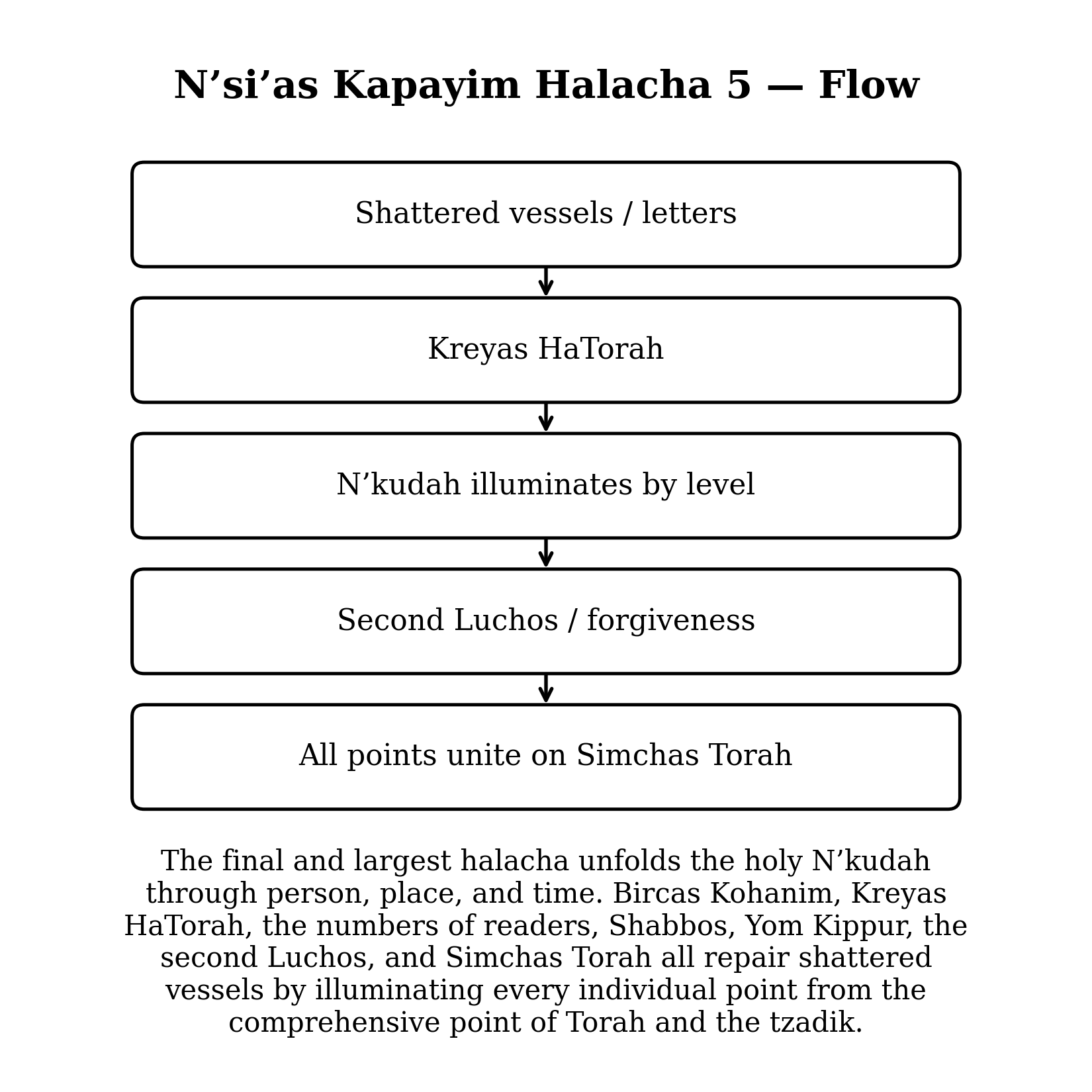
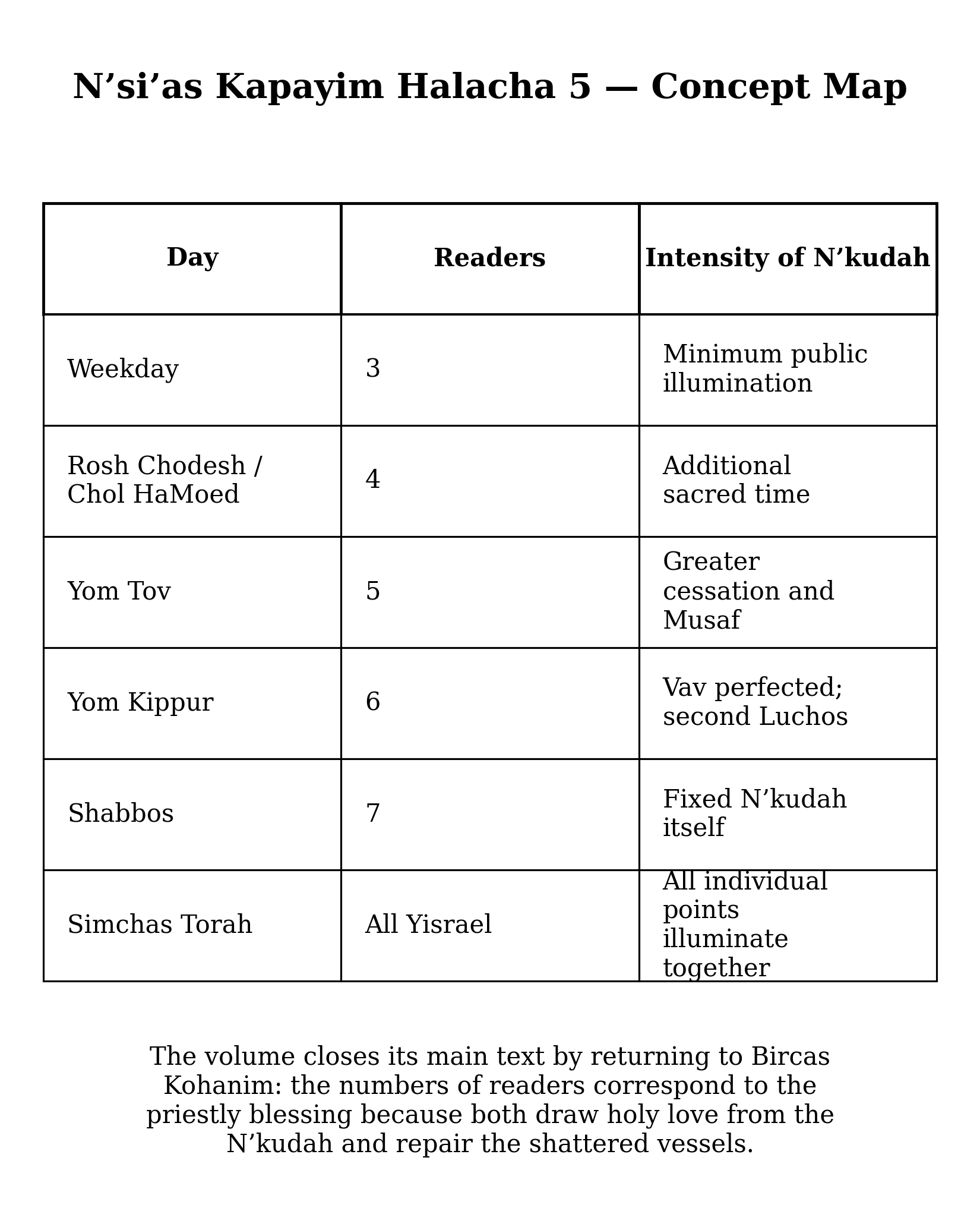
Source edition · Likutay Halachos, Volume 5
נפילת אפים אNifeelas appeye'im — Laws of Falling on One’s Face in Supplication — Halacha 1
הִלְכוֹת נְפִילַת אַפַּיִם וּקְדֻשָּׁה דְּסִידְרָא:
Hilchos Nifeelas appeye'im and the Kidooshuh of the Order:
הֲלָכָה א:
א1
לְאַחַר הַתְּפִלָּה נוֹפְלִין עַל פְּנֵיהֶם שֶׁהוּא בְּחִינַת הַעֲלָאַת מִיַּיִן נוּקְבִין שֶׁנַּעֲשֶׂה עַל-יְדֵי הִשְׁתּוֹקְקוּת וְכִסּוּפִין דִּקְדֻשָּׁה בִּמְסִירַת נֶפֶשׁ שֶׁזֶּה בְּחִינַת נְפִילַת אַפַּיִם כְּמוֹ שֶׁכָּתַב רַבֵּנוּ בְּפֵרוּשׁ בַּמַּאֲמָר הַמַּתְחִיל זִוּוּגָן שֶׁל אוֹתִיּוֹת וְכוּ' ( בְּסִימָן לא לִקּוּטֵי חֵלֶק א) וְעַל-יְדֵי זֶה אָנוּ מְצַיְּרִין הָאוֹתִיּוֹת וְנַעֲשִׂין כְּלִי לְקַבֵּל טוֹב וּבָזֶה אָנוּ גּוֹמְרִין לְתַקֵּן הַהַשְׁפָּעָה שֶׁנִּמְשֶׁכֶת בַּתְּפִלָּה שֶׁתִּהְיֶה שֶׁפַע טוֹבָה וּבְרָכָה עַל-יְדֵי כִּסּוּפִין שֶׁל נְפִילַת אַפַּיִם, כִּי הָעִקָּר תָּלוּי בַּכִּסּוּפִין אִם הֵם דִּקְדֻשָּׁה מְצַיְּרִין הָאוֹתִיּוֹת וְעוֹשִׂין אוֹתוֹ כְּלִי לְקַבֵּל טוֹב כַּמְבֹאָר שָׁם וְעַל-כֵּן אֵין אוֹמְרִים תַּחֲנוּן וְאֵין נוֹפְלִין עַל פְּנֵיהֶם בְּכָל יוֹם שֶׁיֵּשׁ בּוֹ אֵיזֶה תּוֹסֶפֶת קְדֻשָּׁה, כִּי כְּשֶׁיֵּשׁ בּוֹ תּוֹסֶפֶת קְדֻשָּׁה יֵשׁ בְּחִינַת תּוֹסֶפֶת נֶפֶשׁ יְתֵרָה כְּמוֹ בְּשַׁבָּת, רַק שֶׁבְּשַׁבָּת שֶׁקְּדֻשָּׁתוֹ גְּדוֹלָה יֵשׁ בּוֹ נֶפֶשׁ יְתֵרָה מַמָּשׁ וּבִשְׁאָר הַיָּמִים שֶׁיֵּשׁ בָּהֶם קְצָת תּוֹסֶפֶת קְדֻשָּׁה יֵשׁ בָּהֶם בְּחִינוֹת וְנִיצוֹצוֹת נֶפֶשׁ יְתֵרָה וּכְשֶׁיֵּשׁ בְּחִינַת נֶפֶשׁ יְתֵרָה אֵין צָרִיךְ לִפֹּל עַל פְּנֵיהֶם שֶׁעַל-יְדֵי זֶה מְחַדְּשִׁין הַנֶּפֶשׁ, וּבָזֶה מְצַיְּרִין הַשֶּׁפַע, כַּמְבֹאָר שָׁם, כִּי כְּבָר נִתְחַדֵּשׁ נַפְשׁוֹ וְנִתּוֹסֵף קְדֻשָּׁה בְּנַפְשׁוֹ בִּכְנִיסַת הַיּוֹם שֶׁזָּכָה לִבְחִינַת נֶפֶשׁ יְתֵרָה עַל-יְדֵי הַכִּסּוּפִין דִּקְדֻשָּׁה שֶׁהֵם בְּחִינַת כֵּיוָן שֶׁשַּׁבָּת וַי אָבְדָה נֶפֶשׁ שֶׁזֶּה בְּחִינַת כִּסּוּפִין דִּקְדֻשָּׁה שֶׁעַל-יְדֵי זֶה בְּעַצְמוֹ נַעֲשֶׂה הַנֶּפֶשׁ וְעַל-כֵּן אֵין צָרִיךְ עוֹד לִפֹּל עַל פָּנָיו שֶׁהוּא גַּם כֵּן בְּחִינַת כִּסּוּפִין כַּנַּ"ל, עַיֵּן שָׁם בַּמַּאֲמָר הַנַּ"ל הֵיטֵב:
After tefillah we fall on our faces — this is the aspect of raising feminine waters achieved through longing and holy yearnings with self-sacrifice. This is Nifeelas appeye'im, as Rabbainu wrote explicitly in the teaching beginning “The Union of the Letters,” etc. (in section 31 of Likutay, Part 1). Through this we form the letters and become a vessel to receive good. Through this we complete the rectification of the influx drawn during tefillah — that it should be an influx of goodness and blessing — through the yearnings of Nifeelas appeye'im, for the essential depends on the yearnings: if they are of holiness, they form the letters and make one a vessel to receive good, as explained there. Therefore we do not say Tachanoon and do not fall on our faces on any day that has some additional holiness. When there is additional holiness, there is an aspect of an additional extra soul — as on Shabbos. Only on Shabbos, whose holiness is great, there is an actual extra soul. On other days that have some additional holiness, there are aspects and sparks of an extra soul. When there is an aspect of an extra soul, one does not need to fall on one’s face, through which the soul is renewed, and through which the influx is formed — as explained there, for the soul has already been renewed and holiness has already been added to the soul upon the entry of the day, when one merited the aspect of an extra soul through the holy yearnings. These are the aspect of: “Once there is Shabbos — woe! The soul is lost” (Baitzuh 16a; Likutay Moharan I, 31:11). This is the aspect of holy yearnings; by this very means the soul is formed. Therefore one does not need to fall on one’s face further, which is also an aspect of yearnings, as above. See there in the aforementioned teaching carefully.
וְעַל-כֵּן אוֹמְרִים אַחַר כָּךְ קְדֻשָּׁה דְּסִידְרָא כְּדֵי לְהַמְשִׁיךְ קְדֻשָּׁה עַל עַצְמֵנוּ כְּדֵי שֶׁנִּהְיֶה כֵּלִים רְאוּיִים לְקַבֵּל טוֹב וְעַל-כֵּן אוֹמְרִים הַקְּדֻשָּׁה בִּלְשׁוֹן הַקֹּדֶשׁ וּבִלְשׁוֹן תַּרְגּוּם כְּדֵי לְהַשְׁלִים הַלְּשׁוֹן הַקֹּדֶשׁ עַל-יְדֵי לְשׁוֹן תַּרְגּוּם שֶׁזֶּה בְּחִינַת שְׁלֵמוּת לְשׁוֹן הַקֹּדֶשׁ שֶׁעִקַּר הַקְּדֻשָּׁה, עַל-יְדֵי שְׁלֵמוּת לְשׁוֹן הַקֹּדֶשׁ שֶׁעַל יָדוֹ זוֹכִין לִשְׁמִירַת הַבְּרִית שֶׁהוּא עִקַּר הַקְּדֻשָּׁה כִּי כָּל מָקוֹם שֶׁאַתָּה מוֹצֵא גֶּדֶר עֶרְוָה אַתָּה מוֹצֵא קְדֻשָּׁה, כְּמוֹ שֶׁאָמְרוּ רַבּוֹתֵינוּ זִכְרוֹנָם לִבְרָכָה ( וַיִּקְרָא רַבָּה כד) וְעַל-יְדֵי קְדֻשָּׁה זוֹ שֶׁהוּא בְּחִינַת שְׁלֵמוּת לְשׁוֹן הַקֹּדֶשׁ בְּחִינַת שְׁמִירַת הַבְּרִית עַל-יְדֵי זֶה עוֹשִׂין כֵּלִים קְדוֹשִׁים לְהַמְשִׁיךְ הַשֶּׁפַע לְמַטָּה, כִּי עִקַּר תִּקּוּן הַכֵּלִים שֶׁיְּקַבְּלוּ טוֹב הוּא עַל-יְדֵי שְׁמִירַת הַבְּרִית כַּנַּ"ל:
Therefore afterward we say the Kidooshuh of the Order — to draw holiness upon ourselves so we become proper vessels to receive good. Therefore we say the Kidooshuh in the holy tongue and in the language of Targum — to complete the holy tongue through the language of Targum. This is the completeness of the holy tongue, for the essence of holiness is through the completeness of the holy tongue, through which one merits guarding the covenant, which is the essence of holiness. For “Wherever you find a fence against immorality, you find holiness,” as our Sages of blessed memory said (Va'yeekruh Rabbuh 24). Through this holiness, which is the aspect of the completeness of the holy tongue, the aspect of guarding the covenant, through this holy vessels are fashioned to draw the influx below, for the essential rectification of the vessels so they receive good is through guarding the covenant, as above.
וְכֵן שְׁאָר הַפְּסוּקִים שֶׁל 'וּבָא לְצִיּוֹן' כֻּלָּם הֵם הִשְׁתּוֹקְקוּת וְכִסּוּפִין אַחַר הַשֵּׁם יִתְבָּרַךְ הַכֹּל כְּדֵי לְתַקֵּן וּלְצַיֵּר הַכֵּלִים לְטוֹב לְהַמְשִׁיךְ הַשֶּׁפַע טוֹבָה וּבְרָכָה, כִּי אָז הוּא הַמְשָׁכַת הַשֶּׁפַע לְמַטָּה כַּמּוּבָא:
Likewise, the remaining verses of “And Shall Come to Zion” are all expressions of longing and yearnings after G-d, blessed be He — all to rectify and form the vessels for good, to draw an influx of goodness and blessing. For then is the drawing of the influx below, as brought.
וְעַל-כֵּן בְּשַׁבָּת וְיוֹם טוֹב אֵין אוֹמְרִים קְדֻשָּׁה דְּסִידְרָא בְּשַׁחֲרִית כִּי אִם בְּמִנְחָה, כִּי בַּחֹל אֵין נִמְשָׁךְ הַשֶּׁפַע כִּי אִם בִּשְׁעַת הַתְּפִלָּה וְאַחַר כָּךְ נִסְגָּר הַשַּׁעַר, אֲבָל בְּשַׁבָּת וְיוֹם טוֹב כָּל הַיּוֹם קֹדֶשׁ, כִּי הֵם עַצְמָם אוֹת וְנִמְשָׁךְ הַשֶּׁפַע כָּל הַיּוֹם וְעַל-כֵּן אֵין אוֹמְרִים קְדֻשָּׁה דְּסִידְרָא כִּי אִם בִּגְמַר הַיּוֹם שֶׁהוּא תְּפִלַּת מִנְחָה. וְכֵן בְּיוֹם הַכִּפּוּרִים שֶׁיֵּשׁ עוֹד תְּפִלָּה יְתֵרָה אֵין אוֹמְרִים כִּי אִם בַּתְּפִלָּה הָאַחֲרוֹנָה שֶׁהִיא תְּפִלַּת נְעִילָה שֶׁהוּא בִּגְמַר הַיּוֹם, כִּי בִּגְמַר הַיּוֹם אוֹמְרִים הַקְּדֻשָּׁה הַנַּ"ל כְּדֵי לְתַקֵּן וּלְצַיֵּר הַשֶּׁפַע שֶׁנִּמְשְׁכָה כָּל הַיּוֹם שֶׁתִּהְיֶה שֶׁפַע קְדֻשָּׁה טוֹבָה וּבְרָכָה כַּנַּ"ל:
Therefore on Shabbos and Yoam Toav we do not say the Kidooshuh of the Order in Shacharis — only at Mincha. On weekdays, the influx is drawn only during the time of tefillah, and afterward the gate is closed. But on Shabbos and Yoam Toav, the entire day is holy, for they are themselves a sign, and the influx flows all day. Therefore we do not say the Kidooshuh of the Order except at the conclusion of the day, which is the Mincha prayer. Likewise on Yoam HaKipurim, which has yet an additional prayer, we say it only at the final prayer, which is the Neilah prayer, at the day’s conclusion. For at the day’s conclusion we say the aforementioned Kidooshuh — to rectify and form the influx that was drawn all day long, that it should be an influx of holiness, goodness, and blessing, as above.
הִלְכוֹת נְפִילַת אַפַּיִם הֲלָכָה ב נִכְלֶלֶת בְּהִלְכוֹת נְשִׂיאַת כַּפַּיִם הֲלָכָה ב:
Hilchos Nifeelas appeye'im, Halacha 2, is included in Hilchos the Raising of the Hands, Halacha 2:
וְהִלְכוֹת נְפִילַת אַפַּיִם הֲלָכָה ג לֹא מָצָאנוּ בְּאַמְתַּחַת כְּתָבָיו הַקְּדוֹשִׁים וְלֹא נוֹדַע לָנוּ אִם בֵּאֲרָהּ בַּפַּעַם הַשְּׁלִישִׁית גַּם כֵּן אַךְ נֶאֶבְדָה בַּעֲוֹנוֹתֵינוּ הָרַבִּים כְּמוֹ שֶׁכַּמָּה וְכַמָּה הֲלָכוֹת נֶאֶבְדוּ אוֹ לֹא בֵּאֲרָהּ אָז:
And Hilchos Nifeelas appeye'im, Halacha 3, we did not find among his holy writings. It is not known to us whether he expounded it on the third occasion as well, but it was lost, on account of our many sins, as many, many halachos were lost, or whether he did not expound it then:
Summary & study aids — Nifeelas appeye'im — Laws of Falling on One’s Face in Supplication — Halacha 1
Translator's editorial learning aids; separate from the original teaching
Translator's Summary — Nifeelas appeye'im — Laws of Falling on One’s Face in Supplication — Halacha 1
Overview and study aid from the translator; not part of the original text of Likutay Halachos.
Core Message
Reb Noson distinguishes drawing divine influx through prayer from forming it as goodness and blessing. Falling on the face expresses holy yearning with self-sacrifice: it forms the letters, renews the soul, and makes the person a vessel for good. The yearning must be holy, not merely intense. The concluding sanctification continues this preparation through Hebrew and Aramaic; Reb Noson connects the completeness of holy speech with guarding the covenant against sexual immorality. Its other verses also express longing for Hashem. Added holiness and the duration of the influx explain differences in omission and timing.
Main Pillars
• Holy yearning, described as raising feminine waters, forms letters and prepares the recipient; drawing influx alone is not the whole work.
• Added holiness brings prior soul renewal, explaining omitted supplication. Shabbos has an actual additional soul; other such days have aspects and sparks.
• Aramaic completes Hebrew in the sanctification; guarding the covenant is essential to receptive vessels. The surrounding verses likewise express yearning for Hashem.
• Reb Noson explains later sanctification by daylong influx: the afternoon service on Shabbos and festivals, the final service on the Day of Atonement.
Practical Takeaways
• At prayer's conclusion, reflect on whether your longing seeks holiness, rather than measuring its intensity alone.
• Study how the Hebrew and Aramaic sanctification relates to guarding the covenant in conduct.
• Read changed omissions and timing as explanations of renewal and influx, not instructions to alter established prayer practice.
— Translator's summary. Not part of the original text of Likutay Halachos. —
Expanded Study Aid — Nifeelas appeye'im — Laws of Falling on One’s Face in Supplication — Halacha 1
Key Terms and Concept Notes
• Nifeelas appeye'im — Falling on the face: holy yearning with self-sacrifice.
• Letters and vessels — Holy yearning forms letters and makes the person receptive to good.
• Divine influx — The flow drawn through prayer, still requiring formation as goodness and blessing.
• Additional soul — Actual on Shabbos; aspects and sparks on other days of added holiness.
• Concluding sanctification — Hebrew and Aramaic sanctification that draws holiness and prepares receptive vessels.
• Guarding the covenant — Holiness associated here with a fence against sexual immorality.
Series Continuity Note
Based on Likutay Moharan I:31, this unit connects prayer with receptive vessels. The closing notices place Halacha 2 within the laws of raising the hands, Halacha 2. The Hebrew leaves Halacha 3 unlocated: it may have been expounded on the third occasion and lost, or not expounded then. Neither notice supplies an additional teaching.
Diagram 1 — Argument Flow — Prayer and Receptive Vessels
Diagram 2 — Concept Map — Preparing Vessels for Good
— End of translator study aid and diagrams. Not part of the original text of Likutay Halachos. —
Nifeelas appeye'im (Falling on the Face) — Halacha 4
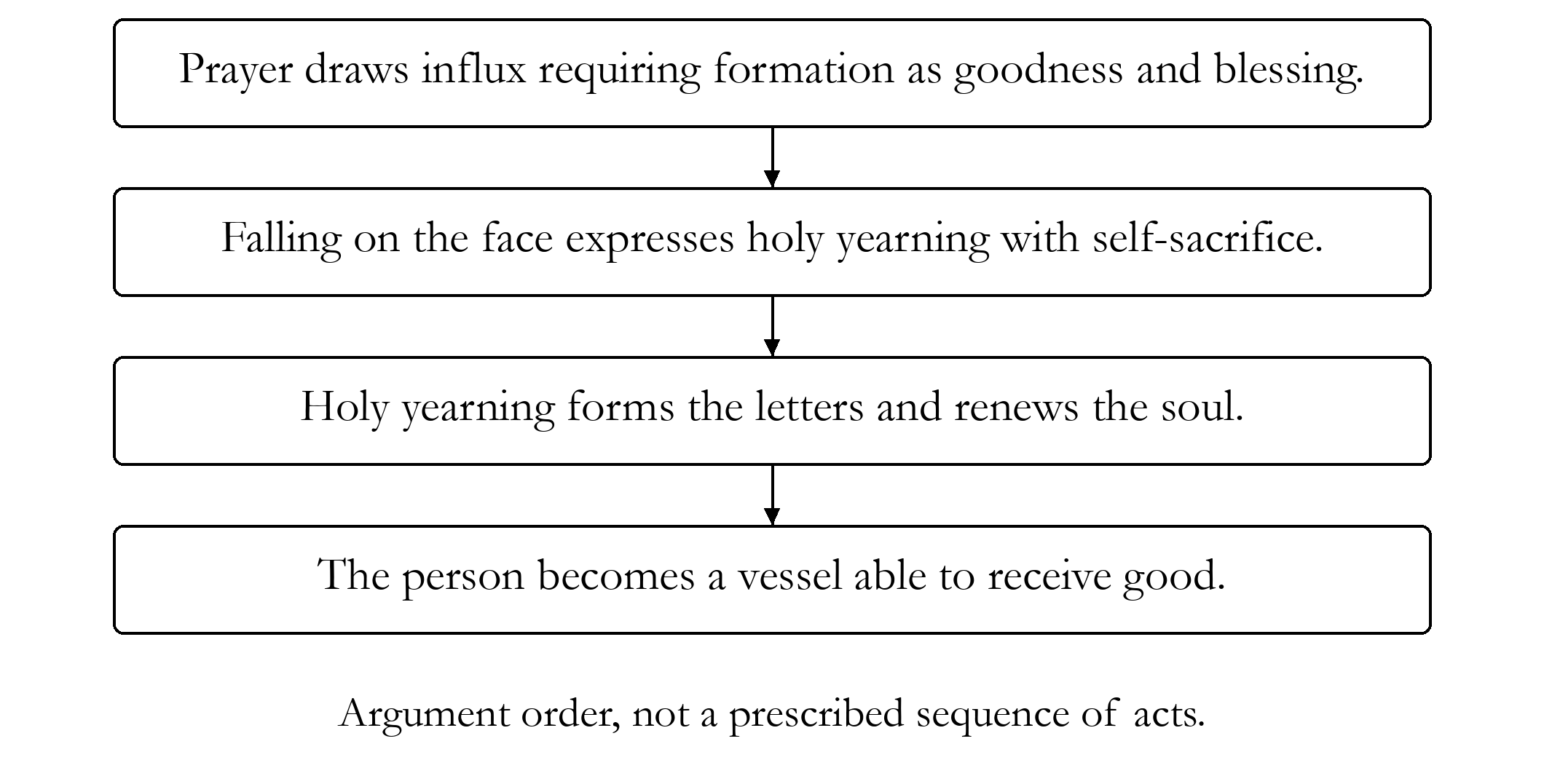
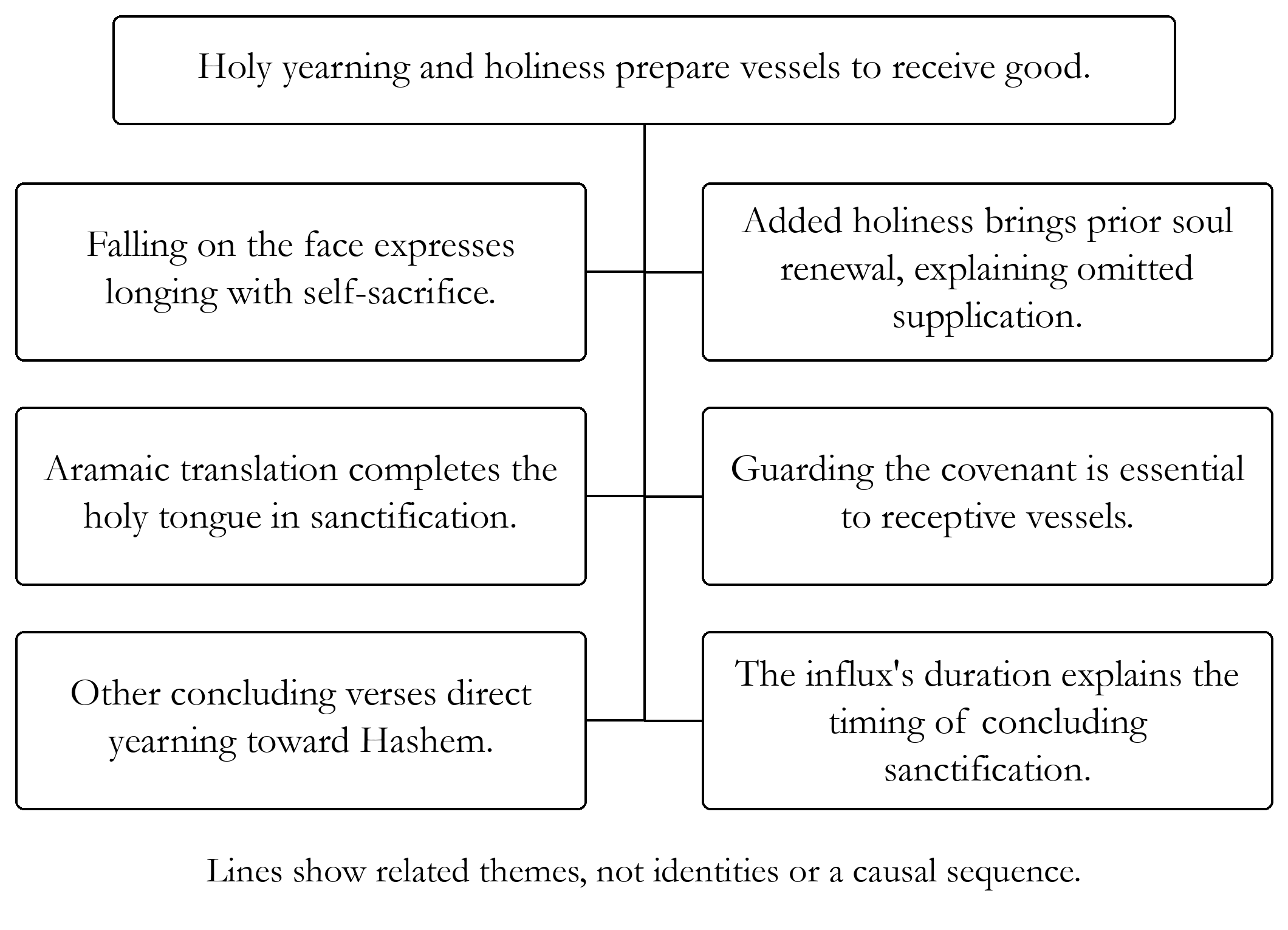
Earlier annotations and link context
Earlier Reader contexts are retained separately. Their links identify current source references; they do not assert that an earlier English selection has the same meaning in the corrected edition.
Earlier paragraph 69
Earlier Reader annotation context; not the corrected source edition
Current source references: [100]
הלכות נפילת אפיםוקדושה דסידרא א'לאחר התפלה נופלין על פניהם שהוא בחינת העלאת מסירות נפש שנעשה על ידי השתוקקות וכיסופין דקדושה במסירת נפש שזה בחינת נפילת אפים כמו שכתב רבינו בפירוש במאמר המתחיל זווגן של ~ אותיות וכו' (בסימן ל"א ליקוטי חלק א'). ועל ידי זה אנו מציירין ה~ אותיות ונעשין כלי לקבל טוב. ובזה אנו גומרין לתקן ההשפעה שנמשכת בתפלה שתהיה שפע טובה וברכה על ידי כיסופין של נפילת אפים. כי העיקר תלוי בכיסופין אם הם דקדושה מציירין ה~ אותיות ועושין ~ אותו כלי לקבל טוב כמבואר שם. ועל כן אין אומרים תחנון ואין נופלין על פניהם בכל יום שיש בו איזה תוספת קדושה. כי כשיש בו תוספת קדושה יש בחינת תוספת נפש יתירה כמו בשבת. רק שבשבת שקדושתו גדולה יש בו נפש יתירה ממש. ובשאר הימים שיש בהם קצת תוספת קדושה יש בהם בחינת וניצוצות נפש יתירה וכשיש בחינת נפש יתירה אין צריך ליפול על פניהם שעל ידי זה מחדשין הנפש, ובזה מציירין השפע כמבואר שם. כי כבר נתחדש נפשו ונתוסף קדושה בנפשו בכניסת היום שזכה לבחינת נפש יתירה על ידי הכיסופין דקדושה שהם בחינת כיון ששבת ווי אבדה נפש שזה בחינת כיסופין דקדושה שעל ידי זה בעצמו נעשה הנפש. ועל כן אין צריך עוד ליפול על פניו שהוא גם כן בחינת כיסופין כנ"ל. עיין שם במאמר הנ"ל היטב:
As we find in several generations — such as Shaul who pursued Dovid for nothing, and likewise the brothers of Yosef who opposed him so strenuously that they permitted his blood — and certainly their intention was for the sake of Heaven, for they thought he was not a man of truth, and that he spoke slander, etc. And so it was in previous generations, and especially in these generations, in ikvesa diMeshicha, where falsehood has overpowered exceedingly — until even among the tzaddikim and kosher people themselves, great machlokes has fallen, and no one knows where the point of truth lies.
Earlier paragraph 70
Earlier Reader annotation context; not the corrected source edition
Current source references: [101]
ועל כן אומרים אחר כך קדושא דסידרא. כדי להמשיך קדושה על עצמינו כדי שנהיה כלים ראויים לקבל טוב. ועל כן אומרים הקדושה בלשון הקדש ובלשון תרגום כדי להשלים הלשון הקדש על ידי לשון תרגום שזה בחינת שלימו לשון הקדש. שעיקר הקדושה על ידי שלימות לשון הקדש שעלי דו זוכין לשמירת הברית שהוא עיקר הקדושה. כי כל מקום שאתה מוצא גדר ערוה אתה מוצא קדושה כמו שאמרו רז"ל (ויקרא רבה כ"ד). ועל ידי קדושה זו שהוא בחינת שלימות לשון הקדש בחינת שמירת הברית על ידי זה עושין כלים קדושים להמשיך השפע למטה. כי עיקר תיקון הכלים שיקבלו טוב הוא על ידי שמירת הברית כנ"ל:
We must plead before Hashem that we merit to find the truth in its truth. This is what one should have in mind when kindling Ner Chanukah: that through the mitzvah of Ner Chanukah we merit to draw the illumination of truth — the aspect of "Sh'lach orcha va'amitecha" — that we merit to draw close to the point of truth always.
Earlier paragraph 71
Earlier Reader annotation context; not the corrected source edition
Current source references: [102]
וכן שאר הפסוקים של ובא לציון כולם הם השתוקקות וכיסופין אחר השם יתברך. הכל כדי לתקן ולצייר הכלים לטוב להמשיך השפע טובה וברכה. כי אז הוא המשכת השפע למטה כמובא:
Earlier pointed Hebrew field
וְכֵן שְׁאָר הַפְּסוּקִים שֶׁל 'וּבָא לְצִיּוֹן' כֻּלָּם הֵם הִשְׁתּוֹקְקוּת וְכִסּוּפִין אַחַר הַשֵּׁם יִתְבָּרַךְ הַכֹּל כְּדֵי לְתַקֵּן וּלְצַיֵּר הַכֵּלִים לְטוֹב לְהַמְשִׁיךְ הַשֶּׁפַע טוֹבָה וּבְרָכָה, כִּי אָז הוּא הַמְשָׁכַת הַשֶּׁפַע לְמַטָּה כַּמּוּבָא:
This is the aspect of why the mother's name specifically is mentioned when praying for a sick person. For all illness of a person is drawn from the aspect of the exchange of the Prince, where the son of the slave overpowers the Prince, chas v'shalom. For all illness is an aspect of death — a withdrawal of the vital forces and life-energy. The essential source of death is drawn from zuhamas hanachash, which is the aspect of zuhamas ha'eved [contamination of the slave] that overpowers the Prince through the sin of Adam HaRishon. For the contamination of the serpent and the contamination of the slave are one and the same aspect — the aspect of the curse pronounced upon the serpent, which is the aspect of "Arur Kena'an eved avadim" — as brought above.
Earlier paragraph 72
Earlier Reader annotation context; not the corrected source edition
Current source references: [103]
ועל כן בשבת ויום טוב אין אומרים קדושה דסידרא בשחרית כי אם במנחה. כי בחול אין נמשך השפע כי אם בשעת התפלה ואחר כך נסגר השער. אבל בבת ויום טוב כל היום קדש כי הם עצמם אותונמשך השפע כל היום. ועל כן אין אומרים קדושה דסידרא כי אם בגמר היום שהוא תפלת מנחה. וכן ביום הכפורים שיש עוד תפלה יתירה אין אומרים כי אם בתפלה האחרונה שהיא תפלת נעילה שהוא בגמר היום. כי בגמר היום אומרים הקדושה הנ"ל כדי לתקן ולצייר השפע שנמשכה כל היום שתהיה שפע קדושה טובה וברכה כנ"ל:
Earlier pointed Hebrew field
וְעַל-כֵּן בְּשַׁבָּת וְיוֹם טוֹב אֵין אוֹמְרִים קְדֻשָּׁה דְּסִידְרָא בְּשַׁחֲרִית כִּי אִם בְּמִנְחָה, כִּי בַּחֹל אֵין נִמְשָׁךְ הַשֶּׁפַע כִּי אִם בִּשְׁעַת הַתְּפִלָּה וְאַחַר כָּךְ נִסְגָּר הַשַּׁעַר, אֲבָל בְּשַׁבָּת וְיוֹם טוֹב כָּל הַיּוֹם קֹדֶשׁ, כִּי הֵם עַצְמָם אוֹת וְנִמְשָׁךְ הַשֶּׁפַע כָּל הַיּוֹם וְעַל-כֵּן אֵין אוֹמְרִים קְדֻשָּׁה דְּסִידְרָא כִּי אִם בִּגְמַר הַיּוֹם שֶׁהוּא תְּפִלַּת מִנְחָה. וְכֵן בְּיוֹם הַכִּפּוּרִים שֶׁיֵּשׁ עוֹד תְּפִלָּה יְתֵרָה אֵין אוֹמְרִים כִּי אִם בַּתְּפִלָּה הָאַחֲרוֹנָה שֶׁהִיא תְּפִלַּת נְעִילָה שֶׁהוּא בִּגְמַר הַיּוֹם, כִּי בִּגְמַר הַיּוֹם אוֹמְרִים הַקְּדֻשָּׁה הַנַּ"ל כְּדֵי לְתַקֵּן וּלְצַיֵּר הַשֶּׁפַע שֶׁנִּמְשְׁכָה כָּל הַיּוֹם שֶׁתִּהְיֶה שֶׁפַע קְדֻשָּׁה טוֹבָה וּבְרָכָה כַּנַּ"ל: הִלְכוֹת נְ
From this contamination — the contamination of the slave, which is the contamination of the serpent — death is drawn, as explained in the Torah: when the serpent injected contamination into Chavah, death was decreed upon the world. For the essential decree of death comes through the aspect of the exchange — where the aspect of the son of the slave seeks to overpower the son of the king. For the body and neshamah are the aspects of the son of the slave and the son of the king. The neshamah is a portion of G-d above — the aspect of the Prince, the aspect of (Shemos 4) "B'ni bechori Yisrael," the aspect of (Shabbos 111a) "All of Yisrael are children of kings," the aspect of (Tehillim 2) "Hashem amar eilai b'ni atah..." — the aspect of a son drawn from the mind of the Father, as is known. As it is written (Yeshayah 46) "Han'su'im mini rechem, ha'amusim mini veten," and as it is written (Bereishis 2) "Vayipach b'apav nishmas chaim," and as it says in the Zohar HaKadosh: "One who blows, blows from within himself" — for they are truly a portion of G-d, which is the aspect of a son.
Earlier paragraph 73
Earlier Reader annotation context; not the corrected source edition
(הלכות נפילת אפים הלכה ב' נכללת בהלכות נשיאת כפים הלכה ב'. והלכות נפילת אפים הלכה ג' לא מצאנו באמתחת כתביו הקדושים. ולא נודע לנו אם ביארה בפעם הג' גם כן אך נאבדה בעוונותינו הרבים כמו שכמה וכמה הלכות נאבדו. או לא ביארה אז:
Earlier pointed Hebrew field
הִלְכוֹת נְפִילַת אַפַּיִם הֲלָכָה ב נִכְלֶלֶת בְּהִלְכוֹת נְשִׂיאַת כַּפַּיִם הֲלָכָה ב: וְהִלְכוֹת נְפִילַת אַפַּיִם הֲלָכָה ג לֹא מָצָאנוּ בְּאַמְתַּחַת כְּתָבָיו הַקְּדוֹשִׁים וְלֹא נוֹדַע לָנוּ אִם בֵּאֲרָהּ בַּפַּעַם הַשְּׁלִישִׁית גַּם כֵּן אַךְ נֶאֶבְדָה בַּעֲוֹנוֹתֵינוּ הָרַבִּים כְּמוֹ שֶׁכַּמָּה וְכַמָּה הֲלָכוֹת נֶאֶבְדוּ אוֹ לֹא בֵּאֲרָהּ
And the body is the aspect of a slave. For the body is the aspect of physical making — asiyah gashmiyis — which is the aspect of a slave, the aspect of work and servitude. Hashem created man in order that he subjugate and subdue the body to the neshamah — the slave to the son. Just as a slave is obligated to serve his master and do his will, so the body is obligated to serve the neshamah, to nullify itself before the neshamah, and to do only the will of the neshamah. Had man not sinned, the aspect of avdus would have been completely nullified. For the essential avdus is drawn from transgressing the words of the Torah, chas v'shalom — in the aspect of (Avos 3) "Whoever casts off the yoke of Torah, upon him is placed the yoke of government and the yoke of worldly occupation" — which are the aspect of avdus. But one who accepts upon himself the yoke of Torah — the yoke of government, etc., is removed from him. For "there is no free person except one who engages in Torah," etc. (Avos 6). The principle: the essential aspect of avdus is from the side of the body, and the essential aspect of cheirus [freedom] and malchus is from the side of the neshamah. Man was created in order to nullify the body before the neshamah, the slave before the son. One must nullify the body to such an extent that it transforms into the nature of the neshamah itself — transforming from body to soul, from slave to son. For even in the service of Hashem there are two aspects. There are those who serve Hashem in the aspect of a slave, and those who are in the aspect of a son, as is brought. That is: a person must serve Hashem with all his strength so that the body does only the will of the neshamah. But as long as the body still has some scent of its bodily desires — only that the person breaks his desire for the sake of the will of the neshamah, which is the will of Hashem — even though this is very good and praiseworthy, nevertheless, his service is still in the aspect of a slave of kedushah. For certainly it is the aspect of a slave, since the service of Hashem is considered labor and toil for him — because the desire of the body does not incline toward it; he merely breaks the will of the body for the sake of the will of the Creator. Therefore he is still in the aspect of a slave. But one who merits to break the body completely, in the ultimate nullification, until the body is transformed into neshamah itself — and he fulfills "V'ahavta es Hashem Elokecha b'chol l'vavcha..." — with both your inclinations: so that even the body loves Hashem and does His will out of love, having no other desire, wanting nothing except the will of the Creator — then he is called a son. For all his service of Hashem is not called by the name of avdus at all — for it is not servitude for him at all! He does the will of Hashem in complete love, by the will of both body and soul, since the body has been transformed into neshamah, as above. Therefore it is certainly not fitting to call him by the name of slave at all, for avdus is only what goes against a person's will. What a person does willingly is not called avdus at all. For example: eating and drinking and other bodily desires are not considered labor and toil for a person, since he does them willingly. Only when he must lift a heavy burden and the like is it called work. Similarly, the service of Hashem: because the body is not accustomed to it, it is called work for him. But when he merits to transform the body into neshamah itself, then all service of Hashem is not called work for him at all — on the contrary, this is his essential vitality and his delight and his pleasure, and he has no other delight and joy in body and soul except when he merits to do the will of his Creator. And in truth, the fact that for most people the matter is the reverse — that eating and drinking and other bodily desires are not considered labor, while mitzvos and good deeds are considered labor and toil — this is itself the aspect of the exchange, where the Prince was exchanged for the son of the maidservant until people thought that the Prince was a slave, chas v'shalom, and the son of the maidservant was a king, chas v'shalom. So too, the truth has been reversed in the world: mitzvos and good deeds — which are the will of Hashem, the will of the neshamah, the aspect of the son of the king — this is considered avdus for them. And the will of the body — bodily desires — is not considered avdus for them, as if the body were king, chas v'shalom, over the neshamah. But in truth it is the exact opposite: the neshamah is the true king, and the body is a slave. And everything that is the will of the neshamah — Torah and mitzvos and good deeds — this is the aspect of kingship, the aspect of (Mishlei 8) "Bi melachim yimlochu" — and this is not called by the name of avdus at all, as above. And what is the will of the body — bodily desires — this is the essential aspect of avdus, the aspect of physical making, where the bodily desires take hold, drawn from the contamination of the slave, which is the contamination of the serpent, as is known. One must nullify the body before the neshamah, break the bodily desires — which are the aspect of avdus — and nullify them completely, until the body is transformed into neshamah itself, until the body does the will of the neshamah, which is the will of the Creator, willingly — and it is no longer considered work for him at all. Then the aspect of avdus is completely nullified, and he merits to be in the aspect of a son. This is the essential perfection, as is known. Had Adam HaRishon not sinned, a person would have merited this level in his lifetime — to transform the body into neshamah itself, so that his service of Hashem would not be in the aspect of a slave at all, but only in the aspect of a son, as above. But due to the sin of Adam HaRishon, through which the zuhamas hanachash — the contamination of the slave — took hold in him, the body became so materialized that great labor and toil are required to break the bodily desires. Then, even when he serves Hashem, his service is still in the aspect of a slave, since it is considered labor for him, because he must force himself to break his body that has not yet been refined to the point of transforming into the essence of the neshamah, as above. Therefore death was decreed — in order to refine and nullify the aspect of avdus. For the essential decree of death is due to the contamination of the serpent, which is the contamination of the slave, as above. That is: now, after the sin of Adam HaRishon, it is impossible to fully attain the aspect of a son — to transform the body into neshamah itself — except after death, when the body decomposes in the earth and rises in the resurrection in a pure and radiant body. Then the body will be in the aspect of neshamah, and the contamination of the slave will be completely nullified. Then one will be in the aspect of a son in body and soul, for the body will be transformed to the aspect of neshamah, and will be incorporated into the Infinite — in body and soul — in ratzo vashov, according to each person's merit. For now, in our present body, it is impossible to fully achieve the aspect of a son and nullify the aspect of avdus. Even exceedingly great tzaddikim who merited to completely refine their body — nevertheless, they must die due to the scheme of the serpent, for the sake of the tikun of the world, to repair the sin of Adam HaRishon and nullify the aspect of avdus from the world. It follows that the essential aspect of death is through the overpowering of the slave over the son — the body over the neshamah — which is the aspect of the sin of Adam HaRishon, through which death was decreed on the world. From there is drawn all illness — which is an aspect of death, a withdrawal of the vitality and powers, as above — drawn from the overpowering of the body over the soul. For the essential source of illness and death is the conflict between the neshamah and the body: when they do not conduct themselves in proper balance, the four elements overpower, chas v'shalom, until the soul cannot dwell with them together, and begins to withdraw from them. All this is drawn from the aspect of the machlokes of the slave against the son — where they were exchanged, etc., as above. For the four elements are the aspect of slaves, as it is written in the Torah "Anochi" (LM I:4, see there §22). For this reason, when praying for a sick person, we mention the mother's name specifically. For the essential vitality of a person — and of all creatures, formed beings, and made things — is through the Name, in the aspect of (Bereishis 2:19) "nefesh chayah — hu shmo" — "a living soul — that is its name." Through the name of everything, the vitality flows into it from the Life of all lives. Even from the Life of all lives, it is impossible to draw the vitality except through His Name, as it were — as explained in the Torah "U'v'yom HaBikurim, HaStarah," etc. (LM I:56): that it is impossible to draw the vitality from the Life of all lives except by calling upon Him by His Name, which is the Torah — see there. For regarding Hashem — "no thought can grasp Him at all" — and we know of Him only through His Name alone, like a great king who is hidden from the people of his land, and they do not see him, but know him only through the name alone. So too, "there is none who knows You at all" — only we know Him through His Name alone. For Hashem, in His compassion, contracted Himself through many contractions until He made for Himself a Name, in the aspect of "Vata'as l'cha sheim k'hayom hazeh" — so that we can know of Him through His Name alone: that there is a Master, Ruler, and Conductor — One, Singular, and Unique, etc. From the aspect of this great and awesome Name, the vitality flows to all creatures in the world — through their name specifically. For everything receives its vitality through its name, from the Name of Hashem Who gives life to all, as above. It is written (Shemos 3) "Zeh Sh'mi l'olam v'zeh zichri l'dor dor," and our Sages expound (Pesachim 50a): "Zeh Sh'mi l'olam" [concealed forever] — for His Name is not read as it is written. It is written with the Name Havayah but read as Adnus. But in the future it will be fulfilled: "Bayom hahu yihyeh Hashem echad u'Shmo echad" — it will be read with Havayah as it is written. But now, we must conceal the essential Sheim Ha'Etzem [the Essential Name], which is the Name Havayah, and it is read only as Adnus. From the secret of these two Names derive and descend the aspects of the father's name and the mother's name. From these two Names are drawn the aspects of neshamah and body — which are the aspects of man and woman. For the essential formation of the body is from the mother, and the essential neshamah is from the father — and their supernal root is the aspect of these two Names. They are the aspects of the sun and the moon, day and night, etc., as is known and understood in the sefarim. Had Adam HaRishon not sinned, and had he merited to transform the body into neshamah — slave into son — he would have merited in his lifetime to perceive the Name Havayah, and would have merited to pronounce it as it is written, as will be in the future. But now, after the sin, where the slave dominates, chas v'shalom — the aspect of the contamination of the serpent that has taken hold in the body — we must conceal the Sheim Ha'Etzem, for it is impossible to receive it in this body. It is impossible to pronounce it and perceive it now except through the Sheim HaKinui [the Name of Appellation], which is the Name Adnus, by which it is pronounced now. For this reason, man must die — so that the body may be refined in the earth, and then rise in the resurrection in a pure body that will be in the aspect of neshamah, and the contamination of the slave will be completely nullified. Then we will be able to pronounce the Sheim Ha'Etzem. Therefore, death is in truth a great good, as it is written (Bereishis Rabbah 9): "'V'hinei tov me'od' — this is death" — so that man will merit through this to perceive Him through the aspect of the Sheim Ha'Etzem, which is now impossible to pronounce, as above. Therefore, before a person's passing, an additional vitality of the neshamah is added to him, and through this he passes away, as it is written (Tehillim 104): "Tosif rucham yigva'un" — "You add their spirit and they expire." For Hashem shows us in this that death is a great good, for then begins the perfection of his tikun — that he must merit in the future to perceive Him with an additional, new perception through the aspect of the Sheim Ha'Etzem. From there is drawn the aspect of tosif rucham before the passing. And through this itself the person passes away, for now in this body, as soon as the additional vitality drawn from the Sheim Ha'Etzem is drawn, one must depart — for it is impossible to receive the vitality drawn from the Sheim Ha'Etzem in this present body, as above. Therefore, when a person is ill — which is the beginning of death, where the neshamah begins to withdraw, drawn from the aspect of tosif rucham yigva'un, so that he will merit in the future to receive the perception of the Sheim Ha'Etzem, etc. — and we wish to pray for him to have his strength restored and continue to live in this world (for he is still needed in this world to refine his body further, since "hayom la'asosam" — "today is for doing" — is written, and therefore we need mercy that a person should extend his years in this world to accumulate sufficient good deeds so that afterward, in the future, he will merit what he will merit, for everything is according to how much one has labored on erev Shabbos in this world) — therefore, when we must pray for the sick person, we mention only the mother's name and conceal the father's name. For the father's name, relative to the mother's name, is in the aspect of the Sheim Ha'Etzem relative to the Sheim HaKinui. And now we must conceal the father's name, in the aspect of "Zeh Sh'mi l'olam" — so that the person not depart, chas v'shalom, through an excess of light, through the aspect of tosif rucham drawn from the Sheim Ha'Etzem, which is the source of the departure, as above. For we wish the light to contract further and for the person to receive the vitality by way of concealment and contraction, gradually and in measure, through the Sheim HaKinui — from which the mother's name derives — so that he can continue to live and not depart through the aspect of tosif rucham, etc. Therefore we mention the mother's name specifically. For as long as a person is healthy and there is peace between the neshamah and the body — which are the aspects of the father's name and the mother's name — the essential one is the father's name, for a son is called by the father's name specifically: "In a place where there is the male, the female is not mentioned" — for the essential vitality is from the father's name specifically. But now, when the person is sick, chas v'shalom — which is the aspect of death, as above, drawn from the aspect of tosif rucham — this aspect of tosif rucham, drawn from the Sheim Ha'Etzem, is drawn and takes hold through the father's name most of all. For the father's name in its supernal root derives and descends from there [the Sheim Ha'Etzem], as above. Therefore now, the father's name should not be mentioned, lest the aspect of tosif rucham be aroused, chas v'shalom — from which comes the departure, chas v'shalom, as above. Therefore now, we must specifically conceal the father's name and mention only the mother's name — so that the vitality will flow to the body and he will continue to live in this world, receiving the vitality from the concealment of the Sheim Ha'Etzem specifically, as above. For in truth, the totality of the names of everything in the world — which is their vitality — is drawn only from the aspect of the Sheim HaKinui, for from the Sheim Ha'Etzem it is now impossible to receive the vitality openly, but only through great concealment. Therefore both the father's name and the mother's name together receive their vitality from the Sheim HaKinui. Only it is known that every aspect is comprised of all the aspects, as explained in the writings of the Arizal many times — that every name, every aspect, every sefirah, etc., is comprised of all the names and all the aspects. Therefore even the Sheim HaKinui itself is comprised of both the aspect of Sheim Ha'Etzem and Sheim HaKinui. Therefore, the father's name and the mother's name — which both derive from the aspect of Sheim HaKinui — are in the aspect of Sheim Ha'Etzem and Sheim HaKinui. For the father's name relative to the mother's name is in the aspect of the Sheim Ha'Etzem relative to the Sheim HaKinui. Normally the essential one is the father's name, which is the essential vitality, etc., as above. But at the time of illness, when the aspect of tosif rucham of the future is aroused — and this aspect is drawn most of all through the father's name, which constantly receives the vitality from the Sheim Ha'Etzem by way of great concealment and hiddenness, and now an aspect of revelation is being drawn upon it — the aspect of tosif rucham of the future, where the essential vitality will come from there, but in this world one must depart through it because it is impossible to receive this light openly in this world, as above — therefore, when we wish to pray for the sick person, we must conceal the father's name completely. For we wish him to continue living in this world, and therefore we must conceal the father's name, whose root is from the Sheim Ha'Etzem from which comes the aspect of tosif rucham — through which he would depart, chas v'shalom. We mention only the mother's name, whose root is from the Sheim HaKinui — to draw upon him vitality gradually and in measure, without additional spirit, so that he may live and extend his days and years further in this world to repair what still needs to be repaired. Amein v'amein. This is the aspect of what we find in all of Sefer Melachim: for all the kings of Beis Dovid, the mother's name of the king is always mentioned. For kingship is the aspect of the Name, as it is written (Shmuel II 8) "Vaya'as Dovid sheim" — "And Dovid made a name." For the essential kingship of Beis Dovid — from which Mashiach will come — is to reveal the Name of the glory of His kingship. For the kingship of Dovid Mashiach is the kingship of kedushah, which is His kingship, which is the aspect of His Name. For kingship is the aspect of the Name, as above. Therefore, for all these kings, the mother's name specifically is mentioned — for the essential revelation of the Name of the glory of His kingship in this world now is through the aspect of the Sheim HaKinui specifically, which is the aspect of the mother's name, as above. This is the aspect of Parshas HaTamid and the other korbanos that are recited in the morning. For all the korbanos are for the purpose of refining the spirit of man from the spirit of the animal, in the aspect of (Koheles 3) "Mi yodei'a ruach bnei ha'adam ha'olah hi l'ma'alah, v'ruach habeheimah hayoredes..." — "Who knows the spirit of man that ascends upward, and the spirit of the animal that descends..." This is the secret of what is written in the Ma'aseh: the Prince who was exchanged — his punishment and his tikun — was through pursuing the animals that the merchant had given him to drive and to graze. Two animals strayed from him, and he went to seek them until he chased after them deep into the thick of the forest, etc. — until he was compelled to stay there overnight, etc. — until a certain man came to him and said: "Desist from pursuing the sins! For these are not animals at all — rather, your sins are leading you thus," etc. See there. This is the secret of all the korbanos. For all of a person's sins are the aspect of beheimos [animals] — the aspect of the animal spirit, from which come all the desires — the animal desires — as it is written in Sotah (Sotah 15a): "She acted in the manner of an animal," etc. Therefore one must bring an animal as a korban to atone, for through the sin — where one was bound to the behavior of an animal, to the animal spirit and animal desires — the spirit of man became intermixed with the spirit of the animal. This is the essential aspect of the mixing of good and evil, the aspect of the blemish of the sin of the Eitz HaDa'as Tov vaRa, which encompasses all the sins in the world. Therefore one must bring an animal as a korban, and through the korban, the spirit of man is refined from the spirit of the animal — this is the secret of all the korbanos, as is known. Therefore it was said to the Prince who was exchanged that his pursuing the animals was his sins, as above — for his sins were clothed in the animals and caused him such suffering. For the sins are the aspect of the animal spirit, as above. For in truth, the exchange of the Prince for the son of the slave is itself the aspect of the intermingling of the spirit of man with the spirit of the animal. For the animal spirit is the aspect of the bodily desires, which is the aspect of the slave, as above — which is the aspect of an animal. As our Sages said: slaves are compared to animals, as they expounded on the verse (Bereishis 22) "Sh'vu lachem poh im hachamor" — "Stay here with the donkey" — a nation that resembles a donkey (Kiddushin 68a). Through sins, chas v'shalom, one causes the spirit of man to be intermixed and exchanged with the spirit of the animal — the aspect of the Prince with the son of the slave — which is the aspect of Heichalei HaTemuros that are empowered, chas v'shalom, through one's sins, as is known. Therefore the punishment of the Prince who was exchanged — who had followed his desires — was to seek and pursue the animals, as above. This is the secret of all the korbanos: they are to refine from the exchange of Heichalei HaTemuros — to refine the spirit of man from the spirit of the animal, which is the aspect of refining the Prince from the son of the slave, as above. And perhaps this is the aspect of the two lambs brought every day for the Temidim [daily offerings] — corresponding to the two animals of the Prince that strayed from him and which he was compelled to pursue, as written there in the Ma'aseh. Corresponding to those two animals, we must bring two animals every day for the Temidim in order to refine and repair this. This is the aspect of the Mishnah of "Aizehu Mekoman" [which is recited every day]: through clarifying the places of the korbanos, we refine and reveal the spirit of man that has fallen and become intermixed with the animal spirit — for which the Prince was compelled to seek them. For each person, according to how much he has intermixed — through his sins — the spirit of man with the spirit of the animal: if he does not merit to repair this in his lifetime, he must receive his punishment and be a wanderer in kaf hakela [the catapult of the sling], seeking the sparks and the spirit of man that he lost and cast into the spirit of the animal — which is the aspect of the pursuit of the animals, as above — until he receives his punishment in full, and then he will be repaired, for the punishment is the tikun, as is known. For this reason we say Parshas HaKorbanos every day — for this refinement, as above. And this is the aspect of the Mishnah of "Aizehu mekoman shel zevachim" — clarifying the places of all the offerings, the korbanos through which the spirit of man is refined from the spirit of the animal. By clarifying all their places, and by mentioning the korbanos and the places of the offerings, it is considered as if one actually offered those korbanos in those places. Through this, one merits to refine all the aspects of the spirit of man from the spirit of the animal, from all the places where they fell — for if one does not merit to repair through korbanos and teshuvah, then one must seek many places, which is the aspect of the punishment of the Prince, as above — but through the recitation of the korbanos said as teshuvah and atonement, by reciting the Parshas HaKorbanos and clarifying and saying Aizehu mekoman shel zevachim, one refines all the places where the spirit of man and the spirit of the animal fell and were intermixed, and repairs and elevates them from there, as above. This is the aspect of Pesukay D'Zimrah that are recited after Parshas HaKorbanos. This is the secret of the aspect of the man of the forest in the Ma'aseh, who took the Prince and brought him to his house. There, the Prince heard the voice of the wondrous niggun — of all the wild animals and domestic animals and birds, etc. — who made a wondrous niggun in honor of the moon, etc. Afterward, this man gave him the wondrous vessel [k'li]: when it is placed upon any species of wild or domestic animal in the world, that animal immediately begins to play this wondrous niggun, etc. See there. All this is the aspect of Pesukay D'Zimrah recited after Parshas HaKorbanos — the aspect of "Kohanim ba'avodasam u'Levi'im l'shiram ul'zimram" — "the Kohanim in their service, and the Levi'im in their song and their melody." For through the korbanos, the spirit of man is refined from the spirit of the animal. Afterward, one must recite songs, praises, and Pesukay D'Zimrah — for the essential completion of the refinement of the spirit of man from the spirit of the animal is through niggun and song, as explained in the words of the Rebbe in several places. See the Torah on the verse "K'chu mizimras ha'aretz bikhleichem..." (LM II:63). Therefore, the essential tikun of the Prince — after he received his punishment through the animals — when it came time to repair him, he merited to hear the voice of the niggun, as above. He was also given the vessel that arouses niggun from all wild and domestic animals when placed upon them. For this vessel has the power that as soon as it is placed on any animal, immediately the spirit of man concealed and intermixed within it begins to be refined and aroused — and through this, the wondrous niggun is made. For the essential source of all niggunim is through the refinement of the spirit of man from the spirit of the animal — this is the aspect of the songs and niggunim of the Levi'im at the time of the korbanos, as above. This is the aspect of Pesukay D'Zimrah after Parshas HaKorbanos, for the essential completion of the refinement is through the niggun — the aspect of Pesukay D'Zimrah, as above. Afterward — after receiving the vessel of niggun, corresponding to which we say Pesukay D'Zimrah — the Prince became able to understand one thing from another, as explained in the Ma'aseh; see there. This is the aspect of Krias Shma recited afterward, where one receives the hisbonenus [contemplation] of the Mochin, as is known in the kavanos — that the essential reception of the Mochin is during Krias Shma. This is the aspect of his meriting afterward to understand one thing from another — the aspect of the Mochin received during Krias Shma, as above. Afterward, the true Prince received the kingship, as written there. This is the aspect of Tefilas Shmoneh Esrei, where the essential building of the Malchus takes place, as is known. For the essential aspect of Malchus is merited through tefillah, which is the aspect of Malchus, as is known. For through tefillah, one rules over all the worlds and directs all the worlds as one wishes, in the aspect of "Tzaddik mosheil yiras Elokim." As our Sages said (Mo'ed Katan 16b): "HaKadosh Baruch Hu decrees a decree and the tzaddik annuls it" — all through tefillah. Through this is the essential kingship and dominion of the true tzaddik — who is the aspect of the true Prince. This is the aspect of why all the Avos were shepherds of animals — all in order to refine the exchange, which is the aspect of the intermingling and exchange of the spirit of man with the spirit of the animal, etc., as above. This is the aspect of Dovid HaMelech, who was a shepherd, and it is written of him (Tehillim 78) "Me'achar alos hevi'o lir'os b'Yaakov imo..." — "From behind the nursing ewes He brought him, to shepherd Yaakov His people." For Dovid was engaged in this more than anyone — to refine the spirit of man from the spirit of the animal, to refine the aspect of the Prince from the son of the maidservant, etc. Therefore Dovid merited the kingship, as above. He shepherded animals with great holiness, and through this he merited to refine the spirit of man from the spirit of the animal — which is the aspect of refining the Prince from the son of the maidservant — and therefore through this specifically he merited the kingship, in the aspect of "me'achar alos hevi'o lir'os b'Yaakov imo..." This is the aspect of Yaakov who was a shepherd of animals in order to refine the neshamah of his match, as it is written (Hosheia 12) "V'avad Yisrael b'ishah..." — as it is written (Bereishis 29) "Va'a'avdecha sheva shanim b'Rachel bitcha hak'tanah" — "I will serve you seven years for Rachel your younger daughter." For the essential hold of avdus — the contamination of the serpent — takes hold most of all in the woman. For the serpent injected its contamination into Chavah specifically, as is known. Therefore we bless in the morning "shelo asani ishah" — for the contamination of avdus is closer to the woman most of all, and more refinement is needed there. Therefore it was decreed upon the woman: "v'hu yimshal bach" — "and he shall rule over you" — which is the aspect of avdus: she must do for her husband all the tasks that a slave does for his master. Therefore Yaakov — since he needed to establish the twelve tribes of Y-K, a complete household — was compelled to cast himself into avdus and be a shepherd of animals for Lavan. For judgment is only sweetened at its root. Therefore he said: "E'evadcha sheva shanim b'Rachel bitcha hak'tanah" — for through his avdus in great holiness, he would merit to refine the good from the evil, subdue the contamination of avdus, and refine the spirit of man from the spirit of the animal through being a shepherd for him. All this in order to refine from Lavan HaArami the neshamah of his match — the neshamah of Rachel — to establish the tribes of Y-K. Since Yaakov knew that Lavan was a great deceiver, deeply embedded in the aspect of Heichalei HaTemuros — from which comes the essential deception of all deceivers, who are suspect of making exchanges — therefore Yaakov doubled his condition and said "E'evadcha sheva shanim b'Rachel bitcha hak'tanah," as Rashi explains there: that he specified meticulously so that Lavan would not exchange Leah for Rachel. All this Yaakov feared because he knew that the sin of Adam HaRishon had not yet been repaired — from which comes the hold of Heichalei HaTemuros, which causes the neshamos of the Avos and Imahos to be intermixed among such wicked people as Lavan, etc., as above. He knew that Lavan was the greatest deceiver, deeply embedded in Heichalei HaTemuros — therefore most suspect of making the exchange. Therefore he doubled his condition with him even more, as above, and as Rashi explains there. Yet in the end, it did not help — for Lavan deceived him and exchanged Leah for Rachel. This exchange caused the machlokes among the tribes and the division of the kingship of Beis Dovid and the sale of Yosef. For had he married Rachel first, Yosef would have been born first and would have been the actual firstborn — his brothers would not have been so jealous of him, for all would have recognized his greatness and his truth. But because of the exchange, his brothers erred about him and thought he was not a man of truth, and they were jealous of him because their father favored and drew him close — and the machlokes was so great that they sold him as a slave. Through this, matters were set in motion and our forefathers went down to Mitzrayim, etc. From this descended the division of the kingship of Beis Dovid, as is known — through which the Beis HaMikdash was destroyed and we were exiled from our land, etc. As is brought in the sefarim, what Lavan HaArami caused through this exchange. The principle: all the sufferings of Yisrael are drawn from the aspect of the exchange of Heichalei HaTemuros — the aspect of the exchange of the Prince — the aspect of all the exchanges and changes in every generation until Mashiach Tzidkeinu comes speedily in our days and refines everything, and each one will come to his place in peace. Amein. Let us return to the matter of Chanukah. For all of this is the aspect of Chanukah. The mitzvah of Chanukah — to draw the light of truth into the world — is all in order to magnify and glorify His Name. For the entire creation from beginning to end was all for the sake of His Name, which is His glory, as it is written (Yeshayah 42) "Ani Hashem hu Shmi u'khvodi..." And it is written: "U'varuch Sheim Kvodo..." And so extensively. And for this He created the entire world: to reveal His Name and His glory. As our Sages said: "Everything that HaKadosh Baruch Hu created, He created only for His glory, as it says: 'Kol hanikra biShmi v'liKhvodi berasiv yetzartiv af asisiv' — 'All that is called by My Name and for My glory, I created it, I formed it, I also made it.'" And the glory is the Name, as above — and as is explicit in this very verse that our Sages brought: "Kol hanikra biShmi v'liKhvodi," etc. For Hashem created everything "b'gin d'yishtamud'in lei" — "so that they would know Him" — as it is written in the Zohar HaKadosh. That is: to know and recognize His Name, for regarding Him Himself, as it were — "no thought can grasp Him at all" — and it is impossible to know of Him except through His Name, as it were. He contracted Himself through many contractions and created the entire creation from beginning to end, and graced us with knowledge and intellect, so that we have the capacity to know and to believe in His Name — to know and to make known and to be made known that there is a Master and Ruler, root and source of all the worlds, Singular, Primordial, He Who conducts and rules — He is the Former, He is the Creator, etc. All this is the aspect of His Name — that we know Him through His Name alone. And in truth, Hashem is one and His Name is one. For His Name is His unity. As it is written: "Ani Hashem hu Shmi..." For even regarding a lower being — a human being — and regarding everything in the world, the name of everything is not something separate from the thing; rather, the name is bound with everything in complete unity all the days of its existence. How much more so, infinitely more, above: His great Name is His unity — the aspect of "Hashem echad u'Shmo echad," the aspect of "Ani Hashem hu Shmi," the aspect of "Ki kh'Shimcha kein T'hilasecha." Only the distinction is on the side of the receivers. For example, in the physical realm, when we call a thing or a person by its name — even though we have not seen it — such as when we speak of a certain king or emperor that we do not see, but only hear his name: this name of the king is the king himself. Yet even so, there is a distinction for us between seeing the king himself and knowing him by his name, even though in truth, in his own place and essence, all is one — for the name is the form of the thing. Only that with created beings, the unity is not in essence, for they are composites, and therefore they can change from name to name according to their state. For example: a piece of silver — when made into a bowl, it is called "a silver bowl"; and at that time the name and the bowl itself are in complete unity, from the side of their composition. But when the bowl is changed into silver spoons, the name changes. So with everything in the world — in all the mineral, vegetable, animal, and human kingdoms — there the unity exists, but it is not essential unity, only from the side of their composition, and therefore there are many changes in them — in the aspect of changing of the name. But to differentiate by a thousand times a thousand and a myriad times a myriad distinctions — above, regarding Him — it is written: "Hashem Shimcha l'olam" — for His Name is His essential unity forever and ever, may His Name be blessed forever. Only for us, in this murky body, there is a distinction in our perception: we can grasp in our minds only His Name alone — that we know and believe that there is a Master, Conductor, and Ruler. But the essence of His G-dliness — no thought can grasp Him at all, as above. Yet in truth, all is one, for Hashem is one and His Name is one, as above. The principle: the essential purpose of creation is to reveal His Name in the world. And all the forms of service in the world through which we serve Him — all are in order to reveal His Name in the world, in the aspect of "B'chol makom muktar u'mugash liShmi" — "liShmi" specifically — that is, to reveal His Name in the world. And all the tefillos and all the berachos and thanksgivings — all are to bless and sanctify and publicize the Name of His glory in the world, in the aspect of "Yehi Sheim Hashem mevorach mei'atah v'ad olam." And it is written: "U'varuch Sheim Kvodo l'olam"; "Vivarechu Sheim Kvodecha"; "Hodu lo barechu Shmo"; "L'hodos l'Sheim kadshecha," etc. — and many like these are explained in all the verses: that the essential service, blessing, and thanksgiving is to magnify and publicize His Name in the world.
Earlier paragraph 3
Earlier Reader text retained for its original links and annotations; related source references do not assert translation or personal-highlight equivalence.
Current source references: [594] [595] [596]
הלכה ה אות א על פי התורה ואתם תהיו לי ממלכת כהנים וכו' (בסימן ל"ד ליקוטי חלק א') עיין שם כל התורה. מבואר שם ענין התפלה שהוא לקשר הנקודה שהוא בחינת צדיק מושל אל הלב שזהו ענין מה שצריכין לדבר בינו לבין קונו לפרש שיחתו לפניו יתברך לעורר לבו לעבודתו יתברך. וכן צריכין לדבר עם חבירו ביראת שמים וכו'. וכן צריכין לדבר עם הצדיק בעצמו. הכל כדי לקבל אור הנקודה הקדושה שהוא בחינת צדיק מושל לקשרו אל הלב להאיר בחינת פי ידבר חכמות לתוך בחינת והגות לבי תבונות כדי לבטל חרפת לב ערלת לב שהם כל האהבות רעות אהבת הנפולין. כי שם אצל הנקודה שורה אהבה הקדושה. כי אור החסד שנשאר שם עיין שם ועל ידי האהבה הקדושה נתבטלין כל החרפות לב. כי על כל הפשעים תכסה אהבה וכו' עיין שם כל זה היטב. ומבואר שם בתחלתו שזהו ענין התפלה עיין שם ב~ אות ג' מה שכתוב שם מענין התפלה שהוא כדי להמשיך השפע על ידי כלי הדיבור כמו שכתוב (דברים א') ויברך אתכם כאשר דבר לכם וכו'. והדיבורים של הצדיק הם בודיאי בשלימות ובמלואה לכן יכול להמשיך השפע לישראל.ועל ידי זה נקרא בחינת מלאפום להורות שהפה שלו במלואה ובשלימות. וכל אחד ואחד מישראל יש בו בחינת צדיק מושל שהוא בחינת מלאפום וכו'. ומלאפום הוא בחינת נקודה עם ואו וכו'. ובחינת מלאפום יש בכלליות ובפרטיות. כי עשרת הדברות עם הלוחות וכו' עיין שם כל זה היטב. נמצא שעיקר התפלה הוא מחמת שבכל אחד מישראל יש נקודה טובה שהוא בחינת צדיק מושל בחינת (ישעיה ס') ועמך כולם צדיקים. וכפי הנקודה טובה שלו כן יכול להמשיך שפע על ידי הדיבור דייקא בחינת הרחב פיך ואמלאהו. ועיקר הממשלה בחינת צדיק משול הוא להאיר ולהתעורר הלב להשם יתברך וכו' כמו שתכוב שם. וזה נעשה על ידי הדיבור של התפלה והתבודדות שהוא שיחה בינו לבין קונו שעל ידי זה מאיר הנקודה בחינת פי ידבר חכמות לתוך הלב לבחינת והגות לבי תבונות. שעל ידי זה נתבטלין כל החרפות לב שהם כל התאוות שהם אהבות הנפולין. כי שם אצל הנקודה טובה שורה אור האהבה הקדושה וכו' עיין שם כל זה היטב:
Earlier pointed Hebrew field
עַל-פִּי הַתּוֹרָה 'וְאַתֶּם תִּהְיוּ לִי מַמְלֶכֶת כֹּהֲנִים' וְכוּ' בְּסִימָן לד לִקּוּטֵי חֵלֶק א עַיֵּן שָׁם כָּל הַתּוֹרָה: מְבֹאָר שָׁם עִנְיַן הַתְּפִלָּה שֶׁהוּא לְקַשֵּׁר הַנְּקֻדָּה שֶׁהִוא בְּחִינַת צַדִּיק מוֹשֵׁל אֶל הַלֵּב שֶׁזֶּהוּ עִנְיַן מַה שֶּׁצְּרִיכִין לְדַבֵּר בֵּינוֹ לְבֵין קוֹנוֹ לְפָרֵשׁ שִׂיחָתוֹ לְפָנָיו יִתְבָּרַךְ לְעוֹרֵר לִבּוֹ לַעֲבוֹדָתוֹ יִתְבָּרַךְ. וְכֵן צְרִיכִין לְדַבֵּר עִם חֲבֵרוֹ בְּיִרְאַת שָׁמַיִם וְכוּ' וְכֵן צְרִיכִין לְדַבֵּר עִם הַצַּדִּיק בְּעַצְמוֹ הַכֹּל כְּדֵי לְקַבֵּל אוֹר הַנְּקֻדָּה הַקְּדֻשָּׁה שֶׁהוּא בְּחִינַת 'צַדִּיק מוֹשֵׁל' לְקַשְּׁרוֹ אֶל הַלֵּב לְהָאִיר בְּחִינַת 'פִּי יְדַבֵּר חָכְמוֹת' לְתוֹךְ בְּחִינַת וְהָגוּת לִבִּי תְבוּנוֹת כְּדֵי לְבַטֵּל חֶרְפַּת לֵב עָרְלַת לֵב שֶׁהֵם כָּל הָאַהֲבוֹת רָעוֹת אַהֲבַת הַנְּפוּלִין, כִּי שָׁם אֵצֶל הַנְּקֻדָּה שׁוֹרָה אַהֲבָה הַקְּדוֹשָׁה, כִּי אוֹר הַחֶסֶד שֶׁנִּשְׁאָר שָׁם, עַיֵּן שָׁם וְעַל-יְדֵי הָאַהֲבָה הַקְּדֻשָּׁה נִתְבַּטְּלִין כָּל הַחֶרְפוֹת לֵב, כִּי עַל כָּל הַפְּשָׁעִים תְּכַסֶּה אַהֲבָה וְכוּ', עַיֵּן שָׁם כָּל זֶה הֵיטֵב וּמְבֹאָר שָׁם בִּתְחִלָּתוֹ שֶׁזֶּהוּ עִנְיַן הַתְּפִלָּה, עַיֵּן שָׁם בְּאוֹת ג מַה שֶּׁכָּתוּב שָׁם מֵעִנְיַן הַתְּפִלָּה שֶׁהוּא כְּדֵי לְהַמְשִׁיךְ הַשֶּׁפַע עַל-יְדֵי כְּלִי הַדִּבּוּר, כְּמוֹ שֶׁכָּתוּב ( דְּבָרִים א), וִיבָרֵךְ אֶתְכֶם כַּאֲשֶׁר דִּבֵּר לָכֶם וְכוּ' וְהַדִּבּוּרִים שֶׁל הַצַדִּיק הֵם בְּוַדַּאי בִּשְׁלֵמוּת וּבִמְלֹאָהּ לָכֵן יָכוֹל לְהַמְשִׁיךְ הַשֶּׁפַע לְיִשְׂרָאֵל וְעַל-יְדֵי זֶה נִקְרָא בְּחִינַת מְלָאפוּם לְהוֹרוֹת שֶׁהַפֶּה שֶׁלּוֹ בִּמְלֹאָהּ וּבִשְׁלֵמוּת וְכָל אֶחָד וְאֶחָד מִיִּשְׂרָאֵל יֵשׁ בּוֹ בְּחִינַת צַדִּיק מוֹשֵׁל שֶׁהוּא בְּחִינַת מְלָאפוּם וְכוּ' וּמְלָאפוּם הוּא בְּחִינַת נְקֻדָּה עִם וָאו וְכוּ' וּבְחִינַת מְלָאפוּם יֵשׁ בִּכְלָלִיּוּת וּבִפְרָטִיּוּת, כִּי עֲשֶׂרֶת הַדִּבְּרוֹת עִם הַלּוּחוֹת וְכוּ', עַיֵּן שָׁם כָּל זֶה הֵיטֵב נִמְצָא שֶׁעִקַּר הַתְּפִלָּה הִוא מֵחֲמַת שֶׁבְּכָל אֶחָד מִיִּשְׂרָאֵל יֵשׁ נְקֻדָּה טוֹבָה שֶׁהוּא בְּחִינַת צַדִּיק מוֹשֵׁל, בְּחִינַת ( יְשַׁעְיָה ס) וְעַמֵּךְ כֻּלָּם צַדִּיקִים וּכְפִי הַנְּקֻדָּה טוֹבָה שֶׁלּוֹ כֵּן יָכוֹל לְהַמְשִׁיךְ שֶׁפַע עַל -יְדֵי הַדִּבּוּר דַּיְקָא בְּחִינַת הַרְחֶב פִּיךָ וַאֲמַלְּאֵהוּ וְעִקַּר הַמֶּמְשָׁלָה בְּחִינַת צַדִּיק מוֹשֵׁל הוּא לְהָאִיר וּלְהִתְעוֹרֵר הַלֵּב לְהַשֵּׁם יִתְבָּרַךְ וְכוּ', כְּמוֹ שֶׁמְּבֹאָר שָׁם וְזֶה נַעֲשֶׂה עַל-יְדֵי הַדִּבּוּר שֶׁל הַתְּפִלָּה וְהִתְבּוֹדְדוּת שֶׁהוּא שִׂיחָה בֵּינוֹ לְבֵין קוֹנוֹ שֶׁעַל-יְדֵי זֶה מֵאִיר הַנְּקֻדָּה בְּחִינַת פִּי יְדַבֵּר חָכְמוֹת לְתוֹךְ הַלֵּב לִבְחִינַת וְהָגוּת לִבִּי תְבוּנוֹת שֶׁעַל-יְדֵי זֶה נִתְבַּטְּלִין כָּל הַחֶרְפוֹת לֵב שֶׁהֵם כָּל הַתַּאֲווֹת שֶׁהֵם אַהֲבוֹת הַנְּפוּלִין, כִּי שָׁם אֵצֶל הַנְּקֻדָּה טוֹבָה שׁוֹרָה אוֹר הָאַהֲבָה הַקְּדוֹשָׁה וְכוּ', עַיֵּן שָׁם כָּל זֶה הֵיטֵב: ~ אות ב וְזֶה בְּחִינַת בִּרְכַּת כֹּהֲנִים בְּסוֹף הַתְּפִלָּה אֵצֶל
The Sukkah is a diras arai — for this vitality is in the aspect of arai. During Sukkos we finish the Torah and immediately begin it again on Sh'mini Atzeres — not wanting to pause at all between completion and beginning, to show that one must always engage in Torah ("V'hagisa bo yomam valailah"). But if so, from where will those distant from Torah receive vitality — all the more so the nations? And it is impossible never to pause at all. Therefore Hashem had mercy and gave us the holy mitzvah of Sukkah → drawing the Chesed Chinam → sustaining vitality during pshitus → sustaining all distant from Torah, even the nations = the 70 bulls offered for the 70 nations.
Earlier paragraph 5
Earlier Reader text retained for its original links and annotations; related source references do not assert translation or personal-highlight equivalence.
Current source references: [597] [598] [599] [600] [601]
אות ב וזה בחינת ברכת כהנים בסוף התפלה אצל שים שלום. כי הנקודה טובה הנ"ל הוא בחינת ברית שלום כמו שכתוב שם. ושם שורה אהבה הקדושה שהוא בחיתנ כהן בחינת אברהם בחינת אתה כהן לעולם כמו שכתוב ששם בהתורה הנ"ל עיין שם. ובשביל זה עיקר התפלה להאיר ולקשר הנקודה הזאת אל הלב כדי לבטל חרפת לב על ידי אור האהבה הקדושה ששורה אצל הנקודה הזאת כנ"ל. ובשביל זה צריכין להתפלל בכל לבו כי התפלה הוא עבודה שבלב כמו שאמרו רז"ל (תענית ב') איזהו עבודה שבלב זו תפלה. כי זהו עיקר עבודת התפלה לטהר ולזכך הלב מכל החרפות לב ערלת לב על ידי הדיבור של התפלה שהוא בחינת צדיק מושל שהוא בחינת הנקודה הקדושה ששם שורה אהבה הקדושה וכו' כנ"ל. ועל כן בשעת התפלה מתגברין ביותר כל הבלבולים וכל מחשבות רעות שבלב. כי עיקר התפלה באה בשביל זה כדי לבטלם. כי כל המחשבות זרות וכל הבלבולים כולם הם בחינת חרפת לב ערלת לב שבירת לב. כי הם מחרפין ומבזין ושוברין לבו של אדם. ומחמת שעל ידי הדיבור של התפלה רוצה לבטלם כנ"ל על כן הם מתגברין אז ביורת כדרך כל הנלחמים זה עם זה שכשבא צד אחד לבטל את חבירו, אז מתעורר חבירו ומתגבר יותר ויותר בכל כחותיו וחיילותיו מחמת שרואה שרוצים להעבירו ולבטלו לגמרי. על כן בשעת התפלה הוא מלחמה גדולה וכנ"ל. וזהו בחינת וחנה מדברת על לבה (שמואל א' א'), שעיקר התפלה לקשר הדיבור אל הלב כדי לבטל חרפת לב שבירת לב על ידי הדיבור שהוא בחינת הנקודה הקדושה שהוא בחינת צדיק מושל ששם שורה אהבה הקדושה שעל ידי זה נתבטלין כל החרפת לב כנ"ל. ועל כן בסוף התפלה אצל שים שלום אז עולין הכהנים לדוכן לברך את ישראל. כי זה עיקר תיקון התפלה. וזה מה שפעלנו בכל התפלה שזוכין שעתה בגמר התפלה עולין הכההנים לברך ברכת כהנים. כי הכהנים הם בחינת אהבה דקדושה הנ"ל שורה אצל הנקודה שהוא הדיבור של התפלה שעל ידי זה עיקר תיקון התפלה כנ"ל. ועל כן בגמר התפלה אז צריכין הכהנים לעלות לדוכן, כי אז נתגלה האהבה הקדושה בחינת כהן שעל ידי זה עיקר תיקון התפלה כנ"ל, ועלכ ן עולין אצל שים שלום, וסיום ברכותיהן הוא שלו. כי האהבה בחינת כהן שורה אצל הנקודה שהוא בחינת ברית שלום כמו שכתוב בכהונה של פינחס הנני נותן לו את בריתי שלום כמו שכתוב שם עיין שם:
Earlier pointed Hebrew field
וְזֶה בְּחִינַת בִּרְכַּת כֹּהֲנִים בְּסוֹף הַתְּפִלָּה אֵצֶל שִׂים שָׁלוֹם, כִּי הַנְּקֻדָּה טוֹבָה הַנַּ"ל הִוא בְּחִינַת בְּרִית שָׁלוֹם, כְּמוֹ שֶׁמְּבֹאָר שָׁם. וְשָׁם שׁוֹרָה אַהֲבָה הַקְּדוֹשָׁה שֶׁהִוא בְּחִינַת כֹּהֵן, בְּחִינַת אַבְרָהָם, בְּחִינַת אַתָּה כֹּהֵן לְעוֹלָם, כְּמוֹ שֶׁמְּבֹאָר שָׁם בְּהַתּוֹרָה הַנַּ"ל, עַיֵּן שָׁם וּבִשְׁבִיל זֶה עִקַּר הַתְּפִלָּה לְהָאִיר וְלִקְשֹׁר הַנְּקֻדָּה הַזֹּאת אֶל הַלֵּב כְּדֵי לְבַטֵּל חֶרְפַּת לֵב עַל-יְדֵי אוֹר הָאַהֲבָה הַקְּדוֹשָׁה שֶׁשּׁוֹרָה אֵצֶל הַנְּקֻדָּה הַזֹּאת כַּנַּ"ל וּבִשְׁבִיל זֶה צְרִיכִין לְהִתְפַּלֵּל בְּכָל לִבּוֹ, כִּי הַתְּפִלָּה הוּא עֲבוֹדָה שֶׁבַּלֵּב, כְּמוֹ שֶׁאָמְרוּ רַבּוֹתֵינוּ זִכְרוֹנָם לִבְרָכָה ( תַּעֲנִית ב), "אֵיזֶהוּ עֲבוֹדָה שֶׁבַּלֵּב זוֹ תְּפִלָּה, כִּי זֶהוּ עִקַּר עֲבוֹדַת הַתְּפִלָּה לְטַהֵר וּלְזַכֵּךְ הַלֵּב מִכָּל הַחֶרְפוֹת לֵב עָרְלַת לֵב עַל-יְדֵי הַדִּבּוּר שֶׁל הַתְּפִלָּה שֶׁהוּא בְּחִינַת צַדִּיק מוֹשֵׁל שֶׁהוּא בְּחִינַת הַנְּקֻדָּה הַקְּדֻשָּׁה שֶׁשָּׁם שׁוֹרָה אַהֲבָה הַקְּדוֹשָׁה וְכוּ' כַּנַּ"ל וְעַל-כֵּן בִּשְׁעַת הַתְּפִלָּה מִתְגַּבְּרִין בְּיוֹתֵר כָּל הַבִּלְבּוּלִים וְכָל מַחֲשָׁבוֹת רָעוֹת שֶׁבַּלֵּב, כִּי עִקַּר הַתְּפִלָּה בָּאָה בִּשְׁבִיל זֶה כְּדֵי לְבַטְּלָם, כִּי כָּל הַמַּחֲשָׁבוֹת זָרוֹת וְכָל הַבִּלְבּוּלִים כֻּלָּם הֵם בְּחִינַת חֶרְפַּת לֵב, עָרְלַת לֵב, שְׁבִירַת לֵב, כִּי הֵם מְחָרְפִין וּמְבַזִּין וְשׁוֹבְרִין לִבּוֹ שֶׁל אָדָם וּמֵחֲמַת שֶׁעַל-יְדֵי הַדִּבּוּר שֶׁל הַתְּפִלָּה רוֹצֶה לְבַטְּלָם כַּנַּ"ל עַל-כֵּן הֵם מִתְגַּבְּרִין אָז בְּיוֹתֵר כְּדֶרֶךְ כָּל הַנִּלְחָמִים זֶה עִם זֶה שֶׁכְּשֶׁבָּא צַד אֶחָד לְבַטֵּל אֶת חֲבֵרוֹ, אָז מִתְעוֹרֵר חֲבֵרוֹ וּמִתְגַּבֵּר יוֹתֵר וְיוֹתֵר בְּכָל כֹּחוֹתָיו וְחֵילוֹתָיו מֵחֲמַת שֶׁרוֹאֶה שֶׁרוֹצִים לְהַעֲבִירוֹ וּלְבַטְּלוֹ לְגַמְרֵי, עַל-כֵּן בִּשְׁעַת הַתְּפִלָּה הוּא מִלְחָמָה גְּדוֹלָה וְכַנַּ"ל. וְזֶהוּ בְּחִינַת וְחַנָּה מְדַבֶּרֶת עַל לִבָּהּ ( שְׁמוּאֵל א, א), שֶׁעִקַּר הַתְּפִלָּה לְקַשֵּׁר הַדִּבּוּר אֶל הַלֵּב כְּדֵי לְבַטֵּל חֶרְפַּת לֵב, שְׁבִירַת לֵב עַל-יְדֵי הַדִּבּוּר שֶׁהוּא בְּחִינַת הַנְּקֻדָּה הַקְּדוֹשָׁה שֶׁהוּא בְּחִינַת צַדִּיק מוֹשֵׁל שֶׁשָּׁם שׁוֹרָה אַהֲבָה הַקְּדוֹשָׁה שֶׁעַל-יְדֵי זֶה נִתְבַּטְּלִין כָּל הַחֶרְפוֹת לֵב כַּנַּ"ל וְעַל-כֵּן בְּסוֹף הַתְּפִלָּה אֵצֶל שִׂים שָׁלוֹם אָז עוֹלִין הַכֹּהֲנִים לַדּוּכָן לְבָרֵךְ אֶת יִשְׂרָאֵל, כִּי זֶה עִקַּר תִּקּוּן הַתְּפִלָּה וְזֶה מַה שֶּׁפָּעַלְנוּ בְּכָל הַתְּפִלָּה שֶׁזּוֹכִין שֶׁעַתָּה בִּגְמַר הַתְּפִלָּה עוֹלִין הַכֹּהֲנִים לְבָרֵךְ בִּרְכַּת כֹּהֲנִים, כִּי הַכֹּהֲנִים הֵם בְּחִינַת אַהֲבָה דִּקְדֻשָּׁה הַנַּ"ל שׁוֹרָה אֵצֶל הַנְּקֻדָּה שֶׁהוּא הַדִּבּוּר שֶׁל הַתְּפִלָּה שֶׁעַל-יְדֵי זֶה עִקַּר תִּקּוּן הַתְּפִלָּה כַּנַּ"ל וְעַל-כֵּן בִּגְמַר הַתְּפִלָּה אָז צְרִיכִין הַכֹּהֲנִים לַעֲלוֹת לַדּוּכָן, כִּי אָז נִתְגַּלֶּה הָאַהֲבָה הַקְּדוֹשָׁה בְּחִינַת כֹּהֵן שֶׁעַל-יְדֵי זֶה עִקַּר תִּקּוּן הַתְּפִלָּה כַּנַּ"ל, וְעַל-כֵּן עוֹלִין אֵצֶל שִׂים שָׁלוֹם, וְסִיּוּם בִּרְכוֹתֵיהֶן הוּא שָׁלוֹם, כִּי הָאַהֲבָה בְּחִינַת כֹּהֵן שׁוֹרָה אֵצֶל הַנְּקֻדָּה שֶׁהוּא בְּחִינַת בְּרִית שָׁלוֹם, כְּמוֹ שֶׁכָּתוּב בַּכְּהֻנָּה שֶׁל פִּינְחָס, הִנְנִי נֹתֵן לוֹ אֶת בְּרִיתִי שָׁלוֹם, כְּמוֹ שֶׁמְּבֹאָר שָׁם, עַיֵּן שָׁם: ~ אות ג וְעַל כָּל אֵין מְבָרְכִ
Hilchos N'si'as Kapayim – Halacha 5, Part E (§28–33)
Earlier paragraph 7
Earlier Reader text retained for its original links and annotations; related source references do not assert translation or personal-highlight equivalence.
Current source references: [602] [603]
אות ג ועל כל אין מברכין אלא בנשיאת כפים. כי נשיאת כפים הוא בחינת נשיאת הלב. כי הידים סמוכין ללב. ועל ידי נשיאת כפים נתנשא הלב בבחינת (איכה ג') נשא לבבינו אל כפים אל אל בשמים. היינו שעל ידי נשיאת כפיהם של הכהנים לברך את ישראל הם מנשאין הלב אל הדיבור פה ששם אהבה הקדושה שורה כדי שיקבל הלב הארה ותיקון משם כנ"ל. כי זה עיקר תיקון התפלה שנגמר התיקון בשלימות על ידי הכהנים שהם בחינת האהבה השורה אצל הברית שלום שהוא הנקודה וכו' כנ"ל. ועל כן מברכין לברך את עמו ישראל באהבה, באהבה דייקא. כי עיקר התיקון על ידי התגלות האהבה הקדושה בחינת כהן בחינת על כל פשעים תכסה אהבה כנ"ל. ועל כן הכהן מכפר על כל העונות. זה בחינת על כל פשעים תכסה אהבה וכנ"ל:
Earlier pointed Hebrew field
וְעַל כָּל אֵין מְבָרְכִין אֶלָּא בִּנְשִׂיאַת כַּפַּיִם, כִּי נְשִׂיאַת כַּפַּיִם הוּא בְּחִינַת נְשִׂיאַת הַלֵּב, כִּי הַיָּדַיִם סְמוּכִין לַלֵּב. וְעַל-יְדֵי נְשִׂיאַת כַּפַּיִם נִתְנַשֵּא הַלֵּב בִּבְחִינַת ( אֵיכָה ג) נִשָּא לְבָבֵנוּ אֶל כַּפָּיִם אֶל אֵל בַּשָּׁמָיִם, הַיְנוּ שֶׁעַל-יְדֵי נְשִׂיאַת כַּפֵּיהֶם שֶׁל הַכֹּהֲנִים לְבָרֵךְ אֶת יִשְׂרָאֵל הֵם מְנַשְּאִין הַלֵּב אֶל הַדִּבּוּר פֶּה שֶׁשָּׁם אַהֲבָה הַקְּדוֹשָׁה שׁוֹרָה כְּדֵי שֶׁיְּקַבֵּל הַלֵּב הֶאָרָה וְתִקּוּן מִשָּׁם כַּנַּ"ל, כִּי זֶה עִקַּר תִּקּוּן הַתְּפִלָּה שֶׁנִּגְמַר הַתִּקּוּן בִּשְלֵמוּת עַל-יְדֵי הַכֹּהֲנִים שֶׁהֵם בְּחִינַת הָאַהֲבָה הַשּׁוֹרָה אֵצֶל הַבְּרִית שָׁלוֹם שֶׁהוּא הַנְּקֻדָּה וְכוּ' כַּנַּ"ל וְעַל-כֵּן מְבָרְכִין לְבָרֵךְ אֶת עַמּוֹ יִשְׂרָאֵל בְּאַהֲבָה, 'בְּאַהֲבָה' דַּיְקָא, כִּי עִקַּר הַתִּקּוּן עַל-יְדֵי הִתְגַּלּוּת הָאַהֲבָה הַקְּדוֹשָׁה בְּחִינַת כֹּהֵן בְּחִינַת עַל כָּל פְּשָׁעִים תְּכַסֶּה אַהֲבָה כַּנַּ"ל וְעַל-כֵּן הַכֹּהֵן מְכַפֵּר עַל כָּל הָעֲוֹנוֹת זֶה בְּחִינַת עַל כָּל פְּשָׁעִים תְּכַסֶּה אַהֲבָה וְכַנַּ"ל:
body{max-width:750px;margin:40px auto;padding:0 20px;font-family:Georgia,'Times New Roman',serif;font-size:17px;line-height:1.85;color:#2b2b2b;background:#fcfaf5}
Earlier paragraph 9
Earlier Reader text retained for its original links and annotations; related source references do not assert translation or personal-highlight equivalence.
Current source references: [605] [606] [607]
אות ד וזה בחינת ג' ברכות של הכהנים שהם ג' שמות. בחינת יברכך ה'. יאר ה'. ישא ה' כנגד שלשה נקודות הנ"ל, שהם נקודת הצדיק בעצמו, ונקודת כל אחד מישראל שיש בו מה שאין בחבירו. ונקודת כל אחד ואחד בעצמו כמבואר שם עיין שם. שעל ידי שלשה נקודות אלו עיקר התיקון כי הנקודה הוא בחינת צדיק בחינת כולו טוב בחינת שמו יתברך שהוא צדיקו של עולם בחינת (תהלים קמ"ה) צדיק ה' בכל דרכיו. כי הנקודה טובה הוא בחינת החלק אלוה ממעל שיש בכל אחד מישראל. ועל כן מרומזין השלש נקודות בהג' שמות של ברכת כהנים וכנ"ל. ויש לרמז בפרטיות ג' הנקודות הנ"ל בהשלש ברכות של הכהנים. כי ברכה ראשונה יברכך ה' וכו' כנגד נקודת הצדיק בעצמו שהוא מקור הברככה כמו שכתוב (משלי י') וברכות לראש צדיק וכמו שכתוב (תהלים כ"ד) ישא ברכה מאת ה'. שתחלה צריכין לקבל ממנו כי הוא נקודה הכללית שהוא מקור הברכה. וזהו וישמרך מן המזיקין שהם מזיקי עלמא שהם הקליפות שכולם נתהוו מן שבירת כלים כידוע. ועל ידי הברכה הנמשכת ממקור הברכה מבחינת נקודת הצדיק יסוד עולם, על ידי זה נתתקן ונתבטל בחינת השבירה, ועל ידי זה נשמרין מן המזיקין. יאר ה' פניו וכו' זה בחינת נקודה הב' שיש בכל אחד מישראל מה שאין בחבירו. וכל אחד צריך לקבל מחבירו זאת הנקודה וכו'. וזהו בחינת יאר ה' פניו בחינת הארת פנים. כי הנקודות טובות שיש בכל אחד משיראל שהם בבחינת צדיק הם בחינת פני ה'. כי צדיקיא אנפי שכינתא. וכל מה שמאירין יותר מאחד לחבירו מאיר יותר הארת פני ה'. וזה עיקר עבודת האדם להמשיך ולהאיר בעולם הארת פניו יתברך כמו שכתוב (תהלים ק"ה) דרשו ה' ועוזו בקשו פניו תמיד. וכתיב (שם כ"ד) זה דור דורשיו מבקשי פניך יעקב סלה. ועיקר בקשת פניו יתברך הוא על ידי בחינת הנ"ל על ידי שכל אחד מדבר עם חבירו ביראת שמים בכל פעם, ומבקש ומשתדל שיקבלו הארה זה מזה מהנקודות טובות שבלבם שהם בחינת פני ה'. שעל ידי זה זוכין שהשם יתברך ימלא משאלות לבם ויאר בהם פניו באהבה כמו שכתוב אם תדרשנו ימצא לך (דברי הימים א' כ"ח). וזה בחינת ברוב עם הדרת מלך, שעל ידי רוב עם שמבקשין לדבר ביראת שמים לגלות ולהאיר הנקודות טובות מזה לזה כנ"ל על ידי זה הדרת מלך. כי על ידי זה מאיר פני ה', שהוא בחינת הדרת מלך בחינת הוד והדר לפניו וכו'. וכן מבואר שם במזמור הודו הנ"ל שבקשת פניו יתברך בחינת בקשו פניו מיד הוא על ידי השיחה שמדבר אחד עם חבירו לעוררו להשם יבתרך כמבואר שם מקודם שמזהיר, שיחו בכל נפל~ אותיו. דהיינו בחינת הנ"ל שצריכין לשוח ולדבר הרבה אחד עם חבירו בכל נפל~ אותיו יתברך כדי לעורו אליו יבתרך כדי שתאיר הנקודה מזה לזה וכנ"ל,-שזהו בחינת דרשו ה' וכו' בקשו פניו תמיד שמזהיר אחר כך וכנ"ל. ועל כן ברכת יאיר ה' פניו הוא בחינת הנקודה הב' הנ"ל שצריכין להאיר מאחד לחבירו וכנ"ל. וזהו ויחונך שיתן לך חן. כי עיקר החן והיופי וההידור הוא בחינת כלליות הגוונין. כי כשנכללין הגוונין רבים זה בזה זה עיקר החן והיופי כמו שכתוב בהתורה אחוי לן מנא על פי חן בעיני ה' (סימן כ"ה ליקוטי חלק א') עיין שם. וזה בחינת נקודה הב' הנ"ל שצריכין לדבר עם חבירו ביראת שמים להאיר הנקודות מזה לזה שהם בחינת הארת פנים. ועל ידי שנכללין הנקודות טובות מכמה בני ישראל מנזה לזה שהם עיקר התפארותו יתברך בחינת ישראטל אשר בך אתפאר. על ידי זה נתרבה ונתגדל החן של ישראל על ידי ריבוי הגוונין וההתפארו שמאירין ונתגלין מזה לזה. כי הנקודות טובות שבכל אחד מישראל הן הן הן וההתפארות של ישראל. וכל מה שמרבין לדבר אחד עם חבירו ביראת שמים שעל ידי זה הנקודות טובות מאירין יותר על ידי זה נתגלין ההתפארות והחן של ישראל ביותר. וזהו יאר ה' פניו אליך ויחונך שהוא בחינת נקודה הב' וכנ"ל. ישא ה' פניו אליך זה בחינת נקודה הג' הנ"ל, שצריכין להאיר הנקודה טובה מיני' ובי' כדי לקשר פי ידבר חכמות אל הלב וכו'. וזהו ישא ה' פניו אליך שישא הנקודה טובה שהוא בחינת פניו יתברך כנ"ל אליך, היינו שברחמיו יקשר הנקודה אל הלב שתאיר הנקודה אל הלב כדי לבטל חרפת לב וכו'. ואחר כך מסיימין וישם לך שלום. זהו תכלית שלימות כל הג' ברכות שהם להמשיך האהבה הקדושה השורה אצל הברית שלום שהוא כלל כל הג' נקודות הנ"ל אל הלב זהו בחינת שלום. כי כשהנקודות רחוקין מהלב ח"ו, אזי אין שלום, בחינת (תהלים ל"ח) אין שלום בעצמי וכו'. בחינת (הושע י') חלק לבם, שהלב חלק מהנקודה. אבל כשמקשרין הנקודה אל הלב שזה עיקר השלום בחינת וישם לך שלום שמסיימין ברכת כהנים וכנ"ל:
h1,h3{font-family:Georgia,serif;color:#1a3c5e}
Earlier paragraph 11
Earlier Reader text retained for its original links and annotations; related source references do not assert translation or personal-highlight equivalence.
Current source references: [611] [612]
אות ה והנה מבואר על פי התורה הזאת שעיקר התפלה כדי להאיר ולקשר הנקודה שהוא בחינת פי ידבר חכמות אל הלב שהוא בחינת והגות לבי תבונות שזהו בחינת מלאפום בחינת צדיק מושל. כי ישראל מושלין בתפלתן להמשיך כל ההשפעות רפו~ אות ופרנסה בני חיי ומזוני וכו', ואפילו לשנות הטבע. ועל כן הם ח"י ברכאין דצלותא כנגד בחינת צדיק חי עלמין כידוע. ומבואר בהתורה הנ"ל ב~ אות ו' וזה לשונו ובחינת מלאפום יש בכלליות ובפרטיות. כי עשרת הדברות עם הלוחות הוא בחינת חמלאפום שהוא יוד, והלוחות הם וא"ו כמו שאמרו רז"ל (בבא בתרא י"ד) וכו'. והתורה עם העולם גם כן יוד וא"ו. כי התורה היא יוד שנקראת ראשית חכמה והעולם הוא ואו שנברא בששת ימי המעשה. וצדיק עם ישראל הם גם כן יוד ואו וכו'. ואצל כל אחד מישראל בפעם אחת יש גם כן בחינת יוד ואו. יוד ל שם הפה כמו שכתוב פי ידבר חכמות. ו' על שם והגות לבי תבונות שהוא בחינת לוחות שהם וא"ו כנ"ל כמו שכתוב (משלי ג') קשרם וכו' כתבם על לוח לבך וכו' עיין שם. ועל פי זה נוכל לבאר שזהו בחינת ד' חלקי התפלה שהם קרבנות וקטורת שזהו בחינת עשיה. ופסוקי דזמרה, וקריאת שמע וברכותיה, ושמונה עשרה שהם כנגד ד' עולמות כידוע. היינו כי בהתורה הנ"ל הוא חושב בענין המלאפום ד' בחינת הנ"ל. וכנגד זה הם ד' חלקי התפלה כנ"ל. כי התפלה עיקרה להמשיך ולהאיר ולקשר הנקודה שהוא בחינת מלאפום כנ"ל:
h1{text-align:center;font-size:26px;border-bottom:2px solid #c8a96e;padding-bottom:12px}
Earlier paragraph 12
Earlier Reader text retained for its original links and annotations; related source references do not assert translation or personal-highlight equivalence.
Current source references: [612] [613] [614] [615]
כי בתחלה אומרים קרבנות וקרטת שהם לטהר עולם העשיה כידוע שעיקר תיקון ובירור עולם העשיה הוא על ידי הקרבנות וקטרת. ועל ידי זה נעשה בחינת המלאפום של התקשרות העולם אל התורה כנ"ל. כי קודם שמטהרין עולם העשיה בודאי אין לו כח להתקשר אל התורה הקדושה. אבל על ידי שאומרים קרבנות וקטרות שבזה מטהרין ומבררין עולם העשיה מהקליפות על ידי זה אנו מקשרין עולם העשיה שנברא בששת ימי המעשה שהוא בחינת וא"ו אל התורה שהיא בחינת יוד. ובשביל זה היו אנשי המעמד עוסקים בתורה בשעת הקרבנות. כי עיקר הקרבנות לטהר העולם ולקשרו אל התורה. ובשביל זה היו עוסקין בפרשת בראשית שמדבר מתחלת הבריאה שברא את העולם בששת ימי המעשה. שעל ידי זה ממשיכין ומאירין בחינת הואו הנ"ל שיתקשר אל התורה שהוא בחינת יוד בחינת בראשית. כי בראשית הוא בחינת נקודה כמו שכתוב (בתיקונים תיקון ה') בראשית נקודה בהיכלי' בחינת ראשית חכמה. כי כשמעידין שהשם יתברך ברא העולם בששת ימי המעשה על ידי זה עיקר הארת הנקודה שהיא חכמה בחינת התורה. כי בה ברא העולם. כי באורייתא ברא קודשא בריך הוא עלמא שהוא בחינת חכמה כמו שכתוב (תהלים ק"ד) כולם בחכמה עשית. וזה בחינת פרקק איזהו מקומן של זבחים שאומרים כדי לברר ולהאיר כל הנקודות טובות שיש בכל המקומות של הבית המקדש שיאירו בכל העולם. שעל ידי זה יש כח להעולם להתקשר אל התורה. כי עיקר הארת עצם הנקודה הקדושה הוא בבחינת המקדש עיקר יסודו על נקודת האבן שתיה, שהוא בחינת הנקודה הקדושה של העולם ששם היה עומד הארון עם עשרת הדברות ושם עיקר התקשרות וכלליות העולם אל התורה. ומשם נמשך הקדושה לכל מקומות הבית המקדש ומשם לירושלים ולכל ארץ ישראל שנתקדשה בעשר קדושות זו למעלה מזו כנגד אור הנקודה שעיקרה בחינת יוד בחינת עשרת הדברות. וכל מה שהמקום סמוך יותר לנקודת האבן שתיה הוא מקודש ביותר. וכל קרבן לפי כפרתו כן היה לו מקום בבית המקדש לשחיטתו ולזריקתו וכו'. כי עיקר כפרת כל העונות הם על ידי אור הנקודה ששם אור האהבה הקדושה שורה בבחינת על כל פשעים תכסה אהבה. ועל כן היו כל הקרבנות על ידי הכהן. כי הכהן הוא בחינת חסד בחינת אהבה הקדושה כנ"ל. ועל כן כפי שהיה הקרבן צריך לכפר כן היה לו מקום בבית המקדש. כי כל מה שהיה הקרבן צריך לכפר ביותר היה לו מקום מיוחד וקבוע ביותר. כגון ק"ק שצריכין צפון דייקא. וכן יש קרבנות שהיו צריכין להכניס דמן להיכל. הכל כפי מה שהיו צריכין בזה הקרבן להמשיך הכפרה ביורת מנקודת האבן שתיה ששם עיק האהבה הקדושה ששורה אצל הנקודה כנ"ל. ועל כן ביום הכורים שאז אנו צריכין לכפר על כל ישראל כולם על כל העונות והחטאים והפשעים של כל השנה כולה. על כן אז היה צריך הכהן גדול ליכנוס לפני ולפנים לנקודת האבן שתיה בעצמה למקום הארון והלוחות להמשיך הכפרה והסליחה מעצם הנקודה ששם עיקר האהבה הקדושה שעל ידי זה עיקר הכפרה בחינת על כל פשעים תכסה אהבה כנ"ל:
Earlier pointed Hebrew field
כִּי בִּתִחִלָּה אוֹמְרִים קָרְבָּנוֹת וּקְטֹרֶת שֶׁהֵם לְטַהֵר עוֹלַם הָעֲשִׂיָּה כַּיָּדוּעַ שֶׁעִקַּר תִּקּוּן וּבֵרוּר עוֹלַם הָעֲשִׂיָּה הוּא עַל-יְדֵי הַקָּרְבָּנוֹת וּקְטֹרֶת וְעַל-יְדֵי זֶה נַעֲשֶׂה בְּחִינַת הַמְּלָאפוּם שֶׁל הִתְקַשְּׁרוּת הָעוֹלָם אֶל הַתּוֹרָה כַּנַּ"ל, כִּי קֹדֶם שֶׁמְּטַהֲרִין עוֹלַם הָעֲשִׂיָּה בְּוַדַּאי אֵין לוֹ כֹּחַ לְהִתְקַשֵּׁר אֶל הַתּוֹרָה הַקְּדוֹשָׁה, אֲבָל עַל-יְדֵי שֶׁאוֹמְרִים קָרְבָּנוֹת וּקְטֹרֶת שֶׁבָּזֶה מְטַהֲרִין וּמְבָרְרִין עוֹלַם הָעֲשִׂיָּה מֵהַקְּלִפּוֹת עַל-יְדֵי זֶה אָנוּ מְקַשְּׁרִין עוֹלַם הָעֲשִׂיָּה שֶׁנִּבְרָא בְּשֵׁשֶׁת יְמֵי הַמַּעֲשֶׂה שֶׁהוּא בְּחִינַת וָא"ו אֶל הַתּוֹרָה שֶׁהִיא בְּחִינַת יוּד וּבִשְׁבִיל זֶה הָיוּ אַנְשֵׁי הַמַּעֲמָד עוֹסְקִים בַּתּוֹרָה בִּשְׁעַת הַקָּרְבָּנוֹת, כִּי עִקַּר הַקָּרְבָּנוֹת לְטַהֵר הָעוֹלָם וּלְקַשְּׁרוֹ אֶל הַתּוֹרָה וּבִשְׁבִיל זֶה הָיוּ עוֹסְקִין בְּפָרָשַׁת בְּרֵאשִׁית שֶׁמְּדַבֵּר מִתְּחִלַּת הַבְּרִיאָה שֶׁבָּרָא אֶת הָעוֹלָם בְּשֵׁשֶׁת יְמֵי הַמַּעֲשֶׂה שֶׁעַל -יְדֵי זֶה מַמְּשִׁיכִין וּמְאִירִין בְּחִינַת הַוָּאו הַנַּ"ל שֶׁיִּתְקַשֵּׁר אֶל הַתּוֹרָה שֶׁהוּא בְּחִינַת יוּד, בְּחִינַת בְּרֵאשִׁית, כִּי בְּרֵאשִׁית הוּא בְּחִינַת נְקֻדָּה, כְּמוֹ שֶׁכָּתוּב ( בַּתִּקּוּנִים תִּקּוּן ה), בְּרֵאשִׁית נְקֻדָּה בְּהֵיכָלֵהּ, בְּחִינַת רֵאשִׁית חָכְמָה, כִּי כְּשֶׁמְּעִידִין שֶׁהַשֵּׁם יִתְבָּרַךְ בָּרָא הָעוֹלָם בְּשֵׁשֶׁת יְמֵי הַמַּעֲשֶׂה עַל-יְדֵי זֶה עִקַּר הֶאָרַת הַנְּקֻדָּה שֶׁהִיא חָכְמָה בְּחִינַת הַתּוֹרָה, כִּי בָּהּ בָּרָא הָעוֹלָם, כִּי בְּאוֹרָיְתָא בָּרָא קוּדְשָׁא בְּרִיךְ הוּא עָלְמָא שֶׁהוּא בְּחִינַת חָכְמָה, כְּמוֹ שֶׁכָּתוּב ( תְּהִלִּים קד), כֻּלָּם בְּחָכְמָה עָשִׂיתָ וְזֶה בְּחִינַת פֶּרֶק 'אֵיזֶהוּ מְקוֹמָן שֶׁל זְבָחִים' שֶׁאוֹמְרִים כְּדֵי לְבָרֵר וּלְהָאִיר כָּל הַנְּקֻדּוֹת טוֹבוֹת שֶׁיֵּשׁ בְּכָל הַמְּקוֹמוֹת שֶׁל הַבֵּית הַמִּקְדָּשׁ שֶׁיָּאִירוּ בְּכָל הָעוֹלָם. שֶׁעַל-יְדֵי זֶה יֵשׁ כֹּחַ לְהָעוֹלָם לְהִתְקַשֵּׁר אֶל הַתּוֹרָה, כִּי עִקַּר הֶאָרַת עֶצֶם הַנְּקֻדָּה הַקְּדוֹשָׁה הוּא בִּבְחִינַת הַמִּקְדָּשׁ עִקַּר יְסוֹדוֹ עַל נְקֻדַּת הָאֶבֶן שְׁתִיָּה, שֶׁהוּא בְּחִינַת הַנְּקֻדָּה הַקְּדֻשָּׁה שֶׁל הָעוֹלָם שֶׁשָּׁם הָיָה עוֹמֵד הָאָרוֹן עִם עֲשֶׂרֶת הַדִּבְּרוֹת וְשָׁם עִקַּר הִתְקַשְּׁרוּת וּכְלָלִיּוּת הָעוֹלָם אֶל הַתּוֹרָה וּמִשָּׁם נִמְשָׁךְ הַקְּדֻשָּׁה לְכָל מְקוֹמוֹת הַבֵּית הַמִּקְדָּשׁ וּמִשָּׁם לִירוּשָׁלַיִם וּלְכָל אֶרֶץ יִשְׂרָאֵל שֶׁנִּתְקַדְּשָׁה בְּעֶשֶׂר קְדֻשּׁוֹת זוֹ לְמַעְלָה מִזּוֹ כְּנֶגֶד אוֹר הַנְּקֻדָּה שֶׁעִקָּרָהּ בְּחִינַת יוּד, בְּחִינַת עֲשֶׂרֶת הַדִּבְּרוֹת וְכָל מַה שֶּׁהַמָּקוֹם סָמוּךְ יוֹתֵר לִנְקֻדַּת הָאֶבֶן שְׁתִיָּה הוּא מְקֻדָּשׁ בְּיוֹתֵר וְכָל קָרְבָּן לְפִי כַּפָּרָתוֹ כֵּן הָיָה לוֹ מָקוֹם בְּבֵית הַמִּקְדָּשׁ לִשְׁחִיטָתוֹ וְלִזְרִיקָתוֹ וְכוּ', כִּי עִקַּר כַּפָּרַת כָּל הָעֲוֹנוֹת הֵם עַל-יְדֵי אוֹר הַנְּקֻדָּה שֶׁשָּׁם אוֹר הָאַהֲבָה הַקְּדוֹשָׁה שׁוֹרָה בִּבְחִינַת עַל כָּל פְּשָׁעִים תְּכַסֶּה אַהֲבָה וְעַל-כֵּן הָיוּ כָּל הַקָּרְבָּנוֹת עַל-יְדֵי הַכֹּהֵן, כִּי הַכֹּהֵן הוּא בְּחִינַת חֶסֶד, בְּחִינַת אַהֲבָה הַקְּדוֹשָׁה כַּנַּ"ל וְעַל-כֵּן כְּפִי שֶׁהָיָה הַקָּרְבָּן צָרִיךְ לְכַפֵּר כֵּן הָיָה לוֹ מָקוֹם בְּבֵית הַמִּקְדָּשׁ, כִּי כָּל מַה שֶּׁהָיָה הַקָּרְבָּן צָרִיךְ לְכַפֵּר בְּיוֹתֵר הָיָה לוֹ מָקוֹם מְיֻחָד וְקָבוּעַ בְּיוֹתֵר, כְּגוֹן קָדְשֵׁי קֳדָשִׁים שֶׁצְּרִיכִין צָפוֹן דַּיְקָא וְכֵן יֵשׁ קָרְבָּנוֹת שֶׁהָיוּ צְרִיכִין לְהַכְנִיס דָּמָן לַהֵיכָל. הַכֹּל כְּפִי מַה שֶּׁהָיוּ צְרִיכִין בָּזֶה הַקָּרְבָּן לְהַמְשִׁיךְ הַכַּפָּרָה בְּיוֹתֵר מִנְּקֻדַּת הָאֶבֶן שְׁתִיָּה שֶׁשָּׁם עִקַּר הָאַהֲבָה הַקְּדוֹשָׁה שֶׁשּׁוֹרָה אֵצֶל הַנְּקֻדָּה כַּנַּ"ל וְעַל-כֵּן בְּיוֹם הַכִּפּוּרִים שֶׁאָז אָנוּ צְרִיכִין לְכַפֵּר עַל כָּל יִשְׂרָאֵל כֻּלָּם עַל כָּל הָעֲוֹנוֹת וְהַחֲטָאִים וְהַפְּשָׁעִים שֶׁל כָּל הַשָּׁנָה כֻּלָּהּ, עַל-כֵּן אָז הָיָה צָרִיךְ הַכֹּהֵן גָּדוֹל לִכְנֹס לִפְנַי וְלִפְנִים לִנְקֻדַּת הָאֶבֶן שְׁתִיָּה בְּעַצְמָהּ לִמְקוֹם הָאָרוֹן וְהַלּוּחוֹת לְהַמְשִׁיךְ הַכַּפָּרָה וְהַסְּלִיחָה מֵעֶצֶם הַנְּקֻדָּה שֶׁשָּׁם עִקַּר הָאַהֲבָה הַקְּדוֹשָׁה שֶׁעַל-יְדֵי זֶה עִקַּר הַכַּפָּרָה בְּחִינַת עַל כָּל פְּשָׁעִים תְּכַסֶּה אַהֲבָה כַּנַּ"ל:
Based on the Ma'aseh of the Prince Who Was Exchanged(Sipuray Ma'asiyos, Story #11)
Earlier paragraph 14
Earlier Reader text retained for its original links and annotations; related source references do not assert translation or personal-highlight equivalence.
Current source references: [616] [617] [618] [619] [620] [621]
אות ו ואחר כך אומרים פסוקי דזמרה לקשר העשרה הדברות עם הלוחות. כי התקשרות והתחברות ~ אותיות התורה של העשרת הדברות אל הלוחות הוא נפל~ אות תמים דעים. כי התורה היא אחדותו יתברך, והשם יבתרך מרומם ומנושא מכל הרוחניות. ועל כן הוא דבר פלא מאד שתוכל התורה להתלבש ב~ אותיות עד שיצטיירו ויוכתבו על הספר או על הלוחות. רק השם יבתרך מאהבה ישראל צמצם את אור התורה בכמה וכמה צמצומים עד שנתצמצמה התורה ב~ אותיות עד שנכתבו על הלוחות. וזה בחינת (שמות ל"ב) והלוחות מעשה אלקים המה והמכתב מכתב אלקים הוא וכו'. היינו שהלוחות שהיה להם כח להצטייר בהם ~ אותיות התורה זה מעשה ה' כי הם מעשיו ונפל~ אותיו בחינת מעשה אלקים המה. וזהו, והמכתב, שנכתבו ~ אותיות התורה על הלוחות. מכתב אלקים הוא, כי הם מעשה ה' ונפל~ אותיו העצומים שיוכלו ~ אותיו התורה להצטייר ולהכתב על הלוחות. כי ~ אותיות התורה בשרשם הם אורות נשגברים ועצומים מאד שאין כל העולמות יכולים לסבול אורם מכל שכן עולם הזה הגשמי. אך בנפל~ אותיו העצומים נתצמצמו כל כך עד שנכתבו על הלוחות וכנ"ל. וכל זה כדי שיוכלו ישראל לקבל את אור התורה כדי שידעו לעשות רצונו ולהתדבק בו יתברך. ועל כן כשחטאו ישראל בעגל נשתברו הלוחות ואמרו רז"ל (תנחומא עקב י"א) שפרחו ה~ אותיו ונעשו הלוחות כבדים ביד משה ועל ידי זה נשתברו. כי בודאי כשאין ישראל עושין רצונו יתברך אין הלוחות יכולים לקבל אור הגדול של ~ אותיו התורה. ועל כן פרחו ה~ אותיות מהלוחות ועל ידי זה נשתברו. כי אי אפשר להלוחות שיקבלו ויסבלו את אור ~ אותיות התורה הקדושה כי אם כשישראל עושין רצונו של מקום ומכוונין את לבם אל התורה ומשתדלים שיהיו דברי התורה נחקקים ונכתבים על לבבם בבחינת (משלי ג') כתבם על לוח לבך. ואז השם יבתרך עושה למען אהבתם ומצמצם ~ אותיו התורה בדרכים נפלאים ומזכך את זה העולם עד שיהיה לו כח לקבל אור התורה. ואז יכולים ~ אותיו התורה להצטייר ולהכתב ולהתקיים על הלוחות שזהו בחינת כתיבת ספר תורה על הקלף. ועל כן עתה בעוונותינו הרבים אחר שנשברו הלוחות. אף על פי שאנו כותבים ספרי התורה על הקלף והנייר. אף על פי כן לאו כל אחד זוכה לאור התורה. כי לאו כל אדם זוכה שיהיה אצלו ~ אותיו התורה כתובים וקשורים היטב על הספר. כי יש בחינת ~ אותיות פורחות הוא בחינת שברי לוחות שמשם נמשך השכחה כמו שאמרו רז"ל (עירובין נ"ד). שמשם נמשך שאף על פי ש~ אותיות התורה כתובים על הספר אף על פי כן אינו רואה אורם כלל שזהו בחינת שכחת התורה שנמשך משברי לוחות שהוא בחינת שה~ אותיו פרחו מהלוחות שעל ידי זה נשברו כנ"ל. עד שיש לפעמים שרואה בהתורה להיפך ח"ו אם אינו מכווין את לבו את האמת כמו שאמרו רז"ל (יומא ע"ב) זכה נעשה לו סם חיים לא זכה נעשה לו סם מות. וכל זה נמשך מבחינת הנ"ל ועיקר התקשרות והתחברות אור ~ אותיות התורה אל הספר שזהו בחינת תיקון ברי לוחות כנ"ל, הוא על ידי ניגון וזמרה להשם יתברך שהם בחינת כל השירות והתשבחות שאומרים להשם יתברך שזהו בחינת כל ספר תהלים שיסד דוד המלך עליו השלום שכלול מכל העשרר מיני נגינה. כי עיקר התחברות שני דברים הרחוקים זה מזה מאד שהם כמו שני הפכים, עיקר התחברותם על ידי ניגון כמו שכתב אדמו"ר ז"ל (בסימן רל"ז) שזהו בחינת הפעם ילוה אישי אלי שאמרה לאה כשנולד לוי שהוא בחינת סטרא דנגונא. כי עיקר הדביקות וההתחברות להשם יתברך מזה העולם השפל והגשמי והנמוך מאד הוא על ידי ניגון וזמרה. וכמו שרואין בחוש שאפילו האדם הרחוק מאד מהשם יתברך ומונח בדיומא התחתונה על פי רוב על ידי ניגון נתעורר להשם יתברך ומזכיר את עצמו היכן הוא בעולם. רק כששומעין הניגון ממנהנים רשעים או קלים המצוים עכשיו ביותר אזי יוכל להזיק לו ביותר כמו שכתוב במקום אחר (בסימן ג' לקוטי א). אבל כששומעים ניגונים וזמירות מאנשים כשרים באמת המכוונים את לבם להשם יתברך או כשמנגן בעצמו איזה ניגון וכוונתו לשמים יכולים להתעורר על ידי זה מאד להשם יתברך וכמו ששמעתי מאדמו"ר ז"ל. כי עיקר החיבור והדביקות מעולם הזה הגשמי להשם יתברך שהוא מרומם ונשגב מאד. בפרט מי שחטא ונתרחק מאד מאביו שבשמים הוא על ידי ניגון וזמרה שהוא בחינת כל השירות והתשבכחות שאומרים להשם יתברך. ועל כן יסד דוד המלך עליו השלום כל ספר תהלים שכלול מכל העשרה מיני נגינה כמו שאמרו רז"ל. כי דוד הוא בחינת משיח שהוא עוסק לתקן פגם שברי לוחות שבא על ידי חטא העגל שהיה על ידי פגם הברית כמו שאמרו רז"ל לא עבדו ישראל עבודה זרה וכו'. שעל ידי זה היה כל החרבנות כידוע, ודוד שהוא משיח שעוסק לתקן זאת שהוא תיקון כל העולמות, על כן יסד ספר תהלים שהוא בחינת עשרה מיני נגינה. כי על ידי עשרה מיני נגינה מתקנים שברי לוחות. כי על ידי ניגון מדבקים ומחברים הלב להשם יתברך מכל מקום שהוא עד שיוכל לקבל אור ~ אותיות התורה בבחינת כתבם על לוח לבך. וכמו כן כפי מה שהלב נמשך אחר השם יבתרך, כמו כן יש כח להלוחות לסבול אור ~ אותיות התורה שזהו בחינת תיקון שברי לוחות שהם בחינת שבירת הלב כנ"ל. וזהו בחינת (משלי ג') קשרם על גרגרותיך כתבם על לוח לבך שנסמכו זה לזה. כי הגרגרת שהוא הגרון הוא מוציא קול הנגינה כי משם יוצאין כל הקולות שעל ידי זה נתתקן בחינת ששברי לוחות. וזהו כשהנגינה שלו לשמים, שמנגן ומזמר להשם יתברך כדי דבק את עצמו להשם יתברך ולהתורה וכנ"ל. וזהו קשרם על גרגרותיך. שיראה לקקשר דברי התורה אל הגרגרת ששם קול הנגינה. היינו שכל קולות הנגינה שלו יהיו לשמים לקשר דברי התורה בלבו, ועל ידי זה כתבם על לוח לבך. כי על ידי זה יזכה שיהיו נכתבין ונחקקין ~ אותיו התורה בלבו שעל ידי זה יש כח להלוחות והספרים לקבל אור ~ אותיות התורה ושיתקיימו בהם שזהו בחינת תיקון שברי לוחות וכנ"ל:
Earlier pointed Hebrew field
וְאַחַר כָּךְ אוֹמְרִים פְּסוּקֵי דְּזִמְרָה לְקַשֵּׁר הָעֲשֶׂרֶת הַדִּבְּרוֹת עִם הַלּוּחוֹת, כִּי הִתְקַשְּׁרוּת וְהִתְחַבְּרוּת אוֹתִיּוֹת הַתּוֹרָה שֶׁל הָעֲשֶׂרֶת הַדִּבְּרוֹת אֶל הַלּוּחוֹת הוּא נִפְלְאוֹת תְּמִים דֵּעִים, כִּי הַתּוֹרָה הִיא אַחְדוּתוֹ יִתְבָּרַךְ, וְהַשֵּׁם יִתְבָּרַךְ מְרוֹמָם וּמְנֻשֵּא מִכָּל הָרוּחָנִיּוּת. וְעַל-כֵּן הוּא דְּבַר פֶּלֶא מְאֹד שֶׁתּוּכַל הַתּוֹרָה לְהִתְלַבֵּשׁ בְּאוֹתִיּוֹת עַד שֶׁיִּצְטַיְּרוּ וְיִכָּתְבוּ עַל הַסֵּפֶר אוֹ עַל הַלּוּחוֹת רַק הַשֵּׁם יִתְבָּרַךְ מֵאַהֲבַת יִשְׂרָאֵל צִמְצֵם אֶת אוֹר הַתּוֹרָה בְּכַמָּה וְכַמָּה צִמְצוּמִים עַד שֶׁנִּתְצַמְצְמָה הַתּוֹרָה בָּאוֹתִיּוֹת עַד שֶׁנִּכְתְּבוּ עַל הַלּוּחוֹת וְזֶה בְּחִינַת ( שְׁמוֹת לב) וְהַלּוּחוֹת מַעֲשֵׂה אֱלֹקִים הֵמָּה וְהַמִּכְתָּב מִכְתָּב אֱלֹקִים הוּא וְכוּ', הַיְנוּ שֶׁהַלּוּחוֹת שֶׁהָיָה לָהֶם כֹּחַ לְהִצְטַיֵּר בָּהֶם אוֹתִיּוֹת הַתּוֹרָה זֶה מַעֲשֵׂה ה', כִּי הֵם מַעֲשָׂיו וְנִפְלְאוֹתָיו בְּחִינַת מַעֲשֵׂה אֱלֹקִים הֵמָּה וְזֶהוּ, וְהַמִּכְתָּב, שֶׁנִּכְתְּבוּ אוֹתִיּוֹת הַתּוֹרָה עַל הַלּוּחוֹת מִכְתַּב אֱלֹקִים הוּא, כִּי הֵם מַעֲשֵׂה ה' וְנִפְלְאוֹתָיו הָעֲצוּמִים שֶׁיּוּכְלוּ אוֹתִיּוֹת הַתּוֹרָה לְהִצְטַיֵּר וּלְהִכָּתֵב עַל הַלּוּחוֹת, כִּי אוֹתִיּוֹת הַתּוֹרָה בְּשָׁרְשָׁם הֵם אוֹרוֹת נִשְׂגָּבִים וַעֲצוּמִים מְאֹד שֶׁאֵין כָּל הָעוֹלָמוֹת יְכוֹלִים לִסְבֹּל אוֹרָם, מִכָּל שֶׁכֵּן עוֹלָם הַזֶּה הַגַּשְׁמִי, אַךְ בְּנִפְלְאוֹתָיו הָעֲצוּמִים נִתְצַמְצְמוּ כָּל כָּךְ עַד שֶׁנִּכְתְּבוּ עַל הַלּוּחוֹת וְכַנַּ"ל וְכָל זֶה כְּדֵי שֶׁיּוּכְלוּ יִשְׂרָאֵל לְקַבֵּל אֶת אוֹר הַתּוֹרָה כְּדֵי שֶׁיֵּדְעוּ לַעֲשׂוֹת רְצוֹנוֹ וּלְהִתְדַּבֵּק בּוֹ יִתְבָּרַךְ וְעַל-כֵּן כְּשֶׁחָטְאוּ יִשְׂרָאֵל בָּעֵגֶל נִשְׁתַּבְּרוּ הַלּוּחוֹת וְאָמְרוּ רַבּוֹתֵינוּ זִכְרוֹנָם לִבְרָכָה ( תַּנְחוּמָא עֵקֶב יא) שֶׁפָּרְחוּ הָאוֹתִיּוֹת וְנַעֲשׂוּ הַלּוּחוֹת כְּבֵדִים בְּיַד משֶׁה וְעַל-יְדֵי זֶה נִשְׁתַּבְּרוּ, כִּי בְּוַדַּאי כְּשֶׁאֵין יִשְׂרָאֵל עוֹשִׂין רְצוֹנוֹ יִתְבָּרַךְ אֵין הַלּוּחוֹת יְכוֹלִים לְקַבֵּל אוֹר הַגָּדוֹל שֶׁל אוֹתִיּוֹת הַתּוֹרָה וְעַל-כֵּן פָּרְחוּ הָאוֹתִיּוֹת מֵהַלּוּחוֹת וְעַל-יְדֵי זֶה נִשְׁתַּבְּרוּ, כִּי אִי אֶפְשָׁר לְהַלּוּחוֹת שֶׁיְּקַבְּלוּ וְיִסְבְּלוּ אֶת אוֹר אוֹתִיּוֹת הַתּוֹרָה הַקְּדוֹשָׁה כִּי אִם כְּשֶׁיִּשְׂרָאֵל עוֹשִׂין רְצוֹנוֹ שֶׁל מָקוֹם וּמְכַוְּנִין אֶת לִבָּם אֶל הַתּוֹרָה וּמִשְׁתַּדְּלִים שֶׁיִּהְיוּ דִּבְרֵי הַתּוֹרָה נֶחְקָקִים וְנִכְתָּבִים עַל לְבָבָם בִּבְחִינַת ( מִשְׁלֵי ג) כָּתְבֵם עַל לוּחַ לִבֶּךָ וְאָז הַשֵּׁם יִתְבָּרַךְ עוֹשֶׂה לְמַעַן אַהֲבָתָם וּמְצַמְצֵם אוֹתִיּוֹת הַתּוֹרָה בִּדְרָכִים נִפְלָאִים וּמְזַכֵּךְ אֶת זֶה הָעוֹלָם עַד שֶׁיִּהְיֶה לוֹ כֹּחַ לְקַבֵּל אוֹר הַתּוֹרָה וְאָז יְכוֹלִים אוֹתִיּוֹת הַתּוֹרָה לְהִצְטַיֵּר וּלְהִכָּתֵב וּלְהִתְקַיֵּם עַל הַלּוּחוֹת שֶׁזֶּהוּ בְּחִינַת כְּתִיבַת סֵפֶר תּוֹרָה עַל הַקְּלָף וְעַל-כֵּן עַתָּה בַּעֲווֹנוֹתֵינוּ הָרַבִּים אַחַר שֶׁנִּשְׁבְּרוּ הַלּוּחוֹת אַף-עַל-פִּי שֶׁאָנוּ כּוֹתְבִים סִפְרֵי הַתּוֹרָה עַל הַקְּלָף וְהַנְּיָר, אַף-עַל-פִּי-כֵן לָאו כָּל אֶחָד זוֹכֶה לְאוֹר הַתּוֹרָה, כִּי לָאו כָּל אָדָם זוֹכֶה שֶׁיִּהְיֶה אֶצְלוֹ אוֹתִיּוֹת הַתּוֹרָה כְּתוּבִים וּקְשוּרִים הֵיטֵב עַל הַסֵּפֶר, כִּי יֵשׁ בְּחִינַת אוֹתִיּוֹת פּוֹרְחוֹת שֶׁהוּא בְּחִינַת שִׁבְרֵי לוּחוֹת שֶׁמִּשָּׁם נִמְשָׁךְ הַשִּׁכְחָה, כְּמוֹ שֶׁאָמְרוּ רַבּוֹתֵינוּ זִכְרוֹנָם לִבְרָכָה ( עֵרוּבִין נד) שֶׁמִּשָּׁם נִמְשָׁךְ שֶׁאַף-עַל-פִּי שֶׁאוֹתִיּוֹת הַתּוֹרָה כְּתוּבִים עַל הַסֵּפֶר, אַף-עַל-פִּי -כֵן אֵינוֹ רוֹאֶה אוֹרָם כְּלָל שֶׁזֶּהוּ בְּחִינַת שִׁכְחַת הַתּוֹרָה שֶׁנִּמְשָׁךְ מִשִּׁבְרֵי לוּחוֹת שֶׁהוּא בְּחִינַת שֶׁהָאוֹתִיּוֹת פָּרְחוּ מֵהַלּוּחוֹת שֶׁעַל-יְדֵי זֶה נִשְׁבְּרוּ כַּנַּ"ל עַד שֶׁיֵּשׁ לִפְעָמִים שֶׁרוֹאֶה בְּהַתּוֹרָה לְהֵפֶךְ חַס וְשָׁלוֹם אִם אֵינוֹ מְכַוֵּן אֶת לִבּוֹ אֶת הָאֱמֶת, כְּמוֹ שֶׁאָמְרוּ רַבּוֹתֵינוּ זִכְרוֹנָם לִבְרָכָה ( יוֹמָא עב), זָכָה-נַעֲשֶׂה לוֹ סַם חַיִּים, לֹא זָכָה-נַעֲשֶׂה לוֹ סַם מָוֶת וְכָל זֶה נִמְשָׁךְ מִבְּחִינָה הַנַּ"ל: וְעִקַּר הִתְקַשְּׁרוּת וְהִתְחַבְּרוּת אוֹר אוֹתִיּוֹת הַתּוֹרָה אֶל הַסֵּפֶר שֶׁזֶּהוּ בְּחִינַת תִּקּוּן שִׁבְרֵי לוּחוֹת כַּנַּ"ל, הוּא עַל-יְדֵי נִגּוּן וְזִמְרָה לְהַשֵּׁם יִתְבָּרַךְ שֶׁהֵם בְּחִינַת כָּל הַשִּׁירוֹת וְהַתִּשְׁבָּחוֹת שֶׁאוֹמְרִים לְהַשֵּׁם יִתְבָּרַךְ שֶׁזֶּהוּ בְּחִינַת כָּל סֵפֶר תְּהִלִּים שֶׁיִּסֵּד דָּוִד הַמֶּלֶךְ עָלָיו הַשָּׁלוֹם שֶׁכָּלוּל מִכָּל הָעֲשָׂרָה מִינֵי נְגִינָה, כִּי עִקַּר הִתְחַבְּרוּת שְׁנֵי דְּבָרִים הָרְחוֹקִים זֶה מִזֶּה מְאֹד שֶׁהֵם כְּמוֹ שְׁנֵי הֲפָכִים, עִקַּר הִתְחַבְּרוּתָם עַל-יְדֵי נִגּוּן, כְּמוֹ שֶׁכָּתַב אֲדוֹנֵנוּ, מוֹרֵנוּ וְרַבֵּנוּ זִכְרוֹנוֹ לִבְרָכָה ( בְּסִימָן רלז) שֶׁזֶּהוּ בְּחִינַת הַפַּעַם יִלָּוֶה אִישִׁי אֵלַי שֶׁאָמְרָה לֵאָה כְּשֶׁנּוֹלַד לֵוִי שֶׁהוּא בְּחִינַת סִטְרָא דְּנִגּוּנָא, כִּי עִקַּר הַדְּבֵקוּת וְהַהִתְחַבְּרוּת לְהַשֵּׁם יִתְבָּרַךְ מִזֶּה הָעוֹלָם הַשָּׁפֵל וְהַגַּשְׁמִי וְהַנָּמוּךְ מְאֹד הוּא עַל-יְדֵי נִגּוּן וְזִמְרָה וּכְמוֹ שֶׁרוֹאִין בַּחוּשׁ שֶׁאֲפִלּוּ הָאָדָם הָרָחוֹק מְאֹד מֵהַשֵּׁם יִתְבָּרַךְ וּמֻנָּח בַּדְּיוֹטָא הַתַּחְתּוֹנָה עַל-פִּי רֹב עַל-יְדֵי נִגּוּן נִתְעוֹרֵר לְהַשֵּׁם יִתְבָּרַךְ וּמַזְכִּיר אֶת עַצְמוֹ הֵיכָן הוּא בָּעוֹלָם רַק כְּשֶׁשּוֹמְעִין הַנִּגּוּן מִמִּנַגְּנִים רְשָׁעִים אוֹ קַלִּים הַמְּצוּיִים עַכְשָׁיו בְּיוֹתֵר אֲזַי יוּכַל לְהַזִּיק לוֹ בְּיוֹתֵר כְּמוֹ שֶׁכָּתוּב בְּמָקוֹם אַחַר ( בְּסִימָן ג לִקּוּטֵי א), אֲבָל כְּשֶׁשּׁוֹמְעִים נִגּוּנִים וּזְמִירוֹת מֵאֲנָשִׁים כְּשֵׁרִים בֶּאֱמֶת הַמְכַוְּנִים אֶת לִבָּם לְהַשֵּׁם יִתְבָּרַךְ אוֹ כְּשֶׁמְּנַגֵּן בְּעַצְמוֹ אֵיזֶה נִגּוּן וְכַוָּנָתוֹ לַשָּׁמַיִם יְכוֹלִים לְהִתְעוֹרֵר עַל -יְדֵי זֶה מְאֹד לְהַשֵּׁם יִתְבָּרַךְ וּכְמוֹ שֶׁשָּׁמַעְתִּי מֵאֲדוֹנֵנוּ, מוֹרֵנוּ וְרַבֵּנוּ זִכְרוֹנוֹ לִבְרָכָה, כִּי עִקַּר הַחִבּוּר וְהַדְּבֵקוּת מֵעוֹלָם הַזֶּה הַגַּשְׁמִי לְהַשֵּׁם יִתְבָּרַךְ שֶׁהוּא מְרוֹמָם וְנִשְׂגָּב מְאֹד, בִּפְרָט מִי שֶׁחָטָא וְנִתְרַחֵק מְאֹד מֵאָבִיו שֶׁבַּשָּׁמַיִם הוּא עַל-יְדֵי נִגּוּן וְזִמְרָה שֶׁהוּא בְּחִינַת כָּל הַשִּׁירוֹת וְהַתִּשְׁבָּחוֹת שֶׁאוֹמְרִים לְהַשֵּׁם יִתְבָּרַךְ וְעַל-כֵּן יִסֵּד דָּוִד הַמֶּלֶךְ עָלָיו הַשָּׁלוֹם כָּל סֵפֶר תְּהִלִּים שֶׁכָּלוּל מִכָּל הָעֲשָׂרָה מִינֵי נְגִינָה, כְּמוֹ שֶׁאָמְרוּ רַבּוֹתֵינוּ זִכְרוֹנָם לִבְרָכָה כִּי דָּוִד הוּא בְּחִינַת מָשִׁיחַ שֶׁהוּא עוֹסֵק לְתַקֵּן פְּגַם שִׁבְרֵי לוּחוֹת שֶׁבָּא עַל-יְדֵי חֵטְא הָעֵגֶל שֶׁהָיָה עַל-יְדֵי פְּגַם הַבְּרִית, כְּמוֹ שֶׁאָמְרוּ רַבּוֹתֵינוּ זִכְרוֹנָם לִבְרָכָה, לֹא עָבְדוּ יִשְׂרָאֵל עֲבוֹדָה זָרָה וְכוּ' שֶׁעַל-יְדֵי זֶה הָיָה כָּל הַחֻרְבָּנוֹת כַּיָּדוּעַ, וְדָוִד שֶׁהוּא מָשִׁיחַ שֶׁעוֹסֵק לְתַקֵּן זֹאת שֶׁהוּא תִּקּוּן כָּל הָעוֹלָמוֹת, עַל-כֵּן יִסֵּד סֵפֶר תְּהִלִּים שֶׁהוּא בְּחִינַת עֲשָׂרָה מִינֵי נְגִינָה, כִּי עַל-יְדֵי עֲשָׂרָה מִינֵי נְגִינָה מְתַקְּנִים שִׁבְרֵי לוּחוֹת, כִּי עַל-יְדֵי נִגּוּן מְדַבְּקִים וּמְחַבְּרִים הַלֵּב לְהַשֵּׁם יִתְבָּרַךְ מִכָּל מָקוֹם שֶׁהוּא עַד שֶׁיּוּכַל לְקַבֵּל אוֹר אוֹתִיּוֹת הַתּוֹרָה בִּבְחִינַת כָּתְבֵם עַל לוּחַ לִבֶּךָ וּכְמוֹ כֵן כְּפִי מַה שֶּׁהַלֵּב נִמְשָׁךְ אַחַר הַשֵּׁם יִתְבָּרַךְ, כְּמוֹ כֵן יֵשׁ כֹּחַ לְהַלּוּחוֹת לִסְבֹּל אוֹר אוֹתִיּוֹת הַתּוֹרָה שֶׁזֶּהוּ בְּחִינַת תִּקּוּן שִׁבְרֵי לוּחוֹת שֶׁהֵם בְּחִינַת שְׁבִירַת הַלֵּב כַּנַּ"ל וְזֶהוּ בְּחִינַת ( מִשְׁלֵי ג) קָשְׁרֵם עַל גַּרְגְּרוֹתֶיךָ כָּתְבֵם עַל לוּחַ לִבֶּךָ שֶׁנִּסְמְכוּ זֶה לָזֶה, כִּי הַגַּרְגֶּרֶת שֶׁהִוא הַגָּרוֹן הוּא מוֹצִיא קוֹל הַנְּגִינָה, כִּי מִשָּׁם יוֹצְאִין כָּל הַקּוֹלוֹת שֶׁעַל-יְדֵי זֶה נִתְתַּקֵּן בְּחִינַת שִׁבְרֵי לוּחוֹת וְזֶהוּ כְּשֶׁהַנְּגִינָה שֶׁלּוֹ לַשָּׁמַיִם, שֶׁמְּנַגֵּן וּמְזַמֵּר לְהַשֵּׁם יִתְבָּרַךְ כְּדֵי לְדַבֵּק אֶת עַצְמוֹ לְהַשֵּׁם יִתְבָּרַךְ וּלְהַתּוֹרָה וְכַנַּ"ל וְזֶהוּ קָשְׁרֵם עַל גַּרְגְּרוֹתֶיךָ שֶׁיִּרְאֶה לְקַשֵּׁר דִּבְרֵי הַתּוֹרָה אֶל הַגַּרְגֶּרֶת שֶׁשָּׁם קוֹל הַנְּגִינָה, הַיְנוּ שֶׁכָּל קוֹלוֹת הַנְּגִינָה שֶׁלּוֹ יִהְיוּ לַשָּׁמַיִם לְקַשֵּׁר דִּבְרֵי הַתּוֹרָה בְּלִבּוֹ, וְעַל -יְדֵי זֶה כָּתְבֵם עַל לוּחַ לִבֶּךָ, כִּי עַל-יְדֵי זֶה יִזְכֶּה שֶׁיִּהְיוּ נִכְתָּבִין וְנֶחְקָקִין אוֹתִיּוֹת הַתּוֹרָה בְּלִבּוֹ שֶׁעַל-יְדֵי זֶה יֵשׁ כֹּחַ לְהַלּוּחוֹת וְהַסְּפָ
h3{font-size:19px;margin-top:32px;color:#8b6914;border-left:3px solid #c8a96e;padding-left:10px}
Earlier paragraph 16
Earlier Reader text retained for its original links and annotations; related source references do not assert translation or personal-highlight equivalence.
Current source references: [622]
אות ז וזהו בחינת פסוקי דזמרה שאומרים קודם קריאת שמע ותפלה כי אי אפשר לנו לדבק עצמינו להשם יתברך לכלול באחדותו יתברך ולדבק אליו יתברך בקריאת שמע ותפלה כי אם על ידי שירות ותושבחות שהם בחינת עשרה מיני נגינה שהם בחינת פסוקי דזמרה שאומרים מקודם. ועל כן פסוקי דזמרה הם בבחינת חיבור העשרת הדברות אל הלוחות שהם בחינת מלאפום. כי עיקר החיבור של ~ אותיו הקדושים של העשרת הדברות אל הלוחות הוא על ידי ניגון וזמרה שהוא בחינת פסוקי דזמרה, ועל כן הם עשרה הללויות כנגד עשרת הדברות שהם כנגד עשרה מיני נגינה וכנ"ל:
Earlier pointed Hebrew field
וְזֶהוּ בְּחִינַת פְּסוּקֵי דְּזִמְרָה שֶׁאוֹמְרִים קֹדֶם קְרִיאַת שְׁמַע וּתְפִלָּה, כִּי אִי אֶפְשָׁר לָנוּ לְדַבֵּק עַצְמֵנוּ לְהַשֵּׁם יִתְבָּרַךְ לִכְלֹל בְּאַחְדוּתוֹ יִתְבָּרַךְ וְלִדָּבֵק אֵלָיו יִתְבָּרַךְ בִּקְרִיאַת שְׁמַע וּתְפִלָּה כִּי אִם עַל-יְדֵי שִׁירוֹת וְתִשְׁבָּחוֹת שֶׁהֵם בְּחִינַת עֲשָׂרָה מִינֵי נְגִינָה שֶׁהֵם בְּחִינַת פְּסוּקֵי דְּזִמְרָה שֶׁאוֹמְרִים מִקֹּדֶם וְעַל-כֵּן פְּסוּקֵי דְּזִמְרָה הֵם בִּבְחִינַת חִבּוּר הָעֲשֶׂרֶת הַדִּבְּרוֹת אֶל הַלּוּחוֹת שֶׁהֵם בְּחִינַת מְלָאפוּם, כִּי עִקַּר הַחִבּוּר שֶׁל אוֹתִיּוֹת הַקְּדוֹשִׁים שֶׁל הָעֲשֶׂרֶת הַדִּבְּרוֹת אֶל הַלּוּחוֹת הוּא עַל-יְדֵי נִגּוּן וְזִמְרָה שֶׁהוּא בְּחִינַת פְּסוּקֵי דְּזִמְרָה, וְעַל-כֵּן הֵם עֲשָׂרָה הַלְלוּיוֹת כְּנֶגֶד עֲשֶׂרֶת הַדִּבְּרוֹת שֶׁהֵם כְּנֶגֶד עֲשָׂרָה מִינֵי נְגִינָה וְכַנַּ"ל:
p{text-indent:28px;margin:10px 0;text-align:justify}
Earlier paragraph 18
Earlier Reader text retained for its original links and annotations; related source references do not assert translation or personal-highlight equivalence.
Current source references: [623] [624] [625] [626] [627]
אות ח וזהו בחינת שירת הים שאומרים בכל יום קודם קריאת שמע ותפלה. כי קריאעת ים סוף הוא בבחינת כתיבת ספרים הקדושים של התורה שהוא דבר נפלא מאד שיהיו יכולים להצטייר אור ~ אותיו התורה על הספר וכנ"ל, אך השם יתברך מאהבתו את ישראל מצמצם ~ אותם בצמצומים נפלאים עד שיוכלו להצטייר על הספר וכנ"ל, וזהו בחינת קריעת ים סוף שהוא בבחינת (בראשית א') יקוו המים מתחת השמים אל מקום אחד ותראה היבשה, שמשם הנס של קריעת ים סוף כמובא. כי קריעת ים סוף מורה על חידוש העולם. שכמו שבשעת הבריאה קבץ וכנס כל המים למקום אחד כמו כן בכחו צוה גם עתה שיקוו המים ויבקעו כדי שיעברו ישראל בתוך הים ביבשה. וזהו בחינת צמצום אור התורה שיוכל זה העולם לסבול ~ אותו. כי אור התורה בשרשו הוא בחינת ים גדול ורחב ידים בחינת ים החכמה כמו שכתוב ומלאה הארץ דעה את ה' כמים לים מכסים. ומחמת גודל הים של החכמה אי אפשר ליכנוס לתוכו ולקבל ממנו כי אם כשמכינין לבו היטב להשם יתברך שאה השם יתברך חומל עליו ובדרכיו הנפלאים הוא מצמצם מימי הדעת ונותן בים דרך ובמים עזים נתיבה כדי שיוכלו התחתונים לקבל מימי הדעת בהדרגה ובמדה. וזהו בחינת צמצום ~ אותיות התורה הקדושה. כי כל אותו~ אות נמשך ממעין הנובע ממעין היוצא מבית ה'. ומאהבת ישראל המכינים לבם להשם יבתרך הוא נתן כח ב~ אות שיוכל לצמצם ים החכמה כדי שנוכל לעבור בו לינק מאור התורה. ועל כן זכו ישראל להשגות נור~ אות בשעת קריעת ים סוף כמו שאמרו רז"ל (מכילתא בשלח) שאפילו שפחה ראתה על הים וכו'. כי קריאת ים סוף הוא בחינת בקיעת מימי הדעת על ידי צמצומים נפלאים של ~ אותיות התורה כדי שנוכל לעבור דרך שם ולשאוב משם בבחינת (ישעיה י"ב) ושאבתם מים בששון ממעיני הישועה ותרגומו ומקבלון אולפן חדת וכו'. וזה שכתוב בזוהר הקדוש ובגלותא קדמאה במטה דילך בזע ימא ובגלותא בתראה בקנה דאיהו קולמסא בזע ימא דאורייתא. כי הקולמס שכותב דברי תורה על הספר הוא בבחינת קריעת ים סוף וכנ"ל. ועל כן אמרו שירה על הים. כי עיקר הדביקות והחיבור של ~ אותיות התורה על הספר שזהו בחינת קריעת ים סוף הוא על ידי שירה ונגינה כנ"ל:
Earlier pointed Hebrew field
וְזֶהוּ בְּחִינַת שִׁירַת הַיָּם שֶׁאוֹמְרִים בְּכָל יוֹם קֹדֶם קְרִיאַת שְׁמַע וּתְפִלָּה, כִּי קְרִיעַת יַם סוּף הוּא בִּבְחִינַת כְּתִיבַת סְפָרִים הַקְּדוֹשִׁים שֶׁל הַתּוֹרָה שֶׁהוּא דָּבָר נִפְלָא מְאֹד שֶׁיִּהְיוּ יְכוֹלִים לְהִצְטַיֵּר אוֹר אוֹתִיּוֹת הַתּוֹרָה עַל הַסֵּפֶר וְכַנַּ"ל, אַךְ הַשֵּׁם יִתְבָּרַךְ מֵאַהֲבָתוֹ אֶת יִשְׂרָאֵל מְצַמְצֵם אוֹתָם בְּצִמְצוּמִים נִפְלָאִים עַד שֶׁיּוּכְלוּ לְהִצְטַיֵּר עַל הַסֵּפֶר וְכַנַּ"ל, וְזֶהוּ בְּחִינַת קְרִיעַת יַם סוּף שֶׁהוּא בִּבְחִינַת ( בְּרֵאשִׁית א) יִקָּווּ הַמַּיִם מִתַּחַת הַשָּׁמַיִם אֶל מָקוֹם אֶחָד וְתֵרָאֶה הַיַּבָּשָׁה, שֶׁמִּשָּׁם הַנֵּס שֶׁל קְרִיעַת יַם סוּף כַּמּוּבָא, כִּי קְרִיעַת יַם סוּף מוֹרֶה עַל חִדּוּשׁ הָעוֹלָם שֶׁכְּמוֹ שֶׁבִּשְׁעַת הַבְּרִיאָה קִבֵּץ וְכִנֵּס כָּל הַמַּיִם לְמָקוֹם אֶחָד כְּמוֹ כֵן בְּכֹחוֹ צִוָּה גַּם עַתָּה שֶׁיִּקָּווּ הַמַּיִם וְיִבָּקְעוּ כְּדֵי שֶׁיַּעַבְרוּ יִשְׂרָאֵל בְּתוֹךְ הַיָּם בַּיַּבָּשָׁה וְזֶהוּ בְּחִינַת צִמְצוּם אוֹר הַתּוֹרָה שֶׁיּוּכַל זֶה הָעוֹלָם לִסְבֹּל אוֹתוֹ כִּי אוֹר הַתּוֹרָה בְּשָׁרְשׁוֹ הוּא בְּחִינַת יָם גָּדוֹל וּרְחַב יָדַיִם, בְּחִינַת יָם הַחָכְמָה, כְּמוֹ שֶׁכָּתוּב, וּמָלְאָה הָאָרֶץ דֵּעָה אֶת ה' כַּמַּיִם לַיָּם מְכַסִּים וּמֵחֲמַת גֹּדֶל הַיָּם שֶׁל הַחָכְמָה אִי אֶפְשָׁר לִכְנֹס לְתוֹכוֹ וּלְקַבֵּל מִמֶּנּוּ כִּי אִם כְּשֶׁמְּכִינִין לִבּוֹ הֵיטֵב לְהַשֵּׁם יִתְבָּרַךְ שֶׁאָז הַשֵּׁם יִתְבָּרַךְ חוֹמֵל עָלָיו וּבִדְרָכָיו הַנִּפְלָאִים הוּא מְצַמְצֵם מֵימֵי הַדַּעַת וְנוֹתֵן בַּיָּם דָּרֶךְ וּבְמַיִם עַזִּים נְתִיבָה כְּדֵי שֶׁיּוּכְלוּ הַתַּחְתּוֹנִים לְקַבֵּל מֵימֵי הַדַּעַת בְּהַדְרָגָה וּבְמִדָּה. וְזֶהוּ בְּחִינַת צִמְצוּם אוֹתִיּוֹת הַתּוֹרָה הַקְּדוֹשָׁה, כִּי כָּל אוֹת וָאוֹת נִמְשָׁךְ מִמַּעְיָן הַנּוֹבֵעַ מִמַּעְיָן הַיּוֹצֵא מִבֵּית ה' וּמֵאַהֲבַת יִשְׂרָאֵל הַמְּכִינִים לִבָּם לְהַשֵּׁם יִתְבָּרַךְ הוּא נָתַן כֹּחַ בָּאוֹת שֶׁיּוּכַל לְצַמְצֵם יָם הַחָכְמָה כְּדֵי שֶׁנּוּכַל לַעֲבֹר בּוֹ לִינֹק מֵאוֹר הַתּוֹרָה. וְעַל-כֵּן זָכוּ יִשְׂרָאֵל לְהַשָּגוֹת נוֹרָאוֹת בִּשְׁעַת קְרִיעַת יַם סוּף, כְּמוֹ שֶׁאָמְרוּ רַבּוֹתֵינוּ זִכְרוֹנָם לִבְרָכָה ( מְכִלְתָּא בְּשַלַּח) שֶׁאֲפִלּוּ שִׁפְחָה רָאֲתָה עַל הַיָּם וְכוּ', כִּי קְרִיעַת יַם סוּף הוּא בְּחִינַת בְּקִיעַת מֵימֵי הַדַּעַת עַל-יְדֵי צִמְצוּמִים נִפְלָאִים שֶׁל אוֹתִיּוֹת הַתּוֹרָה כְּדֵי שֶׁנּוּכַל לַעֲבֹר דֶּרֶךְ שָׁם וְלִשְׁאֹב מִשָּׁם בִּבְחִינַת ( יְשַׁעְיָה יב) וּשְׁאַבְתֶּם מַיִם בְּשָׂשׂוֹן מִמַּעְיְנֵי הַיְשׁוּעָה וְתַרְגּוּמוֹ וּתְּקַבְּלוּן אוּלְפָן חֲדַת וְכוּ' וְזֶה שֶׁכָּתוּב בַּזֹּהַר הַקָּדוֹשׁ, וּבְגָלוּתָא קַדְמָאָה בְּמַטֶּה דִּילָךְ בָּזַע יַמָּא וּבְגָלוּתָא בַּתְרָאָה בְּקָנֶה דְּאִיהוּ קֻלְמְסָא בָּזַע יַמָּא דְּאוֹרָיְתָא, כִּי הַקּוּלְמוֹס שֶׁכּוֹתֵב דִּבְרֵי תּוֹרָה עַל הַסֵּפֶר הוּא בִּבְחִינַת קְרִיעַת יַם סוּף וְכַנַּ"ל. וְעַל-כֵּן אָמְרוּ שִׁירָה עַל הַיָּם, כִּי עִקַּר הַדְּבֵקוּת וְהַחִבּוּר שֶׁל אוֹתִיּוֹת הַתּוֹרָה עַל הַסֵּפֶר שֶׁזֶּהוּ בְּחִינַת קְרִיעַת יַם סוּף הוּא עַל -יְדֵי שִׁירָה וּנְגִינָה כַּנַּ"ל:
p.no-indent{text-indent:0}
Earlier paragraph 20
Earlier Reader text retained for its original links and annotations; related source references do not assert translation or personal-highlight equivalence.
Current source references: [628]
אות ט וזה בחינת תיבת נח ותיבת משה שהלכו על פני המים. כי התיבות של נח ומשה נמשכו מתיבות ו~ אותיות הדיבורים של התורה. כי עיקר מימי המבול נמשכו מחמת שחטאו נגד השם יבתרך ופגמו בברית עד שאל יכלו ~ אותיות התורה להתצמצם בזה העולם ולקיים העולם. כי גם בימי נח קודם מתן תורה היה עיקר קיום העולם על ידי ~ אותיות התורה שקדמה לעלום ובה ברא העולם כידוע. וגם כבר נצטוונו בז' מצות ובהם היה תלוי קיום העולם אז והם עברו עליהם. ועל ידי זה לא היו ~ אותיות התורה יכולים לצמצם מימי הים והתהום ומשם נמשך שנפתחו כל מעיינות תהום רבה עד שבא המבול. ונח שהיה צדיק ניצול על ידי התיבה שנמשכה מתיבות ודיבורים ממש. היינו על ידי ~ אותיות ותיבת התורה שזכה לקיים. על ידי זה זכה ליכנוס בתיבה ועל ידי זה היה כח בהתיבה לילך על פני המים. ועל יד זה ניצול הוא וזרעו וכו' ונתקיים העולם. וזהו גם כן בחינת תיבת משה שניצול בתיבה על פני המים מחמת היה עתיד לקבל את התורה שהם מצמצמין את מימ הים הגדול כנ"ל. רק נח לא זכה על ידי התיבה שהם בחינת ~ אותיו התורה כי אם להציל את עצמו וזרעו לקיום העולם אבל משה הציל את כל ישראל ומסר ~ אותיות ותיבות התורה לכל ישראל לדורות עולם. נמצא שפסוקי דזמרה ושירת הים הם כנגד חיבור עשרת הדברות עם הלוחות שהם בחינת מלאפום וכנ"ל:
.key-term{color:#6b1d1d;font-weight:600}
Earlier paragraph 22
Earlier Reader text retained for its original links and annotations; related source references do not assert translation or personal-highlight equivalence.
Current source references: [631] [632] [633]
אות י ואחר כך אומרים קריאת שמע וברכותיה שהם ברכת המאורות והתורה וגאל ישראל. זה בחינת נקודת המלאפום שנעשה על ידי הצדיק עם ישראל. כי עיקר הנקודה הוא הצדיק שהוא נקודה הכללית שזהו בחינת קריאת שמע וברכותיה. כי קריאת שמע שהיא קבלת אחדותו יתברך זה עיקר אור הנקודה הקדושה. כי עיקר הנקודה טובה הוא לכלול באחדותו יתברך שמשם נמשכה הנקודה הטובה. כי הנקודה בחינת צדיק הוא אחדות פשוט עמו יתברך. וזה בחינת ברכת המאורות. כי האור של כל המאורות נמשכין מנקודת הצדיק שנקרא אור כמו שכתוב (תהלים צ"ז) אור זרוע לצדיק וממנו נמשך כל התורה שהוא ברכת אהבת עולם. וזהו בחינת ברכת גאל ישראל שזהוא בחינת סמיכת גאולה לתפלה.כי גאולה זה בחינת הצדיק כידוע שנקרא גואל כמו שכתוב אם יגאלך טוב וכו' (רות ג') וכמו שכתב אדמו"ר ז"ל במקום אחר שגאולה ותפלה הם בבחינת בועז ורות. כי בועז שהוא הצדיק הוא בחינת גאולה וכו' (עיין בסימן ק"ב חלק שני):
Earlier pointed Hebrew field
וְאַחַר כָּךְ אוֹמְרִים קְרִיאַת שְׁמַע וּבִרְכוֹתֶיהָ שֶׁהֵם בִּרְכַּת הַמְּאוֹרוֹת וְהַתּוֹרָה וְגָאַל יִשְׂרָאֵל זֶה בְּחִינַת נְקֻדַּת הַמְּלָאפוּם שֶׁנַּעֲשֶׂה עַל-יְדֵי הַצַּדִּיק עִם יִשְׂרָאֵל, כִּי עִקַּר הַנְּקֻדָּה הוּא הַצַּדִּיק שֶׁהוּא נְקֻדָּה הַכְּלָלִית שֶׁזֶּהוּ בְּחִינַת קְרִיאַת שְׁמַע וּבִרְכוֹתֶיהָ, כִּי קְרִיאַת שְׁמַע שֶׁהִיא קַבָּלַת אַחְדוּתוֹ יִתְבָּרַךְ זֶה עִקַּר אוֹר הַנְּקֻדָּה הַקְּדוֹשָׁה, כִּי עִקַּר הַנְּקֻדָּה טוֹבָה הוּא לִכְלֹל בְּאַחְדוּתוֹ יִתְבָּרַךְ שֶׁמִּשָּׁם נִמְשְׁכָה הַנְּקֻדָּה הַטּוֹבָה, כִּי הַנְּקֻדָּה בְּחִינַת צַדִּיק הוּא אַחְדוּת פָּשׁוּט עִמּוֹ יִתְבָּרַךְ וְזֶה בְּחִינַת בִּרְכַּת הַמְּאוֹרוֹת, כִּי הָאוֹר שֶׁל כָּל הַמְּאוֹרוֹת נִמְשָׁכִין מִנְּקֻדַּת הַצַּדִּיק שֶׁנִּקְרָא אוֹר כְּמוֹ שֶׁכָּתוּב ( תְּהִלִּים צז), אוֹר זָרֻעַ לַצַּדִּיק וּמִמֶּנּוּ נִמְשָׁךְ כָּל הַתּוֹרָה שֶׁהוּא בִּרְכַּת אַהֲבַת עוֹלָם וְזֶהוּ בְּחִינַת בִּרְכַּת גָּאַל יִשְׂרָאֵל שֶׁזֶּהוּ בְּחִינַת סְמִיכַת גְּאֻלָּה לִתְפִלָּה, כִּי גְּאֻלָּה זֶה בְּחִינַת הַצַּדִּיק כַּיָּדוּעַ שֶׁנִּקְרָא גּוֹאֵל, כְּמוֹ שֶׁכָּתוּב אִם יִגְאָלֵךְ טוֹב וְכוּ' ( רוּת ג) וּכְמוֹ שֶׁכָּתַב אֲדוֹנֵנוּ, מוֹרֵנוּ וְרַבֵּנוּ זִכְרוֹנוֹ לִבְרָכָה בְּמָקוֹם אַחַר שֶׁגְּאֻלָּה וּתְפִלָּה הֵם בִּבְחִינַת בֹּעַז וְרוּת, כִּי בֹּעַז שֶׁהוּא הַצַּדִּיק הוּא בְּחִינַת גְּאֻלָּה וְכוּ', ( עַיֵּן בְּסִימָן קב חֵלֶק שֵׁנִי): ~
.bold-concept{font-weight:bold;color:#1a3c5e}
Earlier paragraph 24
Earlier Reader text retained for its original links and annotations; related source references do not assert translation or personal-highlight equivalence.
אות יא ואחר כך מתפללין עיקר התפלה שהוא תפלת י"ח הוא עבודה שבלב שזהו בחינת נקודת המלאפום שנעה אצל כל אחד ואחד בפני עצמו על ידי שמחבר בחינת פי ידבר חכמות לבחינת והגות לבי תבונות. דהיינו על ידי שמדבר דיבוקי התפלה בכוונה גדולה ומכווין לבו היטב למה שאומר עד שמקשר דיבוק פיו אל הלב שעל יד יזה מאירה הנקודה אל הלב שעל ידי זה נתתקן הכל שזהו כל עבודת התפלה כנ"ל:
.transliteration{font-style:italic;color:#555}
Earlier paragraph 26
Earlier Reader text retained for its original links and annotations; related source references do not assert translation or personal-highlight equivalence.
Current source references: [635] [636] [637] [638] [639] [640] [641] [642] [643]
אות יב וזה בחינת כל פרשת פינחס. כי פינחס זכה לכהונה על ידי שקנא על מעשה זמרי שפגם בברית, ופינחס קנא על זה והמשיך בחינת תיקון הרית, ועל ידי זה זכה לכהונה שהוא בחינת אהבה הקדושה השורה אצל הנקודה שהוא ברית שלום. כמו שכתוב (במדבר כ"ה) הנני נותן לו את בריתי שלום וכו'. וכמבואר ענין זה של כהונת פינחס בהתורה הנ"ל עיין שם.וכל מעשה פינחס היה תיקון להכניע ולבטל קליפת בלעם מן העולם שהוא פגם הברית כמו שכתוב (שם ל"א) הן הנה היה בדבר בלעם. כי בלעם היה פגום ומשוקץ ומתועב בתאוה הזאת מאד כמו שאמרו רז"ל (סנהדרין ק"ו) ונמשך כל ימיו אחר תאוה הזאת ולא רצה להשתדל לבטל ת~ אות לבו על ידי דיבורים קדושים שהם בחינת ג' הנקודות הנ"ל שצריכים לדבר דיבורים קדושים בינו לבין קונו ולדבר עם חבירו ביראת שמים ולדבר עם הצדיק וכו' כנ"ל, ואז יכול אפילו הגרוע שבגרועים לצאת מעמקות נפילתו ולעלות ולהתקרב להשם יתברך ובלעם הרשע ותלמידיו אינם חפצים בזה. ולא די שנמשכין אחר ת~ אות המשגל כל כך, אף גם אינם משתדלים לדבר דיבורים קדושים בג' בחינות הנ"ל. ולא די להם בזה, אף גם הם עושים מהיפך אל היפך שמטמאים דיבוק פיהם מאד על ידי דיבורים רעים של ליצנות ורכילות ולשון הרע ודבקים בטלים וניבול פה, ובפרט על ידי ליצנות ולשון הרע שמדברים על הצדיקי האמת ואנשיהם הכשרים ועל ידיז ה בודאי הם מתרחקים מג' נקודות הנ"ל, ועל כן באמת הם משוקעים בכל פעם יותר בתאוותם הרעות ולא די מה שמזיקים להם בעצמם אף גם על ידי פיהם הרע ח"ו הם רוצים להזיק לכל ישראל. כי כמו שהצדיקים והכשרים מאירים הנקודות טובות בישראל על ידי דיבורים הכשרים והטובים כמו כן להיפך על ידי דיבורים רעים של בחינת בלעם וסיעתו מרחיקים מאד מהנקודה, וזה היה עצת קליפת בלק להביא את קליפת בלעם על ישראל. היינו להזיק לישראל ח"ו על ידי דיבורים רעים של המשוקעים מאד בתאוות ניאוף החולקים על הצדיק בחינת משה שהם בחינת בלעם וסייעתו כנ"ל וכמו שאמרו רז"ל (במדרש רבה פרק כ') שאלו למדין על משה ואמרו לו אין כחו אלא בפה אמרו אף אנו נבא עליהם באדם שכחו בפיו. היינו שאמרו שכחו של הצדיק בחינת משה הוא רק על ידי פיו. על ידי שמאיר וממשיך הנקודות טובות על ידי דיבור פיו כנ"ל, על כן אף אנו נבא עליהם באדם שכחו בפיו שהוא בלעם הרשע שמדבר בפיו דיבוקים להיפך ממש מדיבורים של הצדיק בחינת משה, ועל כן היו ישראל באמת בסכנה גדולה אז כששלח בלק אחר בלעם. כי הדיבור יש לו כח גדול מאד מאד בין בקדושה בין להיפך ח"ו. וכמו שכתוב (מיכה ו) עמי זכר נא מה יעץ עליך בלק מלך מואב ומה ענה ~ אותו בלעם בן בעור וכו'. שנראה מדברי הפסוק שהיתה עצה עמוקה מאד של הסטרא אחרא להביא את בלעם. אך השם יבתרך ברחמיו עמד בעזרתם והפך הקללה לברכה. ועל כן עמד המלאך בג' מקומות ואמרו רז"ל (שם) כי סימני אבות הראהו כמובא בפירוש רש"י. כי ג' אבות הם כנגד ג' נקודות הנ"ל כמובא במקום אחר. היינו שהראהו שהג' נקודות שהם בחינת ג' אבות שממשיכין הצדיקים ואנשיהם בדיבור פיהם הקדוש כחם עולה יותר על דיבור פיו הטמא ובודאי יכניעו ~ אותו. וזהו גם כן בחינת מה שאמרה האתון כי הכיתני זה שלש רגלים ופירש רש"י אתה מבקש לעקור אומה החוגגת ג' רגלים. כי גם ג' רגלים הם כנגד ג' נקודות הנ"ל, כי הג' רגלים הם כנגד הג' אבות כמובא היינו כנ"ל. שאמרה לו שבודאי הג' נקודות של ישראל שממשיכין בדיבור פיהם הקדוש יתגברו כנגד דיבור פיו הטמא כנ"ל. ועל כן כשנתהפך הקללה לברכה ברכם שלש פעמים כמו שכתוב (במדבר כ"ד) והנה ברכת ברך זה שלש פעמים כנגד ג' נקודות הנ"ל שהתגברו בכחם על דיבור פה של בלעם עד שנתהפך הקללה לברכה:
Earlier pointed Hebrew field
וְזֶה בְּחִינַת כָּל פָּרָשַׁת פִּינְחָס, כִּי פִּינְחָס זָכָה לַכְּהֻנָּה עַל -יְדֵי שֶׁקִּנֵּא עַל מַעֲשֵׂה זִמְרִי שֶׁפָּגַם בַּבְּרִית, וּפִינְחָס קִנֵּא עַל זֶה וְהִמְשִׁיךְ בְּחִינַת תִּקּוּן הַבְּרִית, וְעַל-יְדֵי זֶה זָכָה לַכְּהֻנָּה שֶׁהוּא בְּחִינַת אַהֲבָה הַקְּדוֹשָׁה הַשּׁוֹרָה אֵצֶל הַנְּקֻדָּה שֶׁהוּא בְּרִית שָׁלוֹם, כְּמוֹ שֶׁכָּתוּב ( בַּמִּדְבָּר כה), הִנְנִי נֹתֵן לוֹ אֶת בְּרִיתִי שָׁלוֹם וְכוּ' וְכַמְבֹאָר עִנְיָן זֶה שֶׁל כְּהֻנַּת פִּינְחָס בְּהַתּוֹרָה הַנַּ"ל, עַיֵּן שָׁם וְכָל מַעֲשֵׂה פִּינְחָס הָיָה תִּקּוּן לְהַכְנִיעַ וּלְבַטֵּל קְלִפַּת בִּלְעָם מִן הָעוֹלָם שֶׁהוּא פְּגַם הַבְּרִית, כְּמוֹ שֶׁכָּתוּב ( שָׁם לא) הֵן הִנֵּה הָיָה בִּדְבַר בִּלְעָם כִּי בִּלְעָם הָיָה פָּגוּם וּמְשֻׁקָּץ וּמְתֹעָב בַּתַּאֲוָה הַזֹּאת מְאֹד, כְּמוֹ שֶׁאָמְרוּ רַבּוֹתֵינוּ זִכְרוֹנָם לִבְרָכָה ( סַנְהֶדְרִין קו) וְנִמְשָׁךְ כָּל יָמָיו אַחַר תַּאֲוָה הַזֹּאת וְלֹא רָצָה לְהִשְׁתַּדֵּל לְבַטֵּל תַּאֲוַת לִבּוֹ עַל-יְדֵי דִּבּוּרִים קְדוֹשִׁים שֶׁהֵם בְּחִינַת שָׁלשׁ הַנְּקֻדּוֹת הַנַּ"ל שֶׁצְּרִיכִים לְדַבֵּר דִּבּוּרִים קְדוֹשִׁים בֵּינוֹ לְבֵין קוֹנוֹ וּלְדַבֵּר עִם חֲבֵרוֹ בְּיִרְאַת שָׁמַיִם וּלְדַבֵּר עִם הַצַּדִּיק וְכוּ' כַּנַּ"ל, וְאָז יָכוֹל אֲפִלּוּ הַגָּרוּעַ שֶׁבַּגְּרוּעִים לָצֵאת מֵעַמְקוּת נְפִילָתוֹ וְלַעֲלוֹת וּלְהִתְקָרֵב לְהַשֵּׁם יִתְבָּרַךְ וּבִלְעָם הָרָשָׁע וְתַלְמִידָיו אֵינָם חֲפֵצִים בָּזֶה וְלֹא דַּי שֶׁנִּמְשָׁכִין אַחַר תַּאֲוַת הַמִּשְׁגָּל כָּל כָּךְ, אַף גַּם אֵינָם מִשְׁתַּדְּלִים לְדַבֵּר דִּבּוּרִים קְדוֹשִׁים בְּשָׁלשׁ בְּחִינוֹת הַנַּ"ל וְלֹא דַּי לָהֶם בָּזֶה, אַף גַּם הֵם עוֹשִׂים מֵהֵפֶךְ אֶל הֵפֶךְ שֶׁמְּטַמְּאִים דִּבּוּר פִּיהֶם מְאֹד עַל-יְדֵי דִּבּוּרִים רָעִים שֶׁל לֵיצָנוּת וּרְכִילוּת וְלָשׁוֹן הָרָע וּדְבָרִים בְּטֵלִים וְנִבּוּל פֶּה, וּבִפְרָט עַל -יְדֵי לֵיצָנוּת וְלָשׁוֹן הָרָע שֶׁמְּדַבְּרִים עַל הַצַּדִּיקֵי הָאֱמֶת וְאַנְשֵׁיהֶם הַכְּשֵׁרִים וְעַל-יְדֵי זֶה בְּוַדַּאי הֵם מִתְרַחֲקִים מִשָּׁלשׁ נְקֻדּוֹת הַנַּ"ל, וְעַל-כֵּן בֶּאֱמֶת הֵם מְשֻׁקָּעִים בְּכָל פַּעַם יוֹתֵר בְּתַאֲוָתָם הָרָעוֹת וְלֹא דַּי מַה שֶּׁמַּזִּיקִים לָהֶם בְּעַצְמָם אַף גַּם עַל -יְדֵי דִּבּוּר פִּיהֶם הָרָע חַס וְשָׁלוֹם הֵם רוֹצִים לְהַזִּיק לְכָל יִשְׂרָאֵל, כִּי כְּמוֹ שֶׁהַצַּדִּיקִים וְהַכְּשֵׁרִים מְאִירִים הַנְּקֻדּוֹת טוֹבוֹת בְּיִשְׂרָאֵל עַל-יְדֵי דִּבּוּרִים הַכְּשֵׁרִים וְהַטּוֹבִים כְּמוֹ כֵן לְהֵפֶךְ עַל-יְדֵי דִּבּוּרִים רָעִים שֶׁל בְּחִינַת בִּלְעָם וְסִיעָתוֹ מַרְחִיקִים מְאֹד מֵהַנְּקֻדָּה, וְזֶה הָיָה עֲצַת קְלִפַּת בָּלָק לְהָבִיא אֶת קְלִפַּת בִּלְעָם עַל יִשְׂרָאֵל, הַיְנוּ לְהַזִּיק לְיִשְׂרָאֵל חַס וְשָׁלוֹם עַל-יְדֵי דִּבּוּרִים רָעִים שֶׁל הַמְשֻׁקָּעִים מְאֹד בְּתַאֲווֹת נִאוּף הַחוֹלְקִים עַל הַצַּדִּיק בְּחִינַת משֶׁה שֶׁהֵם בְּחִינַת בִּלְעָם וְסִיעָתוֹ כַּנַּ"ל וּכְמוֹ שֶׁאָמְרוּ רַבּוֹתֵינוּ זִכְרוֹנָם לִבְרָכָה ( בְּמִדְרָשׁ רַבָּה פֶּרֶק כ) שָׁאֲלוּ לְמִדְיָן עַל משֶׁה וְאָמְרוּ לוֹ, אֵין כֹּחוֹ אֶלָּא בַּפֶּה אָמְרוּ, אַף אָנוּ נָבֹא עֲלֵיהֶם בְּאָדָם שֶׁכֹּחוֹ בְּפִיו, הַיְנוּ שֶׁאָמְרוּ שֶׁכֹּחוֹ שֶׁל הַצַּדִּיק בְּחִינַת משֶׁה הוּא רַק עַל-יְדֵי פִּיו עַל-יְדֵי שֶׁמֵּאִיר וּמַמְשִׁיךְ הַנְּקֻדּוֹת טוֹבוֹת עַל-יְדֵי דִּבּוּר פִּיו כַּנַּ"ל, עַל-כֵּן אַף אָנוּ נָבֹא עֲלֵיהֶם בְּאָדָם שֶׁכֹּחוֹ בְּפִיו שֶׁהוּא בִּלְעָם הָרָשָׁע שֶׁמְּדַבֵּר בְּפִיו דִּבּוּרִים לְהֵפֶךְ מַמָּשׁ מִדִּבּוּרִים שֶׁל הַצַּדִּיק בְּחִינַת משֶׁה, וְעַל-כֵּן הָיוּ יִשְׂרָאֵל בֶּאֱמֶת בְּסַכָּנָה גְּדוֹלָה אָז כְּשֶׁשָּׁלַח בָּלָק אַחַר בִּלְעָם, כִּי הַדִּבּוּר יֵשׁ לוֹ כֹּחַ גָּדוֹל מְאֹד מְאֹד בֵּין בִּקְדֻשָּׁה בֵּין לְהֵפֶךְ חַס וְשָׁלוֹם וּכְמוֹ שֶׁכָּתוּב ( מִיכָה ו), עַמִּי זְכָר נָא מַה יָּעַץ עָלֶיךָ בָּלָק מֶלֶךְ מוֹאָב וּמֶה עָנָה אֹתוֹ בִּלְעָם בֶּן בְּעוֹר וְכוּ' שֶׁנִּרְאֶה מִדִּבְרֵי הַפָּסוּק שֶׁהָיְתָה עֵצָה עֲמֻקָּה מְאֹד שֶׁל הַסִּטְרָא אָחֳרָא לְהָבִיא אֶת בִּלְעָם, אַךְ הַשֵּׁם יִתְבָּרַךְ בְּרַחֲמָיו עָמַד בְּעֶזְרָתָם וְהָפַךְ הַקְּלָלָה לִבְרָכָה וְעַל-כֵּן עָמַד הַמַּלְאָךְ בְּשָׁלשׁ מְקוֹמוֹת וְאָמְרוּ רַבּוֹתֵינוּ זִכְרוֹנָם לִבְרָכָה ( שָׁם) כִּי סִימָנֵי אָבוֹת הֶרְאָהוּ, כַּמּוּבָא בְּפֵרוּשׁ רַשִׁ"י, כִּי שְׁלשָׁה אָבוֹת הֵם כְּנֶגֶד שָׁלשׁ נְקֻדּוֹת הַנַּ"ל כַּמּוּבָא בְּמָקוֹם אַחֵר הַיְנוּ שֶׁהֶרְאָהוּ שֶׁהַשָּׁלשׁ נְקֻדּוֹת שֶׁהֵם בְּחִינַת שְׁלשָׁה אָבוֹת שֶׁמַּמְשִׁיכִין הַצַּדִּיקִים וְאַנְשֵׁיהֶם בְּדִבּוּר פִּיהֶם הַקָּדוֹשׁ כֹּחָם עוֹלֶה יוֹתֵר עַל דִּבּוּר פִּיו הַטָּמֵא וּבְוַדַּאי יַכְנִיעוּ אוֹתוֹ וְזֶהוּ גַּם כֵּן בְּחִינַת מַה שֶּׁאָמְרָה הָאָתוֹן, כִּי הִכִּיתָנִי זֶה שָׁלשׁ רְגָלִים וּפֵרֵשׁ רַשִׁ"י אַתָּה מְבַקֵּשׁ לַעֲקֹר אֻמָּה הַחוֹגֶגֶת שָׁלשׁ רְגָלִים, כִּי גַּם שָׁלשׁ רְגָלִים הֵם כְּנֶגֶד שָׁלשׁ נְקֻדּוֹת הַנַּ"ל, כִּי הַשָּׁלשׁ רְגָלִים הֵם כְּנֶגֶד הַשְּׁלשָׁה אָבוֹת, כַּמּוּבָא, הַיְנוּ כַּנַּ"ל שֶׁאָמְרָה לוֹ שֶׁבְּוַדַּאי הַשָּׁלשׁ נְקֻדּוֹת שֶׁל יִשְׂרָאֵל שֶׁמַּמְשִׁיכִין בְּדִבּוּר פִּיהֶם הַקָּדוֹשׁ יִתְגַּבְּרוּ כְּנֶגֶד דִּבּוּר פִּיו הַטָּמֵא כַּנַּ"ל וְעַל -כֵּן כְּשֶׁנִּתְהַפֵּךְ הַקְּלָלָה לִבְרָכָה בֵּרְכָם שָׁלשׁ פְּעָמִים, כְּמוֹ שֶׁכָּתוּב ( בַּמִּדְבָּר כד), וְהִנֵּה בֵּרַכְתָּ בָרֵךְ זֶה שָׁלשׁ פְּעָמִים כְּנֶגֶד שָׁלשׁ נְקֻדּוֹת הַנַּ"ל שֶׁהִתְגַּבְּרוּ בְּכֹחָם עַל דִּ
.source{font-size:.88em;color:#888}
Earlier paragraph 28
Earlier Reader text retained for its original links and annotations; related source references do not assert translation or personal-highlight equivalence.
Current source references: [644] [645]
אות יג וזה בחינת הסמיכות של כל הפרשיות שבסר פינחס. כי פינחס הכניע קליפת בלעם ועל ידי זה זכה לכהונה שהוא בחינת אור האהבה הקדושה ששורה אצל הנקודה שהוא בחינת ברית שלום וכנ"ל. ואז נפלו ונתבטלו כל הקליפות והסטרין אוחרנין שמהם אהבות הנפולין. ועל כן על ידי זה היה להם כח לכלות ולבער כל המדינים כמו שכתוב שם תיכף אחר נתינת הכהונה לפינחס צרור את המדינים והכיתם ~ אותם. כי בודאי עתה אחר שזכה פינחס לכהונה שהוא אהבה הקדושה על ידי זה נתבטלו הקליפות שהם אהבות הנפולין. ובודאי עתה יכולין להכות ולבער את המדינים שהחטיאו את ישראל בכח בלעם הרשע שהם בחינת הקליפות הבאים משברי כלים שהם אהבות נפולין. כי עתה הם מתבטלין על ידי פינחס שזכה לאהבה הקדושה וכנ"ל. ועל כן הלך פינחס בעצמו אל המלחמה הזאת והוא בעצמו הרג את בלעם כמו שאמרו רז"ל (במדרש רבה פרק כ"ב). כי עיקר הכנעתם היה על ידי פינחס שזכה לאהבה הקדושה שהוא בחינת הכהונה כנ"ל:
Earlier pointed Hebrew field
וְזֶה בְּחִינַת הַסְּמִיכוּת שֶׁל כָּל הַפָּרָשִׁיּוֹת שֶׁבְּסֵדֶר פִּינְחָס, כִּי פִּינְחָס הִכְנִיעַ קְלִפַּת בִּלְעָם וְעַל-יְדֵי זֶה זָכָה לַכְּהֻנָּה שֶׁהוּא בְּחִינַת אוֹר הָאַהֲבָה הַקְּדוֹשָׁה שֶׁשּׁוֹרָה אֵצֶל הַנְּקֻדָּה שֶׁהוּא בְּחִינַת בְּרִית שָׁלוֹם וְכַנַּ"ל וְאָז נָפְלוּ וְנִתְבַּטְּלוּ כָּל הַקְּלִפּוֹת וְהַסִּטְרִין אָחֳרָנִין שֶׁמֵּהֶם אַהֲבוֹת הַנְּפוּלִין וְעַל-כֵּן עַל -יְדֵי זֶה הָיָה לָהֶם כֹּחַ לְכַלּוֹת וּלְבַעֵר כָּל הַמִּדְיָנִים, כְּמוֹ שֶׁמְּבֹאָר שָׁם תֵּכֶף אַחַר נְתִינַת הַכְּהֻנָּה לְפִינְחָס, צָרוֹר אֶת הַמִּדְיָנִים וְהִכִּיתֶם אוֹתָם, כִּי בְּוַדַּאי עַתָּה אַחַר שֶׁזָּכָה פִּינְחָס לַכְּהֻנָּה שֶׁהוּא אַהֲבָה הַקְּדוֹשָׁה עַל-יְדֵי זֶה נִתְבַּטְּלוּ הַקְּלִפּוֹת שֶׁהֵם אַהֲבוֹת הַנְּפוּלִין וּבְוַדַּאי עַתָּה יְכוֹלִין לְהַכּוֹת וּלְבַעֵר אֶת הַמִּדְיָנִים שֶׁהֶחֱטִיאוּ אֶת יִשְׂרָאֵל בְּכֹחַ בִּלְעָם הָרָשָׁע שֶׁהֵם בְּחִינַת הַקְּלִפּוֹת הַבָּאִים מִשִּׁבְרֵי כֵּלִים שֶׁהֵם אַהֲבוֹת נְפוּלִין, כִּי עַתָּה הֵם מִתְבַּטְּלִין עַל-יְדֵי פִּינְחָס שֶׁזָּכָה לָאַהֲבָה הַקְּדוֹשָׁה וְכַנַּ"ל וְעַל-כֵּן הָלַךְ פִּינְחָס בְּעַצְמוֹ אֶל הַמִּלְחָמָה הַזֹּאת וְהוּא בְּעַצְמוֹ הָרַג אֶת בִּלְעָם, כְּמוֹ שֶׁאָמְרוּ רַבּוֹתֵינוּ זִכְרוֹנָם לִבְרָכָה ( בְּמִדְרָשׁ רַבָּה פֶּרֶק כב), כִּי עִקַּר הַכְנָעָתָם הָיָה עַל-יְדֵי פִּינְחָס שֶׁזָּכָה לָאַהֲבָה הַקְּדוֹשָׁה שֶׁהִוא בְּחִינַת הַכְּהֻנָּה
.bracket-def{font-size:.92em;color:#666}
Earlier paragraph 29
Earlier Reader text retained for its original links and annotations; related source references do not assert translation or personal-highlight equivalence.
Current source references: [648]
יד) וזה שנצטוו תיכף אחר כך למנות את ישראל. כדי לעורר כח כל נפש ונפש מששים רבוא נפשות ישראל כדי להמשיך בחינת הנקודה טובה שיש בכל נפש ונפש מישראל כדי לטהר ~ אותם מטומאת קליפת בלעם שהוא בחינת פגם הברית. כי בכל אחד ואחד מישראל יש נקודה טובה מה אין בחבירו כמו שכתוב שם בהתורה הנ"ל. ועל כן הוצרכו למנות כל ישראל כל יוצאי צבא כל היוצא ללחום מלחמות ה' בזה העולם כדי לעורר כח הנקודה טובה של כל אחד כנ"ל. וזה שפירש רש"י שם החנוכי שמי מעיד עליהם על תיקון הברית. כי ה' בראש יוד בסוף. היינו שעל ידי הזכרת שמותם הקדושים נתעוררה הנקוה טובה שיש בהם בכל אחד ואחד שהוא בחינת שמו יתברך. כי הנקודה טובה הוא בחינת החלק אלקי ממעל שיש בכל אחד ואחד שהוא בחינת שמו יתברך. ועל כן בכל עת שיצאו מחול לקודש מנאום. כי כשיצאו מטומאת מצרים מנאום. וכשחטאו בעגל ונפלו מנאום אחר כך כשהיו צריכים להטהר מעון זה על ידי מעשה המשכן. וכן כשנפלו על ידי מעשה בלעם ומדין מנאום אחר כך כשניצלו. כי המנין הוא לעורר הנקודה טובה שיש בכל אחד מישראל שעל ידי זה נטהרין מכל הטומ~ אות וכנ"ל:
This is the aspect of the sale of Yosef — the aspect of (Tehillim 105) "l'eved nimkar Yosef" — "Yosef was sold as a slave" — which we read in the parshiyos of the sale of Yosef and his subsequent greatness, during the days of Chanukah, when we usually read Parshas Mikeitz and sometimes Parshas Vayeishev, for these parshiyos speak of the matter of Yosef. For the entire matter of the sale of Yosef is drawn from the secret of the Ma'aseh of the Prince who was exchanged — from which come all the confusions and machlokes in the world: where the wicked stand against the tzaddikim, and the nations against all of Yisrael. All those who oppose the truth — it seems to them and to the world that they are the essence, and that to them, chas v'shalom, belong the kingship and dominion from Heaven. They lord themselves over the humble, kosher people for no reason, and wish to drive them from the world, chas v'shalom. But Hashem will not abandon us in their hand.
Earlier paragraph 31
Earlier Reader text retained for its original links and annotations; related source references do not assert translation or personal-highlight equivalence.
Current source references: [652]
אות טו וזה שנסמך מיד אחר כך ירושת ארץ ישראל כמו שכתוב (במדבר כ"ו) לאלה תחלק הארץ בנחלה במספר שמות וכו'. כי אור הנקודה הקדושה נמשכת בכמה בחינות כפי האדם והמקום והזמן. ובכלליות בני העולם עיקר הנקודה הם כלל ישראל. ובין כלליות ישראל עיקר הנקודה הוא הצדיק האמת. וכן במקום. כי גם בבחינת מקום יש נקודה טובה שהוא ארץ ישראל שהיא הנקודה טובה של כל העולם. ובארץ ישראל בעצמה יש עשר קדושות. ועיקר הנקודה הוא מנקודת אבן שתיה שהיא הנקודה של ארץ ישראל שהיא נקודת כל העולם. וכן בזמן. כי בכל יום ויום יש בו נקודה טובה.כי לית יום דלית בו טוב (זוהר פרשת נשא). אך הנקודה של כלל הזמן כלל שבעת ימי בראשית הוא שבת. שהיא הנקודה שמאיר בכל ששת ימי המעשה שבהם נברא העולם. והנקודה של כל השנ והחדשים הם ראשי חדשים וימים טובים. ועיקר הנקודה של כל השנה ושל כל הימים טובים הוא יום כפור כמו שכתוב (תהלים קל"ט) ימים יוצרו ולו אחד בהם, זה יום כפור שבו נכנס הכהן גדול שהוא בחינת צדיק הדור בחינת נקודה הכללית למקום האבן שתיה שהיא נקודת העולם. נמצא שאז נכללו כל הנקודות טובות הכלליות של הצדיק והמקום והזמן. ועל כן אז הוא מחילת וכפרת כל העונות מחמת שאז מאירה עצם הנקודה ביותר ויותר על ידי כל הבחינות הנ"ל של אדם ומקום וזמן. ועל ידי זה מאירה ביותר האהבה הקדושה ששורה אצל הנקודה שעל ידי זה מחילת כל העונות בחינת על כל פשעים תכסה אהבה וכנ"ל. ועל כן נסמכה ירושת ארץ ישראל בפרשת פינחס אחר מנין בני ישראל. כי ארץ ישראל הוא בחינת נקודת המקום. כי שם בארץ ישראל זוכין בני ישראל שיקבל כל אחד ואחד אור הנקודה שלו כפי חלקו בארץ ישראל. ועל כן נסמכו זה לזה:
Likutay Halachos — Hilchos N'si'as Kapayim
Earlier paragraph 33
Earlier Reader text retained for its original links and annotations; related source references do not assert translation or personal-highlight equivalence.
Current source references: [654] [655] [656] [657] [658] [659] [660]
אות טז ואחר כך נסמכה הפרשה של הסתלקות משה. כי משה הוא צדיק הדור בחינת נקודה הכללית הואו נתן התורה לישראל שהוא בחינת הנקודה כנ"ל. והוא היה צריך להכניס את ישראל לארץ ישראל ששם נקודת העולם ושם עיקר מקום הקדושה שהוא אור התורה. כי עיקר קבלת אור התורה בשלימות הוא בארץ ישראל כידוע. ואז היה מתתקן הכל. אבל על ידי פגם בני ישראל גרמו שגם משה נכשל בהכאת הצור במי מריבה שעל ידי זה נגזר שלא יכנוס לארץ. ועיקר פגם הכאת הצור היה בחינת פגם הדיבור כמו שכתוב בפרשה זאת כאשר מריתם פי במי מריבה וכו'. כי עיקר הפגם היה על שלא דיברו אל הסלע כמו שצוום השם יתברך ודברתם אל הסלע שבזה היו מראים גודל כח הדיבור שלהם שיש לו כח להוציא המים בגשמיות ורוחניות. כי כמו שהיו מוציאים מים בגשמיות כך היו מוציאים מימי דעת התורה ברוחניות. ועל ידי זה היה נתקדש שם שמים כי היו הכל רואים גודל כח הדיבור. והיו הכל משתדלים להמשיך הקדושה על עצמם על ידי הדיבור שעל ידי זה ממשיכין אור הנקודה שעל ידי זה עיקר ההתקרבות להשם יתברך כנ"ל. וכל זה גרם המריבה והמחלוקת בחינת מי מריבה שעל ידי זה בלבלו גם דעת משה כמו שכתוב (קהלת ז') כי העושק יהולל חכם וכו' כמו שאמרו רז"ל (שמות רבה פרק ו'). כי הנקודה הקדושה הוא בחינת שלום בחינת ברית שלום כי עיקרה תלויה בשלום. כי מי שאין משתדל להתבודד ולדבר בינו לבין קונו לעורר לבו להשם יתברך זה בחינת מחלוקת בחינת (הושע י') חלק לבם. כי לבו חלק מפיו מבחינת הנקודה הקדושה. וכן כשח"ו אין שלום בין ישראל בין אדם לחבירו בודאי אין יכולין לדבר זה עם זה ביראת שמים מחמת המחלוקת שביניהם. ואפילו כשאין מחלוקת אלא שאין האהבה בשלימות בין אדם לחבירו בודאי אין יכולין לדבר זה עם זה ביראת שמים מחמת המחלוקת שביניהם. ואפילו כשאין מחלוקת אלא שאין האהבה בשלימות בין ישראל שמצווים לאהוב אחד את חבירו כנפשו כמו שכתוב (ויקרא י"ט) ואהבת לרעך כמוך. ובפרט החברים העוסקים בתרוה שצריכים ליזהר ביור ויותר שיהיה ביניהם אהבה רבה כמובא גודל האזהרה שהזהיר האריז"ל על אהבת החבירם בלי שיעור. וכשאין האהבה בשלימות אינם יכולים לדבר זה עם זה כראוי ואינם מאירים זה בזה אור הנקודה הקדושה ומכל שכן וכל שכן כשחולקין ח"ו על הצדיק האמת שהוא עיקר הנקודה הכלליות של כל ישראל. וכשחולקים עליו ח"ו אין יכולין לקבל אור הנקודה שלו. נמצא שעיקר קבלת אור הנקודה הנ"ל הוא על ידי שלום. ועל כן על ידי המחלוקת והמריבה בחינת מי מריבה גרמו שגם משה טעה והכה את הצורה ולא דיבור בפיו. ועל ידי זה נגזר שלא יכנוס לארץ ששם המקום לקבל אור הנקודה בשלימות. ואם היה משה נכנס עמהם לארץ היו מקבלים ממנו שם אור הנקודה בשלימות והיה נתתקן הכל. ובעונותינו על ידי המחלקות גרמו שלא נכנס משה עמהם לארץ ישראל שעל ידי זה גלינו מארצנו וכו'. וכן בכל דור ודור באים צדיקי אמת שהם בחינת משה בחינת נקודה הכללית שעל ידי זה מתקנים נפשות רבות ומחזיקים ~ אותם בתשובה ובכחם הגדול היו יכולים לתקן הכל. אך על ידי המחלוקת גורמים מה שגורמים רחמנא ליצלן המקום ירחם ויסלח להם ויסבב סיבות לטובה שיתתקן הכל. ועל כן בקש משה (במדבר כ"ז) יפקוד ה' אלקי הרוחות איש על העדה וכו'. ופירש רש"י שיודע להלוך נגד רוחו של כל אחד ואחד. היינו שיוכל להאיר הנקודה בלב כל אחד מישראל כי הנקודה היא בחינת רוח אלקים בחינת יוסף הצדיק שנאמר בו (בראשית מ"א) איש אשר רוח אלקים בו. ואז זכה לבחינת יויוסףהוא השליט שהוא בחינת צדיק מושל בחינת נקודה הכללית שמאיר בכל אחד מישראל בחינת שיודע להלוך כנגד רוחו של כל אחד ואחד כנ"ל:
Earlier pointed Hebrew field
וְאַחַר כָּךְ נִסְמְכָה הַפָּרָשָׁה שֶׁל הִסְתַּלְּקוּת משֶׁה, כִּי משֶׁה הוּא צַדִּיק הַדּוֹר בְּחִינַת נְקֻדָּה הַכְּלָלִית וְהוּא נָתַן הַתּוֹרָה לְיִשְׂרָאֵל שֶׁהִוא בְּחִינַת הַנְּקֻדָּה כַּנַּ"ל וְהוּא הָיָה צָרִיךְ לְהַכְנִיס אֶת יִשְׂרָאֵל לְאֶרֶץ יִשְׂרָאֵל שֶׁשָּׁם נְקֻדַּת הָעוֹלָם וְשָׁם עִקַּר מְקוֹם הַקְּדֻשָּׁה שֶׁהִוא אוֹר הַתּוֹרָה, כִּי עִקַּר קַבָּלַת אוֹר הַתּוֹרָה בִּשְׁלֵמוּת הוּא בְּאֶרֶץ יִשְׂרָאֵל כַּיָּדוּעַ וְאָז הָיָה מִתְתַּקֵּן הַכֹּל, אֲבָל עַל-יְדֵי פְּגַם בְּנֵי יִשְׂרָאֵל גָּרְמוּ שֶׁגַּם משֶׁה נִכְשַׁל בְּהַכָּאַת הַצּוּר בְּמֵי מְרִיבָה שֶׁעַל-יְדֵי זֶה נִגְזַר שֶׁלֹּא יִכְנֹס לָאָרֶץ וְעִקַּר פְּגַם הַכָּאַת הַצּוּר הָיָה בְּחִינַת פְּגַם הַדִּבּוּר, כְּמוֹ שֶׁכָּתוּב בְּפָרָשָׁה זֹאת , כַּאֲשֶׁר מְרִיתֶם פִּי בְּמֵי מְרִיבָה וְכוּ', כִּי עִקַּר הַפְּגָם הָיָה עַל שֶׁלֹּא דִּבְּרוּ אֶל הַסֶּלַע כְּמוֹ שֶׁצִּוָּם הַשֵּׁם יִתְבָּרַךְ, וְדִבַּרְתֶּם אֶל הַסֶּלַע, שֶׁבָּזֶה הָיוּ מַרְאִים גֹּדֶל כֹּחַ הַדִּבּוּר שֶׁלָּהֶם שֶׁיֵּשׁ לוֹ כֹּחַ לְהוֹצִיא הַמַּיִם בְּגַשְׁמִיּוּת וְרוּחָנִיּוּת, כִּי כְּמוֹ שֶׁהָיוּ מוֹצִיאִים מַיִם בְּגַשְׁמִיּוּת כָּךְ הָיוּ מוֹצִיאִים מֵימֵי דַּעַת הַתּוֹרָה בְּרוּחָנִיּוּת וְעַל -יְדֵי זֶה הָיָה נִתְקַדֵּשׁ שֵׁם שָׁמַיִם, כִּי הָיוּ הַכֹּל רוֹאִים גֹּדֶל כֹּחַ הַדִּבּוּר, וְהָיוּ הַכֹּל מִשְׁתַּדְּלִים לְהַמְשִׁיךְ הַקְּדֻשָּׁה עַל עַצְמָם עַל -יְדֵי הַדִּבּוּר שֶׁעַל-יְדֵי זֶה מַמְשִׁיכִין אוֹר הַנְּקֻדָּה שֶׁעַל-יְדֵי זֶה עִקַּר הַהִתְקָרְבוּת לְהַשֵּׁם יִתְבָּרַךְ כַּנַּ"ל וְכָל זֶה גָּרַם הַמְּרִיבָה וְהַמַּחֲלֹקֶת בְּחִינַת מֵי מְרִיבָה שֶׁעַל-יְדֵי זֶה בִּלְבְּלוּ גַּם דַּעַת משֶׁה, כְּמוֹ שֶׁכָּתוּב ( קֹהֶלֶת ז), כִּי הָעֹשֶׁק יְהוֹלֵל חָכָם וְכוּ', כְּמוֹ שֶׁאָמְרוּ רַבּוֹתֵינוּ זִכְרוֹנָם לִבְרָכָה ( שְׁמוֹת רַבָּה פֶּרֶק ו) כִּי הַנְּקֻדָּה הַקְּדוֹשָׁה הִוא בְּחִינַת שָׁלוֹם, בְּחִינַת בְּרִית שָׁלוֹם, כִּי עִקָּרָהּ תְּלוּיָה בַּשָּׁלוֹם, כִּי מִי שֶׁאֵין מִשְׁתַּדֵּל לְהִתְבּוֹדֵד וּלְדַבֵּר בֵּינוֹ לְבֵין קוֹנוֹ לְעוֹרֵר לִבּוֹ לְהַשֵּׁם יִתְבָּרַךְ זֶה בְּחִינַת מַחֲלֹקֶת, בְּחִינַת ( הוֹשֵׁעַ י) חָלַק לִבָּם, כִּי לִבּוֹ חָלַק מִפִּיו מִבְּחִינַת הַנְּקֻדָּה הַקְּדוֹשָׁה וְכֵן כְּשֶׁחַס וְשָׁלוֹם אֵין שָׁלוֹם בֵּין יִשְׂרָאֵל בֵּין אָדָם לַחֲבֵרוֹ בְּוַדַּאי אֵין יְכוֹלִין לְדַבֵּר זֶה עִם זֶה בְּיִרְאַת שָׁמַיִם מֵחֲמַת הַמַּחֲלֹקֶת שֶׁבֵּינֵיהֶם וַאֲפִלּוּ כְּשֶׁאֵין מַחֲלֹקֶת אֶלָּא שֶׁאֵין הָאַהֲבָה בִּשְׁלֵמוּת בֵּין יִשְׂרָאֵל שֶׁמְּצֻוִּים לֶאֱהֹב אֶחָד אֶת חֲבֵרוֹ כְּנַפְשׁוֹ, כְּמוֹ שֶׁכָּתוּב ( וַיִּקְרָא יט), וְאָהַבְתָּ לְרֵעֲךָ כָּמוֹךָ. וּבִפְרָט הַחֲבֵרִים הָעוֹסְקִים בַּתּוֹרָה שֶׁצְּרִיכִים לִזָּהֵר בְּיוֹתֵר וְיוֹתֵר שֶׁיִּהְיֶה בֵּינֵיהֶם אַהֲבָה רַבָּה כַּמּוּבָא גֹּדֶל הָאַזְהָרָה שֶׁהִזְהִיר הָאֲרִיזַ"ל עַל אַהֲבַת הַחֲבֵרִים בְּלִי שִׁעוּר וּכְשֶׁאֵין הָאַהֲבָה בִּשְׁלֵמוּת אֵינָם יְכוֹלִים לְדַבֵּר זֶה עִם זֶה כָּרָאוּי וְאֵינָם מְאִירִים זֶה בָּזֶה אוֹר הַנְּקֻדָּה הַקְּדוֹשָׁה וּמִכָּל שֶׁכֵּן וְכָל שֶׁכֵּן כְּשֶׁחוֹלְקִין חַס וְשָׁלוֹם עַל הַצַּדִּיק הָאֱמֶת שֶׁהוּא עִקַּר הַנְּקֻדָּה הַכְּלָלִיּוּת שֶׁל כָּל יִשְׂרָאֵל וּכְשֶׁחוֹלְקִים עָלָיו חַס וְשָׁלוֹם אֵין יְכוֹלִין לְקַבֵּל אוֹר הַנְּקֻדָּה שֶׁלּוֹ נִמְצָא שֶׁעִקַּר קַבָּלַת אוֹר הַנְּקֻדָּה הַנַּ"ל הִוא עַל -יְדֵי שָׁלוֹם וְעַל-כֵּן עַל-יְדֵי הַמַּחֲלֹקֶת וְהַמְּרִיבָה בְּחִינַת מֵי מְרִיבָה גָּרְמוּ שֶׁגַּם משֶׁה טָעָה וְהִכָּה אֶת הַצּוּר וְלֹא דִּבֶּר בְּפִיו. וְעַל-יְדֵי זֶה נִגְזַר שֶׁלֹּא יִכָּנֵס לָאָרֶץ שֶׁשָּׁם הַמָּקוֹם לְקַבֵּל אוֹר הַנְּקֻדָּה בִּשְׁלֵמוּת וְאִם הָיָה משֶׁה נִכְנַס עִמָּהֶם לָאָרֶץ הָיוּ מְקַבְּלִים מִמֶּנּוּ שָׁם אוֹר הַנְּקֻדָּה בִּשְׁלֵמוּת וְהָיָה נִתְתַּקֵּן הַכֹּל. וּבַעֲוֹנוֹתֵינוּ עַל-יְדֵי הַמַּחֲלוֹקוֹת גָּרְמוּ שֶׁלֹּא נִכְנַס משֶׁה עִמָּהֶם לְאֶרֶץ יִשְׂרָאֵל שֶׁעַל-יְדֵי זֶה גָּלִינוּ מֵאַרְצֵנוּ וְכוּ' וְכֵן בְּכָל דּוֹר וָדוֹר בָּאִים צַדִּיקֵי אֱמֶת שֶׁהֵם בְּחִינַת משֶׁה, בְּחִינַת נְקֻדָּה הַכְּלָלִית שֶׁעַל-יְדֵי זֶה מְתַקְּנִים נְפָשׁוֹת רַבּוֹת וּמַחֲזִירִים אוֹתָם בִּתְשׁוּבָה וּבְכֹחָם הַגָּדוֹל הָיוּ יְכוֹלִים לְתַקֵּן הַכֹּל, אַךְ עַל-יְדֵי הַמַּחֲלֹקֶת גּוֹרְמִים מַה שֶּׁגּוֹרְמִים רַחֲמָנָא לִצְלַן, הַמָּקוֹם יְרַחֵם וְיִסְלַח לָהֶם וִיסַבֵּב סִבּוֹת לְטוֹבָה שֶׁיִּתְתַּקֵּן הַכֹּל וְעַל-כֵּן בִּקֵּשׁ משֶׁה ( בַּמִּדְבָּר כז), יִפְקֹד ה' אֱלֹקֵי הָרוּחֹת אִישׁ עַל הָעֵדָה וְכוּ' וּפֵרֵשׁ רַשִׁ"י שֶׁיּוֹדֵעַ לַהֲלֹךְ נֶגֶד רוּחוֹ שֶׁל כָּל אֶחָד וְאֶחָד, הַיְנוּ שֶׁיּוּכַל לְהָאִיר הַנְּקֻדָּה בְּלֵב כָּל אֶחָד מִיִּשְׂרָאֵל כִּי הַנְּקֻדָּה הִיא בְּחִינַת רוּחַ אֱלֹקִים, בְּחִינַת יוֹסֵף הַצַּדִּיק שֶׁנֶּאֱמַר בּוֹ ( בְּרֵאשִׁית מא), אִישׁ אֲשֶׁר רוּחַ אֱלֹקִים בּוֹ וְאָז זָכָה לִבְחִינַת וְיוֹסֵף הוּא הַשַּׁלִּיט שֶׁהוּא בְּחִינַת צַדִּיק מוֹשֵׁל, בְּחִינַת נְקֻדָּה הַכְּלָלִית שֶׁמֵּאִיר בְּכָל אֶחָד מִיִּשְׂרָאֵל בְּחִינַת שֶׁיּוֹדֵעַ לַהֲלֹךְ כְּנֶגֶד רוּחוֹ שֶׁל כָּל אֶחָד וְאֶחָד כַּנַּ"ל: ~ אות יז וְאַחַר כָּךְ נִסְמַךְ פָּרָשַׁת הַקָּרְבָּנוֹת שֶׁל כָּל יְמוֹת הַשָּׁנָה שֶׁהֵם הַתְּמִידִין שֶׁבְּכָל יוֹם וּמוּסָפִין שֶׁל שַׁבָּת יוֹם טוֹב וְרֹאשׁ חֹדֶשׁ זֶה בְּחִינַת לְהַמְשִׁיךְ הַנְּקֻדָּה שֶׁבְּכָל יוֹם וָיוֹם וְכֵן נְקֻדָּה הַכְּלָלִית שֶׁל שַׁבָּת וְיוֹם טוֹב שֶׁ
Halacha 5, Part E (§28–33)
Earlier paragraph 35
Earlier Reader text retained for its original links and annotations; related source references do not assert translation or personal-highlight equivalence.
Current source references: [660] [661]
אות יז ואחר כך נסמך פרשת הקרבנות של כל ימות השנה שהם התמידין שבכל יום ומוספין של שבת יום טוב וראש חדש. זה בחינת להמשיך הנקודה שבכל יום ויום. וכן נקודה הכלית של שבת ויום טוב שבשביל זה באו קרבנות התמידין וקרבנות המוספין של שבת ויום טוב. הכל כפי הנקודה שצריכין להמשיך ב~ אותו היום. כי על ידי הקרבנות שהקריבו בבית המקדש על ידי הכהן. על די זה המשיכו והאירו אור הנקודה הקדושה שעיקרה במקום הבית המקדש שנמשכת על ידי הכהן כפי היום וכנ"ל. שעל ידי זה מחילת כל העוונות בבחינת על כל פשעים תכסה אהבה כנ"ל. נמצא שכל פרשיות אלו של סדר פינחס סמוכים בסמך נפלא זה לזה. כי כולם מדברים להמשיך אור הנקודה הקדושה בכלליות ובפרטיות כפי האדם והמקום והזמן, שעל ידי זה מכניעין כל הקליפות והסטרא אטחרא שהם אהבת הנפולין שזהו בחינת כל הקרבנות להכניע רוח הבהמיות שהם תאוות הבהמיות זה בחינת אהבת הנפולין להכניעם על ידי הכהן שהוא בחינת אהבה הקדושה השורה אצל הנקודה הקדושה שמאירה בבית המקדש ביותר וכנ"ל. שעל ידי זה נתתקן בחינת שבירת כלים בחינת שברי לוחות שעל ידי זה נתתקן הכל ועל ידי זה תבא הגאולה שימה במהרה בימנו אמן:
Earlier pointed Hebrew field
וְאַחַר כָּךְ נִסְמַךְ פָּרָשַׁת הַקָּרְבָּנוֹת שֶׁל כָּל יְמוֹת הַשָּׁנָה שֶׁהֵם הַתְּמִידִין שֶׁבְּכָל יוֹם וּמוּסָפִין שֶׁל שַׁבָּת יוֹם טוֹב וְרֹאשׁ חֹדֶשׁ זֶה בְּחִינַת לְהַמְשִׁיךְ הַנְּקֻדָּה שֶׁבְּכָל יוֹם וָיוֹם וְכֵן נְקֻדָּה הַכְּלָלִית שֶׁל שַׁבָּת וְיוֹם טוֹב שֶׁבִּשְׁבִיל זֶה בָּאוּ קָרְבְּנוֹת הַתְּמִידִין וְקָרְבְּנוֹת הַמּוּסָפִין שֶׁל שַׁבָּת וְיוֹם טוֹב הַכֹּל כְּפִי הַנְּקֻדָּה שֶׁצְּרִיכִין לְהַמְשִׁיךְ בְּאוֹתוֹ הַיּוֹם, כִּי עַל-יְדֵי הַקָּרְבָּנוֹת שֶׁהִקְרִיבוּ בְּבֵית הַמִּקְדָּשׁ עַל-יְדֵי הַכֹּהֵן, עַל-יְדֵי זֶה הִמְשִׁיכוּ וְהֵאִירוּ אוֹר הַנְּקֻדָּה הַקְּדוֹשָׁה שֶׁעִקָּרָהּ בִּמְקוֹם הַבֵּית-הַמִּקְדָּשׁ שֶׁנִּמְשֶׁכֶת עַל-יְדֵי הַכֹּהֵן כְּפִי הַיּוֹם וְכַנַּ"ל שֶׁעַל-יְדֵי זֶה מְחִילַת כָּל הָעֲווֹנוֹת בִּבְחִינַת עַל כָּל פְּשָׁעִים תְּכַסֶּה אַהֲבָה כַּנַּ"ל נִמְצָא שֶׁכָּל פָּרָשִׁיּוֹת אֵלּוּ שֶׁל סֵדֶר פִּינְחָס סְמוּכִים בְּסֶמֶךְ נִפְלָא זֶה לָזֶה, כִּי כֻּלָּם מְדַבְּרִים לְהַמְשִׁיךְ אוֹר הַנְּקֻדָּה הַקְּדֻשָּׁה בִּכְלָלִיּוּת וּבִפְרָטִיּוּת כְּפִי הָאָדָם וְהַמָּקוֹם וְהַזְּמַן, שֶׁעַל-יְדֵי זֶה מַכְנִיעִין כָּל הַקְּלִפּוֹת וְהַסִּטְרָא אָחֳרָא שֶׁהֵם אַהֲבַת הַנְּפוּלִין שֶׁזֶּהוּ בְּחִינַת כָּל הַקָּרְבָּנוֹת לְהַכְנִיעַ רוּחַ הַבַּהֲמִיּוּת, שֶׁהֵם תַּאֲוֹת הַבַּהֲמִיּוֹת שֶׁהֵם בְּחִינַת אַהֲבַת הַנְּפוּלִין לְהַכְנִיעָם עַל-יְדֵי הַכֹּהֵן שֶׁהוּא בְּחִינַת אַהֲבָה הַקְּדוֹשָׁה הַשּׁוֹרָה אֵצֶל הַנְּקֻדָּה הַקְּדוֹשָׁה שֶׁמְּאִירָה בְּבֵית הַמִּקְדָּשׁ בְּיוֹתֵר וְכַנַּ"ל שֶׁעַל-יְדֵי זֶה נִתְתַּקֵּן בְּחִינַת שְׁבִירַת כֵּלִים בְּחִינַת שִׁבְרֵי לוּחוֹת שֶׁעַל-יְדֵי זֶה נִתְתַּקֵּן הַכֹּל וְעַל-יְדֵי זֶה תָּבֹא הַגְּאֻלָּה שְׁלֵמָה בִּמְהֵרָה בְּיָמֵנוּ, אָמֵן: הִלְכוֹת נְפִילַת אַ
Based on LM I:34 (concluded)
Earlier paragraph 38
Earlier Reader text retained for its original links and annotations; related source references do not assert translation or personal-highlight equivalence.
Current source references: [663] [665] [666]
הלכות נפילת אפים אות יח וזה בחינת הווידוי ונפילת אפים שאומרים תיכף אחר התפלה. כי אחר התפלה אז הזמן להתוודות על כל החטאים ולבקש עליהם מחילה וכפרה כמו ביום הכפורים. כי על ידי התפלה מקשרין הלב אל הנקודה שעל ידי זה נתבטלין כל החרפות לב שהם בחינת כל החטאים והפשעים בבחינת על כל פשעים תכסה אהבה כנ"ל. ועל כן עתה הוא הזמן להתוודות על כל החטאים והפשעים ולבקש עליהם מחילה מאחר שעתה נתעוררה האהבה שאצל הנקודה שמכסה על כל הפשעים שהם חרפות לב. נמצא שעתה הוא זמן סליחת עונות על כן בוודאי עתה צריכין להתוודות עליהם ולבקש מחילה עליהם כמו ביו םהכפורים שהוא זמן סליחת עונות מחמת שאז עיקר הארת הנקודה. כי אז נכנס הכהן גדול לפני ולפנים לנקודת אבן שתיה וכו' כנ"ל. ואזי ביום הכפורים צריכין להתודות ולבקש מחילה על כל החטאים. כמו כן עתה אחר התפלה שאז מאירה הנקודה על ידי עבודת התפלה כנ"ל. שעל ידי זה נמחלין כל העונות כנ"ל. על כן בודאי צריכין אז לבתודות ולבקש מחילה. כי בזמן הסליחה והמחילה צריכין להתודות ולבקש מחילה, כמו שעושין ביום הכפורים וכנ"ל.וזה בחינת נפילת אפים. זה בחינת גודל הבושה והחרפה שאנו מתביישין בעצמינו לפני השם יבתרך על עוצם פשעינו שהרבינו לפשוע לפני, והוא ברחמיו מעורר אהבתו וסולח לנו ומכסה על כל פשעינו באהבתו הגדולה. ועל זה אנו מתביישין בעצמינו מאד לפניו. וזהו בחינת נפילת אפים שאנו מפילין עצמינו לארץ ומכסין פנינו מגודל החרפה והבושה לפניו על עוצם חסדו אשר עושה עמנו ומכסה פשעינו באהבה ומעביר חרפתינו. כי כן צריכים שדייקא בעת שהשם יבתרך עוסק למחול פשעינו ולהעביר חרפתינו ובשתינו, אז דייקא אנו צריכין להתודותולהתבייש בעצמינו מאד מאד על עוצם פשעינו ועל גודל חסדו שעוה עמנו באהבתו. וכן מבואר בכמה פסוקים שבעת שימחול השם יתברך עונותינו למען אהבתו אז נתבייש לפניו מאד. כמו שכתוב (ביחזקאל ט"ז) למען תזכרי ובשת ולא יהיה לך עוד פתחון פה מפני כלימותיך בכפרי לך לכל אשר עשית. וכן בקפיטל לו שמדבר שם מגודל החסד שיעשה עמנו השם יתברך ויטהרינו מכל טומאתינו כמו שכתוב וזרקתי עליכם מים טהורים וטהרתם וכו'. ומספר שם ריבוי הטובות נפל~ אות שיעשה עמנו למען חסדו ואהבתו לבד, מסיים שם וזכרתם את דרכיכם הרעים ומעלליכם אשר לא טובים ונקטותם בפניכם וכו' בושו והכלמו מדרכיכם וכו' וכן בכמה מקומות. וזהו בחינת נפילת אפים אחר התפלה. כי כל עבודת התפלה לקשר הלב אל הנקודה כדי לעורר האהבה שורה שם שעל ידי זה השם יתברך מכפר על כל פשעינו כנ"ל, על כן עתה העת להתודות על חטאתינו ולבקש עליהם מחילה ולהתבייש בעצמינו הרבה על מעשינו הרעים שעשינו נגדו יתברך, ועל עוצם אהבתו וחסדו שעושה עמנו שזהו בחינת נפילת אפים שמפילין עצמן לערץ ומכסין פנינו מחמת הבושה כנ"ל, ועל דיי זה הקדוש ברוך הוא מרבה לסלוח עונותינו. כי עיקר התשובה היא בהבושה כמובא במקום אחר. וכל מה שאנו מתביישין עצמינו ביותר כמו כן הוא יתברך מרבה לסלוח ולמחול חטאתינו ביותר. כי השם יבתרך רוצה שעל כל פנים נדע עונותינו שפשענו נגדו כמו שכתוב (ירמיה ג') אך דעי עונך כי בה' אלקיך פשעת וכו'. גם על ידי שאנו מפילין עצמינו לארץ על ידי זה אנו ממשיכין אור הנקודה שבפה בחינת פי ידבר חכמות, לכל העולמות התחתונים ולכל המדריגות התחתונות עד דיוטא התחתונה מאד כדי להעלות משם כל הניצוצות הקדושים שנפלו לשם על ידי עונותינו. כי מאחר שכבר קשרנו הלב אל הנקודה כנ"ל שעל ידי זה נתבטל בחינת שבירת כלים שנלו אל הבריאה בחינת בינה לבא. עתה צריכין להמשיך הארת הנקודה אל שאר העולמות ואל כל המדריגות התחתונות מאד כי שם עיקר אחיזת הקליפות שנתהוו משבירת כלים. כי בבריאה בעצמה אין להם אחיזה כל כך, ועיקר התפשטותם הוא בשאר העולמות, קצת ביצירה וביותר בעשיה מכל שכן למטה יותר רחמנא ליצלן. וכשזוכין לקשר הלב אל הנקודה על ידי שיחה בינו לבין קונו וכו' כנ"ל, שזהו בחינת עבודת התפלה שעל ידי זה נתקן השבירה. אזי יכולין להמשיך הארת הנקודה גם לכל שאר העולמות ולכל המדריגות התחתונות להודיע ולהאיר בכולם אמתת אלקותו וקדושת תורתו הקדושה. ולהעלות כל הניצוצות שנפלו לשם על ידי עונותינו שגורמים בחינת שבירת כלים ביותר רחמנא ליצלן. כי עתה נתתקן בחינת השבירה על ידי אור הנקודה שנתקשרה אל הלב על ידי תפלותיהו וכנ"ל:
All this is drawn from the aspect of the exchange — the aspect of Heichalei HaTemuros. Through this, the world is inverted: upper ones below, lower ones above. The world has become so confused that even among the true tzaddikim and kosher people themselves, machlokes and great confusion have fallen. As it is written (Sanhedrin 97a): "In the generation when Ben Dovid comes, there will be kategoriya [accusation/strife] among talmidei chachamim." This is the aspect of the machlokes between Yosef and his brothers — who were all great tzaddikim — and yet there was great machlokes among them, to the point that they sold Yosef as a slave. For they said he was not a man of truth and did not believe his dreams and his words, because they considered it to be falsehood, chas v'shalom. Therefore they sold him as a slave — which is the aspect of sheker, as explained above. They exchanged the assessment as if, chas v'shalom, his neshamah was from the aspect of a slave, chas v'shalom.
Earlier paragraph 40
Earlier Reader text retained for its original links and annotations; related source references do not assert translation or personal-highlight equivalence.
Current source references: [669]
אות יט וכל זה בימי החול שאומרים בהם תחנון. אבל בשבת ויום טוב ושאר הימים שיש בהם איזה תוספת קדושה שהוא בחינת קדושת שבת ויום טוב אין אומריםב הם תחנון כלל. כי אז נתעורר אהבה גדולה כל כך עד שאין צריכין להתודות ולהתבייש כלל. וגם אין צריכין אז לירד לעולמות התחתונים להעלות הנצוצות משם. כי הכל נתתקן ממילא על ידי ריבוי החסד והאהבה שנמשך אז ביותר ויותר מחמת שיש אז תוספת קדושה שהוא בחינת קדושת שבת אז עיקר הארת הנקודה שמאיר בששת ימי החול כנ"ל. כי אף על פי שאמרנו למעלה שבעת שהשם יתברך מעביר חרפתינו אז אנו צריכין להתבייש ביותר כמבואר בכמה פסוקים כנ"ל. אבל זה לא יהיה לעולם ח"ו. כי בודאי בגמר התיקון לגמרי ביום שכולו שבת בודאי אז לא נתבייש כלל כמו שכתוב (צפניה ג'). ביום ההוא לא תבושי מכל עלילותיך וכו' וכתיב ולא יבושו עמי לעולם (יואל ב'). ועל זה מרמזין הימים שאין אומרים בהם תחנון כי נמשך בהם קדושת שבת ביורת שמרמז על סוף גמר התיקון שאז תתבטל הבושה לגמרי כנ"ל. ועל כן אין בהם נפיל אפים כלל וכנ"ל:
Number of Kru'im · 39 Melachos · Yom Kippur · Simchas Torah
Earlier paragraph 42
Earlier Reader text retained for its original links and annotations; related source references do not assert translation or personal-highlight equivalence.
Current source references: [670] [671] [672] [673]
אות כ וזה בחינת המשכת השפע שאנו ממשיכן באשרי ובא לציון וכו' שאז הוא ירידת השפע כמובא בכוונות. כי על ידי הנקודה בחינת מלאפום על ידי זה נמשכין כל ההשפעות בבחינת הרחב פיך ואמלאהו כמבואר ב חלת התורה כהנ"ל. ועל כן אומרים ג' פעמים קדוש בובא לציון כנגד ג' נקודות הנ"ל. שמשם נמשכה השפע כנ"ל. כי הנקודה בחינת קדש וכו' כמו שכתוב שם בהתורה הנ"ל עיין שם. ועל כן בתחלה אומרים קדושה דיוצר, כי ברכת המאורות וקריאת שמע הם בבחינת עולם הבריאה כמו שכתוב בכוונות ששם צריכין לקשר הנקודה. כי בריאה בחינת לבא כנץל. ועל כן שם צריכין לומר קדושה דהיינו ג' פעמים קדוש. כדי להמשיך הארת ג' הנקודות הנ"ל שהם בחינת קדש וא"ו כנ"ל וכמו שכתוב שם עיין שם. ואחר כך בתפלת י"ח שם עיקר הקדושה בציבור. כי אז עיקר הארת הנקודה שמאיר באצילות שהוא בחינת תפלת י"ח שהוא בחינת פי ידבר חכמות. ועל כן אומרים אז עיקר הקדושה, ואחר כך כשחוזרין וממשיכין השפע מאצילות לבריאה באשרי ובא לציון צריכין לומר שם גם כן קדושה. כי עיקר בחינת הקדושה צריכין לומר בבריאה ואצילות שהם בחינת הלב והפה. כדי לקשר הלב אל הפה שזה בחינת קדוש, קדש וא"ו כנ"ל. ועל כן בברכת יוצר שהוא בחינת בריאה שצריכין לקשר בחינת בריאה דהיינו הלב לאצילות דהיינו אל הפה, על כן אומרים שם ג' פעמים קדוש כדי להמשיך הקדושה מהנקודה דהיינו מג' נקודות הנ"ל. ואחר כך בתפלת י"ח בבחינת אצילות בודאי שם צריכין לומר קדושה. כי שם עיקר הקדושה כי שם עצם הנקודה שהם בחינת קדש. ומשם ממשיכין הקדושה אל הלב שהוא בחינת בריאה. ואחר כך כשחוזרין וממשיכין השפע מאצילות לבריאה שהוא באשרי ובא לציון צריכין לחזור ולומר קדושה כדי שנוכל לקבל השפע הנמשכת מג' נקודות הנ"ל. כי עיקר הקדושה בחינת בריאה ואצילות שהם בחינת לב ופה שהם בחינת קדוש, קדש ואו"ו וכנ"ל:
Earlier pointed Hebrew field
וְזֶה בְּחִינַת הַמְשָׁכַת הַשֶּׁפַע שֶׁאָנוּ מַמְשִׁיכִין בְּאַשְׁרֵי וּבָא לְצִיּוֹן וְכוּ' שֶׁאָז הוּא יְרִידַת הַשֶּׁפַע כַּמּוּבָא בַּכַּוָּנוֹת, כִּי עַל -יְדֵי הַנְּקֻדָּה בְּחִינַת מְלָאפוּם עַל-יְדֵי זֶה נִמְשָׁכִין כָּל הַהַשְׁפָּעוֹת בִּבְחִינַת הַרְחֶב פִּיךָ וַאֲמַלְאֵהוּ כַּמְבֹאָר בִּתְחִלַּת הַתּוֹרָה הַנַּ"ל וְעַל-כֵּן אוֹמְרִים שָׁלשׁ פְּעָמִים קָדוֹשׁ בְּ"וּבָא לְצִיּוֹן" כְּנֶגֶד שָׁלשׁ נְקֻדּוֹת הַנַּ"ל שֶׁמִּשָּׁם נִמְשְׁכָה הַשֶּׁפַע כַּנַּ"ל, כִּי הַנְּקֻדָּה בְּחִינַת קֹדֶשׁ וְכוּ', כְּמוֹ שֶׁמְּבֹאָר שָׁם בְּהַתּוֹרָה הַנַּ"ל, עַיֵּן שָׁם וְעַל-כֵּן בַּתְּחִלָּה אוֹמְרִים קְדֻשָּׁה דְּיוֹצֵר, כִּי בִּרְכַּת הַמְּאוֹרוֹת וּקְרִיאַת שְׁמַע הֵם בִּבְחִינַת עוֹלַם הַבְּרִיאָה כְּמוֹ שֶׁאִיתָא בַּכַּוָּנוֹת שֶׁשָּׁם צְרִיכִין לְקַשֵּׁר הַנְּקֻדָּה, כִּי בְּרִיאָה בְּחִינַת לִבָּא כַּנַּ"ל. וְעַל-כֵּן שָׁם צְרִיכִין לוֹמַר קְדֻשָּׁה, דְּהַיְנוּ שָׁלשׁ פְּעָמִים קָדוֹשׁ, כְּדֵי לְהַמְשִׁיךְ הֶאָרַת שָׁלשׁ הַנְּקֻדּוֹת הַנַּ"ל שֶׁהֵם בְּחִינַת קָדוֹשׁ וָא"ו כַּנַּ"ל וּכְמוֹ שֶׁמְּבֹאָר שָׁם, עַיֵּן שָׁם וְאַחַר כָּךְ בִּתְפִלַּת שְׁמוֹנֶה עֶשְׂרֵה שָׁם עִקַּר הַקְּדֻשָּׁה בַּצִּבּוּר, כִּי אָז עִקַּר הֶאָרַת הַנְּקֻדָּה שֶׁמֵּאִיר בַּאֲצִילוּת שֶׁהוּא בְּחִינַת תְּפִלַּת שְׁמוֹנֶה עֶשְׂרֵה, שֶׁהוּא בְּחִינַת פִּי יְדַבֵּר חָכְמוֹת וְעַל-כֵּן אוֹמְרִים אָז עִקַּר הַקְּדֻשָּׁה, וְאַחַר כָּךְ כְּשֶׁחוֹזְרִין וּמַמְשִׁיכִין הַשֶּׁפַע מֵאֲצִילוּת לַבְּרִיאָה בְּאַשְׁרֵי וּבָא לְצִיּוֹן צְרִיכִין לוֹמַר שָׁם גַּם כֵּן קְדֻשָּׁה, כִּי עִקַּר בְּחִינַת הַקְּדֻשָּׁה צְרִיכִין לוֹמַר בִּבְרִיאָה וַאֲצִילוּת שֶׁהֵם בְּחִינַת הַלֵּב וְהַפֶּה כְּדֵי לְקַשֵּׁר הַלֵּב אֶל הַפֶּה שֶׁזֶּה בְּחִינַת קָדוֹשׁ, קָדוֹשׁ וָא"ו כַּנַּ"ל וְעַל -כֵּן בְּבִרְכַּת יוֹצֵר שֶׁהוּא בְּחִינַת בְּרִיאָה שֶׁצְּרִיכִין לְקַשֵּׁר בְּחִינַת בְּרִיאָה, דְּהַיְנוּ הַלֵּב, לַאֲצִילוּת, דְּהַיְנוּ אֶל הַפֶּה, עַל-כֵּן אוֹמְרִים שָׁם שָׁלשׁ פְּעָמִים קָדוֹשׁ כְּדֵי לְהַמְשִׁיךְ הַקְּדֻשָּׁה מֵהַנְּקֻדָּה, דְּהַיְנוּ מִשָּׁלשׁ נְקֻדּוֹת הַנַּ"ל וְאַחַר כָּךְ בִּתְפִלַּת שְׁמוֹנֶה עֶשְׂרֵה בִּבְחִינַת אֲצִילוּת בְּוַדַּאי שָׁם צְרִיכִין לוֹמַר קְדֻשָּׁה, כִּי שָׁם עִקַּר הַקְּדֻשָּׁה, כִּי שָׁם עֶצֶם הַנְּקֻדָּה שֶׁהֵם בְּחִינַת קָדוֹשׁ וּמִשָּׁם מַמְשִׁיכִין הַקְּדֻשָּׁה אֶל הַלֵּב שֶׁהוּא בְּחִינַת בְּרִיאָה וְאַחַר כָּךְ כְּשֶׁחוֹזְרִין וּמַמְשִׁיכִין הַשֶּׁפַע מֵאֲצִילוּת לַבְּרִיאָה שֶׁהוּא בְּאַשְׁרֵי וּבָא לְצִיּוֹן צְרִיכִין לַחֲזֹר וְלוֹמַר קְדֻשָּׁה כְּדֵי שֶׁנּוּכַל לְקַבֵּל הַשֶּׁפַע הַנִּמְשֶׁכֶת מִשָּׁלשׁ נְקֻדּוֹת הַנַּ"ל, כִּי עִקַּר הַקְּדֻשָּׁה בְּחִינַת בְּרִיאָה וַאֲצִילוּת שֶׁהֵם בְּחִינַת לֵב וּפֶה שֶׁהֵם בְּחִינַת קָדוֹשׁ, קָדוֹשׁ וָא"ו וְכַנַּ"ל: ~
Therefore we do not read Torah with fewer than three [readers], and we do not read fewer than three p'sukim for each reader — corresponding to the three N'kudos. Therefore the entire Torah is m'shuleshes [tripled/tripartite], as the Sages said: "Brich Rachmana d'yahiv lan Oryan t'lisa'ah b'yom t'lisa'ah al y'day t'lisa'ah" — "Blessed is the Merciful One who gave us a threefold Torah on a third day through a third [one]" (Shabbos ch. 8) — all corresponding to the three N'kudos that Torah is comprised of.
Earlier paragraph 44
Earlier Reader text retained for its original links and annotations; related source references do not assert translation or personal-highlight equivalence.
Current source references: [674] [675] [676]
אות כא וזה בחינת השיר של יום שאומרים אחר כך. כי התקשרות והארת הנקודה לכל העולמות הוא על ידי שיר וניגון בחינת עשרה מיני נגינה כנ"ל שזהו מה שהיו צריכין הלוים לעסוק בשירה בשעת עבודת הקרבנות. כי כל הקרבנות היו לקשר כשל העולמות אל הנקודה המאירה בבית המקדש וכנ"ל. ועל כן היו צריכין לזה להרבות בשירות וזמירות שהוא עבודת הלוים בשעת הקרבן כי עיקר ההתקשרות על ידי שיר וזמרה ונגון כנ"ל. וזהו בחינת שיר של יום. כי כל יום ויום יש לו שיר מיוחד כפי הארת הנקודה שמאירה בו משבת שיא עצם הנקודה. ועל כן מזכירין שבת בשיר של יום דיקיא שאומרים בכל ום היום יום ראשון בשבת וכן בשני וכו'. כי על ידי השיר עיקר התקשרות והארת הנקודה אל כל העולמות. ועיקר הנקודה היא בחינת שבת כנ"ל. על כן מזכירין שבת בשיר של יום. ותיכף אחר כך אומרים קטרת שחביה מכל הקרבנות שמטהרת כל העלמות בפרט עולם העשיה מכל הקליפות על ידי קדושת אור הנקודה שנמשכת ומאירה עתה. כדי שכולם יקבלו השפע ורב טוב שנמשך על ידי התפלה כנ"ל:
Earlier pointed Hebrew field
וְזֶה בְּחִינַת הַשִּׁיר שֶׁל יוֹם שֶׁאוֹמְרִים אַחַר כָּךְ, כִּי הִתְקַשְּׁרוּת וְהֶאָרַת הַנְּקֻדָּה לְכָל הָעוֹלָמוֹת הוּא עַל-יְדֵי שִׁיר וְנִגּוּן בְּחִינַת עֲשָׂרָה מִינֵי נְגִינָה כַּנַּ"ל שֶׁזֶּהוּ מַה שֶּׁהָיוּ צְרִיכִין הַלְּוִיִּים לַעֲסֹק בְּשִׁירָה בִּשְׁעַת עֲבוֹדַת הַקָּרְבָּנוֹת, כִּי כָּל הַקָּרְבָּנוֹת הָיוּ לְקַשֵּׁר כָּל הָעוֹלָמוֹת אֶל הַנְּקֻדָּה הַמְּאִירָה בְּבֵית הַמִּקְדָּשׁ וְכַנַּ"ל. וְעַל-כֵּן הָיוּ צְרִיכִין לָזֶה לְהַרְבּוֹת בְּשִׁירוֹת וּזְמִירוֹת שֶׁהוּא עֲבוֹדַת הַלְּוִיִּים בִּשְׁעַת הַקָּרְבָּן, כִּי עִקַּר הַהִתְקַשְּׁרוּת עַל-יְדֵי שִׁיר וְזִמְרָה וְנִגּוּן כַּנַּ"ל וְזֶהוּ בְּחִינַת שִׁיר שֶׁל יוֹם, כִּי כָּל יוֹם וָיוֹם יֵשׁ לוֹ שִׁיר מְיֻחָד כְּפִי הֶאָרַת הַנְּקֻדָּה שֶׁמְּאִירָה בּוֹ מִשַּׁבָּת שֶׁהִיא עֶצֶם הַנְּקֻדָּה וְעַל-כֵּן מַזְכִּירִין שַׁבָּת בְּשִׁיר שֶׁל יוֹם דַּיְקָא שֶׁאוֹמְרִים בְּכָל יוֹם 'הַיּוֹם יוֹם רִאשׁוֹן בְּשַׁבָּת' וְכֵן בְּשֵׁנִי וְכוּ', כִּי עַל-יְדֵי הַשִּׁיר עִקַּר הִתְקַשְּׁרוּת וְהֶאָרַת הַנְּקֻדָּה אֶל כָּל הָעוֹלָמוֹת וְעִקַּר הַנְּקֻדָּה הִיא בְּחִינַת שַׁבָּת כַּנַּ"ל, עַל-כֵּן מַזְכִּירִין שַׁבָּת בְּשִׁיר שֶׁל יוֹם וְתֵכֶף אַחַר כָּךְ אוֹמְרִים קְטֹרֶת שֶׁחֲבִיבָה מִכָּל הַקָּרְבָּנוֹת שֶׁמְּטַהֶרֶת כָּל הָעוֹלָמוֹת, בִּפְרָט עוֹלַם הָעֲשִׂיָּה מִכָּל הַקְּלִפּוֹת עַל-יְדֵי קְדֻשַּׁת אוֹר הַנְּקֻדָּה שֶׁנִּמְשֶׁכֶת וּמְאִירָה עַתָּה כְּדֵי שֶׁכֻּלָּם יְקַבְּלוּ הַשֶּׁפַע וְרַב טוּב שֶׁנִּמְשָׁךְ עַל -יְדֵי הַתְּפִלָּה כַּנַּ"ל:
Therefore on every day that has additional kedushah, we call up more readers: on Rosh Chodesh (which has a Musaf) — four; on Yom Tov (which has bitul melachah) — five; etc. The more readers are added, the more the N'kudah can illuminate — for these readers illuminate the N'kudah in all who hear. Therefore one must incline one's ear and heart well to hear Kri'as HaTorah, and not let one's mind wander, chas v'shalom — and certainly not to speak then! — for his avon is too great to bear, Rachmana litzlan. Through hearing Kri'as HaTorah, one draws upon oneself the illumination of the N'kudah from Torah — on which depends all the tikkun of avonos and desires (from sh'viras kailim), rectified through the light of the N'kudah = tikkun of all worlds.
Earlier paragraph 46
Earlier Reader text retained for its original links and annotations; related source references do not assert translation or personal-highlight equivalence.
Current source references: [677] [678] [679]
אות כב ועל כן אומרים בשבת השיר שהיו הלוים אומרים בבית המקדש בכל יום ויום. כי עיקר השיר שהיו אומרים בבית המקדש בכל יום ויום נמשך משבת שהוא עיקר הנקודה שמאירה בו בכל ששת ימי המעשה שבהם נבראו כל העולמות. ועל כן אומרים שיר מיוחד בכל יום ויום. כי כל יום ויום יש בו הארת מנקודה מיוחדת מה שאין בשאר הימים. ועל כן דקדק אדמו"ר ז"ל בתחלת התורה הנ"ל שצריכין לקשר הלב אל הנקודה המאירה בעת הזאת דיקיא וכמבואר מזה במקום אחר:
Earlier pointed Hebrew field
וְעַל-כֵּן אוֹמְרִים בְּשַׁבָּת הַשִּׁיר שֶׁהָיוּ הַלְּוִיִּים אוֹמְרִים בְּבֵית הַמִּקְדָּשׁ בְּכָל יוֹם וָיוֹם, כִּי עִקַּר הַשִּׁיר שֶׁהָיוּ אוֹמְרִים בְּבֵית הַמִּקְדָּשׁ בְּכָל יוֹם וְיוֹם נִמְשָׁךְ מִשַּׁבָּת שֶׁהוּא עִקַּר הַנְּקֻדָּה שֶׁמְּאִירָה בּוֹ בְּכָל שֵׁשֶׁת יְמֵי הַמַּעֲשֶׂה שֶׁבָּהֶם נִבְרְאוּ כָּל הָעוֹלָמוֹת וְעַל-כֵּן אוֹמְרִים שִׁיר מְיֻחָד בְּכָל יוֹם וָיוֹם, כִּי כָּל יוֹם וָיוֹם יֵשׁ בּוֹ הֶאָרַת נְקֻדָּה מְיֻחֶדֶת מַה שֶּׁאֵין בִּשְׁאָר הַיָּמִים וְעַל-כֵּן דִּקְדֵּק אֲדוֹנֵנוּ, מוֹרֵנוּ וְרַבֵּנוּ זִכְרוֹנוֹ לִבְרָכָה בִּתְחִלַּת הַתּוֹרָה הַנַּ"ל 'שֶׁצְּרִיכִין לְקַשֵּׁר הַלֵּב אֶל הַנְּקֻדָּה הַמְּאִירָה בָּעֵת הַזֹּאת' דַּיְקָא וְכַמְבֹאָר
The more readers, the more the N'kudah illuminates — each person of Yisrael has a unique N'kudah → through increasing readers, the N'kudah illuminates more from its root in Torah. On Rosh Chodesh (Musaf korban) — four, because the korbanos in the Mikdash (through the Kohain) subdued animal desires (fallen loves) through the N'kudah. On days with a Musaf (Rosh Chodesh, Chol HaMo'ed) — the N'kudah illuminates more → additional readers.
Earlier paragraph 49
Earlier Reader text retained for its original links and annotations; related source references do not assert translation or personal-highlight equivalence.
Current source references: [680]
הלכות קריאת התורה אות ג וזה בחינת קריאת התורה בצבור בשעת התפלה. כי התפלה היא לקשר הנקודה אל הלב כנ"ל. ועיקר הנקודה היא התורה הקדושה שכלולה בעשרת הדברות כמו שכתוב שם. כי עיקר צדקת הצדיק שזוכה להנקודה הוא על ידי התורה שמקיים. כי התורה נקראת ברית כמו שכתוב (דברים כ"ח) אלה דברי הברית וכו'. ועל כן צריכין לקרות בתורה בשעת התפלה כדי להמשיך הנקודה מהתורה שהיא עיקר הנקודה כנ"ל:
Earlier pointed Hebrew field
וְזֶה בְּחִינַת קְרִיאַת הַתּוֹרָה בְּצִבּוּר בִּשְׁעַת הַתְּפִלָּה, כִּי הַתְּפִלָּה הִיא לְקַשֵּׁר הַנְּקֻדָּה אֶל הַלֵּב כַּנַּ"ל וְעִקַּר הַנְּקֻדָּה הִיא הַתּוֹרָה הַקְּדֻשָּׁה שֶׁכְּלוּלָה בַּעֲשֶׂרֶת הַדִּבְּרוֹת, כְּמוֹ שֶׁמְּבֹאָר שָׁם, כִּי עִקַּר צִדְקַת הַצַּדִּיק שֶׁזּוֹכֶה לְהַנְּקֻדָּה הוּא עַל-יְדֵי הַתּוֹרָה שֶׁמְּקַיֵּם, כִּי הַתּוֹרָה נִקְרֵאת בְּרִית, כְּמוֹ שֶׁכָּתוּב ( דְּבָרִים כח), אֵלֶּה דִּבְרֵי הַבְּרִית וְכוּ' וְעַל-כֵּן צְרִיכִין לִקְרוֹת בַּתּוֹרָה בִּשְׁעַת הַתְּפִלָּה כְּדֵי לְהַמְשִׁיךְ הַנְּקֻדָּה מֵהַתּוֹרָה שֶׁהִיא עִקַּר הַנְּקֻדָּה כַּנַּ"ל: ~ אות כד וְאֵין
Through this, matters were set in motion and our forefathers went down to Mitzrayim, where they were slaves to Pharaoh in Mitzrayim. All this was in order to refine their neshamos from the aspect of avdus that had taken hold of them through Heichalei HaTemuros — through the exchange that took hold of them due to the sin of Adam HaRishon. For the essential exile of Mitzrayim was on account of this, as is known. For the Ma'aseh encompasses the entire Torah and all the generations — everything that has transpired from the day Hashem created man upon the earth and he sinned and ate from the Eitz HaDa'as Tov vaRa, and caused the empowerment of the Lahat HaCherev HaMishapechos — the aspect of Heichalei HaTemuros, as above. From there are drawn all the exiles, where the son of the maidservant overpowers the Prince each time — until even among Yisrael themselves, and even among the talmidei chachamim themselves, machlokes arises.
Earlier paragraph 51
Earlier Reader text retained for its original links and annotations; related source references do not assert translation or personal-highlight equivalence.
Current source references: [680] [681] [682] [683] [684] [685]
אות כד ואין קורין בתורה כי אם בצבור דהינו ביוד כמו שכתוב בשלחן ערוך (אורח חיים קמ"ג סימן א') אין קורין בתורה בפחות מיוד וכו'. כי עיקר שלימות התפלה הוא בצבור, דהיינו כשיש מנין יו"ד. כי יו"ד בחינת הנקודה כמו שכתוב שם בהתורה הנ"ל. ואז כשיש מנין עשרה מאירין כל השלשה נקודות הנ"ל. כי מתפללין ביחד ועל ידי זה מקבל הארה כל אחד מחבירו בבחינת ומקבלין דין מן דין. וכל אחד מקבל מיני' וביה, וגם מאירה בהם נקודה הכללית של הצדיק. כי אכל בי עשרה שכינתא שריא שהוא בחינת הארת אור הצדיק שהוא בחינת השכינה. כי השראת שכינתו הוא על הצדיקים כי הצדיקים הם מרכבתו של מקום. כי כשיש צבור אזי יורד שליח צבור לפני התיבה והשליח צבור צריך להיות המבחר שבעדה כמו שאמרו רז"ל. והוא בבחינת הצדיק בבחינת הנקודה הכללית נגד כל המתפללין כי הוא מוציא את כולם. ועל כן כשיש מנין עשרה מאירין כל הג' נקודות הנ"ל ואז קורין בתורה להמשיך עצם הנקודה מהתורה. וצריכין לברך על התורה בצבור אף על יש שכבר בירך בבקר ברכת התורה. וברכת התורה הוא נותן התורה. כי עיקר קריאת התורה בברכותיה בצבור הוא להמשיך מחדש בחינת קבלת התורה. כי צריכין לעמוד באימה ויראה ורתת וזיע בשעת הקריאה כאלו מקבלה עתה. כי בשביל זה עיקר הקריאה בצבור כדי לתקן בחינת שבירת הלוחות שהוא בחינת שבירת הכלים שהוא בחינת ~ אותיות פורחות למעלה על ידי מה שחטאו אז כנ"ל. דהיינו שנסתלקה בחינת הנקוה שהוא בחינת העשרת הדברות מהלוחות משהם בחינת וא"ו ועל ידי זה נשתברו כנ"ל. כי עתה אנו עוסקין להמשיך ולקשר הנקודה אל הלב שהוא בחינת לוחות על ידי עבודת התפלה שזהו בחינת תיקון שברי לוחות כנ"ל. ועל כן צריכין לקרות בתורה בפה מלא דייקא כדי להמשיך אור הנקודה של התורה על ידי הדיבור פה בבחינת פי ידבר חכמות וכנ"ל. וזהו (משלי ד') כי חיים הם למוצאיהם ודרשו רז"ל (עירובין נד) למוציאיהם בפה דייקא כי אז דייקא הם חיים. כי בזה מתקנים בחינת שבירת לוחות שהיו ה~ אותיות פורחות מהלוחות. כי על ידי הדיבור מקשרים ה~ אותיו אל הלוחות. ואז הם חיים בחינת (יומא ע"ב) זכה נעה לו סם חיים היפך שבירת הלוחות שהם בחינת שבירת כלים שמשם נמשך סטרא דמותא כמו שכתוב (תהלים פרק ב') אכן כאדם תמותון שנאמר על מעשה העגל כמו שאמרו רז"ל (שמות רבה פרק ל"ב). ומשם נמשך בחינת לא זכה נעשית לו סם מות. כי מי שאינו זוכה אזי אינו רואה אור ~ אותיו התורה שהוא בחינת הארת הנקודה. כי אור ה~ אותיות פורחין מנו ואז לימודו בבחינת שברי לוחות שמשם השכחה שמשם סטרא דמותא כנ"ל וכמבואר לעיל מזה עיין שם. ועל כן צריכין לקרות בתורה בצבור בשעת התפלה בפה מלא בספר תורה כשר שנכתב כדינו על הקלף וכו' ולקרותו בטעמים ונקודות ולברך תחלה וסוף נותן התורה. ועל ידי כל זה ממשיכין עלינו בחינת נתינת התורה מחדש ומתקנים בחינת שבירת הלוחות וכנזכר לעיל:
Earlier pointed Hebrew field
וְאֵין קוֹרִין בַּתּוֹרָה כִּי אִם בְּצִבּוּר, דְּהַיְנוּ בְּיוּד כְּמוֹ שֶׁכָּתוּב בַּשֻּׁלְחָן עָרוּךְ ( אֹרַח חַיִּים קמג סִימָן א) אֵין קוֹרִין בַּתּוֹרָה בְּפָחוֹת מִיּוּד וְכוּ', כִּי עִקַּר שְׁלֵמוּת הַתְּפִלָּה הוּא בְּצִבּוּר, דְּהַיְנוּ כְּשֶׁיֵּשׁ מִנְיַן יוּ"ד, כִּי יוּ"ד בְּחִינַת הַנְּקֻדָּה, כְּמוֹ שֶׁמְּבֹאָר שָׁם בְּהַתּוֹרָה הַנַּ"ל וְאָז כְּשֶׁיֵּשׁ מִנְיַן עֲשָׂרָה מְאִירִין כָּל הַשְּׁלשָׁה נְקֻדּוֹת הַנַּ"ל, כִּי מִתְפַּלְּלִין בְּיַחַד וְעַל-יְדֵי זֶה מְקַבֵּל הֶאָרָה כָּל אֶחָד מֵחֲבֵרוֹ בִּבְחִינַת וּמְקַבְּלִין דֵּין מִן דֵּין וְכָל אֶחָד מְקַבֵּל מִינֵהּ וּבֵהּ, וְגַם מְאִירָה בָּהֶם נְקֻדָּה הַכְּלָלִית שֶׁל הַצַדִּיק, כִּי אַכָּל בֵּי עֲשָׂרָה שְׁכִינְתָּא שַׁרְיָא שֶׁהוּא בְּחִינַת הֶאָרַת אוֹר הַצַּדִּיק שֶׁהוּא בְּחִינַת הַשְּׁכִינָה, כִּי הַשְׁרָאַת שְׁכִינָתוֹ הוּא עַל הַצַּדִּיקִים, כִּי הַצַּדִּיקִים הֵם מֶרְכַּבְתּוֹ שֶׁל מָקוֹם, כִּי כְּשֶׁיֵּשׁ צִבּוּר אֲזַי יוֹרֵד שְׁלִיחַ צִבּוּר לִפְנֵי הַתֵּבָה וְהַשְּׁלִיחַ צִבּוּר צָרִיךְ לִהְיוֹת הַמֻּבְחָר שֶׁבָּעֵדָה, כְּמוֹ שֶׁאָמְרוּ רַבּוֹתֵינוּ זִכְרוֹנָם לִבְרָכָה וְהוּא בִּבְחִינַת הַצַּדִּיק, בִּבְחִינַת הַנְּקֻדָּה הַכְּלָלִית נֶגֶד כָּל הַמִּתְפַּלְּלִין, כִּי הוּא מוֹצִיא אֶת כֻּלָּם וְעַל-כֵּן כְּשֶׁיֵּשׁ מִנְיַן עֲשָׂרָה מְאִירִין כָּל הַשָּׁלשׁ נְקֻדּוֹת הַנַּ"ל וְאָז קוֹרִין בַּתּוֹרָה לְהַמְשִׁיךְ עֶצֶם הַנְּקֻדָּה מֵהַתּוֹרָה וּצְרִיכִין לְבָרֵךְ עַל הַתּוֹרָה בְּצִבּוּר אַף עַל פִּי שֶׁכְּבָר בֵּרַךְ בַּבֹּקֶר בִּרְכַּת הַתּוֹרָה וּבִרְכַּת הַתּוֹרָה הוּא נוֹתֵן הַתּוֹרָה, כִּי עִקַּר קְרִיאַת הַתּוֹרָה בְּבִרְכוֹתֶיהָ בְּצִבּוּר הוּא לְהַמְשִׁיךְ מֵחָדָשׁ בְּחִינַת קַבָּלַת הַתּוֹרָה, כִּי צְרִיכִין לַעֲמֹד בְּאֵימָה וְיִרְאָה וְרֶתֶת וְזִיעַ בִּשְׁעַת הַקְּרִיאָה כְּאִלּוּ מְקַבְּלָהּ עַתָּה, כִּי בִּשְׁבִיל זֶה עִקַּר הַקְּרִיאָה בְּצִבּוּר כְּדֵי לְתַקֵּן בְּחִינַת שְׁבִירַת הַלּוּחוֹת שֶׁהוּא בְּחִינַת שְׁבִירַת הַכֵּלִים, שֶׁהוּא בְּחִינַת אוֹתִיּוֹת פּוֹרְחוֹת לְמַעְלָה עַל-יְדֵי מַה שֶּׁחָטְאוּ אָז כַּנַּ"ל, דְּהַיְנוּ שֶׁנִּסְתַּלְּקָה בְּחִינַת הַנְּקֻדָּה שֶׁהִוא בְּחִינַת הָעֲשֶׂרֶת הַדִּבְּרוֹת מֵהַלּוּחוֹת שֶׁהֵם בְּחִינַת וָא"ו וְעַל-יְדֵי זֶה נִשְׁתַּבְּרוּ כַּנַּ"ל, כִּי עַתָּה אָנוּ עוֹסְקִין לְהַמְשִׁיךְ וּלְקַשֵּׁר הַנְּקֻדָּה אֶל הַלֵּב שֶׁהוּא בְּחִינַת לוּחוֹת עַל-יְדֵי עֲבוֹדַת הַתְּפִלָּה שֶׁזֶּהוּ בְּחִינַת תִּקּוּן שִׁבְרֵי לוּחוֹת כַּנַּ"ל וְעַל-כֵּן צְרִיכִין לִקְרוֹת בַּתּוֹרָה בְּפֶה מָלֵא דַּיְקָא כְּדֵי לְהַמְשִׁיךְ אוֹר הַנְּקֻדָּה שֶׁל הַתּוֹרָה עַל -יְדֵי הַדִּבּוּר פֶּה בִּבְחִינַת פִּי יְדַבֵּר חָכְמוֹת וְכַנַּ"ל וְזֶהוּ ( מִשְׁלֵי ד), כִּי חַיִּים הֵם לְמֹצְאֵיהֶם וְדָרְשׁוּ רַבּוֹתֵינוּ זִכְרוֹנָם לִבְרָכָה ( עירובין נד) לְמוֹצִיאֵיהֶם בַּפֶּה דַּיְקָא, כִּי אָז דַּיְקָא הֵם חַיִּים, כִּי בָּזֶה מְתַקְּנִים בְּחִינַת שְׁבִירַת לוּחוֹת שֶׁהָיוּ הָאוֹתִיּוֹת פּוֹרְחוֹת מֵהַלּוּחוֹת, כִּי עַל-יְדֵי הַדִּבּוּר מְקַשְּׁרִים הָאוֹתִיּוֹת אֶל הַלּוּחוֹת וְאָז הֵם חַיִּים בְּחִינַת ( יוֹמָא עב) זָכָה נַעֲשֶׂה לוֹ סַם חַיִּים הֵפֶךְ שְׁבִירַת הַלּוּחוֹת שֶׁהֵם בְּחִינַת שְׁבִירַת כֵּלִים שֶׁמִּשָּׁם נִמְשָׁךְ סִטְרָא דְּמוֹתָא, כְּמוֹ שֶׁכָּתוּב ( תְּהִלִּים פב) אָכֵן כְּאָדָם תְּמוּתוּן, שֶׁנֶּאֱמַר עַל מַעֲשֵׂה הָעֵגֶל, כְּמוֹ שֶׁאָמְרוּ רַבּוֹתֵינוּ זִכְרוֹנָם לִבְרָכָה ( שְׁמוֹת רַבָּה פֶּרֶק לב) וּמִשָּׁם נִמְשָׁךְ בְּחִינַת לֹא זָכָה נַעֲשֵׂית לוֹ סַם מָוֶת כִּי מִי שֶׁאֵינוֹ זוֹכֶה אֲזַי אֵינוֹ רוֹאֶה אוֹר אוֹתִיּוֹת הַתּוֹרָה שֶׁהוּא בְּחִינַת הֶאָרַת הַנְּקֻדָּה, כִּי אוֹר הָאוֹתִיּוֹת פּוֹרְחִין מִמֶּנּוּ וְאָז לִמּוּדוֹ בִּבְחִינַת שִׁבְרֵי לוּחוֹת שֶׁמִּשָּׁם הַשִּׁכְחָה שֶׁמִּשָּׁם סִטְרָא דְּמוֹתָא כַּנַּ"ל וְכַמְבֹאָר לְעֵיל מִזֶּה, עַיֵּן שָׁם וְעַל-כֵּן צְרִיכִין לִקְרוֹת בַּתּוֹרָה בְּצִבּוּר בִּשְׁעַת הַתְּפִלָּה בְּפֶה מָלֵא בְּסֵפֶר תּוֹרָה כָּשֵׁר שֶׁנִּכְתַּב כְּדִינוֹ עַל הַקְּלָף וְכוּ' וְלִקְרוֹתוֹ בִּטְעָמִים וּנְקֻדּוֹת וּלְבָרֵךְ תְּחִלָּה וָסוֹף נוֹתֵן הַתּוֹרָה וְעַל-יְדֵי כָּל זֶה מַמְשִׁיכִין עָלֵינוּ בְּחִינַת נְתִינַת הַתּוֹרָה מֵחָדָשׁ וּמְתַקְּנִים בְּחִינַת שְׁבִירַת הַלּוּחוֹת וְכַנִּזְכָּר לְעֵיל:
On Yom Tov (which has bitul melachah) — yet more: five. Bitul melachah means the kedushah of Shabbos illuminates more in them — when all melachos cease (they come from the zuhamas haNachash [the contamination of the Serpent], whose power derives from the k'lipos of sh'viras kailim → "B'itzavon tochalena, b'zai'as apecha" — "In sorrow shall you eat, by the sweat of your brow" → all the toil of the 39 melachos). Due to the sin of Adam HaRishon (causing sh'viras kailim greatly), man must toil in the 39 melachos = tikkun sh'viras kailim (repairing and completing all things = tikkun kailim). Therefore the essential tikkun was through the M'leches HaMishkan — which contained the power of all 39 melachos. The Mishkan = the Bais HaMikdash = where the Aron and Luchos stand = the essential N'kudah → tikkun sh'viras kailim.
Earlier paragraph 53
Earlier Reader text retained for its original links and annotations; related source references do not assert translation or personal-highlight equivalence.
Current source references: [686] [687] [688] [689] [691] [693]
אות כה וזה בחינת מה שאמרו רז"ל (נדרים פרק א') שעיקר החורבן היה על שלא ברכו בתורה תחלה. כמו שכתוב (ירמיה ט') על מה אבדה הארץ וכו'. דבר זה שאלו וכו'. מאי ולא הלכו בה שלא ברכו בתורה תחלה. כי כשאין מברכין בתורה אף על פי שעוסקין בתרוה בזה מראין שאין התורה חשובה בעיניהם ואין מחיין עצמן בה בכל עת ורגע רק היא אצלם כמו נימוס ודת ח"ו כמו ארי נימוסים ודתי העובדי כוכבים שזוה בחינת חטא הגל שאמרו קום עשה לנו אלהים אשר ילכו לפנינו שבקשו עבודה זרה כדי שיהיו להם מי שילך לפניהם. כי זה היה עיקר חפצם שיהיה להם מי שילך לפניהם ויוליכם באיזה נימוס ודת כדי שלא יהיו בולעים איש את רעהו. אבל לא הסתכלו על התכלית האחרון הנצחי כלל, ועל ידי זה נכשלו בעבודה זרה. כי אז היה היצר הרע של עבודה זרה בעולם. וכמו כן עכשיו אף על פי שאין עובדים עבודה זרה. כי הרגו היצר הרע של עבודה זרה (יומא ד') אבל אף על פי כן עדיין יש כמה כופרים בעולם שהולכים בדרכי האפיקורסים שרוצים להשוות ח"ו תורת משה כשאר נימוסי הדתות רחמנא ליצלן ואומירם מה שאומרים טעמים של הבל ושטות על מצות תורתינו הקדושה כאלו כולם על פי שכל אנושי ח"ו בשביל לקיים נימוס המדינה כידוע דבריהם הרעים והמרים וזהו בחינת פגם העגל כנ"ל. וזהו בחינת שלא ברכו בתורה תחלה. כי אלו הכתות בודאי אינם מברכים על התורה מאחר שאצלם התורה שוה לשאר הדתות והנימוסים ח"ו. כי עיקר ברכת התורה הוא אשר בחר בנו מכל העמים ונתן לנו את תורתו שמה שנתן לנו את התורה, בזה בחר בנו מכל העמים והבדילנו מהם לגמרי. כי נימוסיהם ודתיהם הוא רק על פי שכל אנושי בשביל חיי שעה של זה העולם. וגם זה אינו בשלימות ואין לו קיום כלל, כי על פי דתיהם ודרכיהם אינם מפרישין את האדם אפילו מדברים שבין אדם לחבירו מאחר שאינם מסתכלין על התכלית האחרון ואינם מתייראין מעונשים של אחר מיתה רק מתייראין מאימת מלכות. על כן אם יוכל לעשות גזילות ורמ~ אות שלא יוודע למלך ושופטיהם עושים כל מה שיכוין לעשות כנראה בחוש. אבל ~ אותנו בחר ה' יתברך מכל העמים ונתן לנו את תורתו אשר היא בחיינו ואורך ימינו לעולמי עד ולנצח נצחים. כי עיקר כל מצות תורתינו הקדושה הוא בשביל התכליתה אחרון. ואפילו המצות שבין אדם לחבירו יש בהם סודות עמוקים ורזין גדולים מאד עד אין סוף ואין תכלית. וכולם בשביל התכלית האחרון למען ייטיב לנו לעולם שכולו ארוך וטוב. ועל זה מורה ברכת התורה שאנו מברכין אשר בחר בנו מכל העמים ונתן לנו את תורתו וכנ"ל. ואנו מסיימין נותן התורה. דהיינו שהםש יבתרך נותן התורה בכל יום מחדש כמו שכתוב (דברים ו') אשר אנכעי מצוך היום ודרשו רז"ל (ספרי שם) בכל יום יהיו בעיניך כחדשים. כי התורה עמוקה ורחבה מני ים וכו'. ובכל יום נמשכת עלינו בהתחדשות נפלא. וגם בזה נבדלת תורתינו הקדושה מדתי שאר האומות להבדיל. כי אצל דתיהם שהם חוק המלכות לתיקון המדינה אין שייך התחדשות בכל יום. כי כבר ניתן הדת מאיזה טעם שהוא על פי שכלם. לא כן תורתינו הקדושה שהיא אחדותו יתברך אשר אין חקר לתבונתו ודבריו חיים וקיימים נאמנים ונחמדים לעד וכו'. כי הם באר מים חיים נובעים בכל עת ורגע מאחר שכלולים בו יתברך והם מחיין ומקיימין כל העולמות עם כל אשר בהם בכל עת ורגע. והם מתחדשים בכל יום ובכל עת ובכל שה. ועל כן אנו מברכין נותן התורה. כי הוא יתברך נותן התורה בכל יום מחדש. כי בכל יום ועת מסבב השם יבתרך סיות בתחבולותיו להכניס קיום התורה בעולם. ושולח לנו צדיקים אמתיים שמחדשין בכל פע חידושין דאורייתא אמתיים. ואפילו מי שאינו בר הכי לחדש חידושין אף על פי כן בכל פעם שנתעורר מחדש לקיים התורה זהו גם כן בחינת קבלת התורה מחדש. כי עיקר הוא קיום התורה כי לא המדרש עיקר אלא המשעה. ועל כן על ידי ברכת התורה אנו ממשיכין עלינו קבלת התורה מחדש. וזהו תיקון שבירת הלוחות שפגמו בנתינת התורה וכנ"ל. ועל כן על ידי שלא ברכו בתורה תחלה על ידי זה נחרב הבית המקדש ששם עיקר הנקודה הקדושה כנ"ל, שעיקר חורבנו היה על ידי חטא העאגל שעל ידי זה נשתברו הלוחות שמאז נגזרה הגזירה הזאת. כי הלוחות נשברו בי"ז בתמוז שאז נגזר החורבן שהתחיל בי"ז בתמוז. אשך על ידי ברכת התורה שממשיכין על עצמן קבלת התורה מחדש מתקנים זאת כנ"ל. ועל כן על ידי שלא ברכו בתורה תחלה ופגמו בזה על כן נחרב הבית וכנ"ל. ועל כן צריכין לברך על התורה בצבור אף על פי שכבר בירך בבקר. כי עיקר בחינת קבלת בהתורה מחדש לתקן שבירת הלוחות הוא על ידי קריאת התורה בצבור וכנזכר לעיל:
Therefore a person must be careful when engaged in melachah or business (all included in the 39 melachos) — to perform them with great kedushah according to Torah, to draw the N'kudah's illumination into the work and business = tikkun kailim. Then all his work is in the aspect of M'leches HaMishkan (see LM I:11).
Earlier paragraph 55
Earlier Reader text retained for its original links and annotations; related source references do not assert translation or personal-highlight equivalence.
Current source references: [694]
אות כו ובשביל זה אומרים ברכת כהנים אחר ברכת התורה בבקר. כי עיקר ברכת התורה הוא לתקן בחינת שבירת הלוחות לזכות להמשיך אור נקודת התורה שם אהבה הקדושה שורה שעל ידי זה נתתקן שבירת כלים שהוא בחינת שבירת הלוחות, שזהו בחינת ברכת כהנים וכמבואר לעיל באריכות:
Earlier pointed Hebrew field
וּבִשְׁבִיל זֶה אוֹמְרִים בִּרְכַּת כֹּהֲנִים אַחַר בִּרְכַּת הַתּוֹרָה בַּבֹּקֶר, כִּי עִקַּר בִּרְכַּת הַתּוֹרָה הוּא לְתַקֵּן בְּחִינַת שְׁבִירַת הַלּוּחוֹת לִזְכּוֹת לְהַמְשִׁיךְ אוֹר נְקֻדַּת הַתּוֹרָה שֶׁשָּׁם אַהֲבָה הַקְּדוֹשָׁה שׁוֹרָה שֶׁעַל-יְדֵי זֶה נִתְתַּקֵּן שְׁבִירַת כֵּלִים שֶׁהוּא בְּחִינַת שְׁבִירַת הַלּוּחוֹת, שֶׁזֶּהוּ בְּחִינַת בִּרְכַּת כֹּהֲנִים וְכַמְבֹאָר לְעֵיל בַּאֲרִיכוּת: ~ א
But on Shabbos, all 39 melachos cease — even M'leches HaMishkan does not override Shabbos. Shabbos is the very essence of the N'kudah → the essential tikkun of all kailim. Therefore it is rest and tranquility — the N'kudah is k'vi'a v'kayma — and the tikkun of all kailim throughout the six weekdays derives its chiyus from Shabbos (= from the N'kudah). Yamim Tovim with bitul melachah are more closely attached to Shabbos → Yom Tov is also called Shabbos → more readers to illuminate the N'kudah more.
Earlier paragraph 57
Earlier Reader text retained for its original links and annotations; related source references do not assert translation or personal-highlight equivalence.
Current source references: [696]
אות כז וזה בחינת מה שקוראין הסדרא בכל שבוע מבראשית עד לעיני כל ישראל עד שגומרין את התורה בכל שנה. כי מבואר בהתורה הנ"ל שצריך כל אחד לקשר את עצמו להנקודה השייך ללבו בעת הזאת וכו'. כי הנקודה מאירה כפי העת והיום וכנ"ל. ועיקר הנקודה הוא התורה כנ"ל ועל כן צריכין לקרות ולגמור הסדרא בכל שבוע עד שיגמרו כל התורה בכל השנה וכן לעולם. כי הסדרא שבכל שבוע מנהגת כל השבוע. כי כל ימות השבוע מקבלין חיות מהנקוה שמאירה בהם על ידי קריאת ~ אותו הסדרא. כי כפי הנקודה שצריכין לקבל ב~ אותו השבוע כן היא הסדרא שהולכת ב~ אותו השבוע. וכן מתנהג כל ימות השנה וכן לעולם. נמצא שכל ימות השנה מקבלין חיות מהתורה שהיא כלל הנקודה. וכל שבוע ושבוע מקבלת מסדר מיוחד וכן כל יום ויום מפרשה מיוחדת. כי ז' פרישות שבכל סדר הם כנגד ז' ימי השבוע שבכל יום ויום צריכין לקבל הנקודה מפרשה מיוחדת. וכן בכל שבוע מסדר מיוחד. וכן בכל שנה מכלל התורה שהוא כלל הנקודה כלל השנה. ועיקר קריאת כל הסדר הוא בשבת כי עיקר הנקודה הוא שבת שקביעא וקיימא שמאירה בכל ששת ימי המעשה כנ"ל. ועל כן קורין ז' קרואים בשבת כנגד שבעת ימי השבוע כדי להאיר הנקודה בשבת על ידי התורה לכל ימות השבוע וכנ"ל:
Therefore on Yom HaKippurim we call up even more: six. The kedushah of Yom Kippur is closer to the kedushah of Shabbos than any other Yom Tov — close in the ultimate proximity: "Ain bain Yom HaKippurim l'Shabbos" — "There is no [difference] between Yom Kippur and Shabbos [except...]" (Megillah 7). Only a small distinction remains between them. On Yom Kippur the N'kudah illuminates enormously — it is the N'kudah of the entire year: "V'lo echad bahem" — "and lo echad bahem" (Tehillim 139). Therefore the Kohain Gadol enters lifnai v'lifnim to the Even Sh'siyah (where the Aron and Luchos stand) to atone for all avonos.
Earlier paragraph 59
Earlier Reader text retained for its original links and annotations; related source references do not assert translation or personal-highlight equivalence.
Current source references: [697] [698]
אות כח ועל כן אין קורין בתורה בפחות משלשה ואין קורין לכל אחד פחות מג' פסוקים כנגד ג' הנקודות הנ"ל. ועל כן כל התורה משולשת כמו שאמרו רז"ל בריך רחמנא דיהיב לן אוריין תליתאה ביום תליתאה על ידי תליתאה וכו' (שבת פרק ח') הכל כנגד ג' נקודות הנ"ל שהתורה כלולה מהם כנ"ל:
Earlier pointed Hebrew field
וְעַל-כֵּן אֵין קוֹרִין בַּתּוֹרָה בְּפָחוֹת מִשְּׁלשָׁה וְאֵין קוֹרִין לְכָל אֶחָד פָּחוֹת מִשְּׁלשָׁה פְּסוּקִים כְּנֶגֶד שָׁלשׁ הַנְּקֻדּוֹת הַנַּ"ל וְעַל-כֵּן כָּל הַתּוֹרָה מְשֻׁלֶּשֶׁת כְּמוֹ שֶׁאָמְרוּ רַבּוֹתֵינוּ זִכְרוֹנָם לִבְרָכָה בְּרִיךְ רַחֲמָנָא דְּיָהִיב לָן אוֹרְיָן תְּלִיתָאָה בְּיוֹם תְּלִיתָאָה עַל-יְדֵי תְּלִיתָאָה וְכוּ' ( שַׁבָּת פֶּרֶק ח) הַכֹּל כְּנֶגֶד שָׁלשׁ נְקֻדּוֹת הַנַּ"
Six readers = the vav of the M'lapum, completed then in its ultimate perfection. Then it receives the very essence of the N'kudah from Shabbos (= the completeness of Da'as and Chochmah = yud = the N'kudah itself). This is a general principle: all aspects, middos, and tikkunim exist in generality and detail — every aspect is comprised of all of them (as Rabbainu z"l explains regarding M'lapum existing in klaliyus and p'ratiyus).
Earlier paragraph 61
Earlier Reader text retained for its original links and annotations; related source references do not assert translation or personal-highlight equivalence.
Current source references: [698] [699] [700] [701] [702] [703]
אות כט ועל כן בכל יום שיש בו תוספת קדושה קוראין קרואים ביותר. דהיינו בראש חדש שיש בו מוסף ד'. וביום טוב שיש בו ביטול מלאכה ה' וכו'. כי כל מה שנתוספין הקרואים יכולין לקבל אור הנקודה ביותר. כי אלו הקרואים בתורה מאירין הנקודה בכל השומעים. ועל כן צריכין להטות אזנו ולבו היטב לשמוע קריאת התורה ושלא להסיח דעתו ח"ו, מכל שכן וכל שכן שלא לשיח אז כי גדול עונו מנשוא רחמנא ליצלן רחמנא לשיזבן. כי על ידי ששומעין קריאת התורה ממשיכין על עצמו הארת הנקודה מהתורה שבזה תלוים כל תיקונים העונות והת~ אות שבאים משבירת כלים שמתקנים על ידי אור הנקודה כנ"ל שהוא תיקון כל העולמות, כידוע שתיקון כל העולמות הוא על ידי תיקון שבירת כלים. וכל מה שנתרבין הקרואים לתורה מאירה הנקודה יותר. כי בכל אחד ואחר מישראל יש בו נקודה טובה מיוחדת. ועל כן כל מה שמתרבין הקרואים יכולים להאיר הנקודה בישראל משרשה שבתורה כפי תוספת הנקודה שבכל אחד מהקרואים שנתרבה. ועל כן בראש חדש קורין ד' מחמת שיש בו קרבן מוסף. כי הקרבנות שהיו מקריבין בבית המקדש על ידי הכהן, היה להכניע ולבטל ת~ אות הבהמיות שהם בחינת אהבת הנפולין על ידי הנקודה שהאיר בבית המקדש כנ"ל. ועל כן ביום שיש בו מוסף כגון ראש חדש וחול המעוד מאירה הנקודה ביותר, על כן מוסיפין בהם הקרואים כדי להמשיך על ידם הארת הנקודה ביותר כנ"ל. וביום טוב שיש בו ביטול מלאכה קורין עוד יותר דהיינו ה'. כי ביטול מלאכה זה בחינת שמאירה בהם ביותר קדושת בת שאז בטלים כל המלאכות שהם מזוהמת הנחש שכחו מהקליפות משבירת כלים שעל ידי זה נגזר בעצבון תאכלנה בזעת אפך וכו'. שמשם כל היגיעות של כל הל"ט מלאכות. כי מחמת שעל ידי חטא אדם הראשון גרם ביותר שבירת כלים כידוע, על כן צריכים כל הל"ט מלאשכות. כי כל המלאכות הם בחינת תיקון שבירת כלים שצריך האדם להתייעגע בל"ט מלאכות לתקן ולגמור כל הדברים שהוא בחינת תיקון כלים. היינו לתקן בחינת שבירת כלים שגרם אדם הראשון בחטאו. ועל כן עיקר התיקון על ידי מלאכת המשכן שהיה בו כח הל"ט מלאכות. כי המשכן הוא בחינת הבית המקדש ששם עומד הארון עם הלוחות ששם עיקר הארת הנקודה שעל ידי זה עיקר תיקון שבירת כלים כנ"ל. ועל כן צריך האדם ליזהר כשעוסק במלאכה או במשא ומתן שהכל כלול בל"ט מלאכות שיעשה המלאכה ועסק המשא ומתן בקדושה גדולה על פי התורה כדי שיוכל להמשיך הארת הנקודה בתוך המלאכה והמשא ומתן שעל ידי זה עיקר תיקון הכלים כנ"ל. ואז כל מלאכתו ומשא ומתן שלו בבחינת מלאכת המשכן (כמבואר במקום אחר שהמשא ומתן והמלאכות צריכים לקדשם שיהיו בבחינת מלאכת המשכן עיין שם בסימן י"א ליקוטי חלק א'). אבל בשבת בטלים כל הל"ט מלאכות. ואפילו מלאכת המשכן אינו דוחה שבת. כי שבת היא עצם הנקודה. שעל ידי זה עיקר תיקון של כל הכלים. ועל כן אז הוא שביתה ונייחא. כי הנקודה קביעא וקיימא. ועיקר תיקון הכלים שבכל ששת ימי החול שכולם מקבלים חיותם משבת כידוע, היינו מהנקודה שעיקר הארתה בעצם הוא בשבת וכנ"ל. וכל הימים טובים שיש בהם ביטול מלאכה הם סמוכים וכלולים ביותר בשבת. ועל כן יום טוב נמי איקרי שבת כמו שאמרו רז"ל. ועל כן קורין בהם גברי ביותר להאיר בהם הנקודה ביותר על ידי ריבוי הקרואים. כי ביום טוב מאירה הנקודה ביותר כי הוא כלול ביותר בבחינת שבת שעל כן יש בו ביטול מלאכה כנ"ל:
Earlier pointed Hebrew field
וְעַל-כֵּן בְּכָל יוֹם שֶׁיֵּשׁ בּוֹ תּוֹסֶפֶת קְדֻשָּׁה קוֹרְאִין קְרוּאִים בְּיוֹתֵר, דְּהַיְנוּ בְּרֹאשׁ חֹדֶשׁ שֶׁיֵּשׁ בּוֹ מוּסָף-אַרְבָּעָה וּבְיוֹם טוֹב שֶׁיֵּשׁ בּוֹ בִּטּוּל מְלָאכָה-חֲמִשָּׁה וְכוּ', כִּי כָּל מַה שֶּׁנִּתּוֹסְפִין הַקְּרוּאִים יְכוֹלִין לְקַבֵּל אוֹר הַנְּקֻדָּה בְּיוֹתֵר, כִּי אֵלּוּ הַקְּרוּאִים בַּתּוֹרָה מְאִירִין הַנְּקֻדָּה בְּכָל הַשּׁוֹמְעִים וְעַל-כֵּן צְרִיכִין לְהַטּוֹת אָזְנוֹ וְלִבּוֹ הֵיטֵב לִשְׁמֹעַ קְרִיאַת הַתּוֹרָה וְשֶׁלֹּא לְהָסִיחַ דַּעְתּוֹ חַס וְשָׁלוֹם, מִכָּל שֶׁכֵּן וְכָל שֶׁכֵּן שֶׁלֹּא לָשִׂיחַ אָז כִּי גָּדוֹל עֲוֹנוֹ מִנְּשׂוֹא רַחֲמָנָא לִצְלַן רַחֲמָנָא לְשֵׁיזְבָן, כִּי עַל-יְדֵי שֶׁשּׁוֹמְעִין קְרִיאַת הַתּוֹרָה מַמְשִׁיכִין עַל עַצְמוֹ הֶאָרַת הַנְּקֻדָּה מֵהַתּוֹרָה שֶׁבָּזֶה תְּלוּיִים כָּל תִּקּוּנֵי הָעֲוֹנוֹת וְהַתַּאֲוֹת שֶׁבָּאִים מִשְּׁבִירַת כֵּלִים שֶׁמְּתַקְּנִים עַל-יְדֵי אוֹר הַנְּקֻדָּה כַּנַּ"ל שֶׁהוּא תִּקּוּן כָּל הָעוֹלָמוֹת, כַּיָּדוּעַ שֶׁתִּקּוּן כָּל הָעוֹלָמוֹת הוּא עַל-יְדֵי תִּקּוּן שְׁבִירַת כֵּלִים וְכָל מַה שֶּׁנִּתְרַבִּין הַקְּרוּאִים לַתּוֹרָה מְאִירָה הַנְּקֻדָּה יוֹתֵר, כִּי בְּכָל אֶחָד וְאֶחָד מִיִּשְׂרָאֵל יֵשׁ בּוֹ נְקֻדָּה טוֹבָה מְיֻחֶדֶת וְעַל-כֵּן כָּל מַה שֶׁמִּתְרַבִּין הַקְּרוּאִים יְכוֹלִים לְהָאִיר הַנְּקֻדָּה בְּיִשְׂרָאֵל מִשָּׁרְשָׁהּ שֶׁבַּתּוֹרָה כְּפִי תּוֹסֶפֶת הַנְּקֻדָּה שֶׁבְּכָל אֶחָד מֵהַקְּרוּאִים שֶׁנִּתְרַבֶּה וְעַל-כֵּן בְּרֹאשׁ חֹדֶשׁ קוֹרִין אַרְבָּעָה מֵחֲמַת שֶׁיֵּשׁ בּוֹ קָרְבַּן מוּסָף, כִּי הַקָּרְבָּנוֹת שֶׁהָיוּ מַקְרִיבִין בְּבֵית הַמִּקְדָּשׁ עַל-יְדֵי הַכֹּהֵן, הָיָה לְהַכְנִיעַ וּלְבַטֵּל תַּאֲווֹת הַבַּהֲמִיּוֹת שֶׁהֵם בְּחִינַת אַהֲבַת הַנְּפוּלִין עַל-יְדֵי הַנְּקֻדָּה שֶׁהֵאִיר בְּבֵית הַמִּקְדָּשׁ כַּנַּ"ל וְעַל-כֵּן בְּיוֹם שֶׁיֵּשׁ בּוֹ מוּסָף כְּגוֹן רֹאשׁ חֹדֶשׁ וְחֹל הַמּוֹעֵד מְאִירָה הַנְּקֻדָּה בְּיוֹתֵר, עַל-כֵּן מוֹסִיפִין בָּהֶם הַקְּרוּאִים כְּדֵי לְהַמְשִׁיךְ עַל יָדָם הֶאָרַת הַנְּקֻדָּה בְּיוֹתֵר כַּנַּ"ל וּבְיוֹם טוֹב שֶׁיֵּשׁ בּוֹ בִּטּוּל מְלָאכָה קוֹרִין עוֹד יוֹתֵר, דְּהַיְנוּ חֲמִשָּׁה, כִּי בִּטּוּל מְלָאכָה זֶה בְּחִינָה שֶׁמְּאִירָה בָּהֶם בְּיוֹתֵר קְדֻשַּׁת שַׁבָּת שֶׁאָז בְּטֵלִים כָּל הַמְּלָאכוֹת שֶׁהֵם מִזֻּהֲמַת הַנָּחָשׁ שֶׁכֹּחוֹ מֵהַקְּלִפּוֹת מִשְּׁבִירַת כֵּלִים שֶׁעַל-יְדֵי זֶה נִגְזַר בְּעִצָּבוֹן תֹּאכֲלֶנָּה בְּזֵעַת אַפֶּךָ וְכוּ' שֶׁמִּשָּׁם כָּל הַיְגִיעוֹת שֶׁל כָּל הַלּ"ט מְלָאכוֹת, כִּי מֵחֲמַת שֶׁעַל-יְדֵי חֵטְא אָדָם הָרִאשׁוֹן גָּרַם בְּיוֹתֵר שְׁבִירַת כֵּלִים כַּיָּדוּעַ, עַל-כֵּן צְרִיכִים כָּל הַלּ"ט מְלָאכוֹת, כִּי כָּל הַמְּלָאכוֹת הֵם בְּחִינַת תִּקּוּן שְׁבִירַת כֵּלִים שֶׁצָּרִיךְ הָאָדָם לְהִתְיַגֵּעַ בְּל"ט מְלָאכוֹת לְתַקֵּן וְלִגְמֹר כָּל הַדְּבָרִים שֶׁהוּא בְּחִינַת תִּקּוּן כֵּלִים, הַיְנוּ לְתַקֵּן בְּחִינַת שְׁבִירַת כֵּלִים שֶׁגָּרַם אָדָם הָרִאשׁוֹן בְּחֶטְאוֹ וְעַל-כֵּן עִקַּר הַתִּקּוּן עַל-יְדֵי מְלֶאכֶת הַמִּשְׁכָּן שֶׁהָיָה בּוֹ כֹּחַ הַלּ"ט מְלָאכוֹת, כִּי הַמִּשְׁכָּן הוּא בְּחִינַת הַבֵּית הַמִּקְדָּשׁ שֶׁשָּׁם עוֹמֵד הָאָרוֹן עִם הַלּוּחוֹת שֶׁשָּׁם עִקַּר הֶאָרַת הַנְּקֻדָּה שֶׁעַל-יְדֵי זֶה עִקַּר תִּקּוּן שְׁבִירַת כֵּלִים כַּנַּ"ל וְעַל -כֵּן צָרִיךְ הָאָדָם לִזָּהֵר כְּשֶׁעוֹסֵק בִּמְלָאכָה אוֹ בְּמַשָּא וּמַתָּן שֶׁהַכֹּל כָּלוּל בְּל"ט מְלָאכוֹת שֶׁיַּעֲשֶׂה הַמְּלָאכָה וְעֵסֶק הַמַּשָּא וּמַתָּן בִּקְדֻשָּׁה גְּדוֹלָה עַל-פִּי הַתּוֹרָה כְּדֵי שֶׁיּוּכַל לְהַמְשִׁיךְ הֶאָרַת הַנְּקֻדָּה בְּתוֹךְ הַמְּלָאכָה וְהַמַּשָּא וּמַתָּן שֶׁעַל-יְדֵי זֶה עִקַּר תִּקּוּן הַכֵּלִים כַּנַּ"ל. וְאָז כָּל מְלַאכְתּוֹ וּמַשָּא וּמַתָּן שֶׁלּוֹ בִּבְחִינַת מְלֶאכֶת הַמִּשְׁכָּן ( כַּמְבֹאָר בְּמָקוֹם אַחֵר שֶׁהַמַּשָּא וּמַתָּן וְהַמְּלָאכוֹת צְרִיכִים לְקַדְּשָׁם שֶׁיִהְיוּ בִּבְחִינַת מְלֶאכֶת הַמִּשְׁכָּן, עַיֵּן שָׁם בְּסִימָן יא לִקּוּטֵי חֵלֶק א) אֲבָל בְּשַׁבָּת בְּטֵלִים כָּל הַלּ"ט מְלָאכוֹת וַאֲפִלּוּ מְלֶאכֶת הַמִּשְׁכָּן אֵינוֹ דּוֹחָה שַׁבָּת, כִּי שַׁבָּת הִיא עֶצֶם הַנְּקֻדָּה שֶׁעַל-יְדֵי זֶה עִקַּר תִּקּוּן שֶׁל כָּל הַכֵּלִים וְעַל-כֵּן אָז הוּא שְׁבִיתָה וְנַיְחָא, כִּי הַנְּקֻדָּה קְבִיעָא וּקְיָמָא וְעִקַּר תִּקּוּן הַכֵּלִים שֶׁבְּכָל שֵׁשֶׁת יְמֵי הַחֹל שֶׁכֻּלָּם מְקַבְּלִים חִיּוּתָם מִשַּׁבָּת כַּיָּדוּעַ, הַיְנוּ מֵהַנְּקֻדָּה שֶׁעִקַּר הֶאָרָתָהּ בְּעֶצֶם הוּא בְּשַׁבָּת וְכַנַּ"ל וְכָל הַיָּמִים טוֹבִים שֶׁיֵּשׁ בָּהֶם בִּטּוּל מְלָאכָה הֵם סְמוּכִים וּכְלוּלִים בְּיוֹתֵר בְּשַׁבָּת. וְעַל-כֵּן יוֹם טוֹב נָמֵי אִקְרֵי שַׁבָּת, כְּמוֹ שֶׁאָמְרוּ רַבּוֹתֵינוּ זִכְרוֹנָם לִבְרָכָה וְעַל-כֵּן קוֹרִין בָּהֶם גַּבְרֵי בְּיוֹתֵר לְהָאִיר בָּהֶם הַנְּקֻדָּה בְּיוֹתֵר עַל-יְדֵי רִבּוּי הַקְּרוּאִים, כִּי בְּיוֹם טוֹב מְאִירָה הַנְּקֻדָּה בְּיוֹתֵר, כִּי הוּא כָּלוּל בְּיוֹתֵר בִּבְחִינַת שַׁבָּת שֶׁעַל-כֵּן יֵשׁ בּוֹ בִּטּוּל מְלָאכָה כַּנַּ"ל: ~ אות ל וְעַל-כֵּן בְּיוֹם הַכִּפּוּרִים קּוֹרִין בְּיוֹתֵר דְּהַיְנ
Therefore even though the N'kudah illuminates in every day and every person — the ordinary person in relation to the great one/Tzaddik is in the aspect of vav (heart), while the Tzaddik is the yud (N'kudah). So too each day relative to the greater day is vav relative to it. But all days — even all Yamim Tovim — are not in the ultimate completeness of even the vav of M'lapum until they are included in Yom Kippur: the one day per year that includes the entire year, when all avonos are forgiven (for it is the N'kudah relative to them — its kedushah being so close to Shabbos = the N'kudah itself).
Earlier paragraph 63
Earlier Reader text retained for its original links and annotations; related source references do not assert translation or personal-highlight equivalence.
Current source references: [706]
אות ל ועל כן ביום הכפורים סמוך ביותר לקדושת שבת יותר מכל הימים טובים והוא סמוך וקרוב לקדושת שבת בתכלית הסמיכה בבחינת (מגילה ') אין בין יום הכפורים לשבת וכו'. נמצא שאין ביניהם אלא חילוק מעט. כי ביום הכפורים מאירה הנקודה ביותר ויותר כי הוא נקודת כל השנה כמו שכתוב ולא אחד בהם כנ"ל. ועל כן אז נכנס הכהן גדול לפני ולפנים לנקודת האבן שתיה ששם הארון והלוחות לכפר כל העונות וכנ"ל. ועל כן אז קוראים קרואים ביותר דהיינו ששה. וששה הוא בחינת ו' של המלאפום שנשלם אז בתכלית השלימות. ואז מקבל עצם הנקודה משבת שהוא בחינת שלימות הדעת והחכמה בחינת יו"ד שהוא עצם הנקודה. כי זה כלל בכל מקום שכל הבחינות והמדות וכל התקונים הם בכלליות ובפרטיות. וכל בחינה ומדה ותיקון כלולה מכולם וכמבואר בדבריו ז"ל בענין זה של המלאפום שהוא בכלליות ובפרטיות. ועל כן אף על פי שבכל יום ויום מאיר בו הנקודה וכן בכל אדם ואדם. אף על פי כן האדם הפשוט כנגד הרבה והצדיק שמאיר בו הוא בבחינת ו' בחינת לב, והצדיק בבחינת יו"ד בחינת הנקודה. וכן כל יום נגד יום הגדול ממנו במעלה הוא בחינת ו' נגדו. כי יום הגדול בקדושה הוא בחינת נקודה נגדו ומאיר בו. אבל כל הימים אפילו כל הימים טובים אינם בתכלית שלימות התיקון אפילו בבחינת ו' של המלאפום עד שנכללין ביום הכפורים עשהוא יום אחד בשנה שכלול מכל השנה. שאנ נמחלין כל העונות כי הוא בבחינת נקודה נגדם מחמת שקדושתו סמוכה לשבת מאד שהוא עצם הנקודה. אבל כל קדושת יום הכפורים כנגד קדושת שבת הוא בבחינת ו' של המלאפום שנשלם אז בתכלית השלימות. עד שמאירה בו בשלימות גדול עצם אור הנקודה של שבת קדש שקדושתה קביעא וקיימא. כי יום הכפורים אף על פי שקדוש מאד מאד ונקרא שבת שבתון אף על פי כן אין קדושתה קביעא וקיימא כמו שבת. כי קדושת יום הכפורים תלוי בישראל דהיינו בבית דין שמקדשין החדש. ועל כן גם ביום הכפורים מברכין מקדש ישראל ויום הכפורים כמו בשאר ימים טובים כי ישראל מקדשי להו כמו שאמרו רז"ל (ראש השנה כ"ד). אבל שבת קביעא וקיימא. כי שבת עצם הנקוה שנמשכת ממנו יתברך בעצמו כי שבת שמא דקודשא בריך הוא. ועל כן יום הכפורים נגד שבת הוא בבחינת ו' של המלאפום ושבת בחינת הנקודה כנ"ל. רק שביום הכפורים נשלמת בחינת הוא"ו בתכלית השלימות יותר מכל הימים טובים שבשנה ועל כן סמוכה אל הנקודה ביותר. כי כשהוא"ו שהוא בחינת הלב בחינת הלוחות נשלמין בשלימות בודאי בקל מקבלין אור הנקודה שהוא בחינת יו"ד בחינת עשרת הדברות בחינת קדושת שבת. ועל כן ביום הכפורים ניתנו הלוחות שניות שהם תיקון של שבירת לוחות שנשתברו בראשונה, היינו כנ"ל. כי עיקר בחינתיום הכפורים תקן שבירת לוחות שמהם כל החטאים. כי ביום הכפורים מאירה הוא"ו בשלימות שהוא בחינת לוחות בשלימות היפך שברי לוחות שעל ידי זה מקבלין אור הנקודה בחינת עשרת הדברות שנחקיין עליהם שיתקיימו לעולם ולא יהיה ה~ אותיו פורחות עוד. ועל כן אז נמחלין כל העונות. כי נתבטלין אז כל החרפות לב וכו' על ידי אור הנקודה שהוא תיקון הכל כנ"ל:
Yet all the kedushah of Yom Kippur relative to Shabbos is in the aspect of vav — completed then in ultimate perfection → receiving the light of the N'kudah of Shabbos Kodesh (k'vi'a v'kayma). Yom Kippur, though exceedingly holy (called Shabbas Shabboson), does not have kedushah that is k'vi'a v'kayma like Shabbos — Yom Kippur's kedushah depends on Yisrael (the Bais Din who sanctify the month → "M'kadesh Yisrael v'Yom HaKippurim" — Yisrael sanctify it). But Shabbos is k'vi'a v'kayma — the very N'kudah drawn from Hashem Himself: "Shabbos — Sh'ma d'Kudsha B'rich Hu" — "Shabbos is the Name of the Holy One."
Earlier paragraph 65
Earlier Reader text retained for its original links and annotations; related source references do not assert translation or personal-highlight equivalence.
Current source references: [710] [711] [712]
אות לא ועל כן נוהגין בשמחת תורה שהוא שמיני עצרת לקרות כל ישראל לעלות לתורה. כי אז גומרין התורה שהוא כלל הנקודה שכלולה מכל הנקודות שיש בכל אחד ואחד מישראל. כי נקודת כל אחד מישראל הוא כפי ה~ אות שיש לו בתורה שמשם שורש נפשו כידוע. ועל כן קורין כל אחד ואחד כדי יאיר בו הנקודה מהתורה שגומרין אז. וזה נעשה בשמיני עצרת הוא שמחת תורה. כי שמינת עצרת הוא גמר וסוף כל הימים טובים. וכל התיקון של ראש השנה ויום הכפורים נגמר בשמיני עצרת כידוע בכתבים. ועל כן נקרא עצרת לשון אסיפה שאוסף ומקבץ כל התיקונים שנעשו בכל השנה בפרט בימים טובים וראש השנ הויום הכפורים הכל נאסף ונתקבץ בשמיני עצרת שאז נגמר כל התיקונים. כיה וא הגמר של חג הסוכות שהוא רל האחרון שנקרא חג האסיף תקופת השנה שבו מקיף וסובב כל השנה. כי תיקון כל ימות השנה נכלל ונגמר בו. על כן גומרין אז כל התורה וקורין כל ישראל לתורה. כי עיקר התיקון על ידי הנקודה שהוא כלל התורה שנגמרת אז. שאז כל אחד ואחד מישראל מקבל מקודתו מהתורה ומאירה בכל ישראל וכל כל אחד בחבירו שעל ידי זה נשלם ונגמר התיקון של כל השנה. כי עיקר כלל כל התיקונים על די הנקודה כנ"ל. ועל כן אז השמחה גדולה מאד מאד מחמת שמאירין אז כל הנקודות של כל ישראל. וכולן מאירין זה בזה ונתוסף האור ביותר ויותר על ידי כלליות הארות הנקודות זה בזה. ועל ידי זה נתרבה השמחה מאד מאד. כי כל הנקודות הם בחינת צדיק כנ"ל ובבחינת צדיק שם עיקר השמחה כמו שכתוב (משלי י"ג) אור צדיקים ישמח וכתיב (תהלים צ"ז) שמחו צדיקים בה'. וכתיב (שם ס"ח) וצדיקים ישמחו יעלצו וכו'. וכתיב (שם צ"ז) אור זרוע לצדיק ולישראל לב שמחה אמן ואמן:
Earlier pointed Hebrew field
וְעַל-כֵּן נוֹהֲגִין בְּשִׂמְחַת תּוֹרָה שֶׁהוּא שְׁמִינִי עֲצֶרֶת לִקְרוֹת כָּל יִשְׂרָאֵל לַעֲלוֹת לַתּוֹרָה, כִּי אָז גּוֹמְרִין הַתּוֹרָה שֶׁהוּא כְּלַל הַנְּקֻדָּה שֶׁכְּלוּלָה מִכָּל הַנְּקֻדּוֹת שֶׁיֵּשׁ בְּכָל אֶחָד וְאֶחָד מִיִּשְׂרָאֵל. כִּי נְקֻדַּת כָּל אֶחָד מִיִּשְׂרָאֵל הוּא כְּפִי הָאוֹת שֶׁיֵּשׁ לוֹ בַּתּוֹרָה שֶׁמִּשָּׁם שֹׁרֶשׁ נַפְשׁוֹ כַּיָּדוּעַ וְעַל-כֵּן קוֹרִין כָּל אֶחָד וְאֶחָד כְּדֵי שֶׁיָּאִיר בּוֹ הַנְּקֻדָּה מֵהַתּוֹרָה שֶׁגּוֹמְרִין אָז וְזֶה נַעֲשֶׂה בִּשְׁמִינִי עֲצֶרֶת שֶׁהוּא שִׂמְחַת תּוֹרָה, כִּי שְׁמִינִי עֲצֶרֶת הוּא גְּמַר וְסוֹף כָּל הַיָּמִים טוֹבִים, וְכָל הַתִּקּוּן שֶׁל רֹאשׁ הַשָּׁנָה וְיוֹם הַכִּפּוּרִים נִגְמָר בִּשְׁמִינִי עֲצֶרֶת כַּיָּדוּעַ בַּכְּתָבִים וְעַל-כֵּן נִקְרָא עֲצֶרֶת לְשׁוֹן אֲסֵפָה שֶׁאוֹסֵף וּמְקַבֵּץ כָּל הַתִּקּוּנִים שֶׁנַּעֲשׂוּ בְּכָל הַשָּׁנָה, בִּפְרָט בַּיָּמִים טוֹבִים וְרֹאשׁ הַשָּׁנָה וְיוֹם הַכִּפּוּרִים הַכֹּל נֶאֱסָף וְנִתְקַבֵּץ בִּשְׁמִינִי עֲצֶרֶת שֶׁאָז נִגְמָר כָּל הַתִּקּוּנִים כִּי הוּא הַגְּמָר שֶׁל חַג הַסֻּכּוֹת שֶׁהוּא רל הָאַחֲרוֹן שֶׁנִּקְרָא חַג הָאָסִיף תְּקוּפַת הַשָּׁנָה שֶׁבּוֹ מַקִּיף וְסוֹבֵב כָּל הַשָּׁנָה, כִּי תִּקּוּן כָּל יְמוֹת הַשָּׁנָה נִכְלָל וְנִגְמָר בּוֹ עַל-כֵּן גּוֹמְרִין אָז כָּל הַתּוֹרָה וְקוֹרִין כָּל יִשְׂרָאֵל לַתּוֹרָה, כִּי עִקַּר הַתִּקּוּן עַל-יְדֵי הַנְּקֻדָּה שֶׁהוּא כְּלַל הַתּוֹרָה שֶׁנִּגְמֶרֶת אָז שֶׁאָז כָּל אֶחָד וְאֶחָד מִיִּשְׂרָאֵל מְקַבֵּל נְקֻדָּתוֹ מֵהַתּוֹרָה וּמְאִירָה בְּכָל יִשְׂרָאֵל וְכָל כָּל אֶחָד בַּחֲבֵרוֹ שֶׁעַל-יְדֵי זֶה נִשְׁלָם וְנִגְמָר הַתִּקּוּן שֶׁל כָּל הַשָּׁנָה, כִּי עִקַּר כְּלַל כָּל הַתִּקּוּנִים עַל -יְדֵי הַנְּקֻדָּה כַּנַּ"ל וְעַל-כֵּן אָז הַשִּמְחָה גְּדוֹלָה מְאֹד מְאֹד מֵחֲמַת שֶׁמְּאִירִין אָז כָּל הַנְּקֻדּוֹת שֶׁל כָּל יִשְׂרָאֵל וְכֻלָּן מְאִירִין זֶה בָּזֶה וְנִתּוֹסֵף הָאוֹר בְּיוֹתֵר וְיוֹתֵר עַל-יְדֵי כְּלָלִיּוּת הֶאָרוֹת הַנְּקֻדּוֹת זֶה בָּזֶה וְעַל-יְדֵי זֶה נִתְרַבֶּה הַשִּמְחָה מְאֹד מְאֹד, כִּי כָּל הַנְּקֻדּוֹת הֵם בְּחִינַת צַדִּיק כַּנַּ"ל ובִּבְחִינַת צַדִּיק שָׁם עִקַּר הַשִּמְחָה, כְּמוֹ שֶׁכָּתוּב ( מִשְׁלֵי יג) אוֹר צַדִּיקִים יִשְׂמָח וּכְתִיב ( תְּהִלִּים צז) שִׂמְחוּ צַדִּיקִים בַּה' וּכְתִיב ( שָׁם סח) וְצַדִּיקִים יִשְׂמְחוּ יַעַלְצוּ וְכוּ' וּכְתִיב ( שָׁם צז) אוֹר זָרֻעַ לַצַּדִּיק וּלְיִשְׁרֵי לֵב שִׂמְחָה, אָמֵן וְאָמֵן: ~ אות לג וְזֶה שֶׁאָמְרוּ זִכְרוֹנָם לִבְרָכָה (
Therefore on Yom Kippur the vav is completed in ultimate perfection — more than all other Yamim Tovim of the year → most closely attached to the N'kudah. When the vav (heart/Luchos) is completed in perfection, it easily receives the light of the N'kudah (yud/Aseres HaDibros/kedushah of Shabbos). Therefore on Yom Kippur the second Luchos were given — the tikkun of the original shivray Luchos. The essential aspect of Yom Kippur is to rectify shivray Luchos (from which come all sins): the vav illuminates in completeness (Luchos in completeness — the opposite of shivray Luchos) → receiving the light of the N'kudah (Aseres HaDibros) etched upon them, enduring forever, the letters never flying off again → all avonos are forgiven: all cherpas laiv are nullified through the light of the N'kudah = the tikkun of everything.
Earlier paragraph 67
Earlier Reader text retained for its original links and annotations; related source references do not assert translation or personal-highlight equivalence.
Current source references: [713]
אות לג וזה שאמרור ז"ל (במגלה פרק הקורא עומד) לענין קריאת התורה. הני שלשה, חמשה, שבעה, כנגד ברכת כהנים. כי עיקר קריאת התורה בצבור הוא להמשיך ולהאיר הנקודה הקדושה ששם שורה אהבה הקדושה שעל ידי זה נתתקן בחינת שברי לוחות. שזהו בחינת ברכת כהנים כנ"ל. ובשביל זה אומרים ברכת כהנים אחר ברכת התורה בכל יום כנ"ל. כי עיקר התיקון הוא בבחינת ברכת כהנים שהוא לעורר האהבה הקדושה ששורה אצל הנקודה הקדושה שממשיכין על ידי קריאת התורה שעל ידי זה נתתקן הכל כנ"ל:
Therefore we read Torah on Monday and Thursday — these are the days on which Moshe Rabbainu ascended and descended to receive the Luchos Sh'niyos [the second Luchos], given on Yom HaKippurim. The second Luchos = tikkun sh'viras kailim. Therefore we read Torah on these days — the essential Kri'as HaTorah is for this tikkun of shivray Luchos.
Earlier paragraph 68
Earlier Reader text retained for its original links and annotations; related source references do not assert translation or personal-highlight equivalence.
(הלכות נשיאת כפים הלכה ו' נכללת בהלכות ברכת השחר הלכה ה'
Earlier pointed Hebrew field
הִלְכוֹת נְשִׂיאַת כַּפַּיִם הֲלָכָה ו נִכְלֶלֶת בְּהִלְכוֹת בִּרְכַּת הַשַּׁחַר הֲלָכָה ה:
This is the aspect of the machlokes between Yosef and his brothers, and between Shaul and Dovid, and the like. For people do not know clearly where the point of truth lies. In every generation there are a number of true tzaddikim; but there is truth above truth — for certainly the levels of all the tzaddikim are not equal. The greater the level of the tzaddik, the greater and more refined is his truth. For the essential thing is the truth. In every generation there is a tzaddik who is the point of truth among the tzaddikim. But due to the bitterness of the exile and the empowerment of the Sitra Achra — where the aspect of the exchange and the falsehood of Heichalei HaTemuros prevails — it is exceedingly difficult to know where the point of truth is. The Adversary usually provokes the tzaddikim themselves and introduces great machlokes among them, placing in the hearts of other tzaddikim the notion that this tzaddik of truth, who is the aspect of the point of truth, is veering, chas v'shalom, from the way of truth — until it incites them to dispute him for the sake of Heaven.
💬 Comments
…Comments are currently read-only.
Loading comments…